Pojangmacha in Seoul: Fewer Than Half Have a Permit, and Jongno 3-ga Is the Street the City Kept

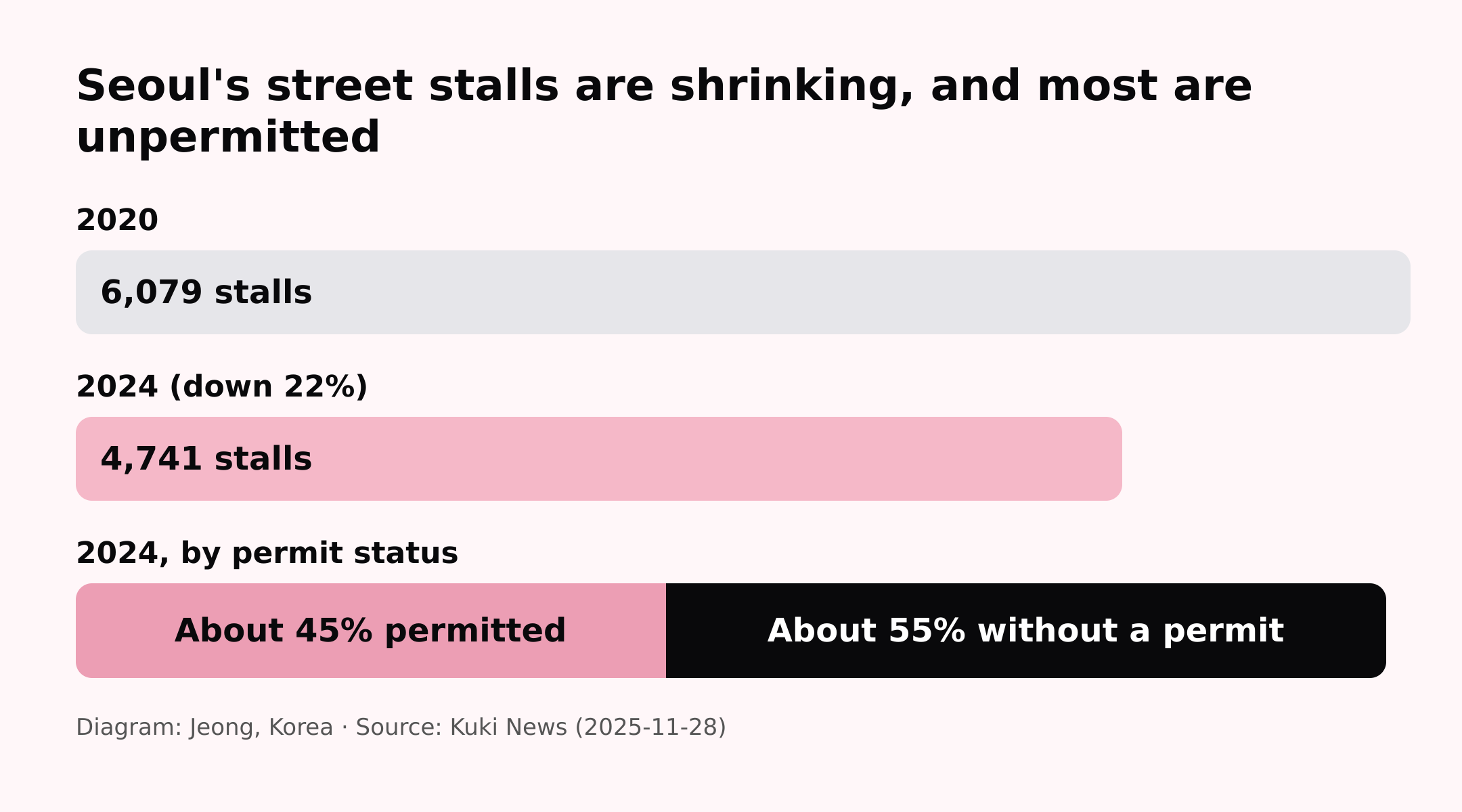
Seoul counted 4,741 street stalls in 2024. More than half had no permit.
That number changes how I think about the orange tents. The ones you see in films feel like part of the pavement, as if they have always been there and always will be. Some have been there for decades. Others have been cleared away. Whether a tent survives has less to do with how good the food is and more to do with a piece of paper from the district office.
In the guide to where Seoulites actually eat, I wrote a short section on the tents under the bridge and what to order there. This post picks up the question that section left open: where can you still find a street pojangmacha, and why did those streets keep theirs?
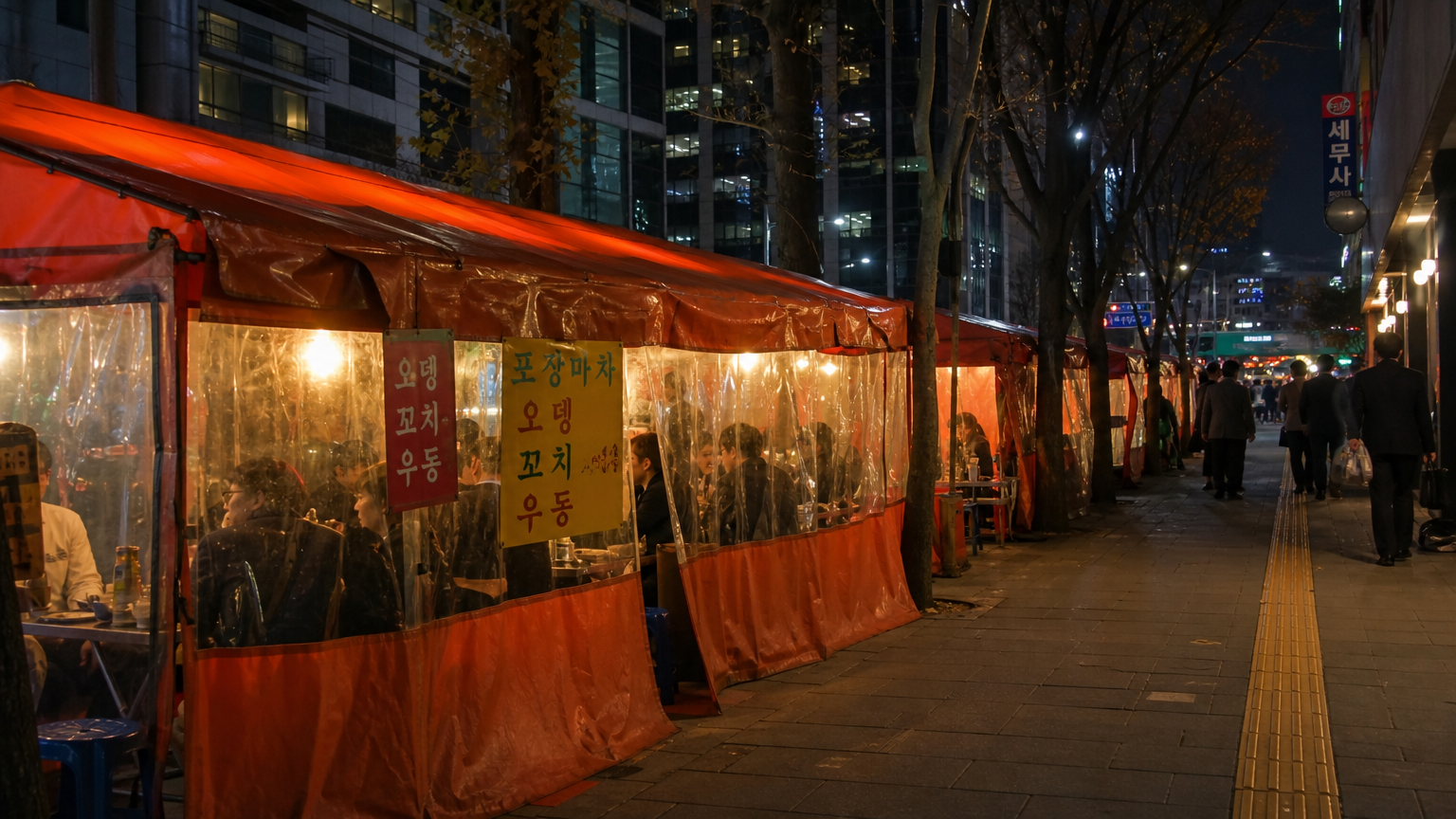
A tent on the pavement and a "pocha" in a building are different things
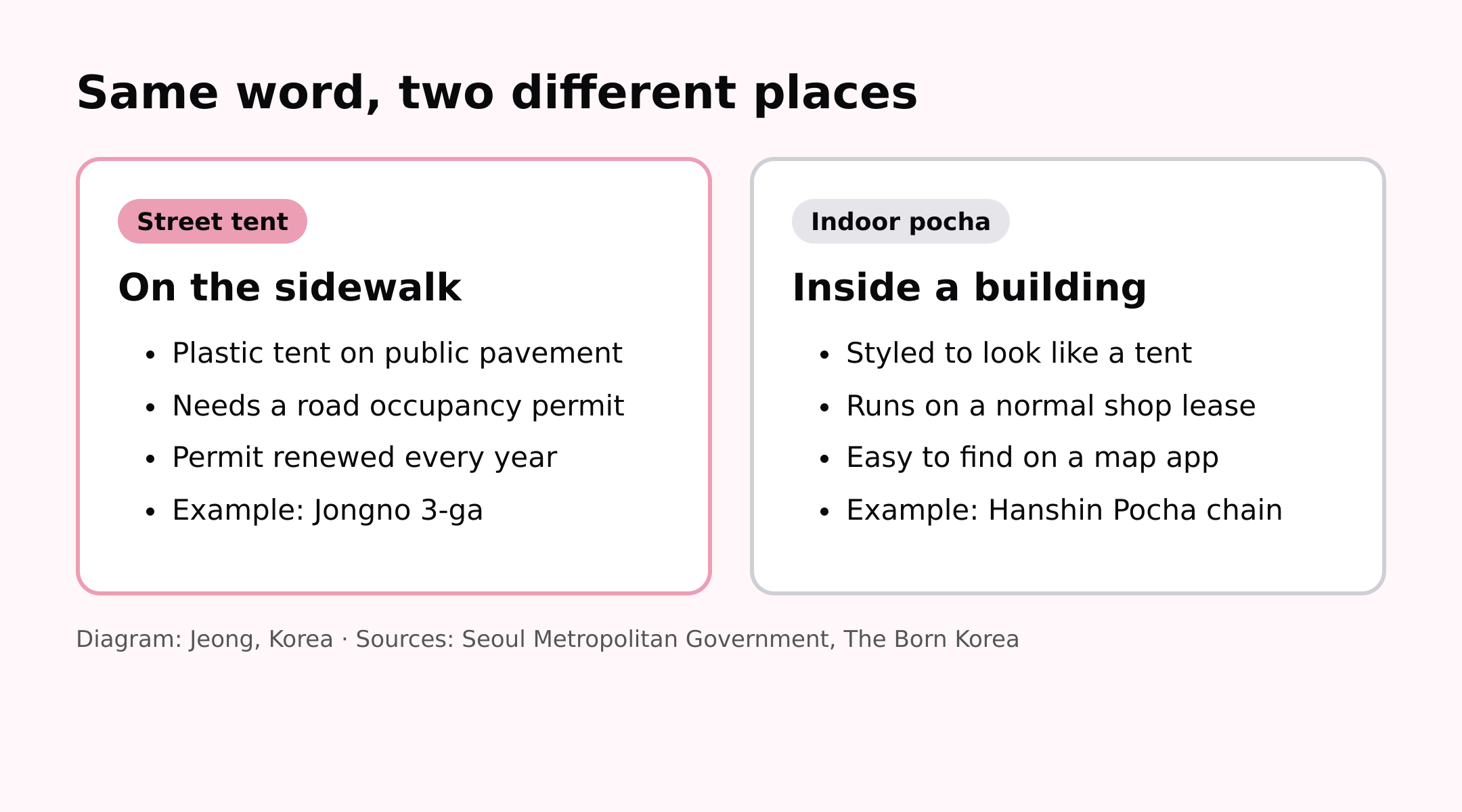
The word covers two places that look alike on Instagram and work very differently.
| Street tent | Indoor pocha | |
|---|---|---|
| Where | On the sidewalk, under a plastic tent | Inside a building, styled like a tent |
| What it needs | A road occupancy permit from the district | A normal shop lease |
| Example | The stalls along Jongno 3-ga | Chains such as Hanshin Pocha |
Hanshin Pocha, for example, is a franchise run by The Born Korea. It borrows the look of the street tent and puts it indoors. There is nothing wrong with that, and on a cold night it may be the more comfortable choice. But if what you are after is the real thing on the pavement, a chain search will not get you there.
So if the indoor ones are easy to find, what decides where the outdoor ones are allowed to stand?
Since 2019, a tent on the pavement needs a road permit
Seoul announced a street shop permit system on 23 October 2018, and it started in January 2019. Under it, a stall on the sidewalk becomes legal by holding a road occupancy permit.
The rules are strict and very physical:
-
The permit lasts one year and has to be renewed.
-
The permit holder must run the stall in person. A spouse can stand in only with approval.
-
Operators attend training at least once a year.
-
The permit cannot be transferred, sublet or used as collateral.
-
A stall can be no larger than 3m by 2.5m, and the sidewalk must be at least 2.5m wide.
-
It must keep 2m from bus and taxi stops and 2.5m from subway exits and crosswalks.
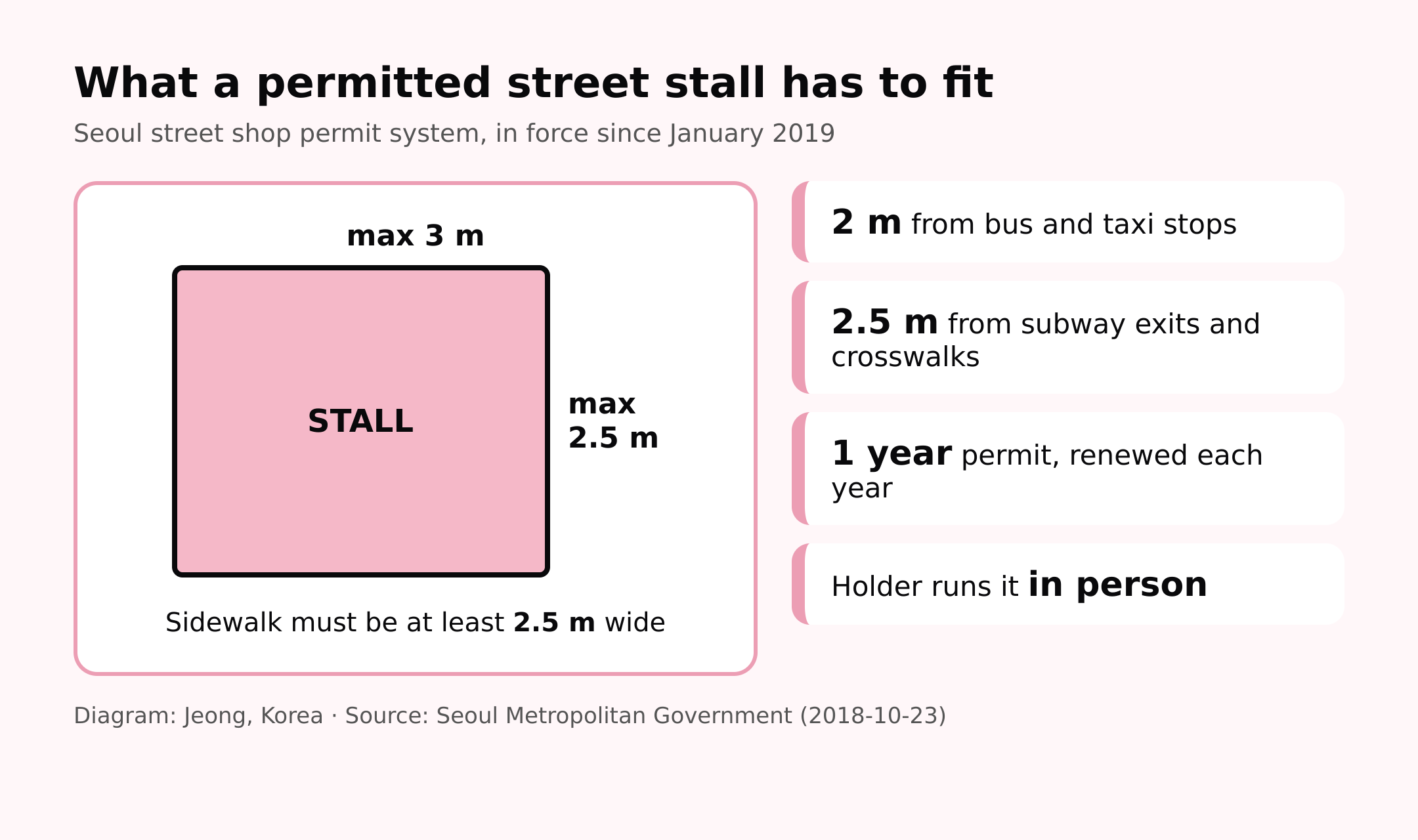
Those distances explain a lot of what you see. A tent squeezed right up against a subway exit is, by the city's own rules, in the wrong place. The Myeongdong food carts sit under the same system, and I covered how that plays out on one street in the post on Myeongdong's street carts being licensed one year at a time.
Enforcement is uneven, though. According to Kuki News in November 2025, Seoul had 4,741 street stalls in 2024, down 22% from 6,079 in 2020. About 45% held permits and about 55% did not. Only 10 of the city's 25 districts had passed their own street shop ordinance.
If most districts never wrote their own rules, why does one street still feel like the whole city's tent bar?
Jongno 3-ga stayed, and other famous spots did not
The clearest way to see the system is to compare three places people used to name.
| Place | What happened |
|---|---|
| Yeongdeungpo Station | Stalls that had stood for about 50 years were removed in 2019 |
| Yeouido | More than 20 unlicensed stalls were removed in September 2022, and a return attempt was blocked in January 2026 |
| Jongno 3-ga | About 25 stalls were still there in mid-2024, and the district made it an official "coexistence street" in October 2025 |
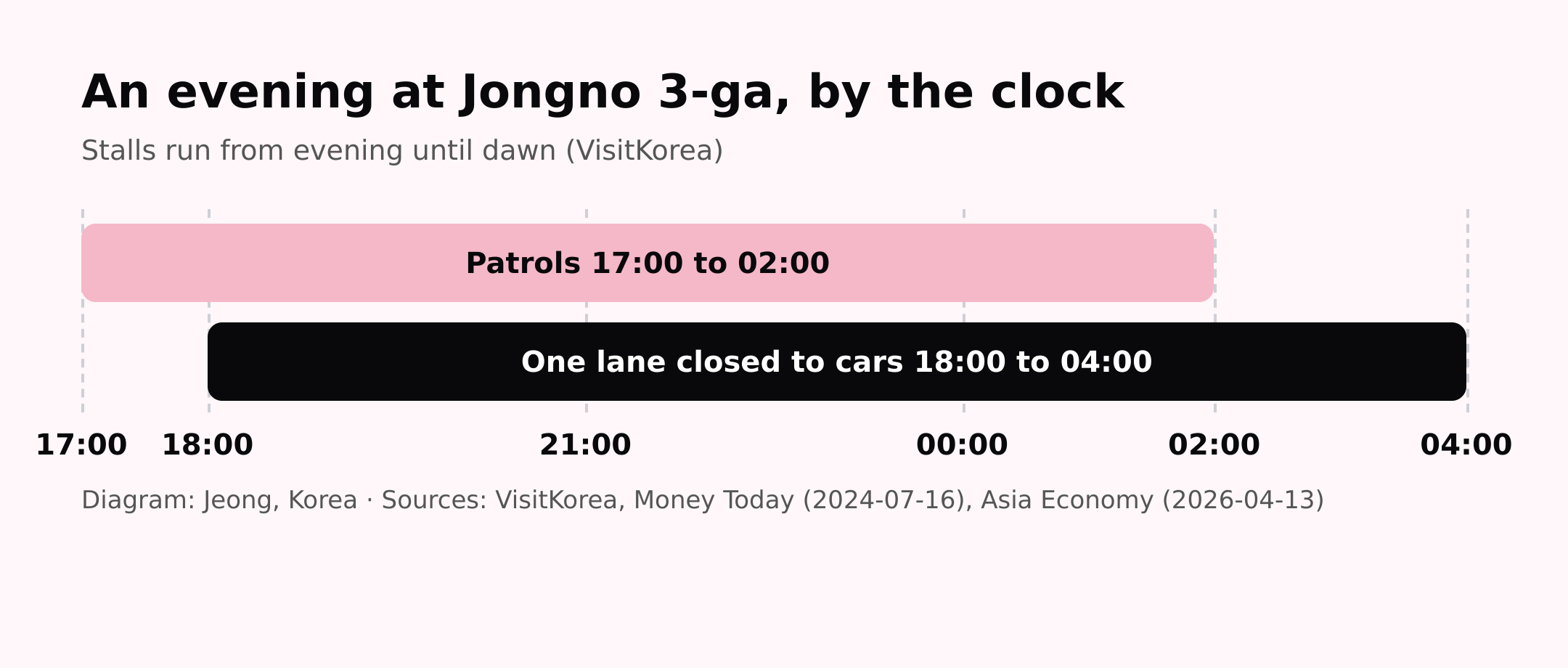
Jongno is one of the districts without its own ordinance; it follows the city guideline. The street did not survive by being left alone. From July 2024, barricades went up and one traffic lane now closes to cars from 18:00 to 04:00. In October 2025 the district designated the stretch a coexistence street, issued road occupancy permits to the stalls, and began patrols from 17:00 to 02:00.
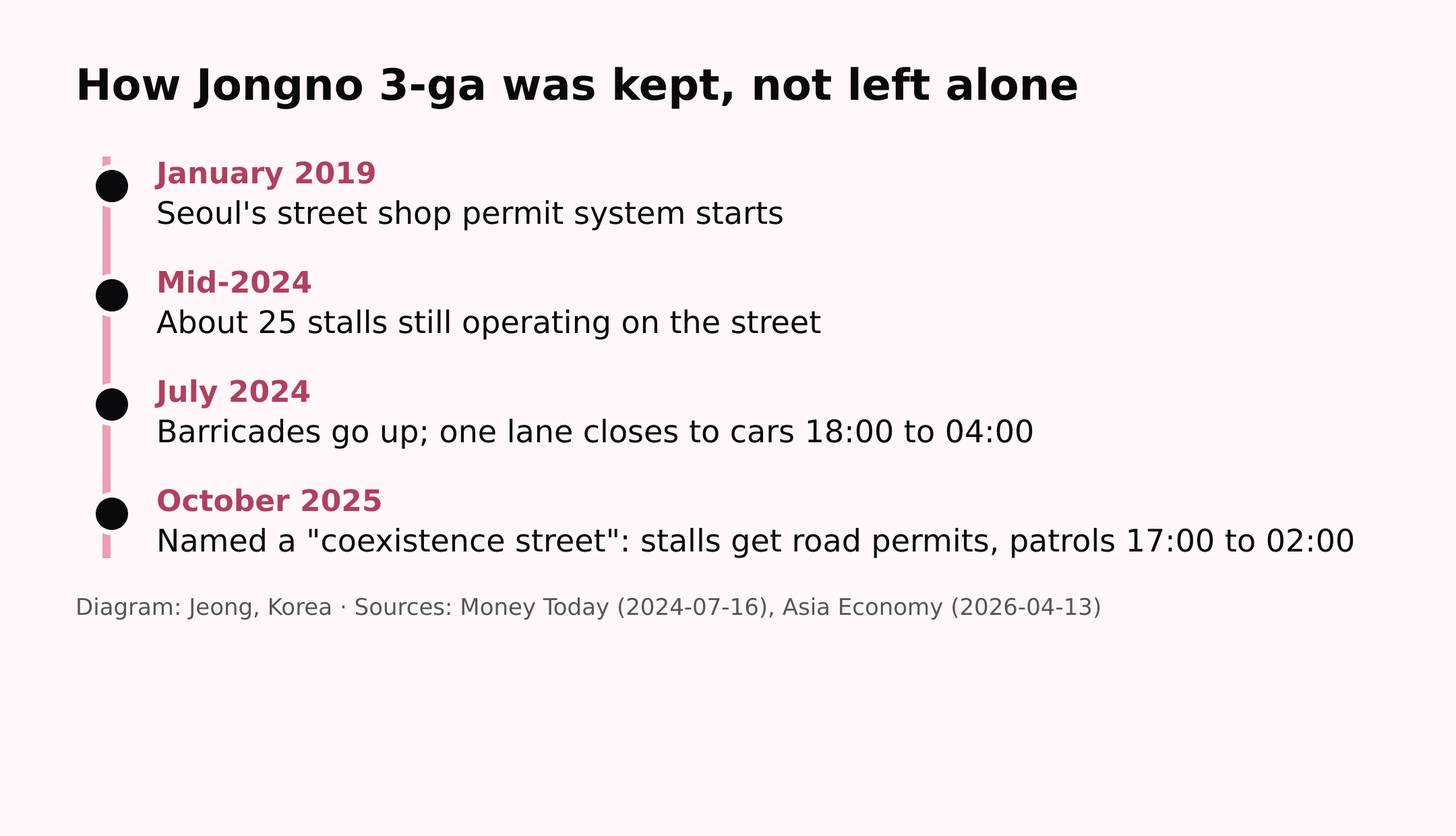
In other words, the tents at Jongno 3-ga are not a survival from the old city. They are a decision the district made recently, with conditions attached.
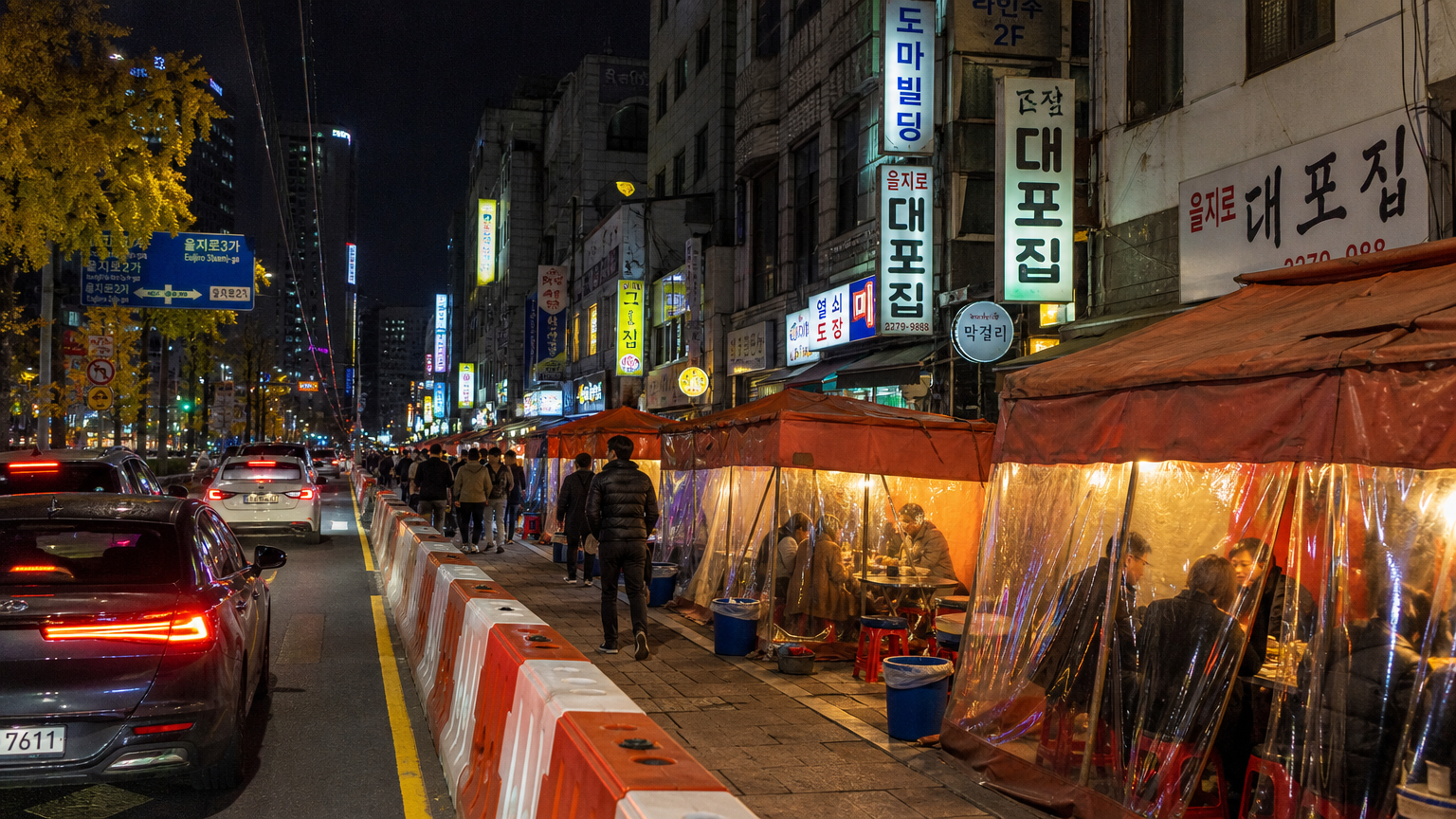
That still leaves the practical part. What is it like to actually sit down there?
How I'd go, and what I could not confirm
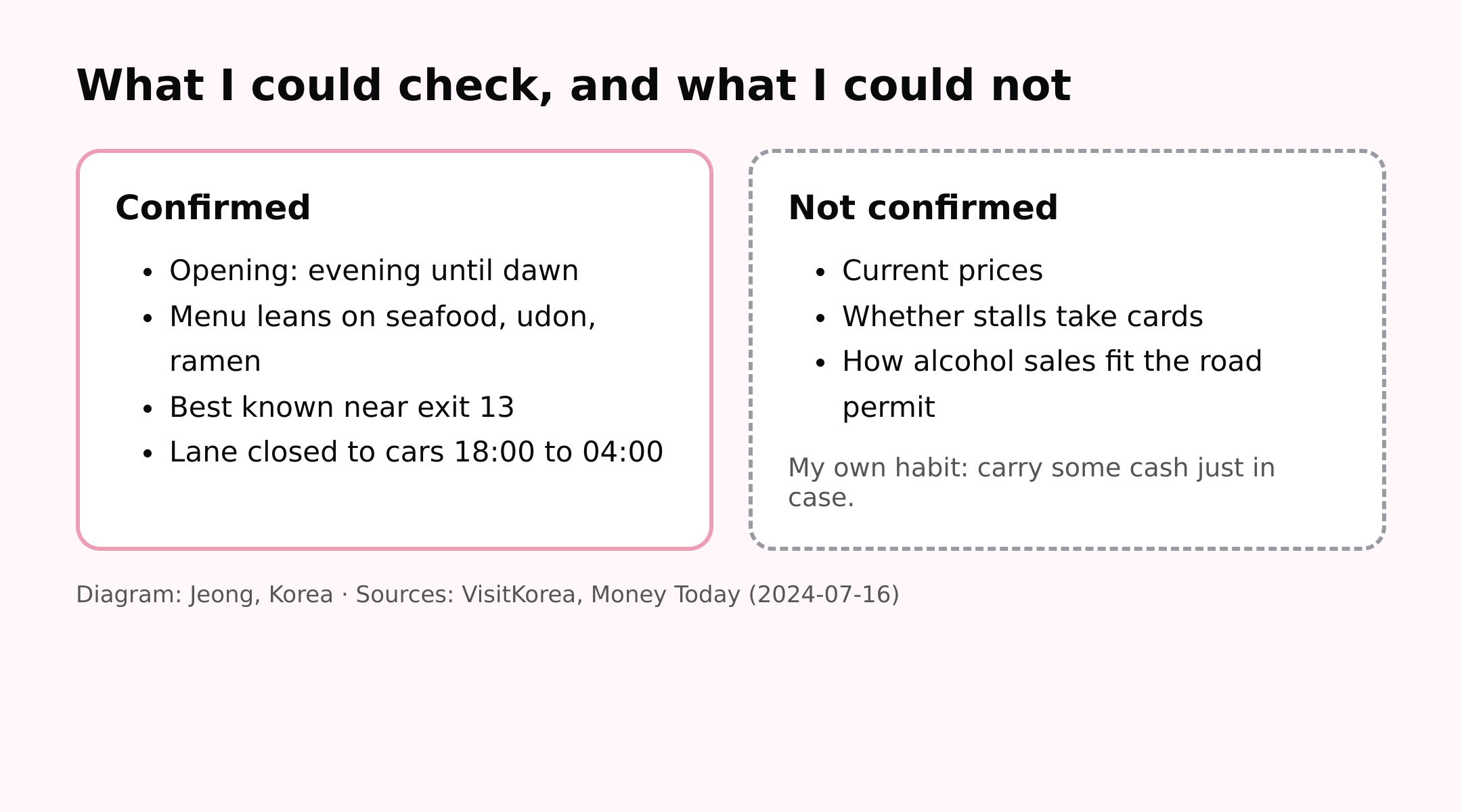
VisitKorea describes the Jongno 3-ga stalls as running from evening until dawn, spread around several station exits and best known near exit 13. The menu leans on seafood, udon and ramen.
There are things I tried to confirm and could not find in any official or news source. I could not find reliable, current prices. I could not confirm whether stalls take cards. I also could not find a clear official statement about how alcohol sales fit within a road permit, since the permit covers the road, not the kitchen. I would carry some cash just in case, and I would not treat any blog's price list as fixed.
If you are going to drink, it helps to know how a Korean table works before you sit down. I wrote about that in Korean drinking culture: the rules are real and so is the way out.
FAQ
Are street pojangmacha in Seoul legal?
Some are. Since January 2019 a stall on the sidewalk is legal if it holds a one-year road occupancy permit. In 2024 about 45% of Seoul's street stalls held one.
Where can I still find tent bars in Seoul?
Jongno 3-ga is the clearest example. About 25 stalls operate there, and the district made it an official coexistence street in October 2025.
Is an indoor pocha the same thing?
No. An indoor pocha is a bar inside a building styled like a tent. Chains such as Hanshin Pocha work this way.
What time do the Jongno 3-ga stalls open?
VisitKorea says they run from evening until dawn. One lane of the road closes to cars from 18:00 to 04:00.
In short
The orange tents are fewer every year, and the ones left are there because a district chose to keep them. If you want a proper street tent, go to Jongno 3-ga after dark and treat it as a place the city deliberately kept, not a leftover.
Sources
-
Seoul Metropolitan Government, street shop permit system announcement (2018-10-23): https://news.seoul.go.kr/safe/archives/55050
-
Seoul Economic Daily (2018-07-01): https://www.sedaily.com/article/11971201
-
Kuki News via Daum (2025-11-28): https://v.daum.net/v/20251128110231133
-
Money Today (2024-07-16): https://www.mt.co.kr/society/2024/07/16/2024071513512276488
-
Nocut News: https://www.nocutnews.co.kr/news/6245275
-
Asia Economy (2026-04-13): https://view.asiae.co.kr/article/2026041307552326443
-
VisitKorea, Jongno 3-ga pojangmacha street: https://korean.visitkorea.or.kr/detail/ms\_detail.do?cotid=fb72a5b9-fcbe-4699-96f9-9618704b876f
-
Newspim (2019-09-25): https://www.newspim.com/news/view/20190925000132
-
Korea Financial Newspaper (2026-02-02): https://www.fntimes.com/html/view.php?ud=202602020805446024048b718333\_18
-
The Born Korea, Hanshin Pocha brand page: https://www.theborn.co.kr/theborn\_brand/%ED%95%9C%EC%8B%A0%ED%8F%AC%EC%B0%A8-2/
More from this series
2026-09-24
Movie Theaters in Seoul: The Film Starts Ten Minutes Late, and Culture Day Moved in 2026
2026-09-23
Bungeoppang: The Carts Appear When It Gets Cold, and Most of Them Do Not Take Cards
2026-09-23
The Korean Photo Booth: Nobody Takes Your Photo, and That Is the Point
2026-09-23
Makgeolli and the Rainy Day: Why Koreans Order Pancakes When the Weather Turns
2026-09-21
Daejeon, Korea: An Hour From Seoul by KTX, and Two Stations Carry the City's Name
2026-09-21
Yuseong Hot Spring: The Foot Bath Is Free and Open Until 10 p.m., and You Cannot Drink the Water
2026-09-19
Seoul Bus: The Colour Tells You Where It Goes, and Some of Them No Longer Take Cash
2026-09-18
Hangul Day: The Alphabet's Birthday Lost Its Day Off for 22 Years, and Its Museum Is Shut Until 2028
2026-09-15
Namdaemun Market Opening Hours: The Market's Own List Has 38 Timetables, and Some Floors Open at 11 p.m.
2026-09-15
Hair Salon in Seoul: The Final Price Must Be on the Wall, and Only a Barber May Shave You
2026-08-28
DMZ Tour: You Can Still Go. The JSA Is the Part You Cannot.
2026-08-28
Gyeongju Food: The Famous One Is a Souvenir, and the Meal Is Next to the Tombs
2026-08-28
Bulguksa Temple: There Is No Direct Bus to Seokguram, and You See the Buddha Through Glass
2026-08-27
Gyeongju From Seoul: Two Hours by KTX, and Then the Part Nobody Plans For
2026-08-27
Gyeongju: Three Separate UNESCO Listings, and Why One Day Does Not Cover Them
2026-08-27
K-ETA Korea: You Are Probably Exempt, and the Arrival Card Is What Catches People
2026-08-18
Autumn in Korea: Don't Pick the Dates, Pick the Latitude
2026-08-18
Hospital in Seoul: Why Koreans Don't Start at the Big One
2026-08-18
Korean Drinking Culture: The Rules Are Real, and So Is the Way Out
2026-07-31
Famous Korean Street Foods You Must Try (Yes, Including the Viral Buldak Omelette)
2026-07-31
What Is Silbi Kimchi? Korea's Spiciest Kimchi — and the Local Hack You Need to Know