Hangul Day: The Alphabet's Birthday Lost Its Day Off for 22 Years, and Its Museum Is Shut Until 2028

On 9 October, Korea closes its government offices for an alphabet. For twenty-two years, it did not.
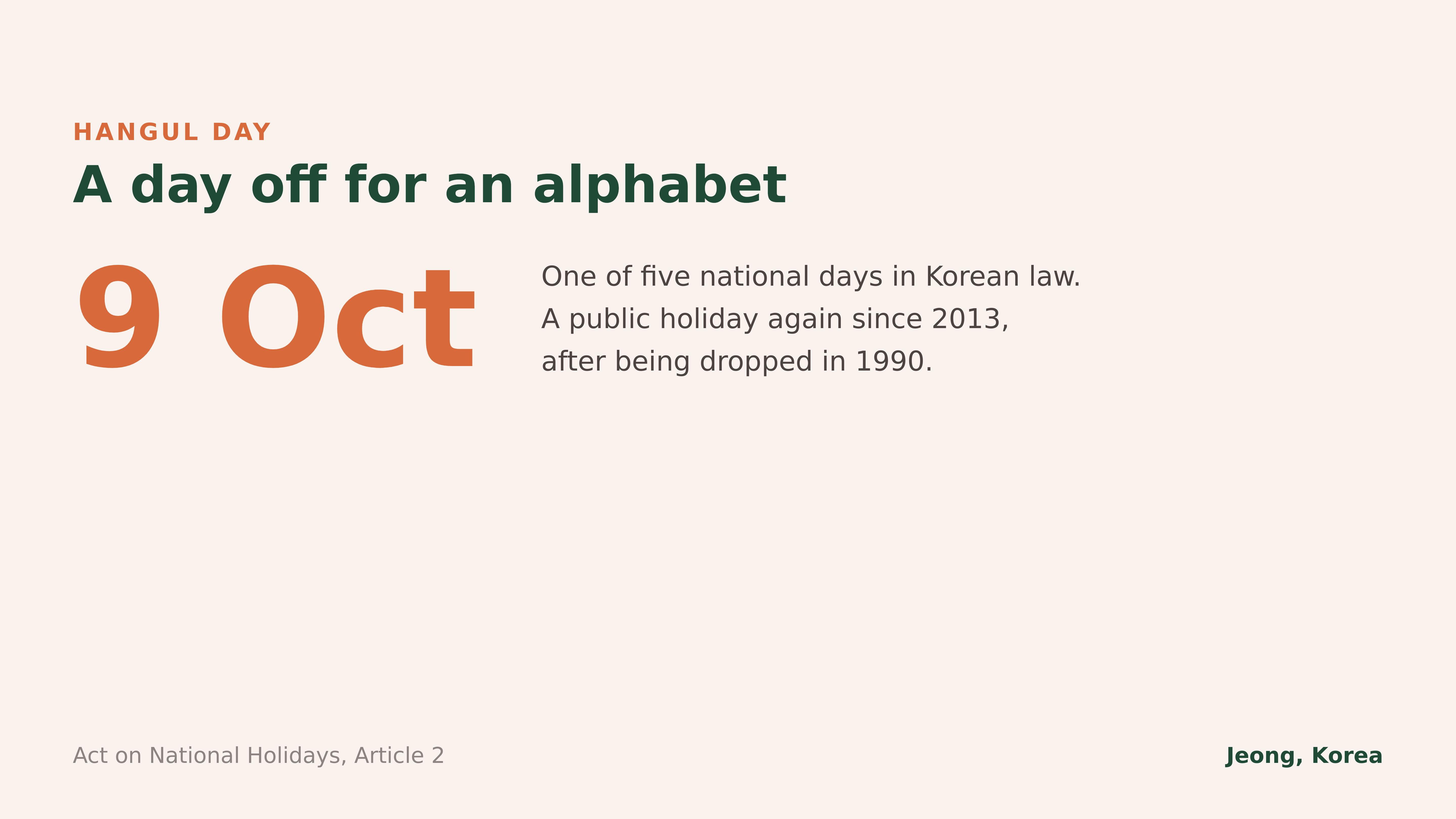
Hangul Day falls on 9 October and is one of the five national days written into Korean law. It has been a public holiday again since 2013, after being dropped in 1990. This guide covers why the date is 9 October, how the day off disappeared and came back, and where in Seoul you can actually see the alphabet on the day, now that the obvious museum is closed.
Say you land in Seoul on Thursday 8 October 2026. The next morning, government offices are shut for the day. It is not a king's birthday or a battle that closed them. It is a writing system.
It is easy to assume a holiday like this has always been there. It has not. The day was taken off the calendar in 1990 and only returned in 2013, and the one museum built for the alphabet has been closed since a fire in 2025. We will go through the date first, then the history of the day off, then the places that are actually open.
Why the date is 9 October
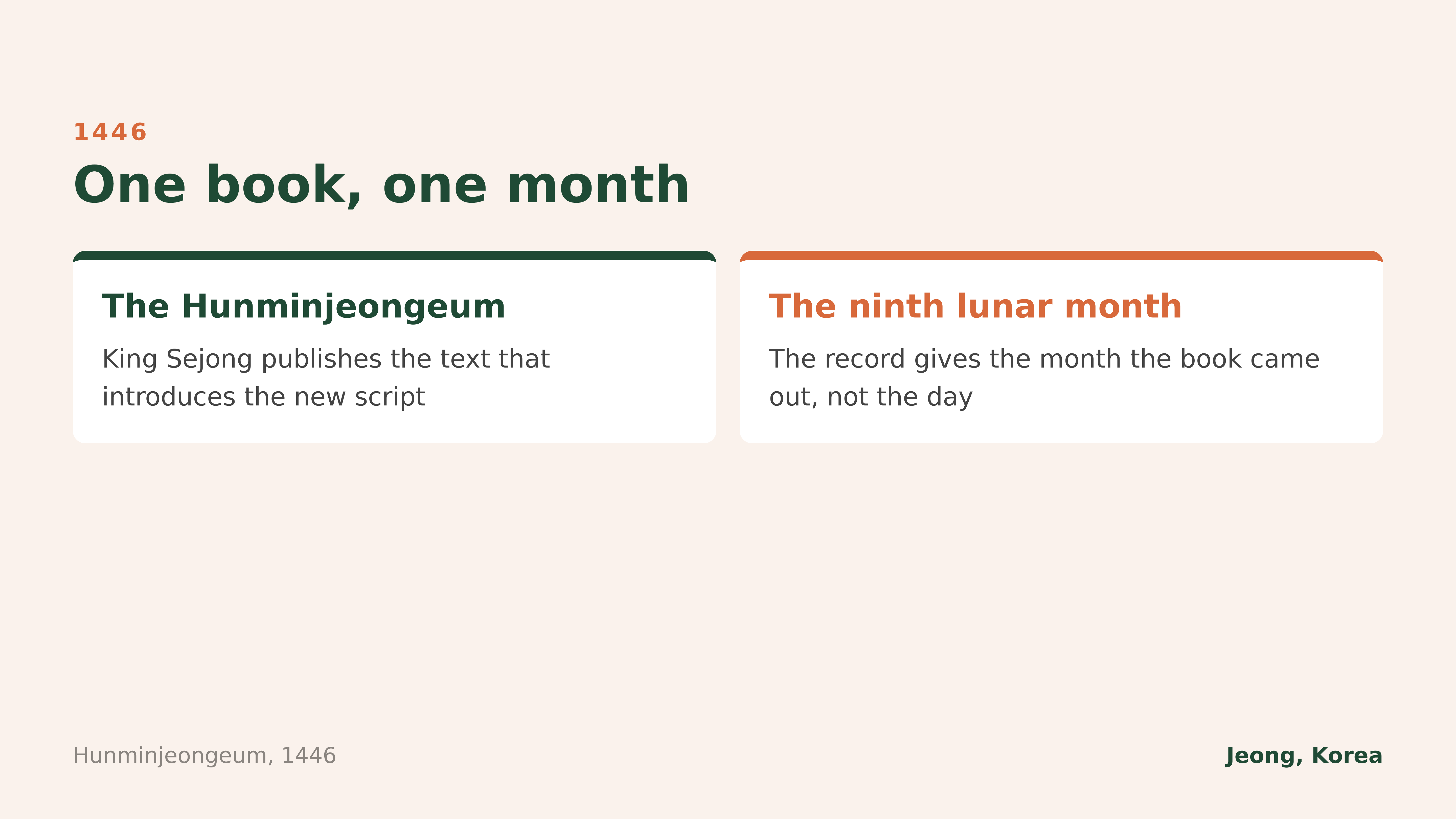
The date comes from a book. In the ninth lunar month of 1446, King Sejong published the Hunminjeongeum, the text that introduced the new script to the country. The original record only gives the month, not the day.
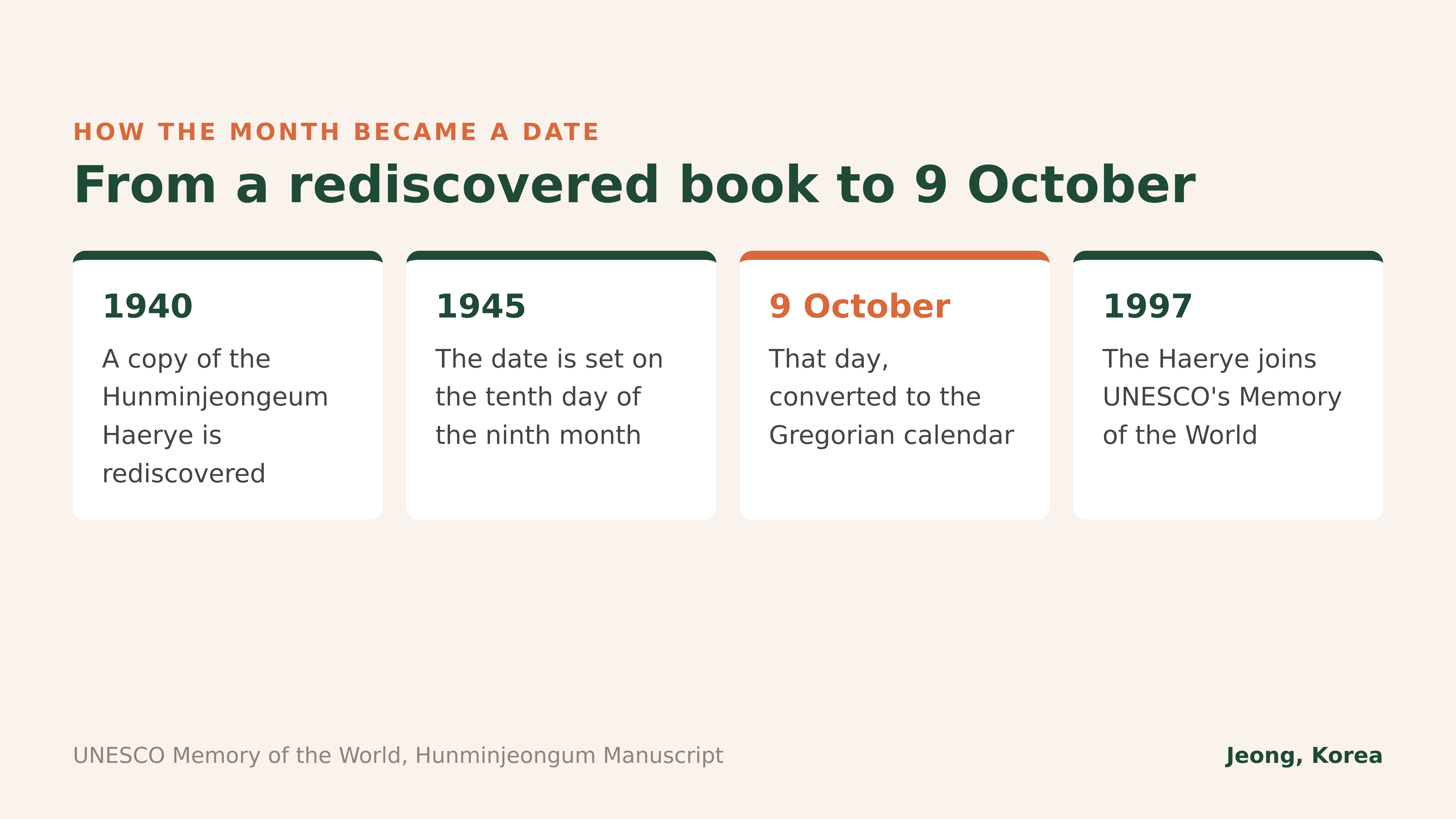
The detail arrived later. A copy of the Hunminjeongeum Haerye, the explanatory edition with a note on when it was completed, was rediscovered in 1940. After liberation in 1945, the date was settled on the tenth day of that ninth month, which converts to 9 October in the Gregorian calendar. It has stayed there ever since.
That rediscovered copy is now one of the most important documents in the country. It was inscribed on UNESCO's Memory of the World Register in 1997 and is held by the Kansong Art Museum in Seoul.
The holiday itself is older than the date. The Korean Language Society first held it in 1926 under the name Gagyanal, taken from the first syllables of the charts children used to learn the letters. North Korea marks its own version on 15 January, so the two Koreas celebrate the same alphabet on different days.
If you want to see how seriously some Seoul streets take the script, Insadong: The Starbucks Wrote Its Name in Hangeul Nine Years Before the Rule Existed tells the story of a sign that became a local rule.
So if the date has been fixed since 1945, why was the day off missing for so long?
The day off disappeared for 22 years
The short answer is productivity. The day became a public holiday in 1949. On 1 November 1990, the government amended the regulation on public holidays and removed it, together with Armed Forces Day, on the grounds that too many holidays were hurting productivity and economic growth.
| Year | What happened |
|---|---|
| 1926 | First celebrated as Gagyanal |
| 1949 | Made a public holiday |
| 1990 | Removed from public holidays from 1991 |
| 2005 | Written into the Act on National Holidays as a national day |
| 2013 | A public holiday again |
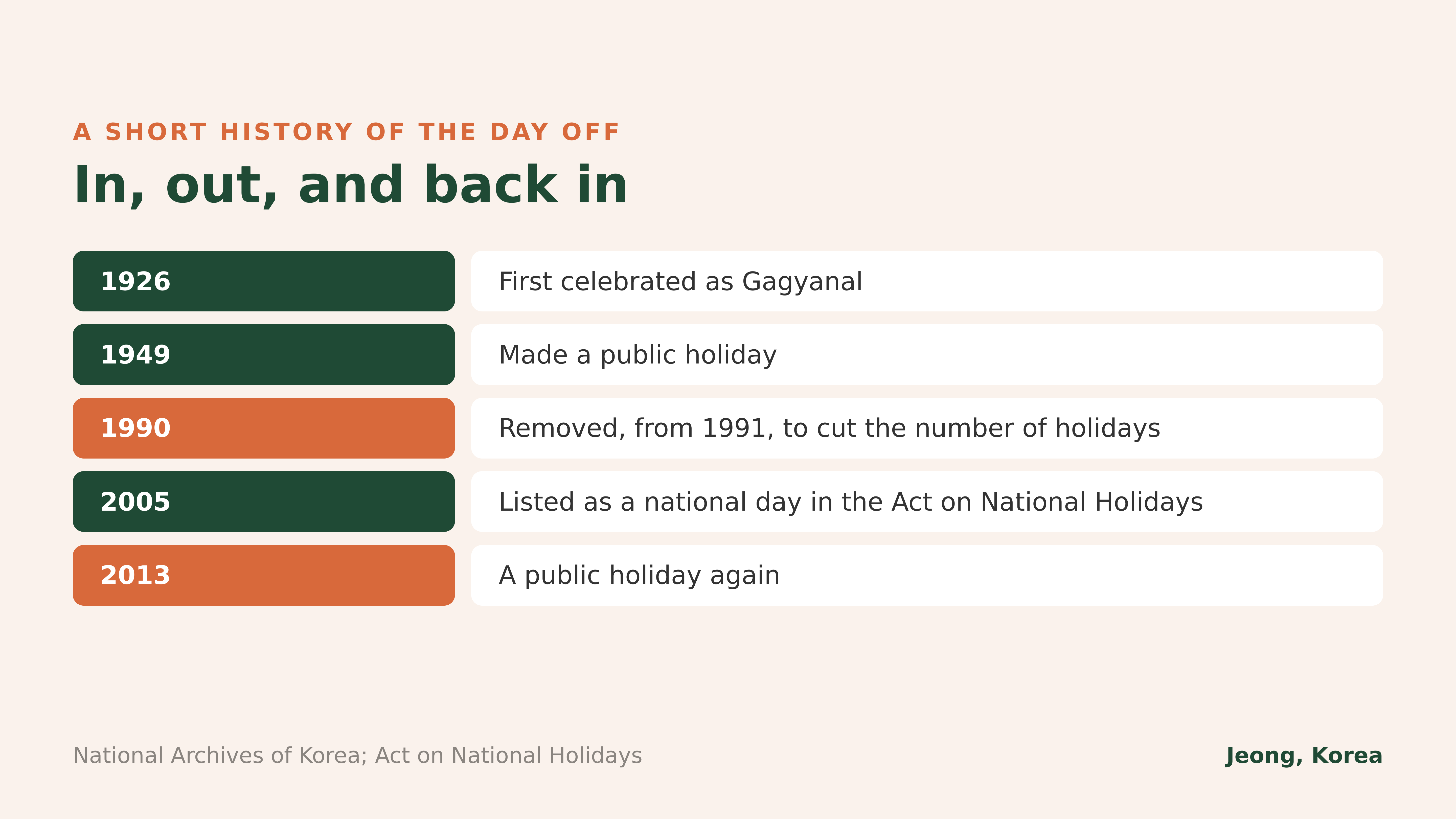
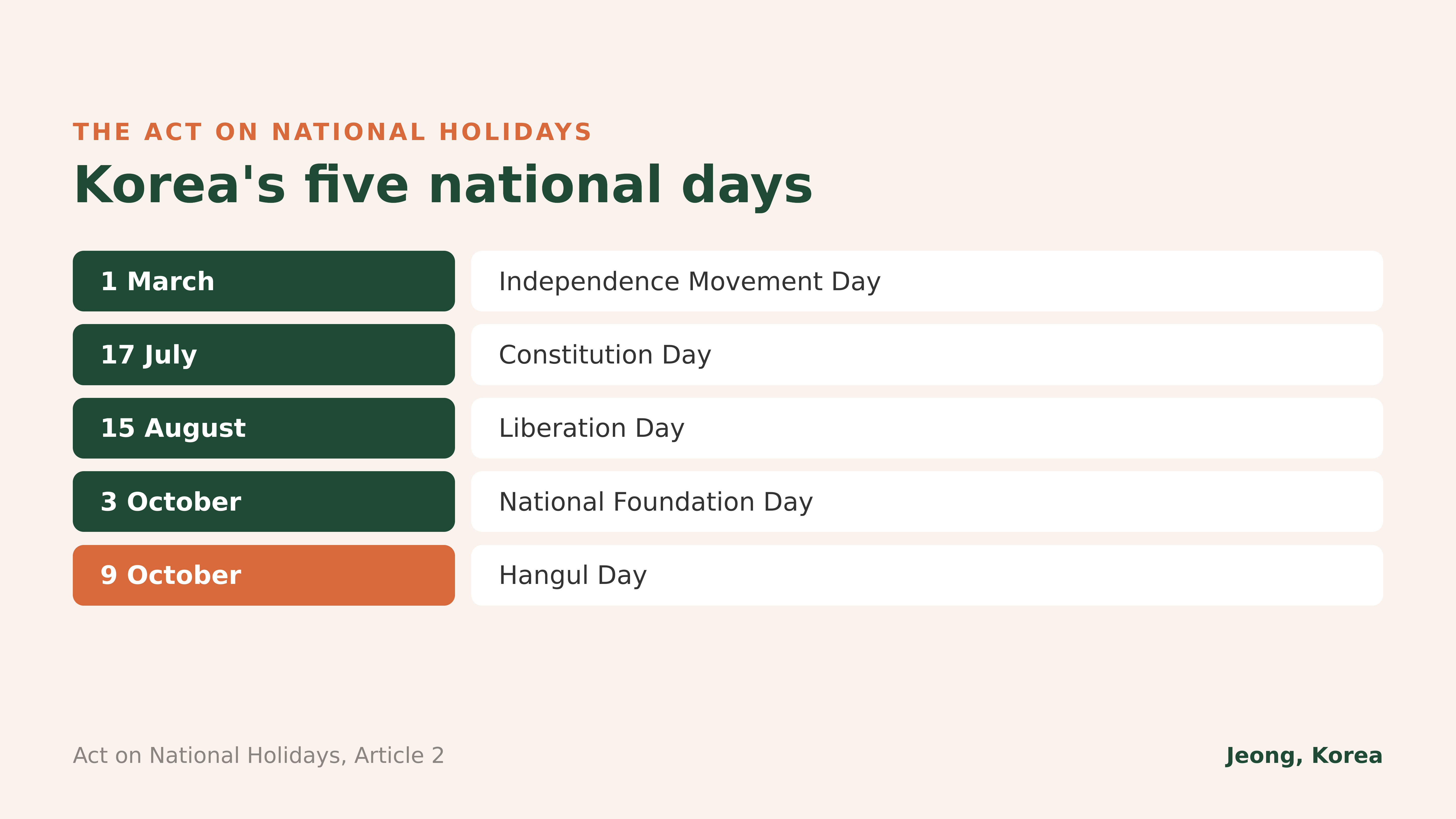
The date did not vanish in those years. It stayed on the calendar as a commemoration, and Korean language groups campaigned for years to bring the day off back. In 2005 the Act on National Holidays listed it as one of five national days, alongside Independence Movement Day, Constitution Day, Liberation Day and National Foundation Day. Even then, offices stayed open. The regulation on public holidays was only amended at the end of 2012, and 2013 was the first year in twenty-two that the day was off again.
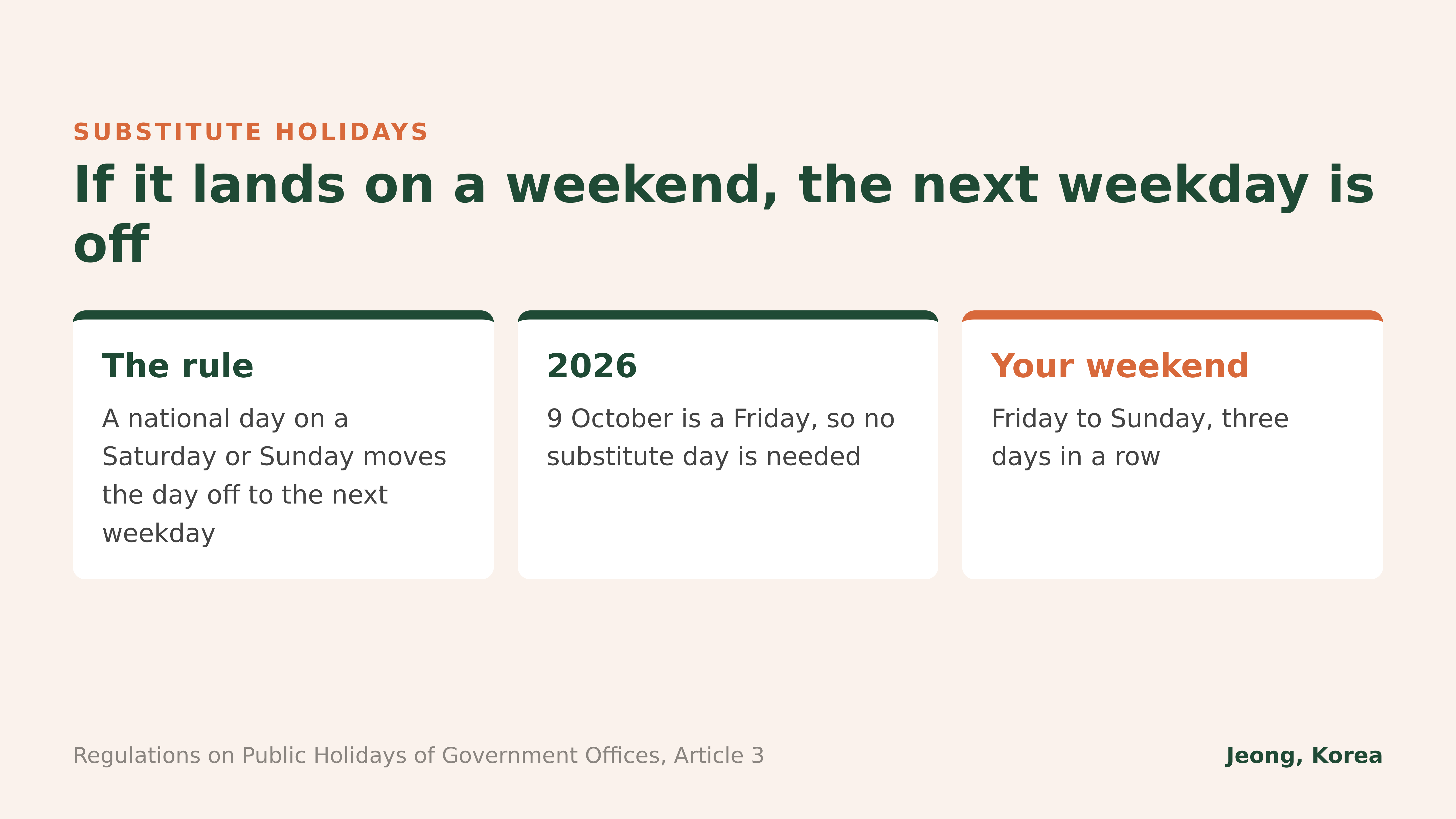
The current rule also protects the day from falling on a weekend. Under the regulation on public holidays, when a national day lands on a Saturday or Sunday, the next weekday becomes a substitute holiday. In 2026 there is no need for that, because 9 October is a Friday and gives you a three-day weekend. How that weekend fits with the other long break in October is covered in Korea in October: Two Long Weekends Decide Your Trip More Than the Weather Does.
Which leaves the practical question: where do you actually go on the day?
Where to see the alphabet in Seoul on the day
Start at Gwanghwamun Square. The seated statue of King Sejong stands in the middle of the square with Gyeongbokgung Palace behind it, and it is the natural place to begin a day about the alphabet.
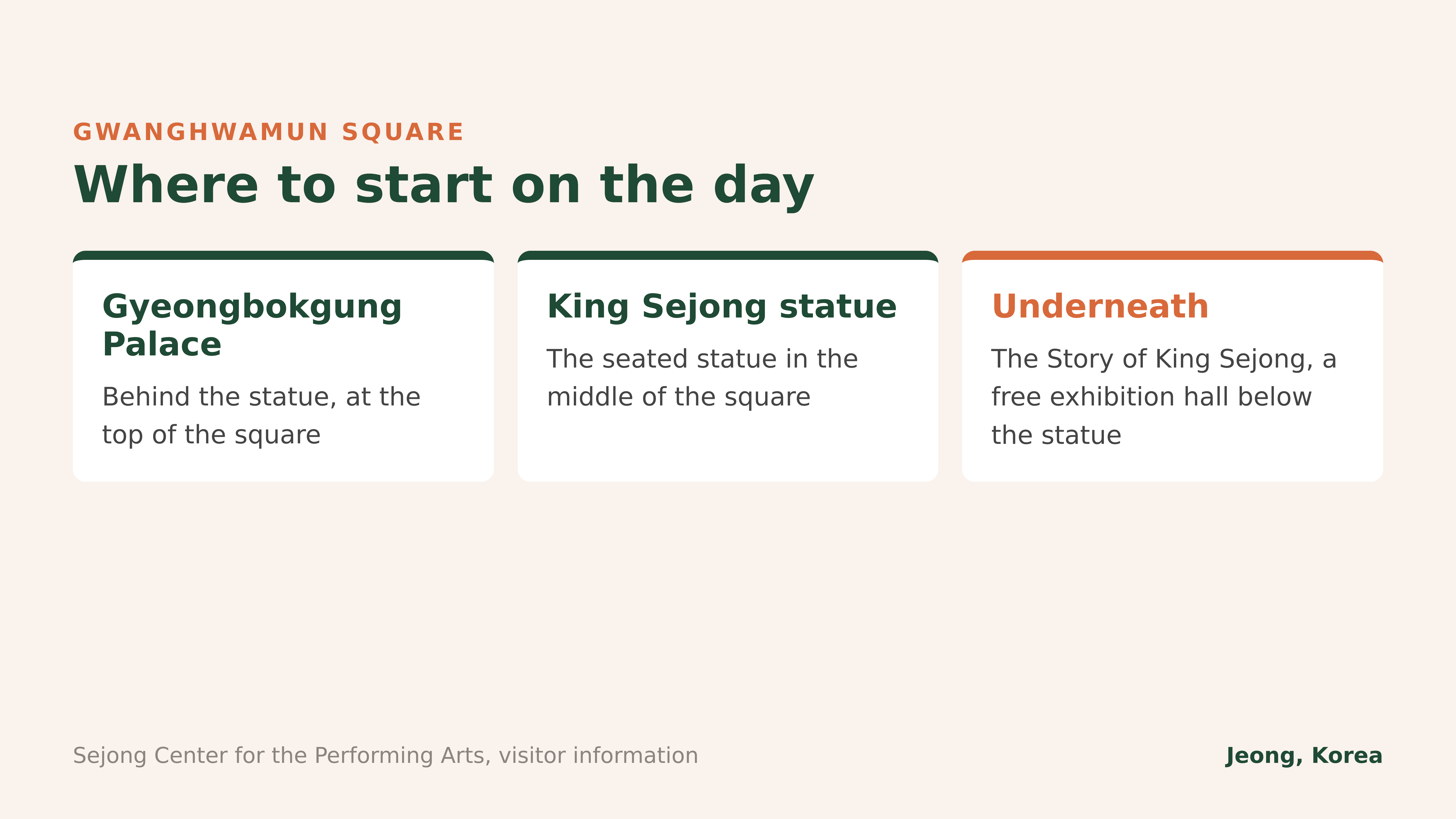
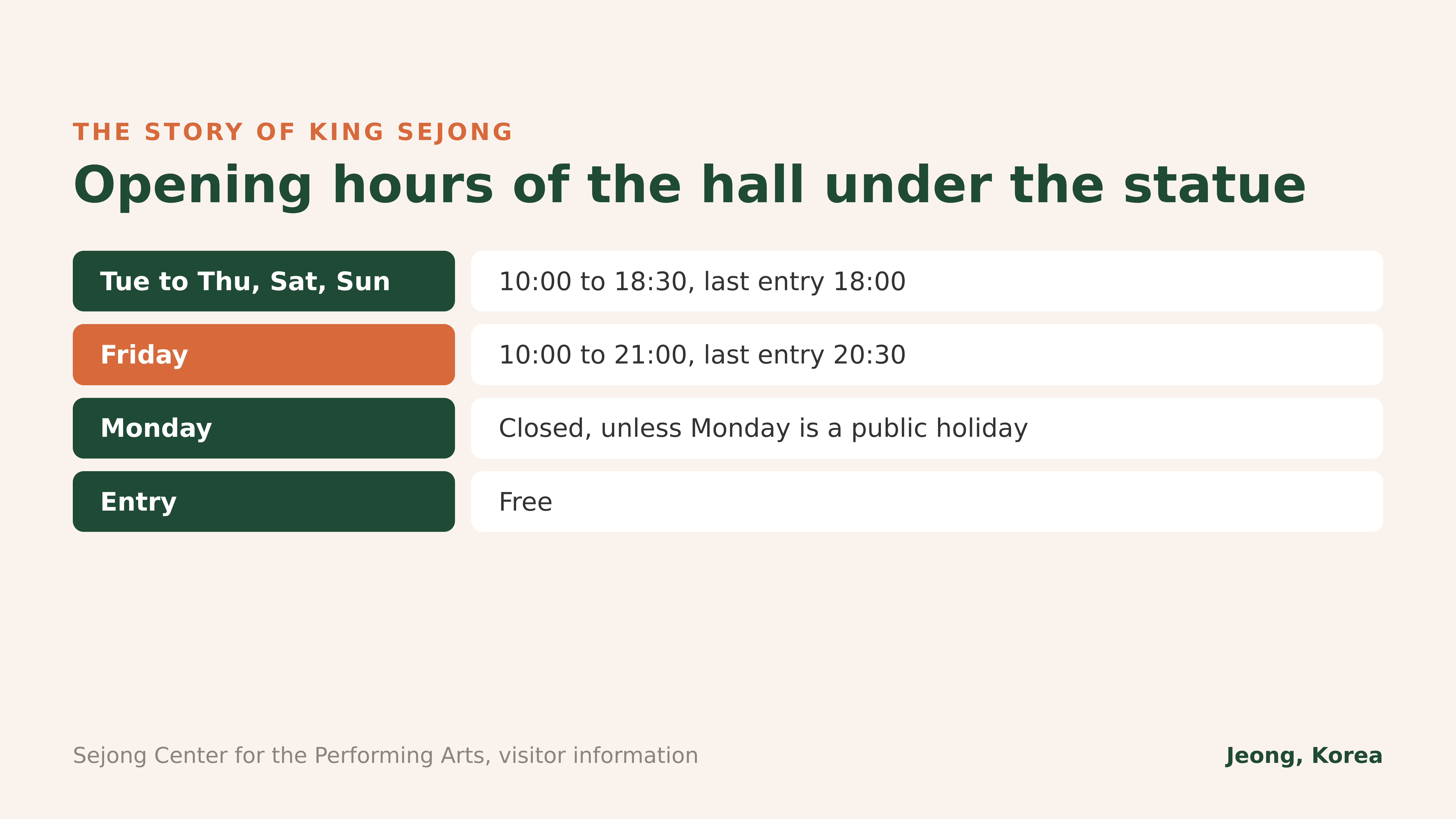
Directly underneath the statue is the part that is easy to miss. The Story of King Sejong is an underground exhibition hall run by the Sejong Center, with free entry. It opens from 10:00 to 18:30, stays open until 21:00 on Fridays, and closes on Mondays. When a Monday is a public holiday, it opens that day and closes on the next weekday instead. Holiday programmes can change the schedule, so check the Sejong Center's notice before you go.
| Place | Status on 9 October 2026 |
|---|---|
| King Sejong statue, Gwanghwamun Square | Open public square |
| The Story of King Sejong, under the square | Free, closed Mondays, open late on Fridays |
| National Hangeul Museum, Yongsan | Closed, planned reopening October 2028 |
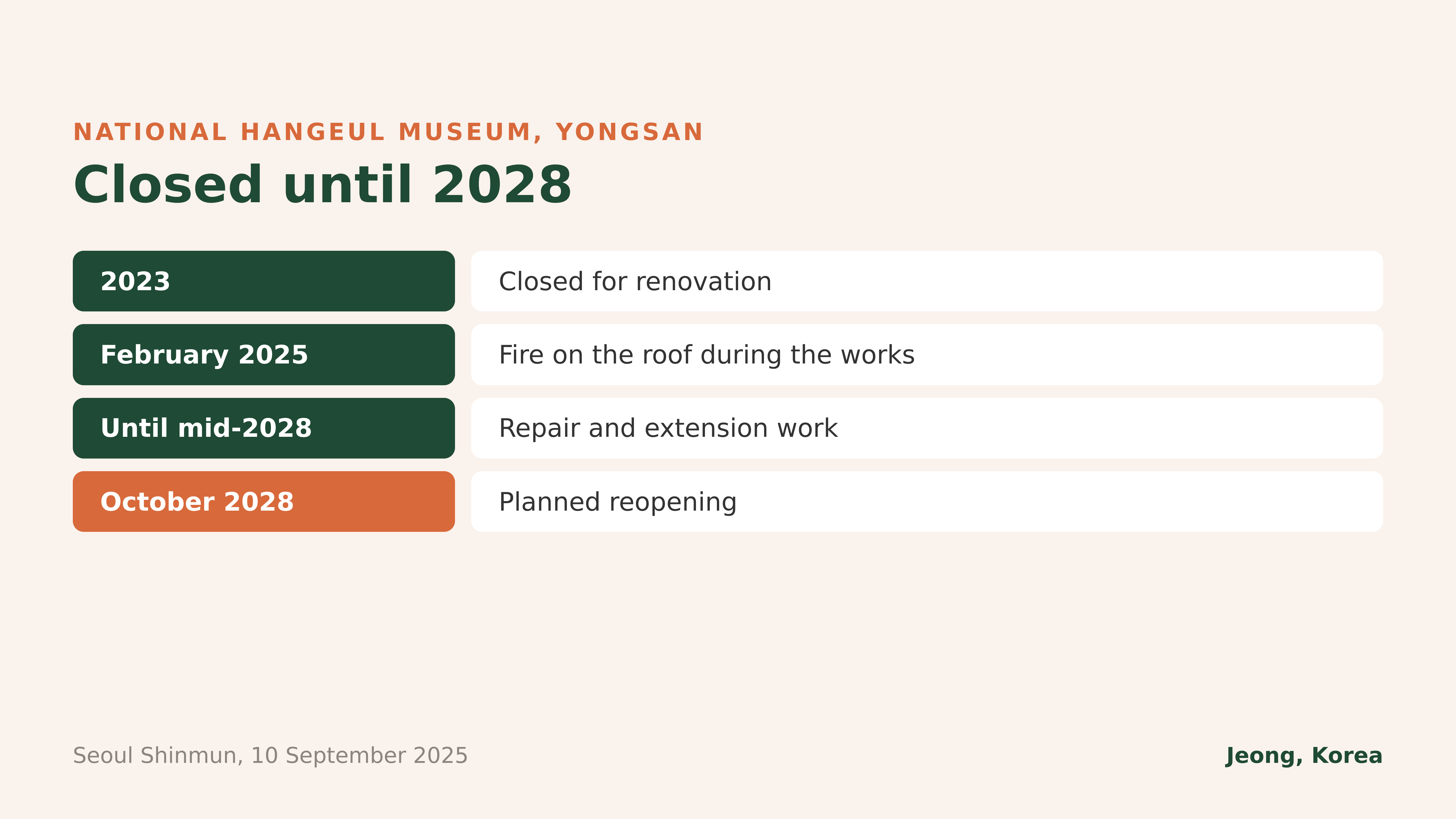
The obvious choice is the one that will disappoint you. The National Hangeul Museum in Yongsan closed for renovation in 2023, and in February 2025 a fire broke out on its roof during the works. The museum has announced that repair and extension work will run until mid-2028, with reopening planned for October 2028.
The Kansong Art Museum, which holds the original Haerye, is a private museum with its own exhibition schedule. It is worth checking, but do not plan the day around seeing the book itself.
FAQ
Is Hangul Day a public holiday in Korea?
Yes. It is one of the five national days in the Act on National Holidays, and it has been a public holiday for government offices again since 2013. It was removed from the list of public holidays in 1990.
What happens when Hangul Day falls on a weekend?
The next weekday becomes a substitute holiday under the regulation on public holidays. In 2026 it falls on a Friday, so there is no substitute day.
Is the National Hangeul Museum open?
No. It has been closed since 2023 for renovation, and a fire in February 2025 extended the works. Reopening is planned for October 2028.
Why does North Korea celebrate on a different day?
North Korea marks the alphabet on 15 January. South Korea's date of 9 October comes from the month the Hunminjeongeum was published in 1446.
The short version
Hangul Day is 9 October, a national day in law and a day off again since 2013 after twenty-two years without one. The date comes from a book published in 1446, and the original explanatory edition is a UNESCO Memory of the World document.
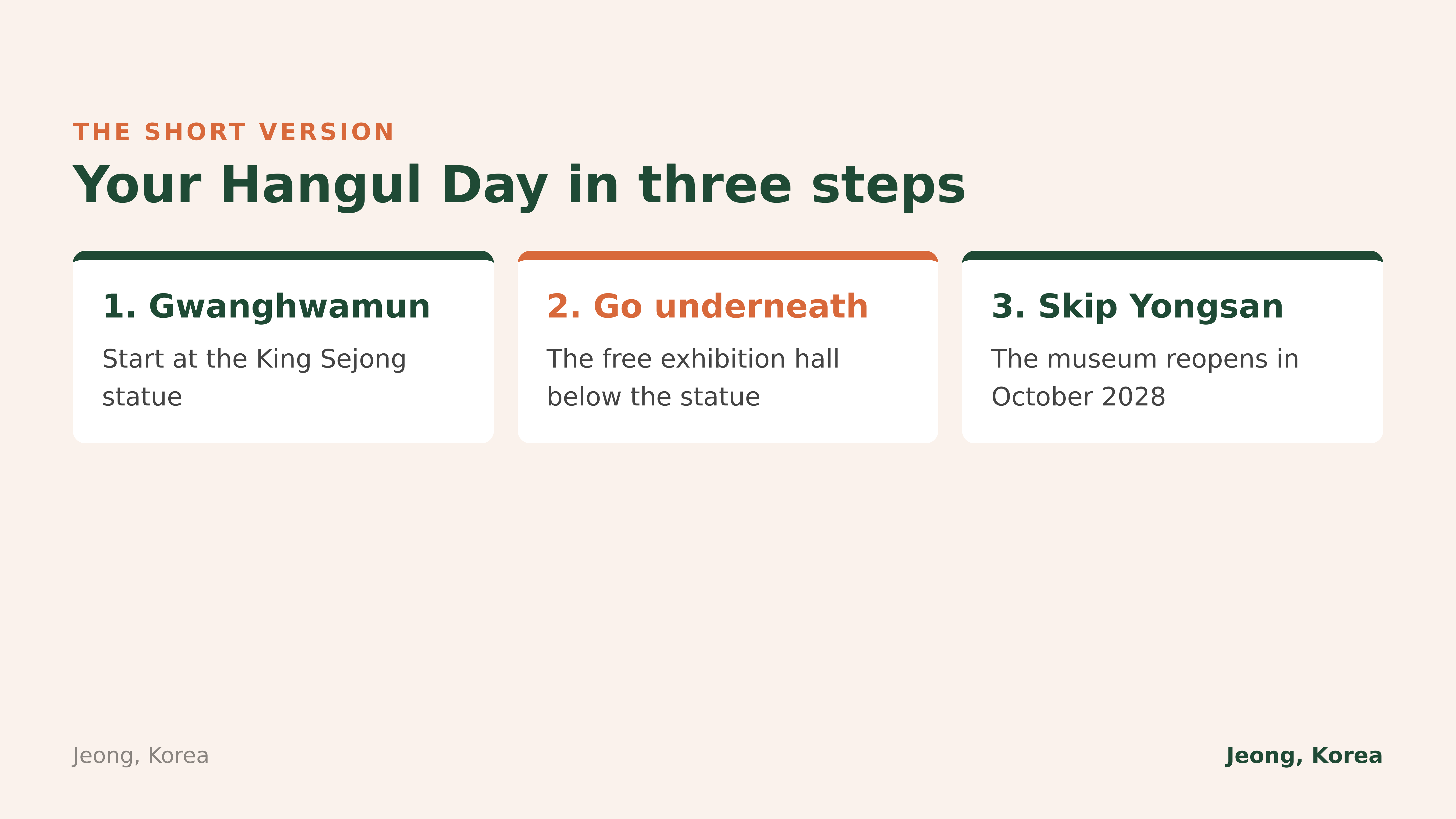
If you are in Seoul on the day, go to Gwanghwamun, walk down into the free exhibition under the statue, and skip the museum in Yongsan until 2028.
References
-
Act on National Holidays, Article 2 (list of national days). Available through the Korea Law Information Center.
-
Regulations on Public Holidays of Government Offices, Articles 2 and 3 (public holidays and substitute holidays). Available through the Korea Law Information Center.
-
National Archives of Korea, record on the removal of the holiday from public holidays in 1990 and its restoration in 2013.
-
UNESCO Memory of the World, Hunminjeongum Manuscript (inscribed 1997).
-
Sejong Center for the Performing Arts, visitor information for The Story of King Sejong and The Story of Admiral Yi Sun-sin.
-
Seoul Shinmun, 10 September 2025, report on the planned October 2028 reopening of the National Hangeul Museum.
More from this series
2026-09-19
Seoul Bus: The Colour Tells You Where It Goes, and Some of Them No Longer Take Cash
2026-09-15
Namdaemun Market Opening Hours: The Market's Own List Has 38 Timetables, and Some Floors Open at 11 p.m.
2026-09-15
Hair Salon in Seoul: The Final Price Must Be on the Wall, and Only a Barber May Shave You
2026-08-28
DMZ Tour: You Can Still Go. The JSA Is the Part You Cannot.
2026-08-28
Gyeongju Food: The Famous One Is a Souvenir, and the Meal Is Next to the Tombs
2026-08-28
Bulguksa Temple: There Is No Direct Bus to Seokguram, and You See the Buddha Through Glass
2026-08-27
Gyeongju From Seoul: Two Hours by KTX, and Then the Part Nobody Plans For
2026-08-27
Gyeongju: Three Separate UNESCO Listings, and Why One Day Does Not Cover Them
2026-08-27
K-ETA Korea: You Are Probably Exempt, and the Arrival Card Is What Catches People
2026-08-18
Autumn in Korea: Don't Pick the Dates, Pick the Latitude
2026-08-18
Hospital in Seoul: Why Koreans Don't Start at the Big One
2026-08-18
Korean Drinking Culture: The Rules Are Real, and So Is the Way Out
2026-07-31
Famous Korean Street Foods You Must Try (Yes, Including the Viral Buldak Omelette)
2026-07-31
What Is Silbi Kimchi? Korea's Spiciest Kimchi — and the Local Hack You Need to Know