DMZ Tour: You Can Still Go. The JSA Is the Part You Cannot.

Panmunjom is on the itinerary. You cannot go. Not right now, and not as a foreign visitor. Check what you are buying.
Search dmz tour and the results are almost entirely booking pages, and a lot of them advertise the Joint Security Area, Panmunjom, the blue huts, the line on the floor. That is the image everybody has of this trip. It is also, right now, not something a foreign visitor can sign up for. The Ministry of Unification runs those visits and its own application page says so plainly. Meanwhile the other half of the trip, the part with the tunnel and the observatory and the station that goes nowhere, is open, straightforward and genuinely worth a day. The problem is that both halves get sold under one word.
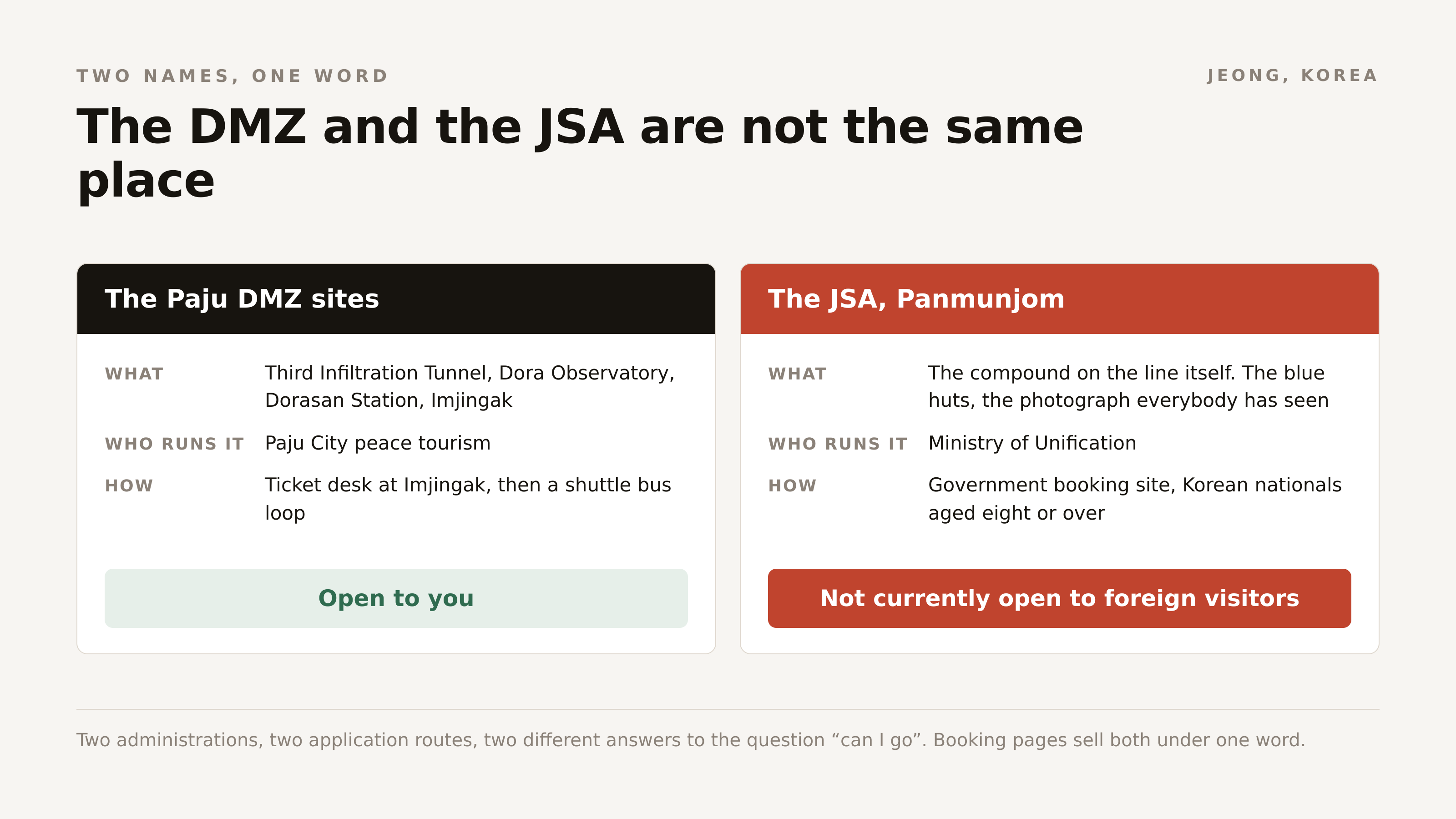
The DMZ and the JSA are not the same place
They are used interchangeably in marketing copy and they are completely different visits.
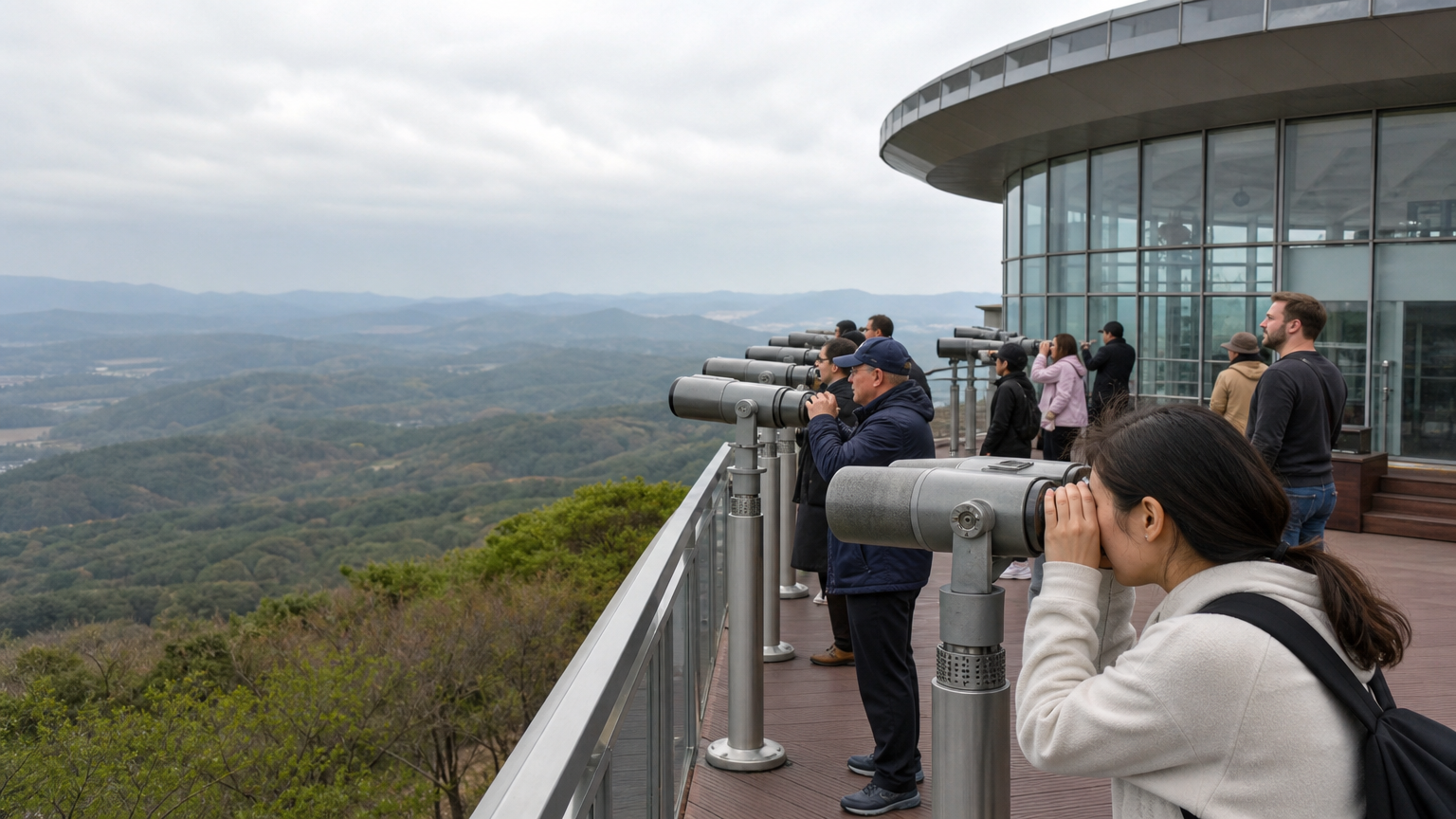
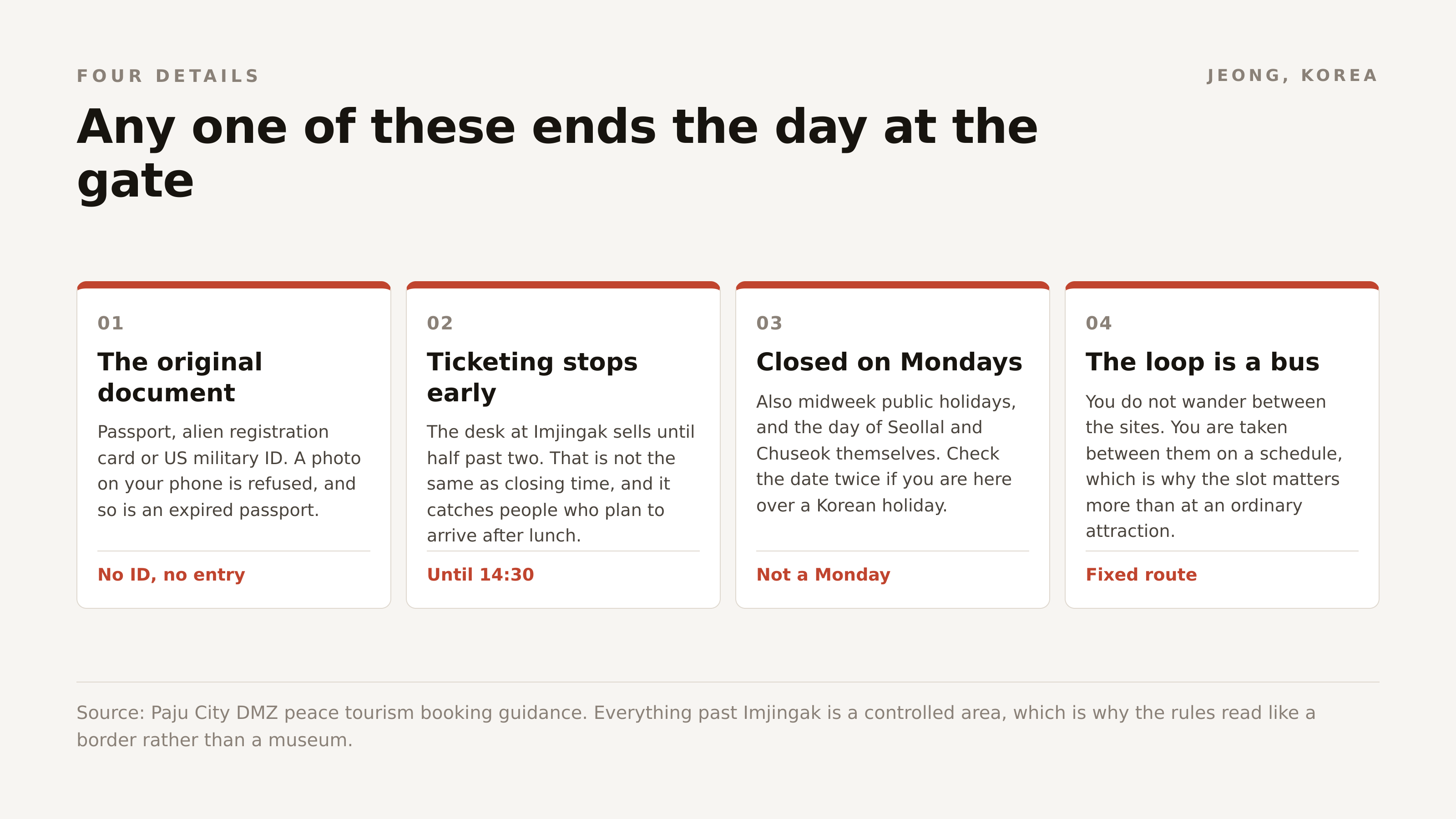
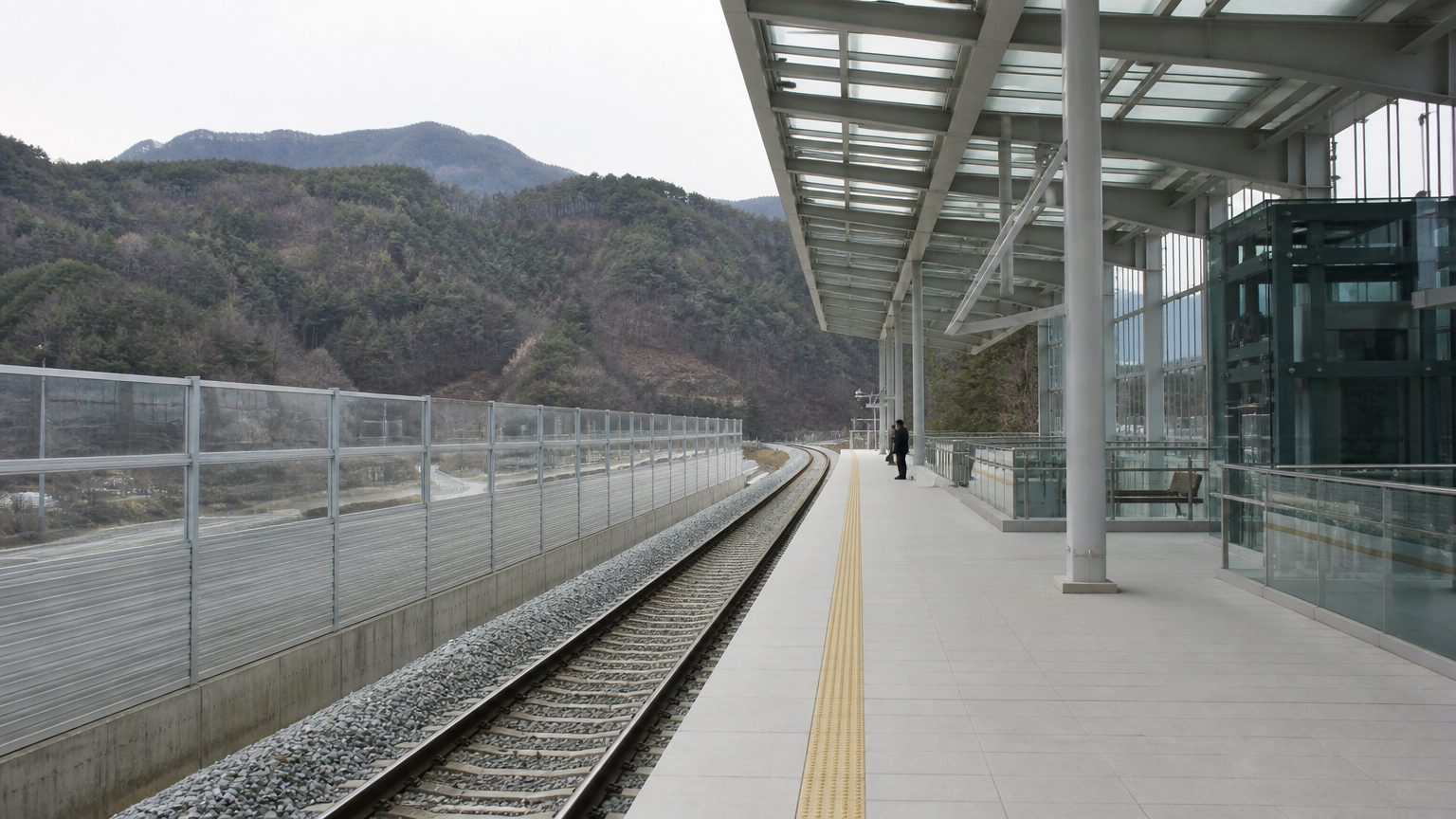
The Demilitarized Zone is a strip roughly 250 kilometres long. Along the western end of it, near Paju, sits a set of sites that ordinary visitors can reach: the Third Infiltration Tunnel, the Dora Observatory looking north, Dorasan Station, and Imjingak on the southern side of the river. The Joint Security Area is a single small compound inside the DMZ where the two sides face each other across the line, and it is the one everybody has seen photographed. Two different administrations, two different application routes, two different answers to the question "can I go".
That distinction is the whole article, because a dmz tour listing will happily bundle both under one word. If you book what you think is a JSA experience and receive the Paju sites, nothing has technically gone wrong, and you may well have a good day. But you paid for a photograph you are not going to take. Read the itinerary rather than the headline.
So which one is actually open to you?
Foreigners cannot currently apply for the JSA
This is not a rumour or a seasonal thing. It is written on the government's own page.
Panmunjom visits are administered by the Ministry of Unification, and its visitor page states that applicants must be Korean nationals aged eight or over, up to five people per application, and then says directly that group and foreign visitor programmes are not currently operating, with further notice to follow. Applications go through the government's own booking site and open on the tenth of the preceding month, closing two weeks before the visit date.
The background, as widely reported, is that Panmunjom visits were suspended at the end of 2023 amid raised tension along the line, and that a limited form restarted later for Korean nationals with smaller groups and a changed route. Whether and when it reopens to foreign visitors is not something anyone outside the ministry can tell you, so treat any page that promises it as out of date rather than dishonest. Most of those pages were written when it was true.
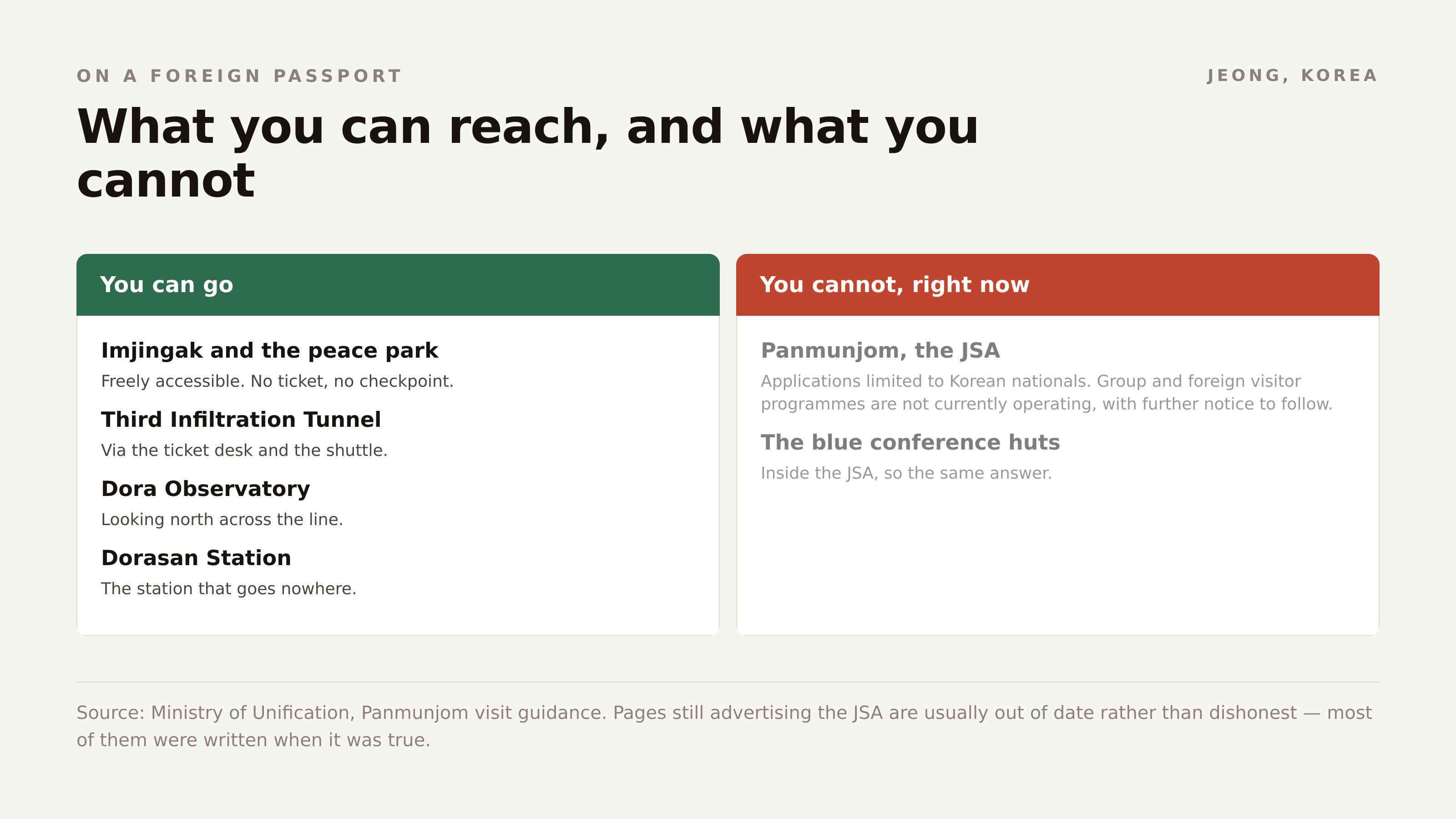
| JSA / Panmunjom | The Paju DMZ sites | |
|---|---|---|
| What it is | The compound on the line itself | Tunnel, observatory, Dorasan Station, Imjingak |
| Who runs it | Ministry of Unification | Paju City peace tourism |
| Foreign visitors | Not currently operating | Open |
| How you apply | Government booking site, Korean nationals | Ticket desk at Imjingak, or online |
Which leaves the trip you can actually take.
What you can do, and the four details that decide whether it works
The Paju sites are open, and four practical facts decide whether your day goes smoothly.
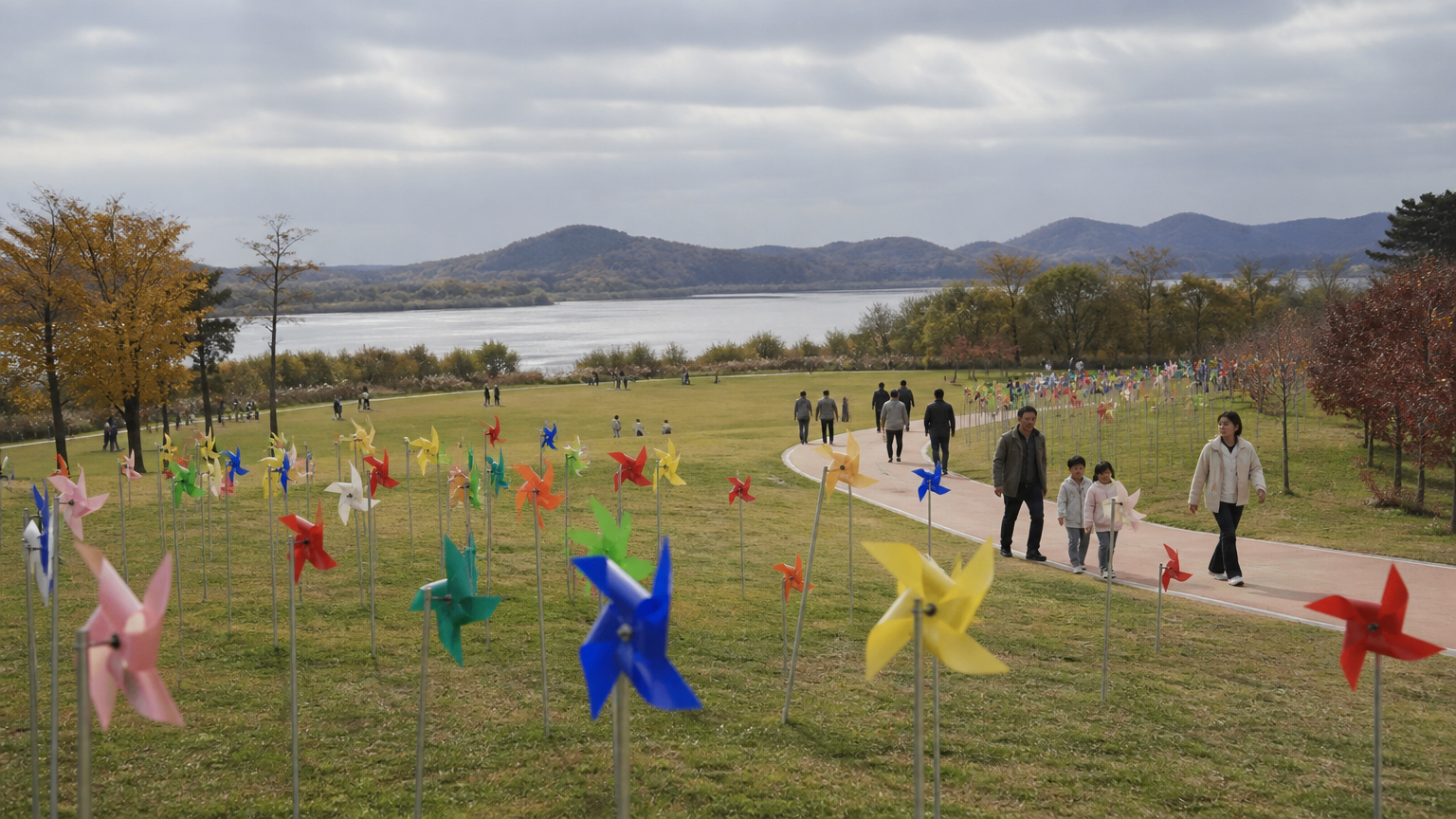
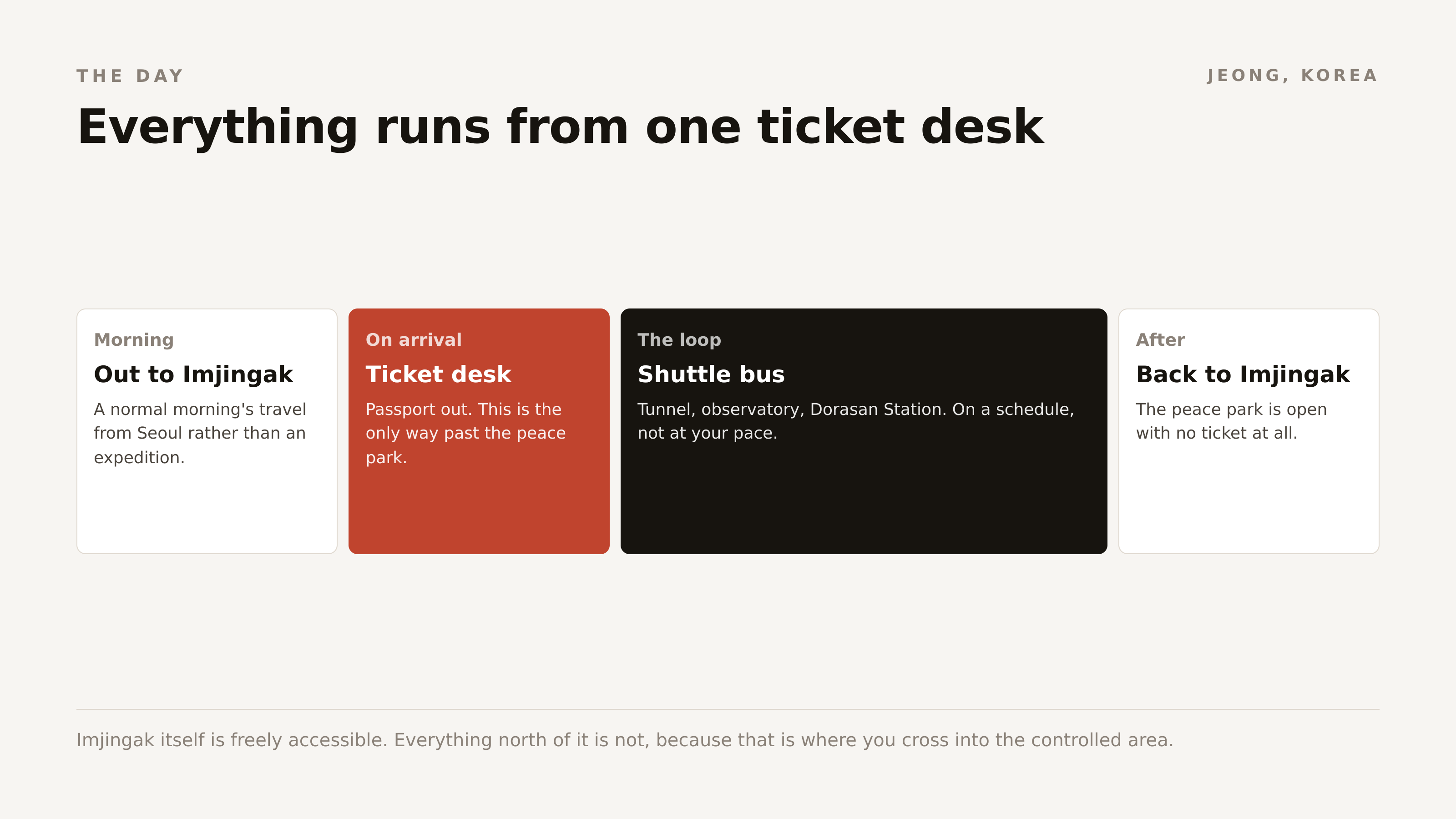
You start at Imjingak. That is where the DMZ ticket desk is, and where the shuttle bus leaves from to run the loop through the tunnel, the observatory and Dorasan Station. Imjingak itself, with its peace park, is freely accessible. Everything past it is not, because you are crossing into a controlled area, and that is where the details start to matter.
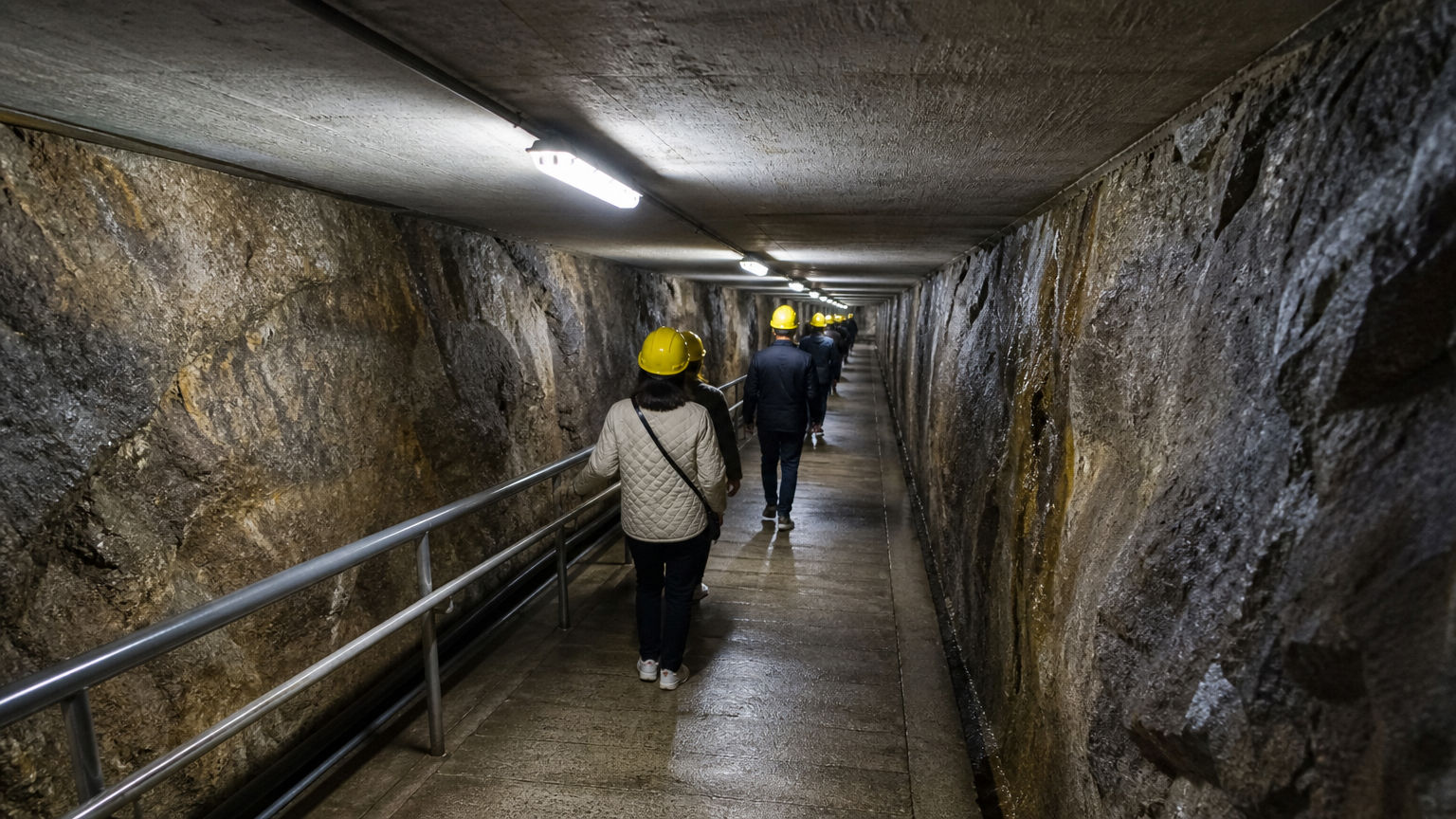
Bring the original identity document. Foreign visitors present a passport, an alien registration card or a US military ID. A photo of your passport on your phone will not do it, and neither will an expired one. Paju City's own booking guidance says outright that anyone without identification cannot enter, which at that point means a long journey back with nothing to show for it.
Ticketing closes in the early afternoon. The desk sells until half past two. This is not the same as closing time, and people who plan to arrive after lunch get caught by it.
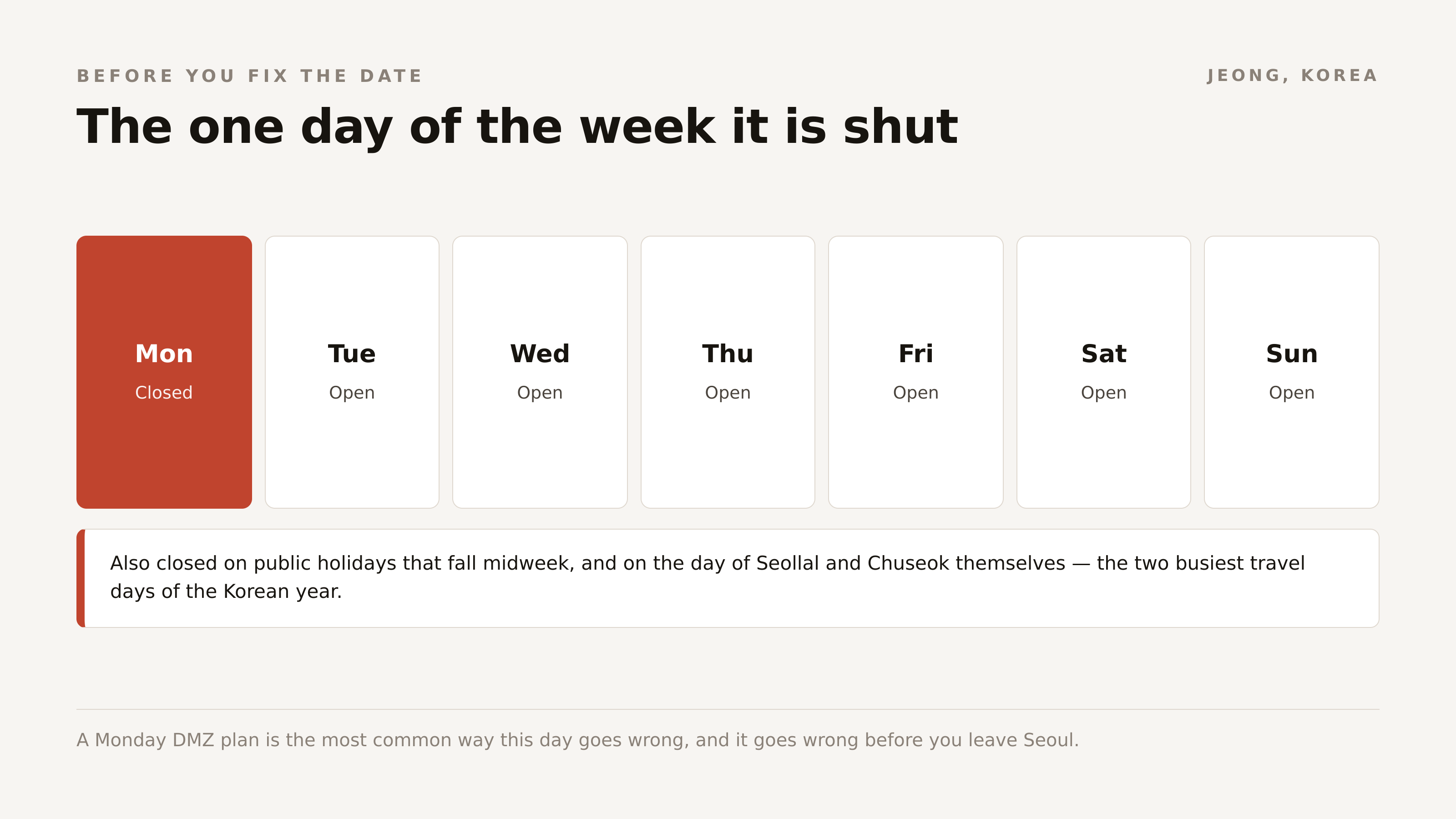
It is shut on Mondays. Also on public holidays that fall midweek, and on the day of Seollal and Chuseok themselves. If you are here over a Korean holiday, check the date twice, because those two are the busiest travel days of the Korean year and the country does not behave normally around them: Chuseok 2026: Why an Empty Seoul Is the Best Time to Be Here (And What Actually Closes).
The loop is a bus, not a walk. You do not wander between these sites. You are taken between them on a schedule, which is why a booked or ticketed slot matters more here than at an ordinary attraction.
| Detail | What it means |
|---|---|
| Ticket desk | Imjingak, selling until 14:30 |
| Identity | Passport, alien registration card or US military ID. Originals only |
| Closed | Mondays, midweek public holidays, and the day of Seollal and Chuseok |
| Getting around inside | Shuttle bus on a fixed loop |
Getting out to Imjingak is a normal morning's travel from Seoul rather than an expedition, and if you have only just landed, the transport question that matters more is the one before this: Incheon Airport to Seoul: 4 Ways, and Which One Is Actually Worth It.
FAQ
When will the JSA reopen to foreign visitors?
Nobody outside the Ministry of Unification can answer that, and its page says only that further notice will follow. Anyone giving you a date is guessing. Check the ministry's own visitor page close to your travel dates rather than a tour listing.
I already booked a dmz tour that mentions the JSA. What now?
Read the itinerary rather than the title, and ask the operator which sites are actually included. Refund and change terms vary by operator and are not something an article can tell you. What an article can tell you is what to ask.
Can I go to the DMZ on my own?
Imjingak and its peace park, yes. Past that, no. Crossing into the controlled area means a ticket, an identity check and the shuttle, which is why every route into the tunnel and the observatory goes through the same desk.
Is a photo of my passport enough?
No. Paju City's guidance is explicit that copies, screenshots and expired documents are refused. Bring the physical passport.
The short version
A dmz tour is still a real day out and one of the more affecting things you can do from Seoul. The Third Infiltration Tunnel, the Dora Observatory and Dorasan Station are open, reachable from Imjingak, and worth the trip. The Joint Security Area is a separate place under a separate authority, and the government's own page currently says foreign visitors are not being accepted.
Before you pay for anything, open the itinerary and look for the site names rather than the word DMZ. Then put your actual passport in your bag, avoid a Monday, and be at the Imjingak ticket desk well before half past two.
Sources
-
Ministry of Unification, Panmunjom visit guidance — eligibility limited to Korean nationals aged eight or over, and the statement that group and foreign visitor programmes are not currently operating, with further notice to follow
-
Paju City DMZ peace tourism booking guidance — accepted identity documents for foreign visitors, the refusal of copies and expired documents, ticketing at Imjingak until 14:30, the shuttle bus loop, and closure on Mondays, midweek public holidays and the day of Seollal and Chuseok
-
Contemporaneous news reporting on the suspension of Panmunjom visits at the end of 2023 and the later limited restart
More from this series
2026-08-28
Gyeongju Food: The Famous One Is a Souvenir, and the Meal Is Next to the Tombs
2026-08-28
Bulguksa Temple: There Is No Direct Bus to Seokguram, and You See the Buddha Through Glass
2026-08-27
Gyeongju From Seoul: Two Hours by KTX, and Then the Part Nobody Plans For
2026-08-27
Gyeongju: Three Separate UNESCO Listings, and Why One Day Does Not Cover Them
2026-08-27
K-ETA Korea: You Are Probably Exempt, and the Arrival Card Is What Catches People
2026-08-18
Autumn in Korea: Don't Pick the Dates, Pick the Latitude
2026-08-18
Hospital in Seoul: Why Koreans Don't Start at the Big One
2026-08-18
Korean Drinking Culture: The Rules Are Real, and So Is the Way Out
2026-07-31
Famous Korean Street Foods You Must Try (Yes, Including the Viral Buldak Omelette)
2026-07-31
What Is Silbi Kimchi? Korea's Spiciest Kimchi — and the Local Hack You Need to Know