Daejeon, Korea: An Hour From Seoul by KTX, and Two Stations Carry the City's Name

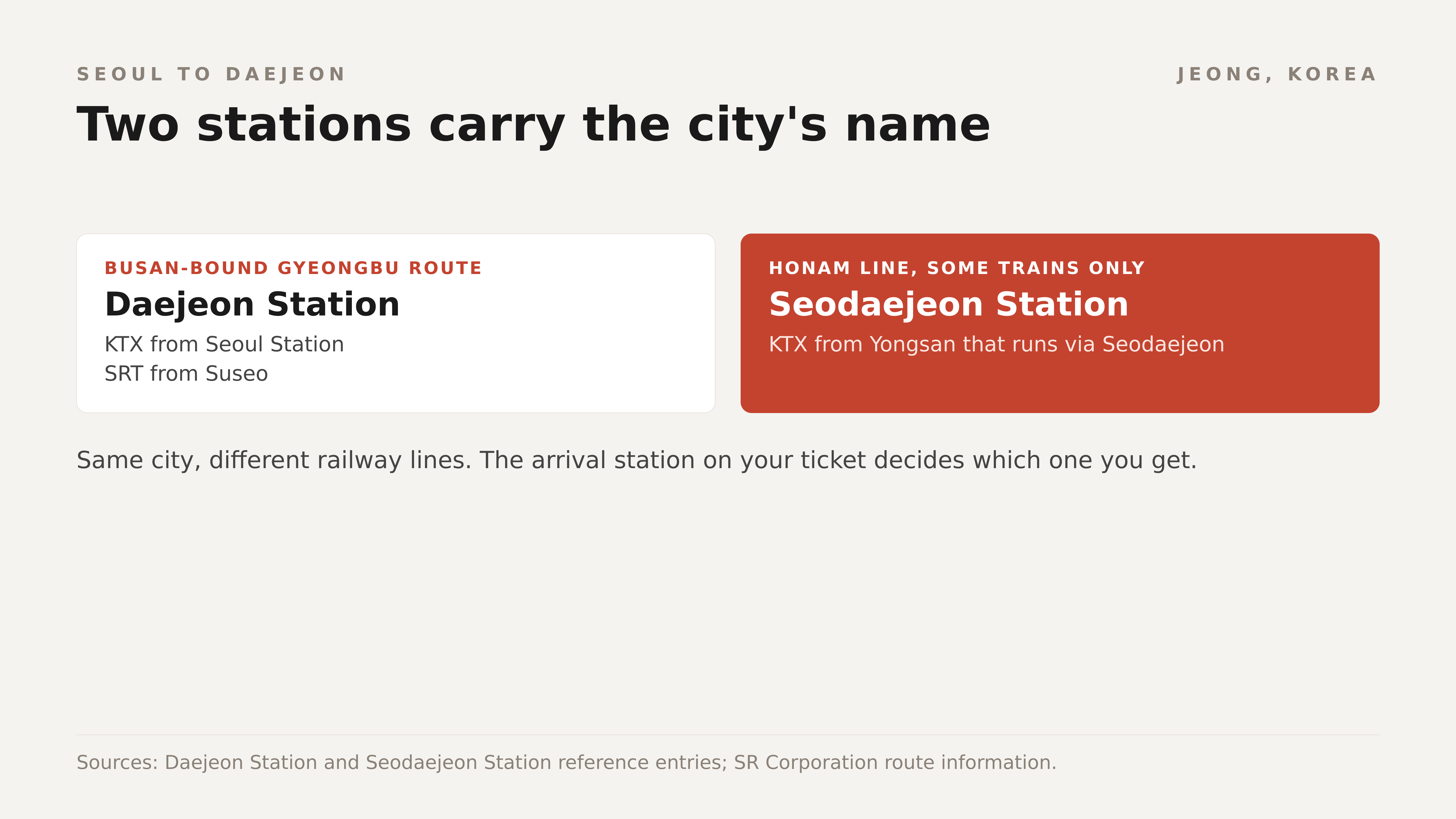
Most people assume a city has one main station. Daejeon has two stations with the city's name on them, they sit on different railway lines, and the train you pick in Seoul decides which one you step off at.
This is the first of three posts on Daejeon, Korea. It covers what the city actually is, how to get there from Seoul in about an hour, and the one detail on your ticket that decides whether you arrive at Daejeon Station or Seodaejeon Station.
Daejeon, Korea is a city the railway built
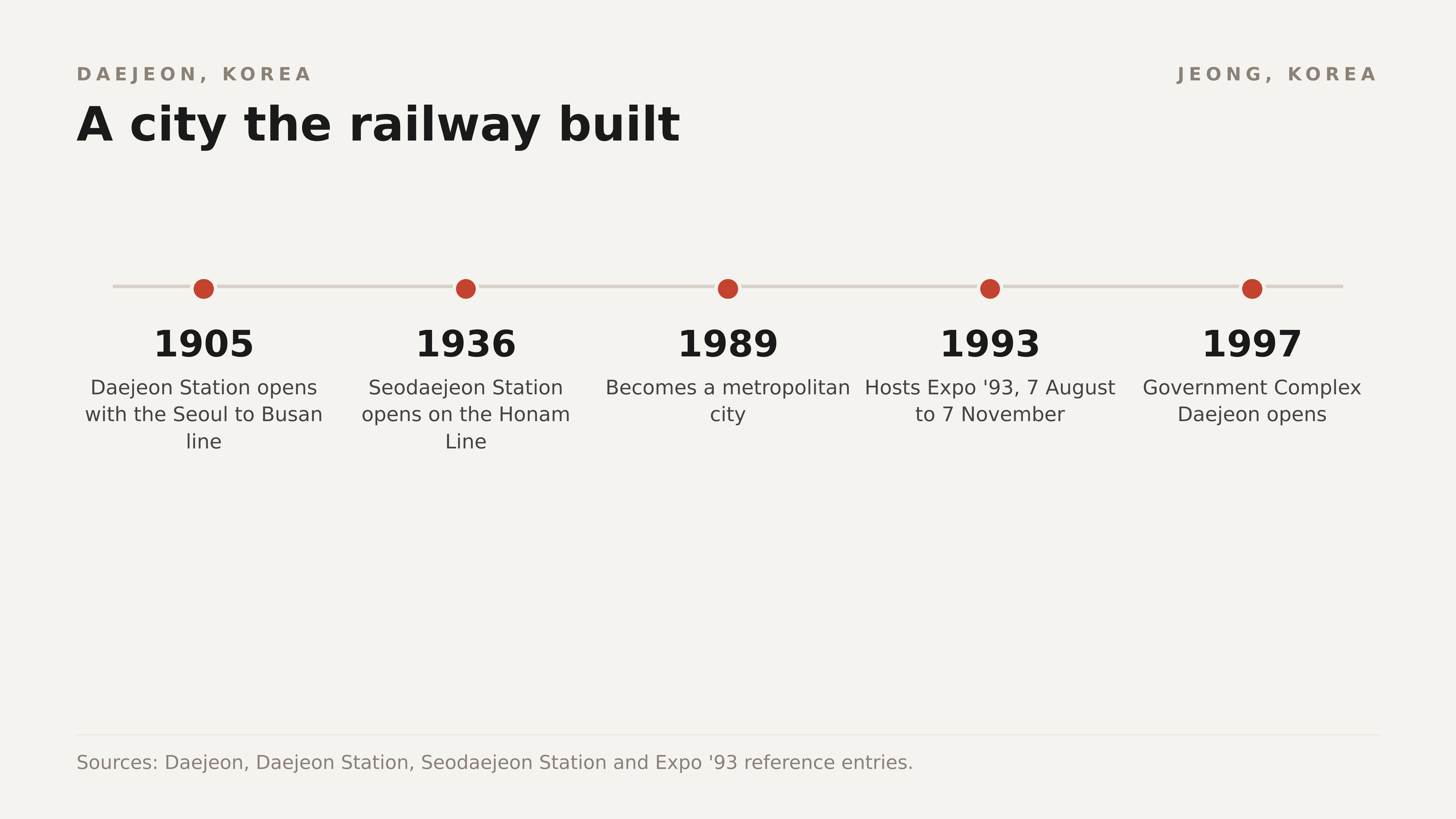
Daejeon is South Korea's fifth-largest city, with a population of nearly 1.5 million, and it has been a metropolitan city since 1989.
The reason it exists at this scale is the railway. Daejeon Station opened on 1 January 1905, the day the Seoul to Busan line opened, and the town grew around the tracks. A second station, Seodaejeon, opened in 1936 on the Honam Line, the conventional line towards the south-west, which is why the city has two today.
Three later decisions shaped the modern city. From the 1980s national government functions were moved here, and the Government Complex Daejeon opened in 1997. Daejeon hosted Expo '93 from 7 August to 7 November 1993, and the site became Expo Science Park. In Yuseong District, Daedeok Innopolis holds KAIST and more than twenty major research institutes.
None of that is why you would come for a day. The next two posts in this series cover the reasons that are: bread, and the hot springs in Yuseong.
If you have already done a KTX day trip elsewhere, the rhythm will feel familiar. Gyeongju From Seoul: Two Hours by KTX, and Then the Part Nobody Plans For works the same way, only further south.
Which raises the practical question of which train.
Seoul to Daejeon takes about an hour, and there are three ways to board
The local district office describes the KTX as connecting Daejeon and Seoul within one hour. Daejeon Station is 166.6 km south of Seoul Station, and every KTX train on the Gyeongbu Line, the Seoul to Busan route, stops there.
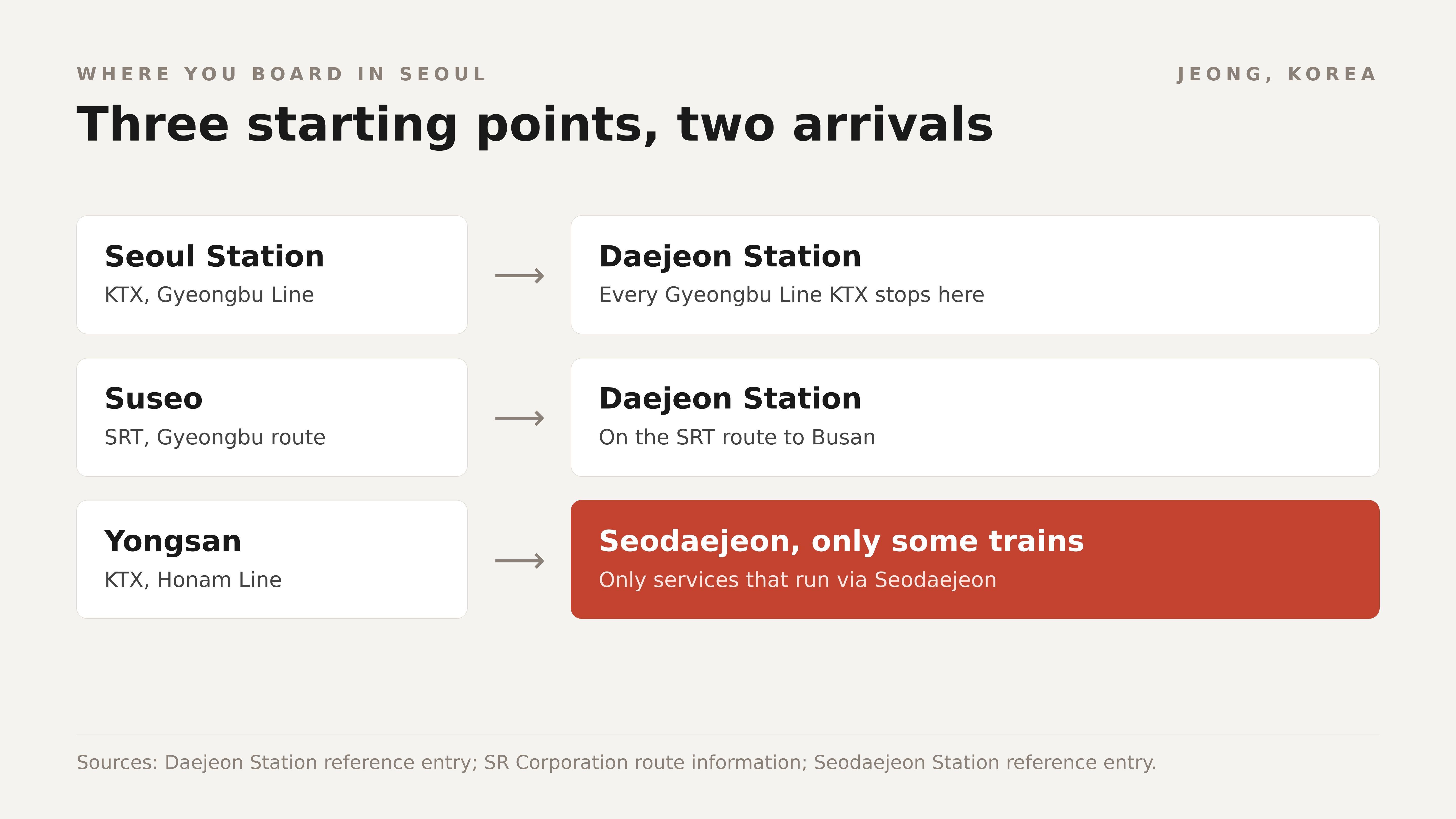
That gives you three sensible starting points in Seoul, and the right one depends on where you slept rather than on which station sounds most important.
| Where you board in Seoul | Train | Where you arrive |
|---|---|---|
| Seoul Station | KTX on the Gyeongbu Line | Daejeon Station |
| Suseo, south-east Seoul | SRT on the Gyeongbu route | Daejeon Station |
| Yongsan | Some KTX on the Honam Line | Seodaejeon Station, if the train runs via Seodaejeon |
The SRT is a separate high-speed operator that starts at Suseo, and its Gyeongbu route stops at Daejeon on the way to Busan. If you are staying in Gangnam or anywhere in the south-east of Seoul, it saves you crossing the city to reach Seoul Station.
Booking any of these with a foreign card has its own problems, and Seoul to Busan KTX: Why Your Card Gets Rejected, and How to Actually Book It covers what works.
The third row is the one that catches people.
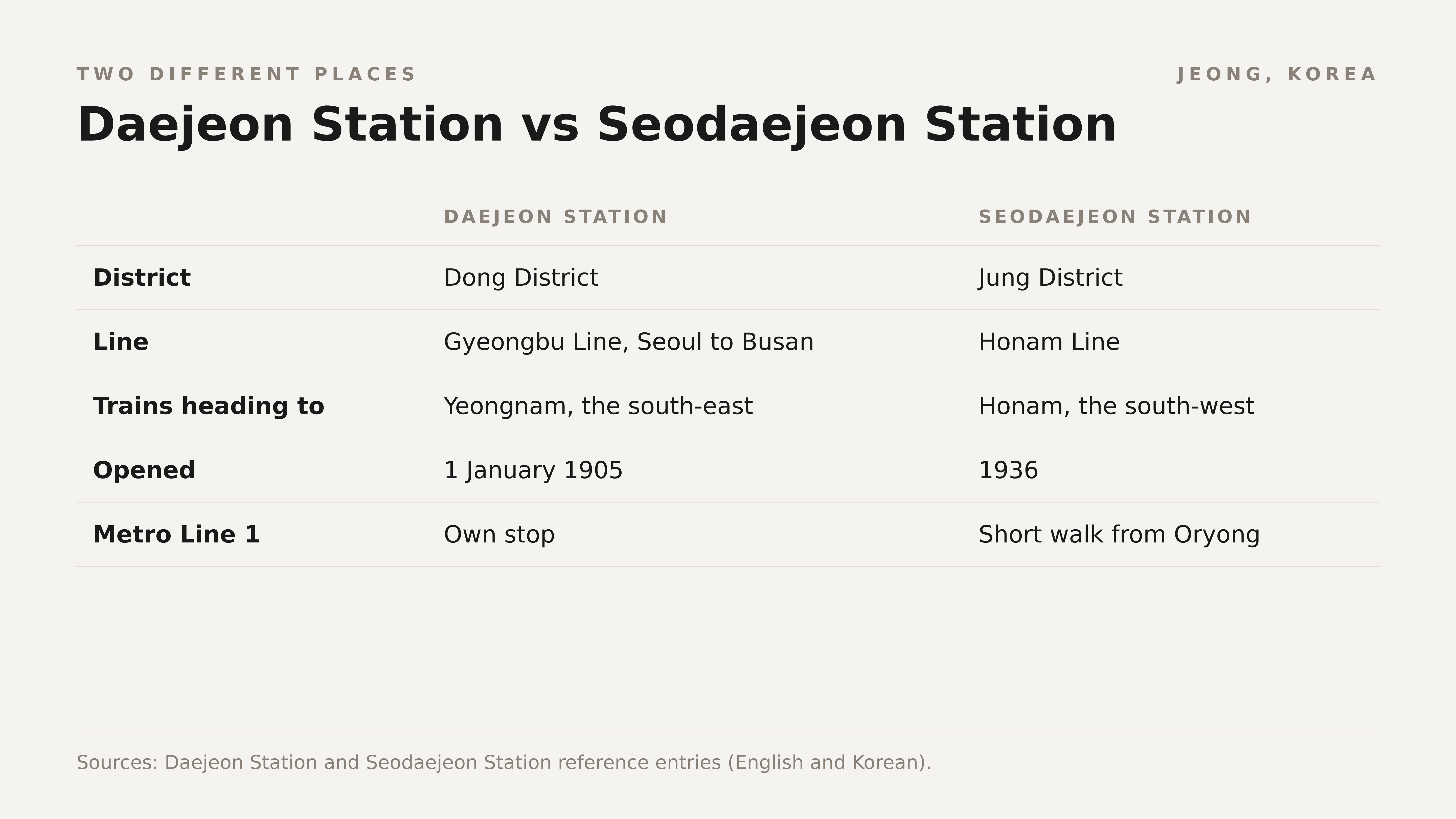
Daejeon Station and Seodaejeon Station are two different places
Daejeon Station is in Dong District. Seodaejeon Station, which simply means West Daejeon, is in Jung District on the Honam Line and opened in 1936. The two do different jobs: trains heading towards the Yeongnam region in the south-east stop at Daejeon Station, and trains heading towards the Honam region in the south-west stop at Seodaejeon.
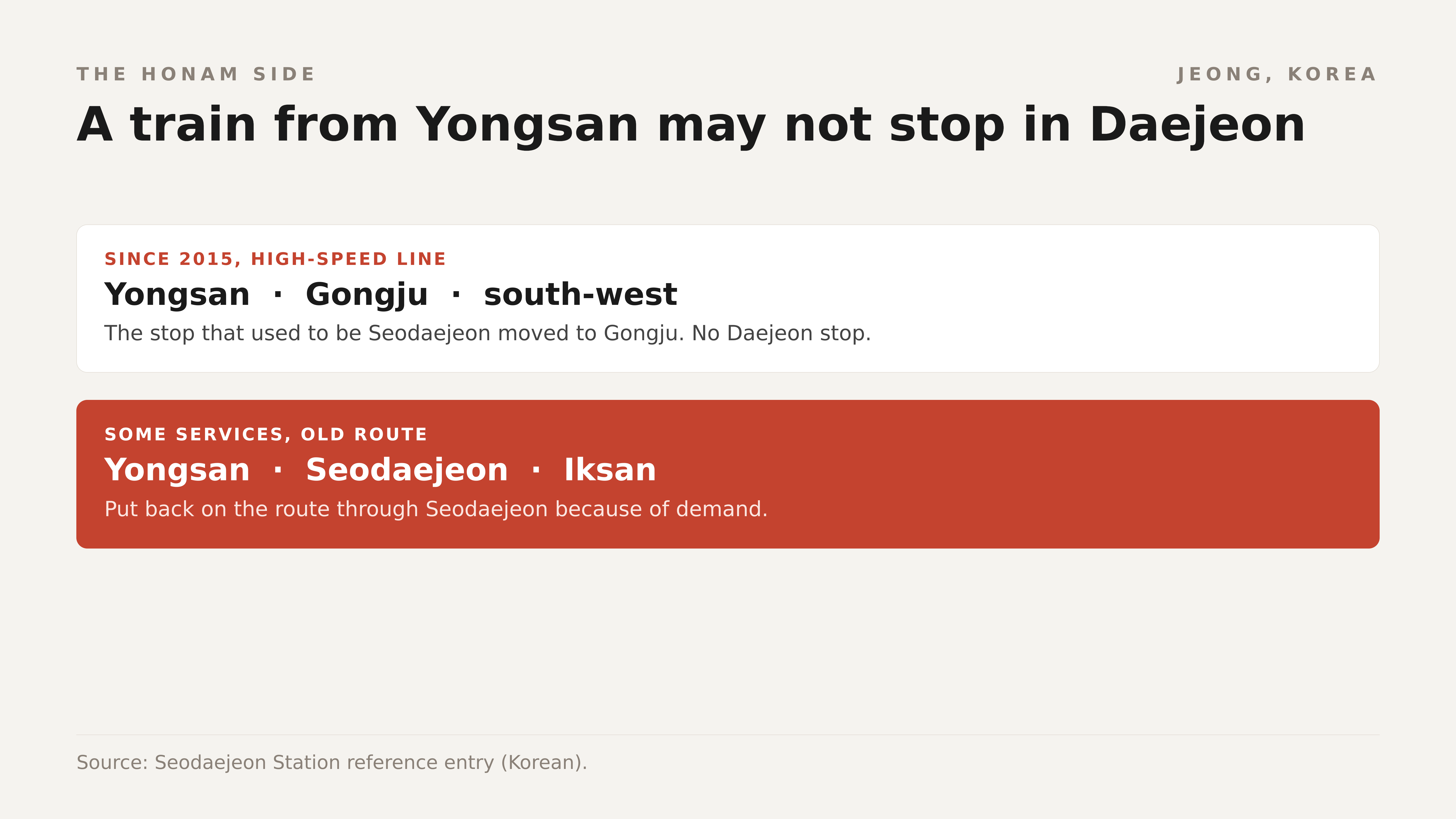
Here is the part that is easy to get wrong. When the Honam high-speed line was completed in 2015, the KTX stop that used to be Seodaejeon moved to Gongju. Because of demand, some trains were later put back on the old route through Seodaejeon, and services such as Yongsan to Seodaejeon to Iksan now run. So a KTX from Yongsan heading south-west may stop at Seodaejeon, or it may pass the city without stopping.
If you are going south-west after Daejeon, for example to Jeonju, that line is where you will be. Jeonju: Korea's Only UNESCO City of Gastronomy, and the Train There Leaves From Yongsan explains that side of the network.
What to do about it is simpler than it sounds.
Read the arrival station on your ticket, then use Line 1
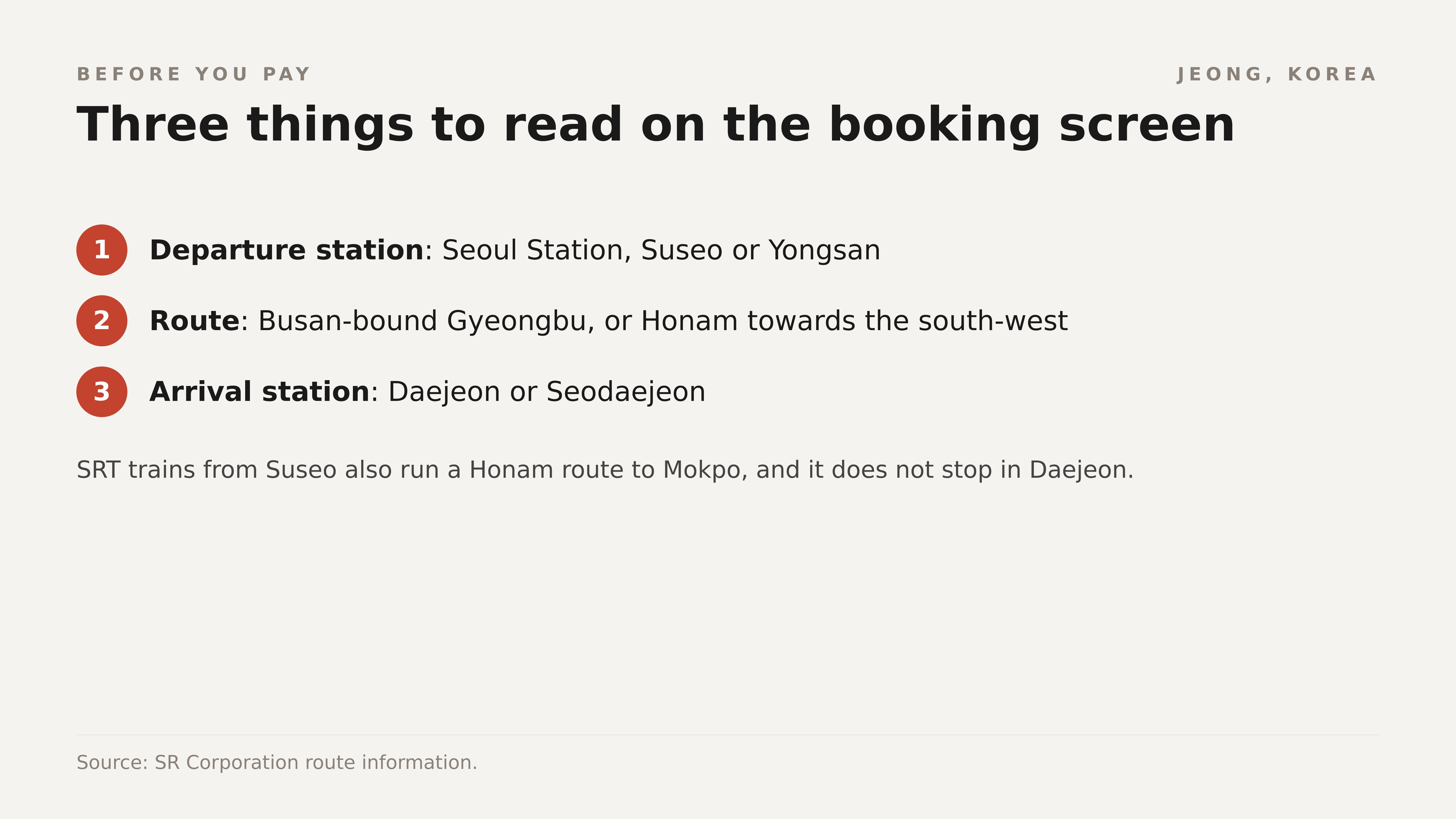
Before you pay, look at the arrival station on the booking screen and make sure it says the station you meant. Suseo also sends SRT trains towards Mokpo on the Honam side, so the route matters as much as the departure station. If you just want the quickest Seoul to Daejeon trip, pick a train on the Busan-bound Gyeongbu route, KTX from Seoul Station or SRT from Suseo, and it will stop at Daejeon Station.
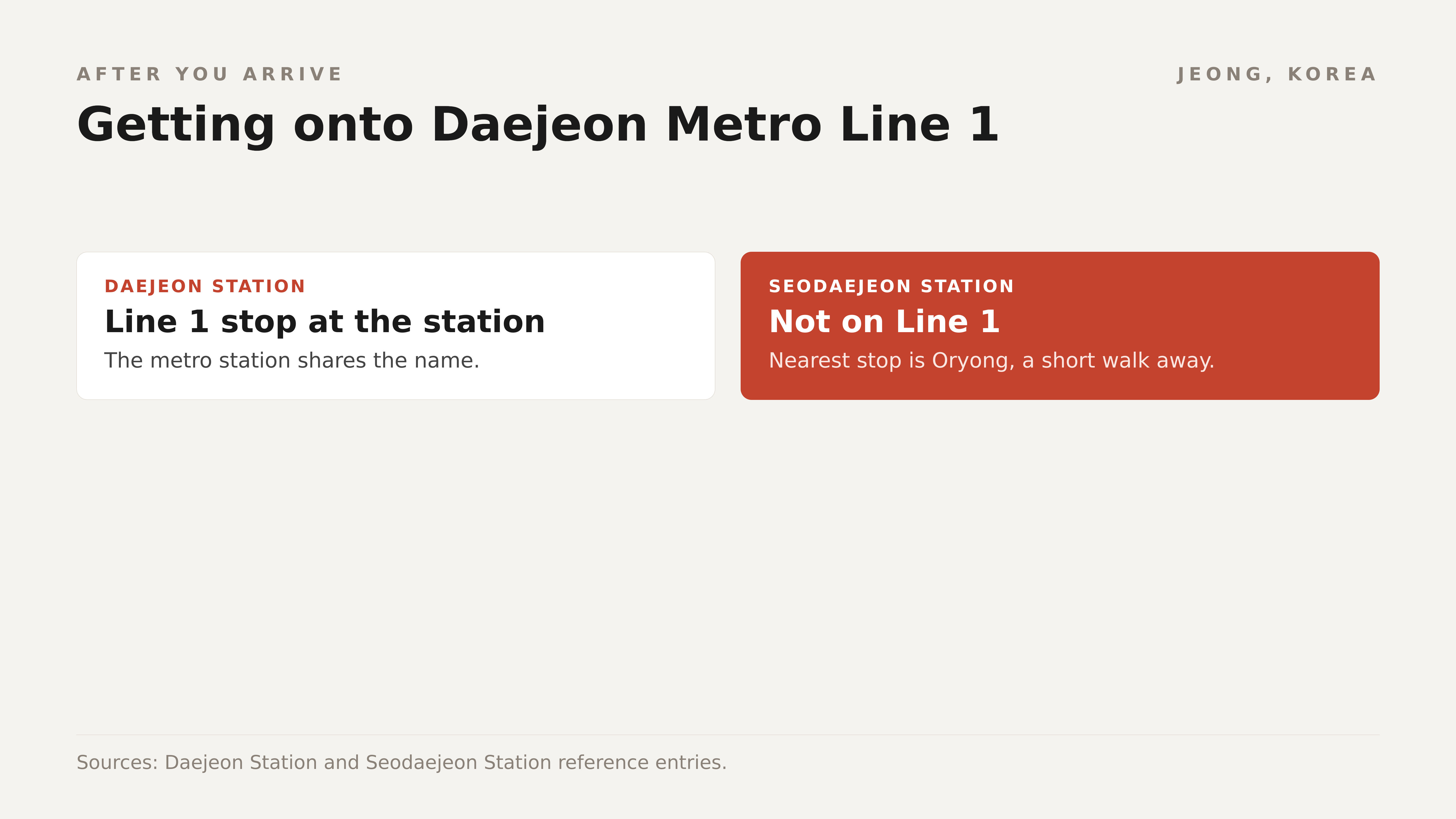
Once you arrive, Daejeon Metro Line 1 does most of the work. Daejeon Station has its own Line 1 stop. Seodaejeon is not directly on the line, and the nearest stop is Oryong, a short walk away.
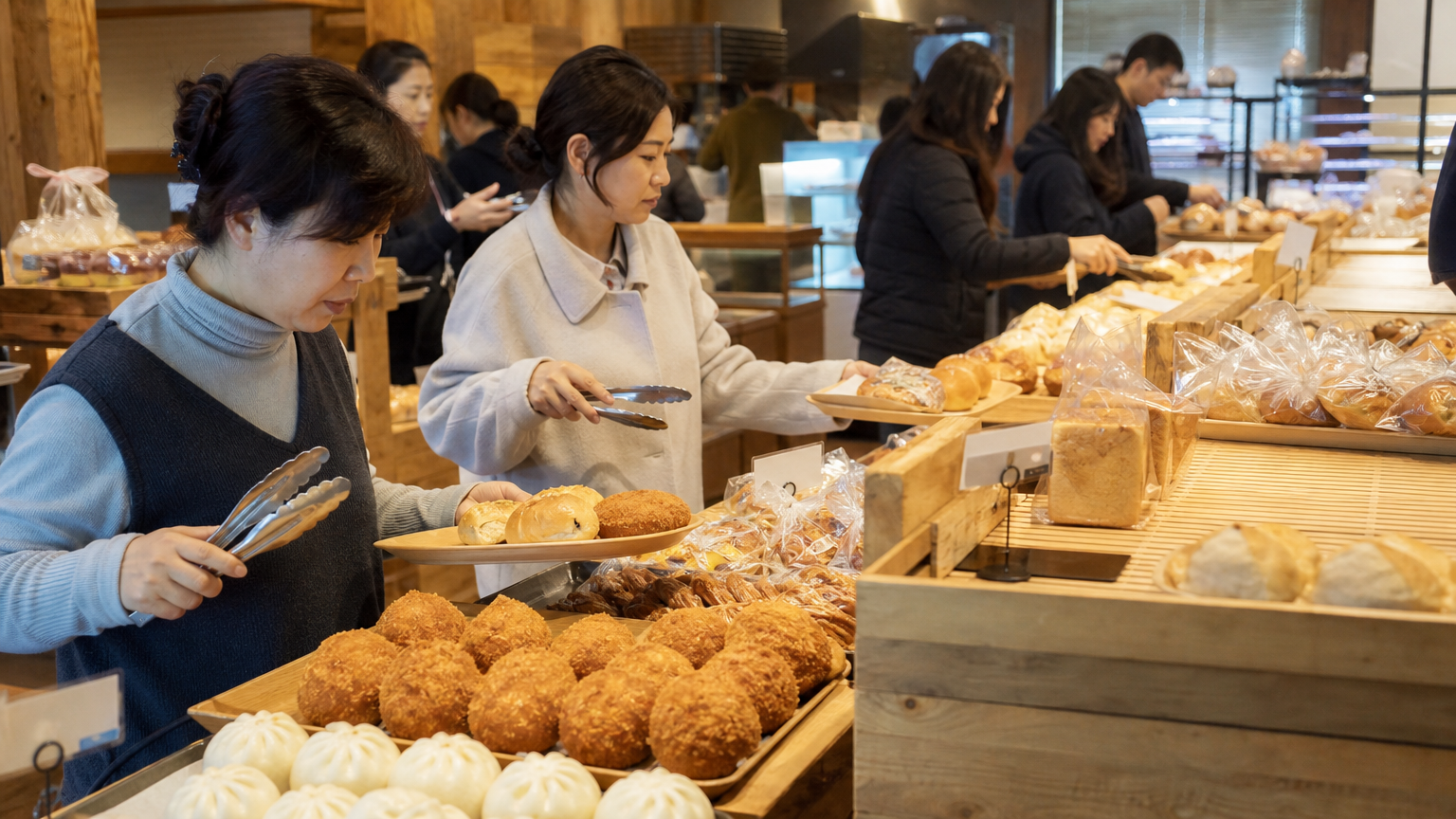
Daejeon Station also matters for the next post. Sungsimdang, the bakery that post is about, describes itself as having started as a small steamed-bun shop in front of Daejeon Station.
FAQ
How long does it take to get from Seoul to Daejeon?
About an hour by high-speed train. The Daejeon district office describes the KTX as connecting the two cities within one hour, and Daejeon Station is 166.6 km from Seoul Station.
Which station should I board at in Seoul?
Seoul Station if you are in the north or centre of the city, Suseo for the SRT if you are in Gangnam or the south-east. Choose a train on the Busan-bound Gyeongbu route and both arrive at Daejeon Station.
What is the difference between Daejeon Station and Seodaejeon Station?
Daejeon Station is on the Seoul to Busan line in Dong District. Seodaejeon is on the Honam Line in Jung District and is served by some trains from Yongsan heading south-west.
Do all KTX trains from Yongsan stop in Daejeon?
No. When the Honam high-speed line was completed in 2015, the stop moved from Seodaejeon to Gongju. Only the services that run via Seodaejeon stop in the city, so check the arrival station before paying.
Is Daejeon worth a day trip from Seoul?
It can be, because an hour each way leaves most of the day free. The next two posts cover the two things to plan the day around: the bread, and the hot springs in Yuseong.
The short version
Daejeon, Korea is the country's fifth-largest city and grew around a railway station that opened in 1905. Seoul to Daejeon takes about an hour on the Busan-bound Gyeongbu route, by KTX from Seoul Station or by SRT from Suseo, and both arrive at Daejeon Station in Dong District. Seodaejeon is a separate station on the Honam Line, served only by some KTX trains from Yongsan, so the arrival station on your ticket is the one thing to check. Metro Line 1 connects Daejeon Station directly; Seodaejeon is a short walk from Oryong.
Next in this series: a bakery that began as a steamed-bun shop in front of Daejeon Station, and what to know before you go looking for it.
Sources
Daejeon Dong-gu District Office, public transport guide: the KTX connecting Daejeon and Seoul within one hour, and bus and metro information. https://www.donggu.go.kr/dg/eng/contents/753
SR Corporation, SRT route information: stations on the Gyeongbu route from Suseo, including Daejeon, and the separate Honam route to Mokpo. https://www.srail.or.kr/cms/archive.do?pageId=KR0405000000
Daejeon Station reference entry: opening on 1 January 1905 with the Gyeongbu Line, Dong District location, 166.6 km from Seoul Station, all Gyeongbu Line KTX stopping, and the Line 1 connection. https://en.wikipedia.org/wiki/Daejeon_Station
Seodaejeon Station reference entry (Korean): Jung District location on the Honam Line, opening in 1936, the 2015 change to Gongju, services via Seodaejeon, and the split between Honam and Yeongnam directions. https://ko.wikipedia.org/wiki/서대전역
Seodaejeon Station reference entry (English): walking access from Oryong station on Metro Line 1. https://en.wikipedia.org/wiki/Seodaejeon_station
Daejeon city reference entry: population, metropolitan city status in 1989, the Government Complex opening in 1997, Expo '93 and Daedeok Innopolis. https://en.wikipedia.org/wiki/Daejeon
Expo '93 reference entry: exposition dates of 7 August to 7 November 1993. https://en.wikipedia.org/wiki/Expo_%2793
Sungsimdang official website: the bakery's own description of starting as a small steamed-bun shop in front of Daejeon Station. https://sungsimdang.co.kr/31/15
More from this series
2026-09-21
Yuseong Hot Spring: The Foot Bath Is Free and Open Until 10 p.m., and You Cannot Drink the Water
2026-09-19
Seoul Bus: The Colour Tells You Where It Goes, and Some of Them No Longer Take Cash
2026-09-18
Hangul Day: The Alphabet's Birthday Lost Its Day Off for 22 Years, and Its Museum Is Shut Until 2028
2026-09-15
Namdaemun Market Opening Hours: The Market's Own List Has 38 Timetables, and Some Floors Open at 11 p.m.
2026-09-15
Hair Salon in Seoul: The Final Price Must Be on the Wall, and Only a Barber May Shave You
2026-08-28
DMZ Tour: You Can Still Go. The JSA Is the Part You Cannot.
2026-08-28
Gyeongju Food: The Famous One Is a Souvenir, and the Meal Is Next to the Tombs
2026-08-28
Bulguksa Temple: There Is No Direct Bus to Seokguram, and You See the Buddha Through Glass
2026-08-27
Gyeongju From Seoul: Two Hours by KTX, and Then the Part Nobody Plans For
2026-08-27
Gyeongju: Three Separate UNESCO Listings, and Why One Day Does Not Cover Them
2026-08-27
K-ETA Korea: You Are Probably Exempt, and the Arrival Card Is What Catches People
2026-08-18
Autumn in Korea: Don't Pick the Dates, Pick the Latitude
2026-08-18
Hospital in Seoul: Why Koreans Don't Start at the Big One
2026-08-18
Korean Drinking Culture: The Rules Are Real, and So Is the Way Out
2026-07-31
Famous Korean Street Foods You Must Try (Yes, Including the Viral Buldak Omelette)
2026-07-31
What Is Silbi Kimchi? Korea's Spiciest Kimchi — and the Local Hack You Need to Know