Myeongdong Shopping Street: It Is Three Layers, and the Street Carts Are Licensed One Year at a Time

Every guide tells you Myeongdong is where you shop and eat. Almost none of them mention that the food carts are licensed, that the licence is issued for one year at a time, and that the cart you photographed last night may be legally closed tonight.
That last part is not bad luck. It is a condition of the permit.
Once you see Myeongdong as three separate layers with three different sets of rules, the place stops feeling like one chaotic street and starts making sense.
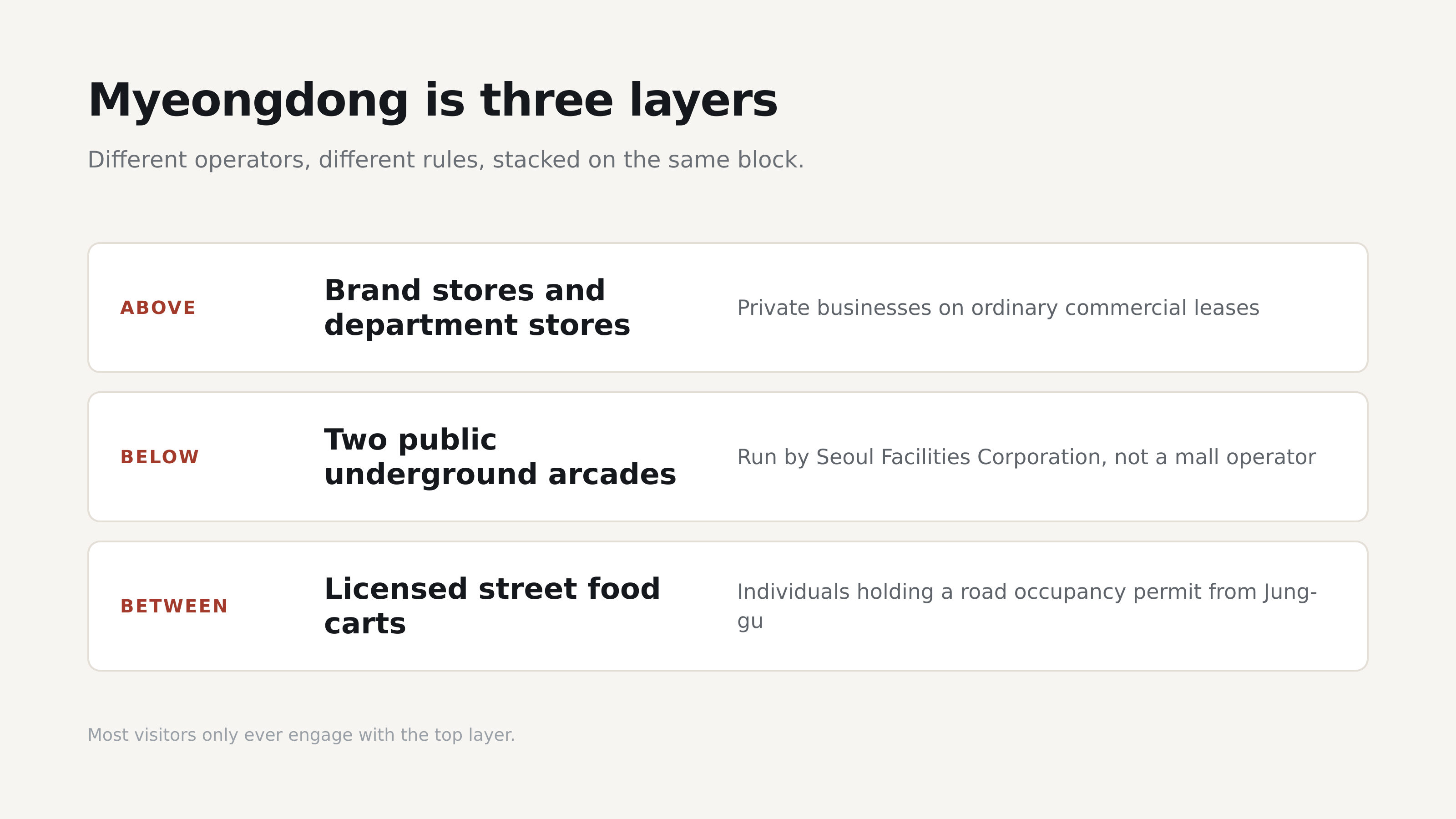
Three layers stacked on the same block
The shops, the underground arcades, and the carts are run by completely different people under completely different rules.
| Layer | What it is | Who runs it |
|---|---|---|
| Street level | Brand stores, cosmetics shops, department stores | Private businesses on ordinary commercial leases |
| Underground | Two public underground arcades | Seoul Facilities Corporation |
| The street itself | Food carts and stalls | Individuals holding a road occupancy permit from Jung-gu |
Most visitors only ever engage with the first layer. The other two are where the interesting rules live.
Start underneath, because almost nobody does.
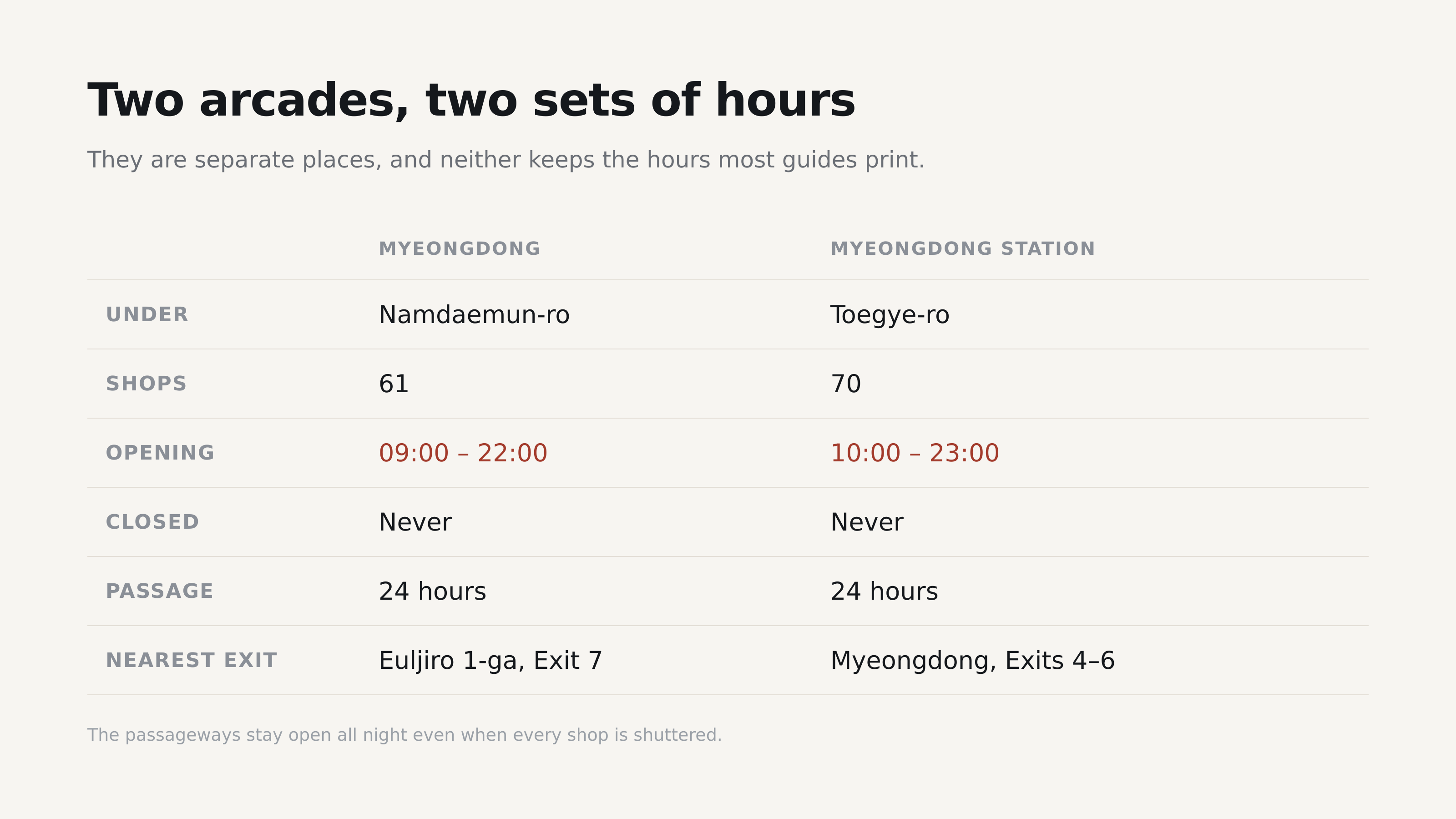
The underground is two arcades, and they keep different hours
There are two public underground arcades here, not one, and the city runs them rather than a mall operator.
Myeongdong Underground Shopping Centre sits under Namdaemun-ro with 61 shops across 3,838㎡, opening 09:00 to 22:00. It is the stretch that links the Lotte Department Store main branch to the Myeongdong high street. Myeongdong Station Underground Shopping Centre sits under Toegye-ro with 70 shops across 2,215㎡, opening 10:00 to 23:00, and leans heavily towards women's clothing.
Both trade every day of the year. And the detail worth carrying: the passageways stay open 24 hours, even when every shop in them is shuttered. On a wet evening or a January night, that is a route, not a destination.
| Myeongdong | Myeongdong Station | |
|---|---|---|
| Shops | 61 | 70 |
| Opening | 09:00–22:00 | 10:00–23:00 |
| Closed | Never | Never |
| Passage | 24 hours | 24 hours |
| Nearest exit | Euljiro 1-ga (Line 2), Exit 7 | Myeongdong (Line 4), Exits 4–6 |
Now come back up to the street, where the rules get specific.
The carts are licensed, and the licence explains how they look
A cart in Myeongdong is not an informal thing that appeared. It is a road occupancy permit.
Jung-gu has a written set of rules for them. The regulation defines a street stall as "a facility installed on a road in a variable and temporary manner in order to sell goods or services" — Article 2, Paragraph 1. Everything about how the carts look follows from that definition.
Article 5, Paragraph 3 says the form, colour and design must follow standards set by the district head, and that screens and partitions may not be installed. That single clause is why the carts are open on every side and why they all look like each other. It is not a style choice.
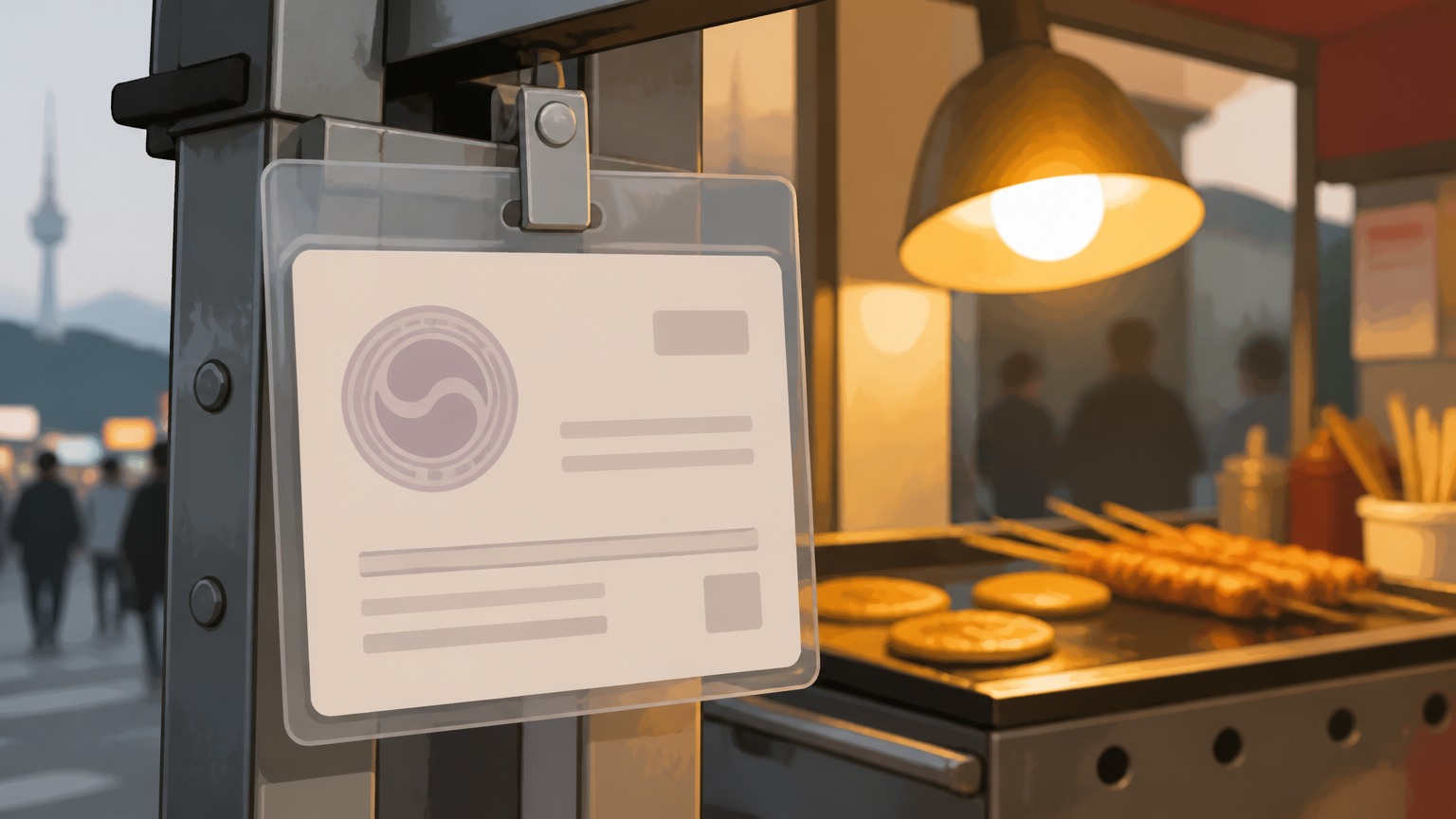
Article 11, Paragraph 4 requires the operator to attach the road occupancy permit "where ordinary citizens can easily see it". If you want to know whether a cart is licensed, the answer is supposed to be stuck to the cart.
And Article 7, Paragraph 2 sets the term at one year or less, with the operator's eligibility re-examined every year before it is extended.
Who is allowed to run one
This is where it stops being a business licence and starts being something else.
Under Article 7, Paragraph 1, permits go to existing operators recognised by the district head, or to residents in financial hardship who have been through a review committee. It is not open to whoever wants a pitch.
The part that told me what this system actually is sits in Article 10, Paragraph 3. If an operator dies, a spouse may succeed to the permit, but children and parents may not. You cannot hand a Myeongdong cart down. The permit is attached to a household's circumstances rather than to a family business, and when those circumstances end the pitch goes back.
I am not sure most people eating a skewer there know they are standing in front of a welfare instrument.
Which brings us to why the cart moves.
Why the cart you photographed may be gone tomorrow
Many Myeongdong permits carry an alternate-day operating condition, and the district enforces it.
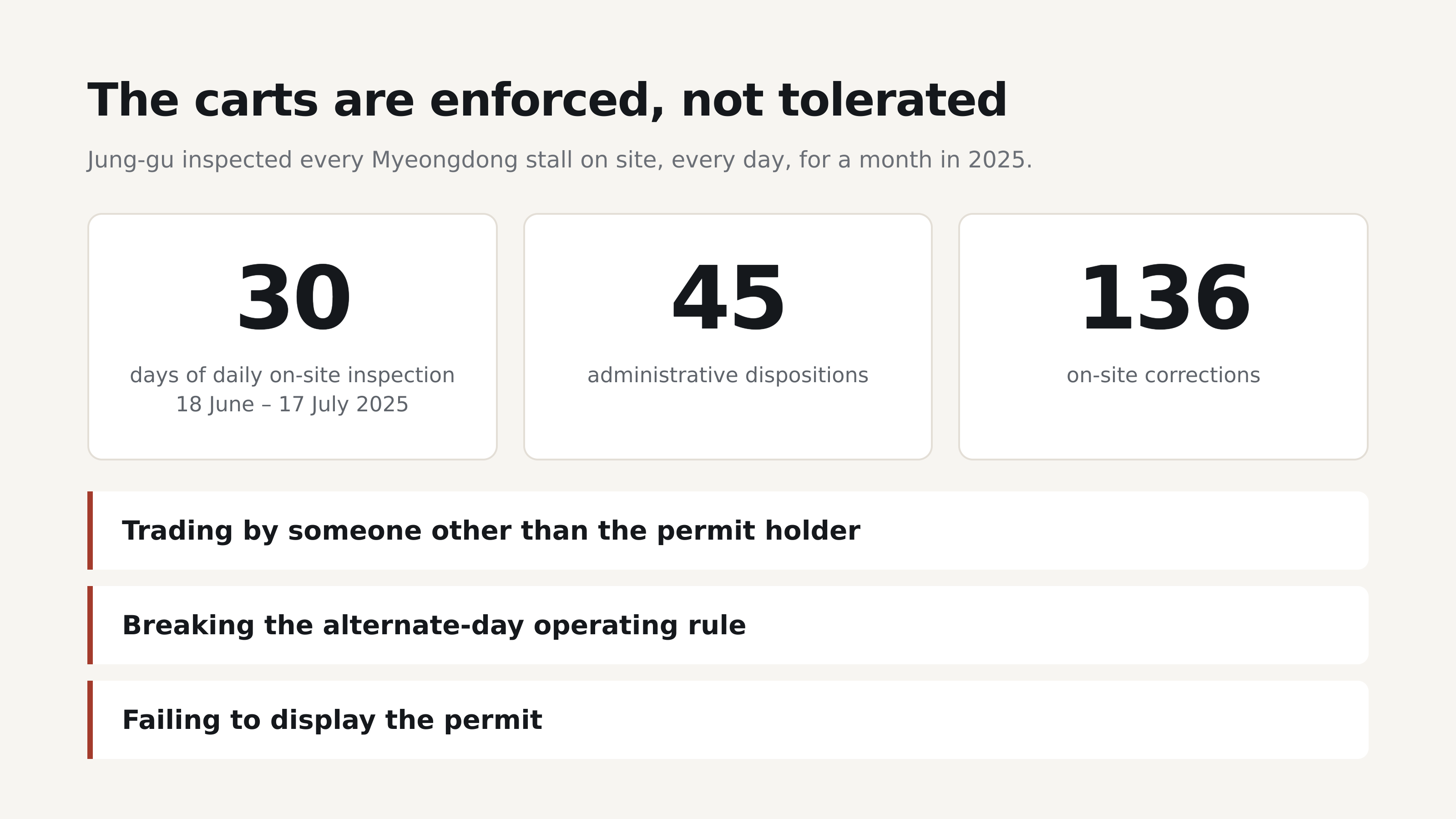
In 2025 Jung-gu ran a month-long special inspection of Myeongdong street stalls, from 18 June to 17 July, checking every stall on site every day. It ended with 45 administrative dispositions and 136 on-site corrections.
The violations it found say more than the numbers do. Three types came up: operating by someone other than the permit holder, breaking the alternate-day operating rule, and failing to display the permit.
So a stall trading on Tuesday may be required to be closed on Wednesday. The gap in the row is the rule working, not a vendor having a bad week. The district has also reduced stall numbers during periods of heavy crowding.
Which station, and what else is on the block
Two stations serve Myeongdong, and they put you on different ends of it.
Euljiro 1-ga on Line 2 puts you at the top of the district — Exit 7 is the one the city lists for the Namdaemun-ro arcade. Myeongdong Station on Line 4 sits at the other end, with Exits 4 to 6 feeding the Toegye-ro arcade. If you are walking the whole street you will arrive through one and leave through the other.
Two things on this block have their own guides. Olive Young's Myeongdong stores and how the tax refund actually works covers the cosmetics half of the district. And the money changers here are genuinely good, but where Koreans actually change money explains which ones, and why not the airport.
FAQ
Are the Myeongdong street carts legal?
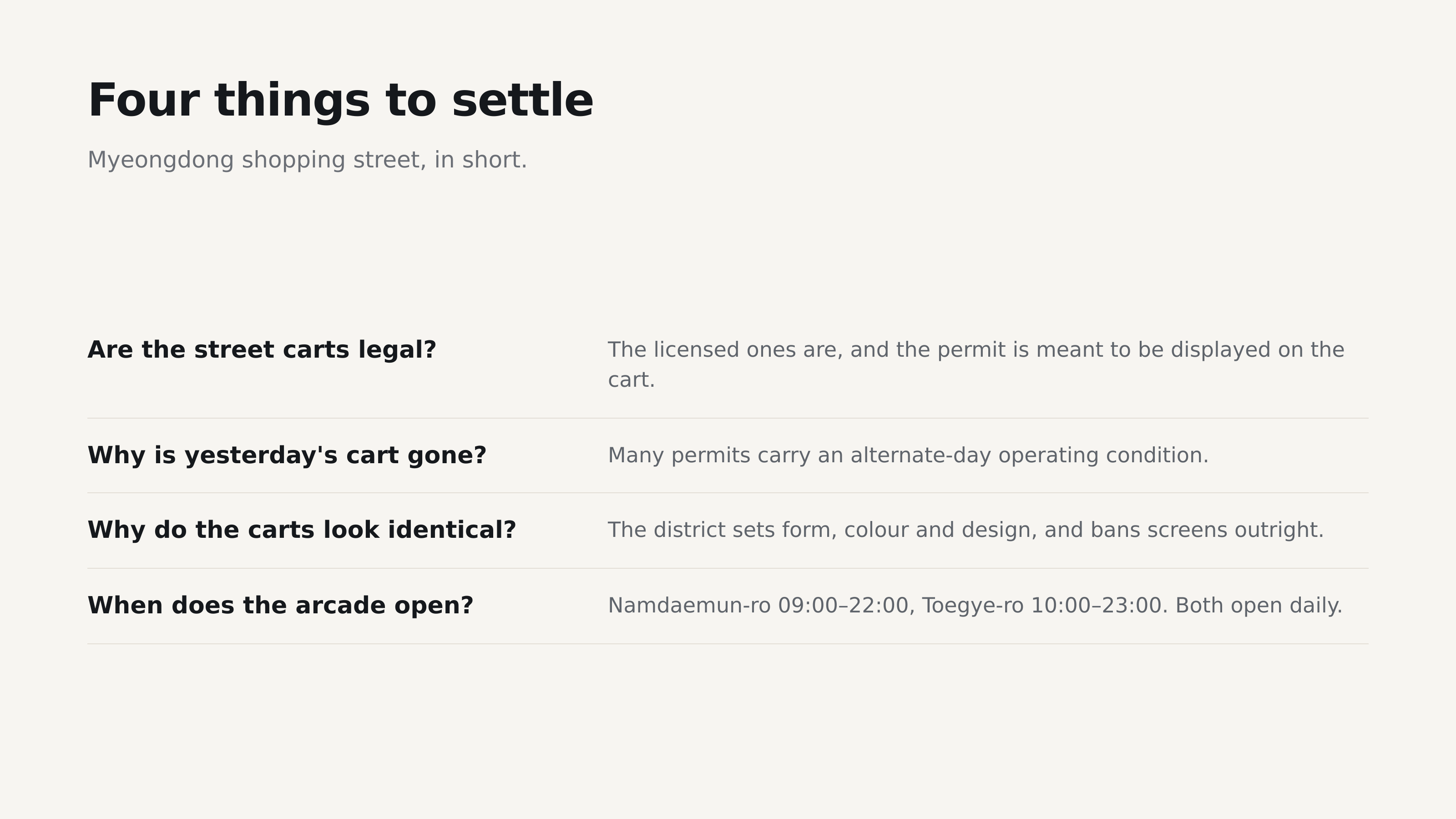
The licensed ones are. They hold a road occupancy permit from Jung-gu, and the permit is supposed to be displayed on the cart where you can see it.
Why is the cart I saw yesterday not there today?
Many permits carry an alternate-day operating condition. A stall that traded yesterday may be required to stay closed today.
Why do all the carts look the same?
The district sets the form, colour and design, and the regulation bans screens and partitions outright.
What time does the underground shopping centre open?
There are two. The Namdaemun-ro arcade runs 09:00 to 22:00 and the Toegye-ro arcade runs 10:00 to 23:00. Both open every day, and both passageways stay open 24 hours.
One sentence is enough
Myeongdong is three layers — private shops above, public arcades below, and a licensed street in between — and the street is the one with rules you can actually read.
If a cart has no permit stuck to it, that is information.
References
-
서울특별시 중구 거리가게 운영 규정 — 제2조①(정의) · 제5조③(디자인·가림막) · 제7조(허가 대상·기간) · 제10조③(승계) · 제11조④(허가증 부착)
-
서울시설공단 지하도상가 — 명동 — 61개 점포, 09:00~22:00, 통로개방 24시간, 을지로입구역 7번 출구
-
서울시설공단 지하도상가 — 명동역 — 70개 점포, 10:00~23:00, 통로개방 24시간, 명동역 4·5·6번 출구
-
국제뉴스 — 중구, 명동 거리가게 특별정비 완료 — 정비 기간, 행정처분 45건, 현장계도 136건, 위반 유형