Movie Theaters in Seoul: The Film Starts Ten Minutes Late, and Culture Day Moved in 2026

If someone told you Culture Day tickets cost 7,000 won, they were right until April 2026. The deal still exists. It just moved to a different set of Wednesdays and a different price, and most of what is written about it in English has not caught up.
I go to the cinema a lot here, mostly on weeknights, mostly alone. This is what I would tell a friend before their first movie theater Seoul trip: which chain you are walking into, why the screen stays on adverts after the listed time, how the discount night works now, and which of the big screens is worth a detour.
If you are taking a teenager with you, the rating rules are a separate question, and I covered them in the 15 rating and the adults-only door. This post is about everything around the ticket.
Three chains run almost every screen you will see
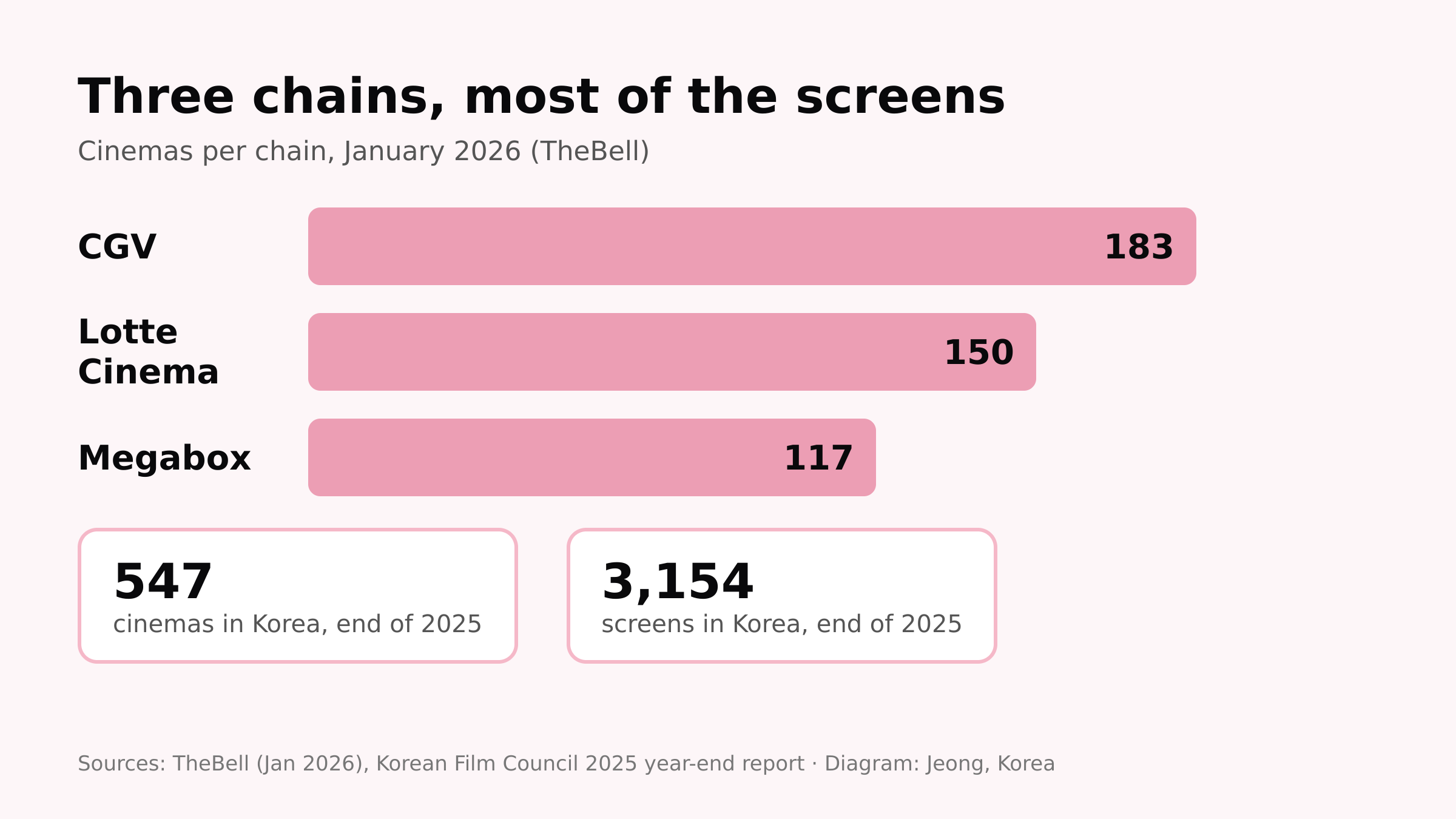
Korea had 547 cinemas and 3,154 screens at the end of 2025, according to the Korean Film Council's year-end report. That same report shows how hard the last year was: box office revenue fell 12.4% and admissions fell 13.8%, to about 106 million.
Nearly all of those screens sit inside three brands. CGV, Lotte Cinema and Megabox are the names on the signs in malls, department stores and station buildings. A January 2026 report in TheBell counted 183 CGV cinemas, 150 Lotte Cinemas and 117 Megaboxes.
| Chain | Cinemas (Jan 2026) | Premium screens (end of 2025) |
|---|---|---|
| CGV | 183 | 495 |
| Lotte Cinema | 150 | 280 |
| Megabox | 117 | 439 |
The same TheBell report said Lotte and Megabox were discussing a merger. I cannot tell you where that stands now, and I will not pretend to. For a visitor it changes nothing yet: the nearest movie theater Seoul has to your hotel will almost certainly carry one of these three names.
Subtitles, not dubbing, and ten minutes of adverts first
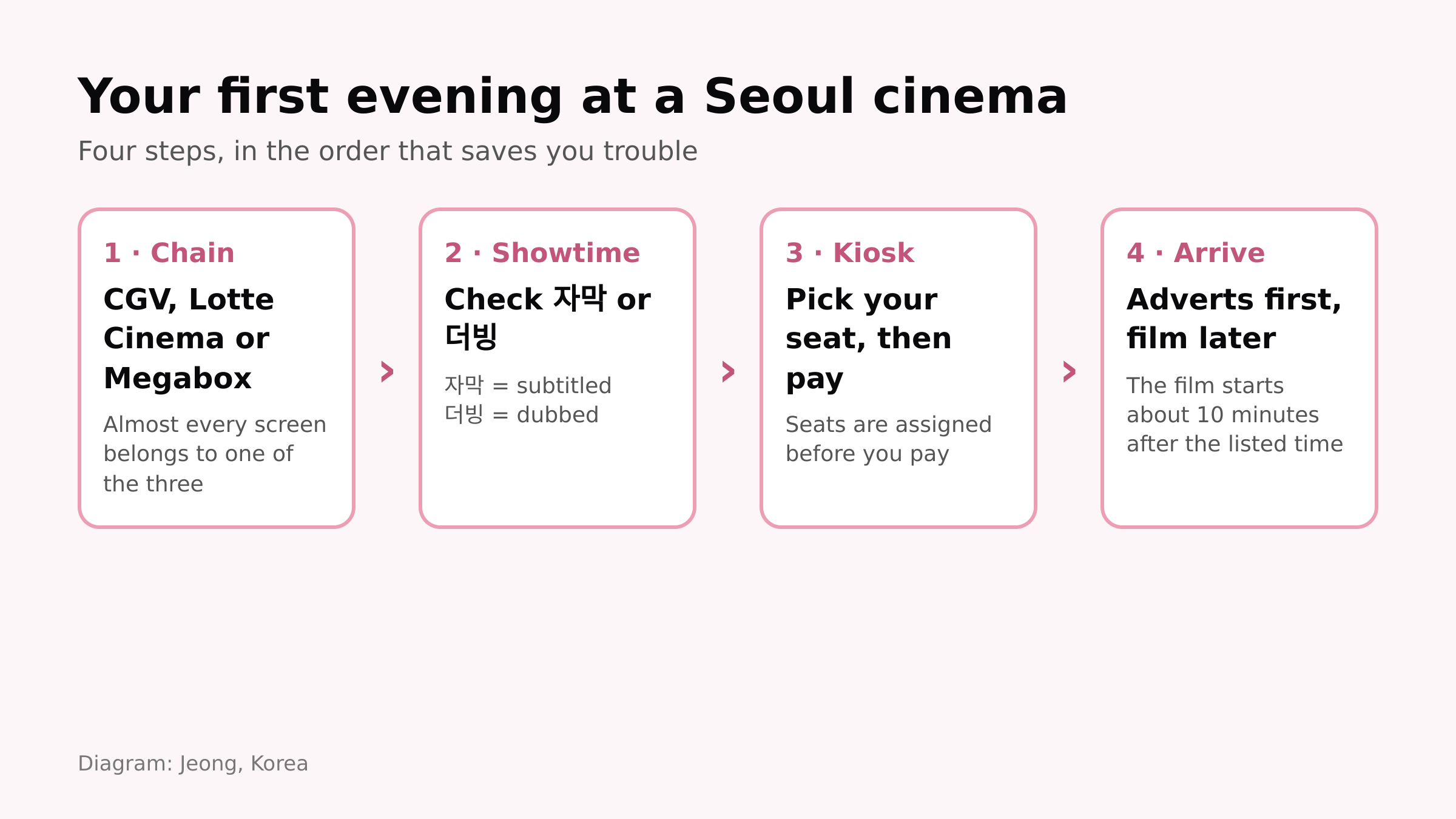
Foreign films play in their original language with Korean subtitles. An English-language film is therefore just an English-language film, and you can watch it the way you would at home. Dubbing is mostly for children's animation, which often runs in two versions side by side. Look for 자막 (subtitled) or 더빙 (dubbed) next to the showtime.
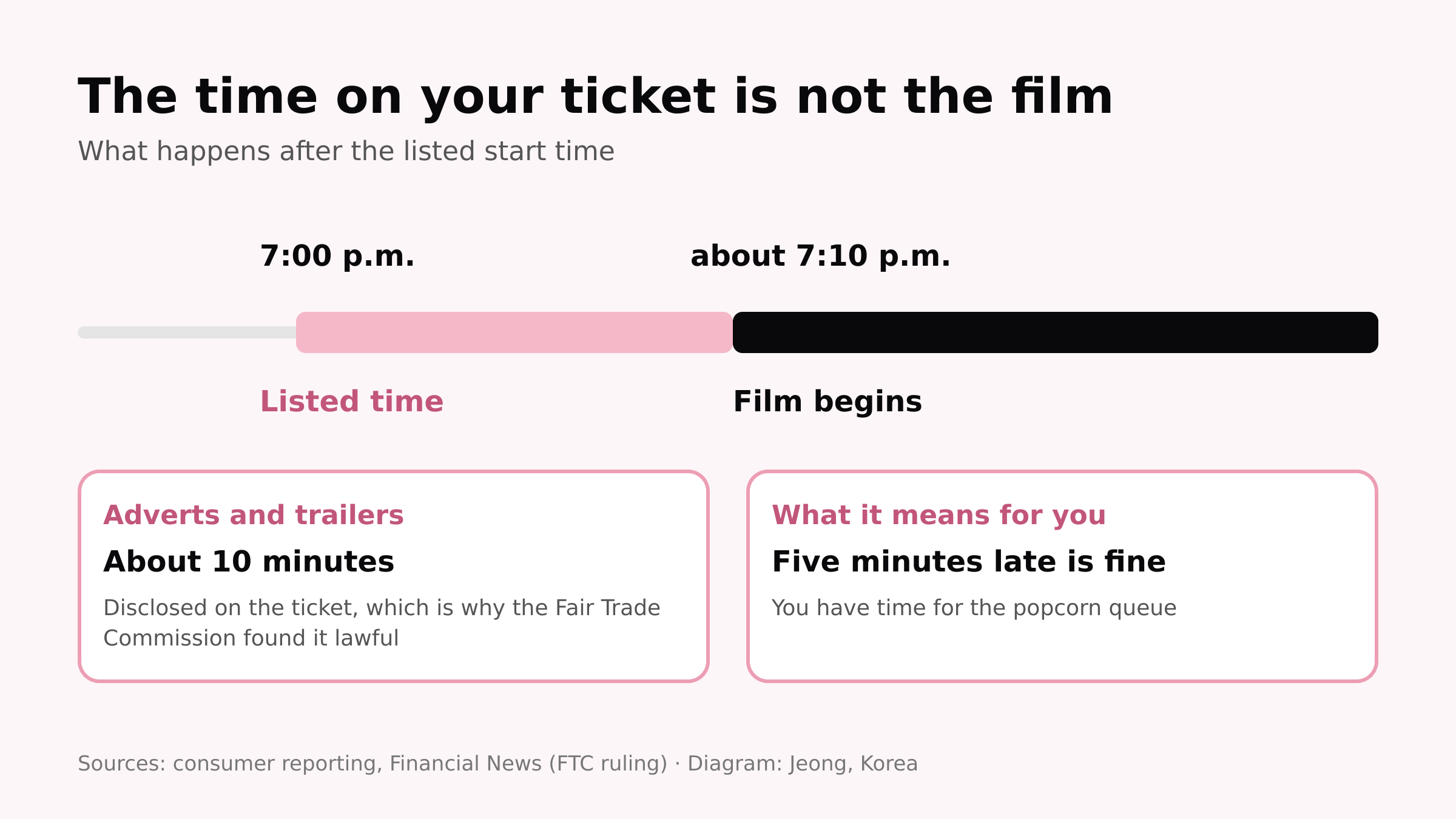
The part that catches people out is the start time. The time on your ticket is when the adverts begin, not the film. Consumer reporting has measured the gap at around ten minutes, and the Fair Trade Commission ruled the practice lawful because the delay is disclosed on the ticket.
So the practical rule is simple. If you are running five minutes late, you have not missed the opening scene. If you want the popcorn queue behind you before the lights go down, you have more time than the clock suggests.
Culture Day moved in 2026, and the price went up
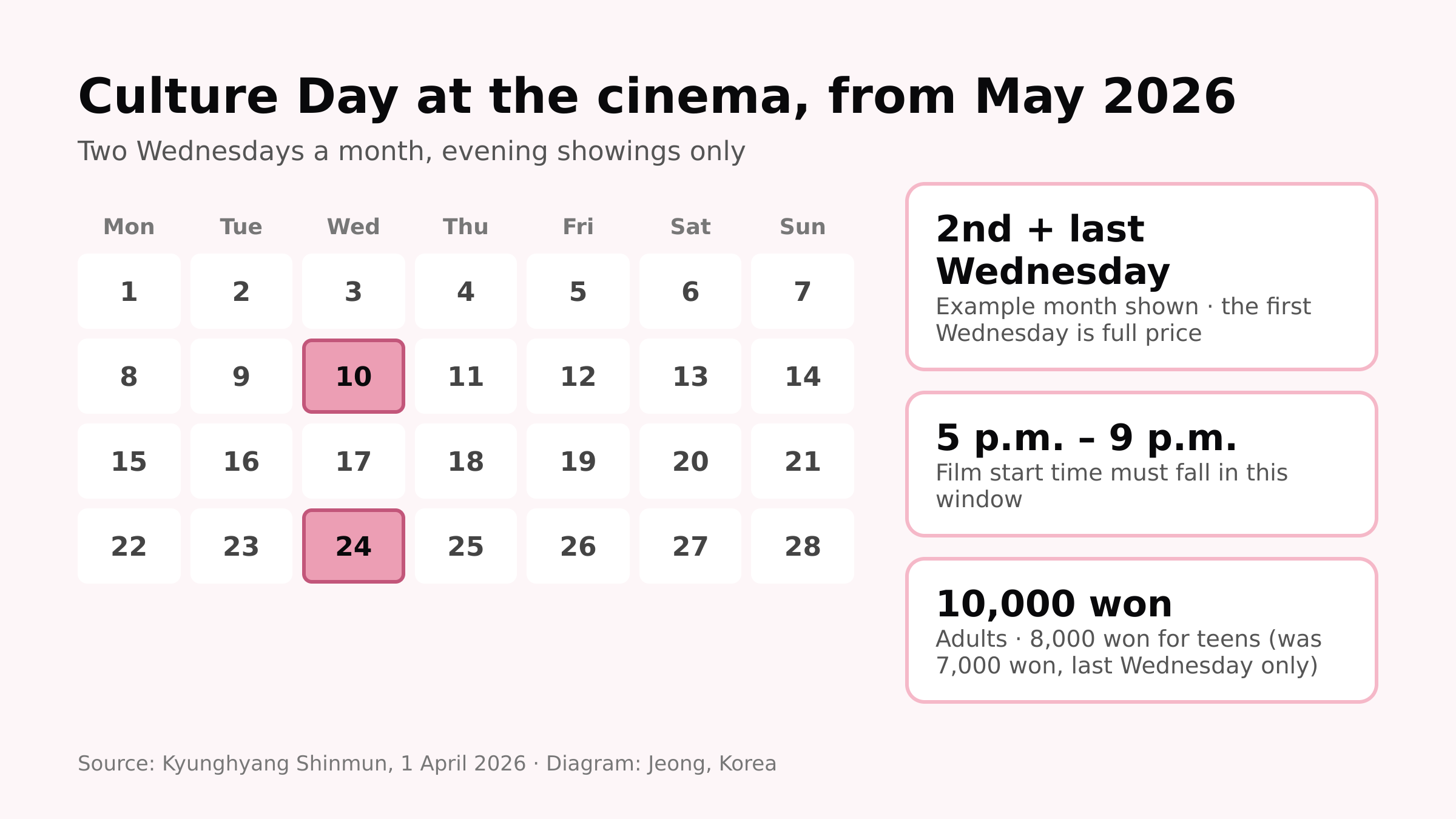
Culture Day (문화가 있는 날) used to mean one thing at the cinema: the last Wednesday of the month, 7,000 won. That arrangement ended. From May 2026, CGV, Lotte Cinema and Megabox agreed to run the discount on two Wednesdays a month instead of one, according to a Kyunghyang Shinmun report from 1 April 2026.
| Before May 2026 | From May 2026 | |
|---|---|---|
| Which Wednesdays | Last Wednesday only | Second and last Wednesday |
| Adult ticket | 7,000 won | 10,000 won |
| Teen ticket | — | 8,000 won |
| Showtimes covered | — | Films starting 5 p.m. to 9 p.m. |
The government now calls every Wednesday Culture Day, but the cinemas signed up for two. That is why you will see "every Wednesday" in some places and still pay full price on the first Wednesday of the month.
The time window matters as much as the date. A 4:40 p.m. showing on the right Wednesday is not covered. A 9:10 p.m. one is not either. Pick a start time inside the window and the discount applies at the counter or in the app.
The big screens are worth one evening
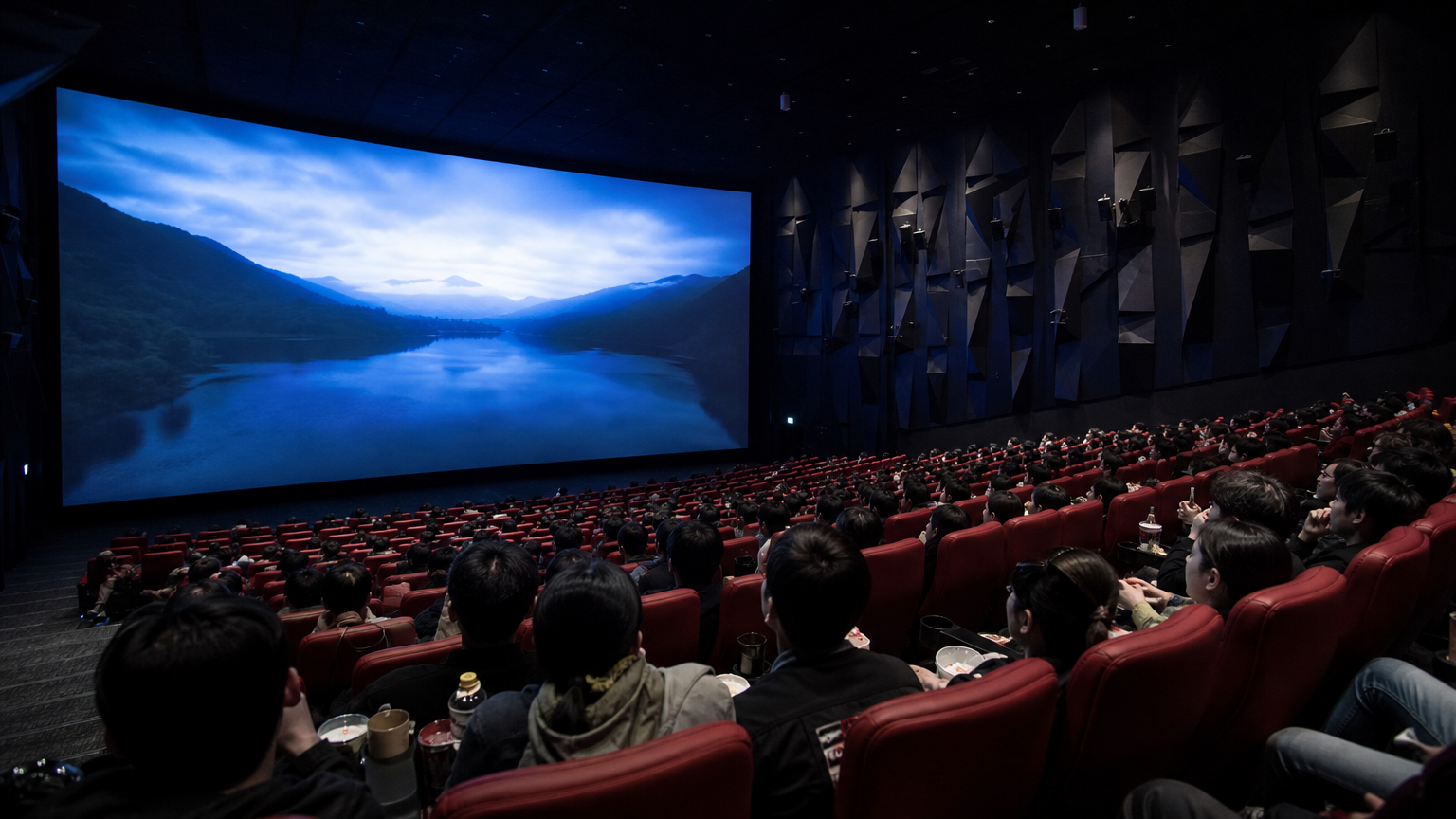
If you only go once, go to a special screen. Every chain has them, and the headline ones are genuinely different experiences, not just bigger versions of a normal hall.
| Screen | Where | The verified detail |
|---|---|---|
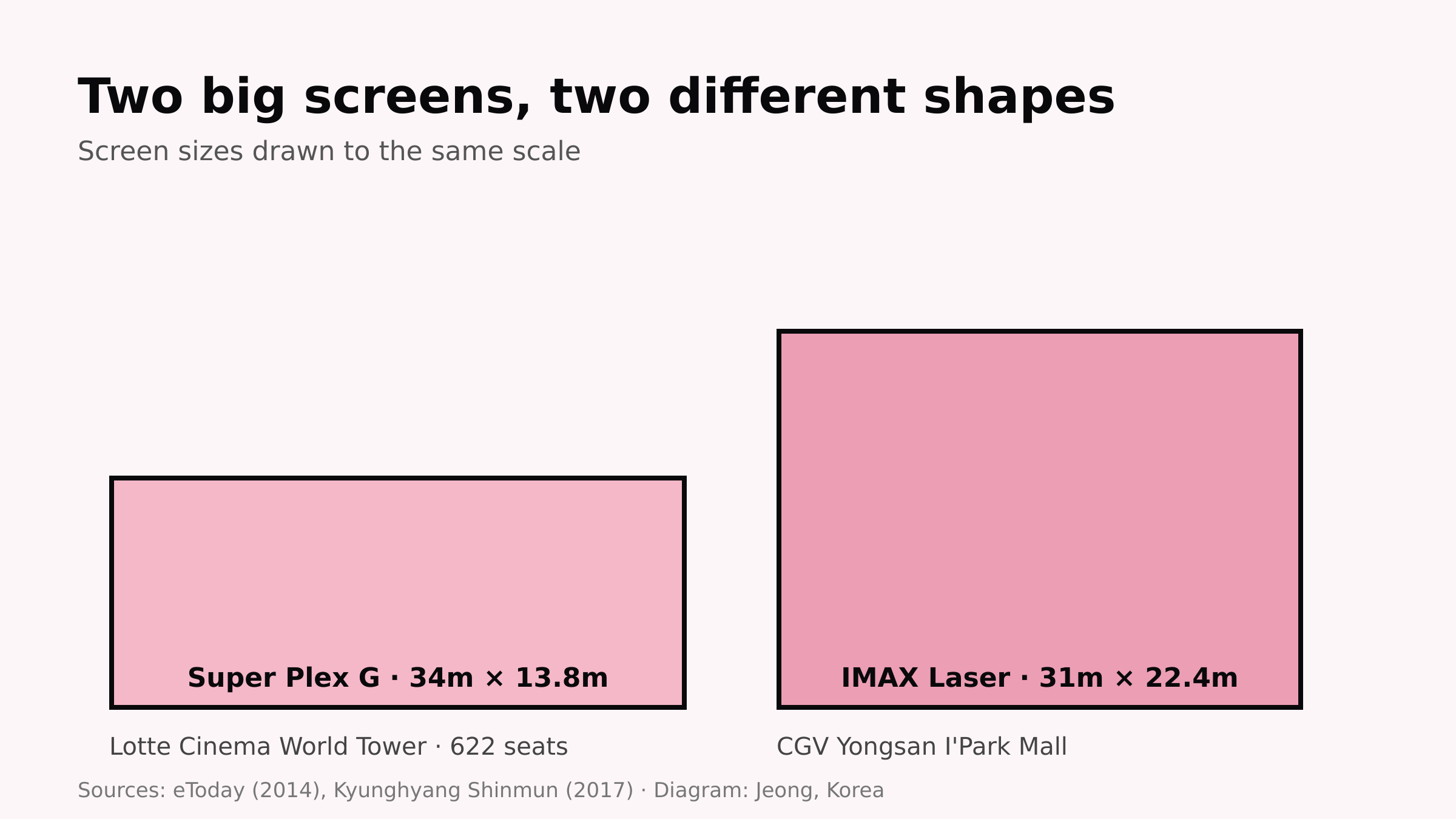
| IMAX Laser | CGV Yongsan I'Park Mall | 31m × 22.4m screen, billed as the world's largest IMAX screen when it opened in 2017 |
| Super Plex G | Lotte Cinema World Tower | 34m × 13.8m screen with 622 seats, entered Guinness World Records in 2014 |
| Dolby Cinema | Megabox COEX | Korea's first Dolby Cinema, opened in July 2020 |
| 4DX and ScreenX | Many CGV branches | Both formats were developed by CJ 4DPLEX, a CJ group company |
A note on Super Plex G: it held the Guinness record for the world's largest screen in 2014, but that title has since passed to another cinema. It is still enormous. It is just not the record holder any more.
4DX moves your seat and adds wind, water and scent. ScreenX extends the picture onto the side walls. Both suit action films and suit slow dramas badly, so choose the film first and the format second.
Buying the ticket in person is the dependable route
Here is where I have to be honest about a gap. I could not confirm, from any official source, whether the three chains' apps accept an overseas card or a foreign phone number for booking. Travel blogs contradict each other on this, and I would rather tell you I do not know than send you to a checkout screen that may refuse you.
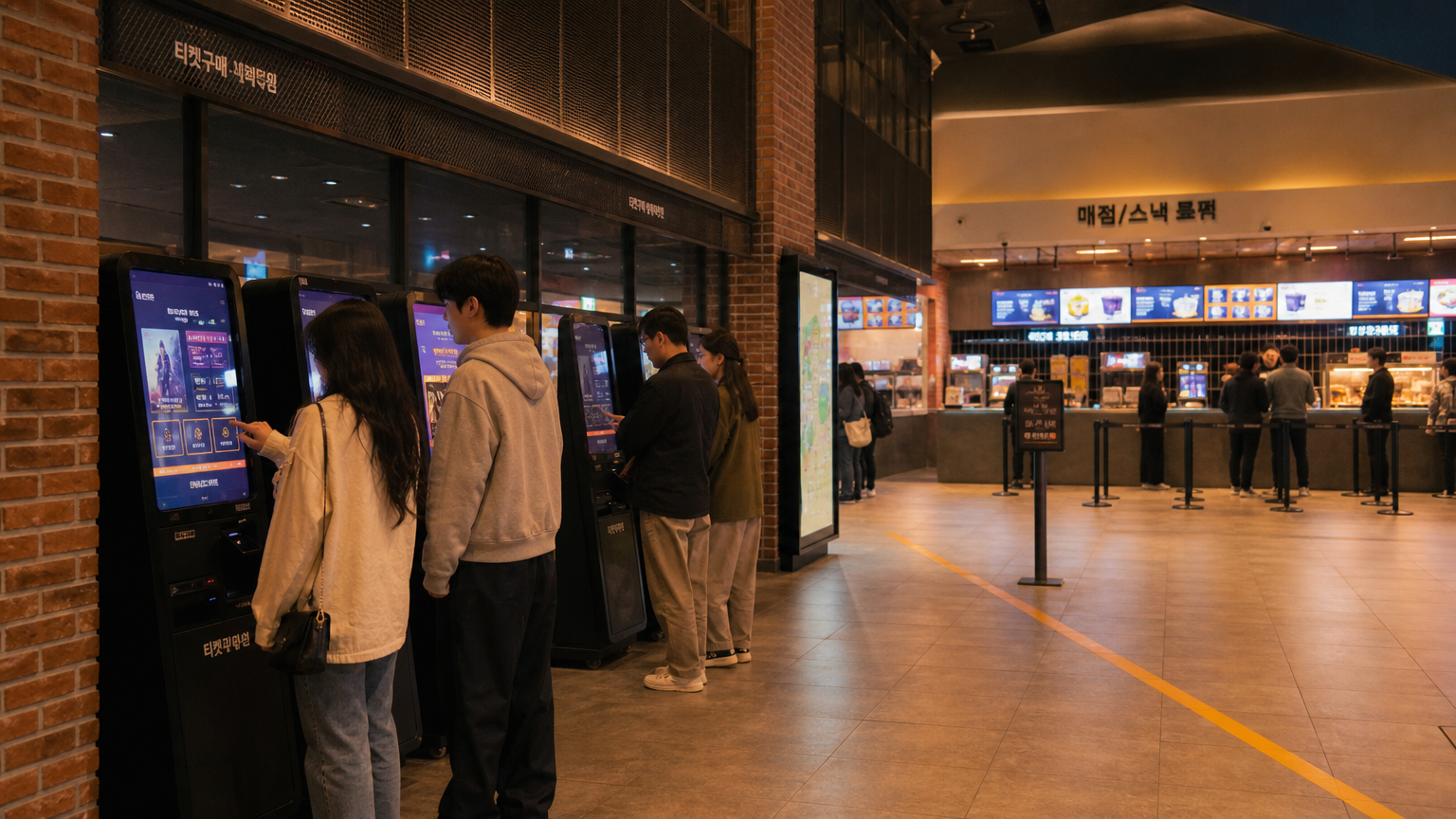
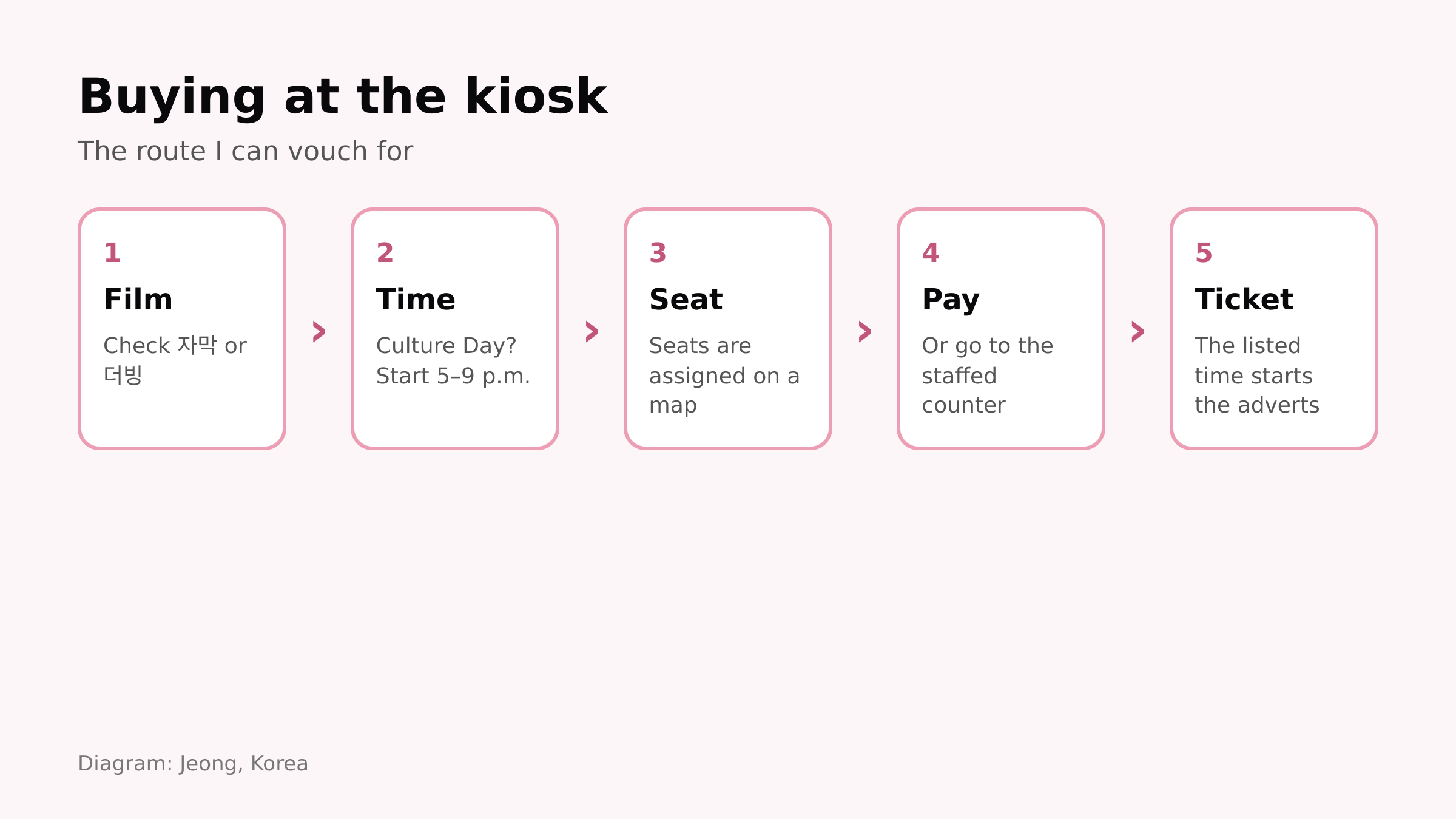
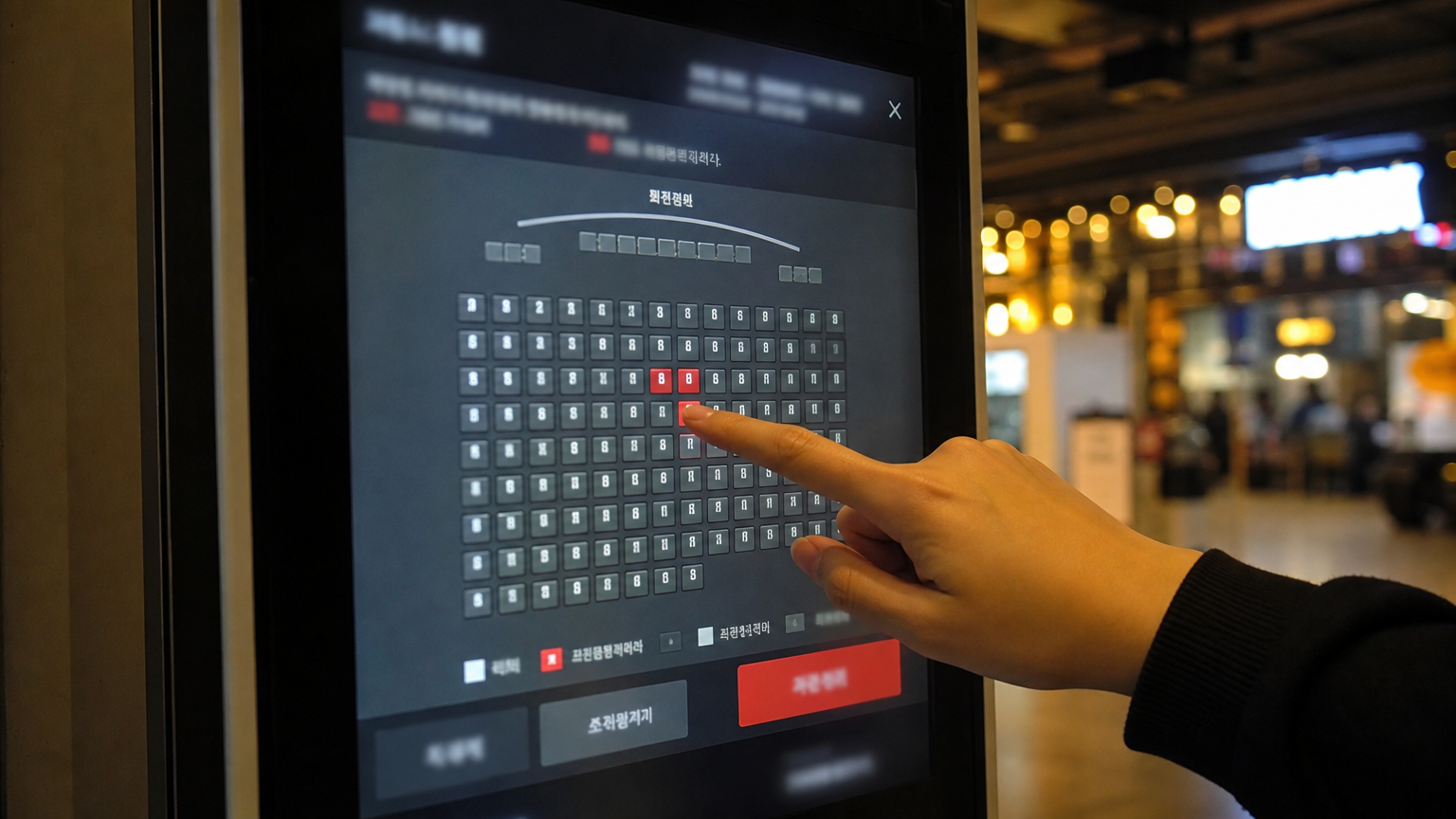
What does work is the lobby. Every cinema has self-service kiosks and a staffed counter. The kiosks show seat maps, and seats are assigned, so you choose yours on the screen before paying. If a showing is close to selling out, going early in the day matters more than which payment method you carry.
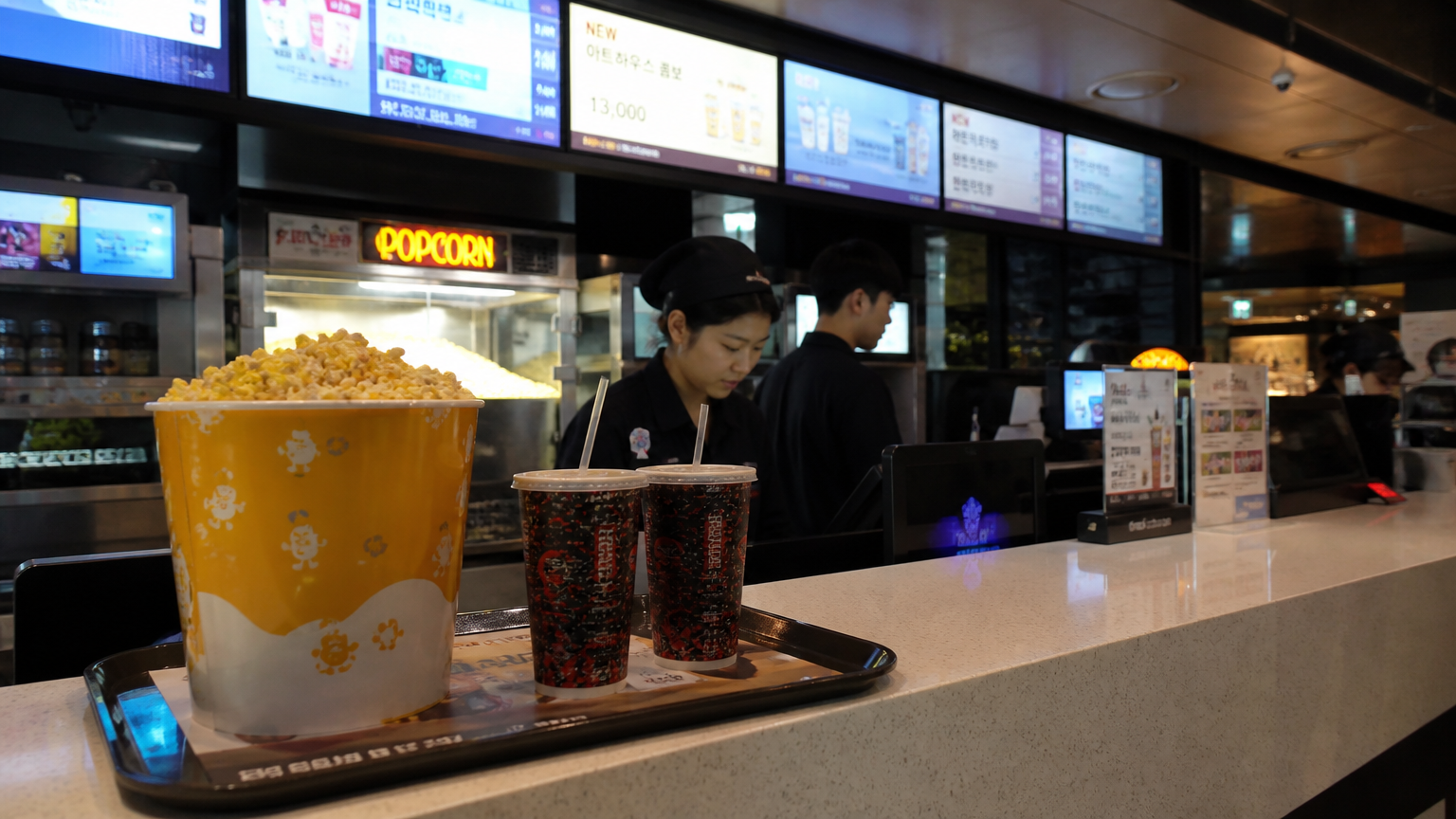
Food is part of the evening. Popcorn and drinks come from the counter in the lobby. Rules on bringing your own food have varied by chain; in the past Lotte Cinema asked people not to bring strong-smelling food such as burgers or gimbap. Check the sign at the entrance of the branch you are in.
Premium seating varies too. Lotte Cinema's Charlotte halls have leather recliners and their own lounge, and some halls have paired seats for couples. If you want the full evening with photos afterwards, the photo booths in most cinema buildings are their own small ritual, which I wrote about in the Korean photo booth, where nobody takes your photo.
FAQ
Are foreign films dubbed in Korean cinemas?
No, apart from most children's animation. English-language films play in English with Korean subtitles. Animated films often run in both a subtitled and a dubbed version, marked 자막 and 더빙.
Why does the film start after the time on my ticket?
The listed time is when the adverts and trailers begin. The gap is usually around ten minutes. The Fair Trade Commission found this lawful because the ticket discloses it.
When is Culture Day at the cinema in 2026?
From May 2026, the second and last Wednesday of each month, for films starting between 5 p.m. and 9 p.m. Adult tickets are 10,000 won and teen tickets are 8,000 won.
Can I book a movie theater Seoul ticket online with a foreign card?
I could not confirm it from an official source, and reports disagree. Buying at the lobby kiosk or counter is the route I can vouch for.
The short version
Three chains, subtitles as standard, ten minutes of adverts, and a discount that now falls on two Wednesdays at 10,000 won. If you have one free evening, spend it on a special screen and arrive a little early to pick your seat at the kiosk. That is the whole movie theater Seoul routine, and it is a good one.
Sources
-
Korean Film Council (KOFIC), 2025 year-end film industry report — http://magazine.kofic.or.kr/webzine/web2/2777/pdsView.do
-
TheBell, cinema counts and merger discussion (January 2026) — http://m.thebell.co.kr/m/newsview.asp?svccode=00&newskey=202601280827412300107393
-
Kyunghyang Shinmun, Culture Day change (1 April 2026) — https://www.khan.co.kr/article/202604011543001
-
Fair Trade Commission ruling on pre-film adverts, reported by Financial News — https://www.fnnews.com/news/201809081740153116
-
Kyunghyang Shinmun, CGV Yongsan IMAX (2017) — https://www.khan.co.kr/article/201707181444001
-
eToday, Lotte Cinema World Tower Super Plex G (2014) — https://www.etoday.co.kr/news/view/943391
-
Newsis, Megabox COEX Dolby Cinema (2020) — https://www.newsis.com/view/NISX20200722\_0001103766
-
CJ Newsroom, 4DX and ScreenX — https://cjnews.cj.net/4dx%EC%99%80-screenx%EA%B0%80-%EA%B2%B0%ED%95%A9%ED%95%9C-%EA%B6%81%EA%B7%B9%EC%9D%98-%EA%B2%BD%ED%97%98-ultra-4dx%EB%A5%BC-%EC%95%8C%EC%95%84%EB%B3%B4%EB%8B%A4/
-
Consumer News, outside food rules at cinemas (2018) — https://www.consumernews.co.kr/news/articleView.html?idxno=523259
-
Lotte Cinema, special halls — https://www.lottecinema.co.kr/NLCHS/Cinema/SpecialCinema?divisionCode=2&screendivcd=960
More from this series
2026-09-24
Pojangmacha in Seoul: Fewer Than Half Have a Permit, and Jongno 3-ga Is the Street the City Kept
2026-09-23
Bungeoppang: The Carts Appear When It Gets Cold, and Most of Them Do Not Take Cards
2026-09-23
The Korean Photo Booth: Nobody Takes Your Photo, and That Is the Point
2026-09-23
Makgeolli and the Rainy Day: Why Koreans Order Pancakes When the Weather Turns
2026-09-21
Daejeon, Korea: An Hour From Seoul by KTX, and Two Stations Carry the City's Name
2026-09-21
Yuseong Hot Spring: The Foot Bath Is Free and Open Until 10 p.m., and You Cannot Drink the Water
2026-09-19
Seoul Bus: The Colour Tells You Where It Goes, and Some of Them No Longer Take Cash
2026-09-18
Hangul Day: The Alphabet's Birthday Lost Its Day Off for 22 Years, and Its Museum Is Shut Until 2028
2026-09-15
Namdaemun Market Opening Hours: The Market's Own List Has 38 Timetables, and Some Floors Open at 11 p.m.
2026-09-15
Hair Salon in Seoul: The Final Price Must Be on the Wall, and Only a Barber May Shave You
2026-08-28
DMZ Tour: You Can Still Go. The JSA Is the Part You Cannot.
2026-08-28
Gyeongju Food: The Famous One Is a Souvenir, and the Meal Is Next to the Tombs
2026-08-28
Bulguksa Temple: There Is No Direct Bus to Seokguram, and You See the Buddha Through Glass
2026-08-27
Gyeongju From Seoul: Two Hours by KTX, and Then the Part Nobody Plans For
2026-08-27
Gyeongju: Three Separate UNESCO Listings, and Why One Day Does Not Cover Them
2026-08-27
K-ETA Korea: You Are Probably Exempt, and the Arrival Card Is What Catches People
2026-08-18
Autumn in Korea: Don't Pick the Dates, Pick the Latitude
2026-08-18
Hospital in Seoul: Why Koreans Don't Start at the Big One
2026-08-18
Korean Drinking Culture: The Rules Are Real, and So Is the Way Out
2026-07-31
Famous Korean Street Foods You Must Try (Yes, Including the Viral Buldak Omelette)
2026-07-31
What Is Silbi Kimchi? Korea's Spiciest Kimchi — and the Local Hack You Need to Know