Seoul Bus: The Colour Tells You Where It Goes, and Some of Them No Longer Take Cash

In Seoul, you can tell roughly where a bus is going before you read its number. The colour has already told you.
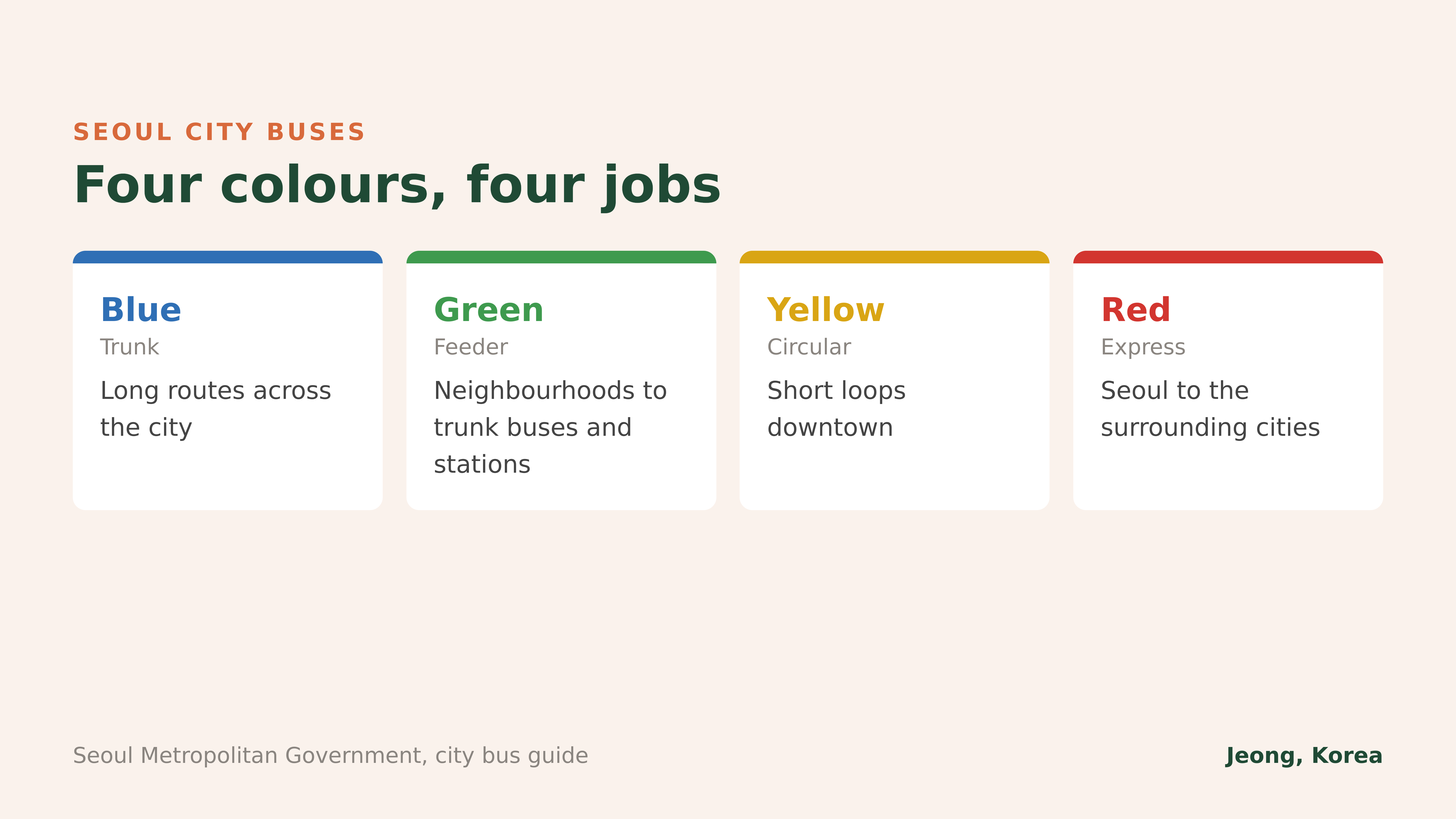
A Seoul bus comes in four colours: blue for long trunk routes, green for short feeder routes, yellow for downtown loops and red for express runs out to the suburbs. The colour also sets the fare. This guide covers what each colour means, how to read the number, what you pay, and the two habits that save you money, which are tapping out and carrying a card.
Say you are at a stop near Seoul Station and three buses pull in one after another: a blue one with three digits, a green one with four, and a red one. All three show the same stop name on their route maps. They are not the same kind of ride, and one of them costs twice as much as the others.
It is easy to treat the colours as decoration. They are the system. Seoul sorted its city buses by colour and role in the 2004 reform, and the same logic still decides the fare you pay and how far the bus goes. We will go through the colours first, then the numbers, then paying and transferring.
Four colours, four jobs
The city's own guide describes the buses by what they connect, and the colour follows the job.
| Colour | Type | What it does |
|---|---|---|
| Blue | Trunk (Ganseon) | Long routes linking outer areas, downtown and sub-centres |
| Green | Feeder (Jiseon) | Shorter routes linking neighbourhoods to trunk buses and subway stations |
| Yellow | Circular (Sunhwan) | Loops around downtown and sub-centres |
| Red | Express (Gwangyeok) | Links Seoul with the surrounding metropolitan cities |
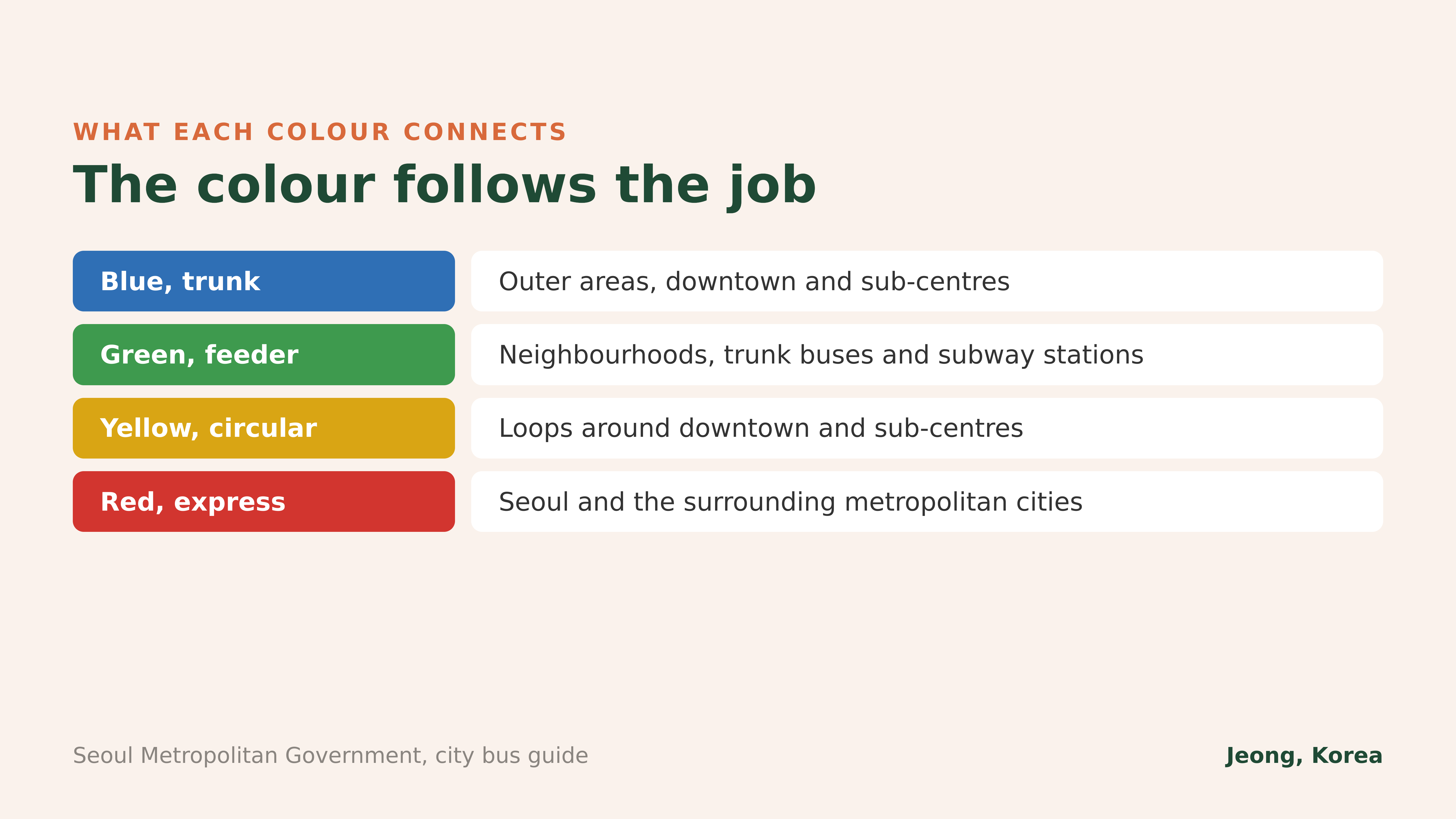
Blue is the one you will use to cross the city. Green is the one that gets you from a subway exit to a hotel on a hill. Yellow only runs short loops in central areas. Red is the one to be careful with, because it links Seoul with the surrounding cities, so check that it actually stops where you need before you tap in.
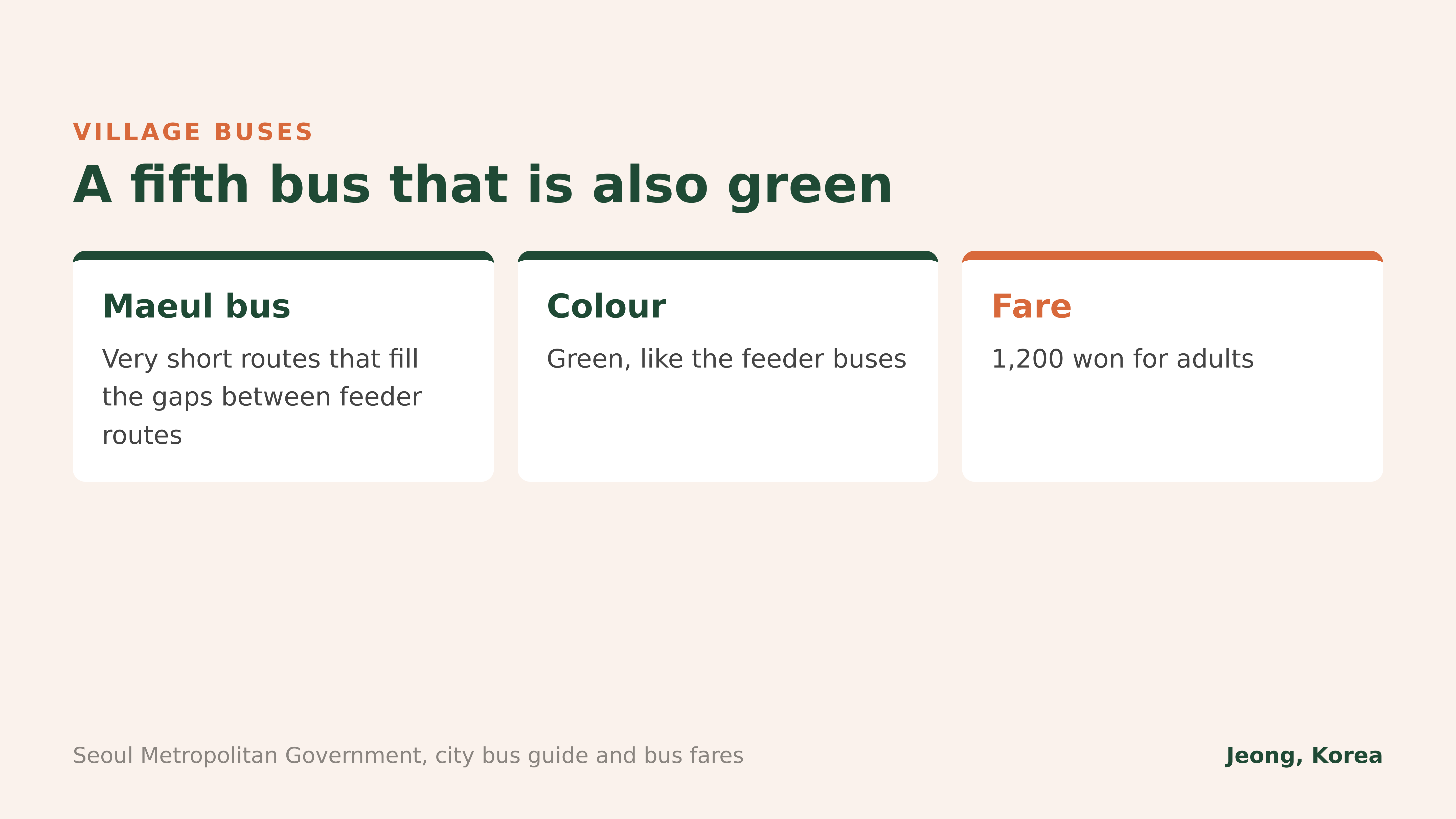
Village buses, called maeul buses, are green too. They run very short routes that fill the gaps between feeder routes, and they have their own fare.
The colour tells you the kind of bus. The number tells you more.
The number is a map in digits
Seoul's city buses carry two to four digit numbers designed to show where they start and where they end. For blue and green buses, the first digit is the zone the bus starts from and the second digit is the zone it heads to. The rest is the route's own serial number.
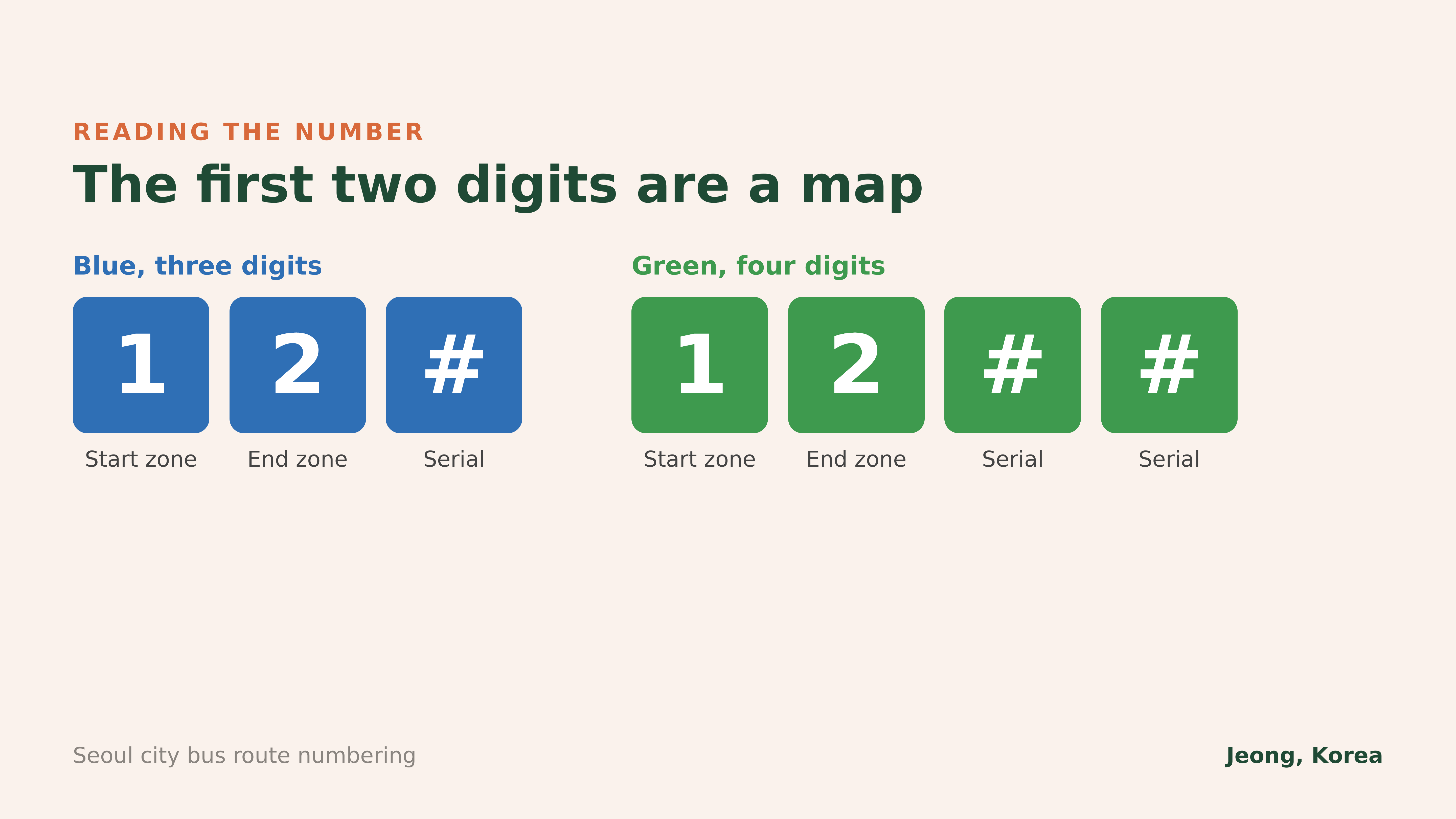
That is why two blue buses with the same first digit start in the same part of the city. You do not need to memorise the zones. It is enough to know that the number is not random, and that a map app will tell you which one to take.
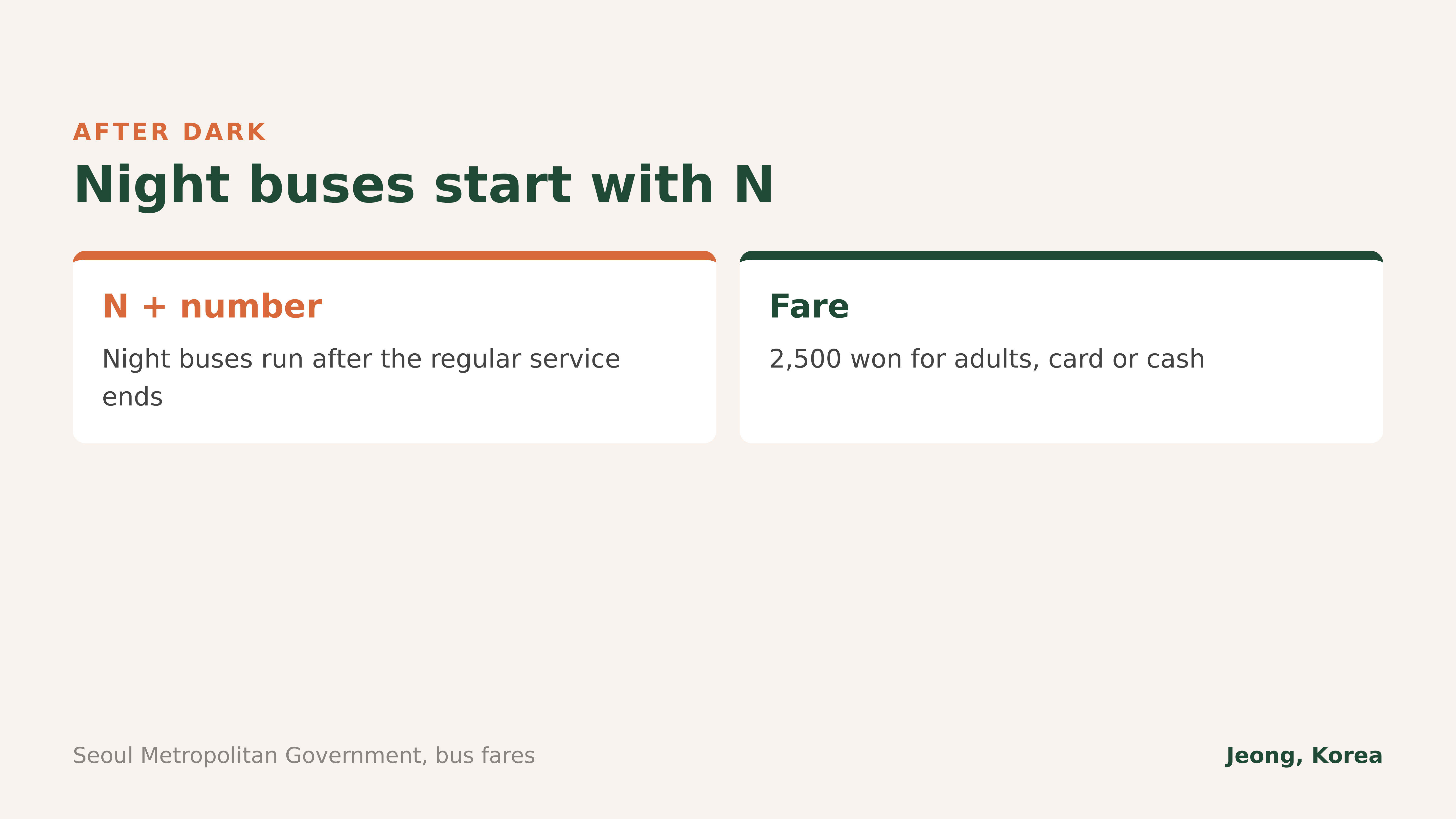
Late at night, look for buses whose number starts with N. These are night buses that run after the regular service ends, and they have their own fare.
Once you know which bus to take, the next question is what it costs.
What a Seoul bus costs
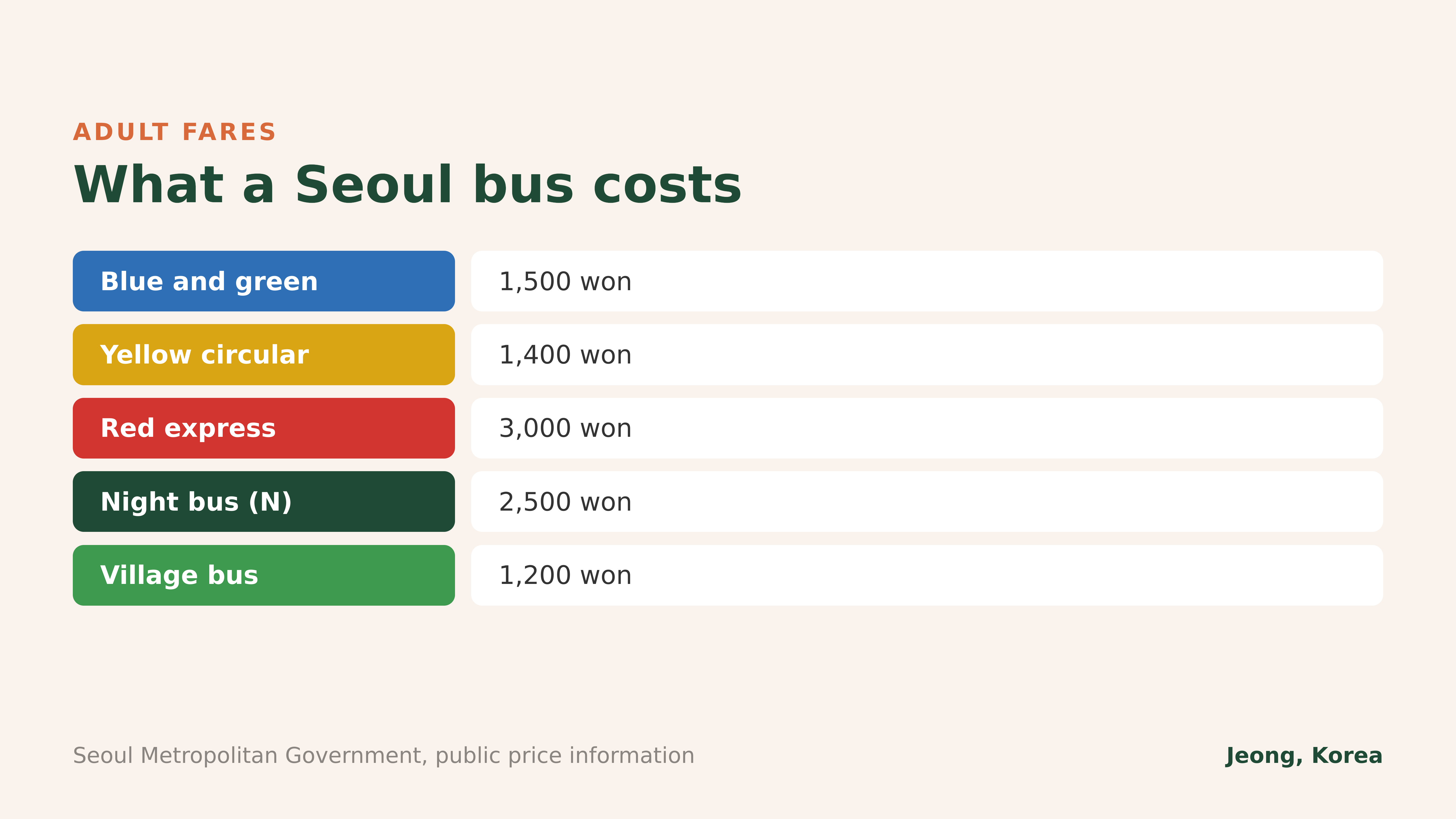
Fares are set by bus type, and the city's price page lists the same adult fare for card and cash.
| Bus | Adult fare |
|---|---|
| Blue and green | 1,500 won |
| Yellow circular | 1,400 won |
| Red express | 3,000 won |
| Night bus (N) | 2,500 won |
| Village bus | 1,200 won |
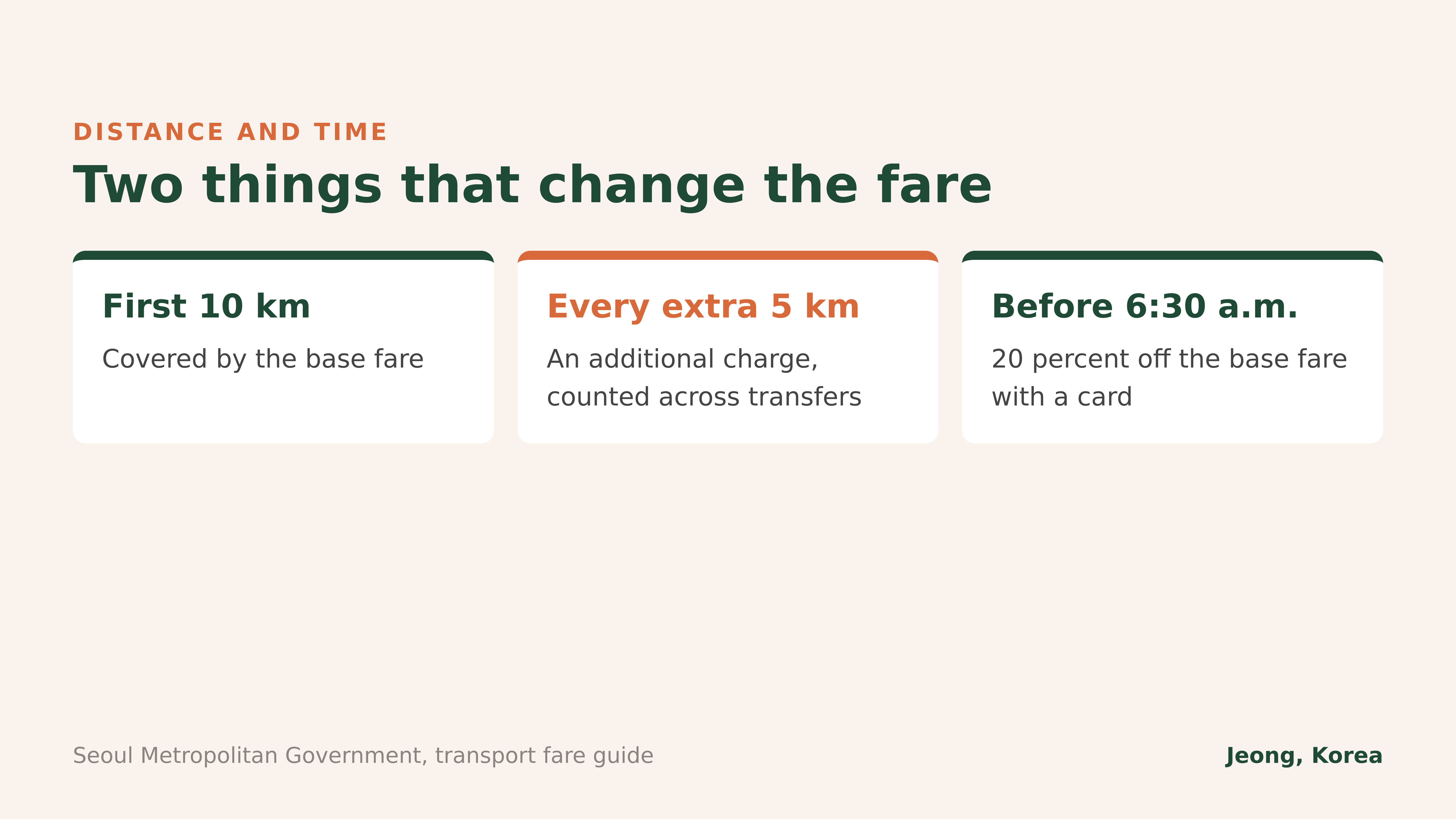
The base fare covers the first 10 km of a trip. After that, an extra charge is added for every additional 5 km, and that distance counts across the whole journey, including transfers. If you board with a card before 6:30 in the morning, the base fare is discounted by 20 percent.
A transit card is what makes all of this work. If you have not picked one up yet, T-Money Card in Korea: What It Is, Where to Buy It, How to Use It covers where to buy and top up.
So what happens when you get off?
Tap in, tap out, and carry a card
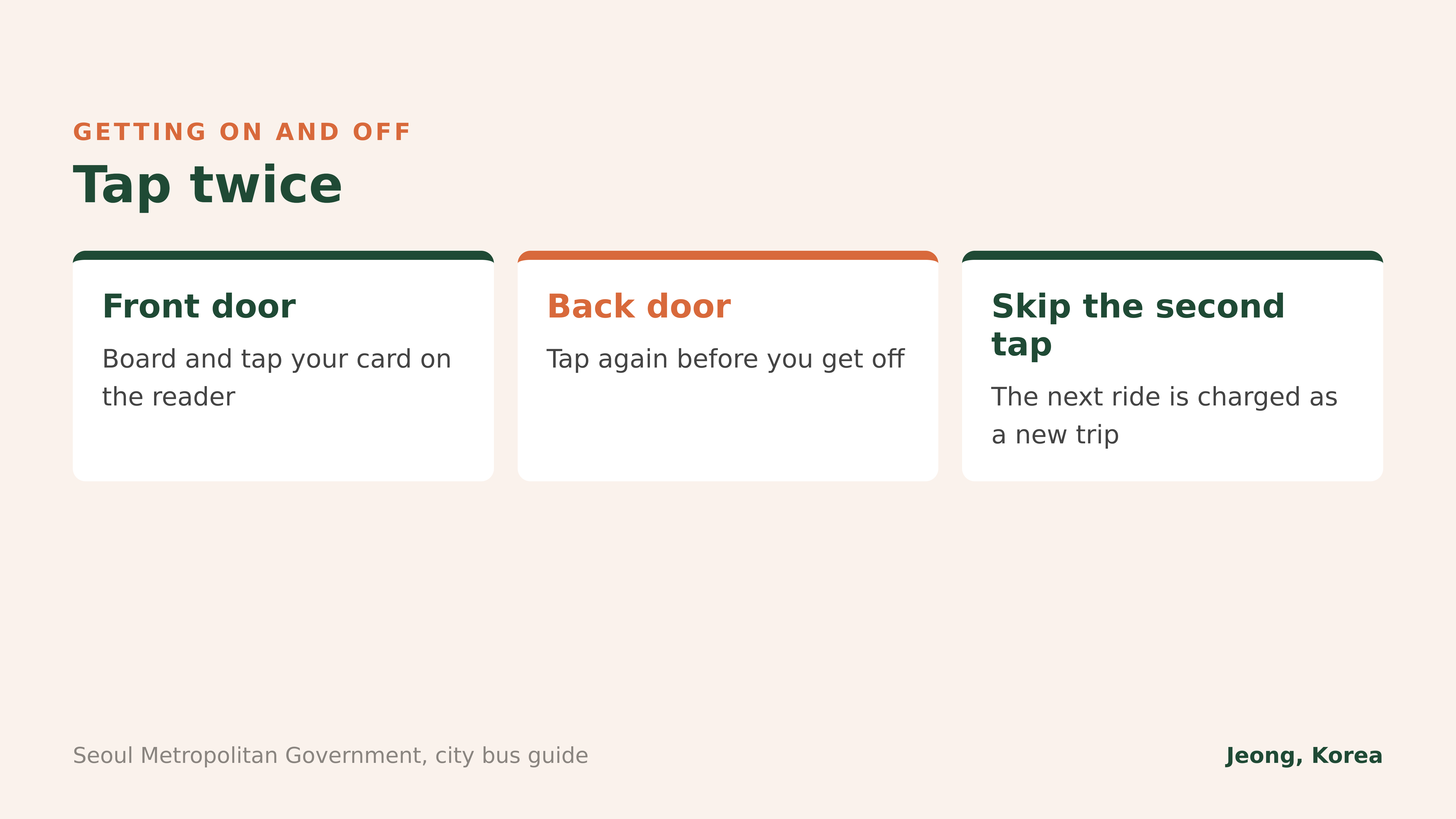
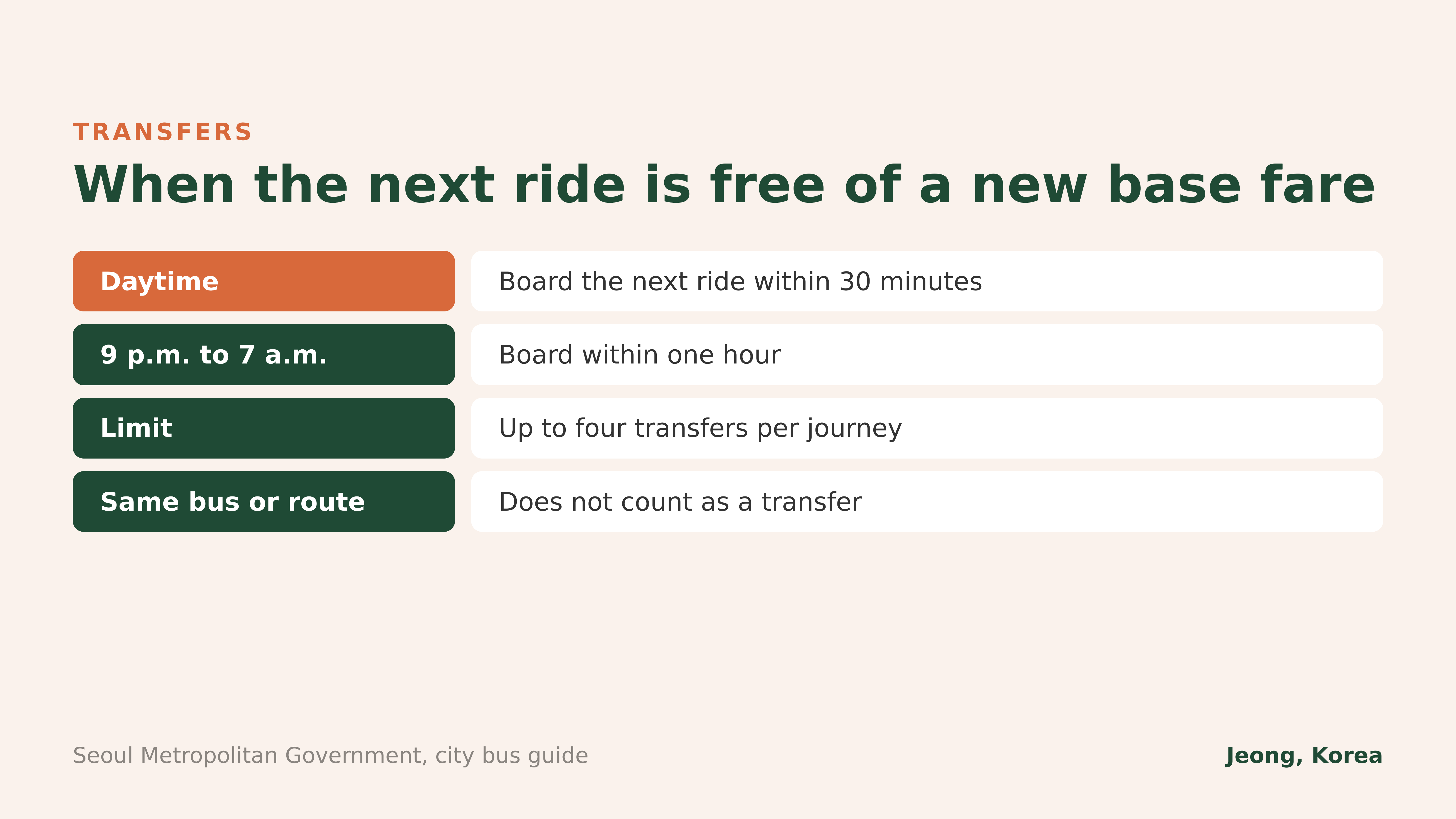
You board at the front door and tap your card on the reader, and you get off at the back door and tap again. The second tap is the easy one to forget. The city's guide makes it clear that you have to tap the reader when you get off, or the next ride does not count as a transfer.
A transfer works if you board the next bus or train within 30 minutes of getting off, or within one hour between 9 p.m. and 7 a.m. You can transfer up to four times on one journey. Getting back on the same bus, or the same route, does not count. The rule is shared with the subway, which is explained in more detail in Seoul Subway Map: How to Actually Read It (and the Transfer Rules Nobody Explains).
The second habit is carrying a card at all. Seoul has been expanding cashless buses, which do not accept cash on board. The city has widened them to 108 routes and 1,876 buses, about a quarter of its fleet, and it publishes the route list on its website. On those buses, a rider without a card is given a payment notice to settle by bank transfer later, which is not a realistic option for most visitors. The design of the buses may change too, since the city has been working on a new look for the first time in about twenty years, so go by the colour you see on the day.
FAQ
Can I pay cash on a Seoul bus?
On many buses, yes, and the adult cash fare is the same as the card fare. But Seoul now runs cashless buses on more than a hundred routes, where cash is not taken. Carrying a transit card avoids the problem entirely.
Do I need to tap my card when I get off?
Yes, if you want your next ride to count as a transfer. Without the tap when you get off, the next bus or train is charged as a new trip.
Which bus goes to the airport?
The four colours in this guide are city buses. Airport buses are a separate service with their own fares and stops, so check the airport's official bus page for the route to your area.
What is the difference between a blue bus and a green bus?
Blue buses run long trunk routes across the city. Green buses run shorter routes that connect neighbourhoods with trunk buses and subway stations.
The short version
Colour tells you the job, the number tells you the start and end zones, and the fare follows the colour: 1,500 won for blue and green, 3,000 won for red.
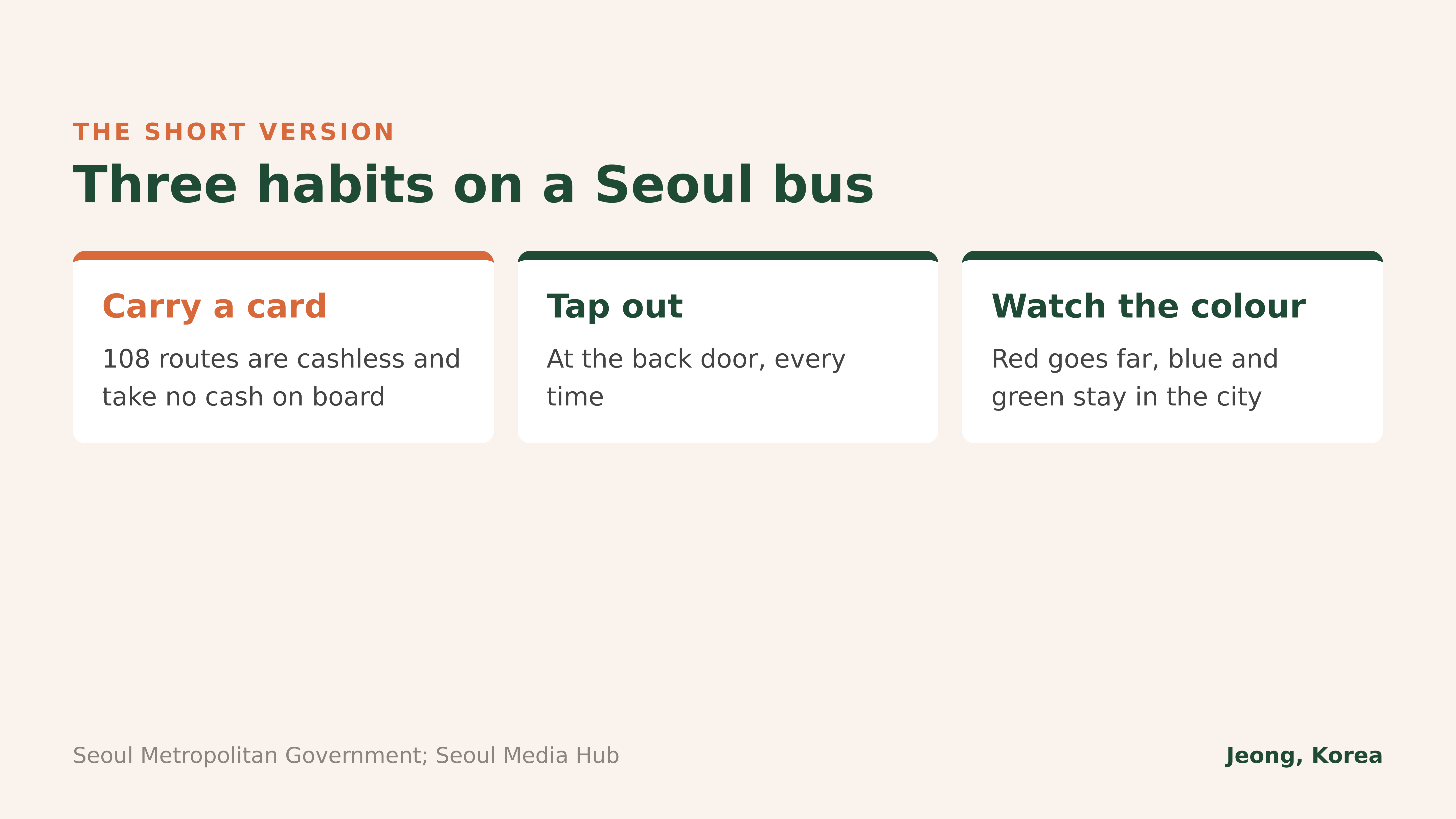
Carry a card, tap it again at the back door, and board your next bus within 30 minutes. If a red bus pulls in when you only need three stops, let it go and wait for the blue or green one.
References
-
Seoul Metropolitan Government, Seoul city bus system and how to use it (bus types, route numbers, transfer rules).
-
Seoul Metropolitan Government, public price information for buses (fares by bus type).
-
Seoul Metropolitan Government, transport fare guide (early morning discount and distance-based fares).
-
Seoul Metropolitan Government, cashless bus route list (January 2026) and Seoul Media Hub report on the cashless bus expansion.
-
Herald Business, 24 January 2025, report on the planned redesign of Seoul bus colours.
More from this series
2026-09-18
Hangul Day: The Alphabet's Birthday Lost Its Day Off for 22 Years, and Its Museum Is Shut Until 2028
2026-09-15
Namdaemun Market Opening Hours: The Market's Own List Has 38 Timetables, and Some Floors Open at 11 p.m.
2026-09-15
Hair Salon in Seoul: The Final Price Must Be on the Wall, and Only a Barber May Shave You
2026-08-28
DMZ Tour: You Can Still Go. The JSA Is the Part You Cannot.
2026-08-28
Gyeongju Food: The Famous One Is a Souvenir, and the Meal Is Next to the Tombs
2026-08-28
Bulguksa Temple: There Is No Direct Bus to Seokguram, and You See the Buddha Through Glass
2026-08-27
Gyeongju From Seoul: Two Hours by KTX, and Then the Part Nobody Plans For
2026-08-27
Gyeongju: Three Separate UNESCO Listings, and Why One Day Does Not Cover Them
2026-08-27
K-ETA Korea: You Are Probably Exempt, and the Arrival Card Is What Catches People
2026-08-18
Autumn in Korea: Don't Pick the Dates, Pick the Latitude
2026-08-18
Hospital in Seoul: Why Koreans Don't Start at the Big One
2026-08-18
Korean Drinking Culture: The Rules Are Real, and So Is the Way Out
2026-07-31
Famous Korean Street Foods You Must Try (Yes, Including the Viral Buldak Omelette)
2026-07-31
What Is Silbi Kimchi? Korea's Spiciest Kimchi — and the Local Hack You Need to Know