Hospital in Seoul: Why Koreans Don't Start at the Big One


Four completely different kinds of building are called a hospital in Seoul, and Korean law treats them as four separate categories. Walking into the wrong one is the most expensive mistake a foreigner makes when they get sick here.
The instinct is to go big. Something is wrong, so find the famous name with the good doctors. Koreans do the opposite, and not out of modesty — starting at the top costs more, takes longer, and usually ends with being sent back out to do the step you skipped.
Here is how the four levels work, and which door to use.
The four levels of hospital in Korea, and what the sign outside tells you
Korea's Medical Service Act sorts medical institutions into categories by what they are built to do — not by how good they are.
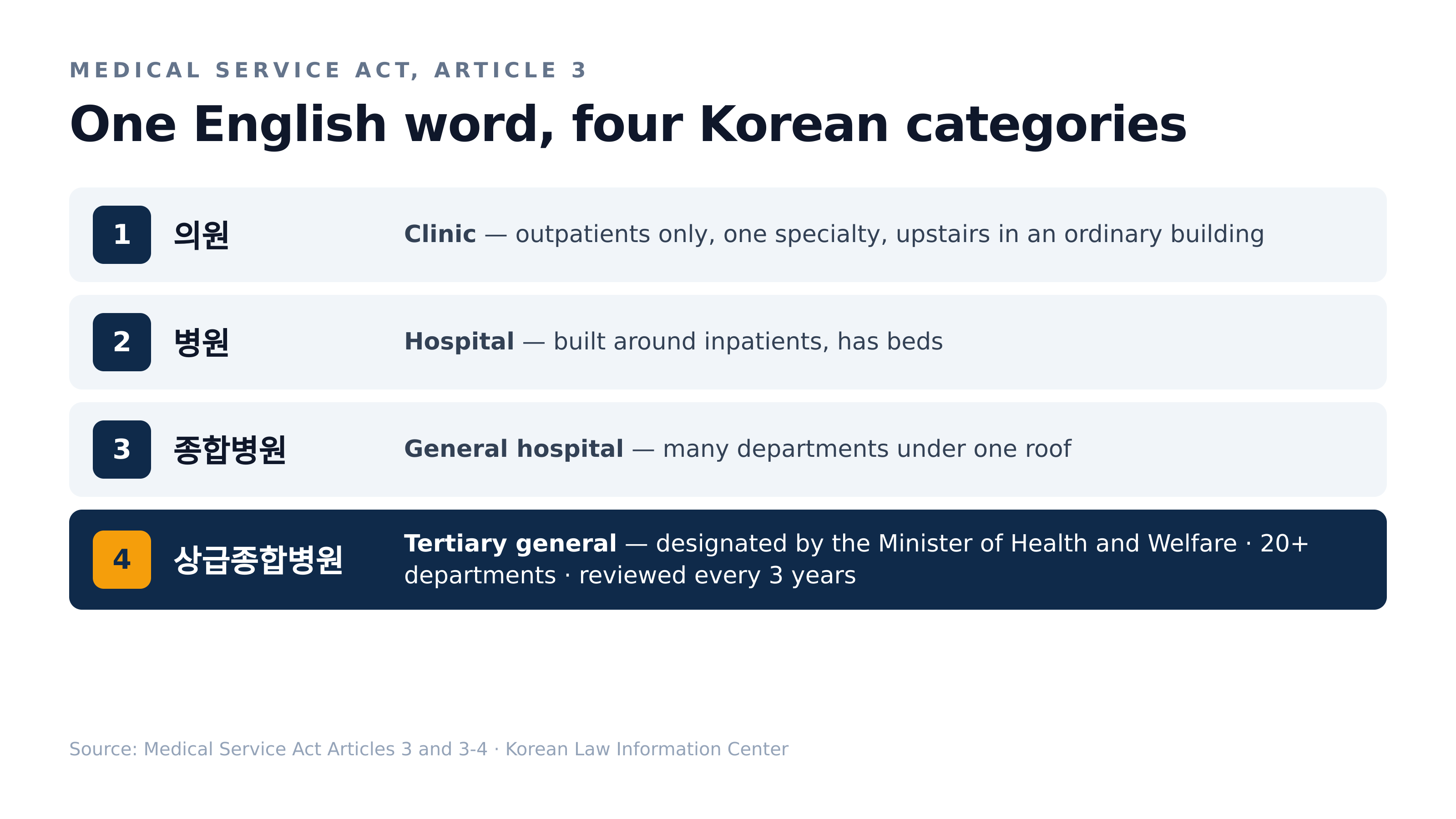
Clinic-level (의원, uiwon) — a doctor seeing outpatients. One or two doctors, one specialty, usually on the second or third floor of an ordinary building. This is where a Korean goes with a fever, a rash, a sprain, or a stomach problem.
Hospital-level (병원, byeongwon) — built around inpatients, with beds. Includes general hospitals (종합병원), dental hospitals, and oriental medicine hospitals.
General hospital (종합병원) — a hospital with multiple departments under one roof. This is where you go when the clinic says you need imaging or a specialist they do not have.
Tertiary general hospital (상급종합병원) — the "big one." Under Article 3-4 of the Medical Service Act, the Minister of Health and Welfare designates these from among general hospitals for high-difficulty treatment of serious disease. To qualify, an institution must run at least 20 departments, each with its own full-time specialist, and must be a training institution for residents. The designation is reviewed every three years.
That last category is the one everyone searches for by name. It is also the one the system is actively trying to keep you out of unless you belong there.
The number that changes: what each level costs
Here is where the instinct gets expensive. Under national health insurance, what you pay out of pocket at a hospital in Korea rises with the level of the institution — for the same visit, the same complaint, the same prescription.
| Level | Your share (city districts) | Your share (towns/rural) |
|---|---|---|
| Clinic (의원) | 30% | 30% |
| Hospital (병원) | 40% | 35% |
| General hospital (종합병원) | 50% | 45% |
| Tertiary general (상급종합) | 60% plus 100% of the consultation fee | — |
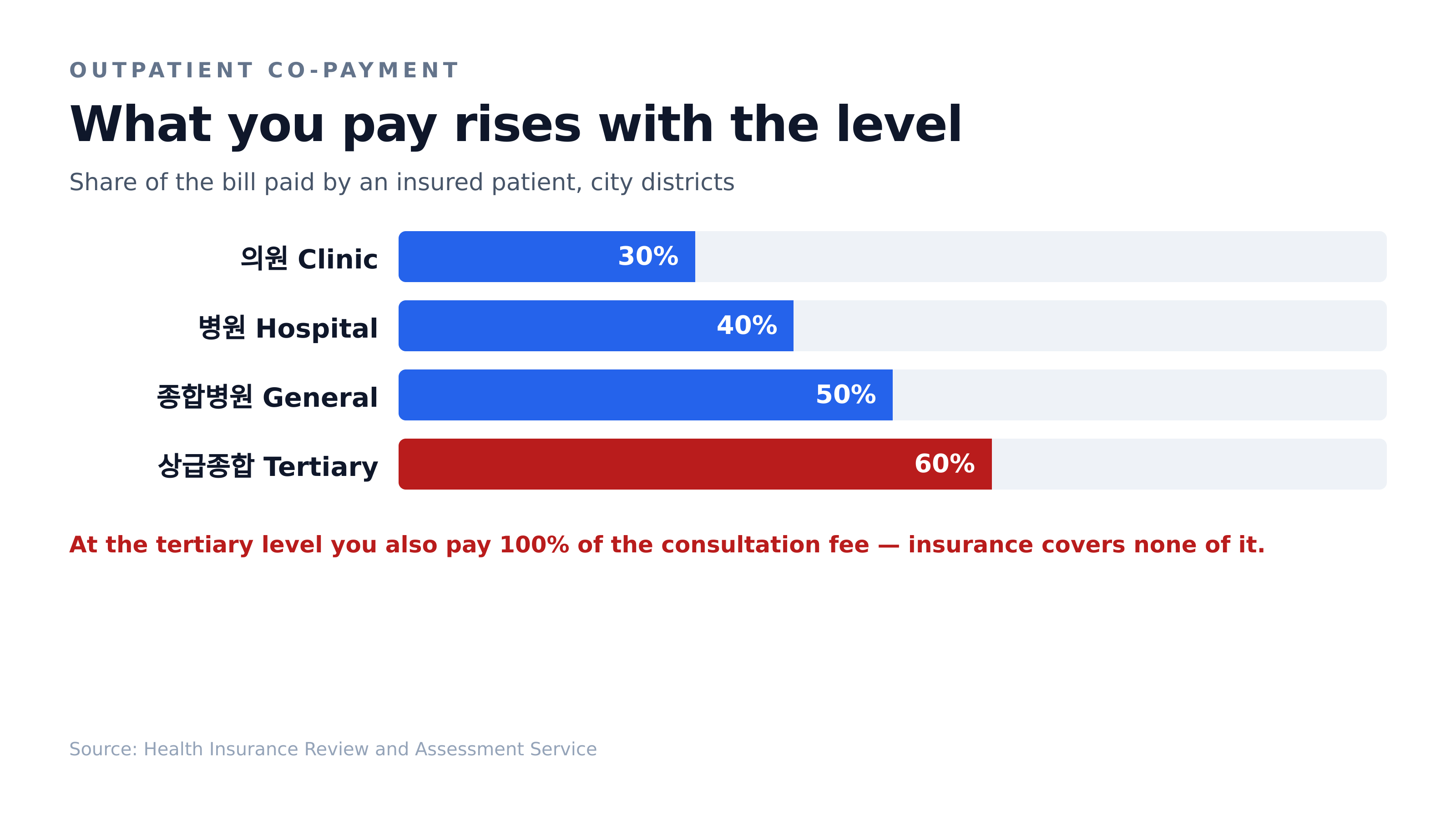
Read the last row again. At a tertiary general hospital you pay 60% of the treatment cost and the entire consultation fee, with no insurance contribution toward it at all. The same complaint, seen at a clinic, costs you 30% and nothing extra.
So a Korean with a sore throat goes to the clinic on the corner. Not because the clinic is better — because the clinic is correct, and correct is cheaper.
The referral letter, and the seven times you do not need one
This is the part that surprises people most. You cannot simply decide to be treated at a tertiary general hospital.

The National Health Insurance benefit rules split care into two stages. Stage one is care received at any institution except a tertiary general hospital. Stage two is care at a tertiary general hospital — and the rule is that you receive stage one first, then stage two.
To get stage-two care, you hand over one of two documents at reception, together with your ID:
-
a referral letter (요양급여의뢰서) from the clinic or hospital that saw you first, or
-
a health-screening result with a doctor's written opinion that tertiary care is needed
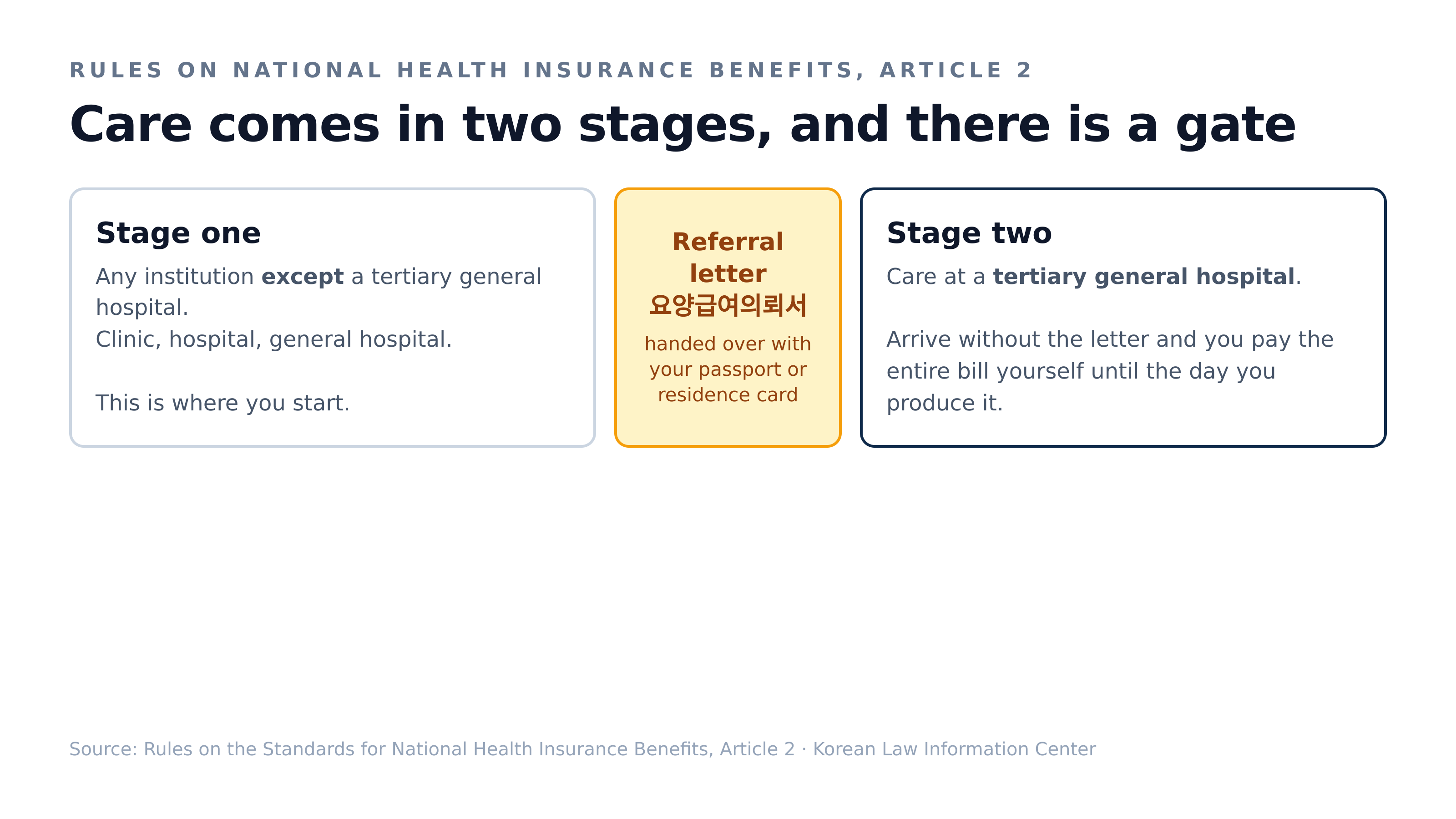
Without it, you can still be seen. You will simply pay the entire bill yourself, with no insurance applied, until the day you produce the document. That is the mechanism people discover at the cashier.
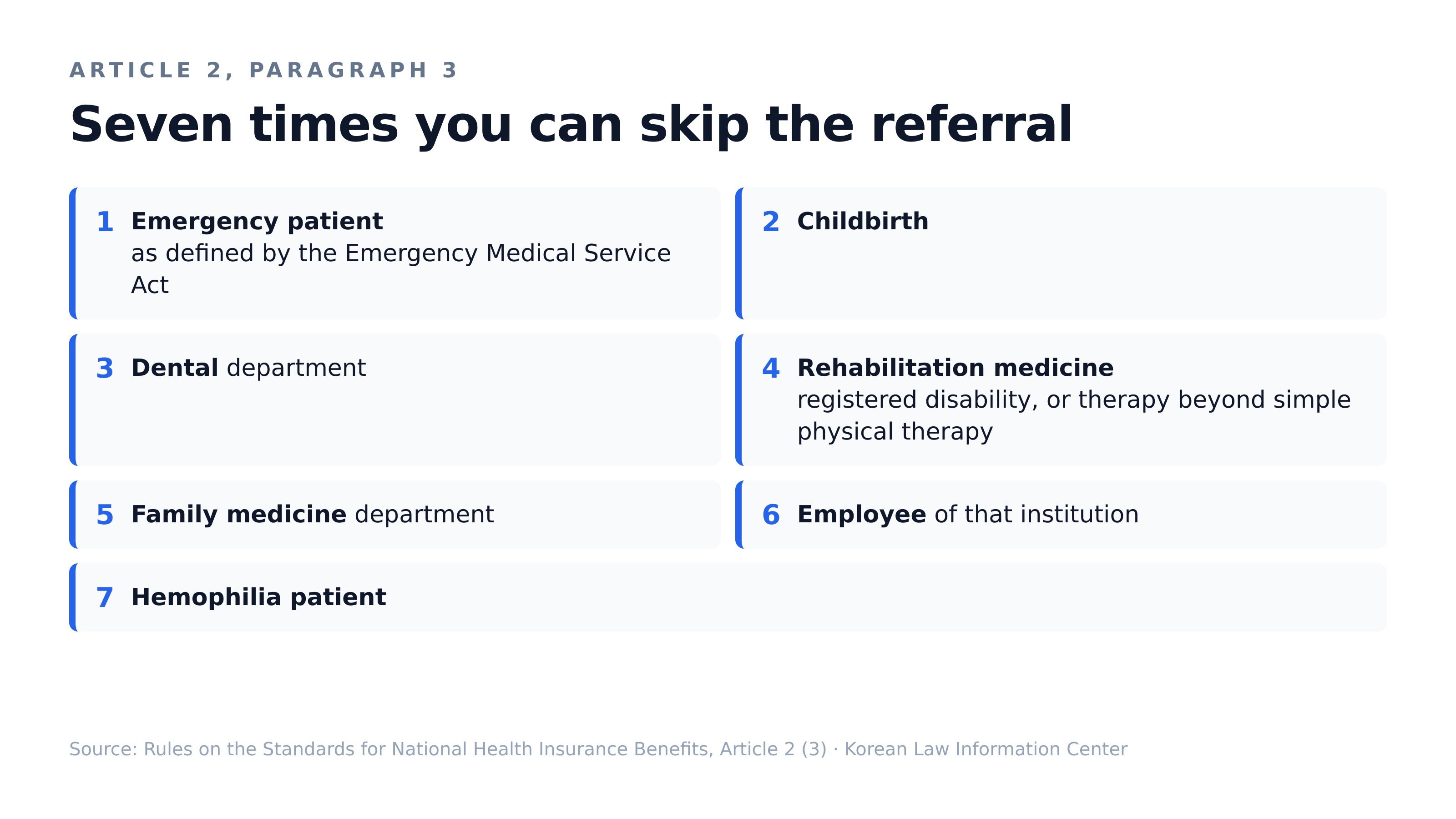
There are seven situations where you may go straight to a tertiary general hospital for stage-one care:
-
You are an emergency patient as defined by the Emergency Medical Service Act
-
Childbirth
-
Treatment in the dental department
-
A registered person with a disability, or someone needing rehabilitation therapy beyond simple physical therapy, being seen in the rehabilitation medicine department
-
Treatment in the family medicine department
-
You are an employee of that institution
-
You are a hemophilia patient
Item 5 is the practical loophole Koreans actually use. Family medicine sits inside the big hospital and takes you without a referral — and can then route you internally.
Item 1 is the one worth memorizing. If it is a genuine emergency, go. The rule does not stand between you and the emergency room.
Whether any of this applies to you
Everything above describes what you pay at a hospital in Korea when you are covered by national health insurance. Two very different situations exist.
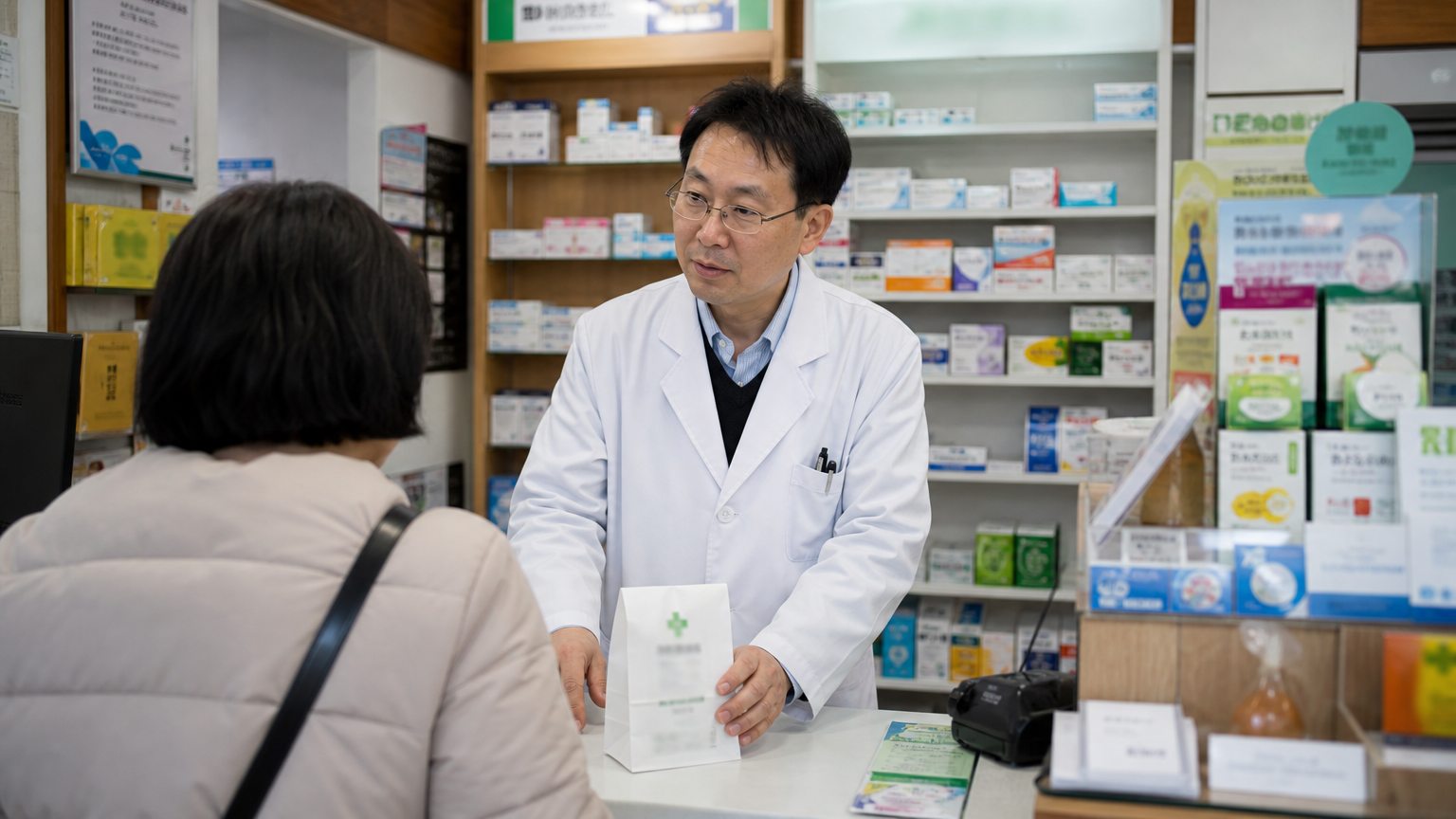
Short-term visitors. No national coverage. You pay the listed price, which is neither the 30% nor the 60% — it is the whole thing. The level still matters, because the underlying price at a clinic is far below the underlying price at a tertiary general hospital for the same complaint. If you have travel insurance, you pay on the spot and claim afterward, so keep the itemized receipt and the prescription.
Long-term residents. Foreign nationals on long-stay visas are enrolled in national health insurance automatically after six consecutive months in the country — a rule introduced in 2019. Students on a D-2 visa are enrolled immediately rather than waiting, and pay a 50% reduced premium. Once enrolled, every percentage in the table above is yours.
How to actually pick one, in practice
The system rewards starting small, so start small.
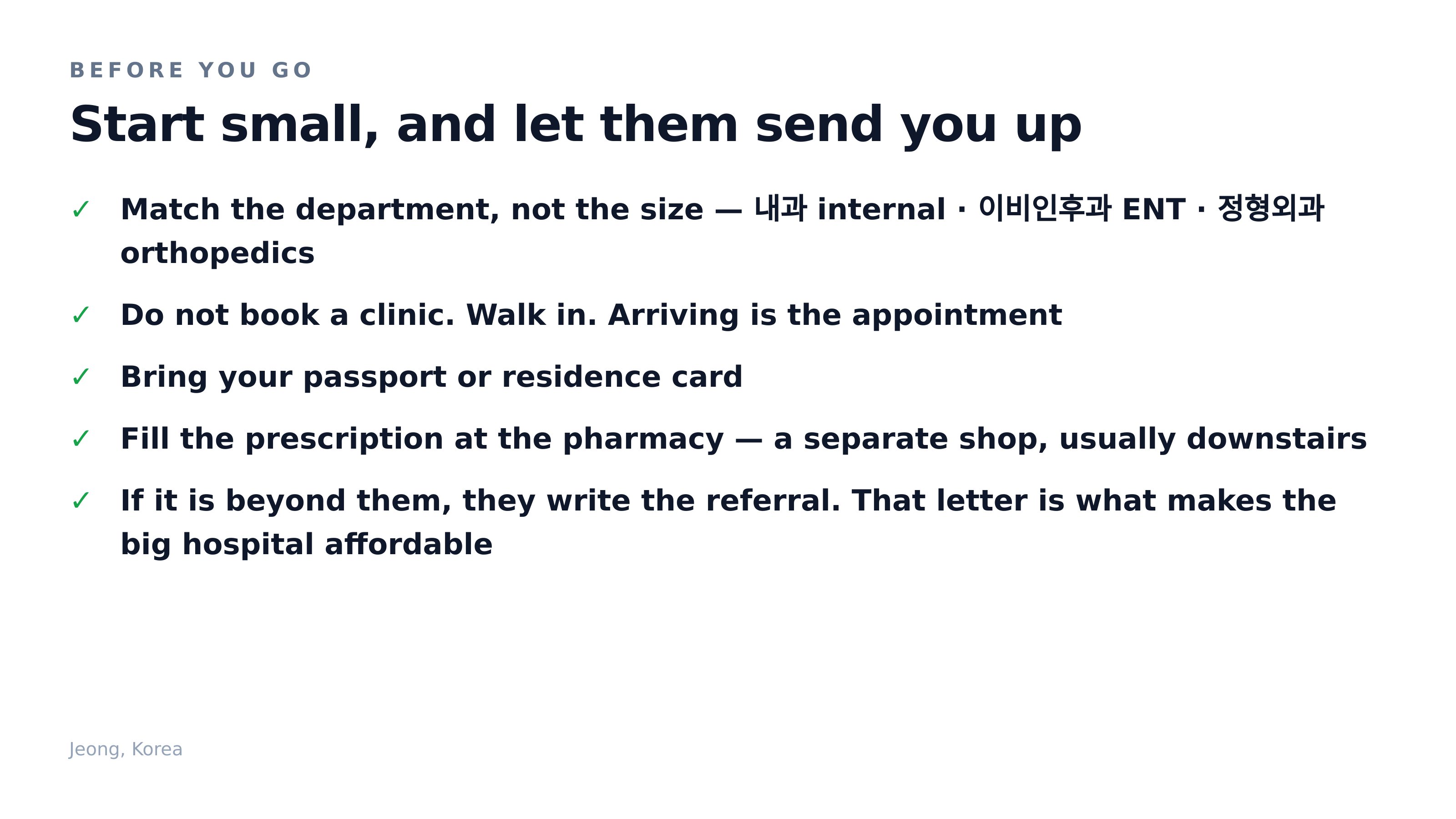
Match the department, not the size. Korean clinics are single-specialty and say so on the sign: 내과 internal medicine, 이비인후과 ear-nose-throat, 정형외과 orthopedics, 피부과 dermatology, 안과 ophthalmology. A cold goes to 내과 or 이비인후과. A twisted ankle goes to 정형외과.
Do not book. Clinics run on walk-ins. Arriving is the appointment. Bring your passport or residence card.
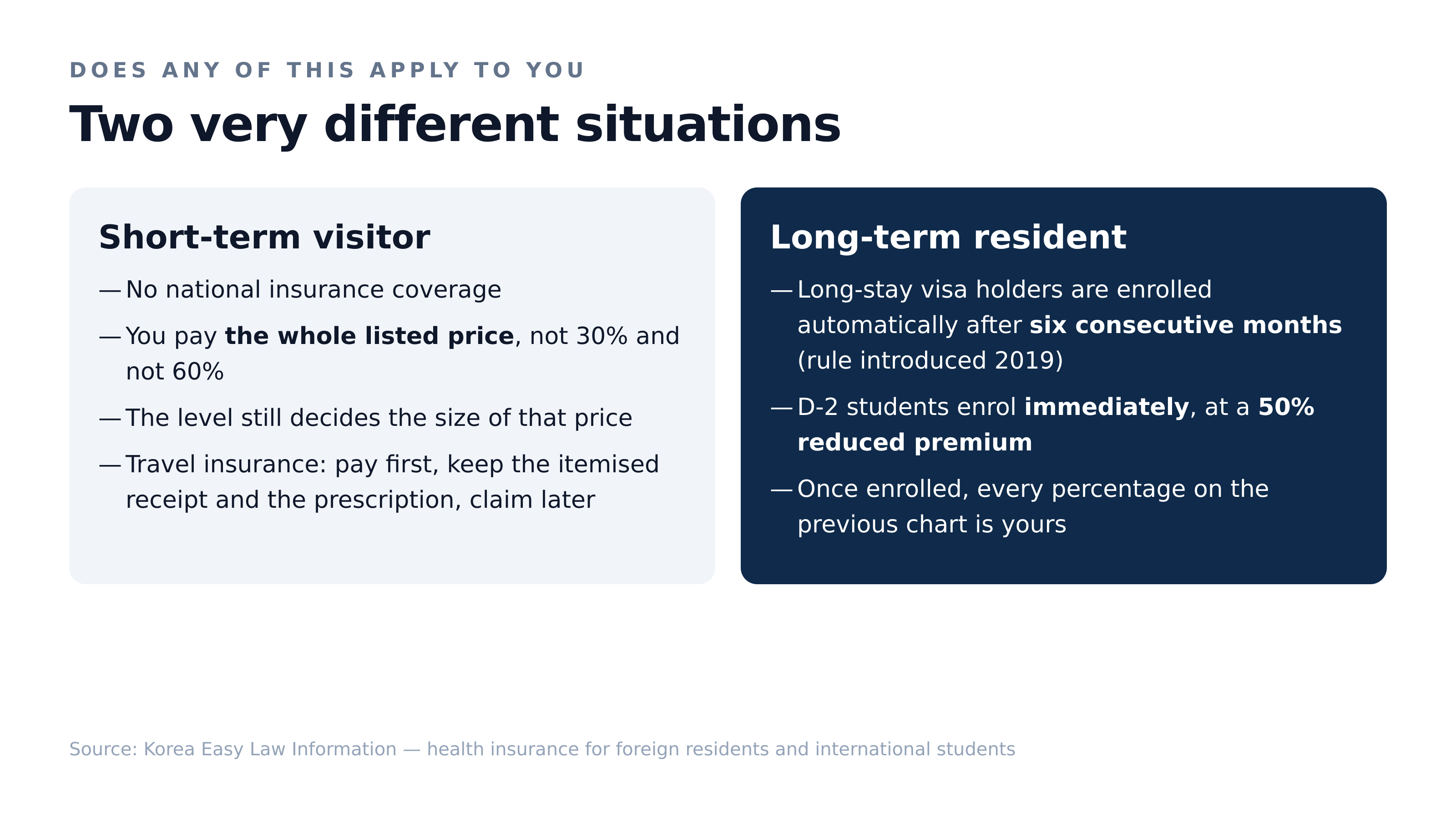
Expect it to be fast. A clinic visit is typically minutes, not hours, and you leave with a prescription to fill at a pharmacy — a separate shop, usually on the ground floor of the same building or directly across the street.

Let them escalate you. If the clinic cannot handle it, they will write the referral. That letter is the thing that makes the largest hospital in Korea affordable, and you can only get it by going to the small place first.
None of this is about settling for less. Every hospital in Seoul, from the clinic upstairs from a convenience store to the university medical center, bills against the same national fee schedule and dispenses from the same national formulary. You are not choosing between good care and cheap care. You are choosing the door that is built for what you have.
FAQ
Do I need an appointment at a hospital in Korea?
It depends entirely on the level. Clinic-level institutions run on walk-ins, and you register at the front desk when you arrive. Tertiary general hospitals are the opposite — they run on appointments, and getting one usually requires the referral letter described above.
Will anyone speak English?
At a tertiary general hospital, very likely — the large ones run international healthcare centers with dedicated coordinators. At a neighborhood clinic, it varies, and it is entirely reasonable to arrive with your symptoms written out in Korean on your phone. Many doctors read English far more comfortably than they speak it.
What do I bring?
Your passport or residence card, and your insurance card if you have one. For stage-two care at a tertiary general hospital, the referral letter must be handed over with your ID — the rule names it explicitly.
I do not have Korean insurance. Should I still go to a clinic first?
Yes. Without insurance you pay the full price either way, and the full price at a clinic is substantially lower than the full price at a large hospital for the same visit. The only reason to go straight to a big hospital is that your condition genuinely requires it — or that it is an emergency, in which case go immediately.
What if it is the middle of the night?
Every large hospital in Seoul runs an emergency room around the clock, and emergency patients are exempt from the referral requirement entirely. For something that is uncomfortable but not dangerous, waiting until morning and visiting a clinic will be faster and far cheaper than an overnight emergency visit.
References
-
Medical Service Act, Article 3 (classification of medical institutions) and Article 3-4 (designation of tertiary general hospitals) — Korean Law Information Center
-
Rules on the Standards for National Health Insurance Benefits, Article 2 (procedure for benefits; stage one and stage two; the referral letter; the seven exceptions) — Korean Law Information Center
-
Outpatient co-payment rates by institution type — Health Insurance Review and Assessment Service
-
Health insurance enrollment for foreign residents and international students — Korea Easy Law Information
More from this series
2026-08-18
Autumn in Korea: Don't Pick the Dates, Pick the Latitude
2026-08-18
Korean Drinking Culture: The Rules Are Real, and So Is the Way Out
2026-07-31
Famous Korean Street Foods You Must Try (Yes, Including the Viral Buldak Omelette)
2026-07-31
What Is Silbi Kimchi? Korea's Spiciest Kimchi — and the Local Hack You Need to Know