K-ETA Korea: You Are Probably Exempt, and the Arrival Card Is What Catches People

Most guides still say you need a K-ETA. Most visitors do not. The exemption runs to 31 December.
Search K-ETA Korea and the first page of results is a wall of application guides, step-by-step walkthroughs and sites offering to file it for you. Almost all of them are technically about a real system. Almost none of them lead with the thing that decides whether you should read any further, which is that citizens of the countries this was designed for have been temporarily released from it since the start of the year. Meanwhile the document that actually is compulsory for you gets a sentence at the bottom, if it appears at all.
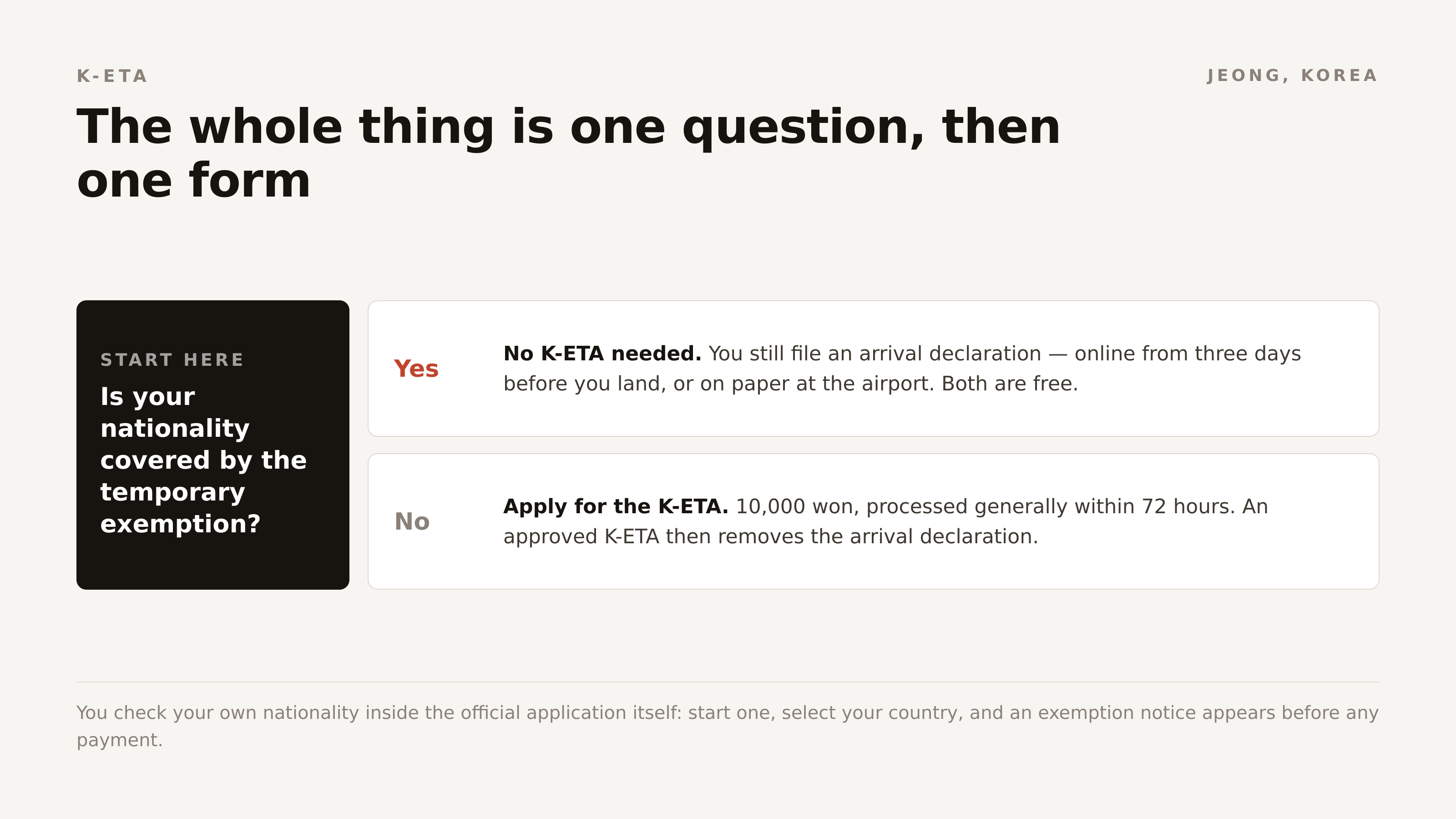
The exemption is real, it is dated, and it is buried
The Ministry of Justice suspended the requirement for a specific group of countries, and has renewed that suspension every year since.
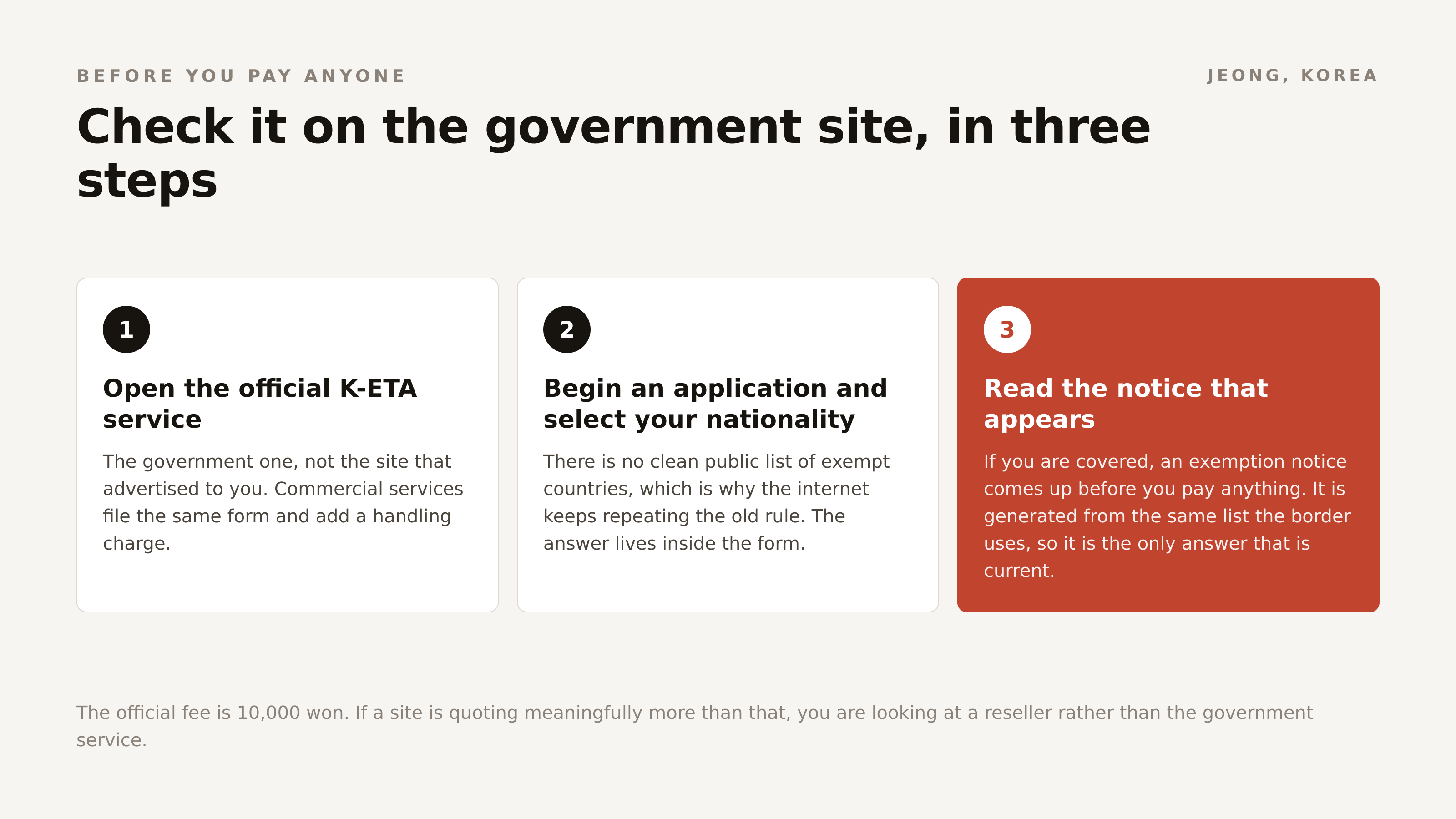
The current period runs from 1 January 2026 to 31 December 2026, Korean time, and Korean embassy notices confirm it applies to the countries already covered, the United States among them. It was introduced to make short visits easier and it has been rolled forward more than once. The official notice does not publish a country list in the text, which is part of why the internet keeps repeating the old rule. Instead you check it inside the application itself: start an application, select your nationality, and an exemption notice appears if you are covered.
That is a strange piece of design and it explains a lot. There is no clean government page listing exempt nationalities, so every travel site that wants to be helpful ends up writing "apply for your K-ETA" because that is the rule as originally written. The exemption is genuine, but it lives one click inside a form rather than on a poster.
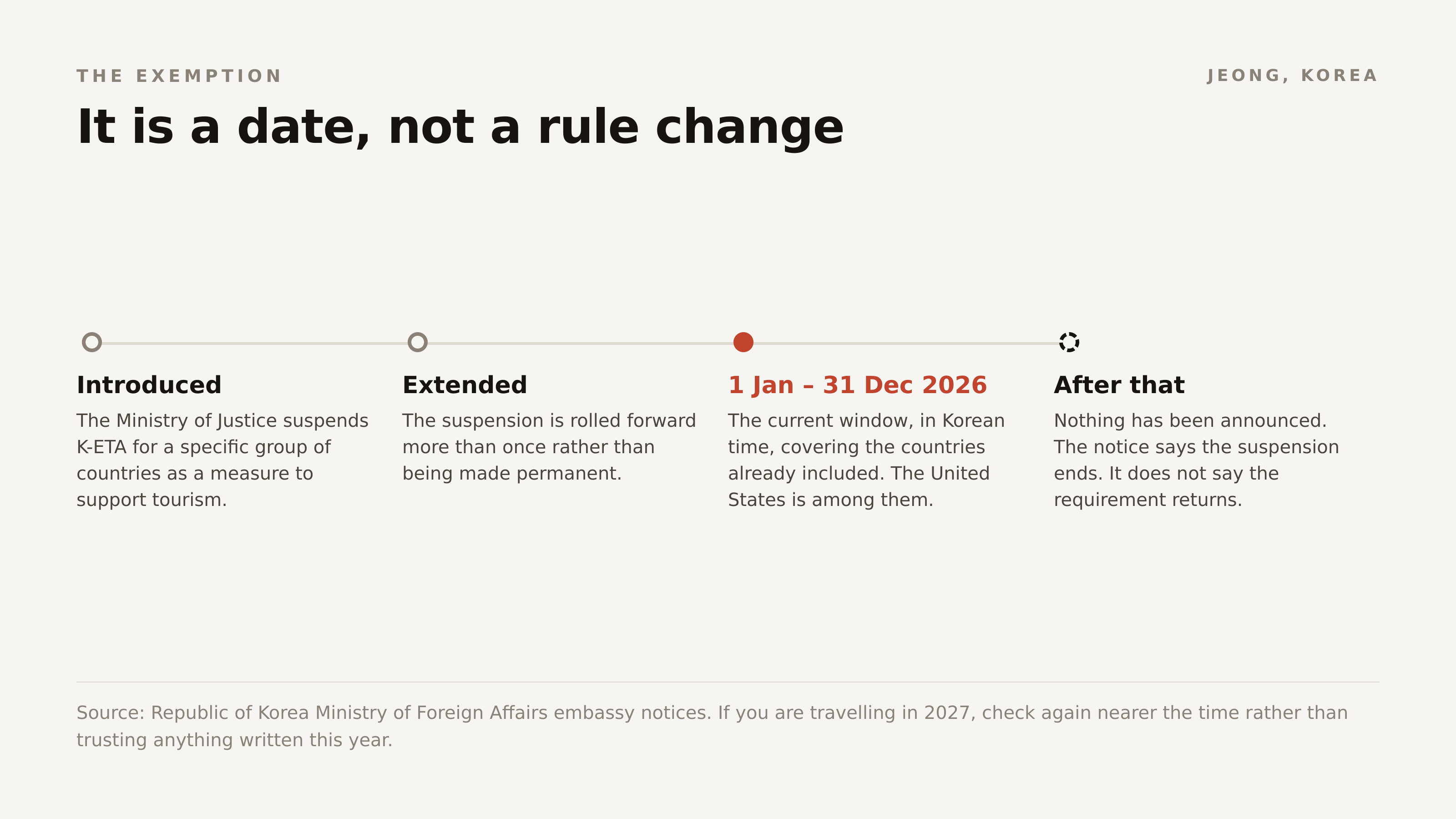
One caution about the date, because this is where even good articles get careless. The notice says the suspension ends on 31 December 2026. It does not say the requirement returns on 1 January 2027. It has been extended repeatedly and no announcement has been made about what follows. If you are planning a trip for next year, check again closer to the time rather than trusting anything written this year, including this.
So if the K-ETA Korea exemption covers you, what is left?
What is compulsory is not the K-ETA, it is the arrival card
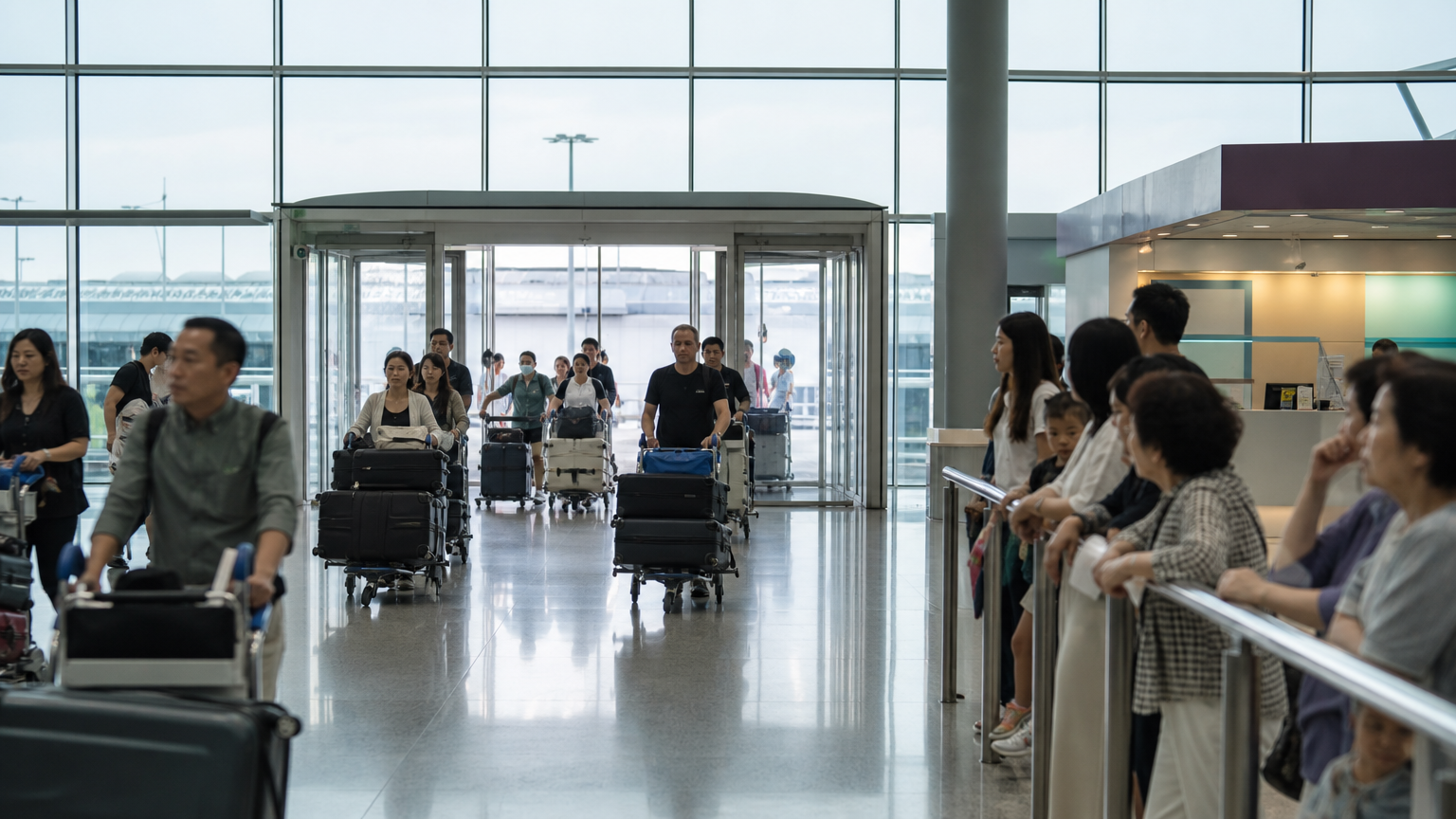
Every foreign visitor files an arrival declaration, and skipping the K-ETA puts you back in that queue.
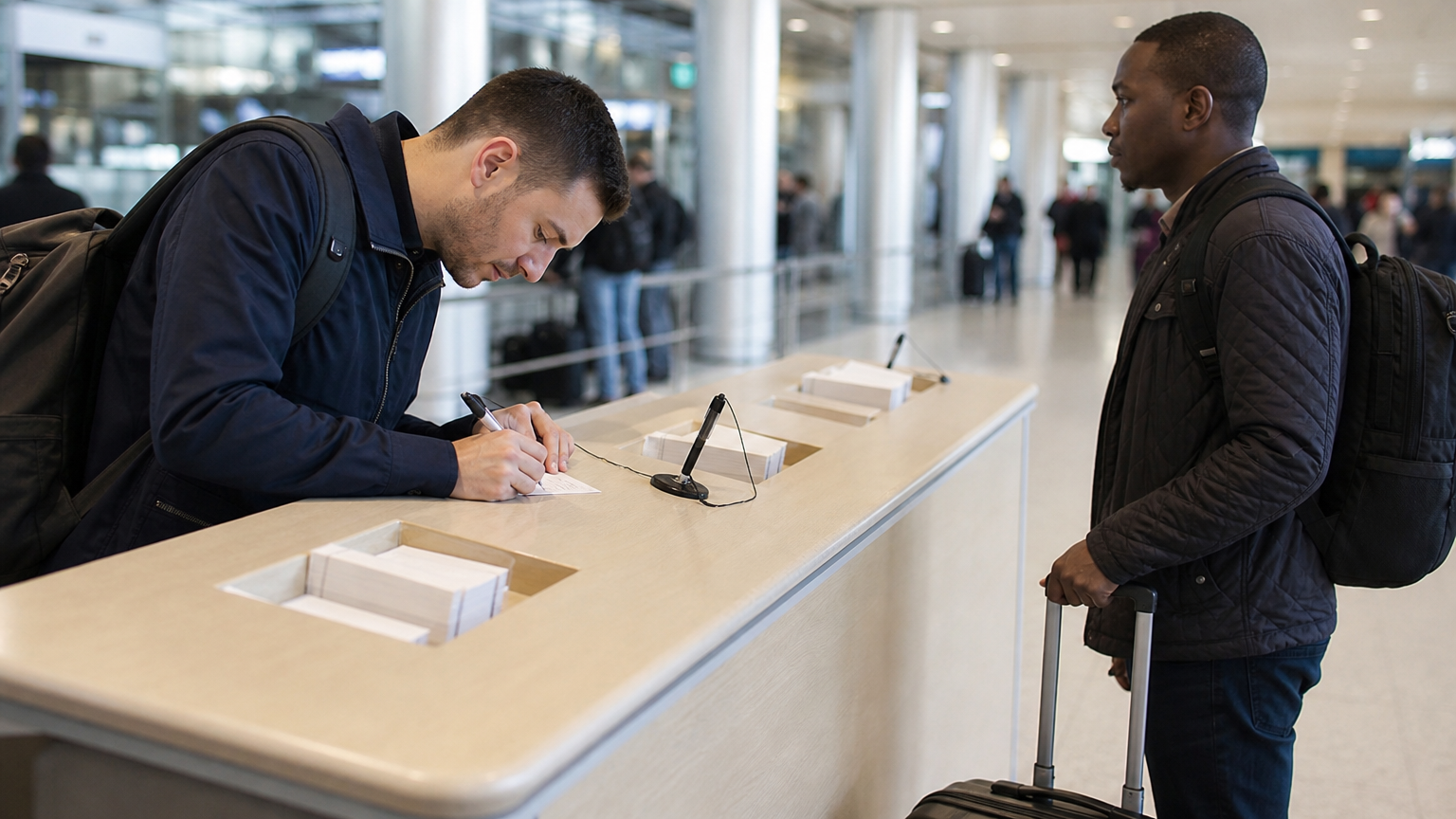
Korea runs an electronic arrival card service alongside the paper form. You can file it online from three days before you land, which takes a few minutes on a phone and means you walk to immigration with nothing to fill in. Filing in advance is not compulsory. If you do not, you complete the paper card before the immigration desks, which is what people did for decades and still works.
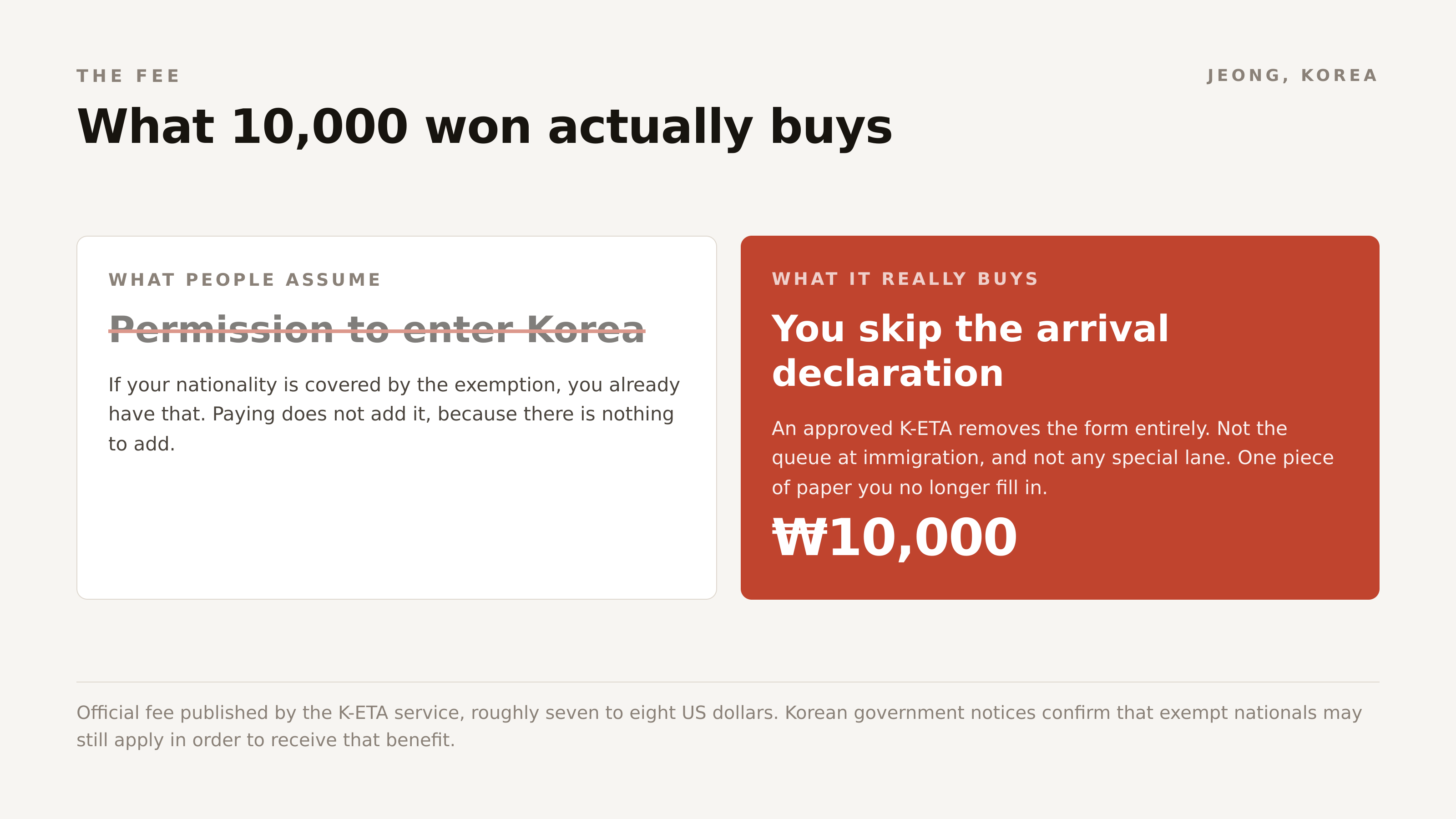
Here is the part that reframes the whole question. An approved K-ETA exempts you from the arrival declaration altogether. That is what the ten thousand won actually buys. Not permission to enter, which you already have, but the removal of a form. Once you see it that way, the choice stops being "do I need this" and becomes "is skipping the arrival card worth the fee and the wait", which is a much easier question to answer.
| K-ETA | Arrival card | |
|---|---|---|
| What it is | Advance travel authorisation | Entry declaration |
| Who it is for | Visa-free nationalities | Foreign visitors generally |
| Right now | Suspended for covered countries to 31 December 2026 | Still required |
| Cost | 10,000 won, about seven to eight US dollars | Free |
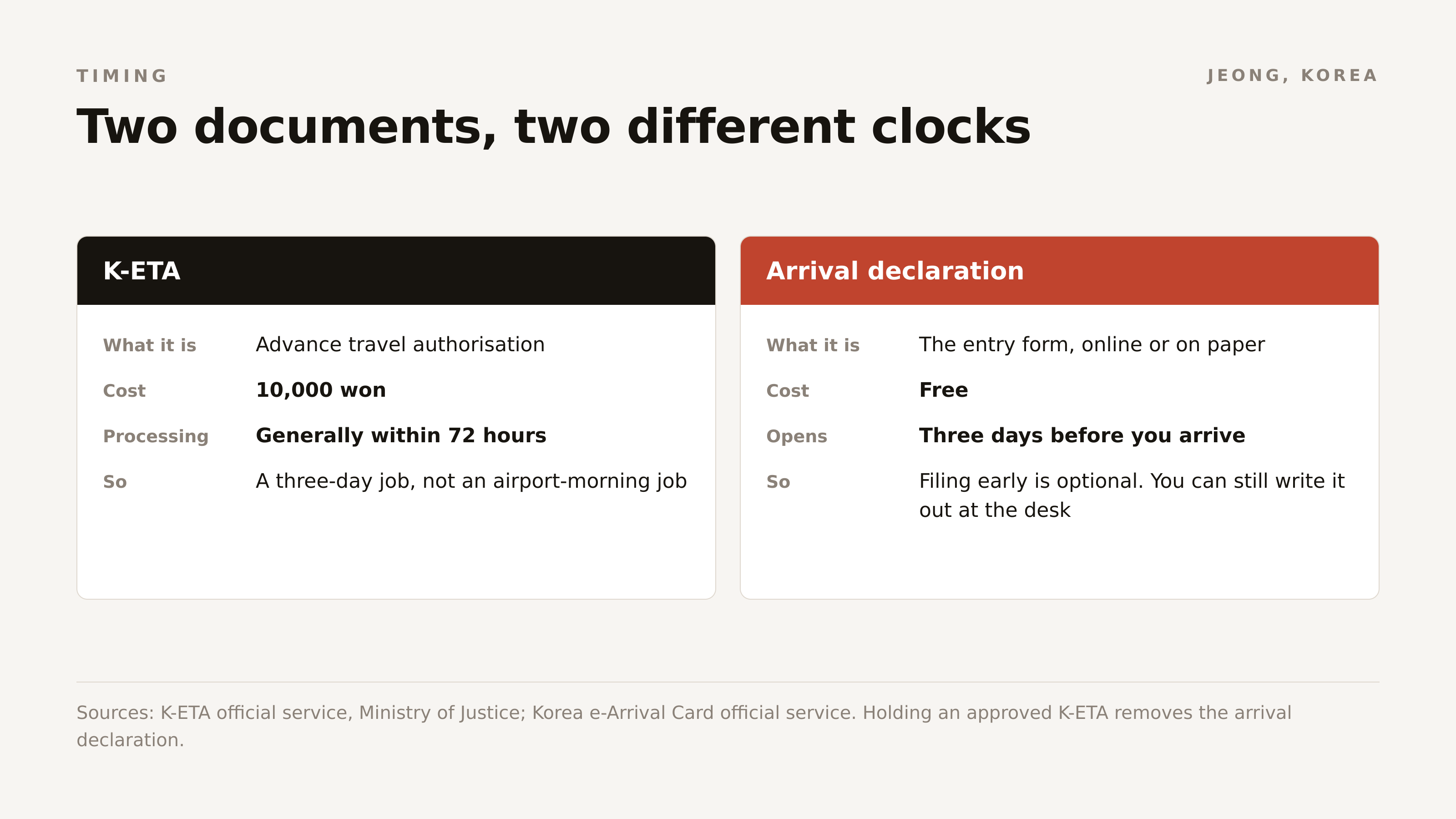
| When | Processing generally within 72 hours | Online from three days before arrival, or on paper at the airport |
| Holding one | Removes the arrival card | Not applicable |
Landing at Incheon with the form already done is worth more at some hours than others, and if you are arriving late the onward transport is the bigger problem: Incheon Airport to Seoul: 4 Ways, and Which One Is Actually Worth It.
How to check your own passport, and when paying is worth it
Check on the official site, not on the site that is advertising to you.
Go to the government K-ETA service, begin an application and select your nationality. If you are covered, the exemption notice appears before you pay anything. This takes about a minute and it is the only answer that is current, because it is generated from the same list the border uses. The official fee is 10,000 won. If a site is quoting you meaningfully more than that, you are looking at a reseller filing the same form on your behalf.
Paying anyway is defensible in a few situations. A family with small children, an arrival on a heavy afternoon bank of flights, or anyone who simply does not want to fill in a form at a desk after eleven hours in a seat. The application is generally processed within 72 hours, so it is not a same-day option. For most single travellers on a normal arrival, the free electronic arrival card three days out does the same job for nothing.
| Your situation | What to do |
|---|---|
| Covered by the exemption, arriving this year | Skip the K-ETA. File the arrival card online three days before |
| Covered, but travelling with children or landing at a busy hour | Consider paying for the K-ETA to remove the arrival card |
| Not covered by the exemption | Apply for the K-ETA, allowing 72 hours |
| Travelling in 2027 | Check again nearer the time. Nothing has been announced |
If this is a move rather than a holiday, the entry document is the smallest of the forms waiting for you: Living in Korea as a Foreigner: Your First 30 Days, In the Right Order.
FAQ
Is the K-ETA Korea exemption automatic?
Yes. There is nothing to claim or register. If your nationality is covered, you simply arrive without one, and you file an arrival declaration instead.
Can I apply anyway if I am exempt?
You can, and the fee still applies. Korean government notices explicitly allow exempt nationals to apply in order to receive the benefits that come with an approval, including not having to complete a separate arrival card.
Why are some websites charging much more?
They are commercial services filling in the government form for you. The official fee is 10,000 won, roughly seven to eight US dollars, paid on the government site. Anything above that is somebody's handling charge.
How long does approval take?
Generally within 72 hours according to the official service. Treat it as a three-day job rather than an airport-morning job.
The short version
K-ETA Korea is, for most visitors, not something you have to do this year. The suspension runs to 31 December 2026 and the fastest way to confirm your own nationality is to open the official application and select it. What you cannot skip is the arrival declaration, which you either file online in the three days before you land or write out on paper at the airport. An approved K-ETA removes that form, and that is the honest case for paying the ten thousand won.
Check it on the government site before you pay anyone. Then, if you are landing at Incheon, spend the saved minutes deciding how you are getting into the city, because that decision costs more than this one.
Sources
-
K-ETA official service, Ministry of Justice — application fee of 10,000 won, processing generally within 72 hours, and nationality-based exemption notice shown during application
-
Republic of Korea Ministry of Foreign Affairs, embassy notices — temporary K-ETA exemption for the period 1 January 2026 to 31 December 2026 (KST), and the note that exempt nationals may still apply in order to skip a separate arrival declaration
-
Korea e-Arrival Card official service — online arrival declaration available from three days before arrival
More from this series
2026-08-28
DMZ Tour: You Can Still Go. The JSA Is the Part You Cannot.
2026-08-28
Gyeongju Food: The Famous One Is a Souvenir, and the Meal Is Next to the Tombs
2026-08-28
Bulguksa Temple: There Is No Direct Bus to Seokguram, and You See the Buddha Through Glass
2026-08-27
Gyeongju From Seoul: Two Hours by KTX, and Then the Part Nobody Plans For
2026-08-27
Gyeongju: Three Separate UNESCO Listings, and Why One Day Does Not Cover Them
2026-08-18
Autumn in Korea: Don't Pick the Dates, Pick the Latitude
2026-08-18
Hospital in Seoul: Why Koreans Don't Start at the Big One
2026-08-18
Korean Drinking Culture: The Rules Are Real, and So Is the Way Out
2026-07-31
Famous Korean Street Foods You Must Try (Yes, Including the Viral Buldak Omelette)
2026-07-31
What Is Silbi Kimchi? Korea's Spiciest Kimchi — and the Local Hack You Need to Know