Movie Theaters in Seoul: The 15+ Rating Has a Door, the Adults-Only One Does Not

A 15+ film in Korea is not closed to a 14-year-old. A parent can walk them in, and the law says so in writing. The adults-only rating has no such door, and no guardian can open it.
Korean cinema ratings are set by statute, not by the cinema chain, and there are five of them. This article covers what the five ratings are, the guardian exception that surprises most visitors, who the law counts as a minor, and why the trailer you sat through was chosen for you.
Most people arriving from abroad read a movie theater rating the way they read one at home: a recommendation from the industry, enforced loosely, argued with at the counter. In a lot of countries that is roughly true.
In Korea it is not. Ratings are assigned by a statutory body before a film may be shown at all, and the rules about who may be admitted are written into the Promotion of the Motion Pictures and Video Products Act. The cinema staff member asking for your ID is not applying a house policy.
Today I want to go through those five ratings, the one exception the law builds in, and the small definition that decides whether it applies to you.
There are five ratings, and one of them is not for ordinary cinemas
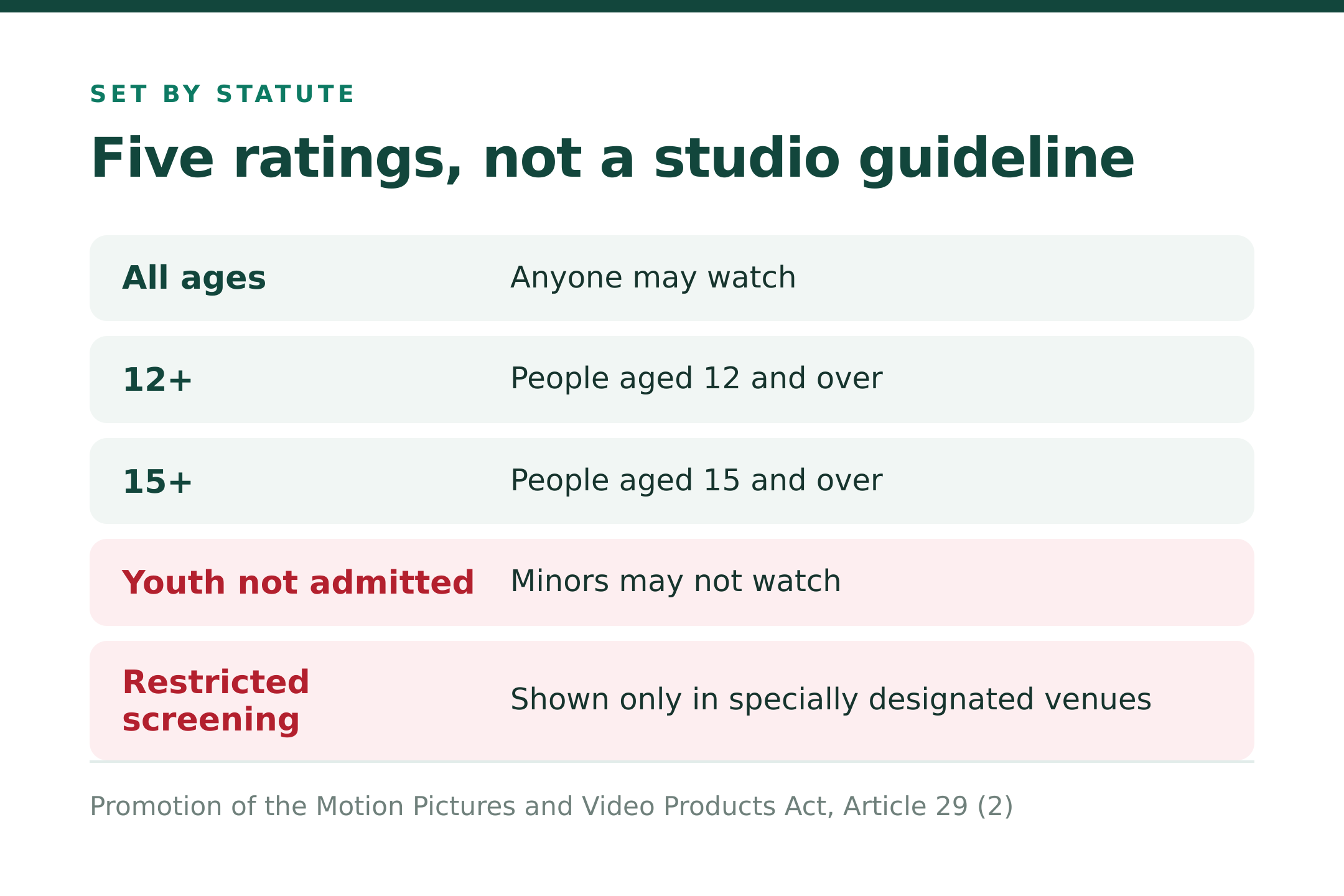
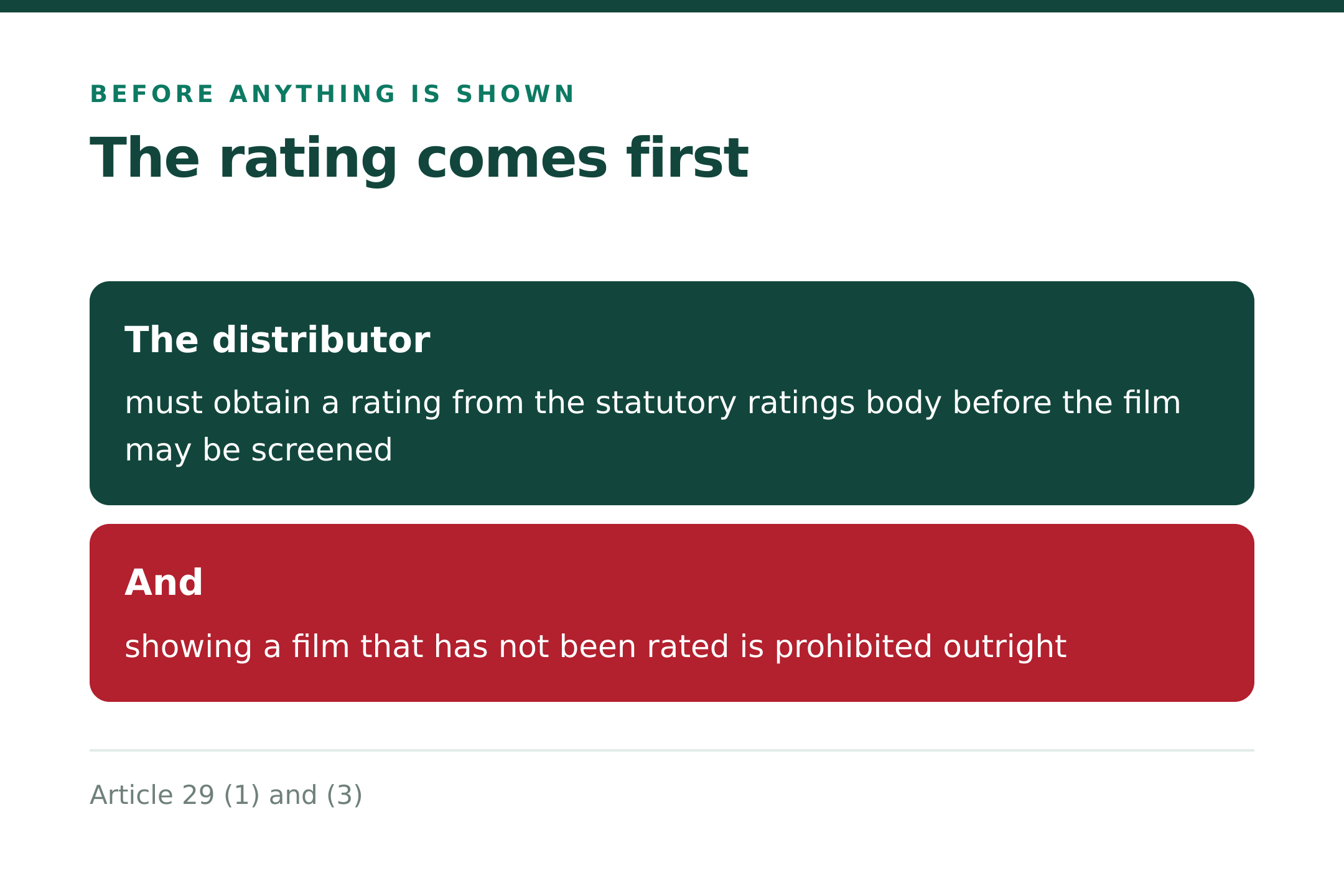
Before a film is shown, the distributor has to have it rated. The Act lists five categories.
| Rating | Who may watch |
|---|---|
| All ages | Anyone |
| 12+ | People aged 12 and over |
| 15+ | People aged 15 and over |
| Youth not admitted | Minors may not watch |
| Restricted screening | Shown only in specially designated venues |
That last one is worth a note. The Act defines a restricted screening cinema as a separate kind of venue, so a restricted-rating film is not something you will run into while picking a Saturday showtime at a mall movie theater.
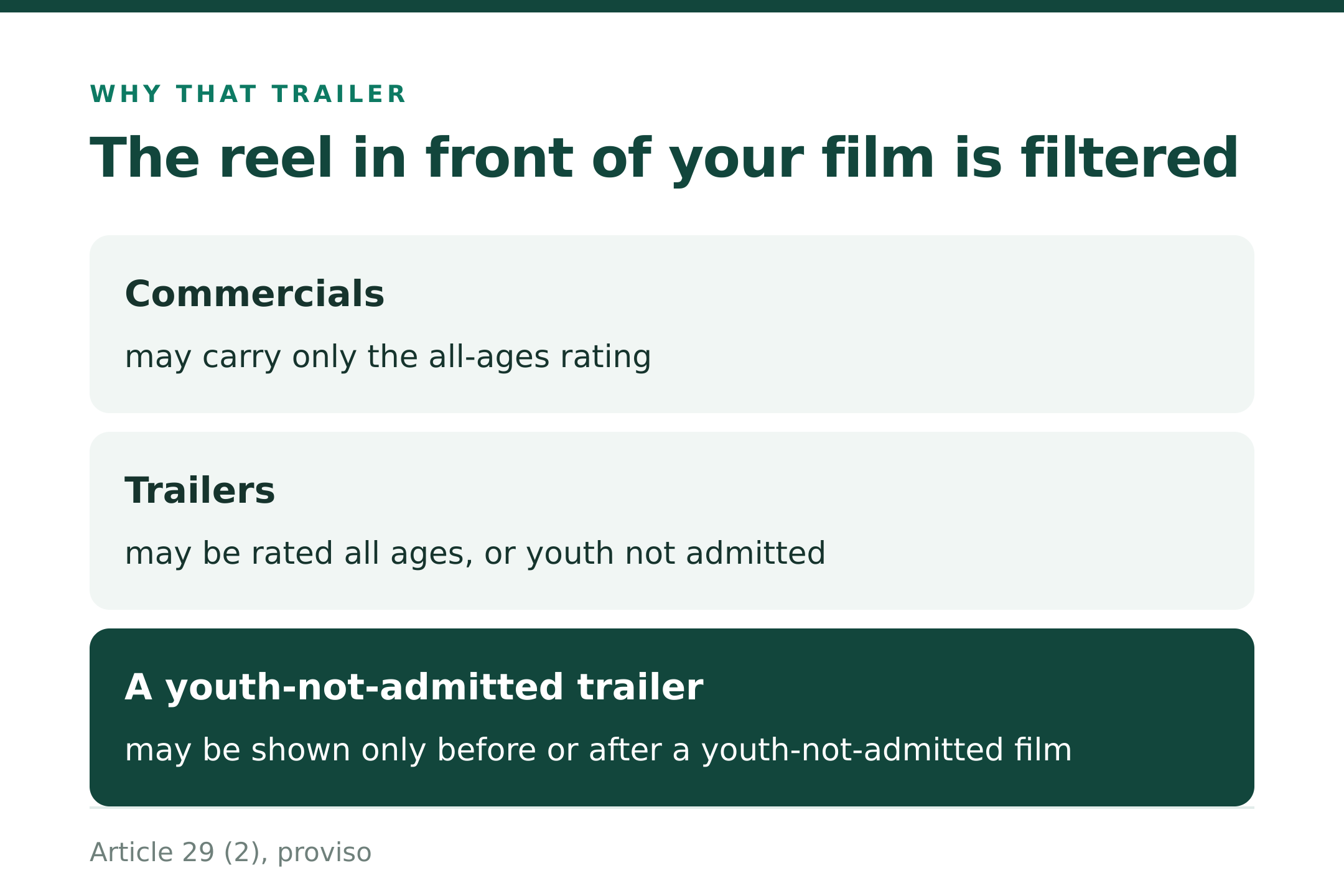
The rating also travels with the advertising. The Act allows commercials shown before or after a film to carry only the all-ages rating, and trailers may be rated either all ages or youth-not-admitted. A youth-not-admitted trailer may only be shown before or after a youth-not-admitted film.
So the block of trailers in front of your film is not a random reel. It has been filtered by the rating of the film you bought a ticket for. If you are curious how other Korean venues handle age and access, coin karaoke in Korea runs on a different set of rules again.
Then what happens when someone is a year or two short?
For 12+ and 15+, a guardian can take them in
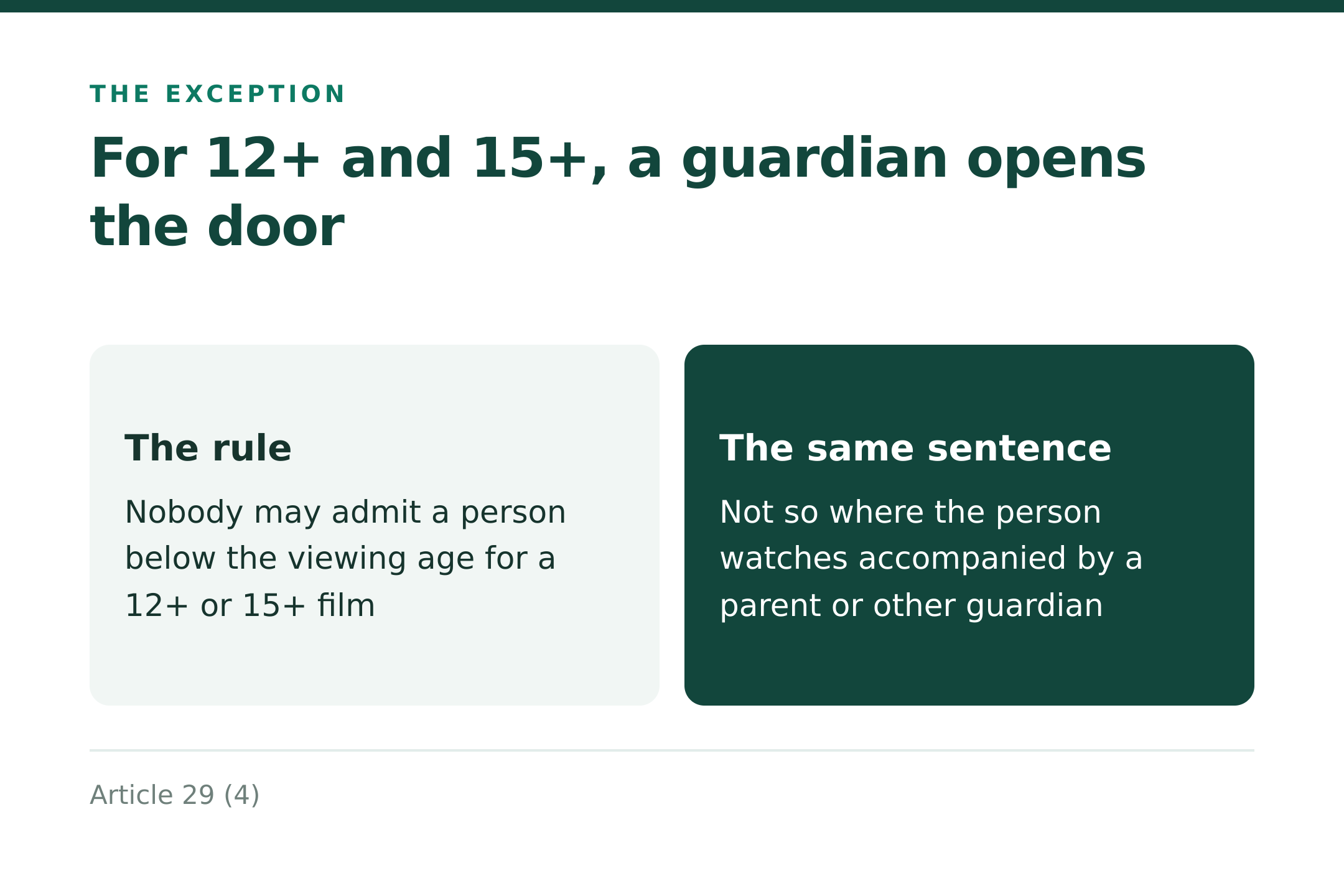
This is the part that catches visiting families off guard. The Act says that nobody may admit a person who has not reached the viewing age for a 12+ or 15+ film — and then adds an exception in the same sentence: not so where the person watches accompanied by a parent or other guardian.
So a 13-year-old can legally sit through a 15+ film with a parent beside them. The age bar on those two ratings is real, but it is not absolute.
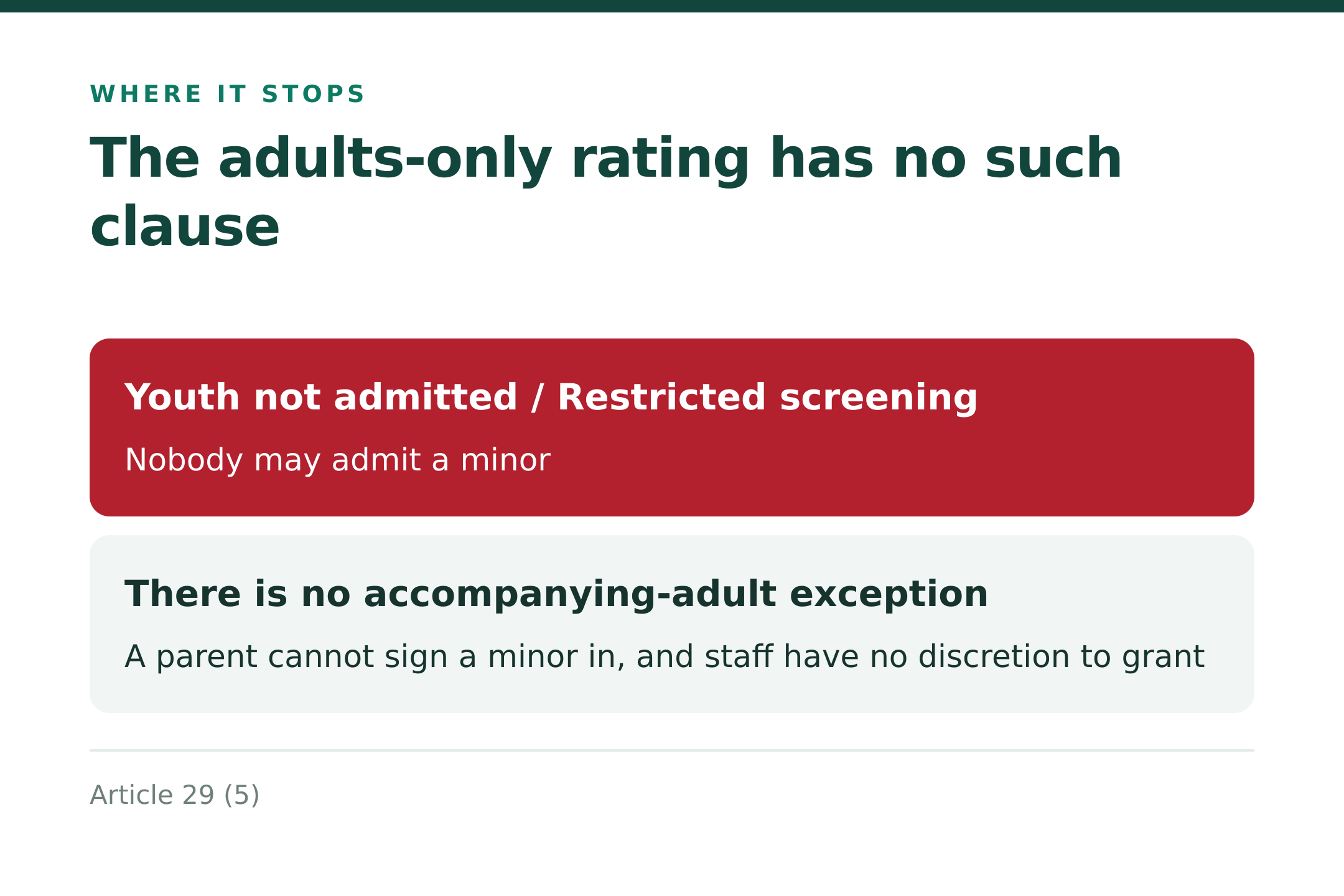
The next line removes the door entirely. For films rated youth-not-admitted, and for restricted-screening films, the Act says that nobody may admit a minor. There is no accompanying-adult clause. A parent cannot sign a minor in, and movie theater staff who let it happen are not exercising discretion they have.
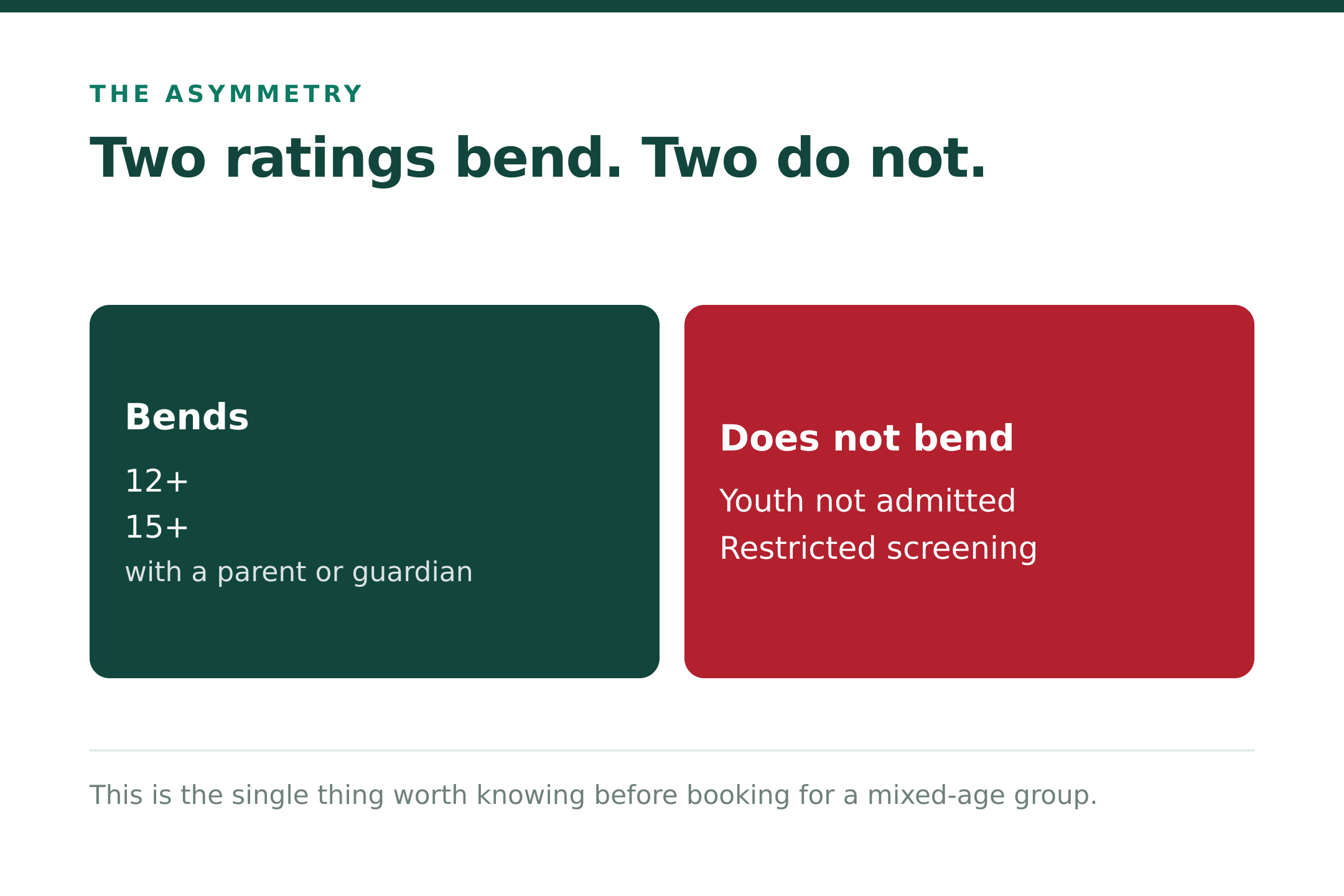
That asymmetry is the single most useful thing to know before you buy tickets for a mixed-age group. Two ratings bend. Two do not.
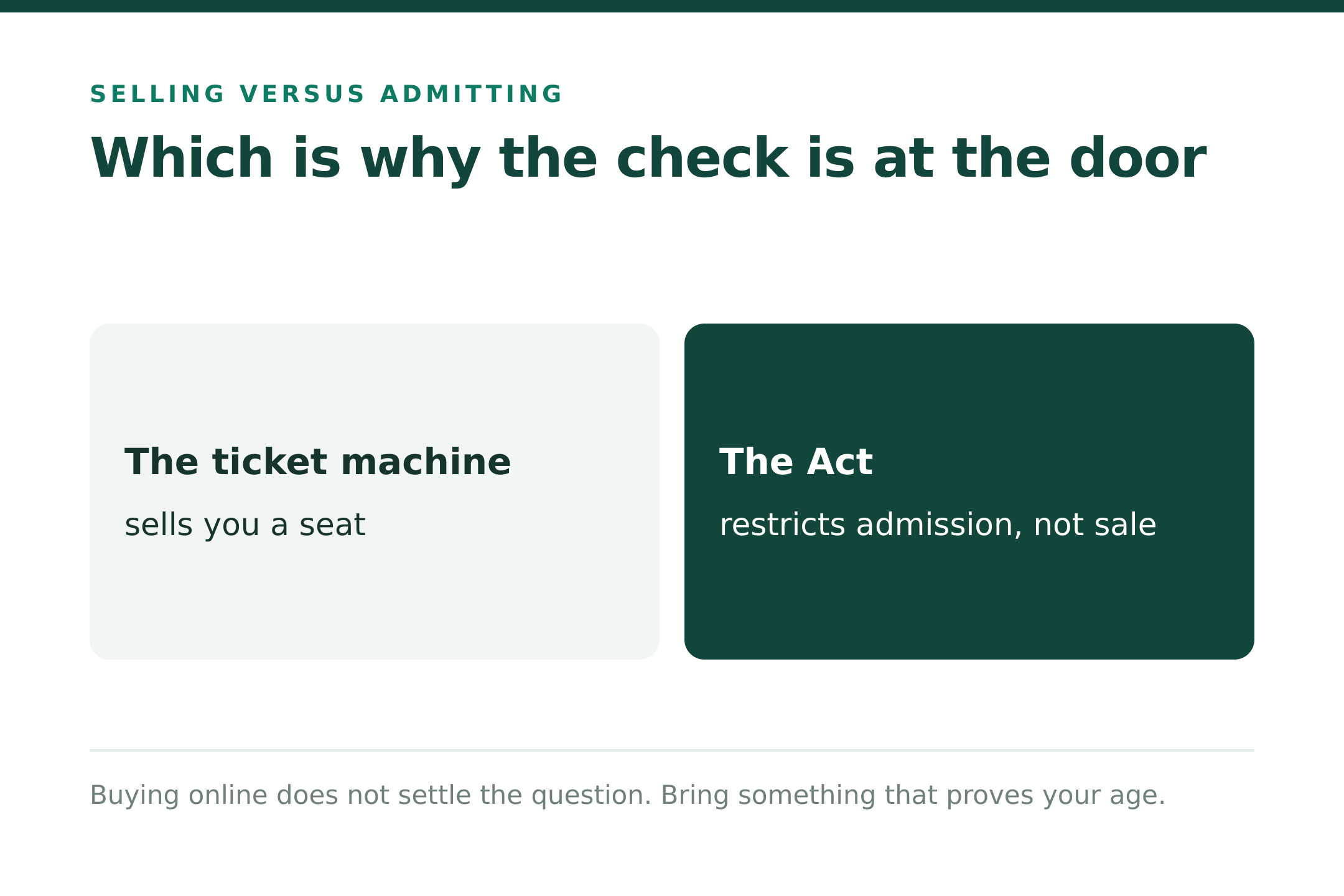
It is also why the ID check happens at the door rather than at the ticket machine. The machine sells you a seat; the law restricts admission. Bringing something that proves your age is worth doing, and if you live here, your residence card is the usual answer — the timing of getting one is covered in the alien registration card.
So who exactly counts as a minor here?
The cut-off is not your birthday
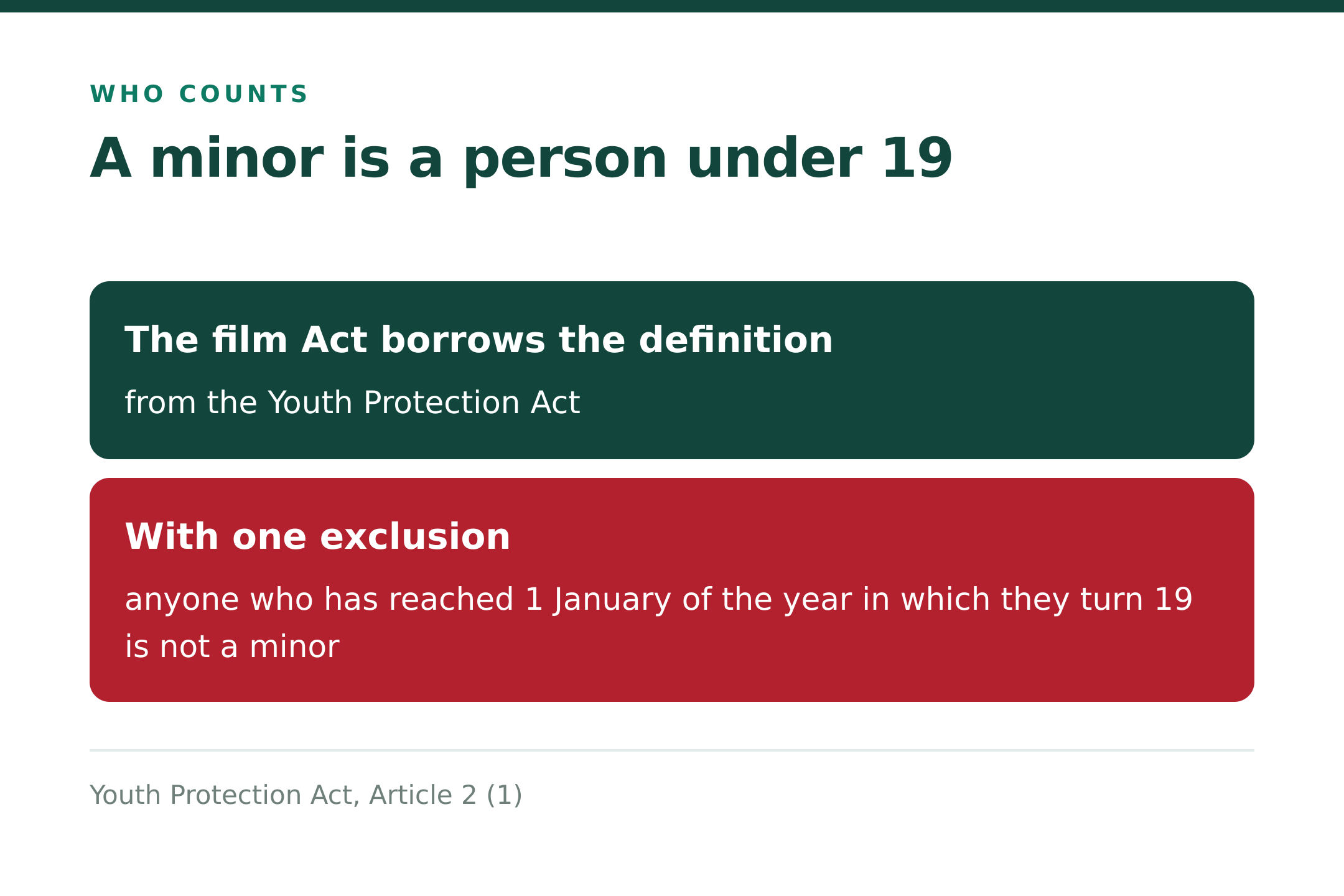
The film Act borrows its definition of "youth" from the Youth Protection Act, and that definition has a twist in it. A minor is a person under 19. But the same provision excludes anyone who has reached 1 January of the year in which they turn 19.
Read that carefully, because it is not a birthday rule. Everyone born in the same calendar year ages out together, on 1 January, regardless of which month they were born in.
| Situation | Counted as a minor? |
|---|---|
| Turns 19 in March, and it is now February | No, the calendar year has already begun |
| Turns 19 in March, and it is now December of the previous year | Yes |
| Is 17 | Yes |
This is a different clock from the one the country switched to for ordinary age counting, which I wrote about in Korean age. Age in daily conversation and age for this kind of legal restriction are simply not the same measurement.
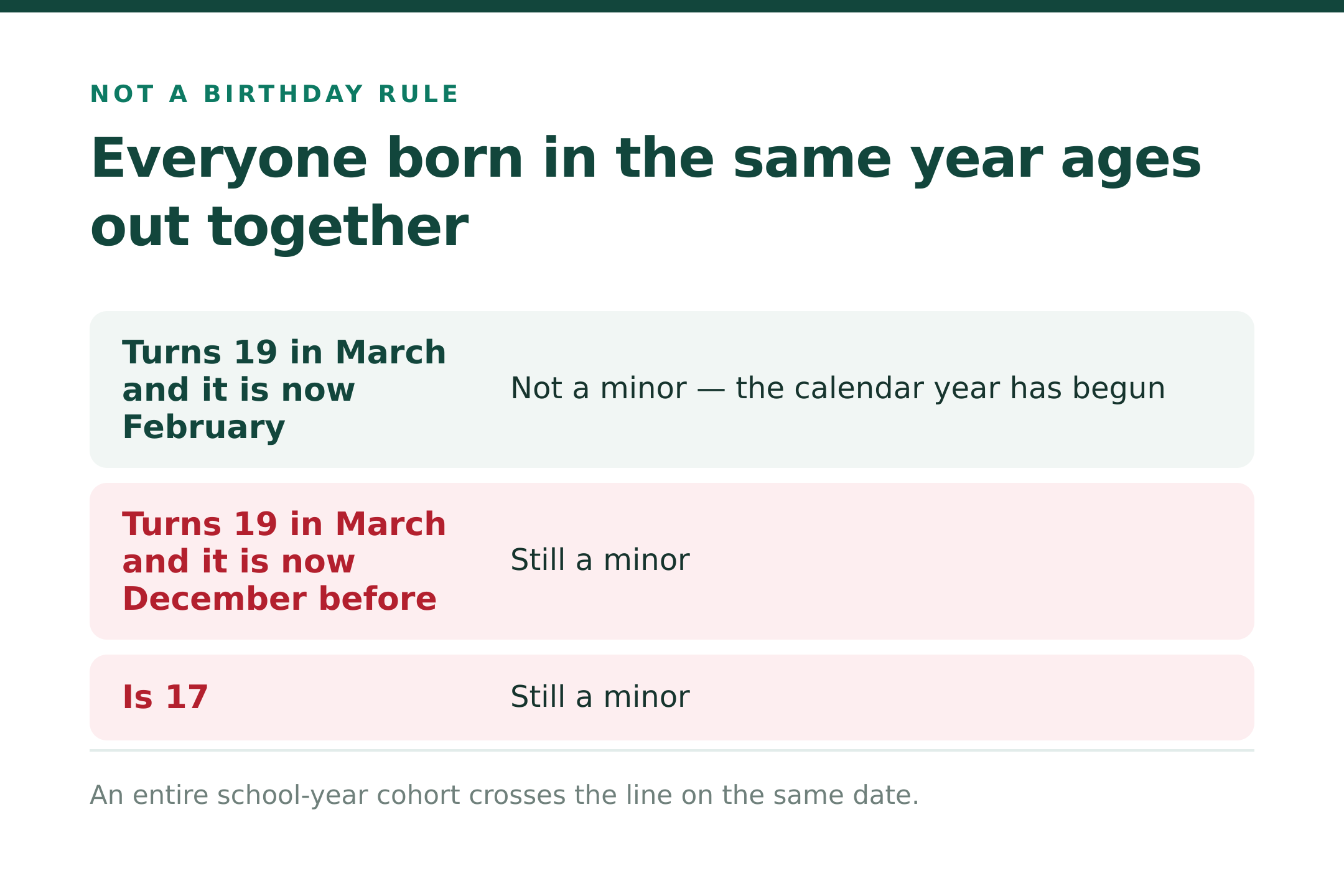
If that seems like a strange way to draw a line, it is doing a practical job: it means an entire school year cohort crosses the threshold on the same date, rather than trickling across it one birthday at a time.
None of this tells you which seat to book or which screen is worth the surcharge. But it does tell you what the person at the door is doing, and it tells you in advance whether the film you picked will admit everyone standing next to you.
Frequently Asked Questions
Can I get into a 15+ film if I am 14?
Only if you are accompanied by a parent or another guardian. The Act writes that exception in directly for 12+ and 15+ films, so it is not down to the individual movie theater.
Does the same exception work for an adults-only film?
No. For films rated youth-not-admitted, the Act simply says a minor may not be admitted, with no accompanying-adult clause attached. A guardian cannot authorise it.
Why do I need ID when I already bought the ticket online?
The restriction in the Act is on admitting people, not on selling them seats. That is why the check happens at the door of the screen rather than at the point of purchase.
Are the ratings ever skipped?
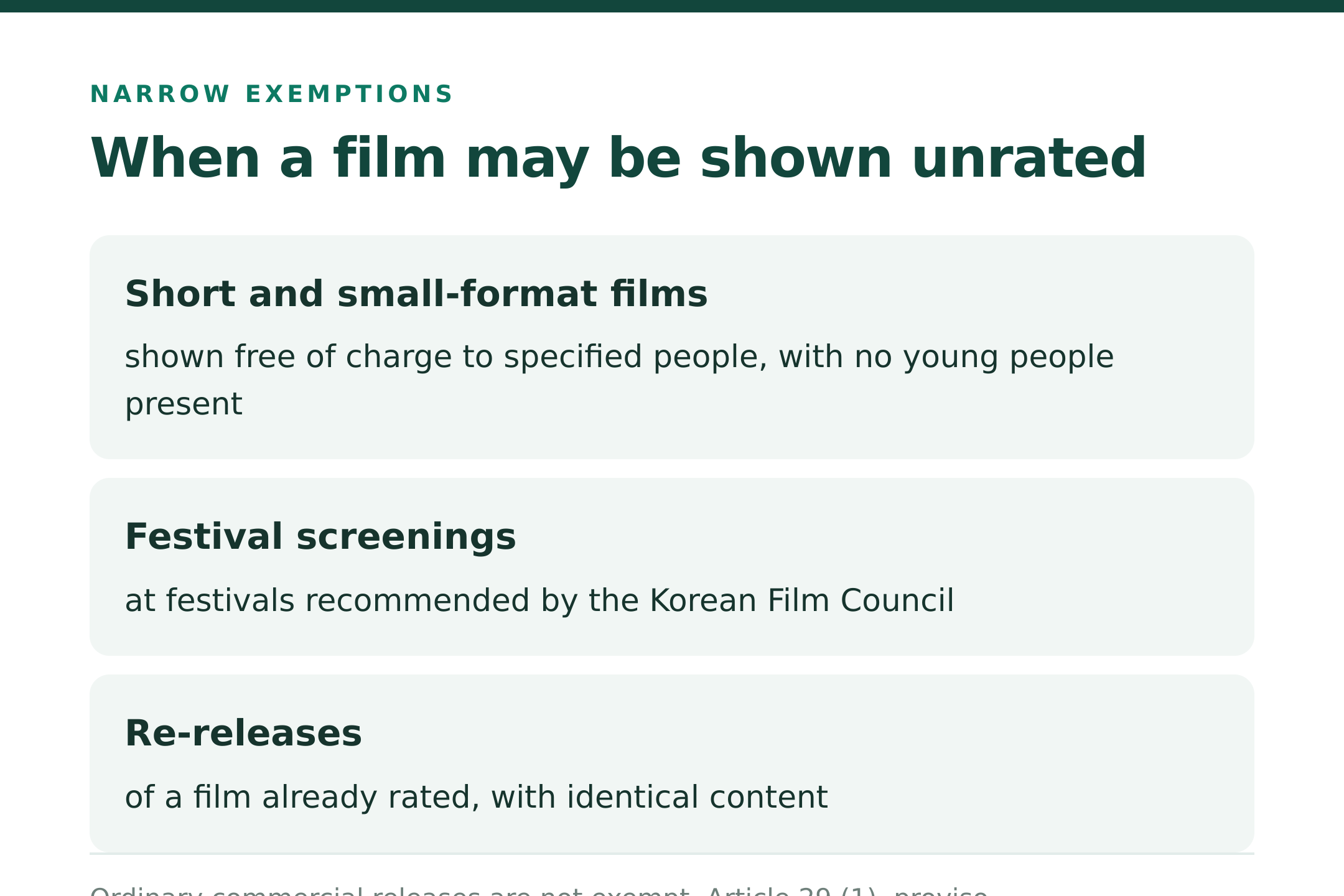
The Act exempts a few narrow categories, including films shown at festivals recommended by the Korean Film Council and re-releases of films already rated with identical content. Ordinary commercial releases are not exempt, and showing an unrated film is prohibited outright.
In short
Going to a movie theater here runs on five statutory ratings rather than a studio guideline. Two of them, 12+ and 15+, allow an under-age viewer in when a parent or guardian comes along. The youth-not-admitted and restricted ratings do not, and nobody at the cinema has the authority to waive that.
The definition of a minor is the last piece, and it is the one most people get wrong: under 19, but everyone born in the same year ages out together on 1 January. If your group sits near that line, check the rating before you book rather than at the door.
Sources
-
Promotion of the Motion Pictures and Video Products Act, Article 29 (screening ratings) : available at the Korean Law Information Center
-
Youth Protection Act, Article 2 (definitions) : available at the Korean Law Information Center