Seoul Subway Map: How to Actually Read It (and the Transfer Rules Nobody Explains)

Every year, about 15 million people in the Seoul metropolitan area walk out of a subway gate and walk straight back in within ten minutes.
They missed their stop. They needed a bathroom. They took the wrong exit. Until 2023, every one of them paid a second full fare for it — roughly 18 billion won a year, collectively, in mistakes.
That number tells you something the map itself never will: getting lost down here is normal, and it is almost never because the map is confusing. It is because nobody explains the rules the map is drawn on top of.
So here is what my friends actually need before their first ride — not a list of pretty stations, but the four rules that decide where you end up and what you pay.
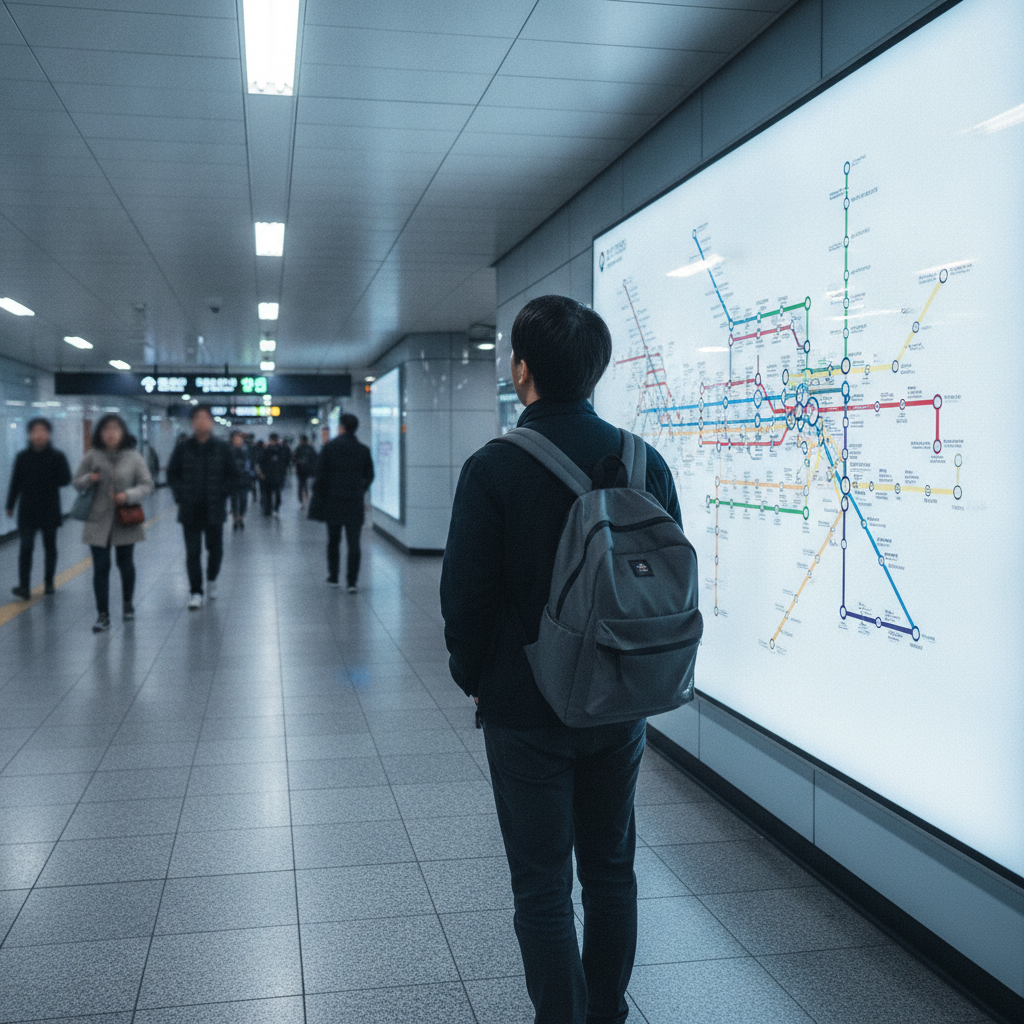
The map is not a map of Seoul
This is the first thing to unlearn. The seoul subway map is a diagram, not geography. Lines are straightened, distances are flattened, and two stations that look like neighbors on paper can be a fifteen-minute walk apart underground.
What the diagram is accurate about is the system: color, number, and order. Those three carry all the information you need.
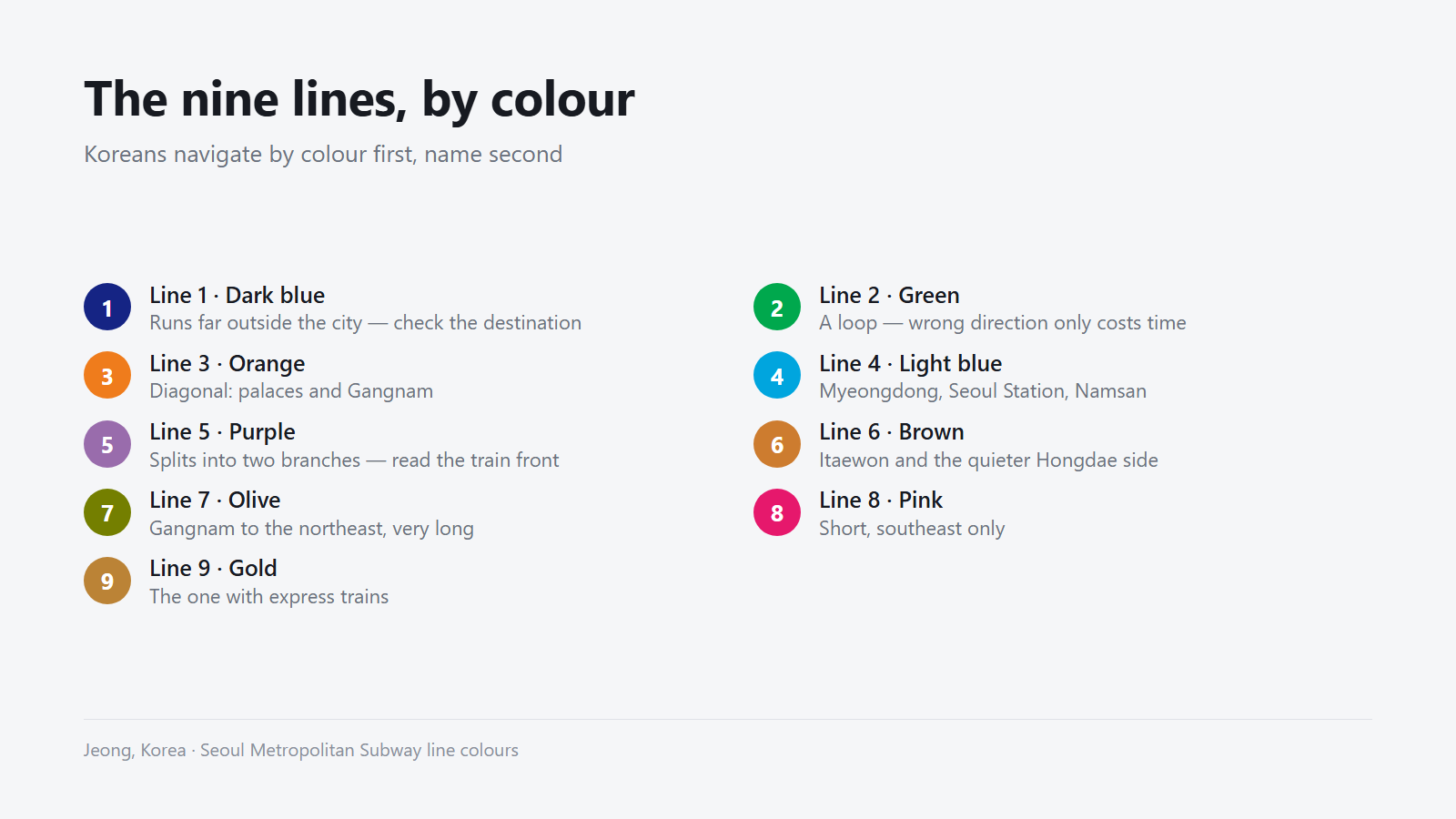
There are nine numbered lines in the core network, and each one owns a color permanently. Koreans navigate by color first and name second — if I tell a friend "take the orange line," that is a complete instruction here.
| Line | Color | What it means for a visitor |
|---|---|---|
| Line 1 | Dark blue | The oldest line, runs far out of the city — check your train's destination carefully |
| Line 2 | Green | A loop. You cannot ride it in a wrong direction forever, only a slow one |
| Line 3 | Orange | Cuts diagonally through the city, hits the palaces and Gangnam |
| Line 4 | Light blue | Myeongdong, Seoul Station, Namsan side |
| Line 5 | Purple | Runs under the Han River twice, splits into two branches at the east end |
| Line 6 | Brown | Itaewon, Hongdae's quieter neighbor stations |
| Line 7 | Olive green | Gangnam to the northeast, very long |
| Line 8 | Pink | Short, southeast only |
| Line 9 | Gold | The one with express trains — see below |
The two that trip people up are Line 2 and Line 5. Line 2 is a circle, so "wrong direction" only costs you time. Line 5 splits into two branches, so the destination on the front of the train matters more than the line color.
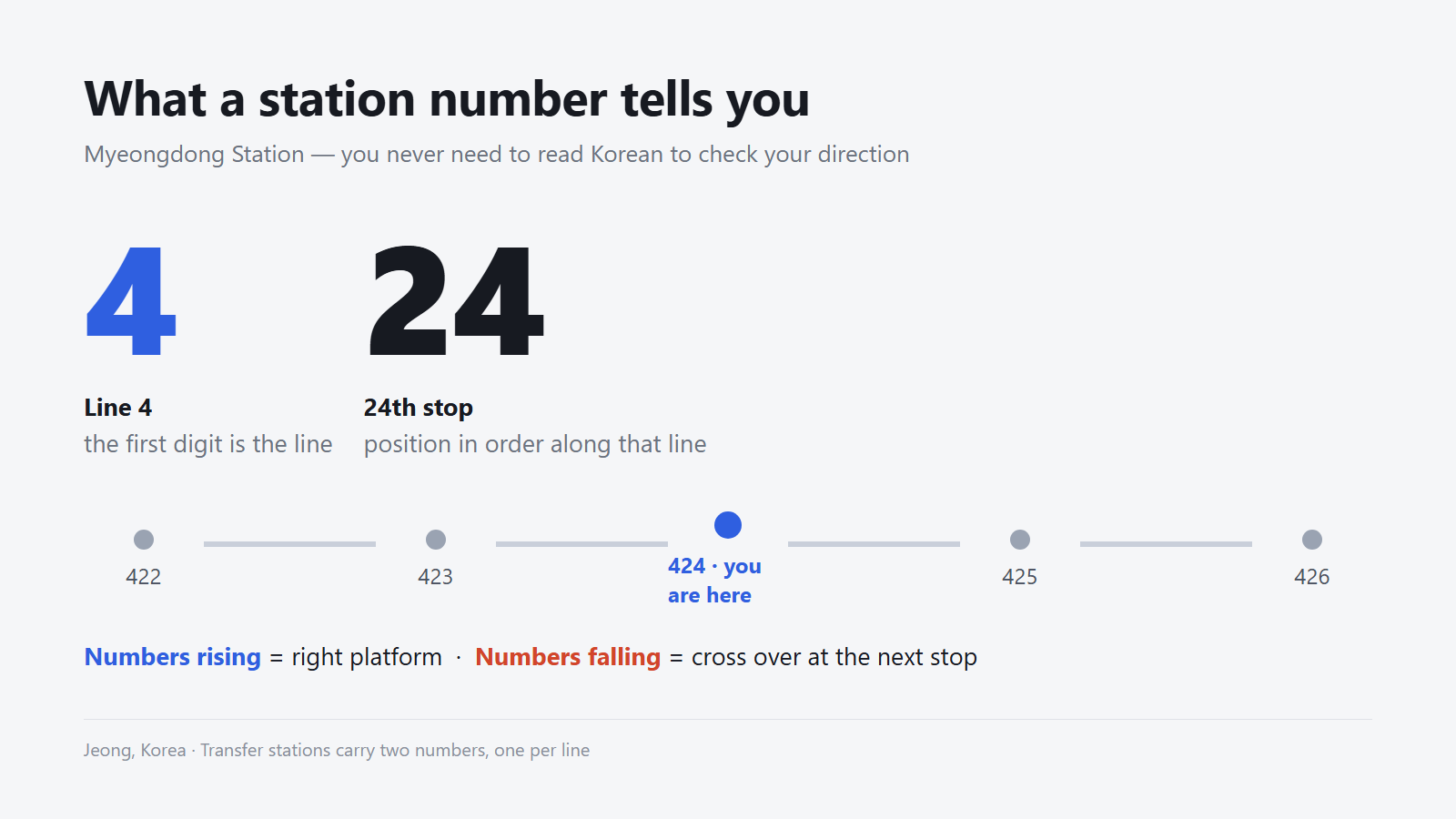
Every station has a three-digit number, and it is doing real work
Look at any station sign and you will see a number in a colored circle. Myeongdong is 424.
-
The first digit is the line. 4 means Line 4.
-
The last two digits are the station's position in order along that line. 24 means it is the 24th stop.
This is the single most useful thing on the seoul subway map, and almost no guide mentions it. It means you never need to read Korean to know whether you are going the right way. If you are at 424 and your destination is 428, the numbers should be rising as you ride. If they start falling, you are on the wrong platform — get off at the next stop and cross over.
Transfer stations carry two numbers, one for each line, because they hold two positions in two different sequences.
The transfer rule that quietly decides your fare
Korea does not charge you per ride. It charges you per journey, and a journey can include subway and bus together.
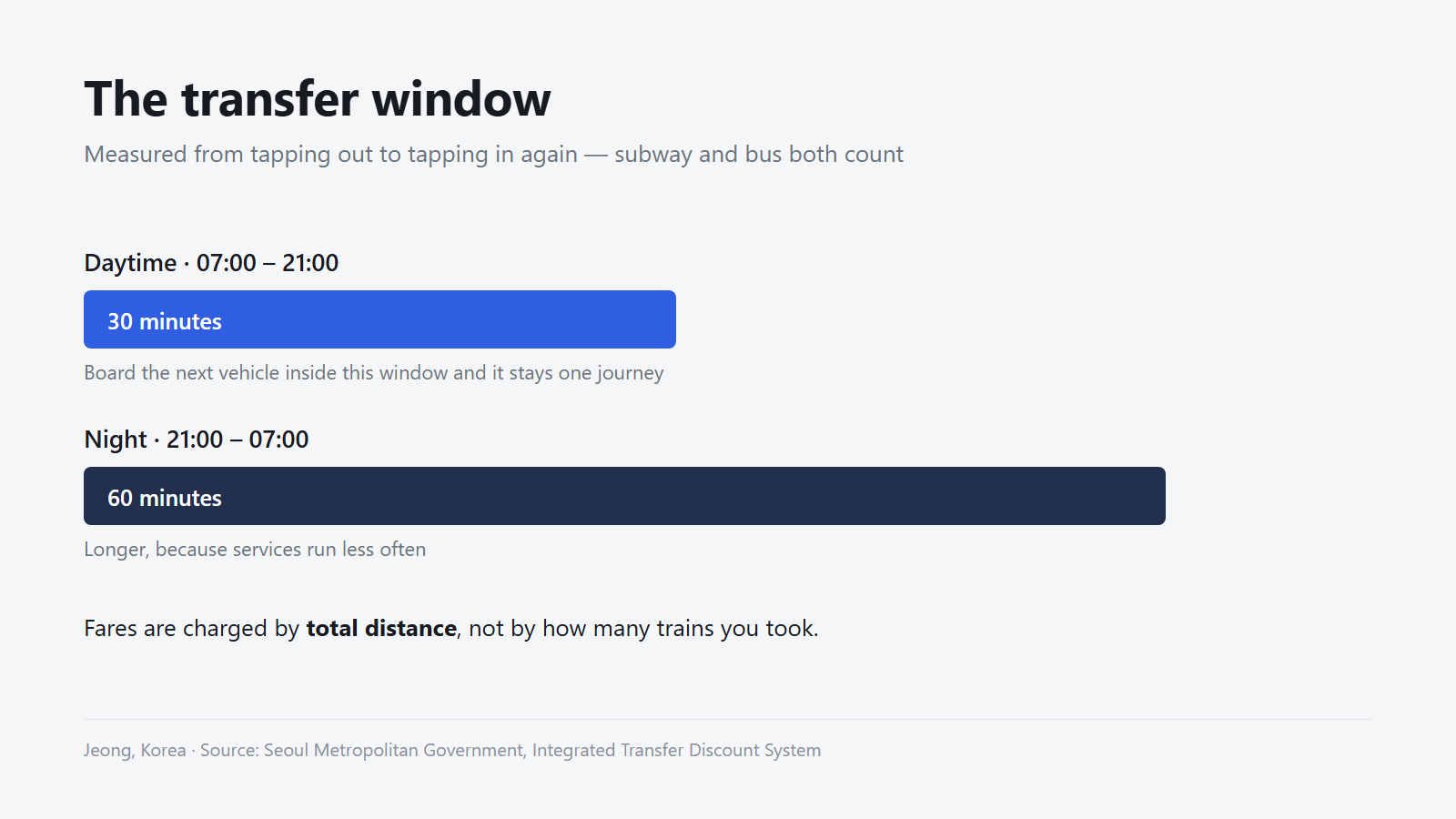
The rule: your transfer counts as one continuous journey if you board the next vehicle within 30 minutes of tapping out. Between 9 PM and 7 AM that window stretches to 60 minutes, because service is thinner late at night. The clock is measured from your tap-out to your next tap-in.
Fares themselves work on distance, not on how many trains you took.
| Amount | |
|---|---|
| Base fare, transit card, adult | 1,550 won |
| Base fare, single-journey cash ticket | 1,650 won |
| Youth / child | 900 won / 550 won |
| Distance covered by the base fare | First 10 km |
| Beyond that | +100 won per additional 5 km |
| Early-bird discount | 20% off the base fare if your first tap-in is before 6:30 AM |
Two consequences worth internalizing. First, always use a card, never a paper ticket — the card is cheaper per ride and it is the only thing that makes transfers free. Second, a bus-then-subway trip usually costs the same as subway alone, so taking the bus for one stop to reach a better line is free. Koreans do this constantly.
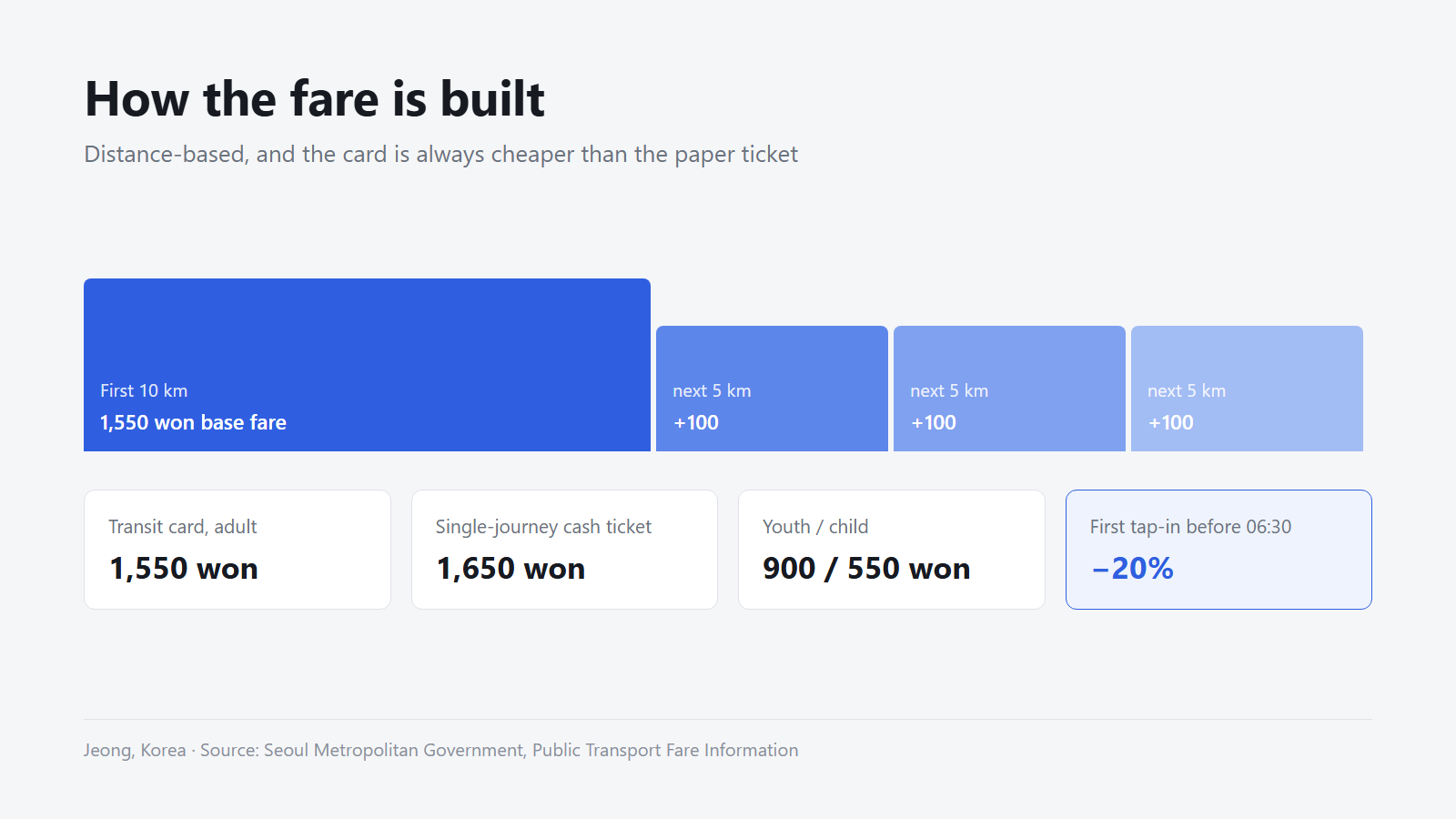
Source: Seoul Metropolitan Government — Public Transport Fare Information.
The ten-minute rule, which is the one nobody tells you
This is my favorite thing about the system and it exists because of those 15 million annual mistakes.
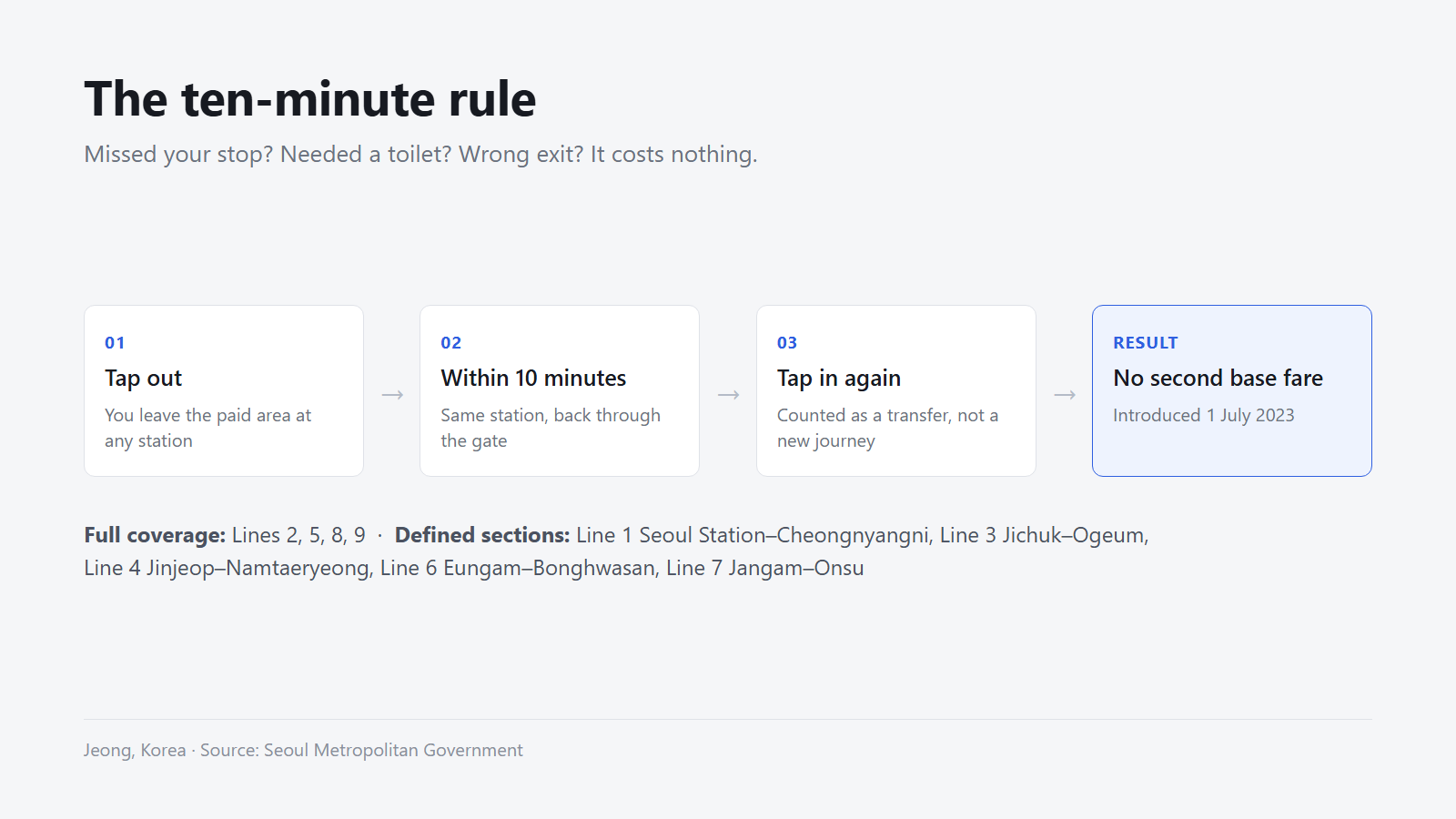
If you tap out and then tap back in at the same station within 10 minutes, it is treated as a transfer instead of a new journey. No second base fare.
It was introduced on 1 July 2023 for exactly the situations you are going to be in: you overshot your stop, you needed a toilet on the paid side, you came up the wrong exit and want to cross under the road.
One caveat — it does not cover the whole network. It applies across all of Lines 2, 5, 8 and 9, and on defined sections of the others: Line 1 between Seoul Station and Cheongnyangni, Line 3 between Jichuk and Ogeum, Line 4 between Jinjeop and Namtaeryeong, Line 6 between Eungam and Bonghwasan, and Line 7 between Jangam and Onsu. That covers essentially all of central Seoul, which is where you will be.
Source: Seoul Metropolitan Government.
Express trains, and why your train might skip your station
Line 9 runs two kinds of train on the same track: express and all-stop. They are physically different trains and they use the same platform, which is how people get caught.
The express skips roughly two thirds of the stations. Riding it from the western end toward Gangnam saves a genuinely large amount of time. Riding it past the station you wanted costs you the same amount back.
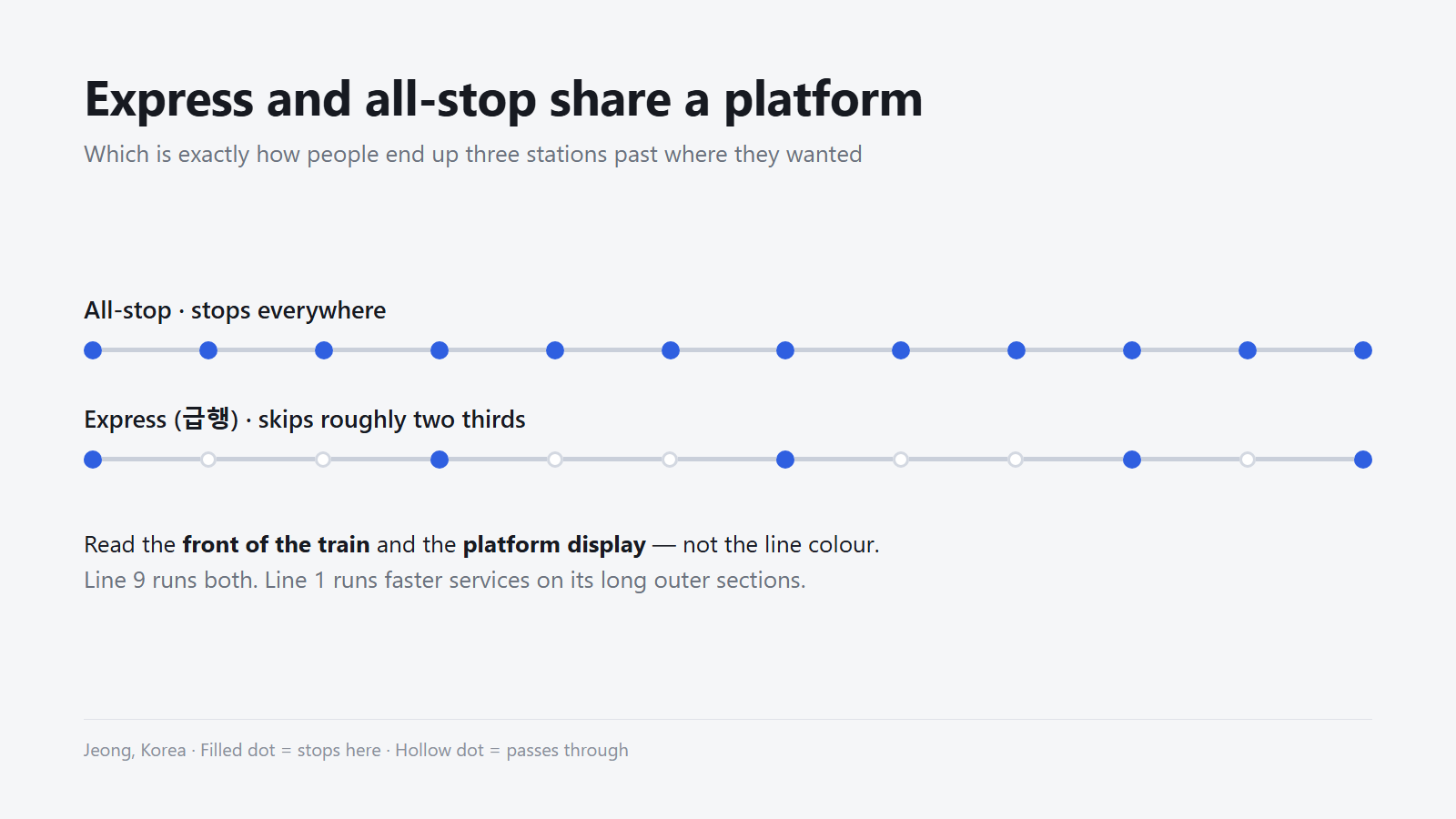
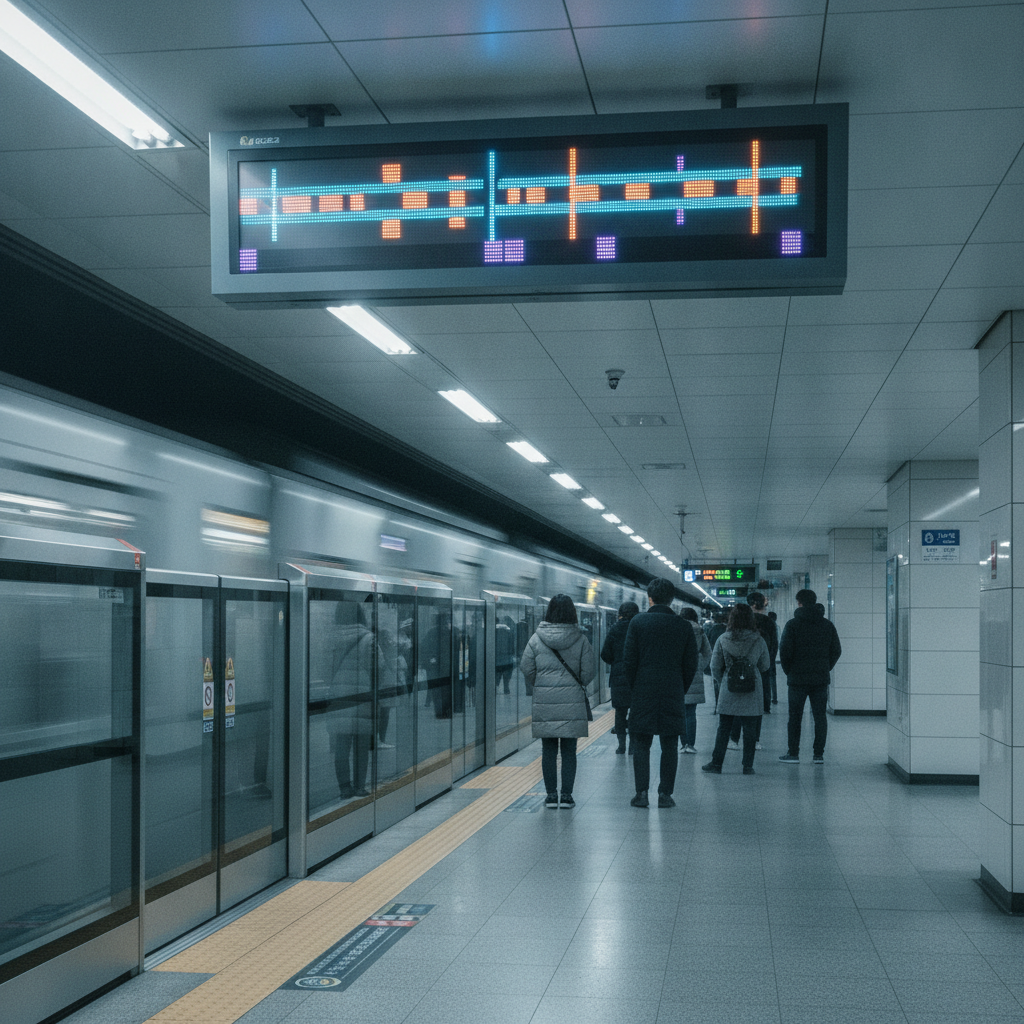
Line 1 also runs faster services on its long outer sections. The rule everywhere is the same: read the front of the train and the platform display, not just the line color. If the display says 급행 (express), it is skipping stops.
Which pass to actually buy
For most visitors the answer is a plain T-money card, topped up as you go. But if you are staying in Seoul and riding a lot, the Climate Card (기후동행카드) has short-term passes made for exactly this.
| Pass | Price |
|---|---|
| 1 day | 5,000 won |
| 2 days | 8,000 won |
| 3 days | 10,000 won |
| 5 days | 15,000 won |
| 7 days | 20,000 won |
Unlimited rides within Seoul for the period. Do the arithmetic honestly: the 1-day pass beats pay-as-you-go from about four rides onward, which is an ordinary sightseeing day but not a slow one. Foreign visitors can buy the physical card at the Seoul Tourism Plaza and Myeongdong tourist information centers.
If you have not sorted out a transit card yet, start with the T-money guide — that is the layer underneath all of this.
Reading it on your phone
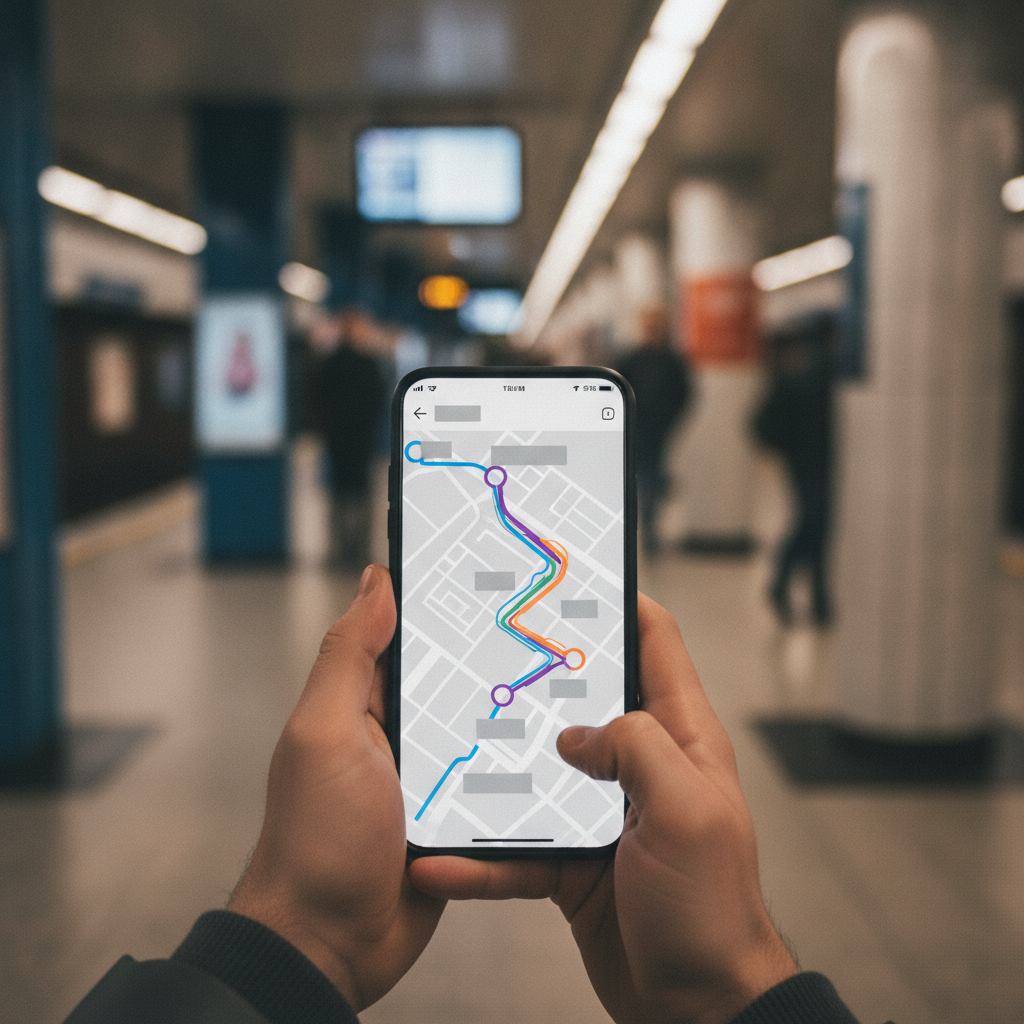
One warning that catches almost every visitor: Google Maps does not give working transit directions in Korea. That is not a bug in your phone and it is not fixable by trying again.
Use Naver Map or KakaoMap instead — both have English interfaces and both know the express trains, the exit numbers, and which car to board for the fastest transfer. Here is why Google Maps fails and what to install.
For the paper version, every station hands out a free English seoul subway map at the information booth, and the wall diagrams are bilingual throughout.
FAQ
Do I pay again when I transfer between subway lines?
No. Transfers within the same journey are free as long as you board within 30 minutes of tapping out — 60 minutes between 9 PM and 7 AM. You are charged by total distance travelled, not by the number of trains. This works between subway and bus too.
What do I do if I get on going the wrong direction?
Get off at the next station and check the station number. If the numbers were falling when they should have been rising, cross to the opposite platform. If you have to leave the paid area to cross, the ten-minute re-entry rule means it costs you nothing as long as you come back within ten minutes at the same station.
Is there an English seoul subway map I can download?
Yes — Seoul Metro publishes bilingual maps, and every station information booth has free printed copies. Naver Map and KakaoMap also carry the full network in English, which is more useful in practice because they update for service changes.
What happens if I miss the last train?
Last trains generally leave the terminals around midnight, and the actual time varies by line and direction, so check the app rather than assuming. If you miss it, taxis are plentiful and the late-night bus network runs through the small hours. Note that the 60-minute transfer window applies at that hour, which helps if you are combining a bus and a train.
Can I eat or drink on the train?
There is no formal ban on drinks, and people carry coffee constantly. Eating a meal on board is not done — it is one of those unwritten rules that nobody will confront you about and everybody will notice.
The short version
Colors get you on the right line. The three-digit numbers tell you whether you are going the right way. Thirty minutes keeps your transfer free, and ten minutes forgives your mistake.
That is the whole system. Everything else on the seoul subway map is decoration.
And if you are planning the rest of the trip, the airport-to-city routes are the decision you will make before any of this matters.
Sources
-
Seoul Metropolitan Government — Public Transport Fare Information: https://news.seoul.go.kr/traffic/traffic\_price
-
Seoul Metropolitan Government — Integrated Transfer Discount System: https://news.seoul.go.kr/traffic/transfer\_discount
-
Seoul Metropolitan Government Media Hub — 10-minute re-entry rule: https://mediahub.seoul.go.kr/archives/2008368
Fares and service hours change. Check before you travel.