Halal Food in Seoul: Where to Actually Eat, and What the Labels Do Not Tell You

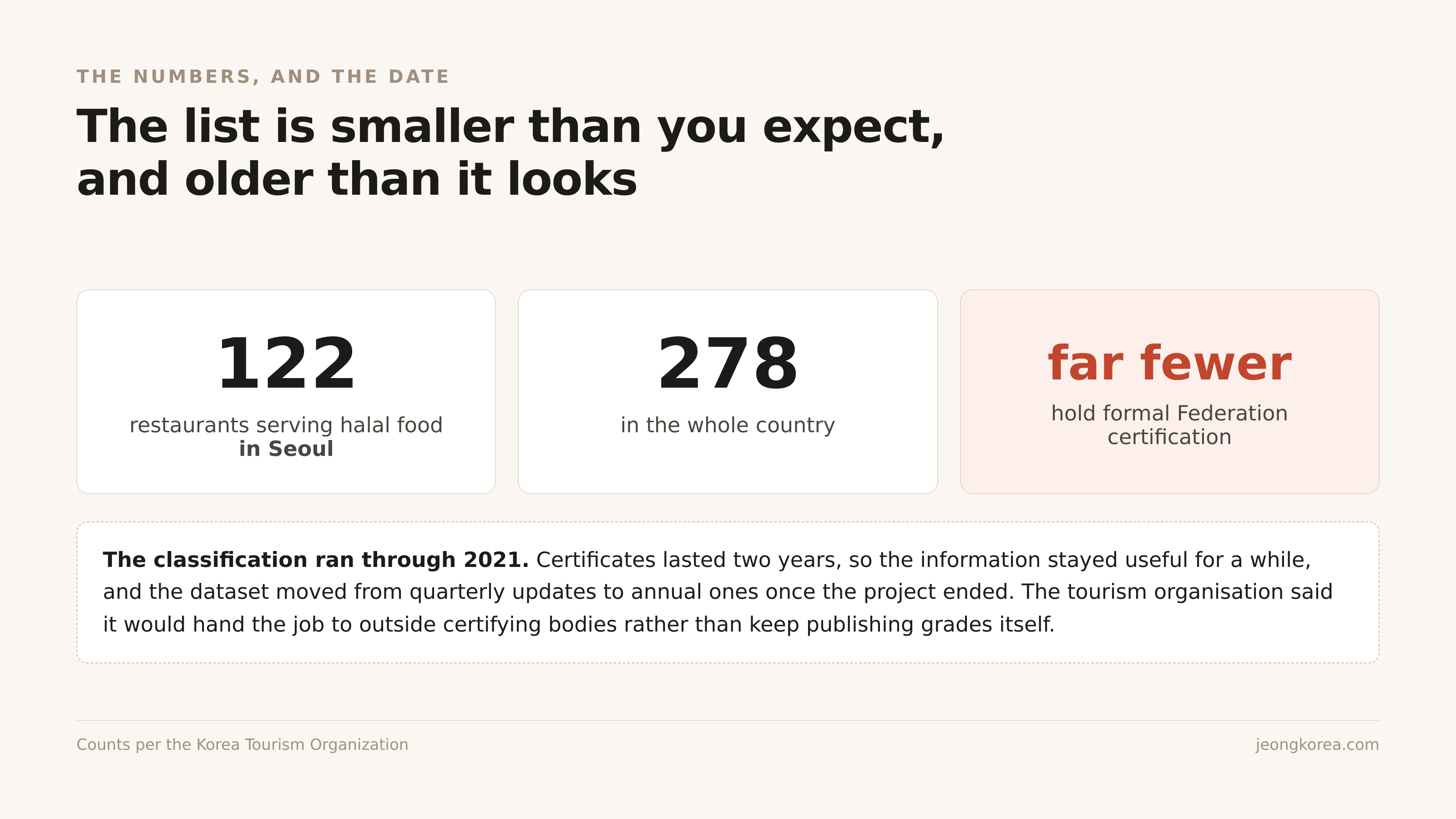
Seoul has about 122 places serving halal food. Only a handful are certified. One of those serves Korean food.
That last one matters more than the number does. Plenty of cities have Turkish and Pakistani restaurants. What a Muslim visitor to Korea usually wants is Korean food, eaten in Korea, without having to guess, and that is a much shorter list.
Halal food in Seoul is easier to find than the guides suggest, but only if you start in the right place. So this piece is in two halves. First, where to go. Then what the labels on everything else actually promise, because they promise far less than they sound like.
Start with the hill behind the mosque
Most halal food in Seoul is clustered in Hannam-dong in Yongsan District, on and around the slope leading up to the Seoul Central Mosque. Turkish kebab houses, Pakistani and Indian kitchens and Middle Eastern bakeries sit along that street, most of them displaying either a Korea Muslim Federation sticker or a hand-written sign in Arabic.
The reason to start here is not that it is the most famous area. It is that these restaurants serve a Muslim community that actually lives in the neighbourhood. Regulars would notice if a kitchen changed how it worked, which is a form of accountability no badge provides.
EID (이드) is the one to know. It is a small family-run Korean restaurant a short walk from the mosque, and it is the Korean restaurant in Seoul most consistently cited as holding active Korea Muslim Federation certification. The menu changes a little day to day and covers the dishes you came for: bibimbap, bulgogi, samgyetang in a clay pot, with refillable side dishes. Seating is limited, so go outside peak hours or expect a queue. Seoul's own city tourism site lists it.
Halal Kitchen (할랄키친) is the other one worth writing down, and it is nowhere near Itaewon. It sits in Samcheong-dong by Bukchon Hanok Village, open daily from 11am to 9pm, cooking Korean food with halal ingredients and doing lunch boxes for delivery. Braised lamb ribs and dakgangjeong are what it is known for.
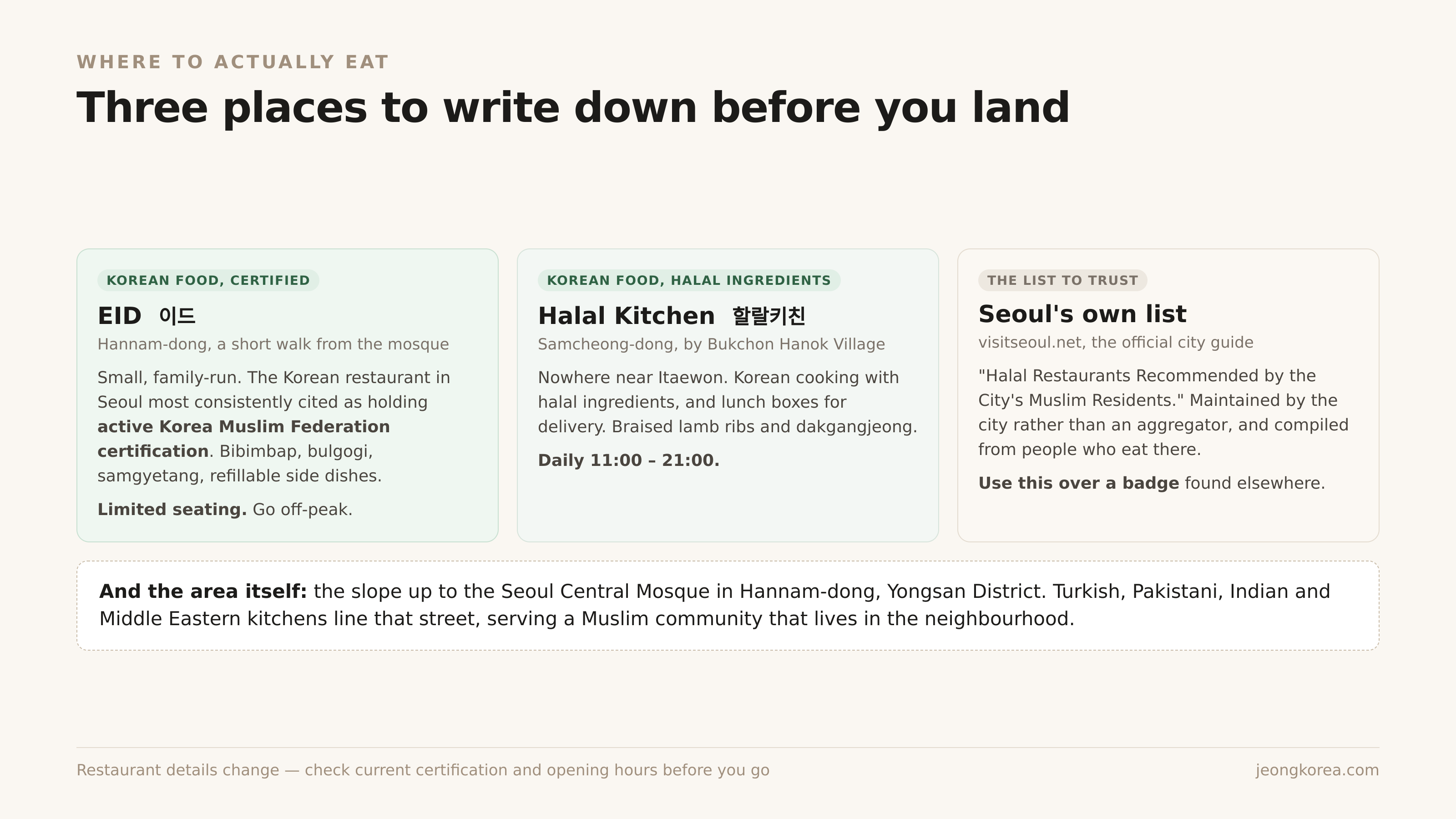
Beyond those two, the list that is worth trusting is the one Seoul city publishes itself: Seoul's Halal Restaurants Recommended by the City's Muslim Residents, on the official VisitSeoul site. It is maintained by the city rather than by an aggregator, and it is compiled from people who eat there.
That is the practical answer. The rest of this is about why you cannot simply trust a label you find somewhere else.
The four grades, and how far apart they are
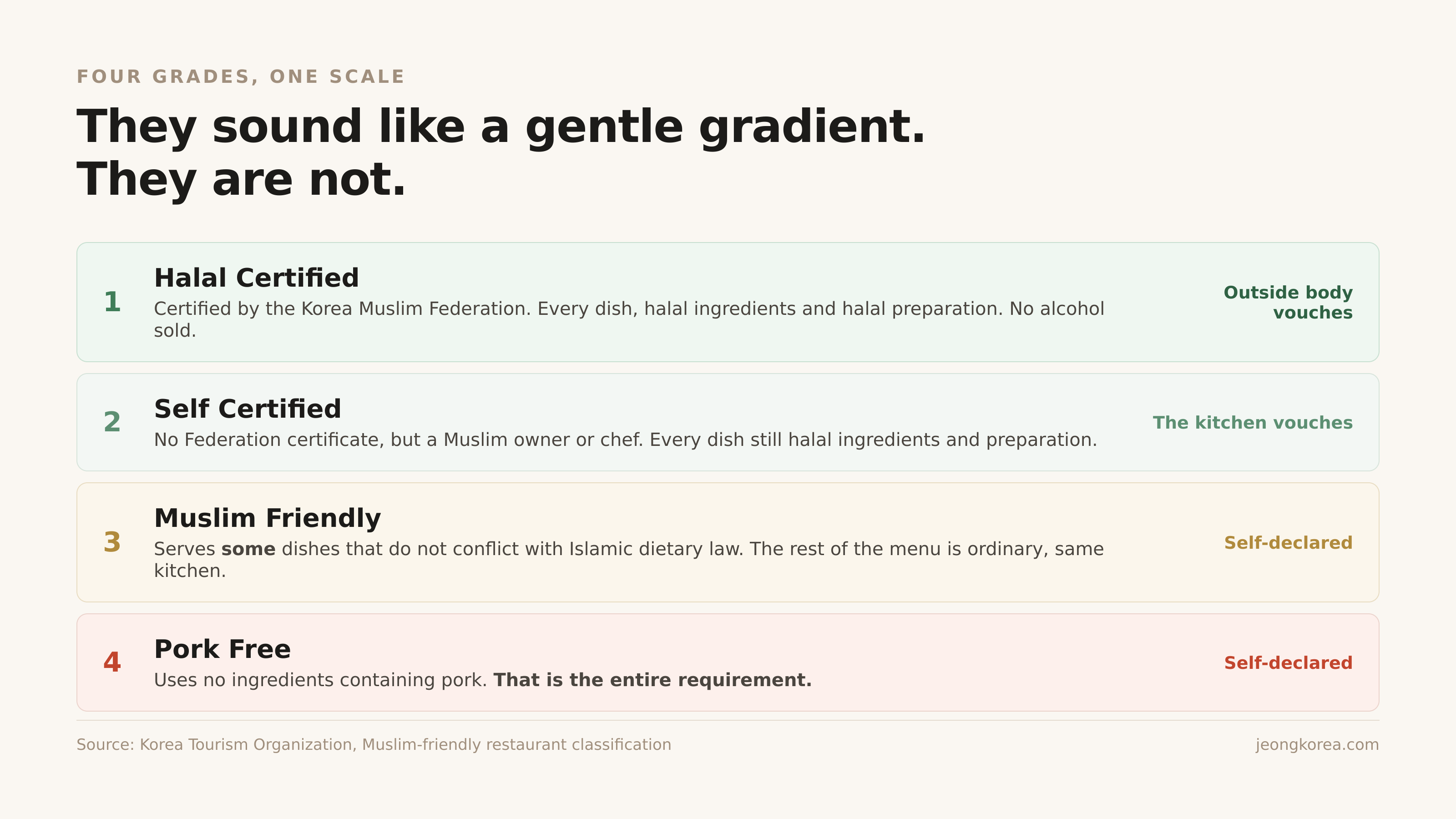
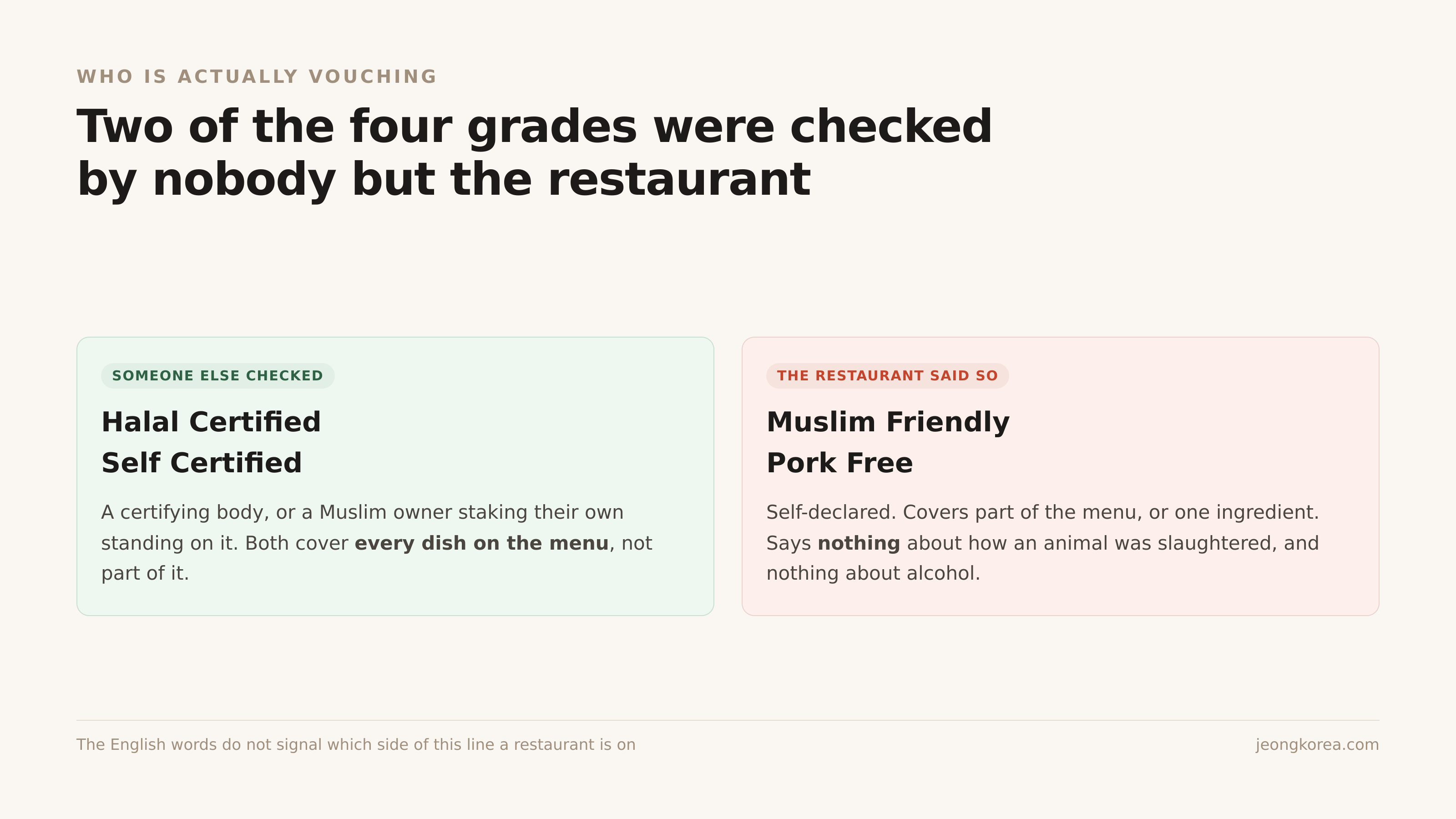
Korea's tourism authority sorted Muslim-friendly restaurants into four categories. In English they sound like a gentle gradient. In practice the distance between the top and the bottom is enormous.
| Grade | Who vouches for it | What it covers | Alcohol |
|---|---|---|---|
| Halal Certified | Korea Muslim Federation | Every dish | Not sold |
| Self Certified | The Muslim owner or chef | Every dish | Not specified by the grade |
| Muslim Friendly | The restaurant | Some dishes only | Usually sold |
| Pork Free | The restaurant | Pork only | Usually sold |
Halal Certified means formal certification by the Korea Muslim Federation, which was founded in 1967 and has issued halal certification since 1994. Every dish, halal ingredients and halal preparation, and no alcohol sold at all.
Self Certified means no Federation certificate but a Muslim owner or chef, still covering every dish. The difference is who vouches: the kitchen rather than an outside body.
Muslim Friendly means the restaurant serves some dishes that do not conflict with Islamic dietary law. Not all of them. The rest of the menu is ordinary food from the same kitchen.
Pork Free means no ingredients containing pork. That is the entire requirement.
One more thing is worth knowing about these labels. Korean reporting indicates the tourism authority ran the classification through 2021 and then stopped publishing the grades directly, handing that role to outside certifying bodies. The labels stayed in circulation afterwards, which means a badge you find on an aggregator today may date from a classification round some years ago.
That is not a reason to distrust the grades. It is a reason to treat one as a starting point rather than a verdict, and to check the certifying body rather than the badge.
"Pork Free" is the label most likely to mislead you
In English, "pork free" reads like a safety guarantee. In this system it is the lowest rung, and it answers exactly one question.
It does not say the beef or chicken was slaughtered according to Islamic requirements. It does not say the kitchen keeps separate equipment. It does not say anything about alcohol in the cooking. It says there is no pork in the ingredients, and Korean restaurants that serve no pork are extremely common for reasons that have nothing to do with religion.
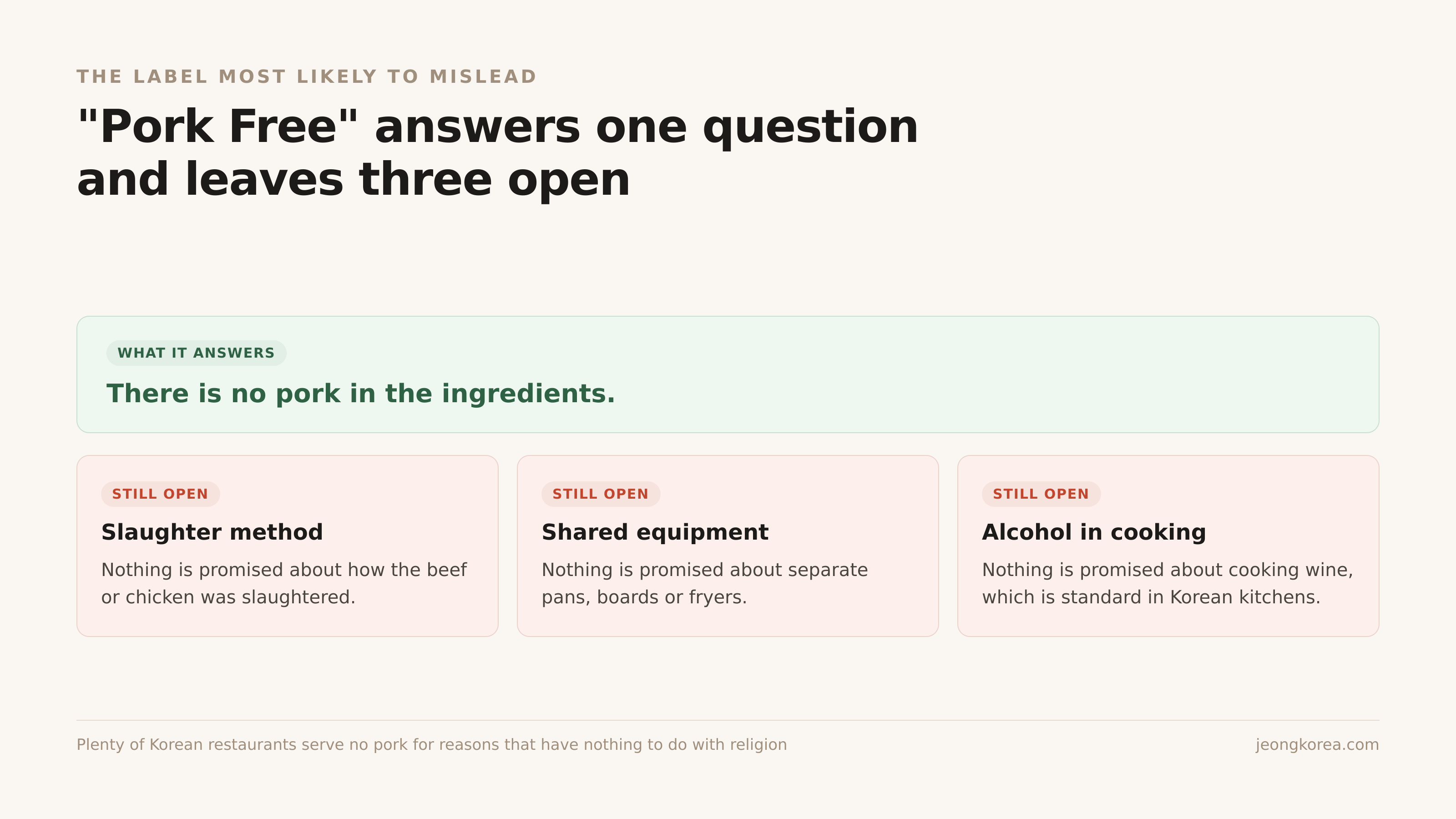
This is the same shape as the problem in the broth that makes a vegetarian dish not vegetarian. A label answers the question it was written to answer, and a visitor reads it as answering a larger one. The label is not lying. It is just narrower than it sounds.
So what is the thing the lower grades leave out?
The cooking wine nobody mentions
Korean kitchens routinely use cooking wine to take the odour off meat and fish. It appears in recipes as 맛술 or 미림, and it is not a symbolic splash. Mirin is made from rice koji with added spirit and contains around fourteen percent alcohol. Supermarket cooking wines sit between roughly ten and nineteen percent, comparable to diluted soju.
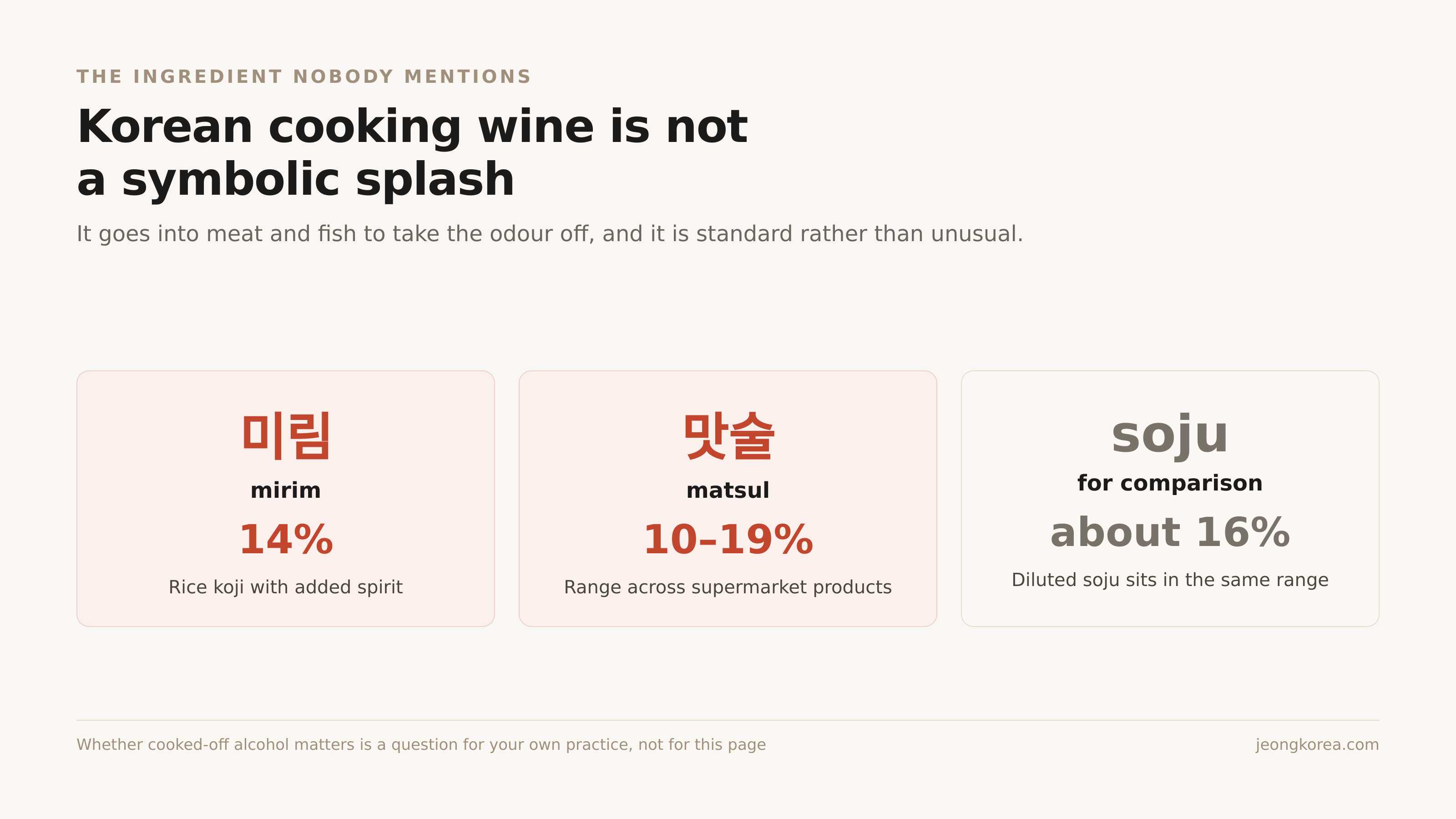
Whether cooked-off alcohol matters is a question for you and your own practice, and it is not one this article is qualified to settle. What is worth knowing is that the ingredient is there, it is standard rather than unusual, and a Pork Free or Muslim Friendly restaurant has made no commitment about it either way.
The way to find out is the same as everywhere else in Korean cooking: ask about the specific ingredient rather than the general category. That is also how you get a straight answer about what is actually in a Korean dish when you cannot see it.
Three questions to have on your phone
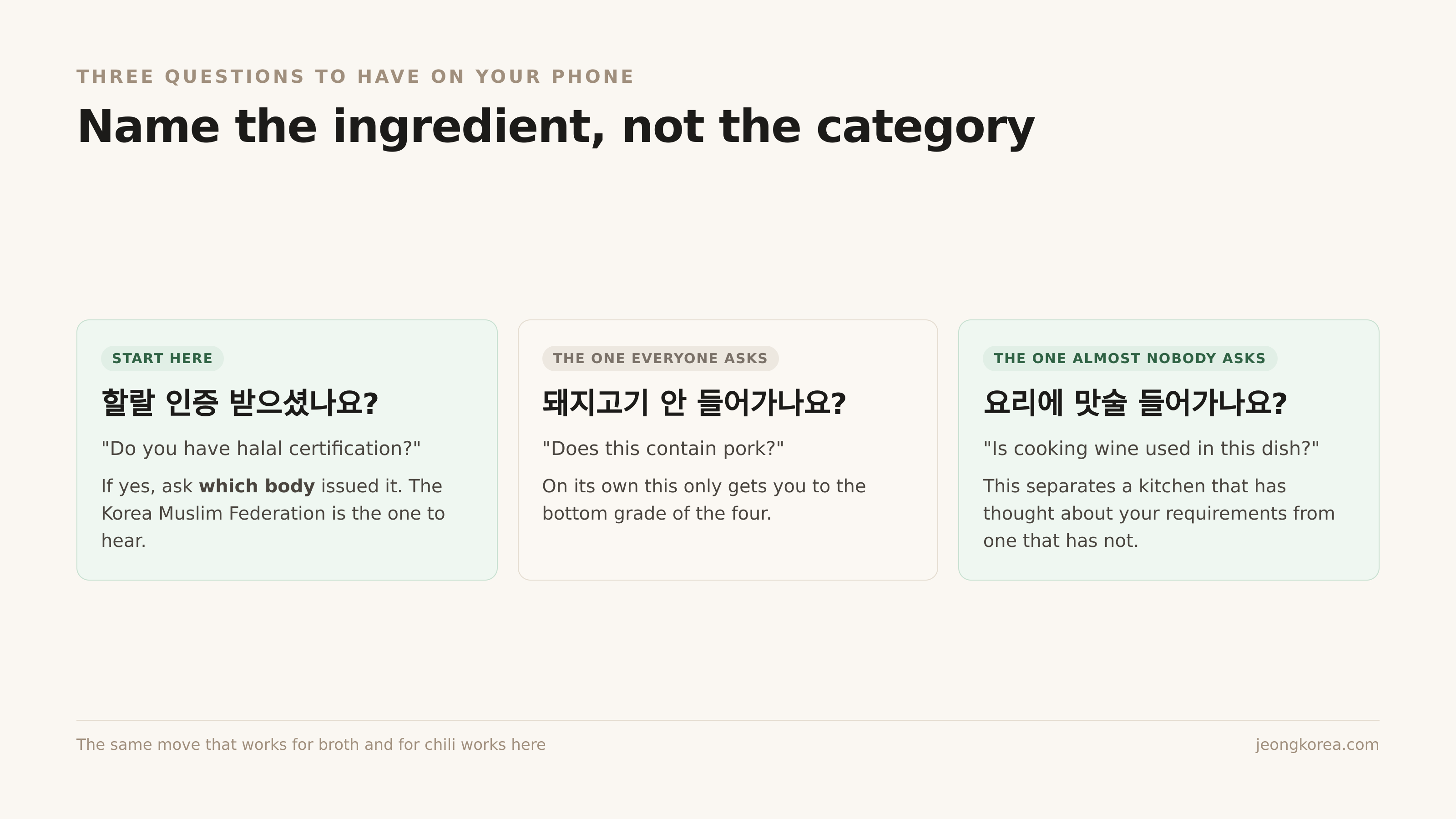
할랄 인증 받으셨나요? means "do you have halal certification?" If the answer is yes, ask which body issued it. The Korea Muslim Federation is the one to hear.
돼지고기 안 들어가나요? means "does this contain pork?" This is the question most visitors already ask, and on its own it only gets you to the bottom grade.
요리에 맛술 들어가나요? means "is cooking wine used in this dish?" This is the question almost nobody asks, and it is the one that separates a kitchen that has thought about your requirements from one that has not.
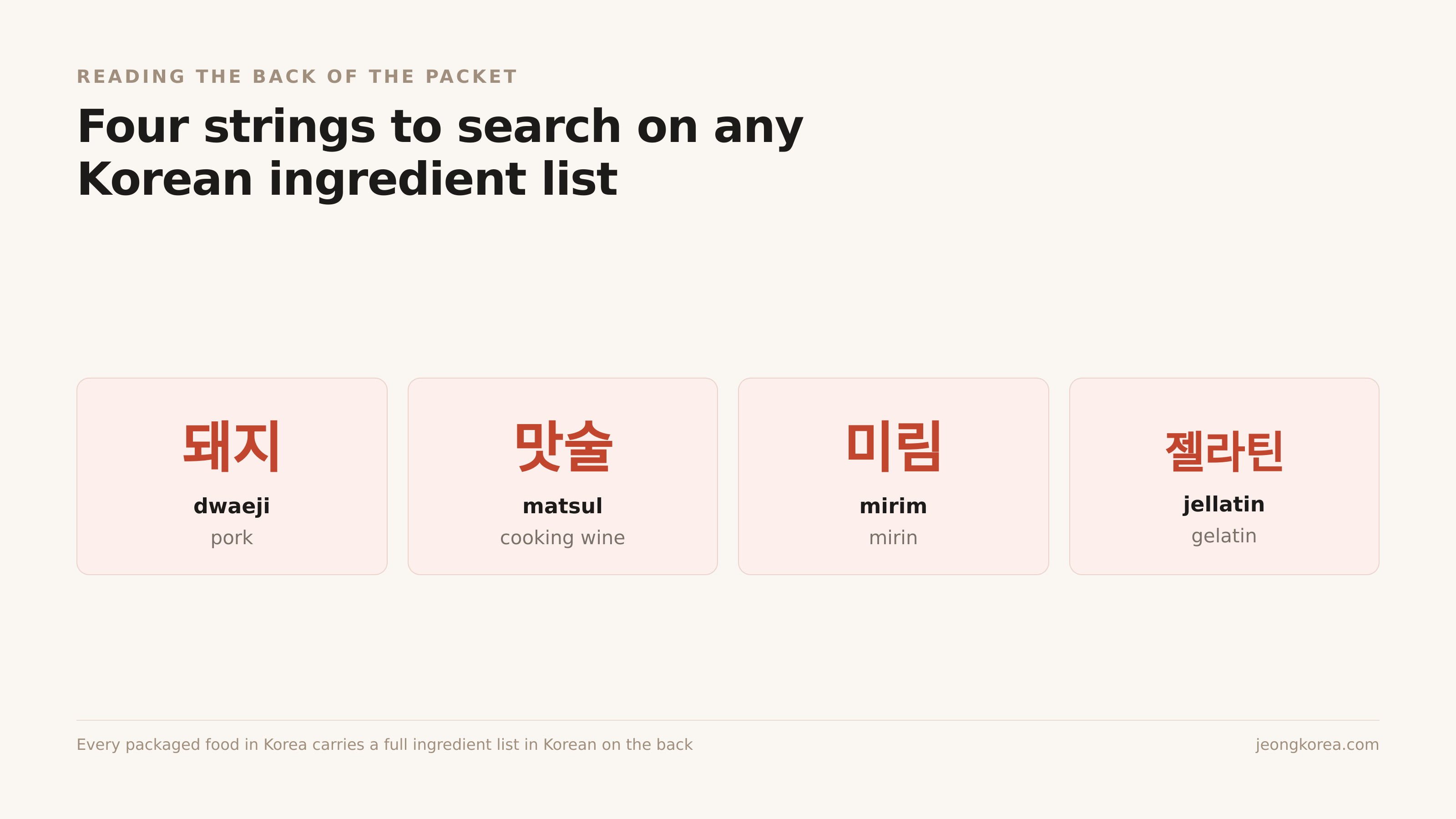
Packaged food carries a full ingredient list in Korean on the back, and the strings to search are 돼지 for pork, 맛술 and 미림 for cooking wine, and 젤라틴 for gelatin. The same label-reading skill that makes Korean convenience stores navigable works here too.
FAQ
Where is the halal area in Seoul?
Hannam-dong in Yongsan District, on the slope up to the Seoul Central Mosque. Most of it is concentrated there, and those restaurants serve a resident Muslim community rather than only tourists.
Is there halal Korean food, not just kebabs?
Yes, though the list is short. EID near the mosque is the Korean restaurant most consistently cited as holding active Korea Muslim Federation certification, and Halal Kitchen in Samcheong-dong cooks Korean food with halal ingredients. Seoul's official city tourism site also publishes a list compiled from Muslim residents.
Is Korean food halal by default?
No. Pork is common, and Korean kitchens routinely use cooking wine containing roughly ten to nineteen percent alcohol to remove odour from meat and fish. Beef and chicken dishes also carry no assurance about slaughter method unless the restaurant is certified.
What does "Muslim Friendly" actually mean in Korea?
It was one of four grades in the tourism classification, and it meant the restaurant served some dishes that do not conflict with Islamic dietary law, not all of them. It was self-declared rather than certified.
Before you go
Finding halal food in Seoul is easier than it looks if you start in the right place and read the labels for what they say rather than what they suggest. Go to the hill behind the mosque, note EID and Halal Kitchen if you want Korean food specifically, and use the city's own list rather than an aggregator's.
Then do the one thing almost nobody does, and do it before you are hungry and standing in a doorway. Ask which body certified the restaurant, and ask about the cooking wine. Two questions, ten seconds, and they are the difference between eating well here and eating carefully.