Vegetarian Food in Korea: The Broth Is the Problem, Not the Menu

Order the mushroom stew in Seoul. There will be no meat in the bowl. It still will not be a vegetarian meal.
Most guides to vegetarian food in Korea start from the wrong place. They hand you a list of dishes that look plant-based and tell you to point at them. Bibimbap. Doenjang-jjigae. Japchae. Kimchi. The logic seems sound, because in most cuisines a dish without visible meat is a dish without meat.
Korean food is not built that way. The base unit of a Korean meal is not the side dish. It is the liquid the dish was made in, and that liquid is almost always animal. Once you understand that, the whole problem changes shape. You stop trying to subtract meat from dishes and start looking for the dishes where it was never added.
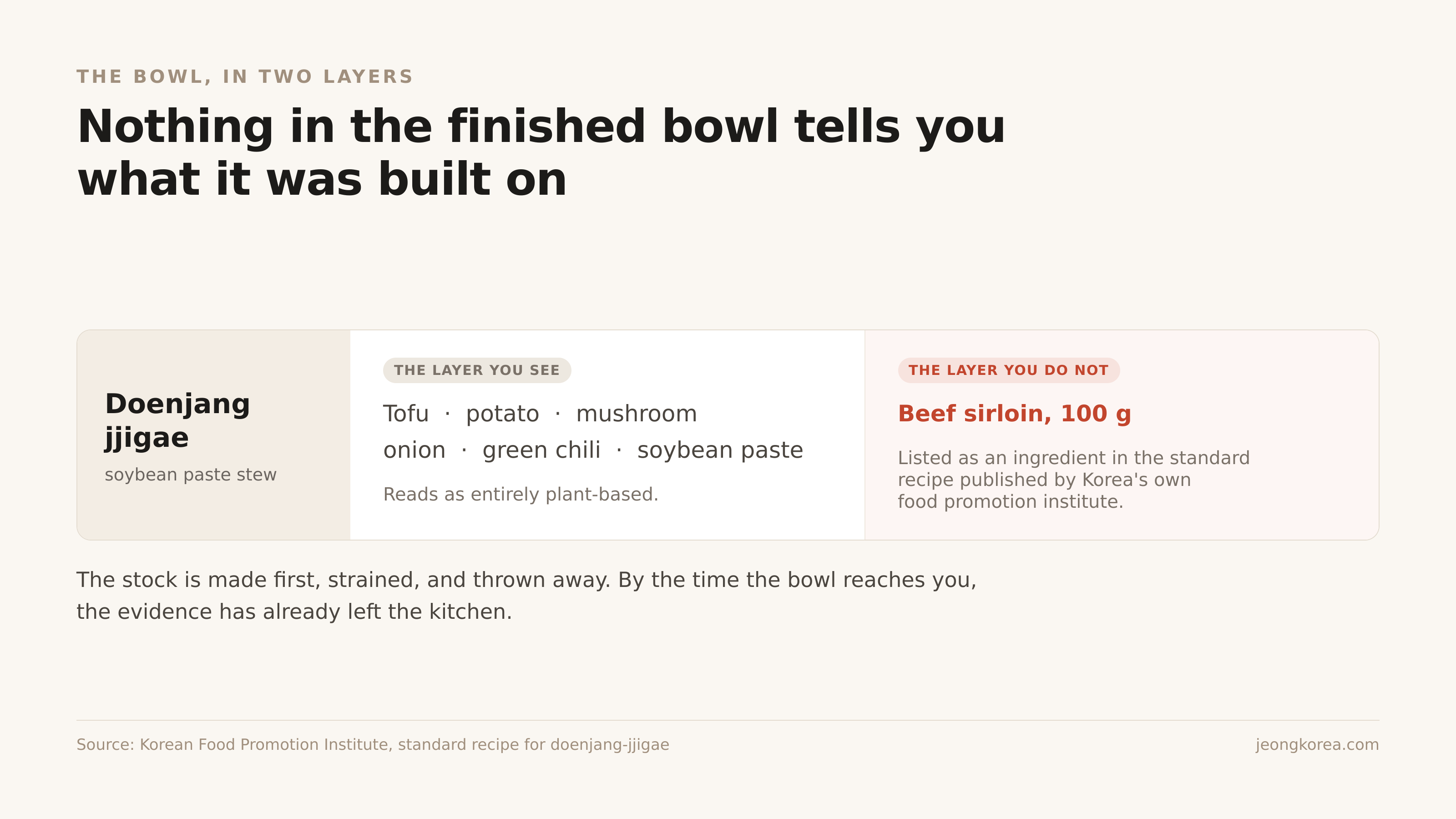
The meat is in the broth, and the official recipe says so
If you want proof that this is a structural feature and not a matter of one careless cook, read the country's own recipe.
The Korean Food Promotion Institute publishes standard recipes for Korean dishes. Its recipe for doenjang-jjigae, the soybean paste stew that reads as the most vegetable-forward thing on any menu, lists 100 grams of beef sirloin in the ingredients. Not as an option. As an ingredient, alongside the tofu and the potato and the mushrooms.
That is the dish foreigners are most often told is the safe vegetarian choice.
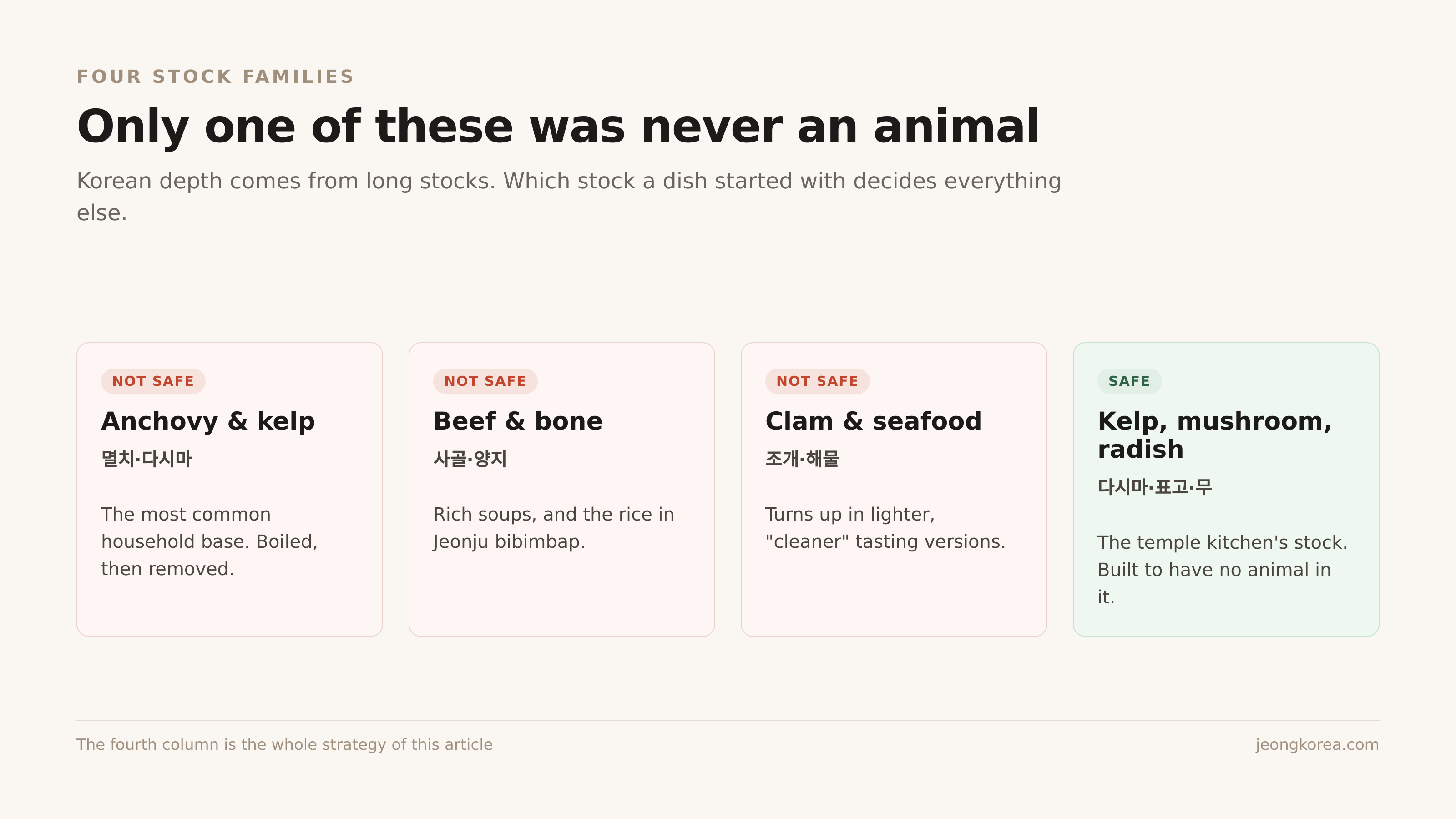
Anchovy and kelp stock is the other common base, and clam stock turns up in seafood-leaning versions. What all three have in common is that they are invisible. They are made before the dish starts, strained, and thrown away. Nothing in the finished bowl shows you what it was built on. A cook who has never thought about it will look at a pot of doenjang-jjigae and say, truthfully as they understand it, that there is no meat in it.
So the question you have been asking at the counter has been answering a different question than the one you meant.
Here is what sits underneath the dishes most often recommended to vegetarians:
| Dish | Looks like | What is usually underneath |
|---|---|---|
| Doenjang-jjigae | Soybean paste and vegetables | Beef, or anchovy and kelp stock |
| Kimchi-jjigae | Kimchi and tofu | Pork, plus the jeotgal already in the kimchi |
| Japchae | Glass noodles and vegetables | Beef, often stir-fried in first |
| Bibimbap | Rice and namul vegetables | Beef, and in Jeonju the rice itself |
| Kalguksu | Hand-cut noodles | Anchovy or chicken stock |
| Tteokbokki | Rice cakes in chili sauce | Anchovy stock, fish cake |
That fourth row is not a generalisation. In Jeonju bibimbap the rice is cooked in beef broth before anything is put on top of it, which means the one component you assumed was neutral is the component carrying the meat.
So if the meat is in the part you cannot see, what happens when you ask for it to be left out?
"No meat" means something narrower in Korean
Ask a Korean server to make your dish without meat and you will usually get a yes. The yes is sincere. It is also answering a smaller question than you asked.
In everyday Korean usage, 고기 refers to flesh you can identify: pork belly, beef, chicken. It does not reliably extend to stock, to fish sauce, to the anchovies that were boiled and removed, or to the shrimp paste folded into the kimchi. When a cook says there is no meat, they are telling you there is no piece of meat, and they are correct.
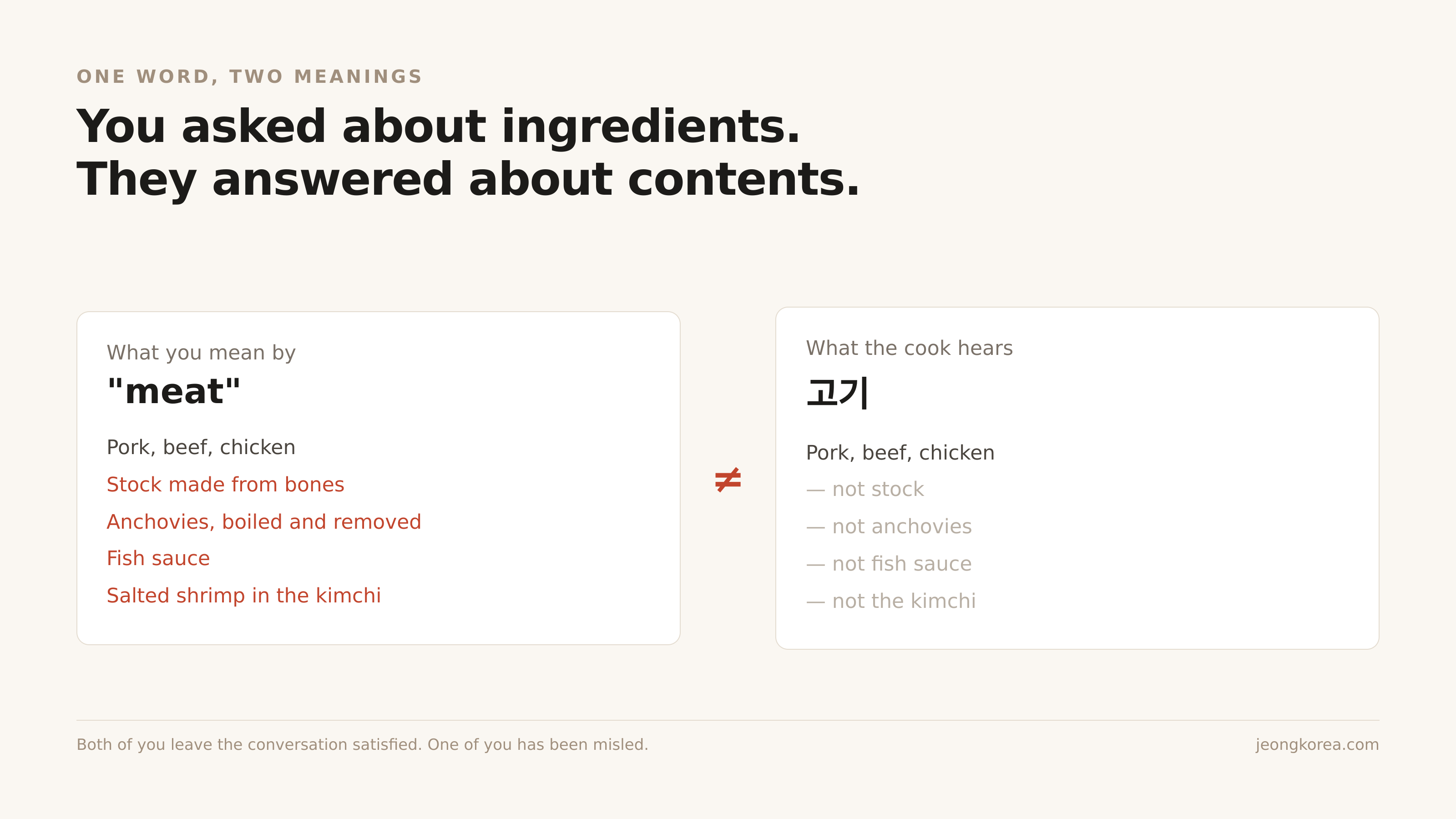
This is why the same conversation goes wrong in the same way for almost everyone. You ask a question about ingredients. They hear a question about contents. Both of you leave satisfied and one of you has been misled.
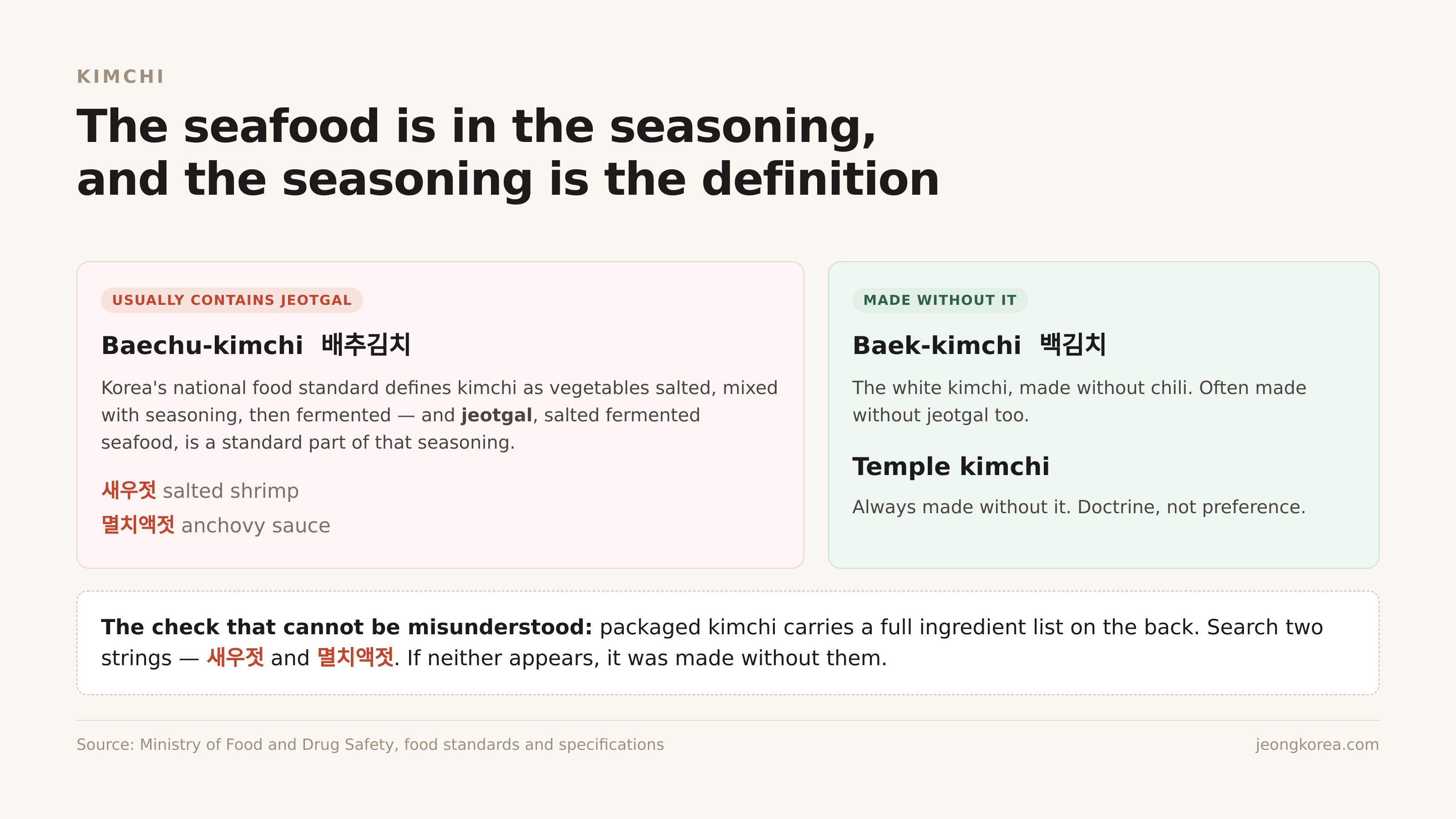
Kimchi is the clearest case. Korea's national food standards define kimchi as vegetables that are salted, mixed with seasoning, and fermented, and jeotgal, salted fermented seafood, is a standard part of that seasoning. Salted shrimp and anchovy sauce are not a regional flourish. They are how the seasoning is normally built. You will not see them in the finished kimchi and no one will think to mention them.
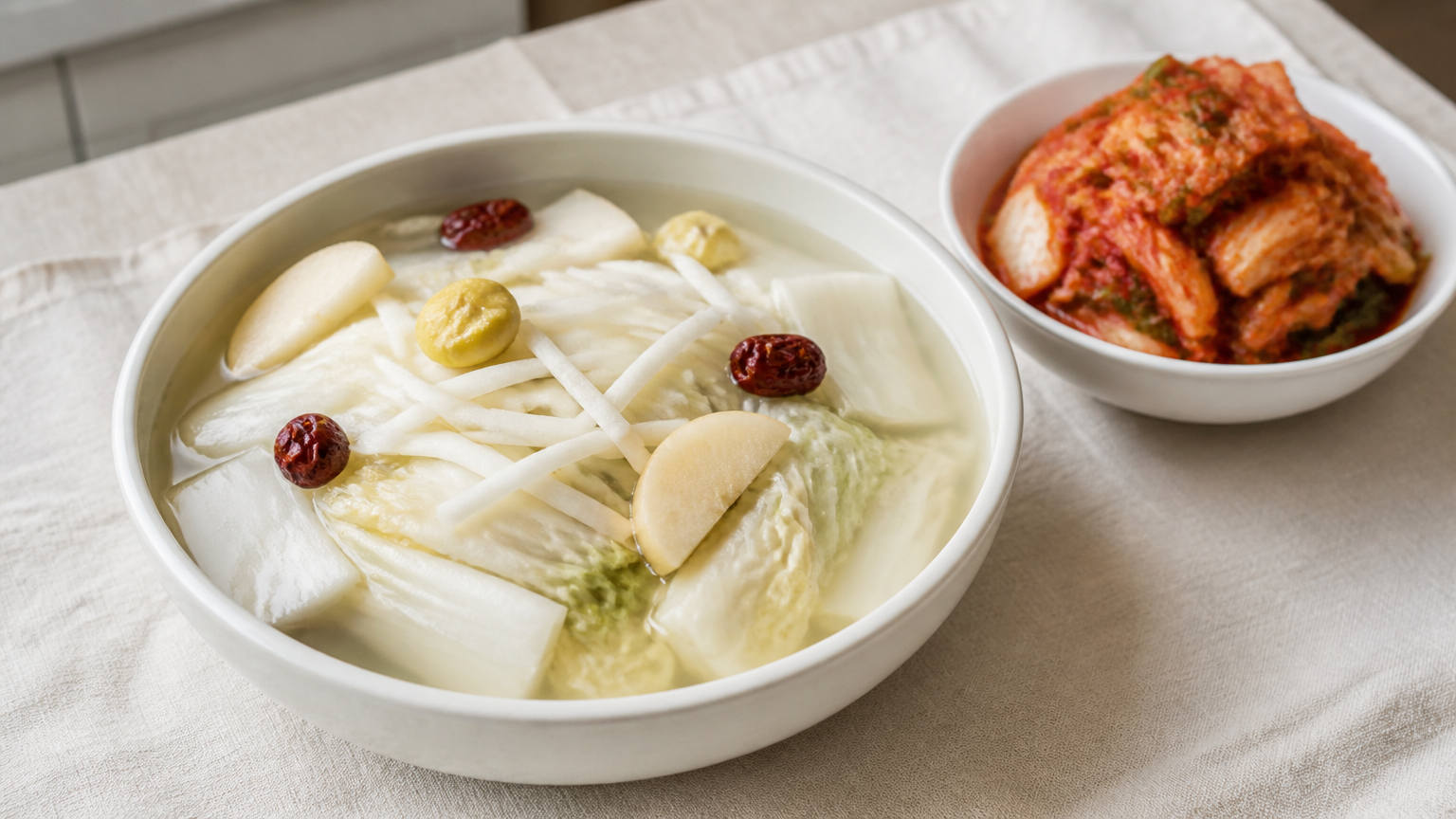
The practical move here is not to ask better questions in English. It is to check the thing that cannot be misunderstood: on any packaged kimchi in a supermarket, the ingredient list is printed on the back. 새우젓 is salted shrimp and 멸치액젓 is anchovy sauce. If neither appears, you are holding kimchi made without them, and those do exist. Baek-kimchi, the white kimchi made without chili, is often one of them, and temple kimchi always is.
Knowing how to be told the truth is useful. Knowing where the truth was never a problem is better.
Three places where the broth was never animal
Vegetarian food in Korea gets much simpler in three categories, because in those you are not negotiating with a recipe. The recipe was built to exclude animals from the start.
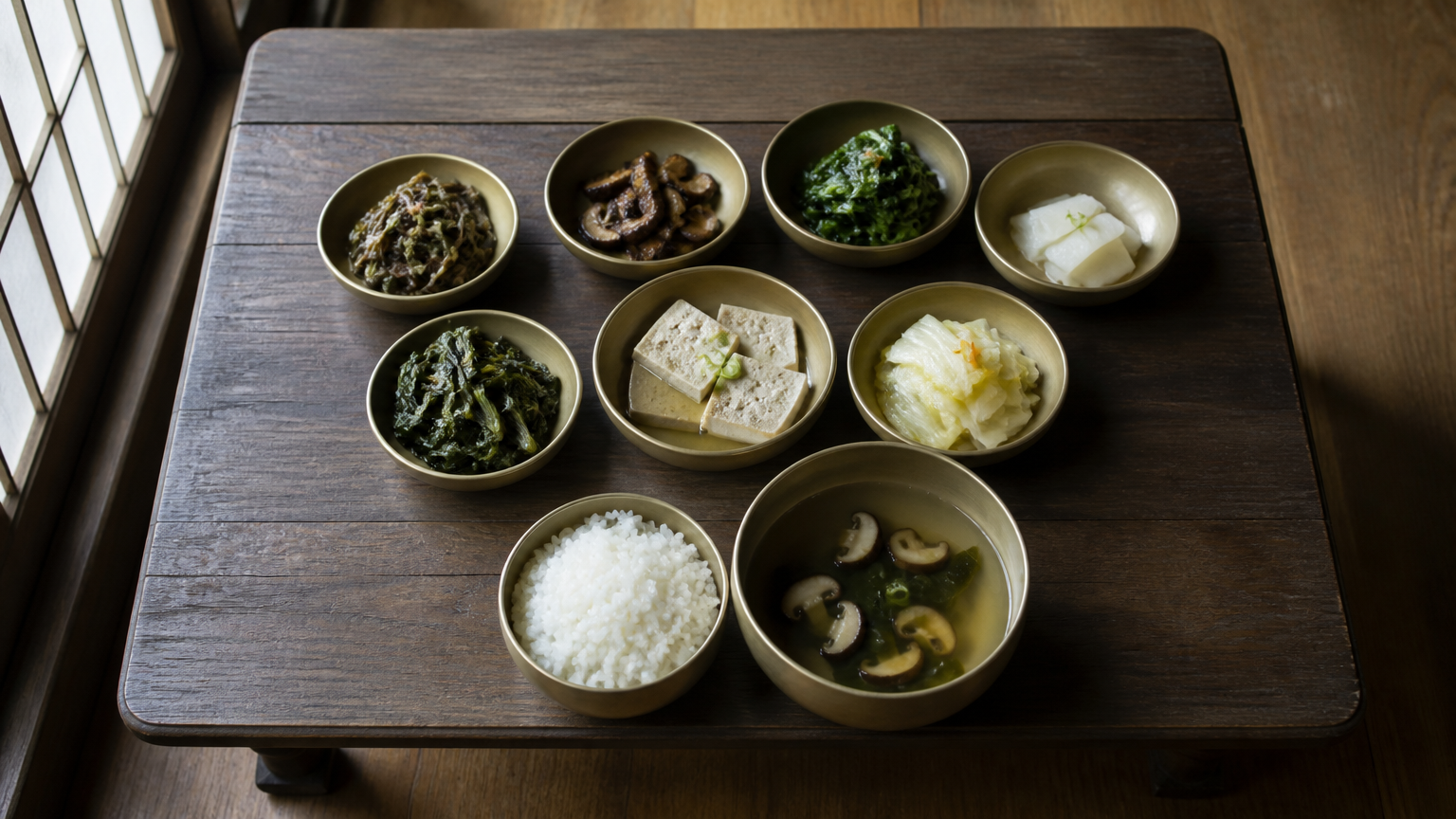
Temple food. Korean Buddhist temple cuisine, or sachal eumsik, is fully plant-based by doctrine, and it goes further than most Western vegetarian cooking by also excluding the five pungent vegetables, including garlic and onion. This is not a modern health trend adapted for tourists. It is a monastic tradition with its own stock made from kelp, mushroom, and radish. The Jogye Order runs a temple food centre in central Seoul through its Korean Buddhist Culture Foundation, with hands-on classes and interpreted sessions for foreign participants. It is the single most reliable full meal in the country for a strict vegetarian, and it is also the best one.
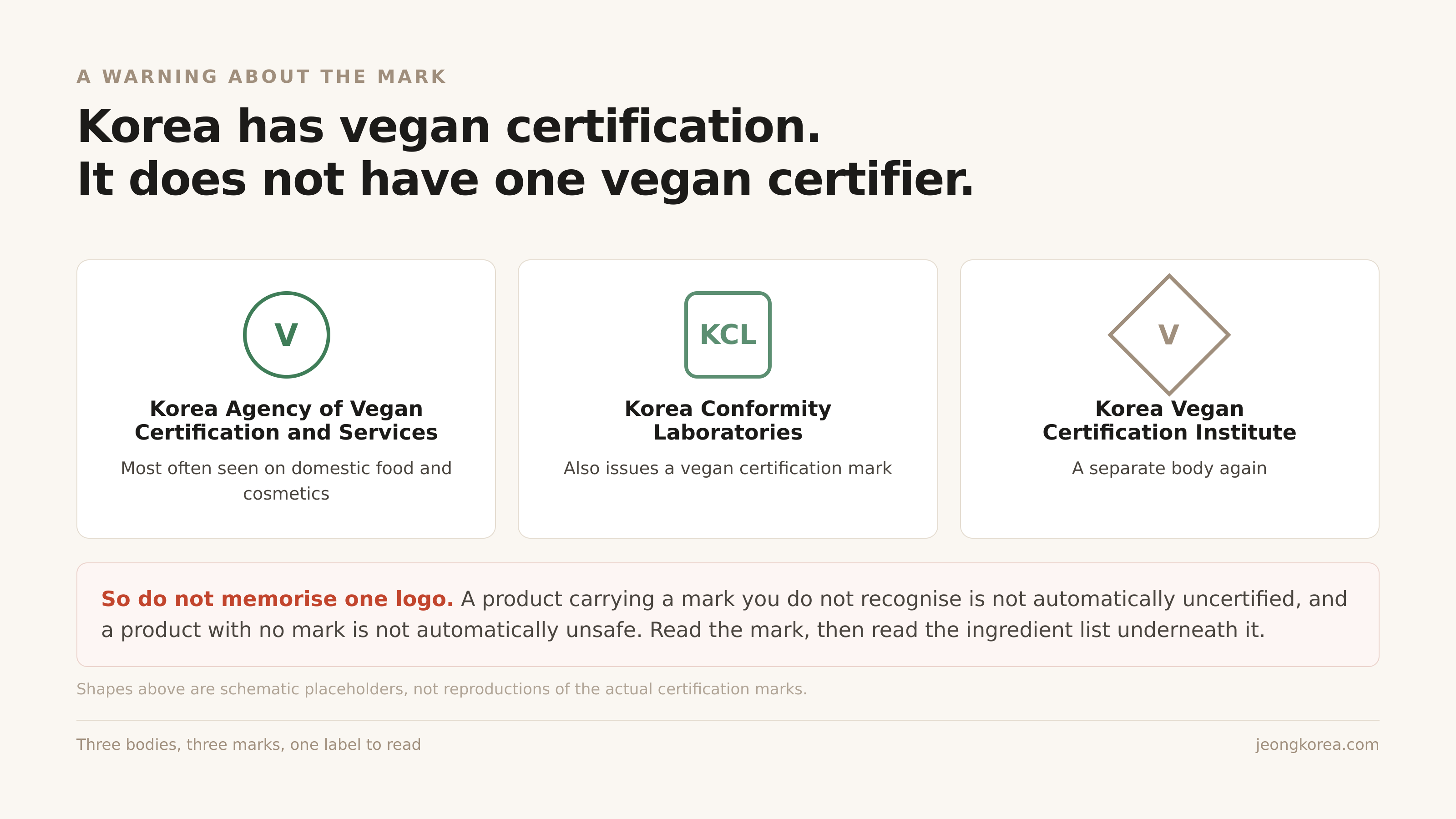
Certified vegan products. Korea now has vegan certification, and this is where a small warning belongs: there is more than one certifying body. The Korea Agency of Vegan Certification and Services is the one most often seen on domestic food and cosmetics, but the Korea Conformity Laboratories and the Korea Vegan Certification Institute also issue marks. So do not memorise one logo and treat everything else as uncertified. Read the mark, and if you cannot read it, read the ingredient list underneath it.
Restaurants that describe themselves in your language. A place with an English vegan menu has already had this exact conversation a thousand times. You are not the edge case there, and you do not have to explain the broth problem from scratch.
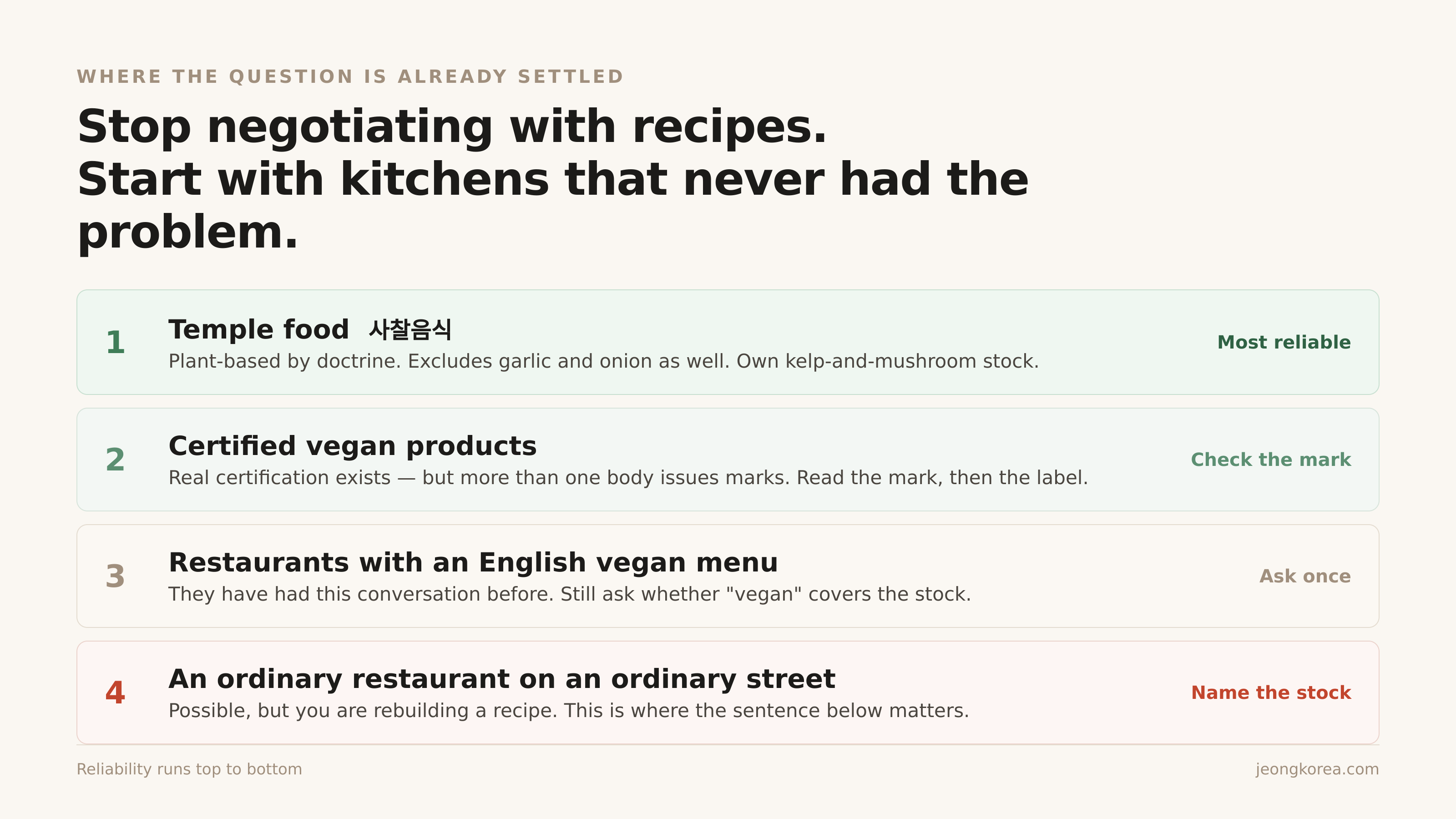
| Where | What it excludes | What to know before you go |
|---|---|---|
| Temple food | All animal products, plus garlic and onion | Central Seoul centre runs interpreted classes; book ahead |
| Certified vegan | All animal products | Several certifying bodies, so check the mark and the label |
| Vegan restaurants | Varies by restaurant | Ask whether the stock is included in "vegan" |
Convenience stores sit outside all three, and they are where most people actually end up at eleven at night. The rules there are their own subject, and if you have not read how Korean convenience store food actually works yet, that is the piece to read next, because the labelling rules are the same ones you will be using.
That still leaves the ordinary restaurant on an ordinary street. What do you say there?
What to say, and what to check yourself
Two Korean sentences do most of the work, and they are different from each other in a way that matters.
고기 빼 주세요 means "please leave out the meat." This is the sentence most phrasebooks give you and it is the weaker one, because it asks for a subtraction and it uses the narrow word.
저는 채식주의자예요. 고기, 생선, 육수 다 안 돼요. means "I am a vegetarian. Meat, fish, and broth are all not possible." Naming the broth is the entire point. It moves the conversation from contents to ingredients, and Korean cooks understand the word 육수 precisely, because it is a thing they make.
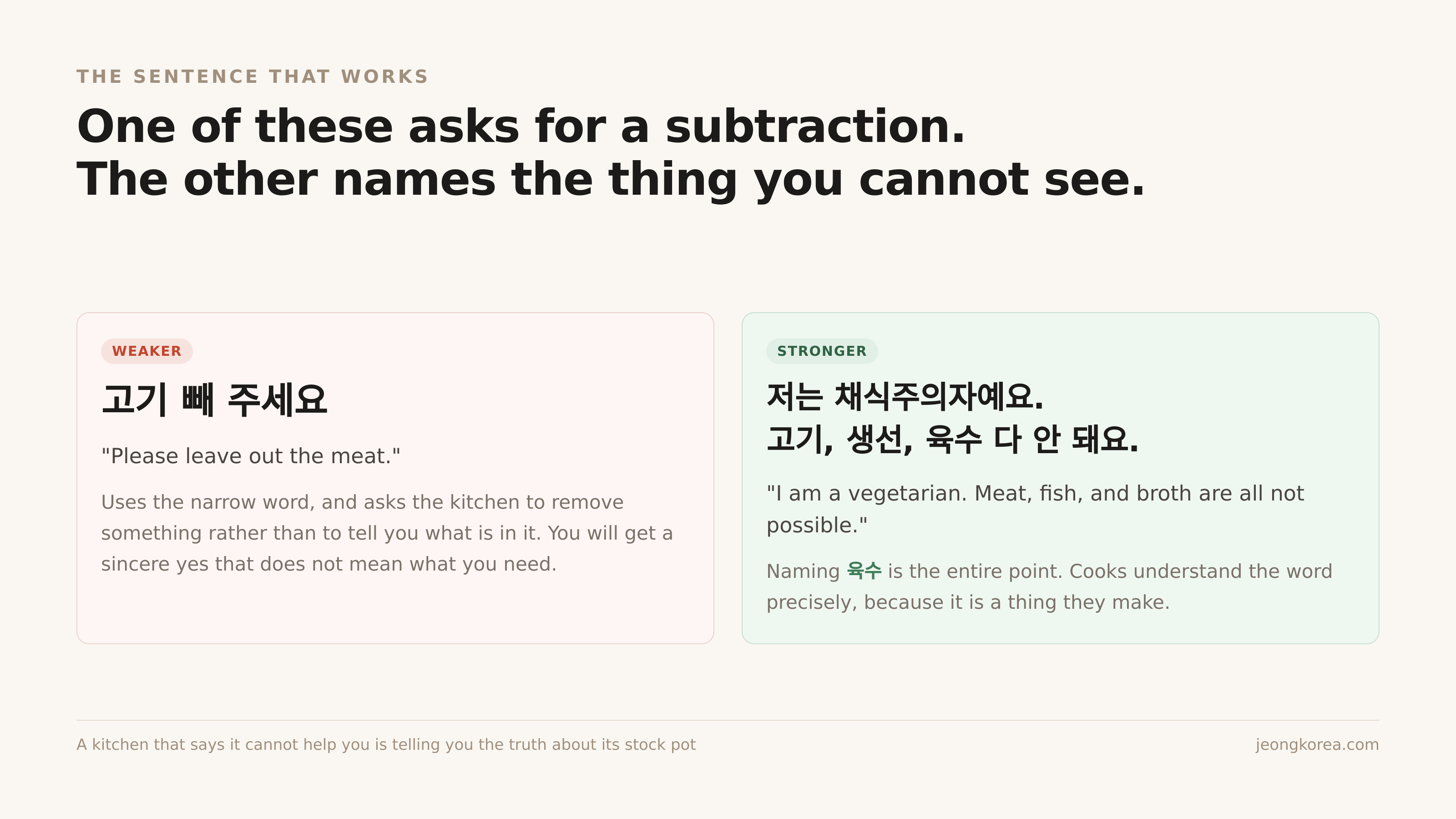
Say the second one and one of two things happens. Either the cook thinks for a moment and offers you something they know is safe, which is a real answer. Or they tell you they cannot help, which is also a real answer and worth more than a polite yes. A kitchen that cannot serve you is telling you the truth about its stock pot.
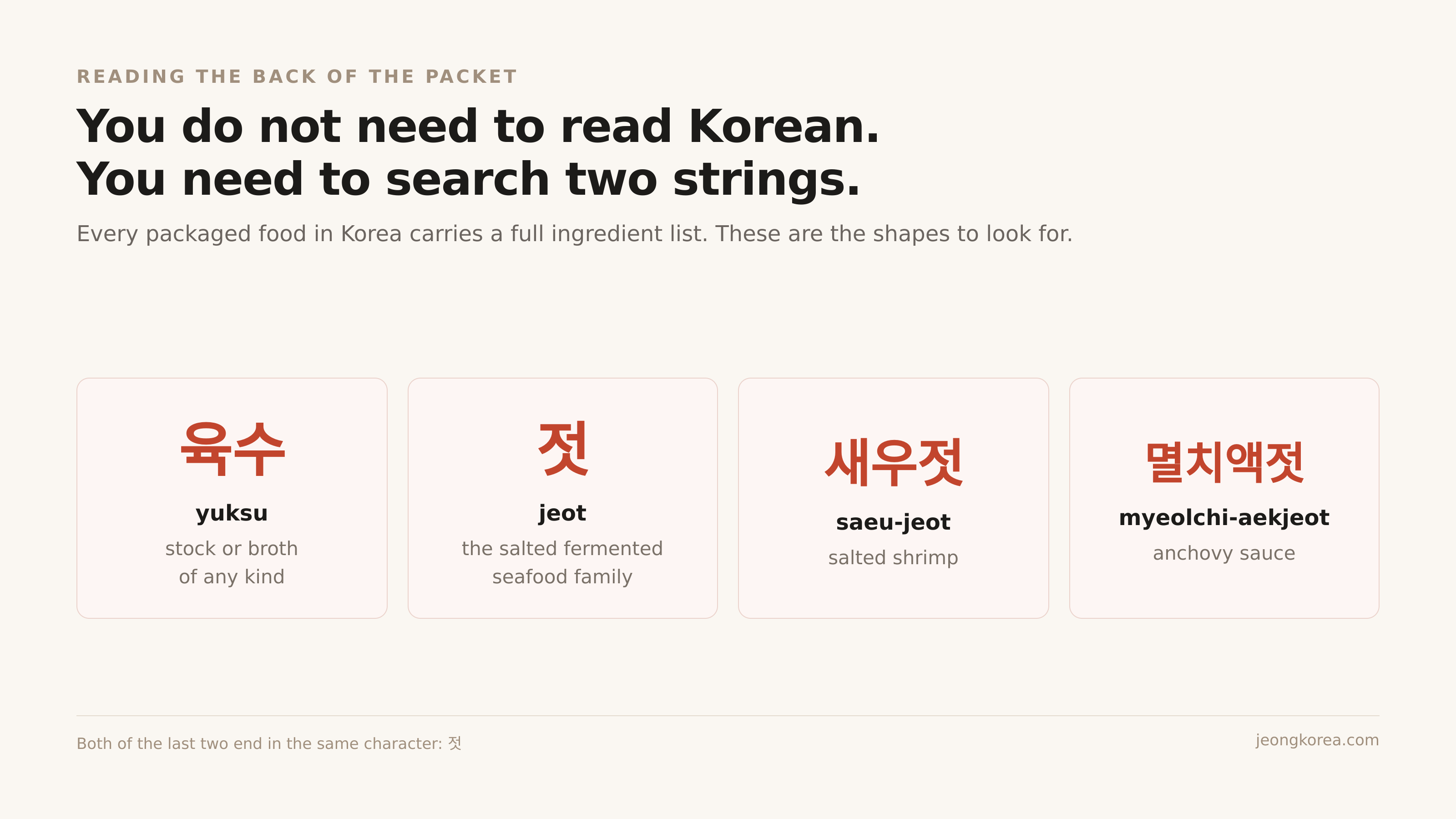
Beyond that, three habits make vegetarian food in Korea far easier to navigate, and they cost you nothing:
-
Packaged food carries a full ingredient list in Korean on the back. You do not need to read Korean to search two strings: 육수 for broth and 젓 for the salted seafood family.
-
Side dishes are not neutral. The small plates that arrive free at the start of a meal often contain fish sauce or dried anchovy, and nobody will mention them because nobody ordered them.
-
Ordering as a group is easier than ordering alone. Korean meals are shared, and a table where one person eats differently is far more normal than a single diner asking a kitchen to rebuild one bowl.
None of this is about Korean food being hostile to vegetarians. It is about a cuisine that developed its depth through fermented seafood and long stocks rather than through fat and roasting, which means the animal content went into the layer you cannot see instead of the layer you can. That is a difference in architecture, not in hospitality. There is more about how that shared table works in the dining etiquette Koreans actually follow.
FAQ
Is kimchi vegetarian?
Usually not. Korea's food standards treat jeotgal, salted fermented seafood, as a normal part of kimchi seasoning, and most commercial and restaurant kimchi contains salted shrimp or anchovy sauce. Baek-kimchi and temple kimchi are commonly made without it. On packaged kimchi, look for 새우젓 and 멸치액젓 in the ingredient list on the back.
Can I just ask them to leave the meat out?
You can, but it often will not do what you want. The everyday Korean word for meat refers to identifiable pieces of flesh, not to stock or fish sauce, so a cook can honestly say there is no meat in a dish built on anchovy broth. Name the broth directly instead: 육수.
Do I need to book temple food in advance?
For the classes and sit-down programmes at the Seoul temple food centre run by the Jogye Order, yes. Interpreted sessions for foreign participants run on a schedule rather than on demand, so check the programme calendar before you plan a day around it.
Is there anything vegetarian in a convenience store?
Some things, and the ingredient list is how you find them rather than the photo on the front. Plain rice balls, some instant noodles, fruit, and soy milk are the usual finds. The same two search strings work here: 육수 and 젓.
Before you go
The short version is that vegetarian food in Korea is not a matter of finding dishes without meat on top. It is a matter of finding dishes that were not built on an animal underneath. Temple food, certified products, and restaurants that already speak your language are the three places where that question is already settled. Everywhere else, the word to say is 육수 and the place to look is the back of the packet.
There is a second thing people are told about Korean food before they arrive, and it is wrong in a more interesting way than the first. Everyone says it is all spicy. It is not, and the reason is not that some dishes are milder. It is that Korea has two different kinds of heat that happen to share one English word, and knowing which one you are looking at decides whether you can eat the dish at all. That is the next piece.