Korean Convenience Store Food: What to Order, How to Heat It, and the Rules Nobody Explains

Korea has roughly one convenience store for every 950 people. Japan, the country that invented the format, has one for every 2,200.
You will walk past four of them between the subway exit and your hotel. And if you are like most visitors, you will go in once, buy a bottle of water, and leave — which is a bit like walking into a restaurant to use the bathroom.
Because that is the thing nobody tells you. In Korea, the convenience store is not a shop you buy from. It is a place you eat. There is a microwave, a hot water tap, a counter with stools, and often a machine that cooks instant noodles for you. Koreans eat full meals in there, every day, without thinking about it.
So here is how to actually use one. Korean convenience store food is genuinely good, it costs almost nothing, and it is open at 3am when everything else in this city has given up on you.
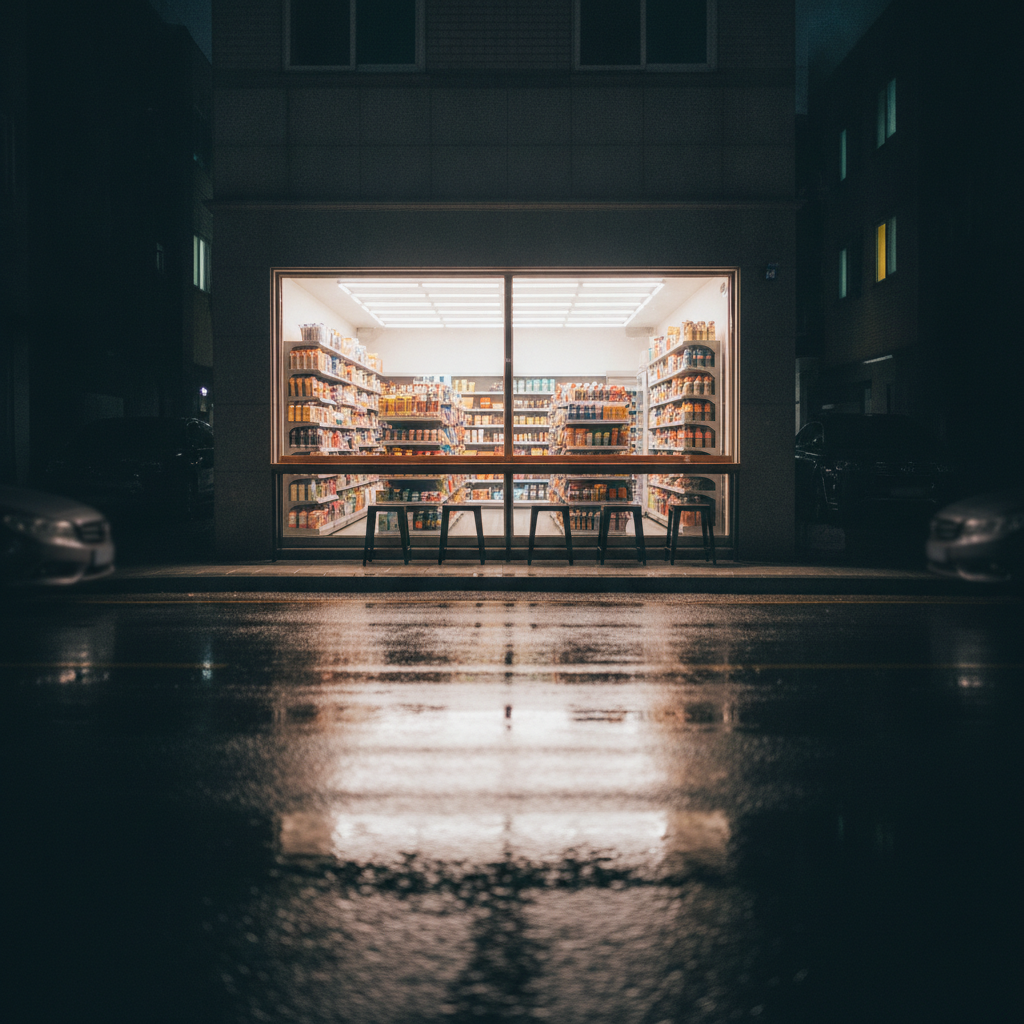
First, find the corner everyone else walks past
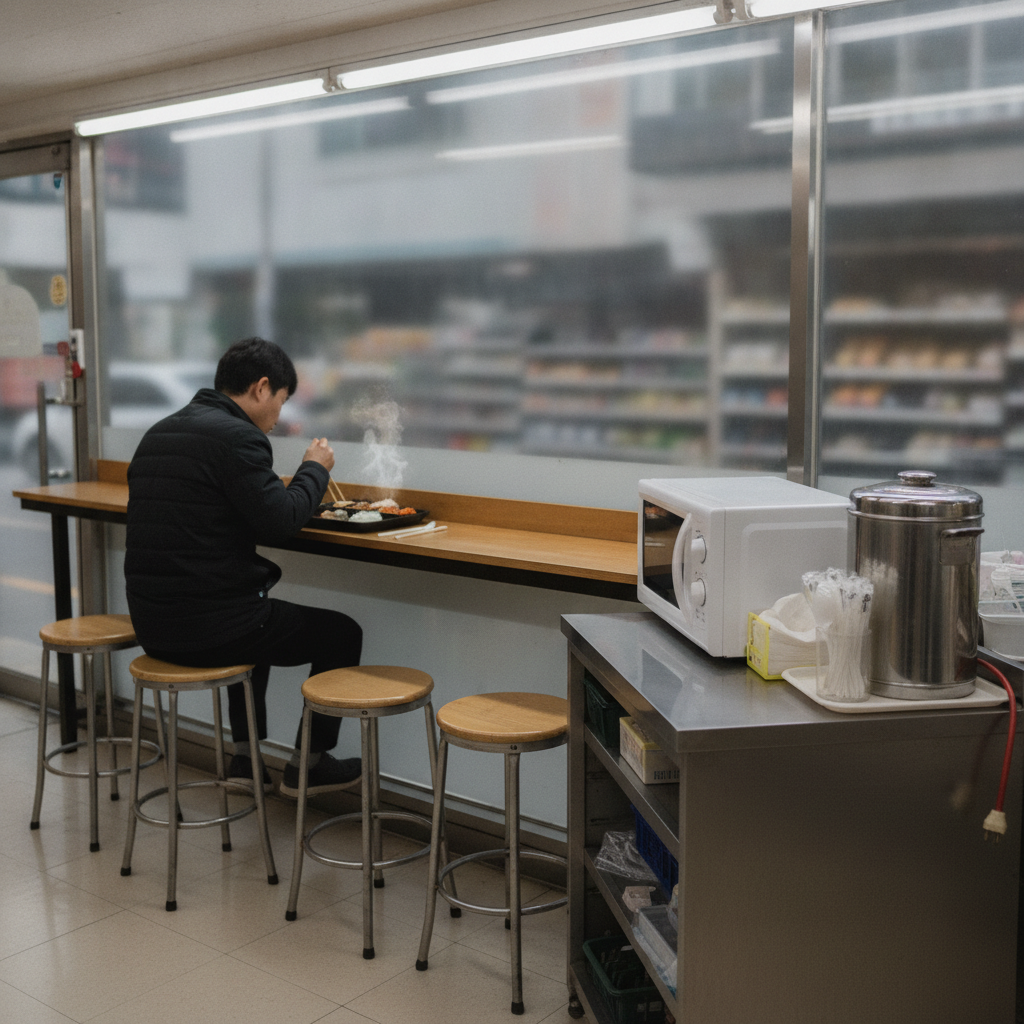
Near the back or along the window there is usually a counter with stools, and next to it:
-
A microwave. Free. You heat your own food.
-
A hot water dispenser. Free. This is for cup noodles.
-
A ramen cooker in many branches — a small machine you set your cup into, press once, and it boils it properly.
-
Chopsticks, spoons, scissors, napkins. All free, all self-serve.
Nobody will help you, and nobody expects you to ask. You buy the thing, you heat the thing, you sit down and eat it. That is the whole system, and once you know it exists, the entire country gets cheaper.
What to actually order
Korean convenience store food splits into two groups: things you heat, and things you do not. Getting that wrong is the most common mistake.
| What | What it is | How to handle it |
|---|---|---|
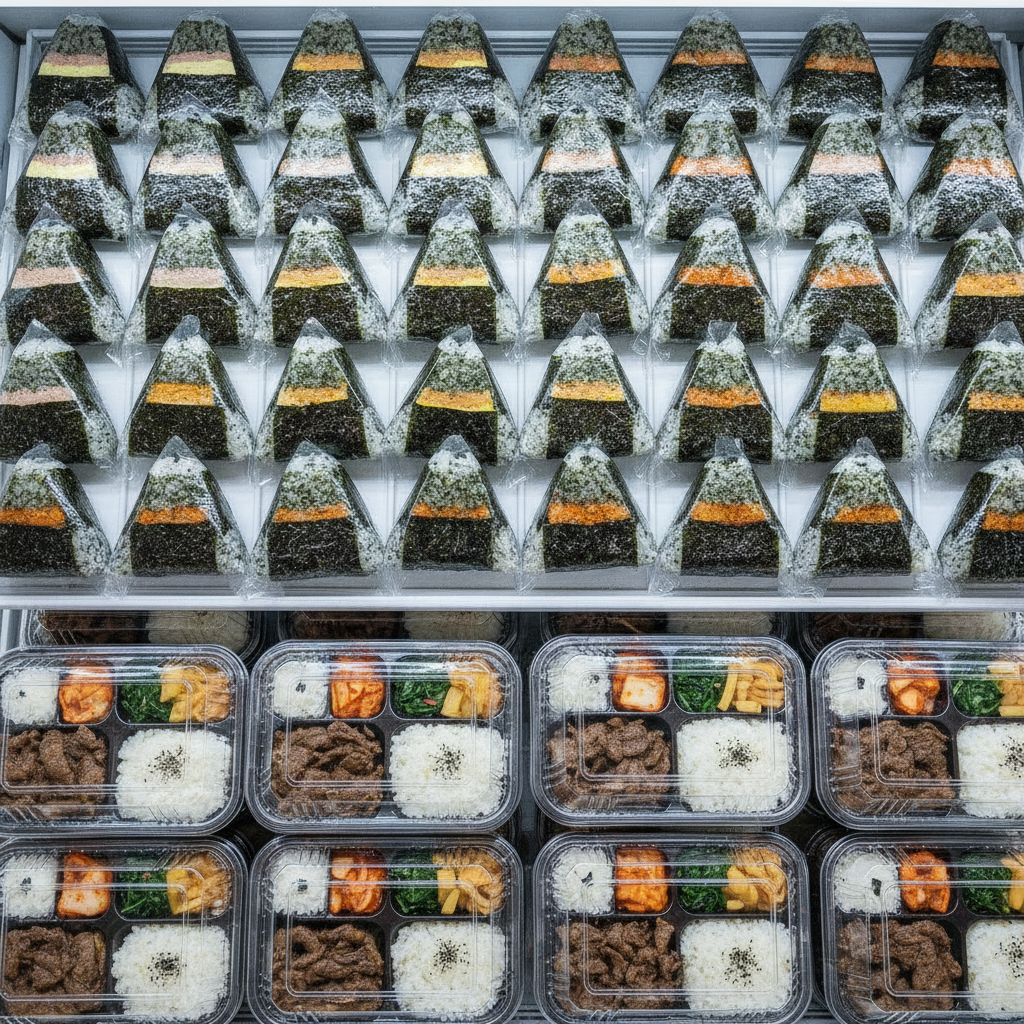
| Samgak-kimbap (triangle rice ball) | Rice and filling wrapped in seaweed, the single most-eaten item | Do not microwave. See the wrapper section below |
| Dosirak (lunch box) | A full tray — rice, meat, several sides | Microwave, usually 2–3 minutes; the time is printed on the lid |
| Cup ramen | Far better than what is exported | Hot water to the inside line, 3 minutes |
| Cup udon or jjajang noodles | Thicker, milder, underrated | Same, but drain if the lid says to |
| Sausage on a stick (hot bar) | Sits in a warmer by the till | Ready to eat, ask for it at the counter |
| Boiled eggs, often smoked | Sold in twos, weirdly excellent | Ready to eat |
| Store coffee | Bean-to-cup machine, about the price of nothing | Pay first, then use the machine |
If you order one thing, make it a dosirak on a night you are too tired to find a restaurant. It is a proper meal, it is hot in three minutes, and it costs less than a coffee does in most of the countries you might be flying in from.
The triangle kimbap problem
This is the one everyone fails, and it is worth thirty seconds of your life.
The wrapper keeps the seaweed dry and separate from the rice until the moment you open it. That is the entire point of the design — and it only works if you open it in the right order.
There are three numbers printed on the wrapper.
-
Pull the ① strip straight down the middle. It splits the plastic into two halves.
-
Pull ② out sideways — the left half of the plastic slides away.
-
Pull ③ out sideways — the right half follows.
The seaweed wraps itself around the rice as the plastic leaves. If you tear into it randomly you get a fistful of plastic and rice and a soggy sheet of seaweed, which is how most first attempts go.
Do not microwave it. The seaweed goes rubbery and the rice goes hard. It is meant to be eaten cold.
The shelf price is not the price
Two signs are everywhere, and they change what you should put in your basket:
-
1+1 — buy one, get one free.
-
2+1 — buy two, get one free.
You have to physically take the extra items to the till. Nothing is deducted automatically, and the staff will not remind you. If a drink is 1+1 and you take one, you paid double for no reason.
The promotions rotate weekly and differ between chains, so the same drink can be 1+1 at one store and full price at the one across the street. It is worth ten seconds of looking at the shelf label before you decide.
Late-night discounts. Many stores mark down lunch boxes and fresh items as their expiry approaches, usually late in the evening. Not every branch does it and the timing is not fixed, so treat it as a bonus rather than a plan.
The four chains, and whether it matters
| Chain | Roughly |
|---|---|
| CU | 17,800 stores |
| GS25 | 17,500 stores |
| 7-Eleven | 13,800 stores |
| Emart24 | 6,700 stores |
Figures as reported by Korean business press; the four chains together run somewhere above 50,000 stores nationwide.
Does the difference matter? A little. Each chain develops its own lunch boxes and its own collaborations, and Koreans genuinely have preferences. But for a visitor, the honest answer is: go into whichever one you are standing in front of. The gap between chains is much smaller than the gap between knowing how the store works and not knowing.
Things you can do in there that are not eating
-
Top up your transit card. Every convenience store does this, in cash. If you have not got one yet, start here.
-
ATMs. Most branches have one, and many accept foreign cards — useful, because foreign cards get rejected in more places here than you would expect.
-
Send and collect parcels.
-
Buy an umbrella at the exact moment it starts raining, which in this country is a genuine service.
FAQ
Is convenience store food in Korea actually good?
Yes, and that is not politeness. The lunch boxes are made fresh and delivered daily, the chains compete hard on them, and Korean office workers eat them by choice rather than as a last resort. It is closer to a cheap canteen than to a vending machine.
Can I eat inside the store?
Almost always. Look for the counter with stools, usually by the window or at the back. Larger branches have proper seating areas. You do not need to ask permission, and you clear your own tray into the bins provided.
Do I need to speak Korean?
No. Everything is self-service, prices are on the shelf, and the till shows the total on a screen facing you. If you want a hot bar item from behind the counter, pointing works. Card payment is universal.
Are they really open 24 hours?
Most, but not all — some branches in quieter neighbourhoods close overnight. In central Seoul you can assume 24 hours; outside it, check the door.
What is the one thing I should try?
A triangle kimbap with tuna mayo, eaten cold, and a cup of the store coffee. It is what half the country has for breakfast, it costs almost nothing, and it will tell you more about ordinary life here than a restaurant will. When you are ready for the next step up, the street food is a short walk away.
One last thing
The reason I keep sending friends out for Korean convenience store food is not the food, exactly. It is that a Korean convenience store at midnight — a student doing homework at the window counter, a taxi driver eating noodles, the microwave beeping — is one of the few places you can sit inside ordinary Korean life without anybody performing it for you.
Buy a rice ball. Sit at the window. That is the recommendation.
Sources
-
Money Today, on Korea overtaking Japan in convenience store density (2024): https://news.mt.co.kr/mtview.php?no=2024072015205488517
-
Ajunews, fact-check on store counts by chain (2025): https://www.ajunews.com/view/20250203103218861
Promotions, discount timing and opening hours vary by branch and change frequently.