Is Korean Food Spicy? There Is a Number on the Tub, and Most of the Famous Dishes Are Not

Every tub of gochujang in Korea has a heat number on it. It is a national standard. Almost nobody looks.
There are five grades, and the scale exists because Koreans do not agree with each other about heat either. A grandmother in Jeonju and a university student in Seoul want different things from the same red paste, and the food industry had to put a figure on the label to settle the argument. The country that supposedly eats one kind of fire actually grades it.
So when people ask is Korean food spicy, the honest answer is that the question is missing a word. Korea has more than one kind of heat, they come from different peppers, they behave differently in your mouth, and one of them can be removed from your bowl while the other cannot. Knowing which one you are looking at is the whole skill.
Most of what Korea is famous for is not spicy at all
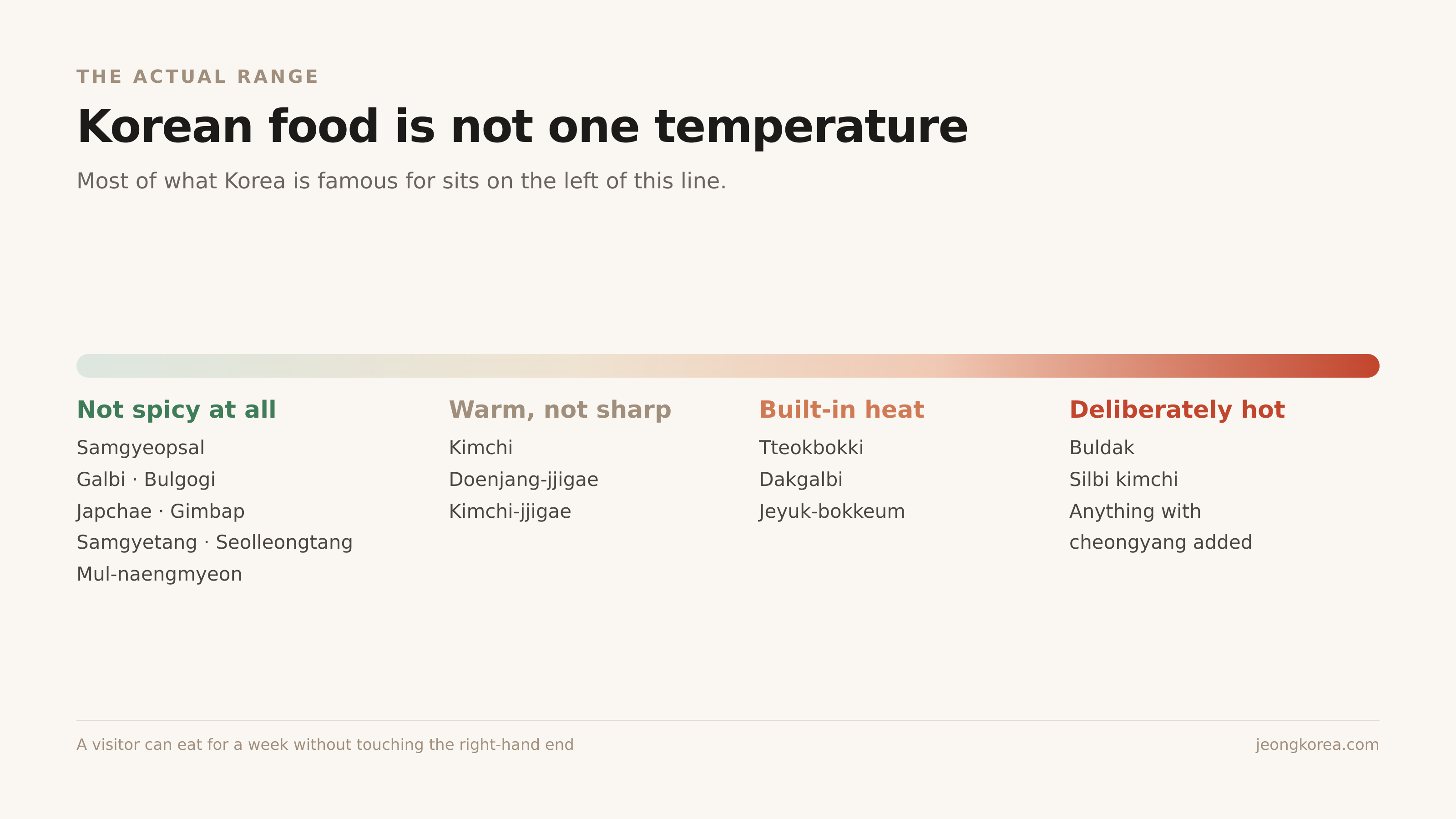
People who ask is Korean food spicy are usually picturing the red dishes they have seen online. Start with the thing that surprises them most. The dishes Korea exports hardest, the ones on every list of what to eat, are mostly not spicy.
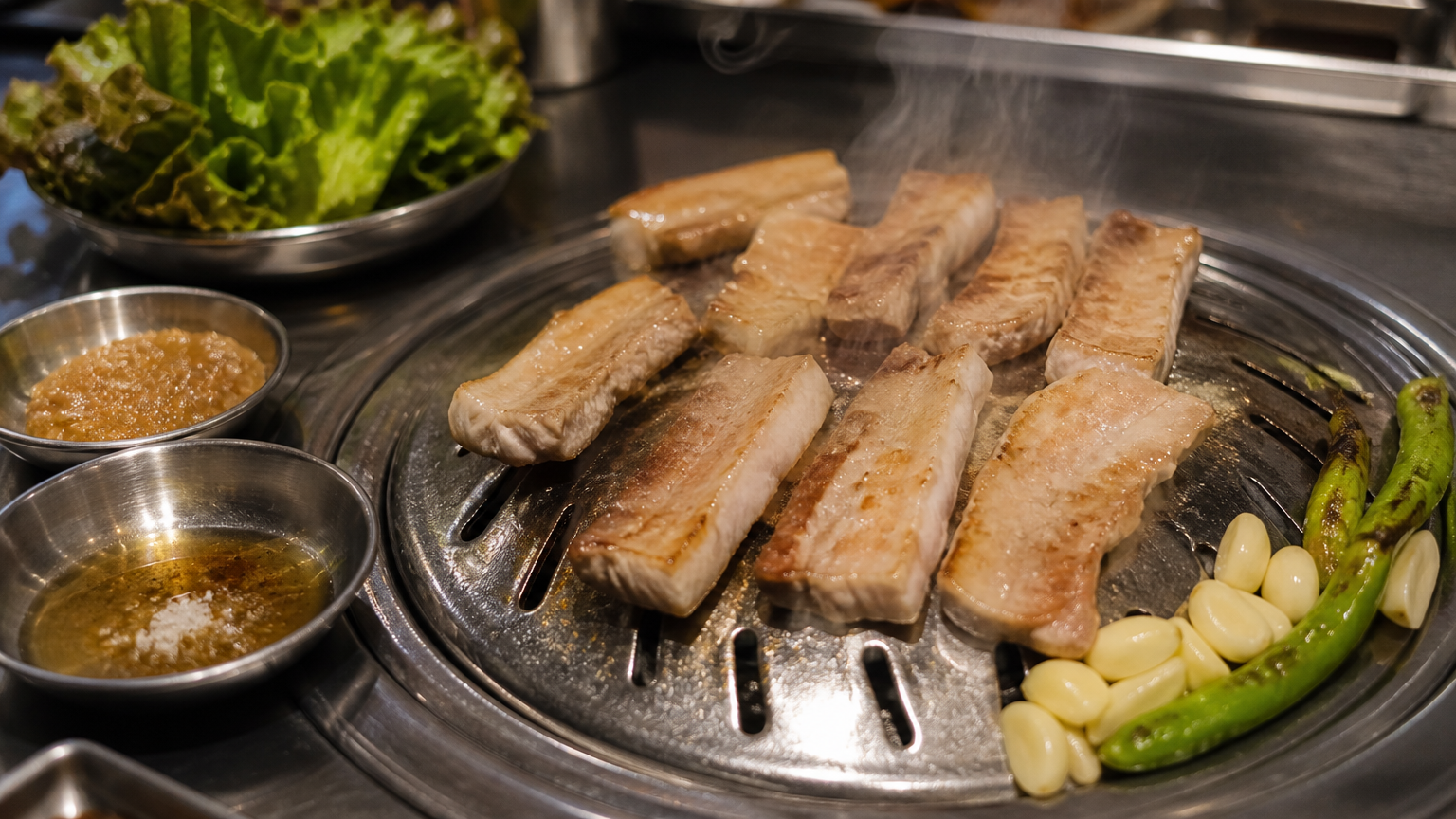
Samgyeopsal is unseasoned pork belly grilled at your table. Galbi and bulgogi are marinated in soy sauce, pear, and sugar, and the dominant flavour is sweet. Japchae is glass noodles in soy and sesame oil. Gimbap, mandu, samgyetang, seolleongtang, and the cold buckwheat noodles of mul-naengmyeon contain no chili at all.
That covers most of a week of eating. A visitor who never touches a red dish still eats extremely well here, which is why the answer to whether Korean BBQ in Seoul is spicy is simply no. The meat arrives plain. Anything sharp on that table is in a small dish beside it, and you control how much of it you touch.
| Dish | Spicy? | What it actually tastes of |
|---|---|---|
| Samgyeopsal | No | Nothing but pork and salt |
| Galbi, bulgogi | No | Soy sauce, pear, sugar |
| Japchae | No | Soy and sesame |
| Samgyetang, seolleongtang | No | Chicken or beef, ginseng, garlic |
| Mul-naengmyeon | No | Cold beef or radish broth |
| Kimchi-jjigae, sundubu | Yes, built in | Fermented chili and pork |
| Tteokbokki, buldak | Yes, built in | Gochujang and added capsaicin |
| Dakgalbi, jeyuk-bokkeum | Yes, pre-marinated | Gochujang, sugar, garlic |
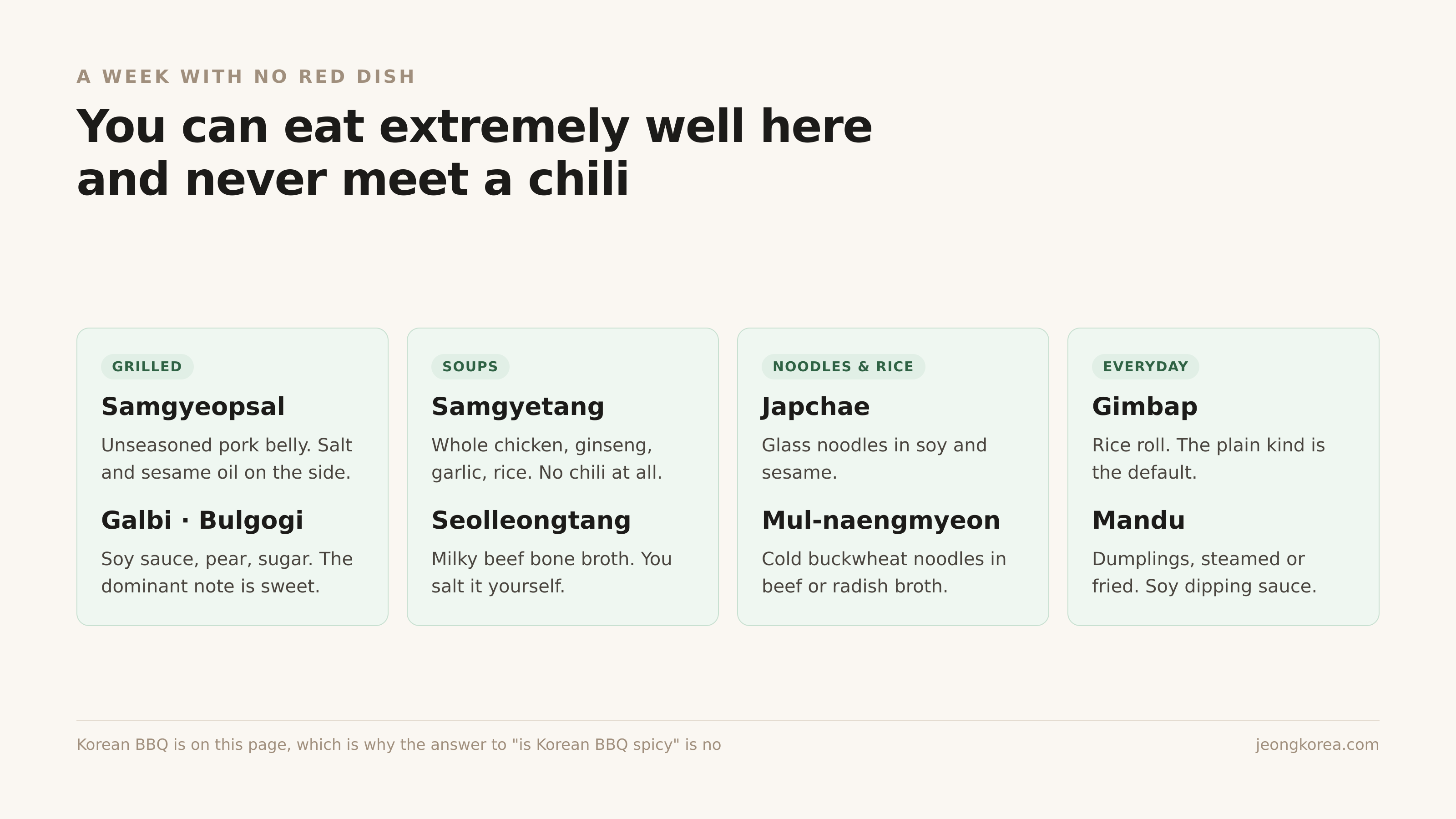
So the picture is not a wall of fire. It is a menu with a spicy section, the same as anywhere else. The difference is what is in that section.
There are two peppers, and English calls them the same thing
Here is where the confusion actually starts. Korean cooking uses two different chilies for two different jobs, and English has one word covering both.
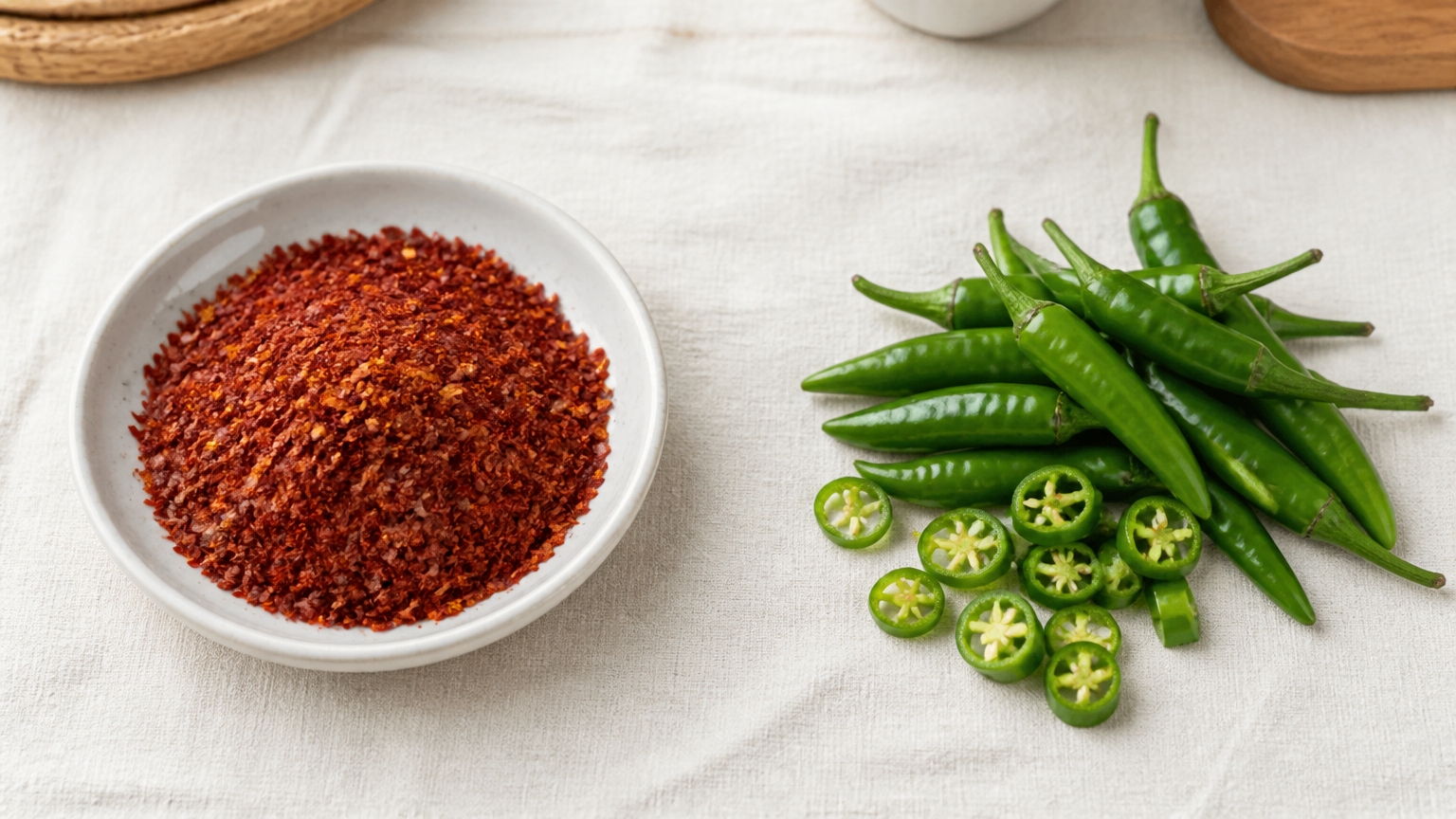
Gochugaru is coarse dried red pepper flakes. It is the base of almost everything red in Korea. It goes in before cooking, it colours the whole dish, and its heat is broad and warming rather than sharp. This is the heat in kimchi, in most stews, in the paste that becomes gochujang. It is not a mild ingredient, but it does not stab.
Cheongyang gochu is a fresh chili, usually sliced in at the very end or served whole on the side. It measures between four thousand and twelve thousand on the Scoville scale. Its heat is sharp, it arrives fast, and it lands in the throat rather than spreading across the tongue.
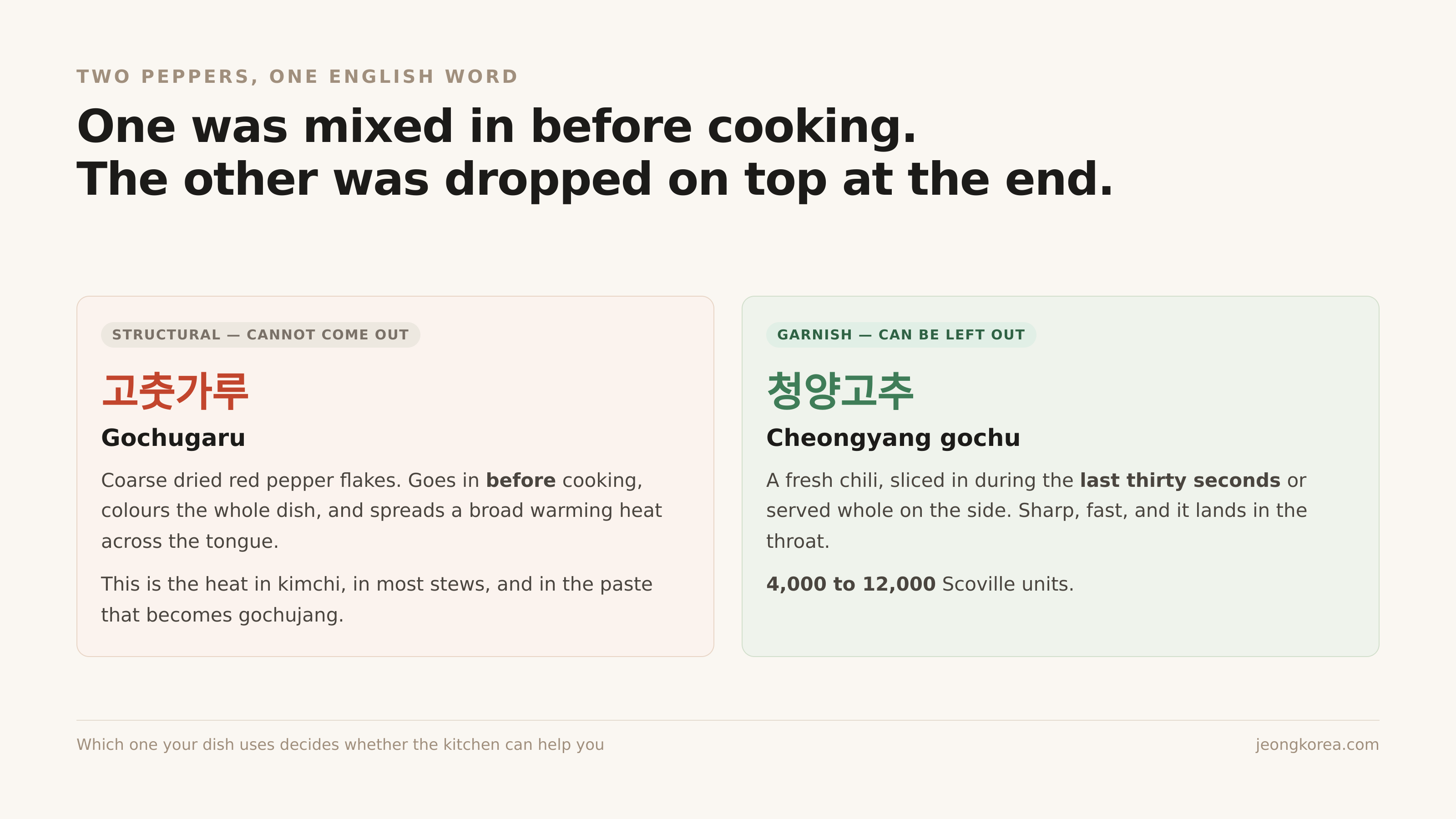
The practical consequence is enormous and almost nobody tells visitors about it. Gochugaru heat is structural. It was mixed in before the pot went on the stove and it cannot be taken out. Cheongyang heat is a garnish. It was dropped in during the last thirty seconds and it can simply be left out if you say so.
Korean itself keeps these apart. 맵다 is the general word for spicy. 매콤하다 is a pleasant, mild version of it. 얼큰하다 describes a deep warming heat in a broth, the kind that clears your head when you are ill. 칼칼하다 describes a sharp heat that catches the back of your throat. Four words, four sensations, and English flattens all of them into one.
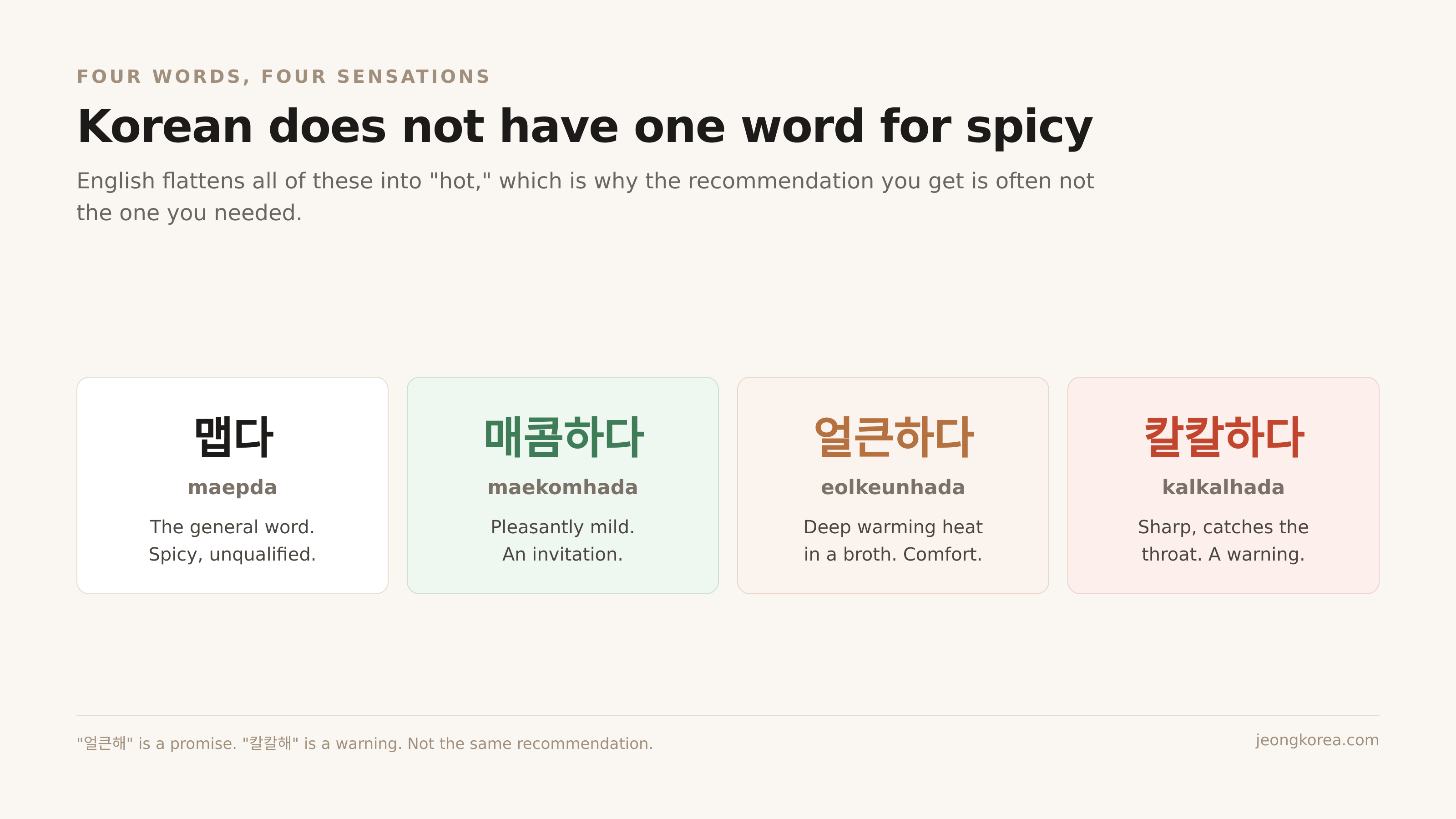
If a Korean tells you a stew is 얼큰해, they are promising you comfort. If they say it is 칼칼해, they are warning you. Those are not the same recommendation.
So if the heat has grades in the language, does it have grades anywhere you can actually read?
It does, and it is printed on the tub
In 2010 the Ministry of Agriculture and the Korea Food Research Institute developed a spiciness scale for gochujang. It is called GHU, for Gochujang Hot taste Unit, and since the first of January 2011 it has been mandatory on KS-certified gochujang. Five grades, printed on the container.
| Grade | Korean | GHU |
|---|---|---|
| 1 Mild | 순한맛 | under 30 |
| 2 Slightly spicy | 덜 매운맛 | 30 to 45 |
| 3 Moderately spicy | 보통 매운맛 | 45 to 75 |
| 4 Spicy | 매운맛 | 75 to 100 |
| 5 Very spicy | 매우 매운맛 | 100 and above |
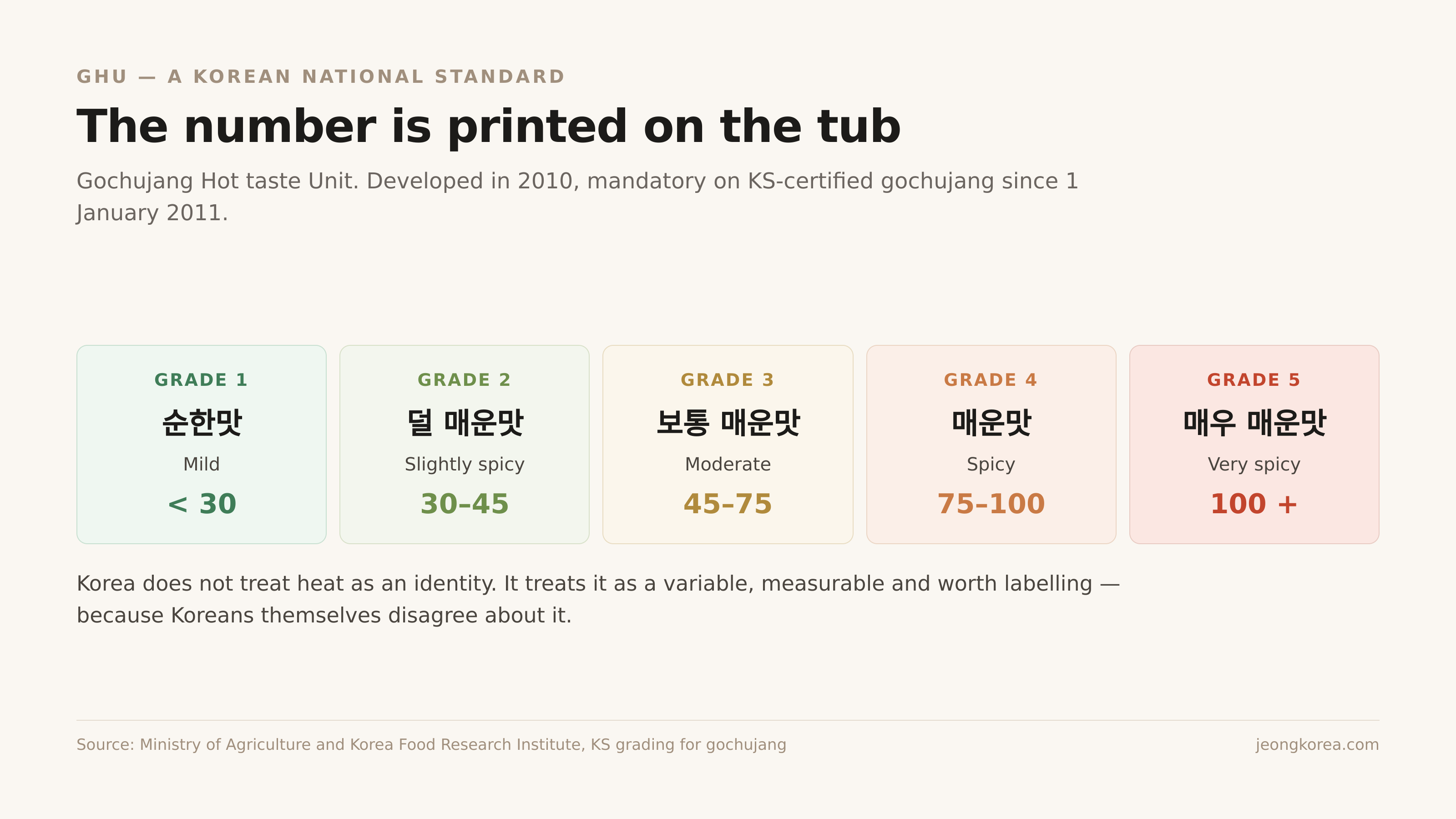
A national standard for how hot a condiment is tells you something the tourist guides do not. Korea does not treat heat as an identity. It treats it as a variable, measurable and worth labelling, because Koreans themselves range from people who cannot eat tteokbokki to people who add cheongyang peppers to food that is already red.
The other scale is the one you already know. Scoville units, invented by the American chemist Wilbur Scoville in 1912, measure how far a chili extract has to be diluted before the heat disappears. And this is where the most useful number in this article sits.
Buldak bokkeummyeon, the fire noodle that made Korean spice famous worldwide, measures 4,404 Scoville units. The extra-hot version, haek-buldak, measures 8,706. A single cheongyang pepper runs from 4,000 to 12,000.
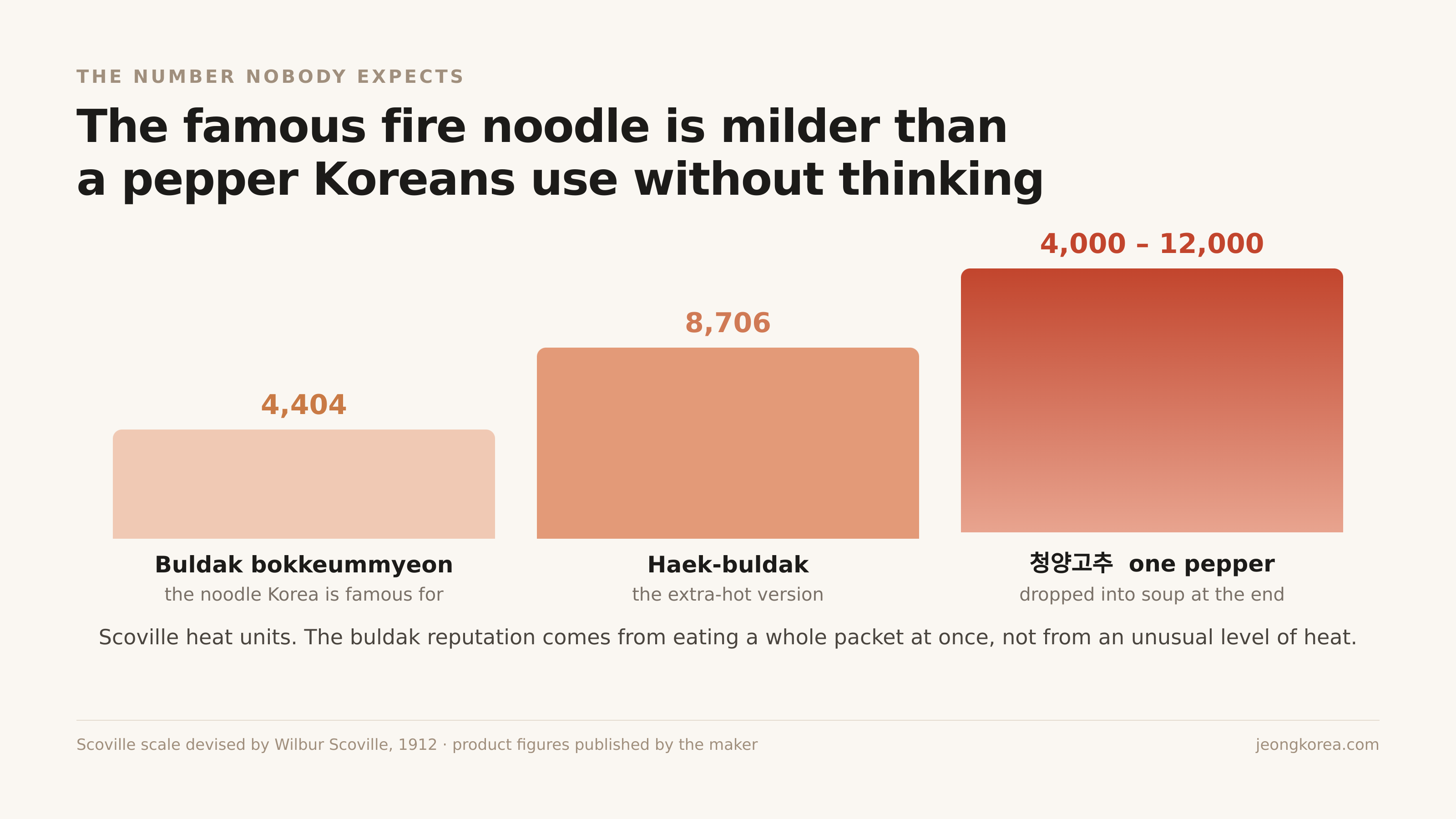
Read that again. The noodle that people film themselves crying over is, at the top of the cheongyang range, less hot than one pepper a Korean drops into soup without thinking about it. The buldak reputation comes from eating a whole packet at once, not from an unusual level of heat. Korea's genuinely hot everyday ingredient is the green thing in the side dish, and nobody makes videos about that.
The same logic explains Korea's spiciest kimchi, silbi kimchi. It is not hot because kimchi is hot. It is hot because someone deliberately pushed one variable a long way up.
So how do you use any of this at a table?
What to say, and what cannot be changed
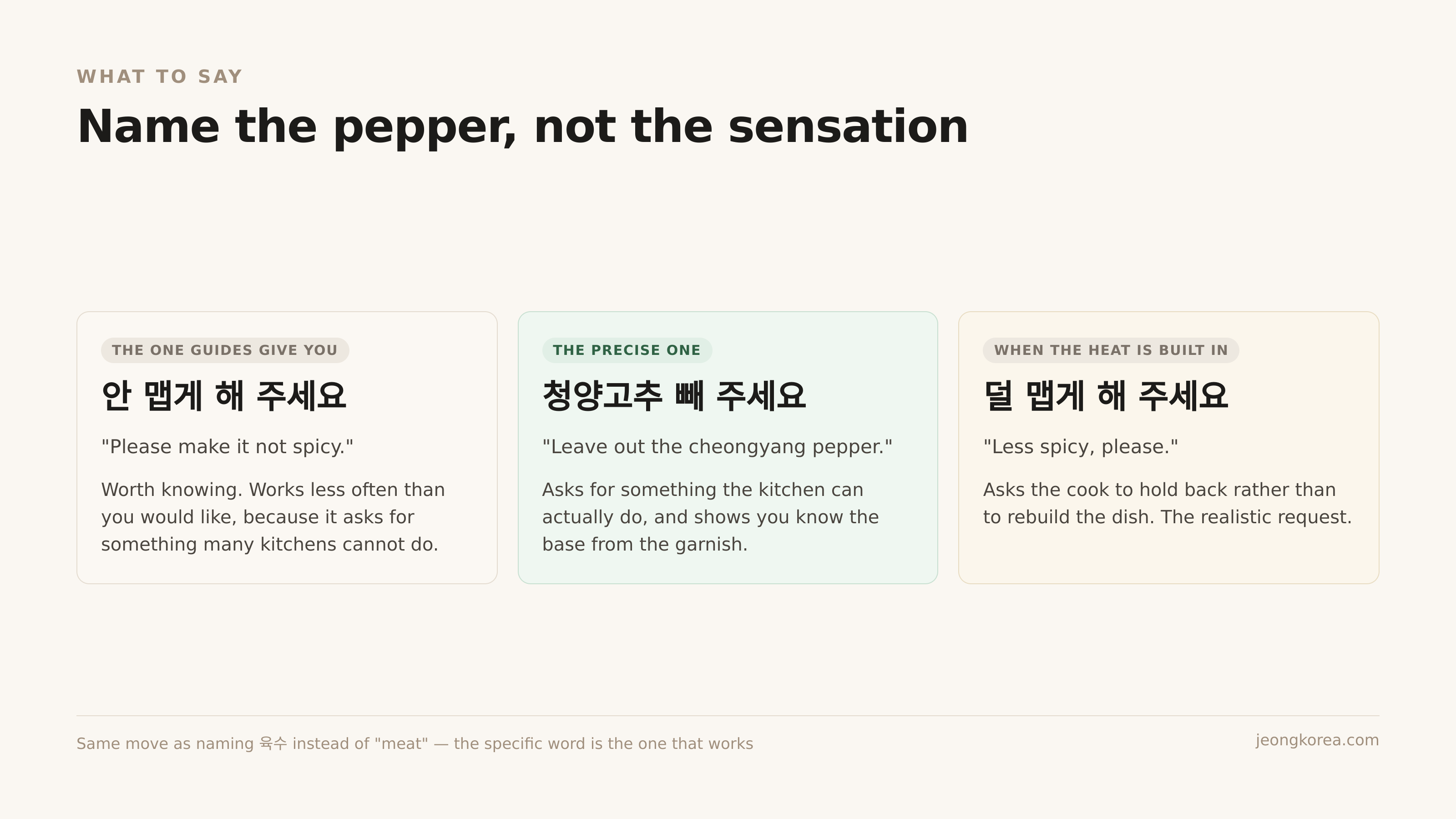
The sentence most guides give you is 안 맵게 해 주세요, meaning "please make it not spicy." It is worth knowing, and it works less often than you would like, for a reason that should feel familiar by now.
If the red is in the sauce the dish was built with, it cannot come out. Dakgalbi and jeyuk-bokkeum are marinated hours in advance. Kimchi-jjigae is made from kimchi that fermented for weeks. The kitchen cannot un-mix those, and a cook who says no is being honest rather than unhelpful.
If the red is a pepper floating on top, it can come out. That is most soups, most sundubu, and a great deal of everyday cooking where the sharp note is added at the very end.
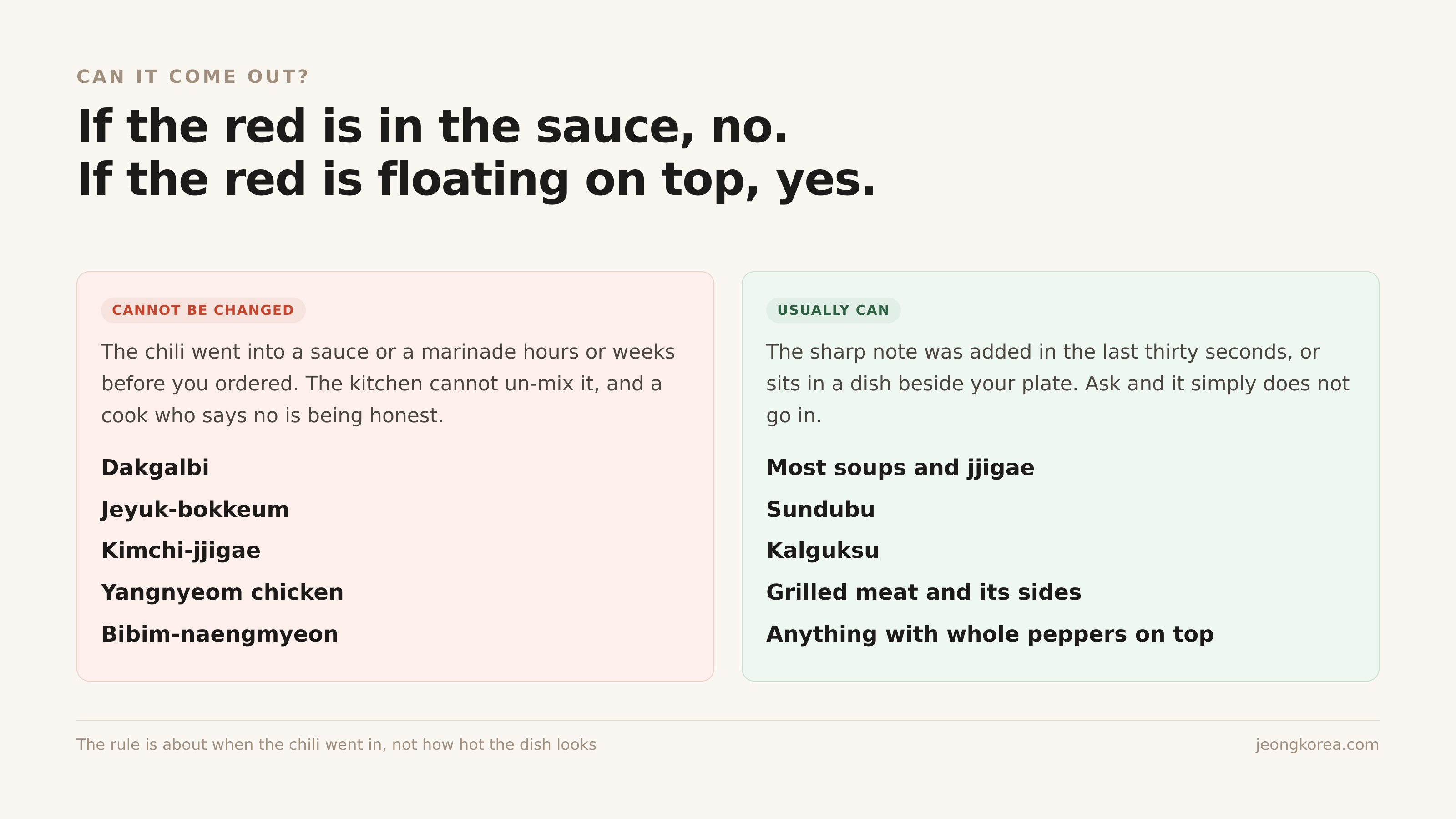
So the precise sentence is not about spiciness in general. It names the pepper.
청양고추 빼 주세요 means "please leave out the cheongyang pepper." It asks for something the kitchen can actually do, and it tells the cook you know the difference between the base and the garnish. This is the same move as the one in the broth that makes a vegetarian dish not vegetarian: naming the specific ingredient works, and naming the general category does not.
덜 맵게 해 주세요 means "less spicy, please," and it is the better request when the heat is structural. It asks the cook to hold back rather than to rebuild.
Three more things worth knowing before you sit down:
-
The side dishes are your controls. Rice, egg, and cold radish take heat out of your mouth faster than water does, and they are already on the table.
-
Milk and soy milk are sold in every convenience store in Korea, and they work because capsaicin dissolves in fat rather than in water. This is why Koreans hand you banana milk after tteokbokki.
-
Ordering to share protects you. If one dish turns out to be too much, a Korean table has four other dishes on it and nobody is watching whether you finish.
FAQ
Is Korean BBQ spicy?
No. Samgyeopsal is unseasoned pork belly, and galbi and bulgogi are marinated in soy sauce and sugar rather than chili. Anything sharp at a Korean BBQ table is in a separate small dish that you add yourself, so you control it completely.
Is Korean food spicier than Indian or Thai food?
Generally no, and the character is different. Korean heat comes almost entirely from one plant, the red pepper, so it reads as one flavour turned up or down. Indian and Thai cooking build heat alongside many other aromatics, which can make the same Scoville level feel more complex. Buldak, the noodle Korea is famous for, sits at 4,404 Scoville units, well below a bird's eye chili.
Can I ask for my food to be less spicy?
Sometimes. If the chili was mixed into the sauce or the marinade in advance, the kitchen cannot remove it, and dakgalbi, jeyuk-bokkeum and kimchi-jjigae all fall into that group. If the heat comes from fresh peppers added at the end, it can be left out. Say 청양고추 빼 주세요 for the pepper, or 덜 맵게 해 주세요 for less heat overall.
What are the least spicy Korean dishes?
Samgyetang, seolleongtang, galbi-tang, mul-naengmyeon, japchae, gimbap, mandu, and any of the grilled meats. None of them contain chili, and together they cover a full week of eating without a single red dish.
Before you go
Is Korean food spicy? Some of it, in two different ways, and the country puts a number on one of them. The heat that was mixed in before cooking cannot be removed, and the heat that was dropped on top in the last thirty seconds can. Ask for the pepper by name and you will usually get what you want.
There is a third thing people bring to a Korean table, and it is not about taste at all. Some visitors need to know how the animal was raised and who slaughtered it, which is a question a menu cannot answer and a cook has probably never been asked. Korea has a real answer to it, in a specific neighbourhood, with a certification system most people have never heard of. That is the next piece.