Sokcho: The Food Is Northern Because the People Were

There is a reason the signature dishes here taste like they came from somewhere else, and no menu in the city will tell you what it is.
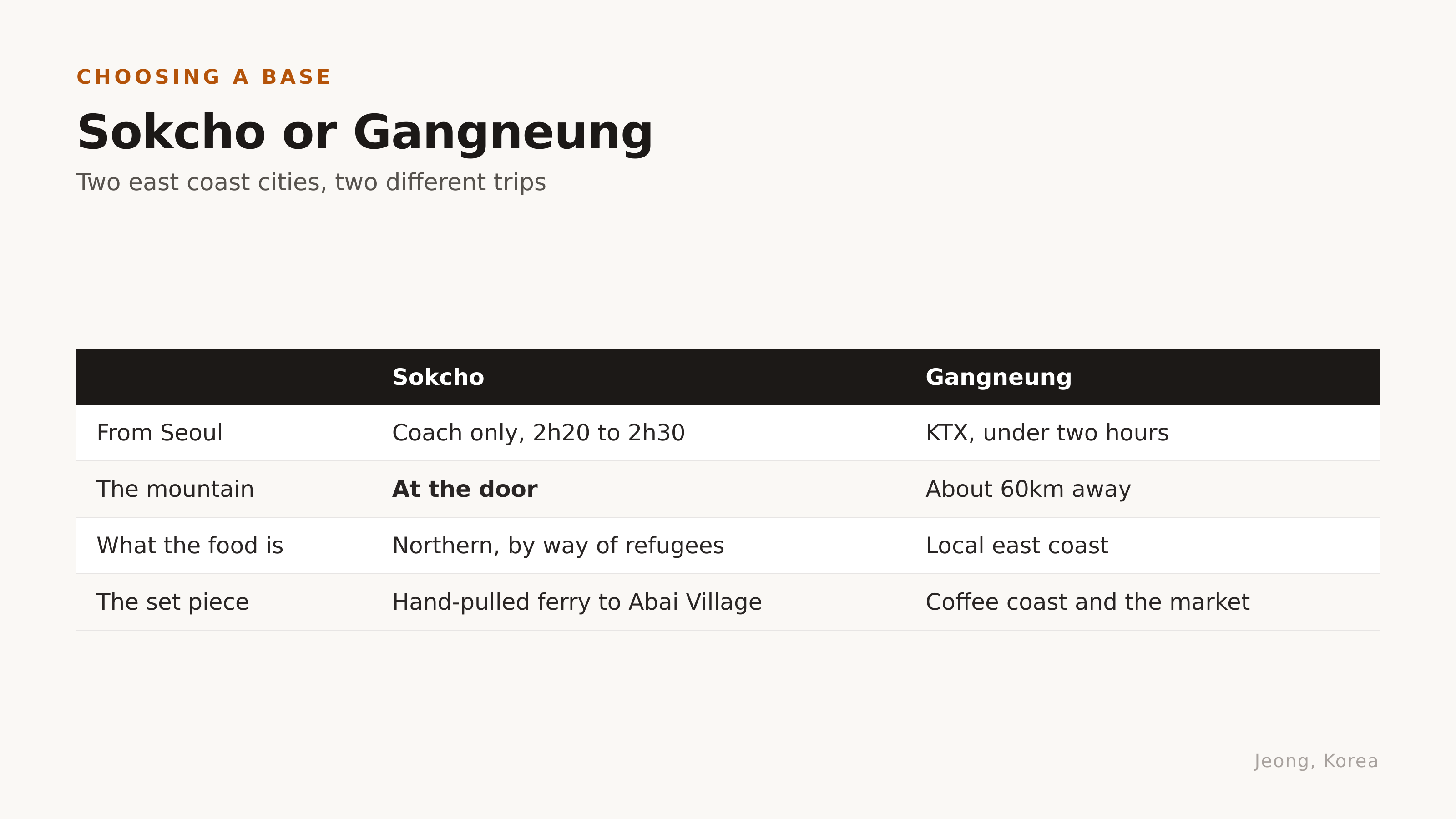
Most visitors arrive with a simple picture. East coast, fishing port, raw fish and a beach, a convenient place to sleep before going up the mountain. All of that is true and none of it explains why the food you are told to try is squid stuffed like a sausage, a cold noodle dish named after a city in the north, and a blood sausage called by a word that is not standard Korean.
The explanation is not culinary. It is a border, and it used to run south of here.
If you have already stood in the fried chicken queue one city down the coast, this is a very different market town: Gangneung Jungang Market: The Queue Is for Fried Chicken is the other east-coast version of the same afternoon.
This city was not in South Korea until the 1950s
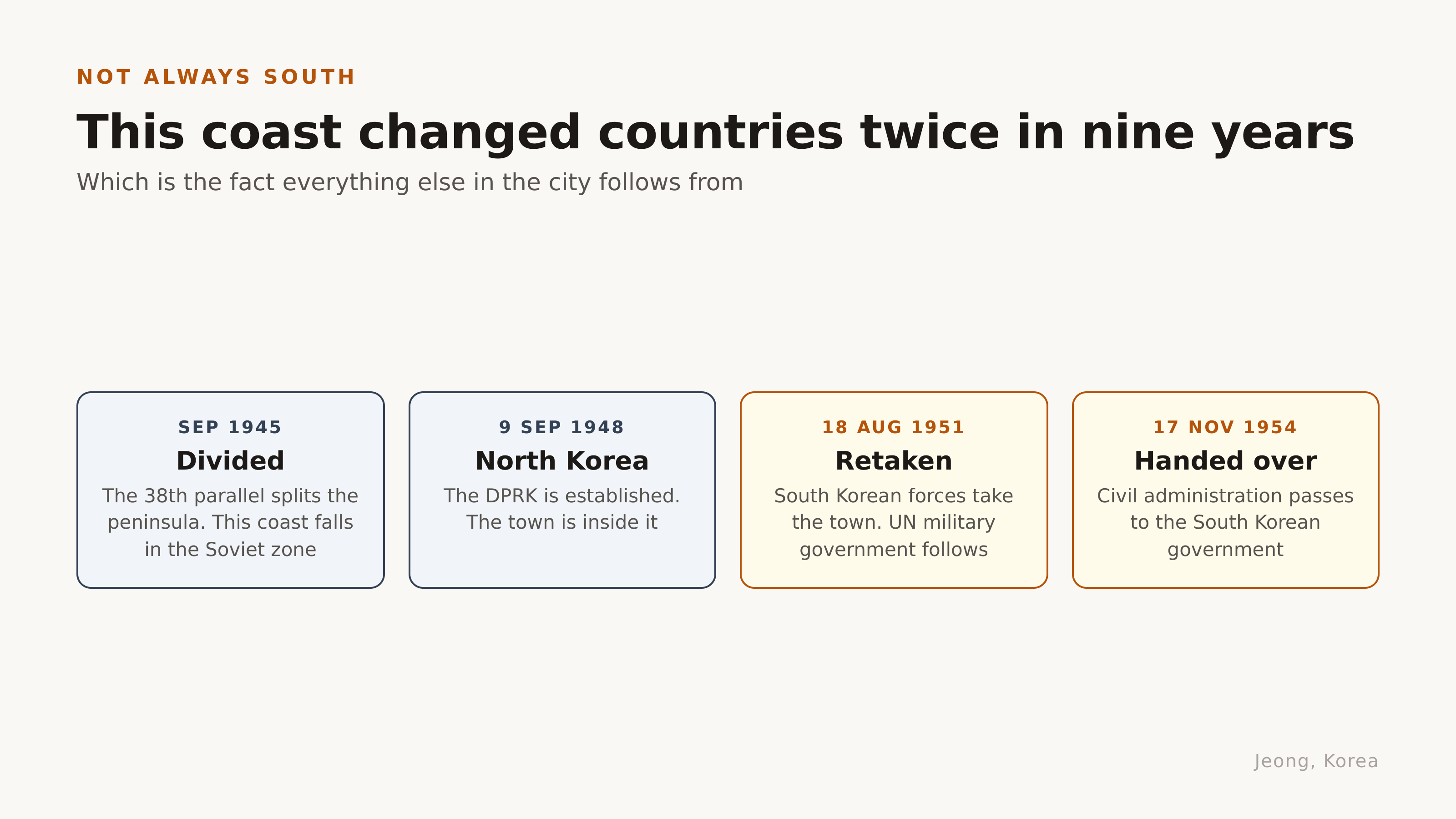
Start with the fact that reorders everything else. Sokcho spent the late 1940s under North Korean administration.
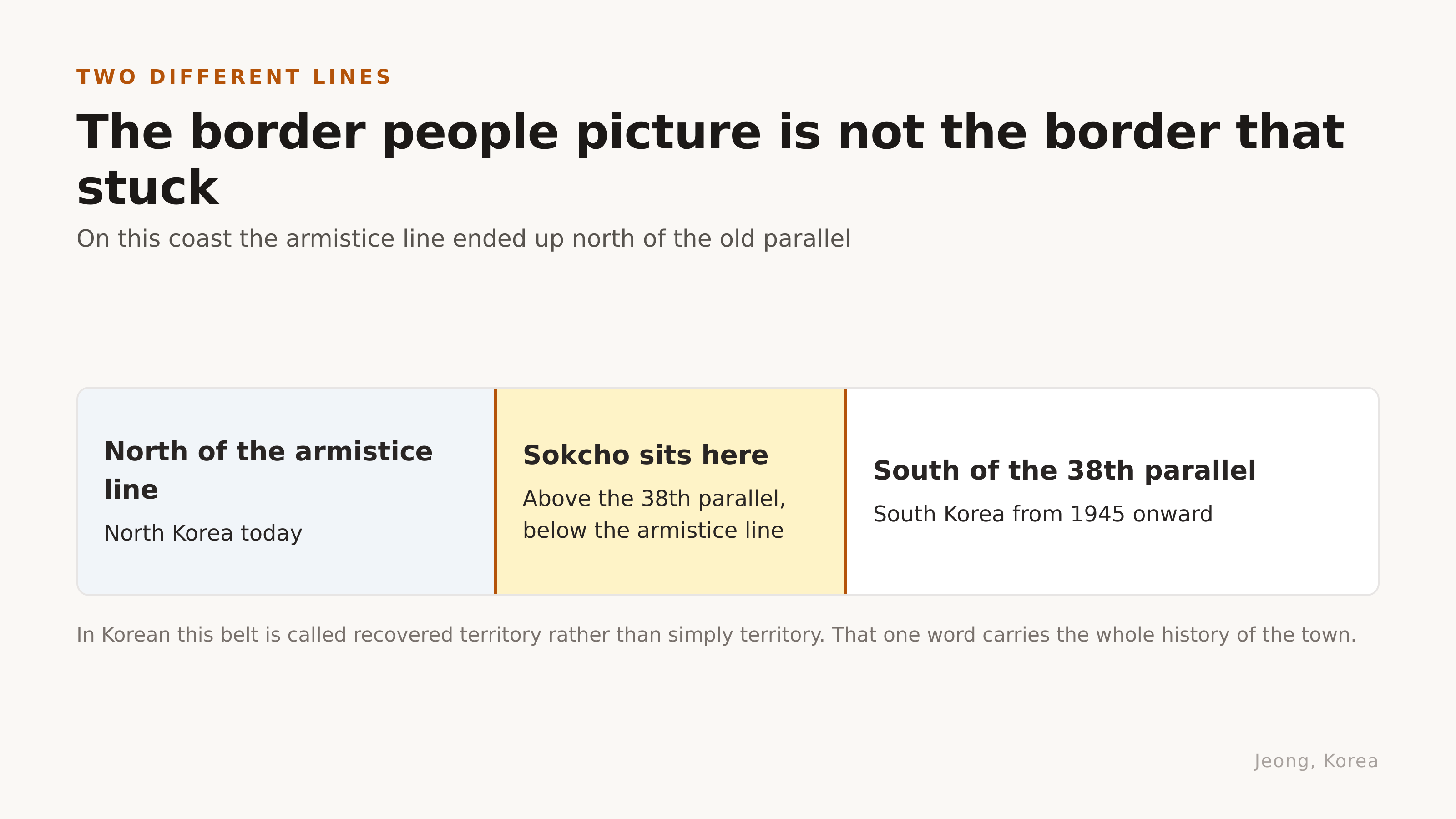
The reason is the line that everybody has heard of and few people place on a map. When the United States and the Soviet Union divided the peninsula in September 1945, they used the 38th parallel, and this stretch of coast sits above it. So the town fell inside the Soviet occupation zone, and when the Democratic People's Republic of Korea was established on 9 September 1948, it fell inside that state.
That lasted until the war moved it. South Korean forces retook the town on 18 August 1951, after which it was run under United Nations military government rather than by Seoul, and civil administration was not handed over to the South Korean government until 17 November 1954. The armistice line had ended up north of the old parallel here, which is why this coast is described in Korean as recovered territory rather than simply as territory.
So when you walk around, you are not in an old South Korean fishing town that happens to be near the border. You are in a place that changed countries within living memory, and the population changed with it.
Korea has one other city whose entire food culture was rewritten by the same war, and it is at the opposite end of the country: Busan Food: What People From Busan Actually Eat.
Which is where the plate in front of you comes from.
The famous local dish is a substitution, not a tradition
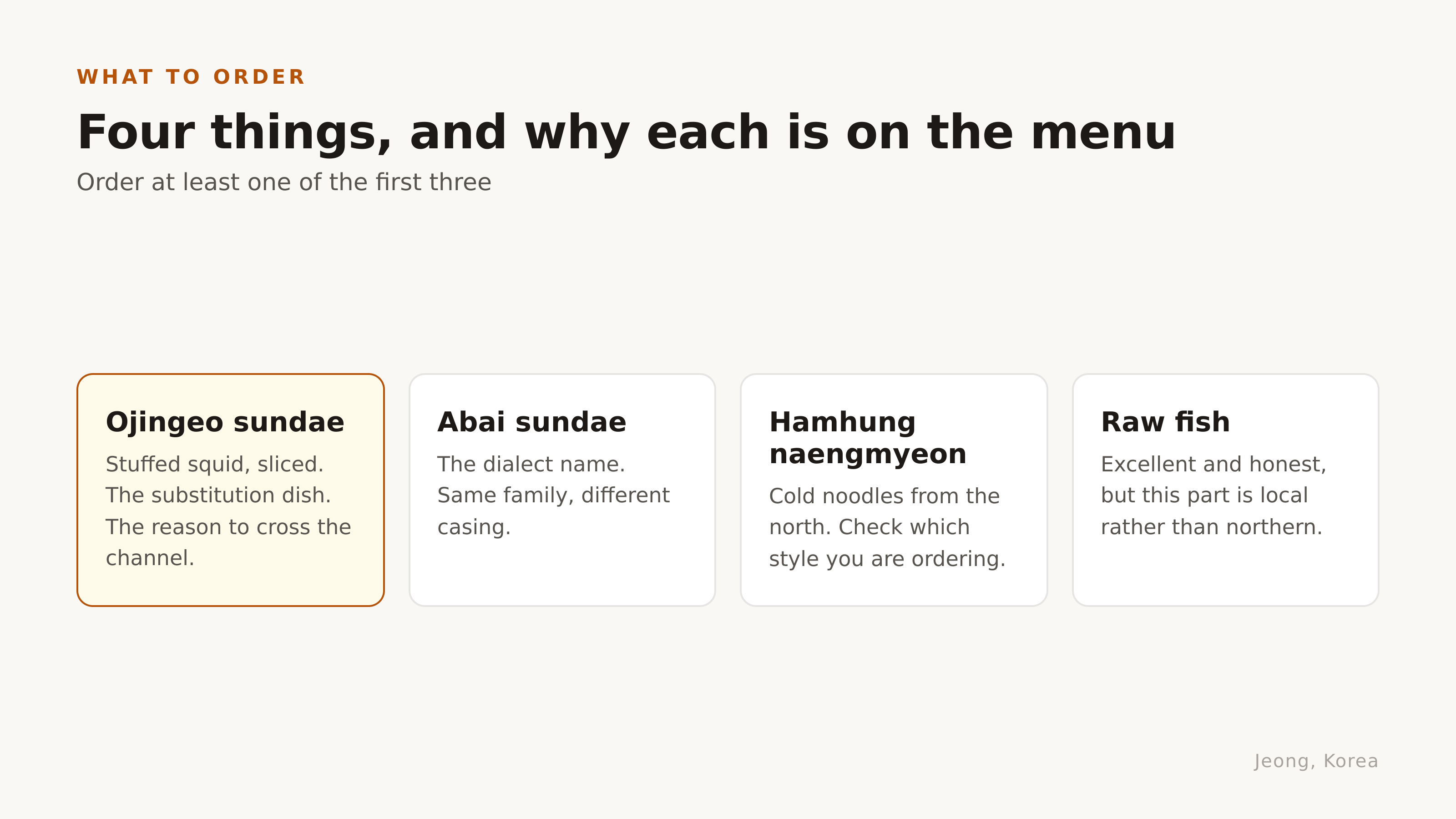
Do not read ojingeo sundae as ancient coastal cooking. It is a workaround that stuck.
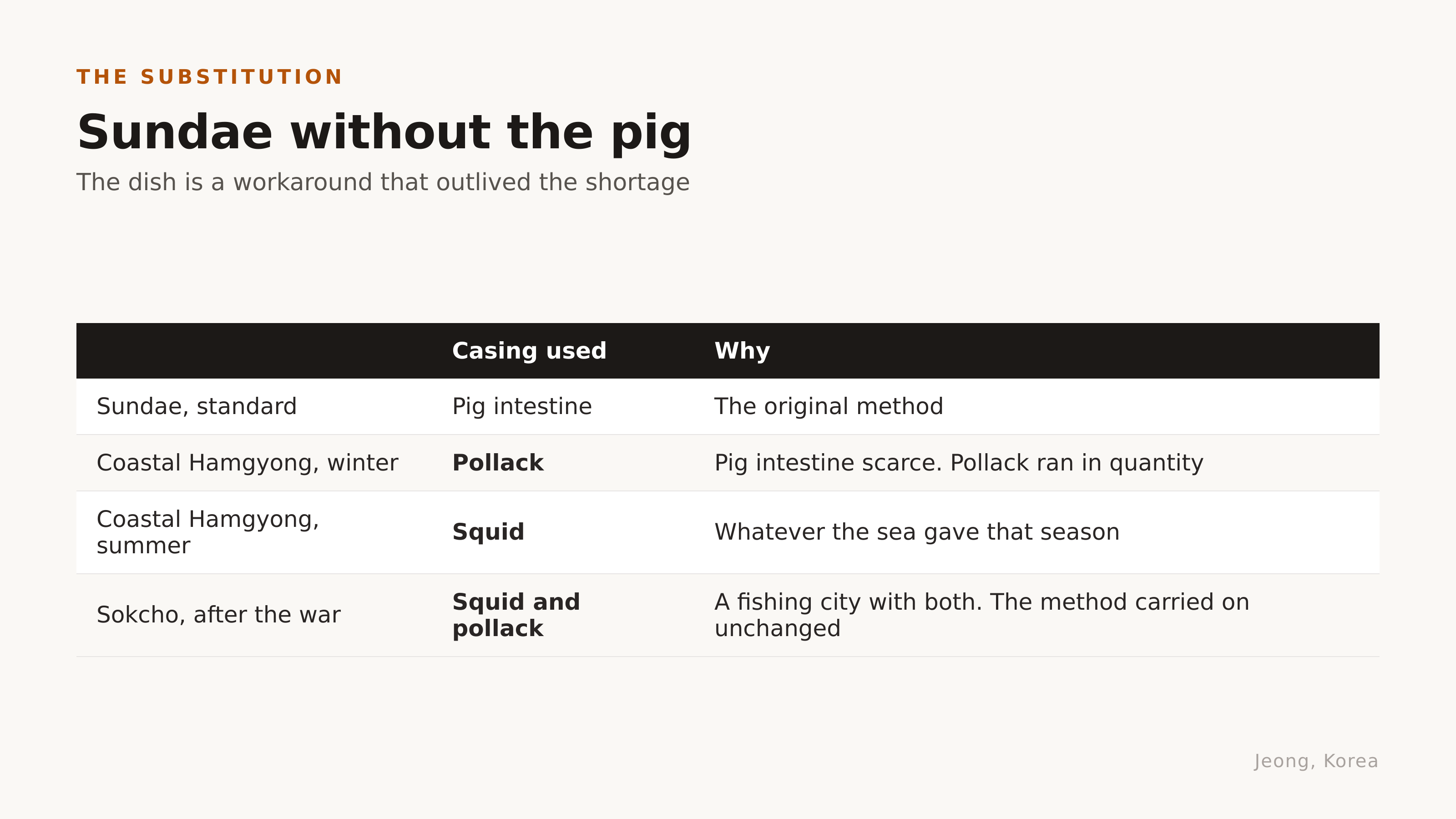
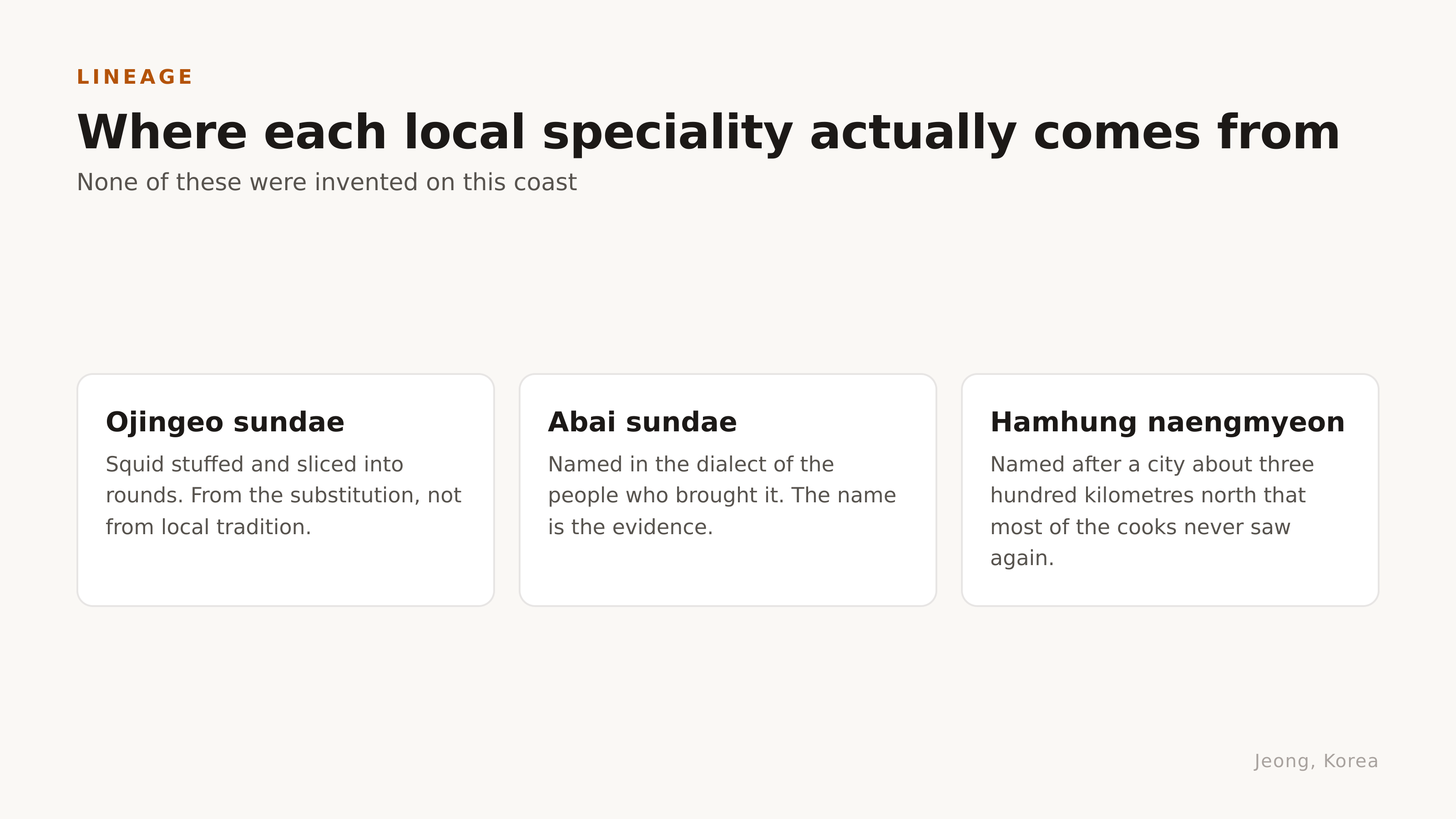
The reason sits in the original recipe. Sundae, the sausage, is properly made by stuffing pig intestine. In the coastal parts of Hamgyong Province, in what is now North Korea, pig intestine was scarce and seafood was not, so households substituted what the sea gave them. In winter they stuffed pollack, which ran in quantity. In summer they used squid. It was the same dish solving the same problem with a different casing.
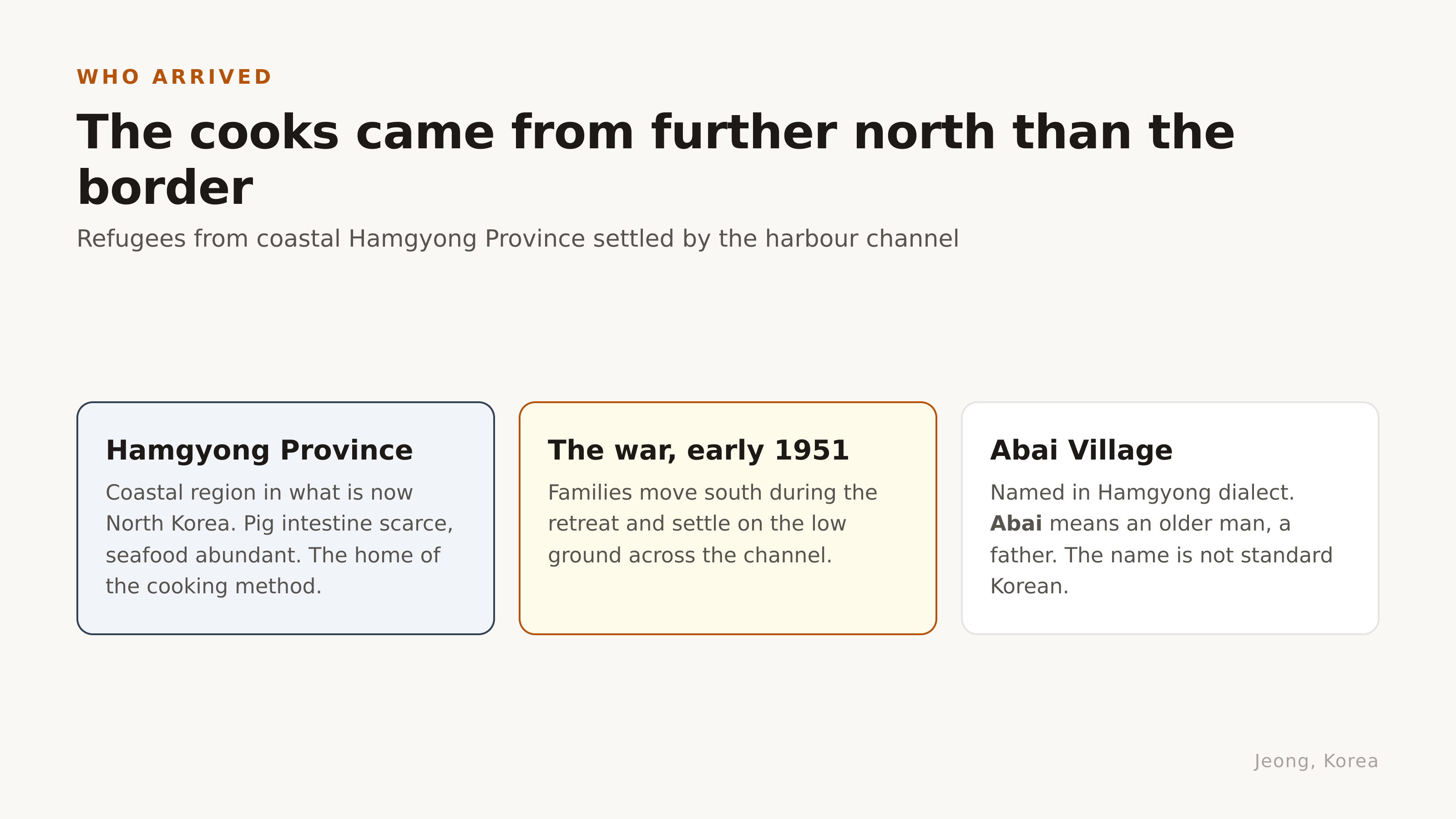
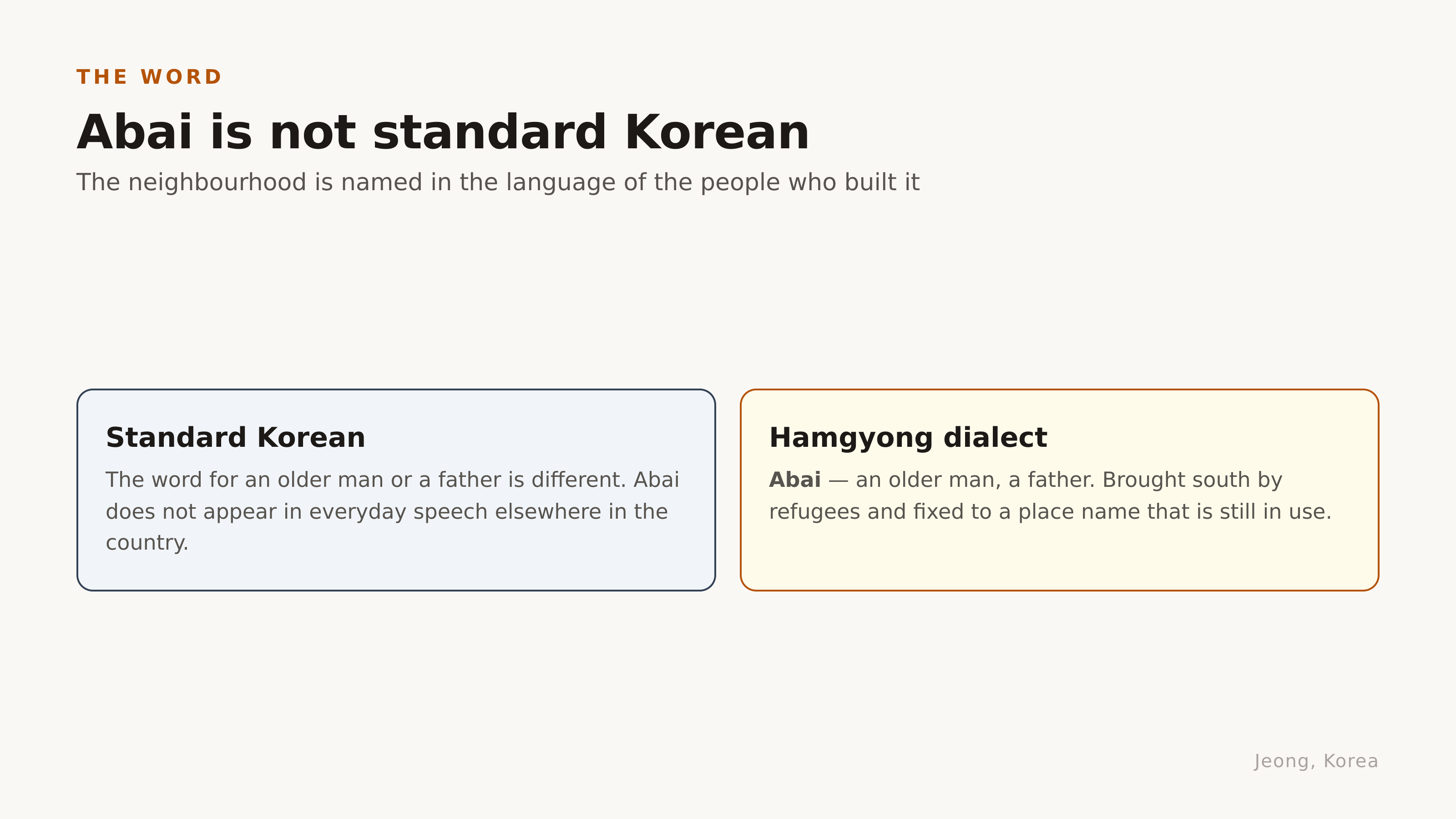
Then the people who cooked that way came south. Refugees from Hamgyong arrived on this coast during the war, many of them in the retreat of early 1951, and settled in the low ground by the harbour channel that became known as Abai Village. Abai is not standard Korean. It is Hamgyong dialect for an older man, a father, and the settlement is named in the language of the people who built it. They found themselves in a fishing city with abundant squid and pollack, which is to say they found themselves able to keep cooking exactly as they had.
That is why the local specialities line up the way they do. Squid sundae and pollack sundae from the substitution. Abai sundae from the dialect. Hamhung-style cold noodles from a city three hundred kilometres north that most of the cooks never saw again.
So the honest description of this food is not that it is from Sokcho. It is that it arrived in Sokcho and had nowhere else to go.
The cold noodle half of that story has a split in it that trips up almost every visitor: Naengmyeon: It Was a Winter Dish, and the Split Is the Flour, Not the Broth sorts out which bowl you are ordering.
Getting to the neighbourhood where all of this is cooked is its own small event.
You cross to Abai Village on a boat with no engine
Take the gaetbae. It costs 500 won and it is the point, not the transport.
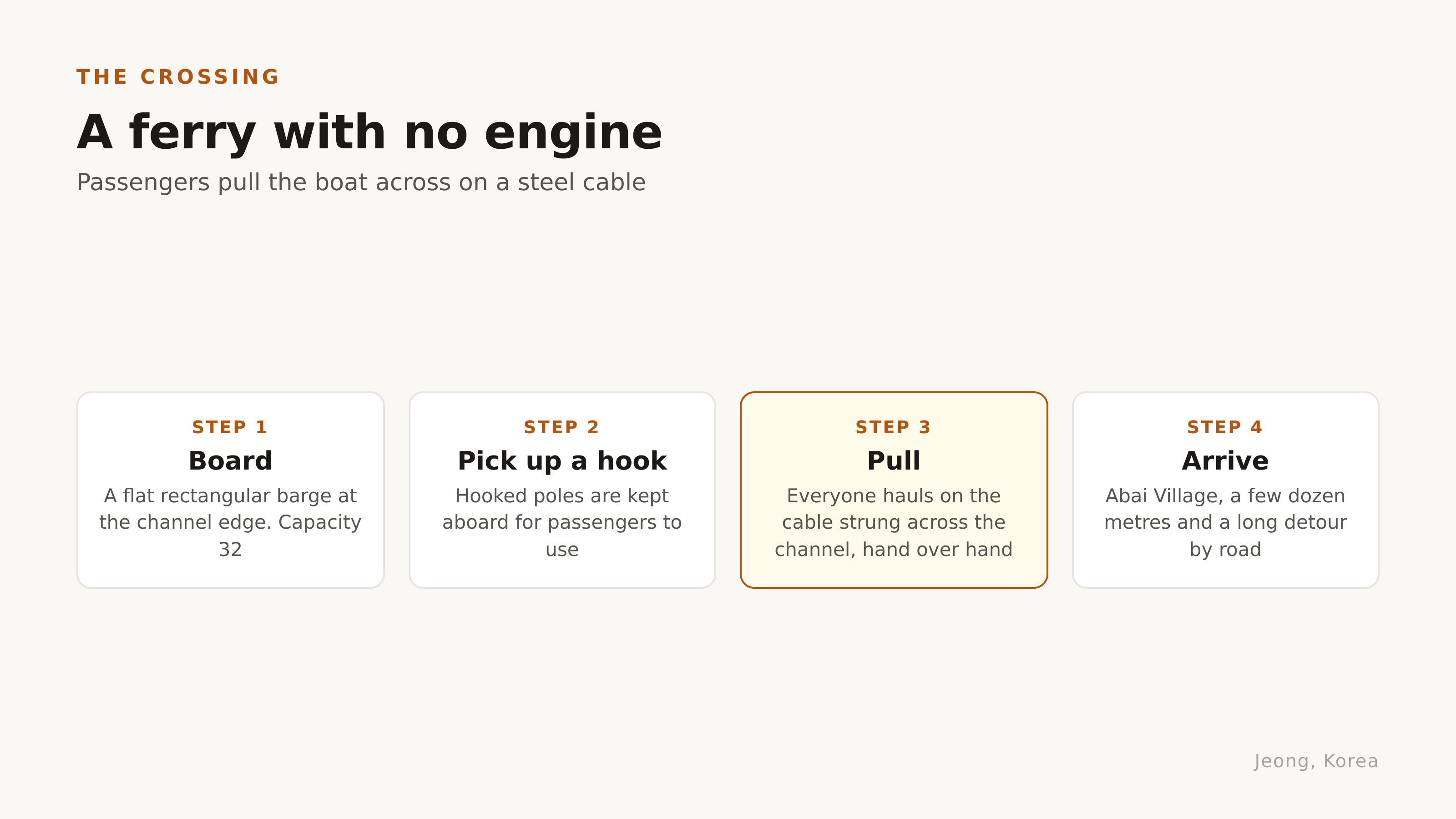
The reason it exists is geography. Abai Village sits on a spit across the channel at the mouth of Cheongchoho lagoon, so although it is a few dozen metres from the city centre in a straight line, going around by road is a long detour. The crossing has always been made by a flat rectangular barge.
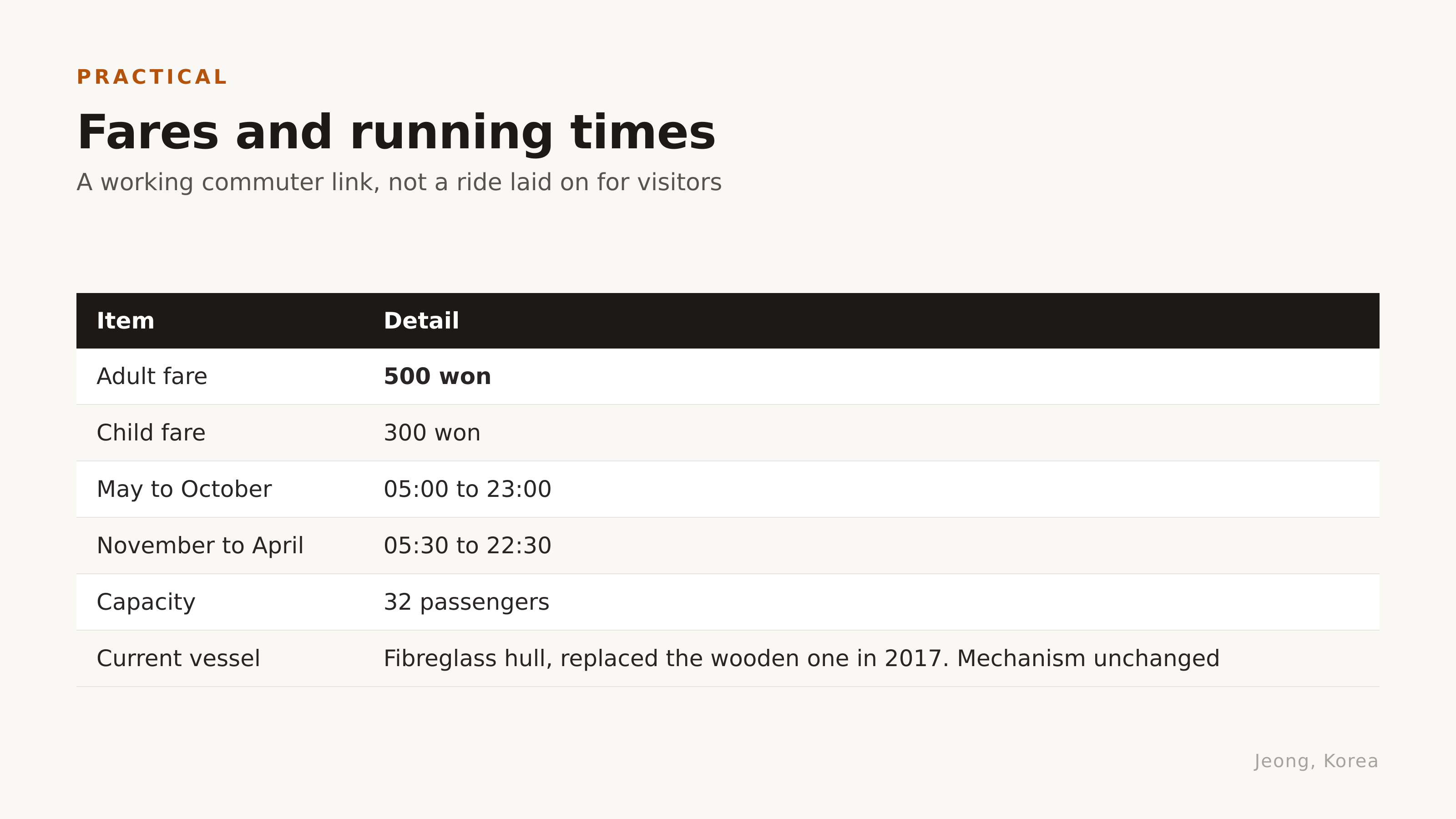
What makes it worth doing is how the barge moves. There is no motor. A steel cable runs across the channel, and passengers pick up hooked poles and haul the boat over hand over hand. Everyone aboard pulls. The current vessel takes 32 passengers and replaced the old wooden one with a fibreglass hull in 2017, but the mechanism is unchanged. Adults pay 500 won and children 300. It runs from 05:00 to 23:00 between May and October, and 05:30 to 22:30 from November to April, which means it is a working commuter link rather than a ride laid on for tourists. Korean visitors mostly know it from a television drama filmed here in 2000 and from a long-running variety show, and the crowd on a weekend reflects that.
So budget five minutes and a 500-won coin, pull the rope yourself, and eat on the other side. The queue in front of the sundae shops there is made of Koreans, which is the only endorsement worth quoting.
What you are actually eating
The summary is short. This coast was North Korean territory until the 1950s, the people who cook here came from further north than that, and the dishes they are famous for were invented to work around an ingredient they did not have. The squid is not tradition. It is substitution that outlived the shortage.
Which leaves you a choice about what kind of meal you want. You can eat the coast, and the raw fish here is excellent and honest and worth your money. Or you can eat what happened to the coast, cross the channel on a rope, and order the thing that only exists because a family had to improvise seventy-five years ago and then could not go home. Both are good lunches. Only one of them is a piece of the country's history that you can still taste.
FAQ
Was Sokcho really part of North Korea?
Yes. The city lies north of the 38th parallel, so it fell in the Soviet occupation zone from 1945 and under North Korean administration from 1948. South Korean forces retook it on 18 August 1951, and civil administration passed to the South Korean government on 17 November 1954.
What is ojingeo sundae?
Squid stuffed with a sundae filling and sliced into rounds. It came from coastal Hamgyong Province, where pig intestine was scarce, so cooks substituted squid in summer and pollack in winter. Refugees brought the method south during the war.
What does Abai mean?
It is Hamgyong dialect for an older man or father. The village is named in the dialect of the refugees who settled it, which is itself a clue about where the neighbourhood came from.
How much is the gaetbae ferry and when does it run?
Adults pay 500 won and children 300. It runs 05:00 to 23:00 from May to October and 05:30 to 22:30 from November to April. There is no engine. Passengers pull the boat across on a steel cable.
Is Sokcho worth a night, or is it just a base for the mountain?
Both work. Most people sleep here because the mountain has no accommodation at the trailhead, but the harbour, the lagoon and Abai Village are a genuine half day on their own, and they are the part of the trip that nobody plans for and everybody remembers.
References
출처 : 속초시 연혁 및 수복지구 행정권 이양 기록 (1945 divided occupation, 1948, 1951-08-18, 1954-11-17) 출처 : 지역N문화, 향토음식 아카이브 — 오징어순대·아바이순대의 함경도 기원 출처 : 속초시 대중교통 안내 — 갯배 운항 시간 및 요금