The Seoraksan Cable Car Stops at 699m. The Summit Is 1,708m.

Six hundred and ninety-nine, and one thousand seven hundred and eight. Those two numbers are the entire story. Almost nobody checks them before buying a ticket.
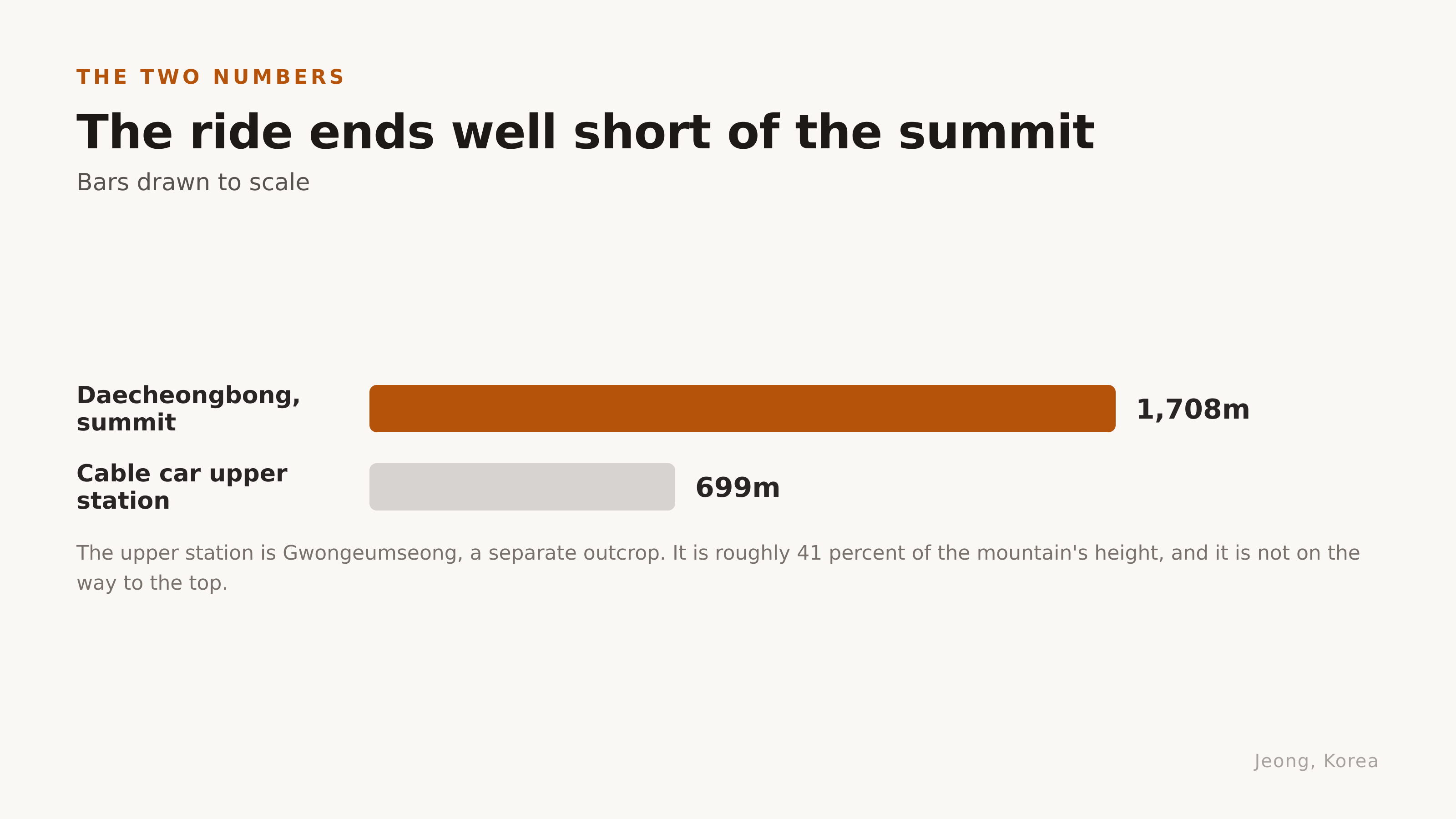
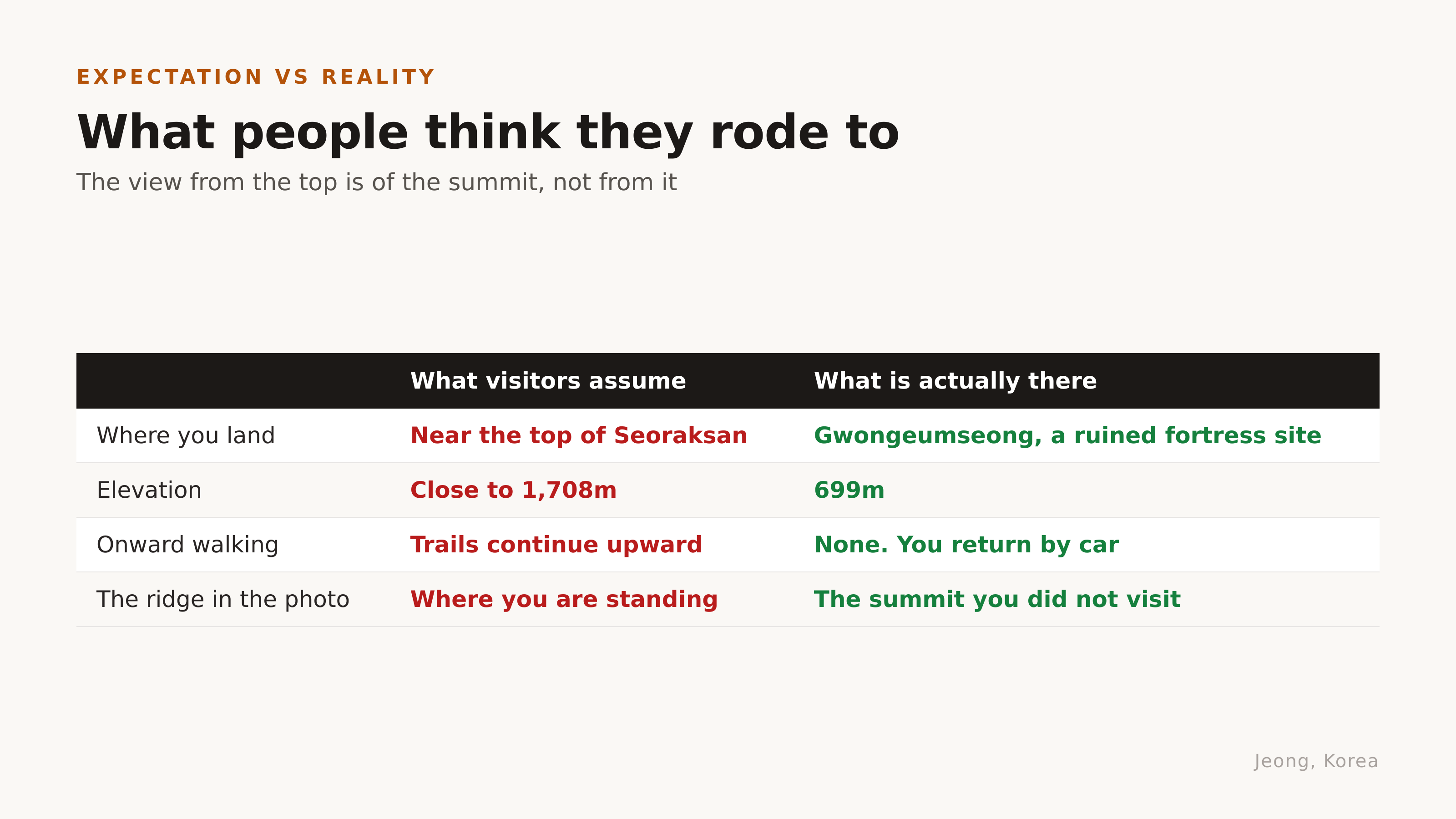
The first is the elevation of the upper station of the Seoraksan cable car. The second is Daecheongbong, the actual summit of the mountain. People ride up, stand on the rocks, photograph the ridge line going away from them in every direction, and come home believing they have been to the top of Korea's most famous mountain. They have been to roughly forty percent of its height, on a completely different peak, and the view they are looking at is the summit they did not visit.
This is not a complaint about the ride. It is a very good ride. It is a complaint about how it gets described, because the gap between those two numbers changes what you should plan for the day.
If you have not sorted out how you are getting here yet, that has its own set of surprises, and hiking near the capital is a different exercise entirely: Hiking in Seoul: The Mountain I Take Foreign Friends To covers the easy version.
The cable car goes to a fortress, not to a peak
Stop thinking of this as a shortcut up the mountain.
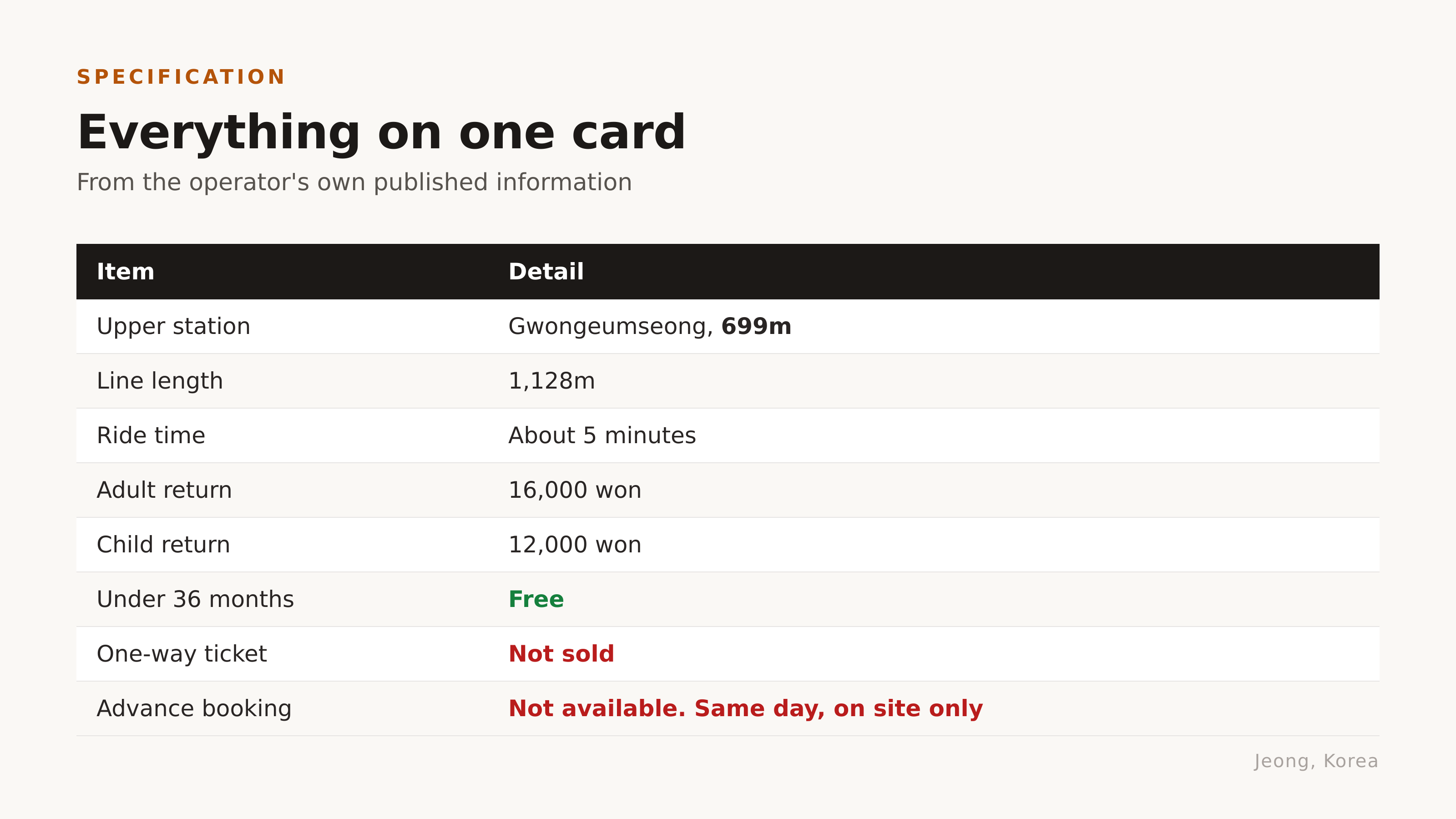
The upper station sits on Gwongeumseong, a ruined fortress site on a rock outcrop, at 699 metres. That is a real elevation and a real view, but it is a separate feature of the park rather than a staging point on the way to anywhere. The line runs 1,128 metres and the ride takes about five minutes.
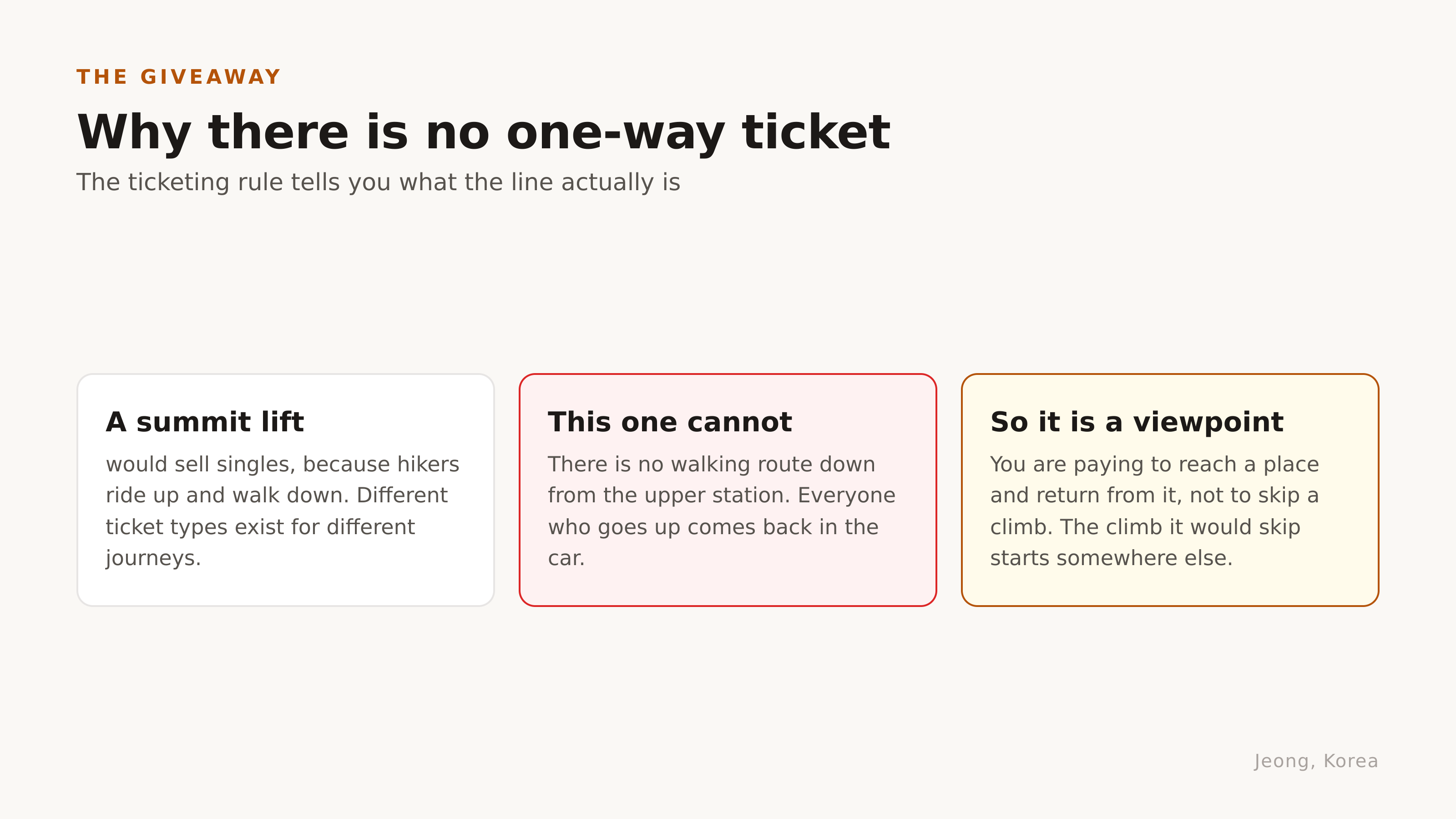
The clearest proof of this is in how the tickets are sold. The operator does not sell one-way tickets at all, only return, and the stated reason is that there is no walking route down from the top. You go up in the car and you come back down in the car. A cable car that genuinely served a summit approach would sell singles to hikers. This one cannot, because it does not connect to anything.
| Item | Detail |
|---|---|
| Upper station | Gwongeumseong, 699m |
| Line length | 1,128m |
| Ride time | About 5 minutes |
| Adult return | 16,000 won |
| Child return | 12,000 won |
| Under 36 months | Free |
| One-way tickets | Not sold |
| Advance booking | Not available. Same-day, on-site only |
That last row is the one that catches people out. There is no online reservation system. You buy at the ticket window on the day, which in mid-October means arriving early and expecting to wait.
So treat it as a viewpoint you pay to reach, not as a way of skipping a climb. The climb it would skip does not start there.
The other Korean mountain where the summit access is tightly controlled works the opposite way round: Hallasan Hike: Only One Trail Reaches the Summit Right Now.
Which brings up the other cable car, the one a lot of articles describe as though you can ride it.
The second cable car you have read about does not exist yet
Do not plan around the Osaek line.
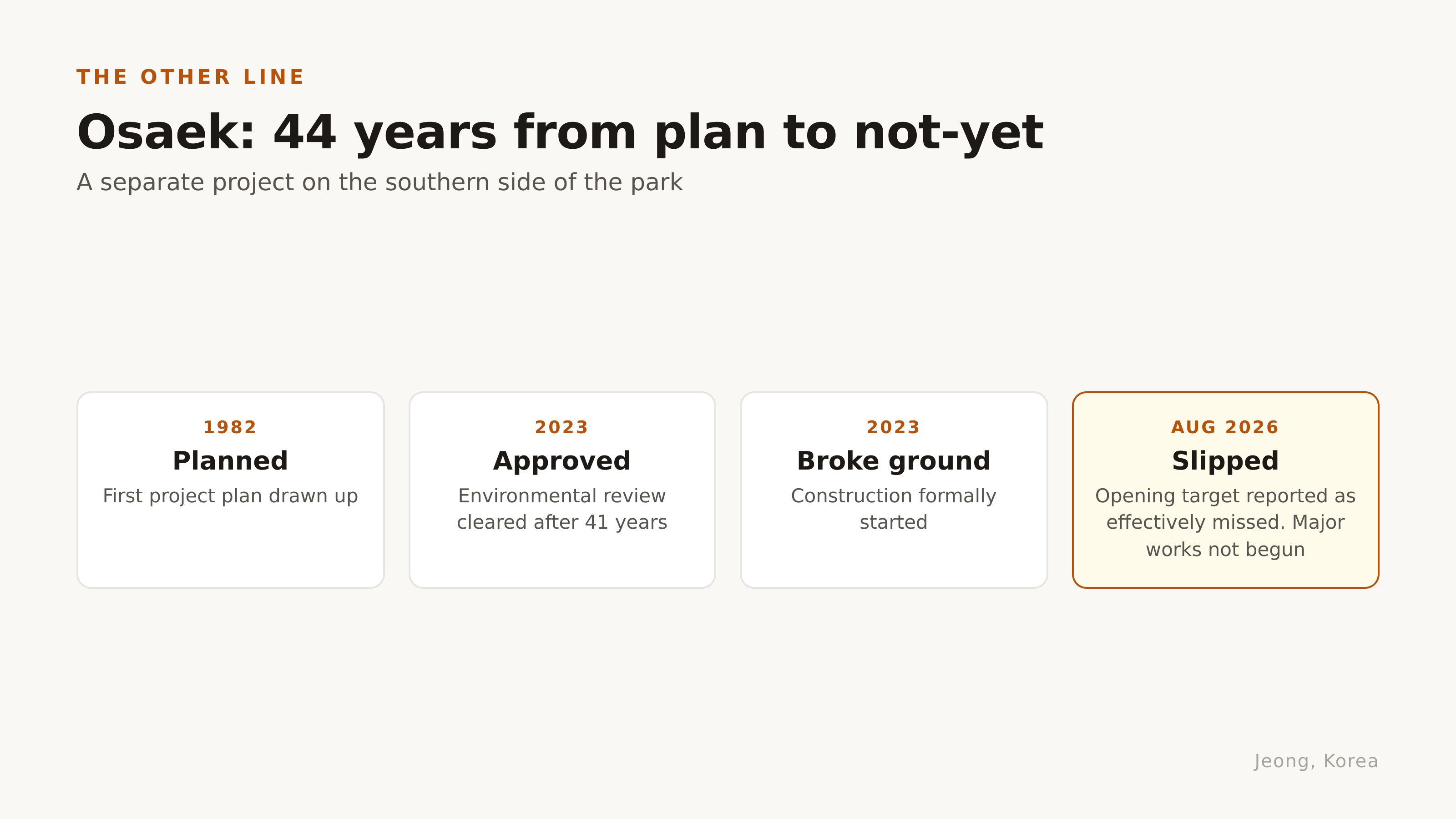
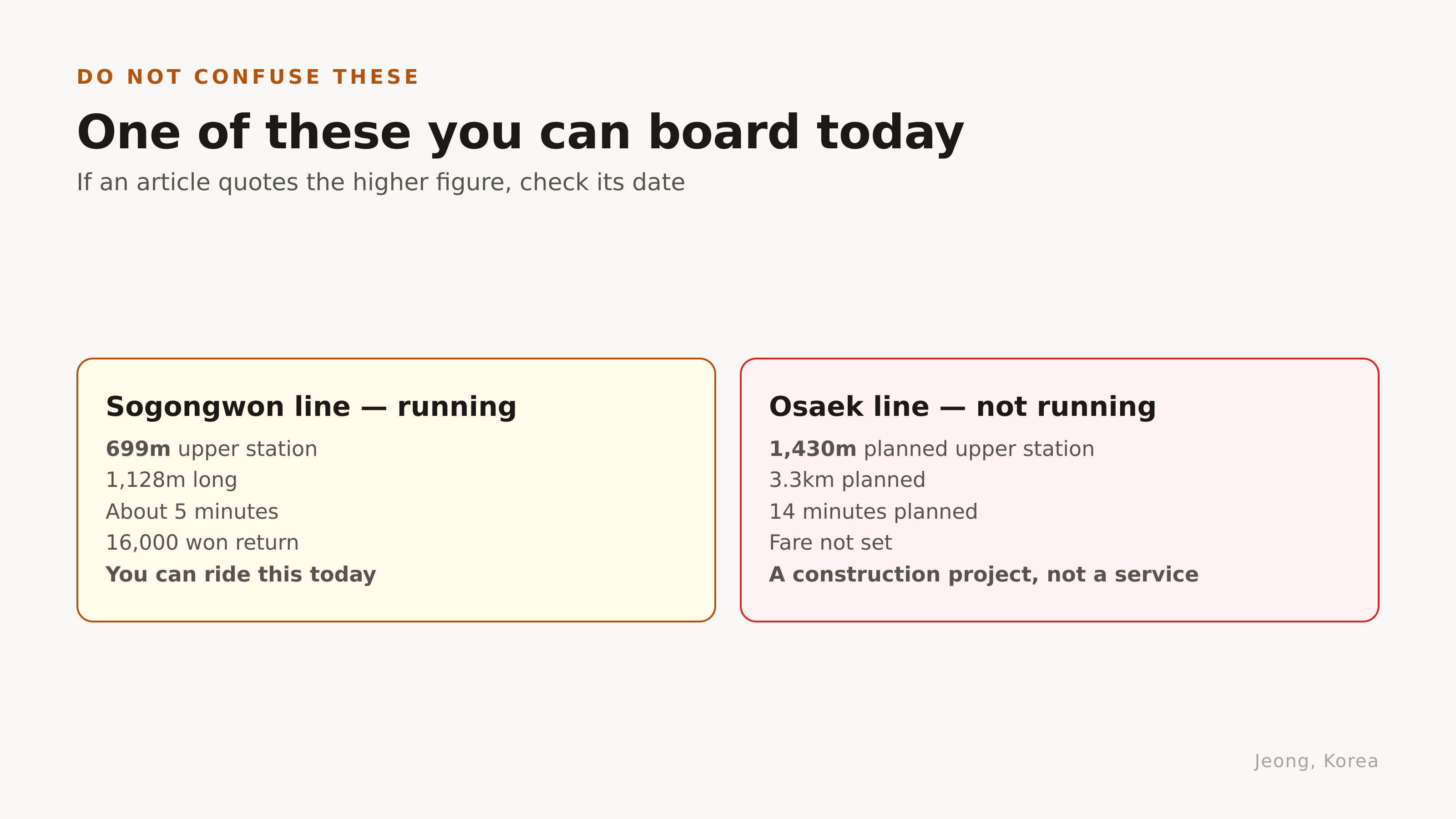
If you have seen a Seoraksan cable car described as climbing to 1,430 metres in fourteen minutes, that is a different project on the southern side of the park, and it is not carrying passengers. The plan dates back to 1982. It cleared its environmental review and broke ground in 2023, forty-one years later, with a route of 3.3 kilometres from Osaek up to Kkeutcheong and gondolas running to an upper station far above the one that exists today.
Then it stopped moving. As of August 2026, Korean press reporting says the opening target has effectively slipped, with design changes for safety pushing costs up by hundreds of billions of won, and that substantial construction has not begun. The site work has stayed at the survey stage.
I am being careful here because this is a live project and the situation may change. What I can say is that the numbers you may have read, 1,430 metres and fourteen minutes, describe a plan rather than a service. The only cable car you can currently board at Seoraksan is the 699-metre one at the main entrance.
So if a page you are reading quotes a much higher figure, check the date on it before you build a day around it.
There is a similar gap between what people expect and what is actually in front of them at Korea's most photographed temple: Bulguksa Temple: You See the Buddha Through Glass.
None of which answers the practical question, which is what to do with the rest of the day.
A full day at the main gate, without a single steep step
Plan the flat version. It works better than people expect.
The reason is that the Sogongwon entrance area is genuinely level for a long way in. This is not a trailhead that throws you at a gradient. It is a valley floor with a temple, a river and several walking routes fanning out from a single car park, and the serious climbing starts well after the point most visitors turn around.
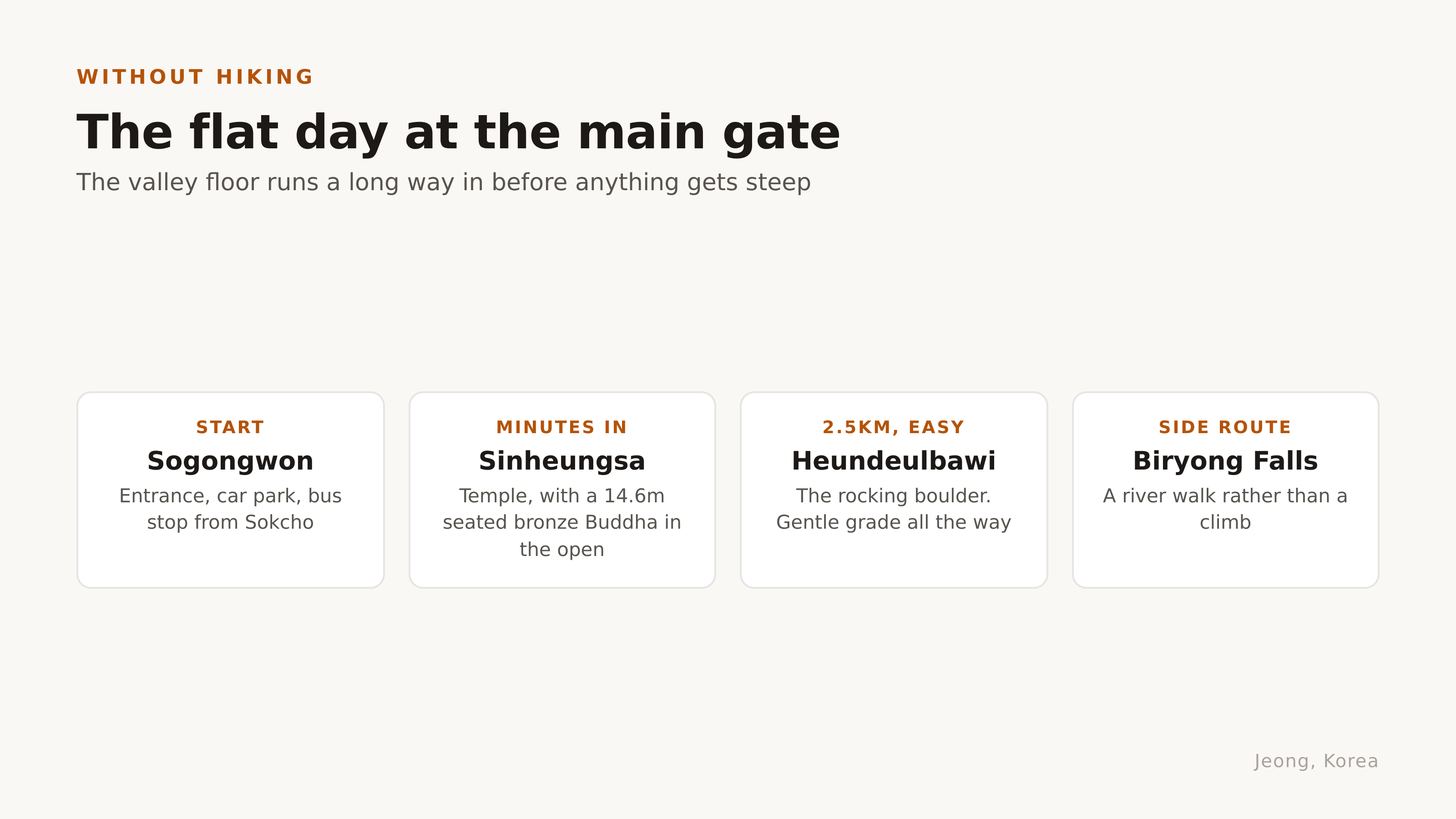
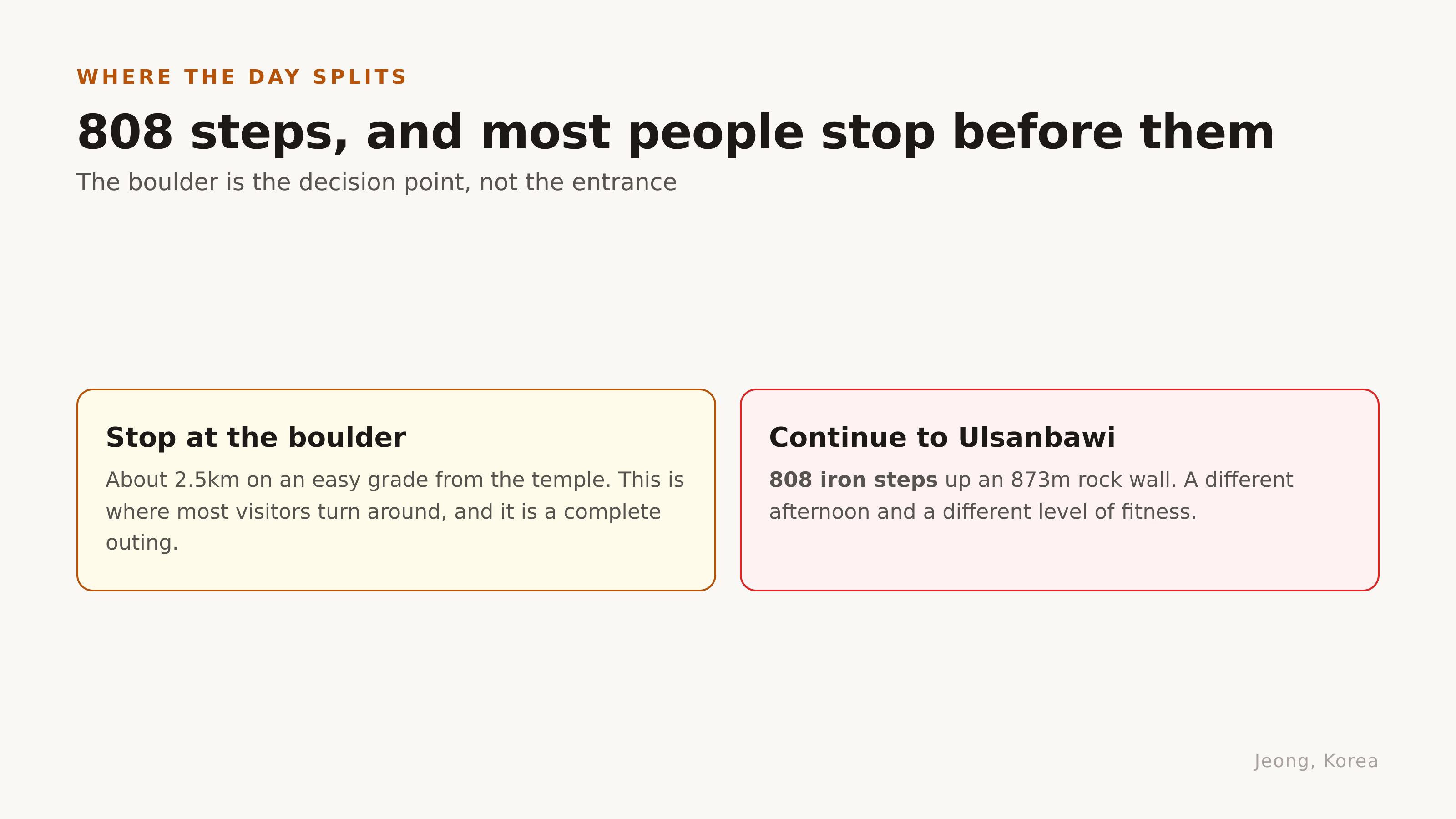
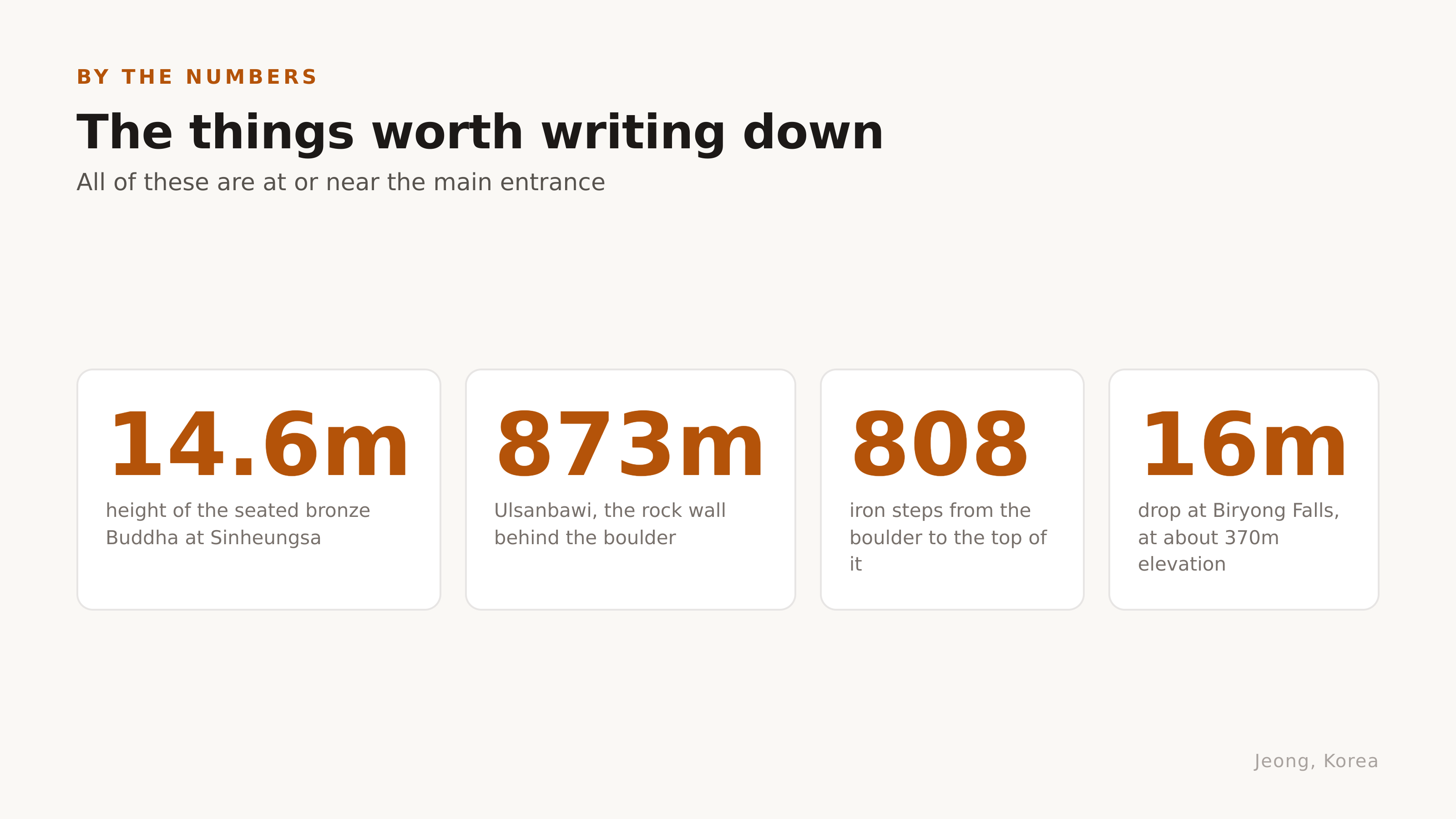
Sinheungsa sits a few minutes from the entrance, with the Unification Buddha, a seated bronze figure 14.6 metres tall, in the open in front of it. Beyond the temple, the path to Heundeulbawi, the rocking boulder, runs about 2.5 kilometres on an easy grade. That is the point where the day splits. Continuing up Ulsanbawi, the 873-metre rock wall behind it, means 808 iron steps, and that is a different afternoon. Most people stop at the boulder, and there is no shame in it. In the other direction, Biryong Falls drops about 16 metres at an elevation of roughly 370 metres, reached by a river walk rather than a climb.
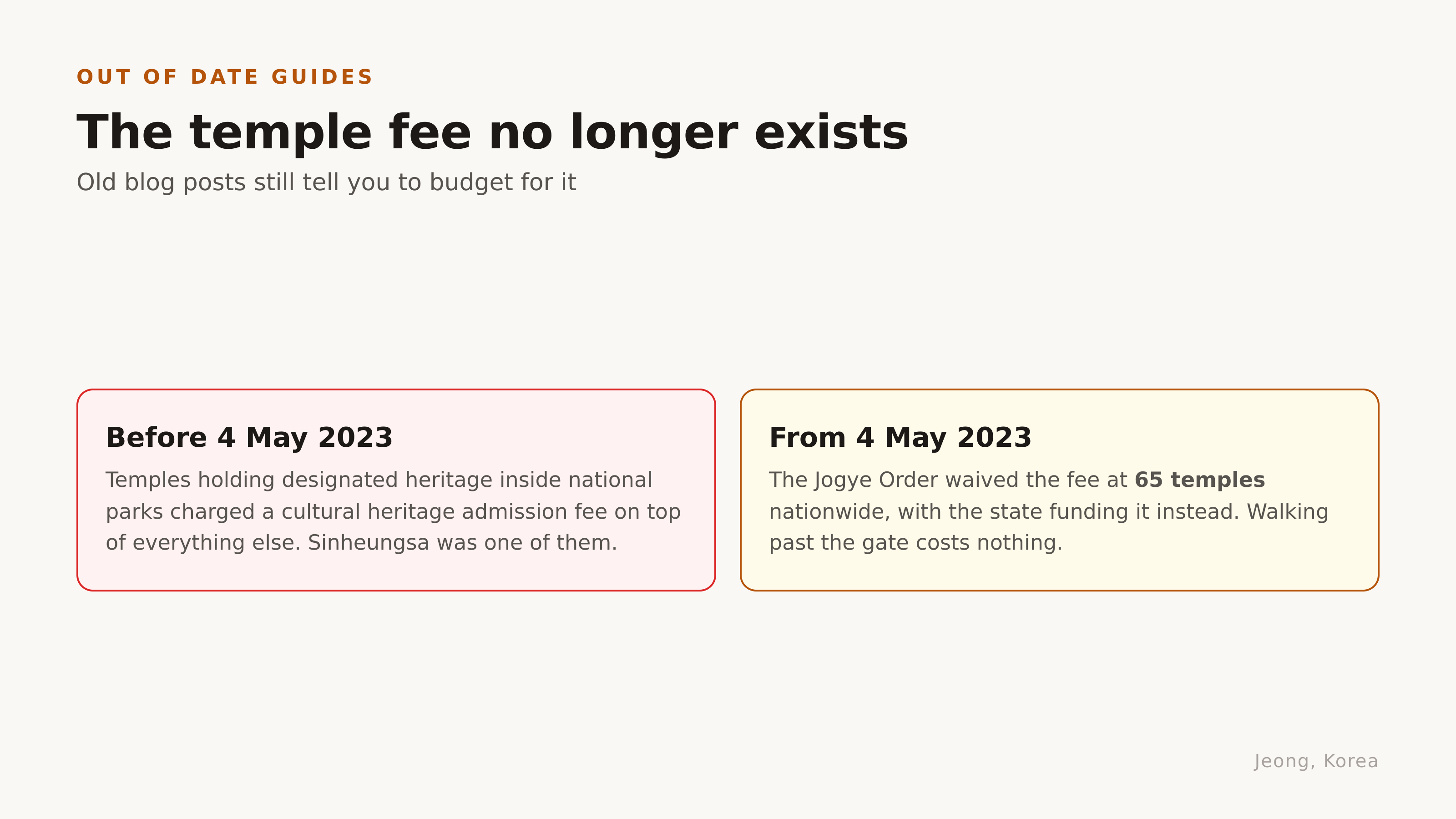
One more thing worth knowing, because old guides still get it wrong. Temples inside national parks used to charge a cultural heritage admission fee on top of everything else, and Sinheungsa was one of them. On 4 May 2023 the Jogye Order waived it at 65 temples nationwide, funded by the state instead. If a blog post tells you to budget a few thousand won to walk past the temple gate, that post is out of date.
So a day that reads as cable car, temple, boulder, waterfall, bus back to town is a complete day here, and it asks nothing of your knees.
What to actually take with you
The short version is three numbers and one decision.
The upper station is 699 metres and the summit is 1,708, so the ride is a viewpoint rather than a climb. Tickets are 16,000 won return, sold only on the day and only as returns. And the Osaek line that appears in newer articles is a construction project, not a service you can book.
The decision is whether you are climbing. If you are not, you do not need boots, you do not need a reservation, and you do not need to be fit. You need a bus ticket and a morning. That is a lower bar than almost anything else people travel this far for, and the mountain does not hold it against you.
FAQ
How high does the Seoraksan cable car actually go?
The upper station at Gwongeumseong is at 699 metres. The summit of the mountain, Daecheongbong, is 1,708 metres, so the ride covers a little over a third of the mountain's height and ends on a separate outcrop.
Can I book the Seoraksan cable car online in advance?
No. The operator does not take advance reservations. Tickets are sold at the ticket office on the day of your visit, so in autumn it is worth arriving early.
Why is there no one-way ticket?
Because there is no walking route down from the upper station. The operator sells returns only. Adult return is 16,000 won and child return is 12,000 won, with under-36-months free.
Is the Osaek cable car open?
Not at the time of writing. It broke ground in 2023 after four decades of planning, but reporting in August 2026 indicated that the opening target had slipped and that major construction had not started. Check current news before relying on it.
Do I still have to pay to enter Sinheungsa temple?
No. The cultural heritage admission fee was waived at 65 temples across the country on 4 May 2023, Sinheungsa among them, with the government covering the cost instead. Older guides that quote a fee are out of date.
References
출처 : Seorak Cable Car official operator information (fares, line length, ride time, upper station elevation, ticketing rules) 출처 : Korea National Park Service, Seoraksan National Park trail and feature data 출처 : Hankook Ilbo, reporting on the Osaek cable car schedule and cost revision, 16 August 2026 출처 : Jogye Order of Korean Buddhism, cultural heritage admission fee waiver at 65 temples, 4 May 2023