PC Bang in Korea: How It Works, and Why Nobody Will Speak to You

A Korean PC bang is one of the few rooms in Seoul where you can be completely self-sufficient from the moment the door shuts behind you. You can spend four hours inside one without saying a single word to another person. That is not shyness and it is not luck — the room is built that way.
Almost nobody knows that going in, which is why so many people stop at the doorway. What stops them is never the price and it is never the games. It is the sixty seconds after the door, where you cannot tell whether you are supposed to walk to the counter, wait to be seated, or just sit down somewhere.
So here is the order things actually happen in.
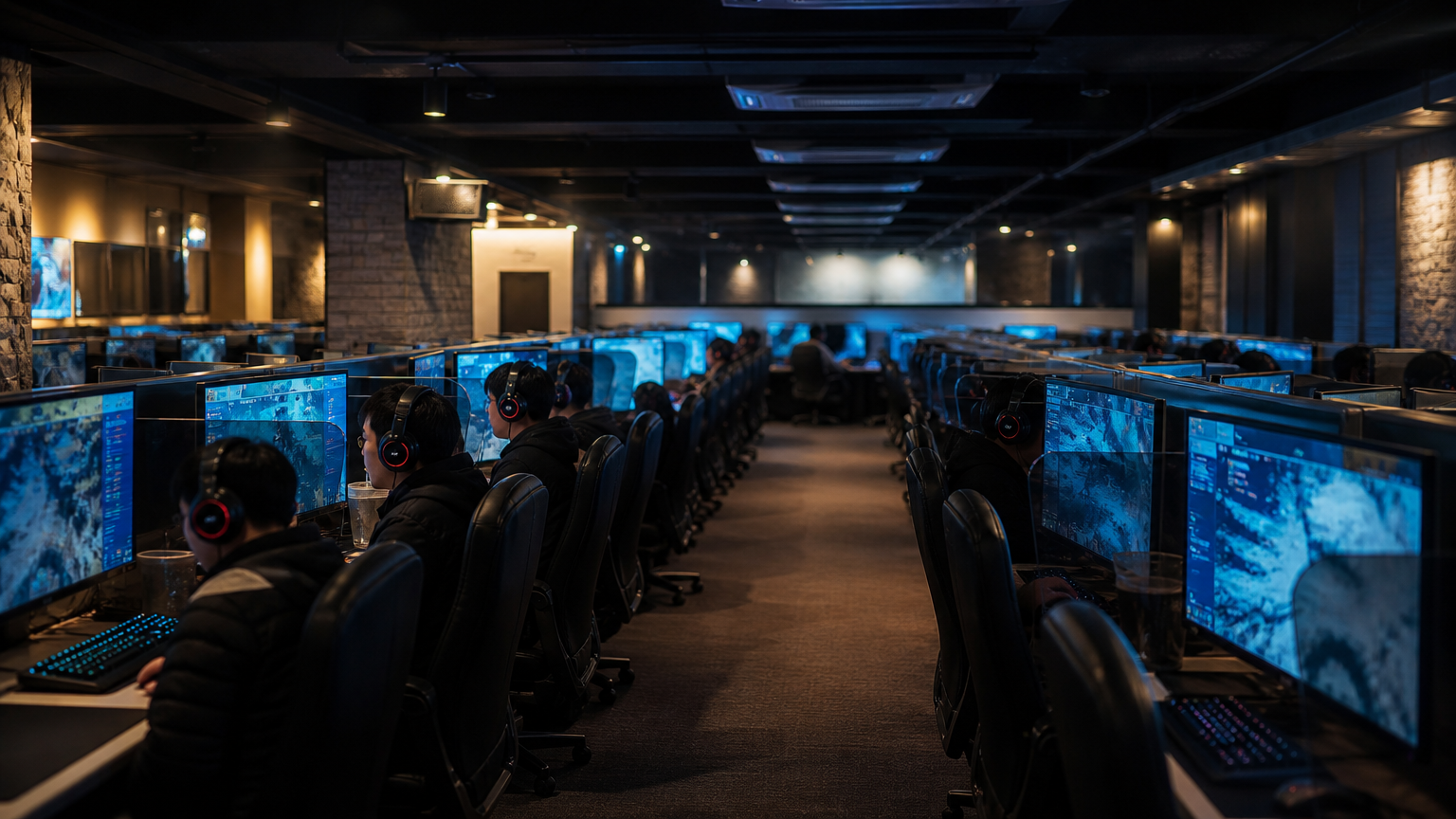
Sit down first. That really is the whole first step.
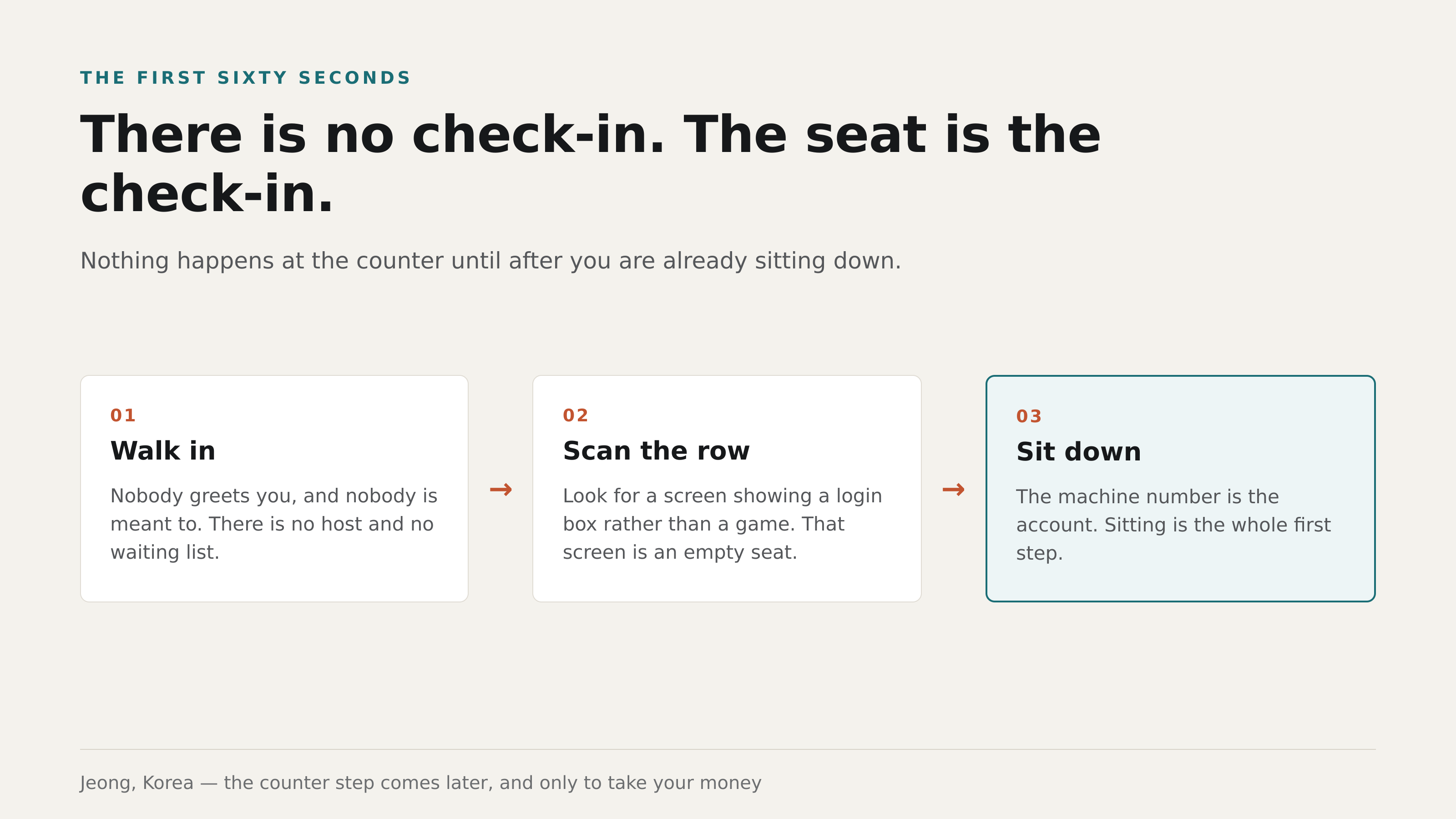
You do not check in anywhere. You find an empty seat and you sit in it.
The reason is that the seat is the account. Every machine has a number on it, and that number is what the shop's software is tracking — not your name, not a booking, not a queue. There is no host and no waiting list, because there is nothing for a host to hold.
You can see this if you look at an empty station on your way past. The screen is not dark and it is not running a screensaver. It is showing a login box, waiting. That box is the check-in, and it is sitting at the seat rather than at the counter on purpose.
So: walk in, look down the row for a screen with a login box on it, and take that chair.
If that arrangement feels familiar, it is the same logic behind coin karaoke here — a room designed so that using it alone is the normal case rather than the sad one.
But the login box is asking for something. What do you type?
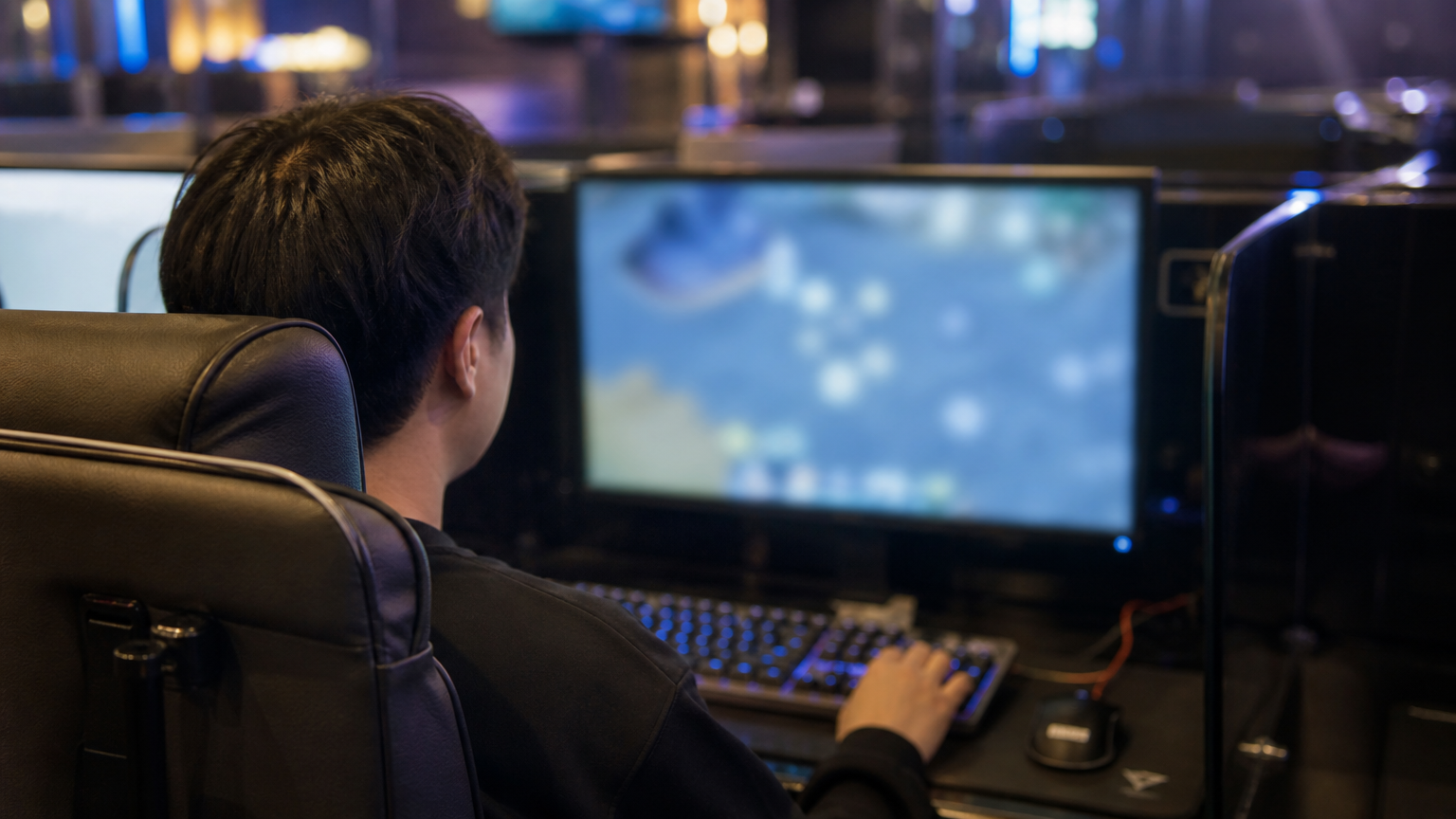
The login screen, and how to get past it without a Korean account
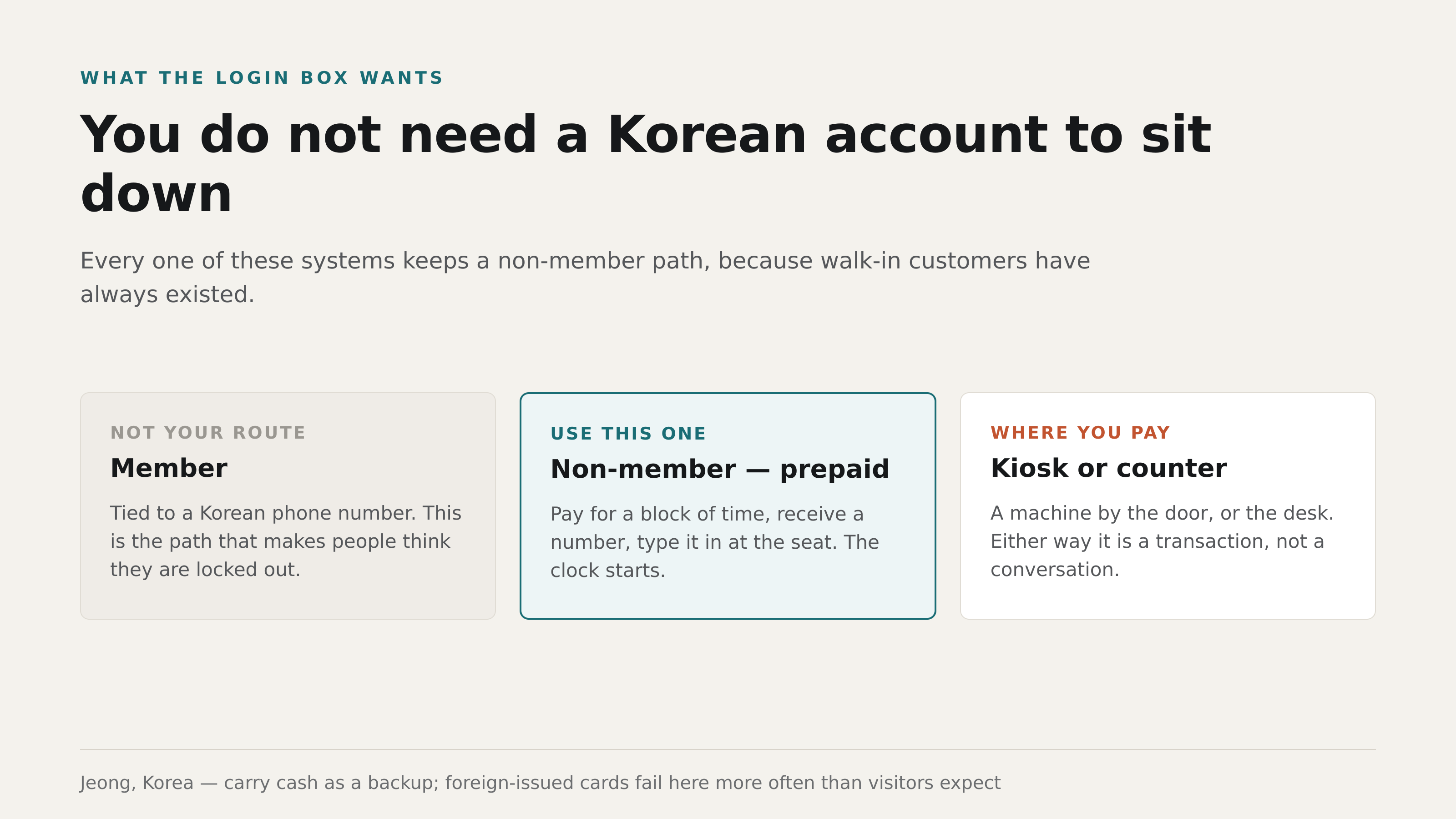
You do not need a Korean account, and you do not need a Korean phone number to sit down.
Every one of these systems is built with a non-member path, because Korean shops have always had walk-in customers who are not going to register for anything. The non-member route is prepaid: you pay for a block of time up front, you are given a number to enter, and the clock starts.
What varies is where you pay. Some shops have a kiosk near the entrance that takes cash or card and prints your code. In others you pay at the counter. Either way, the interaction is a transaction and not a conversation — you are handing over money and receiving a number.
There is one thing that can be asked of you, and it is worth knowing why. Under the Game Industry Promotion Act, an operator is allowed to ask an entrant to show identification, and to refuse entry to someone who will not produce it without good reason. That provision exists to enforce the age rules further down this article, not to screen foreigners. A passport answers it.
Bring some cash as a backup for the payment step. Foreign-issued cards fail in Korea more often than visitors expect, for reasons that have nothing to do with your bank — we wrote that up separately, because it catches people out constantly.
You are in and the clock is running. Now the part that surprises people most.
The food arrives at your seat, and you still do not speak
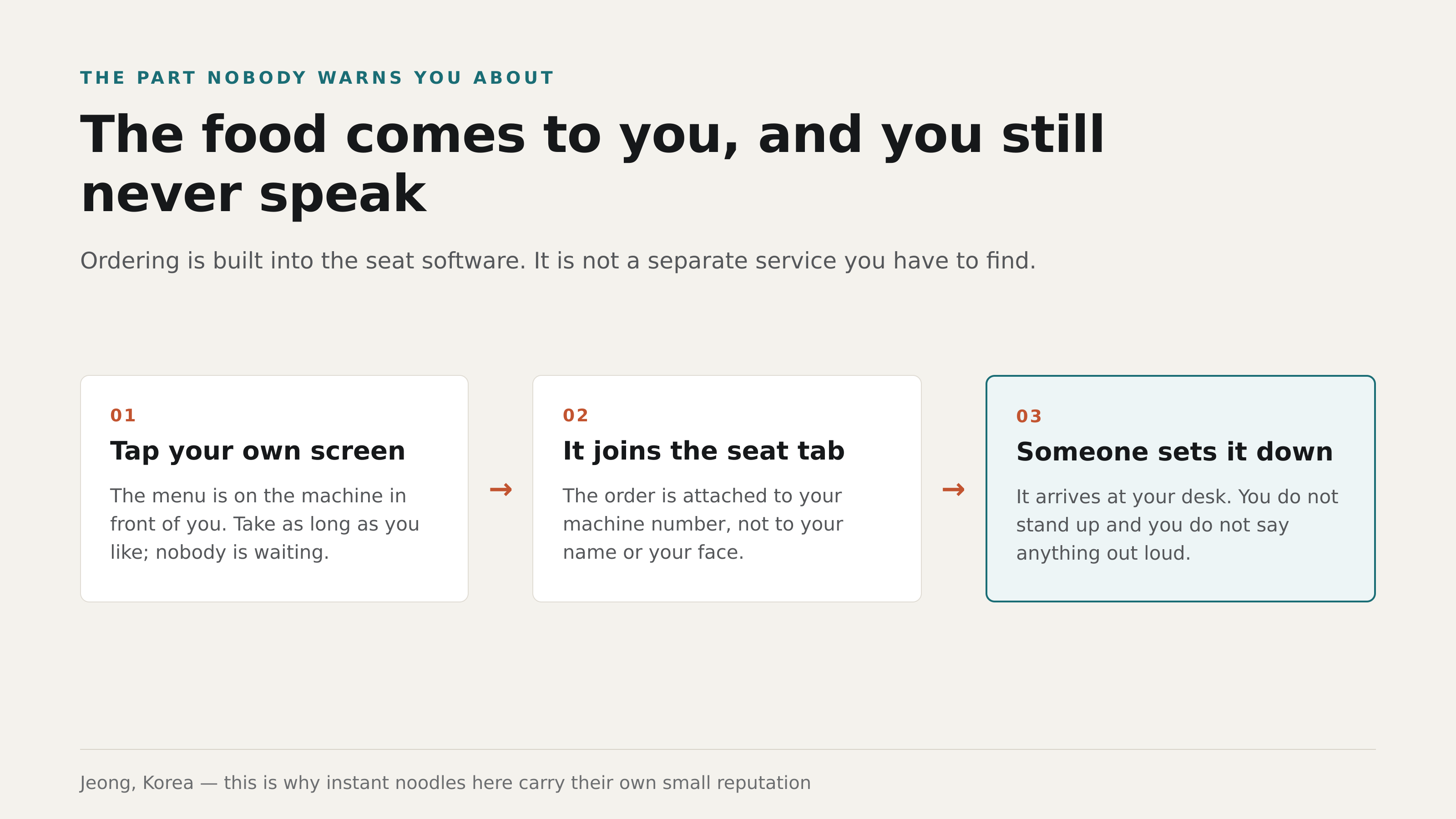
You order food from the same screen you are already sitting at.
The ordering menu is part of the seat software, not a separate service. You pick what you want, it goes onto your seat's tab, and somebody brings it to your desk. You do not stand up, you do not go to a counter, and you do not have to name anything out loud in a language you do not speak.
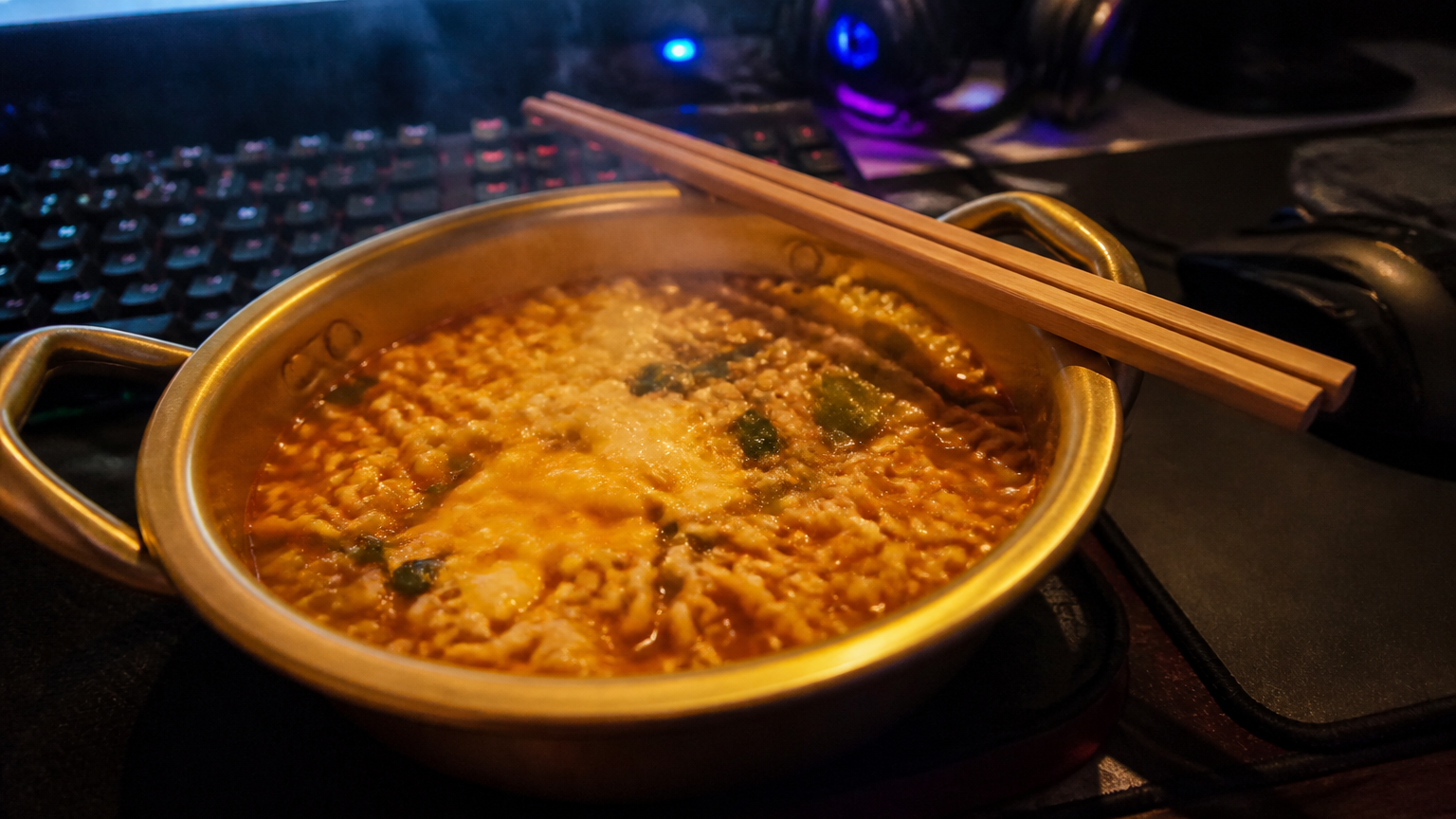
This is the reason instant noodles from one of these places carry their own small reputation in Korea. It is not a better noodle. It is that the whole path — deciding, ordering, paying, eating — happens without you leaving the chair or breaking whatever you were in the middle of. The convenience is the flavour.
If you want to understand how Korea got this good at the fifteen-minute meal, the convenience store is the other half of that story.
So what is it that you are actually buying here?
What the meter is actually counting
The meter runs on time, and nothing else on the desk is being sold to you.
That sounds like a technicality until you notice how much of the room is shaped by it. Nobody hurries you, because your leaving early does not free up anything they can resell. Nobody checks on you, because there is nothing to check. If you buy a block and use half of it, the remainder usually stays on your number for next time rather than evaporating at the door.
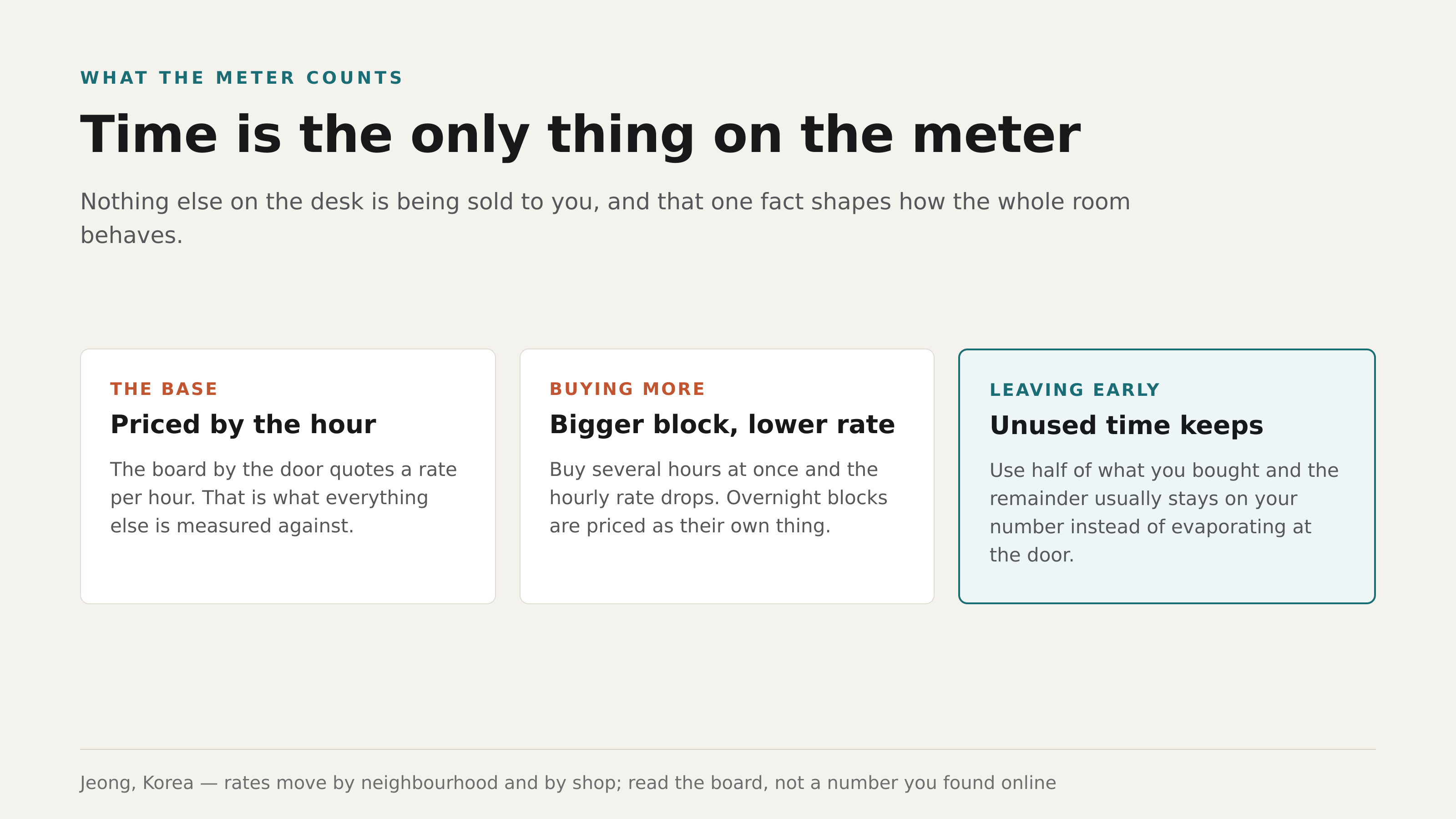
It also explains the pricing you will see on the wall. Rates are quoted per hour, blocks get cheaper the larger they are, and overnight blocks are usually priced as their own thing. Figures move by neighbourhood and by shop, so read the board rather than trusting a number you found online.
And then there are the hours, which are not the shop's decision at all.
Two clocks the law puts on the room, and one rule about smoke
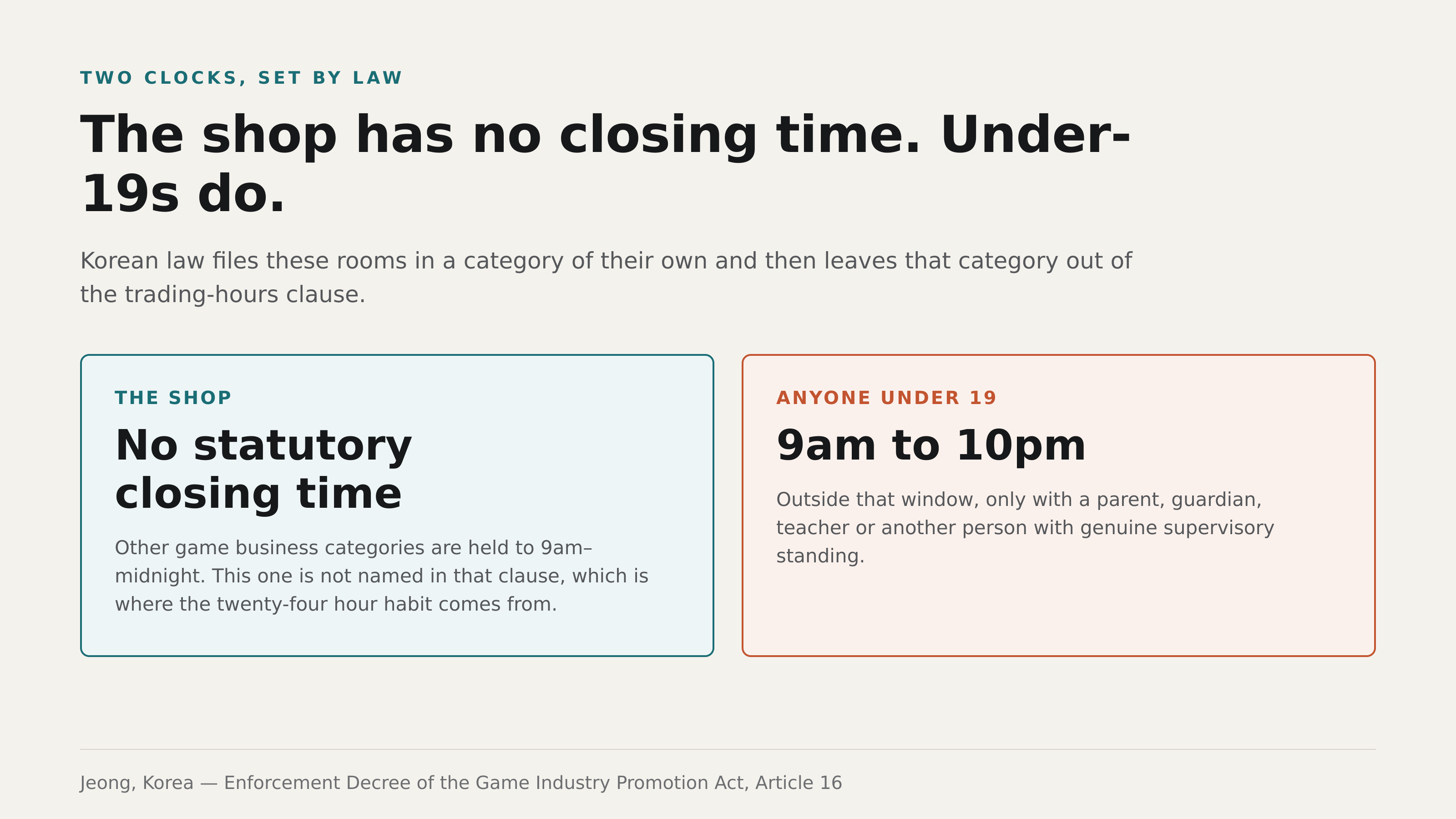
Korean law files these places under a category of their own — 인터넷컴퓨터게임시설제공업, roughly "internet computer game facility provision business" — and that category is where the twenty-four hour thing comes from. The enforcement decree that sets trading hours for game businesses simply does not set any for this one. Arcades and the other game categories are held to 9am to midnight. This category is left out of that clause.
| Business type | Trading hours | Under-19 entry |
|---|---|---|
| PC bang | No statutory limit | 9am to 10pm |
| Arcade and general game arcades | 9am to midnight | 9am to 10pm or barred, by category |
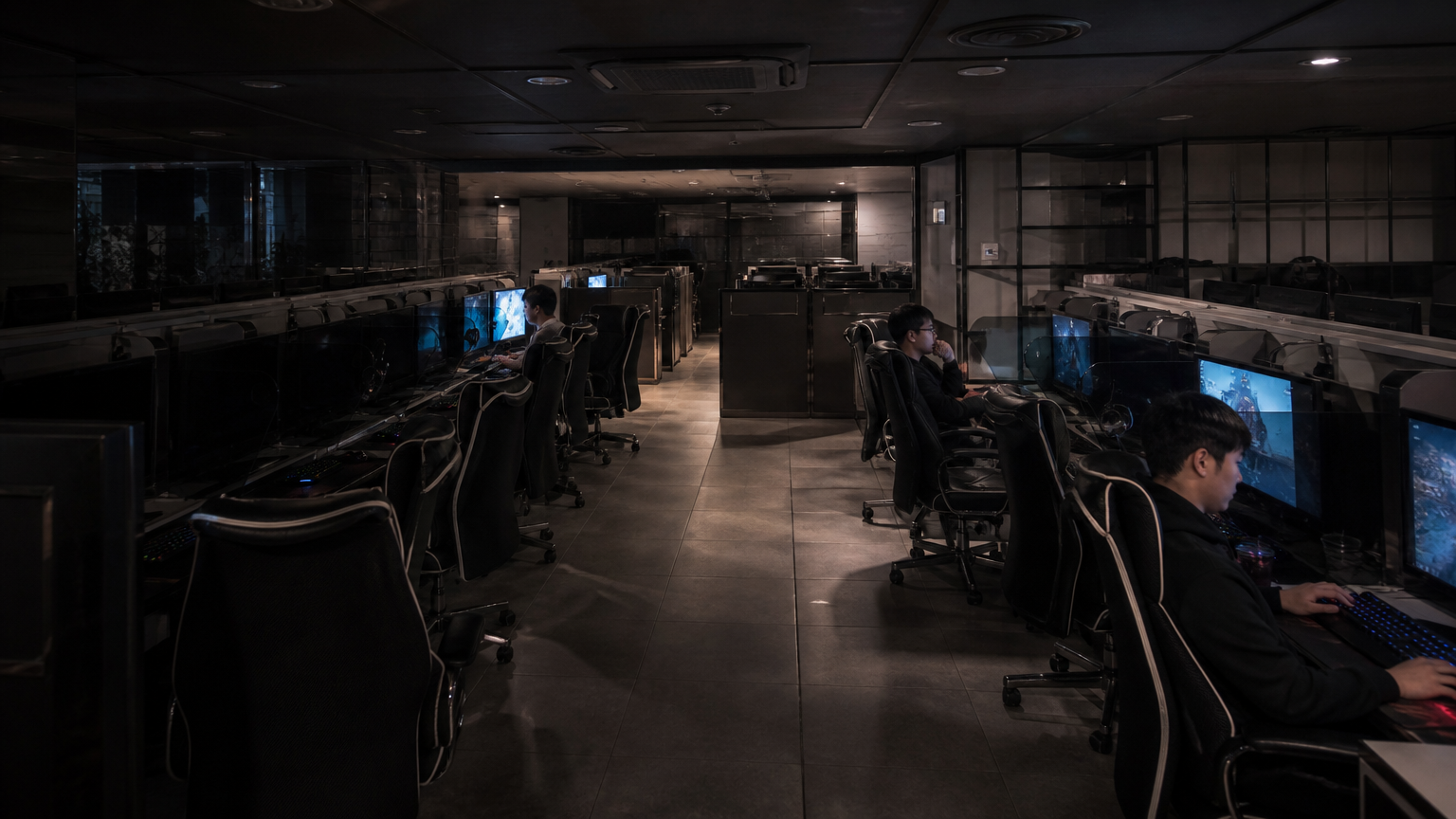
The second column is the one that catches visitors off guard at night. Anyone under nineteen may only be inside between 9am and 10pm, unless they are with a parent, guardian, teacher or someone else with real supervisory standing. That is why one of these rooms at one in the morning holds a noticeably older crowd than the same shop at four in the afternoon. It is not a cultural drift. It is a decree.
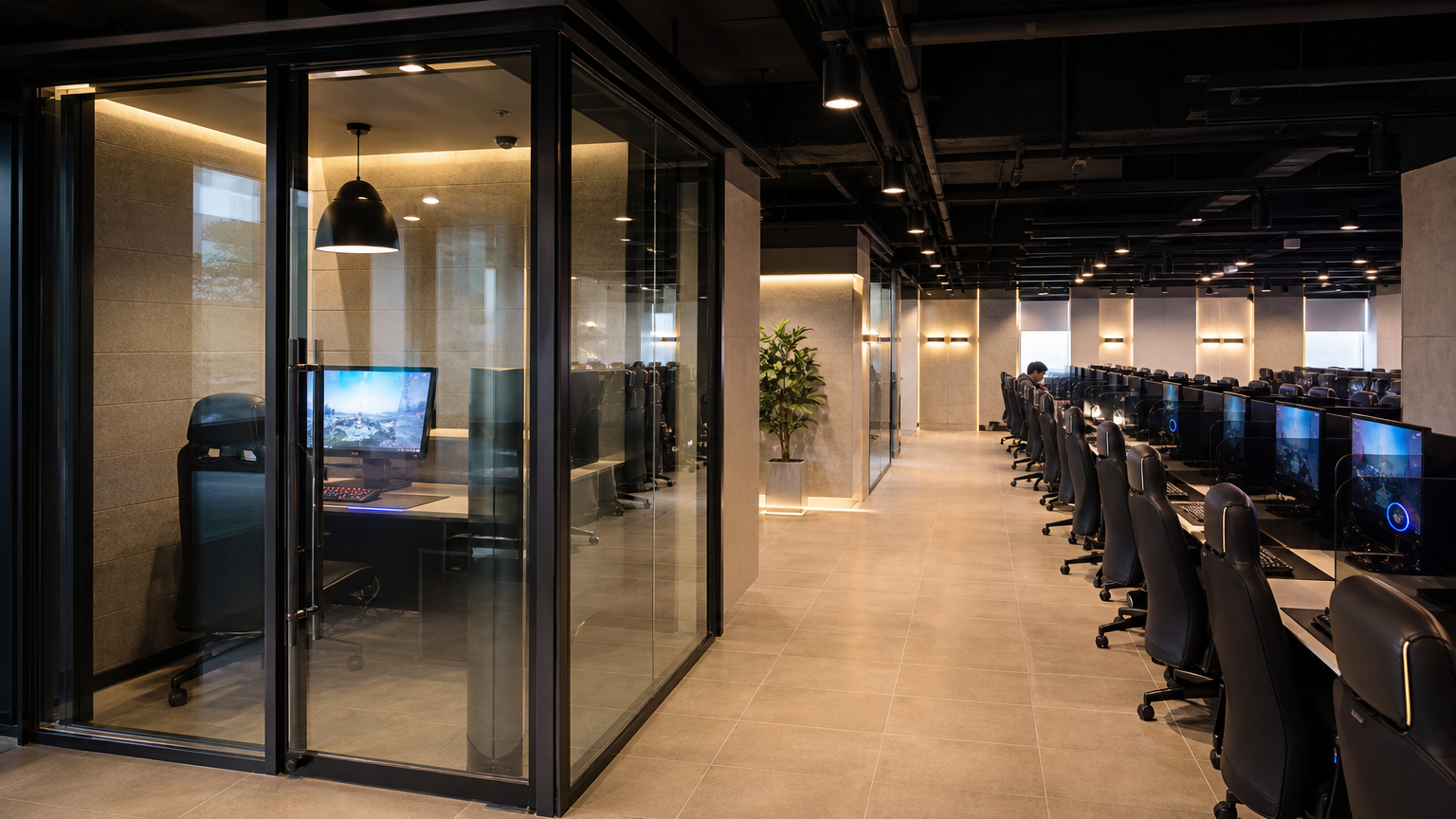
One more thing that surprises people who have heard old stories about these rooms: they are legally smoke-free. The National Health Promotion Act lists this exact business category among the premises that must be designated non-smoking in their entirety. A shop may build a separate enclosed smoking room, and many have, but the floor you are sitting on is not one.
What it is actually for
Sit down at any seat. Pay at a machine or a counter without explaining yourself. Order food to your desk with a few taps. Stay as long as you paid for, at any hour, and leave without telling anyone.
None of that is about games.
I am not telling you to go and play something. Most Koreans who walk into one of these rooms on a given evening are not there for a title they have been waiting for — they are there because they wanted a warm chair, a fast machine, a hot bowl of something, and a few hours that belong to nobody else. It is the cheapest private room in a city with very little private space, and it happens to have a computer in it.
That is the thing worth trying. Go in for an hour and answer email if that is all you want to do. The room will not find it strange, because that is closer to what it is for than the name suggests.
FAQ
Do I need to be a member to use a PC bang?
No. Every shop supports a non-member route, which is prepaid — you pay for a block of time at a kiosk or at the counter, receive a number, and enter it at the seat.
Can I use a PC bang if I do not speak Korean?
Yes, and this is the main thing people get wrong about them. Payment is a transaction at a machine or counter rather than a conversation, food is ordered from the screen at your seat, and nobody comes to check on you. Menus are often icon-driven, and many shops in central Seoul have an English toggle.
Do I need a Korean phone number?
Not for the non-member route. A Korean number is generally what a membership account is tied to, which is exactly why the non-member option exists.
Are these places open twenty-four hours?
Many are, and it is legal for them to be. The enforcement decree of the Game Industry Promotion Act sets trading hours for other game business categories but not for this one. Individual shops still choose their own hours, so a quiet neighbourhood branch may close.
Can I bring my child, or go as a teenager?
Anyone under nineteen may only be inside between 9am and 10pm under the same decree, unless accompanied by a parent, guardian, teacher or another person with genuine supervisory responsibility for them.
Will it smell of smoke?
It should not. This business category is listed in the National Health Promotion Act among premises that must be designated non-smoking throughout. Some shops have a separate enclosed smoking room, which is permitted, but the main floor is not a smoking area.
Can I order food if I cannot read the menu?
Usually yes. Ordering happens on your own screen rather than out loud, so you can take as long as you like, and the menus lean heavily on photographs.
References
-
Game Industry Promotion Act (게임산업진흥에 관한 법률), Article 2(7) — statutory definition of the internet computer game facility provision business, the category these rooms fall under
-
Same Act, Article 28(2) — an operator may require an entrant to produce identification and may refuse entry where it is withheld without good reason
-
Enforcement Decree of the Game Industry Promotion Act (같은 법 시행령), Article 16 — trading hours by game business category, and the 9am to 10pm entry window for persons under 19, with the accompanied-minor exception
-
National Health Promotion Act (국민건강증진법), Article 9(4)(23) — internet computer game facility premises among the facilities required to be designated non-smoking in their entirety
-
Jeong, Korea, Coin Karaoke in Korea — the same design logic in a different room
-
Jeong, Korea, Korean Convenience Store Food — the other half of the fifteen-minute meal
-
Jeong, Korea, Why Your Foreign Card Gets Rejected in Korea — why to carry cash for the payment step