Why Your Foreign Card Gets Rejected in Korea (And What to Carry Instead)

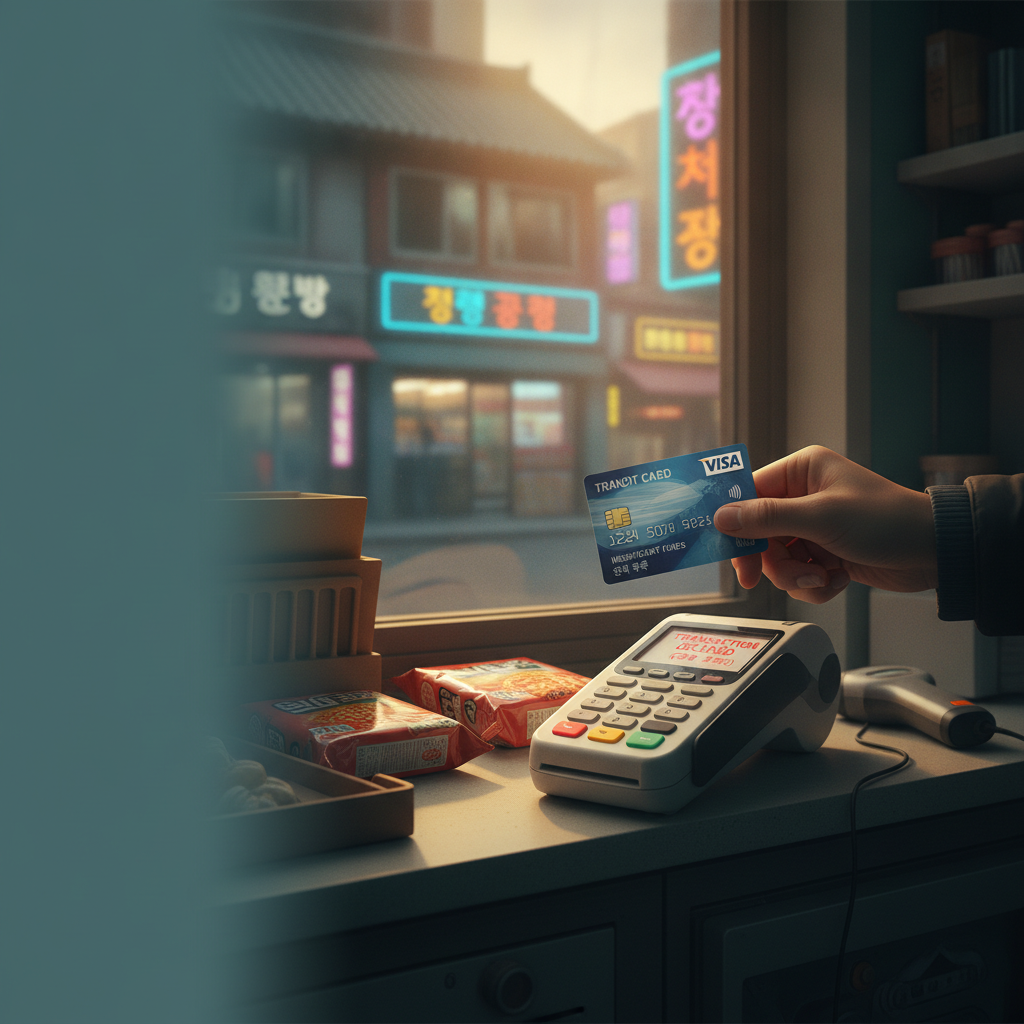
Korea is one of the most cashless countries on earth. Over 80% of transactions here are card or mobile. So the story you hear before you fly is simple: leave the cash at home, just tap your card.
Then you land, walk into a convenience store at midnight, hand over your Visa, and the machine says no.
This happens to almost every visitor at least once, and it is not your bank's fault. Korea is cashless — but it is cashless on Korean rails. Understanding the difference is the single most useful thing you can learn in your first hour here.
Quick Answer (TL;DR)
If you only read one section, read this:
-
Your foreign Visa or Mastercard will work at department stores, hotels, chain cafes, airport shops, and most sit-down restaurants.
-
It will often fail at small independent restaurants, street food stalls, traditional markets, older taxis, some convenience store kiosks, and self-service machines.
-
The fix is not a better credit card. The fix is a T-money card plus 30,000 to 50,000 won in cash.
-
Domestic delivery apps and most Korean e-commerce will reject foreign cards entirely. That part has no workaround for a short visit.
Why It Actually Fails
There are three separate reasons, and they get confused constantly.
1. The terminal only speaks Korean card networks
Many small merchants run terminals connected only to domestic networks — BC, Shinhan, KB, Hyundai. A Visa or Mastercard transaction has to be routed internationally, and their terminal simply has no path for it. The owner is not refusing you. The machine genuinely cannot process it.
This is why the same card works at Olive Young and fails at the noodle shop two doors down.
2. Your bank flags Korea as high risk
A sudden 4,500 won charge in Seoul at 1am, right after your last charge was at your home airport, looks like fraud. Some issuers auto-decline the first one or two attempts.
Tell your bank you are travelling before you leave. It takes two minutes in the app and removes an entire category of failure.
3. It is not a card problem at all — it is an identity problem
This is the one nobody warns you about.
Korean apps — delivery, ride-hailing beyond the basics, ticketing, most online shops — require a Korean phone number and often a resident registration number for identity verification. Your card is fine. You just cannot get past the signup screen.
No amount of card troubleshooting solves this. It is worth knowing early so you stop trying.
What To Actually Carry
Think of it as three layers, in this order.
Layer 1: A T-money card
Buy one at any convenience store for 2,500 to 4,000 won. Top it up with cash at the counter or at any subway station machine.
It covers subway, city buses, intercity buses, airport limousine buses, many taxis, and — this is the part people miss — purchases at most convenience stores nationwide. It is the closest thing Korea has to a universal payment method that does not care who you are.
Since March 2026, supported station kiosks also accept foreign credit cards for top-ups, which removes the old chicken-and-egg problem of needing cash to load your cashless card.
Layer 2: 30,000 to 50,000 won in cash
Not for everything. For the specific gaps: street food, traditional markets, older taxis, small family-run restaurants, and any moment when a machine says no and there is a queue behind you.
Withdraw from a Global ATM — look for the English label. They are in every convenience store and subway station. Regular Korean-only ATMs frequently reject foreign cards.
Layer 3: Your credit card, for the big stuff
Hotels, department stores, duty free, airline counters, chain restaurants, museums. Anywhere with an English menu, your card is almost certainly fine.
Use it there and stop expecting it to work everywhere else. That single mental adjustment removes most of the frustration.
The Mistake Almost Everyone Makes
Assuming that because Korea is high-tech, payment will be effortless.
It is effortless — for residents. Samsung Pay, Kakao Pay, and Naver Pay are genuinely excellent, and locals move through the day without touching a wallet. But every one of those services is built on a Korean phone number and a Korean bank account.
What you experience as a visitor is not a less advanced system. It is a very advanced system you are not enrolled in. Once you frame it that way, carrying a transit card and some cash stops feeling like a downgrade and starts feeling like the obvious workaround.
A Realistic First Day
Here is what this looks like in practice, from landing.
-
At the airport, withdraw 50,000 won from a Global ATM.
-
Buy a T-money card at the convenience store in arrivals and load 20,000 won.
-
Take the airport bus or train — tap T-money.
-
Hotel check-in — credit card.
-
Dinner at a small place near your hotel — cash.
-
Convenience store snack on the way back — T-money.
Six transactions, three payment methods, zero declined cards. That is the whole system.
Frequently Asked Questions
Why does my Visa work at some places and not others?
The merchant's terminal decides. Larger businesses connect to international networks; many small independent shops connect only to Korean domestic networks. The same card genuinely works at one shop and cannot be processed at the next.
Can I use Apple Pay in Korea?
Partially. Apple Pay launched in Korea but acceptance is limited compared to what you are used to at home. Treat it as a bonus when it works, not as your primary method.
Do I need cash in Seoul in 2026?
Yes — but far less than a decade ago. 30,000 to 50,000 won covers the gaps for a typical day. You will not need hundreds of thousands.
Can I use delivery apps as a tourist?
Generally no. Korean delivery apps require a Korean phone number for identity verification, and most reject foreign cards at checkout. Some hotels will order for you. Otherwise, plan on eating out or using convenience stores.
What is the single best thing to do before I fly?
Call or message your bank and tell them you will be in Korea. It costs nothing and eliminates the most common decline reason.
Korea will not make you fumble for cash the way it did in 2015. But it has not become a place where a foreign card just works everywhere either. Bring the transit card, bring a little cash, and let your credit card handle the big-ticket items.
Do that, and you will never stand at a counter watching a card reader blink red while the queue grows behind you.