Coin Karaoke in Korea: The Karaoke Etiquette Fight That Cannot Happen Here

A friend of mine from the Philippines came to Seoul last year. On his second night we ended up outside a coin karaoke place near my neighbourhood station, the kind with a glowing sign and a row of small booths visible through the glass.
He looked through the door for a while before going in. Then he said something I have thought about ever since.
"Nobody can take it from you here."
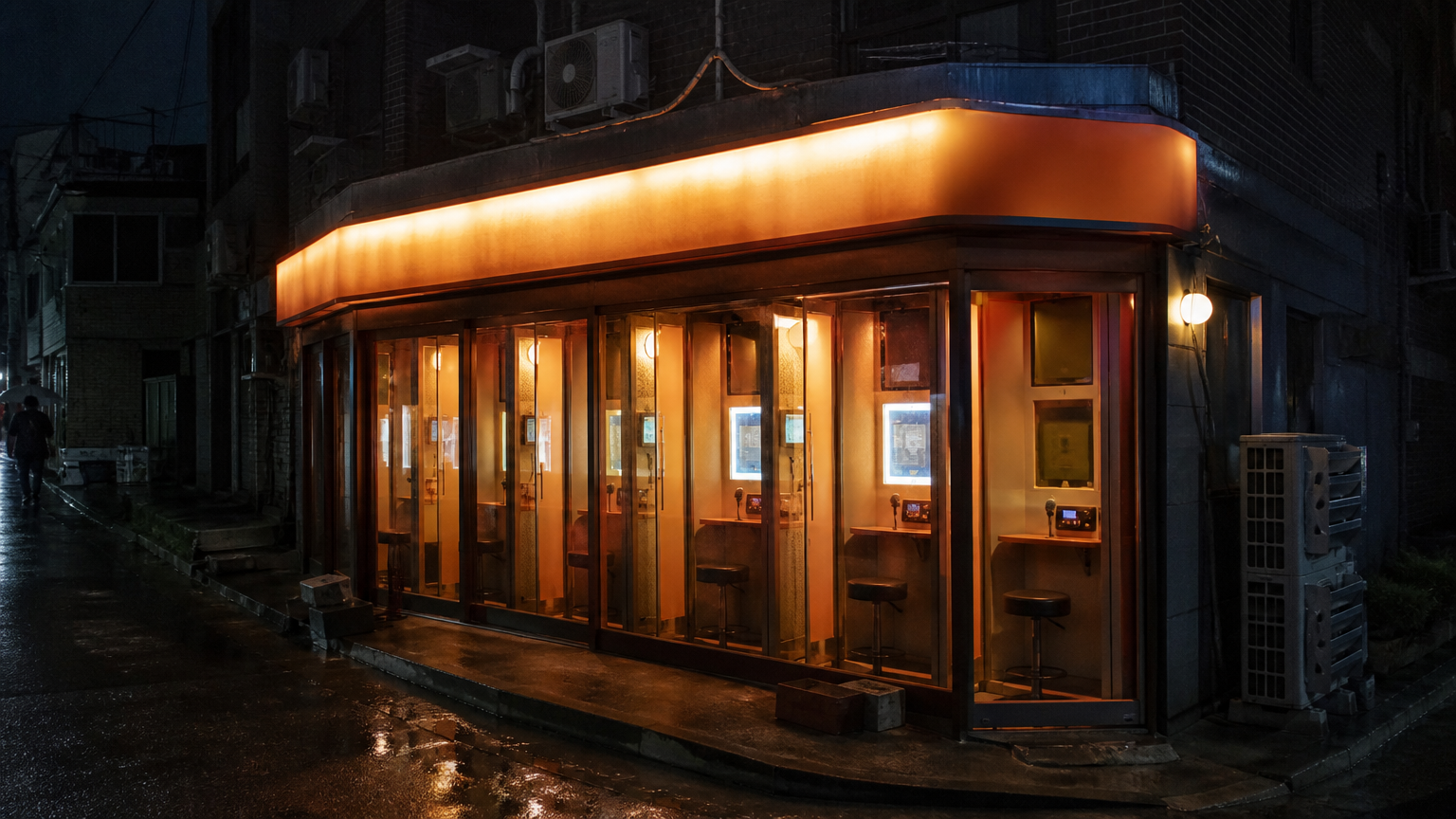
I did not understand the sentence. I had been going to these booths since university and had never once thought about anyone taking anything. That is the thing about the rules you grow up with — you cannot see them, because nothing in your life has ever broken them.
Karaoke etiquette is not one set of rules
I had assumed karaoke was karaoke. You sing, somebody claps, the next person goes. What I had actually learned was one specific version of it, the Korean one, and I had learned it so early that it felt like physics rather than custom.
It is not. The room changes the rules.
| Where | The usual setting | What people are protecting |
|---|---|---|
| Korea | A private room you rent by the hour, or a booth you pay by the song | Your turn inside a group you already know |
| Japan | A private room, similar to Korea | The same, with a stronger sense of the song list as a shared queue |
| United States, United Kingdom | A bar with one stage and a signup sheet | Your place in a public queue among strangers |
| Philippines | Often a bar, a home machine, or a rented set at a gathering | The song itself, and the person's claim to it |
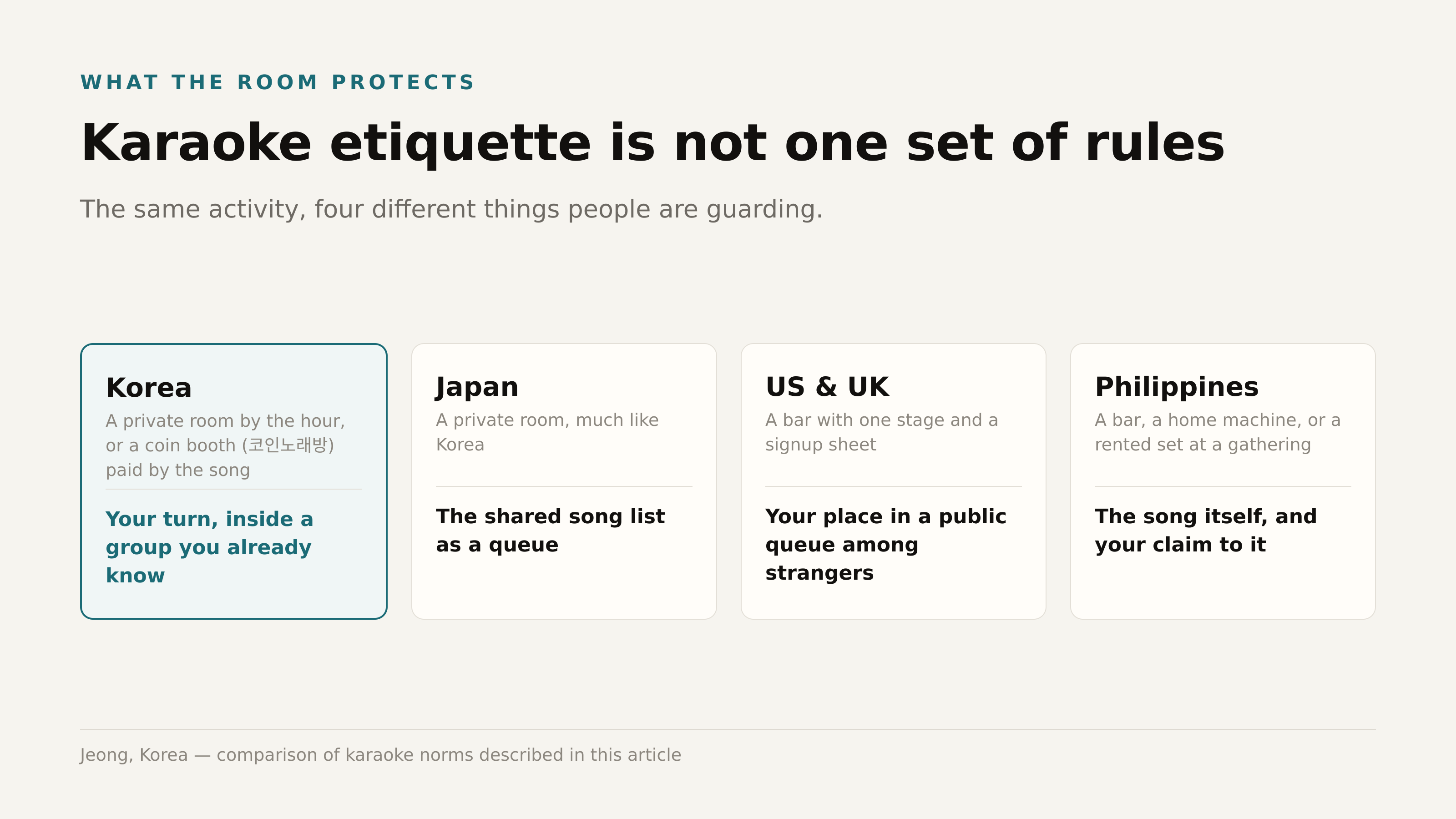
That last column is the one I had never considered. In Korea, the thing that could go wrong is losing your turn. Somewhere else, the thing that could go wrong is losing your song.
What taking someone's song means
My friend explained it plainly. Cutting in while someone is singing, grabbing the microphone, singing over them for a laugh — these are not small rudenesses where he is from. They are the kind of thing that ends an evening badly.
He said, and I am translating him loosely, that people do not always let it go.
I went and read about it afterwards, because I wanted to know whether this was one person's caution or something wider. It is wider, and it is documented. There is a set of incidents in the Philippines known internationally as the "My Way" killings — disputes during karaoke performances of the Frank Sinatra song that ended in death. The New York Times reported on the phenomenon in February 2010, counting at least six such deaths at that point. Many bars quietly removed the song from their machines.

I want to be careful here, because it would be easy to turn this into a story about a dangerous country, and that is not what it is. The killings are rare and specific, and no Filipino I know treats them as ordinary. What is ordinary is the norm underneath them: the microphone is not a communal toy, and a song in progress belongs to the person singing it. My friend did not tell me about the news stories. He told me about the karaoke etiquette. The news stories are just the extreme edge of a rule that everybody there already follows.
What a coin booth removes
Here is what he saw through that glass door, and what took me twenty years to notice.
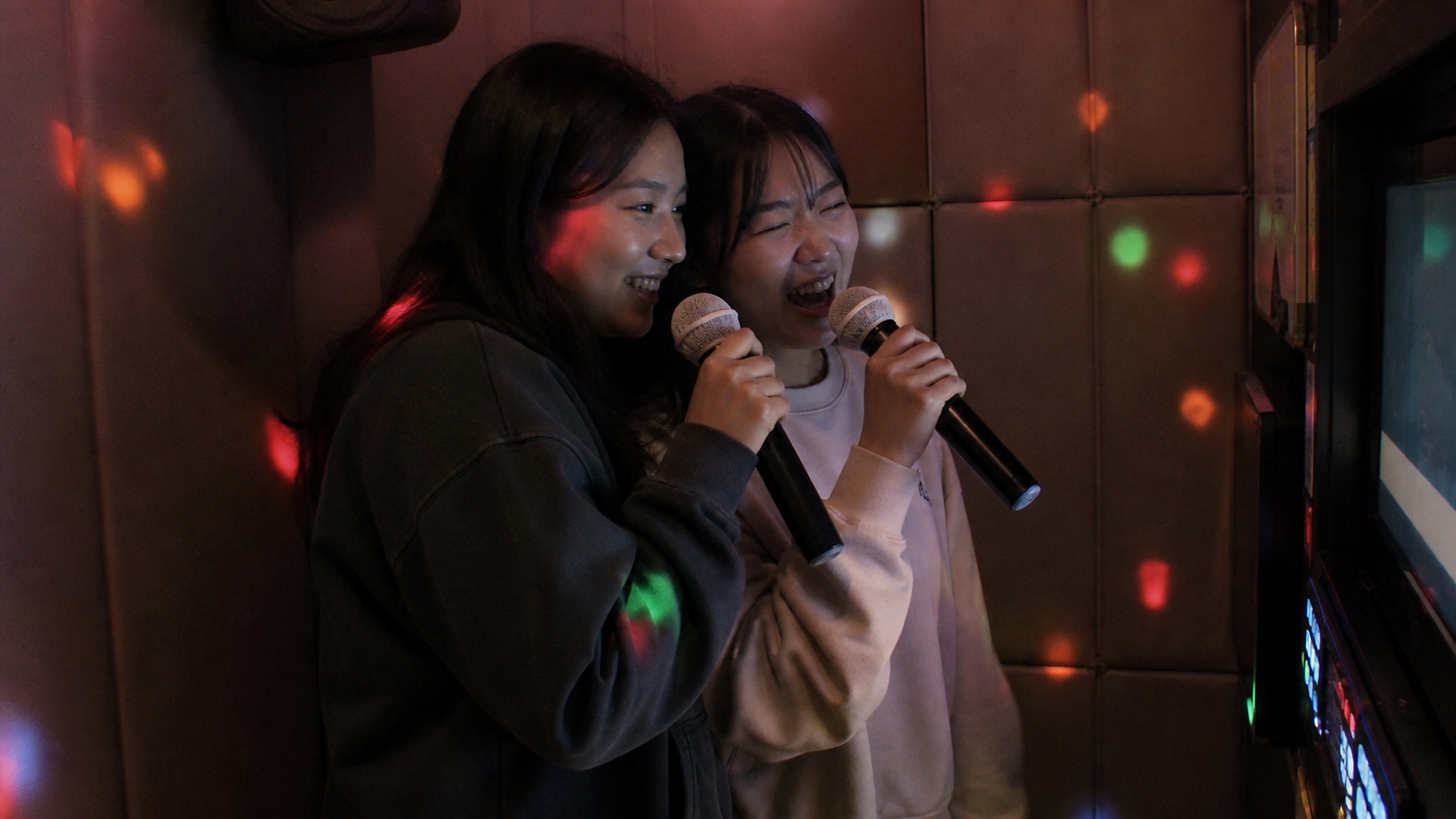
A Korean coin karaoke booth is built for one or two people. You pay by the song, not by the hour. There is no shared room, no group of eight, no list of who is next.
Which means there is no queue to jump.
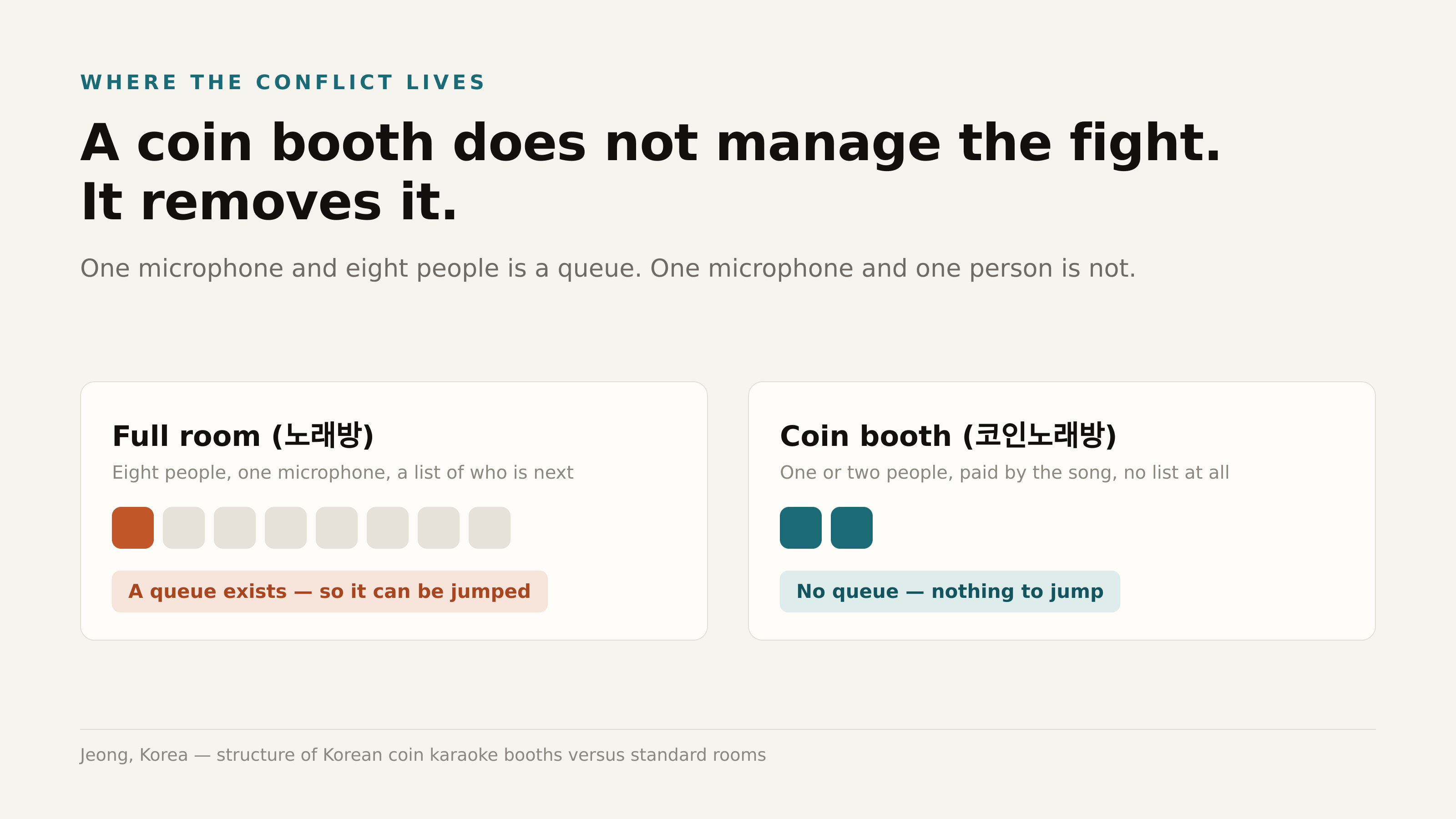
The conflict my friend was scanning for is not managed well in a coin booth. It is structurally impossible. You cannot cut in front of someone when there is no line. You cannot take the microphone when there is only one, and it is in your hand, in a room the size of a lift.
Korea did not solve the microphone problem with better manners. It solved it by selling singing in single portions.
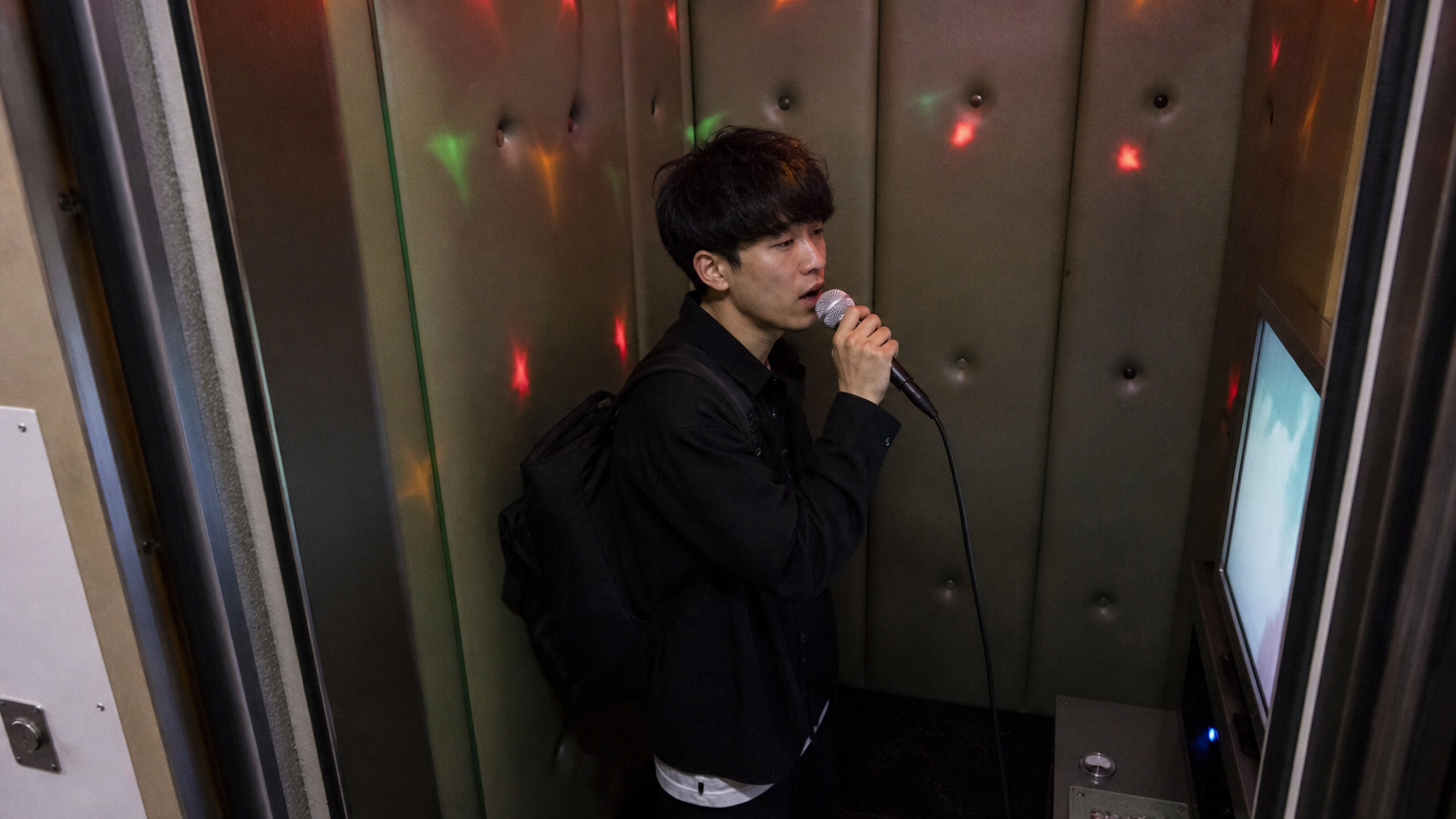
I have never seen this framed as a design decision, and I suspect it was not one. Coin booths spread because they are cheap, they fit into small spaces, and they let people sing for ten minutes on the way home. The conflict-proofing was a side effect. But it is real, and if you are nervous about karaoke because of how it works where you are from, it is the single most useful thing to know about the Korean version.
If you want the mechanics — prices, how the booths differ from full rooms, whether to bring cash — I wrote that up separately in our guide to noraebang in Korea. This piece is about the part that guide does not cover.
The karaoke etiquette Koreans do follow
There are rules. They are just quieter, and almost none of them are about ownership.
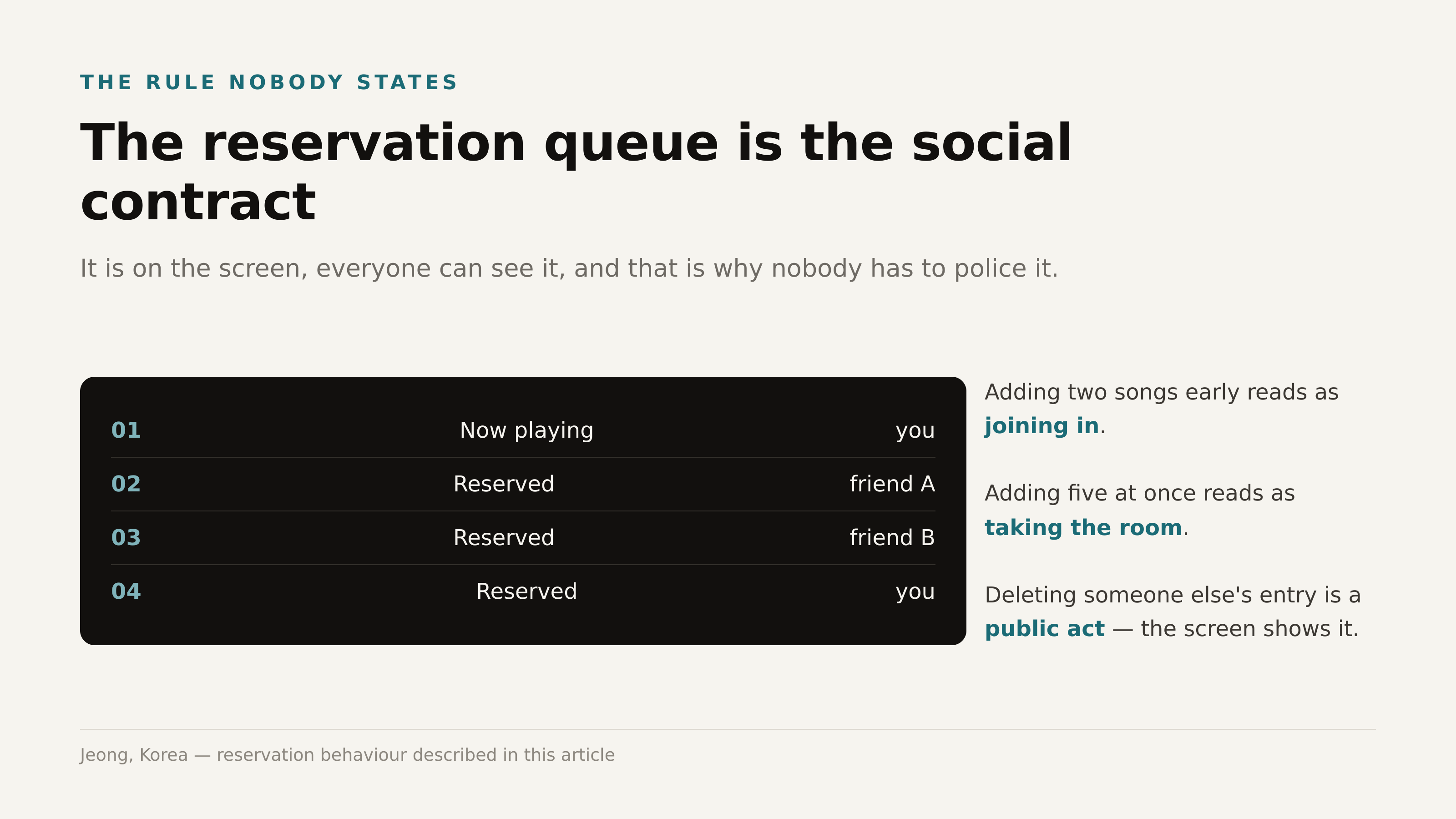
The reservation queue is the rule. Every machine has a reserve function. You punch in song numbers and they stack up. That stack is the social contract of the room. Nobody polices it, and nobody needs to, because everyone can see it on the screen.
Cutting a song short is normal. There is a button that jumps the long instrumental break. Using it on your own song is thoughtful. Using it on somebody else's, when they are visibly enjoying the instrumental break, is the closest thing Korean karaoke has to a genuine offence — and even then it registers as annoying rather than serious.
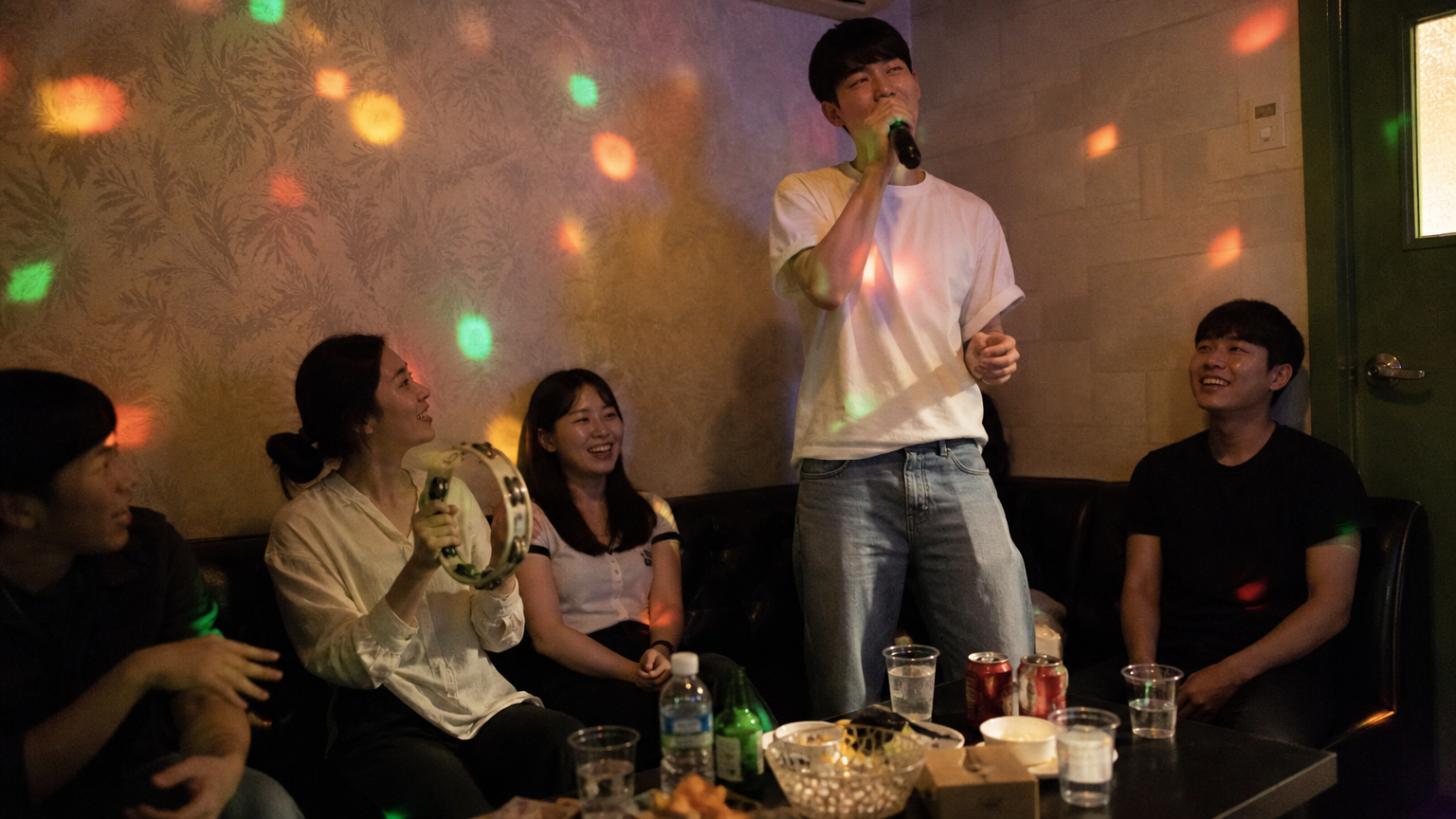
Someone will pick up the tambourine. This is not a performance. It is how a person who does not want to sing participates. If you are handed one, take it. Refusing looks stranger than playing it badly.
Nobody sings well. This is the part visitors get wrong most often. Korean karaoke is not a talent display, and the scoring number at the end of each song is a joke, not a verdict. Enthusiasm reads better than competence, and singing quietly to avoid embarrassment is the one thing that actually makes the room awkward.
The last song is a decision. When the time on the display is nearly gone, somebody chooses what closes the night, and that choice carries a little weight. In a group, it is often given to whoever has been quietest.
Extra time appears. This is the one I would tell you to watch for. The staff can add minutes to the clock, and they often do without being asked. You are singing, the timer says four minutes, and then it says nineteen. Nobody announces it. Nobody comes in.
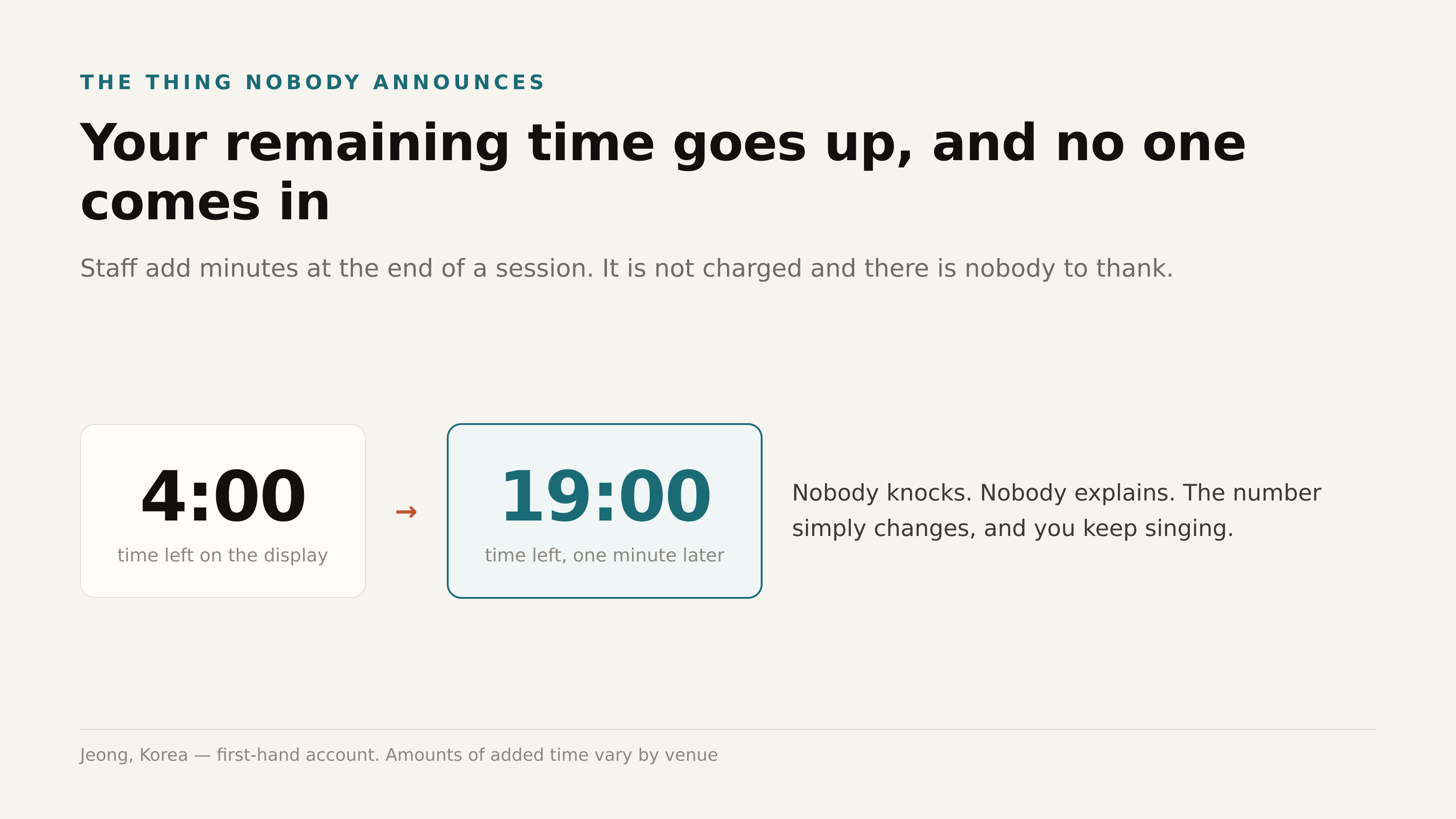
That is the part of the night I would want my friend to feel rather than have explained. Somebody you have not met and will not thank decided you should keep going. There is a word for the thing that transaction is not, and I am not going to translate it here.
Coin karaoke, or a room: how not to be the person who ruins it
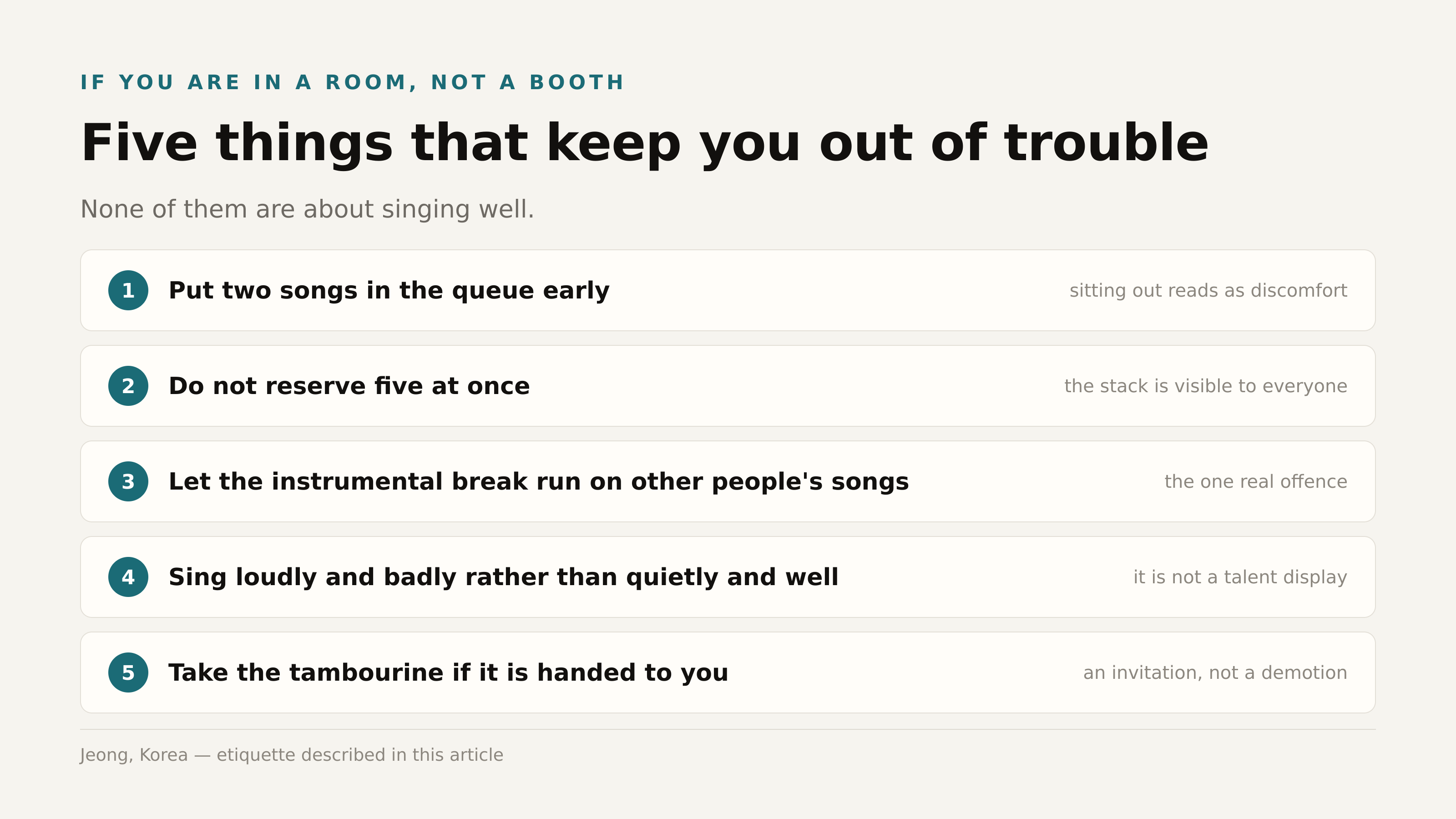
If you are joining Koreans in a full room rather than going to a booth alone:
-
Put two songs in the queue early. Sitting out the whole night reads as discomfort, and people will start worrying about you.
-
Do not reserve five songs at once. The stack is visible.
-
Let the instrumental break run on other people's songs.
-
Sing loudly and badly rather than quietly and well.
-
If somebody hands you a tambourine, that is an invitation, not a demotion.
And if you would rather skip all of that — take the booth. Two thousand won, twenty minutes, nobody watching, no queue to negotiate. It is what half of Seoul does on the way home anyway.
What my friend did
He went in. He sang four songs, all of them badly, and used up my coins doing it.
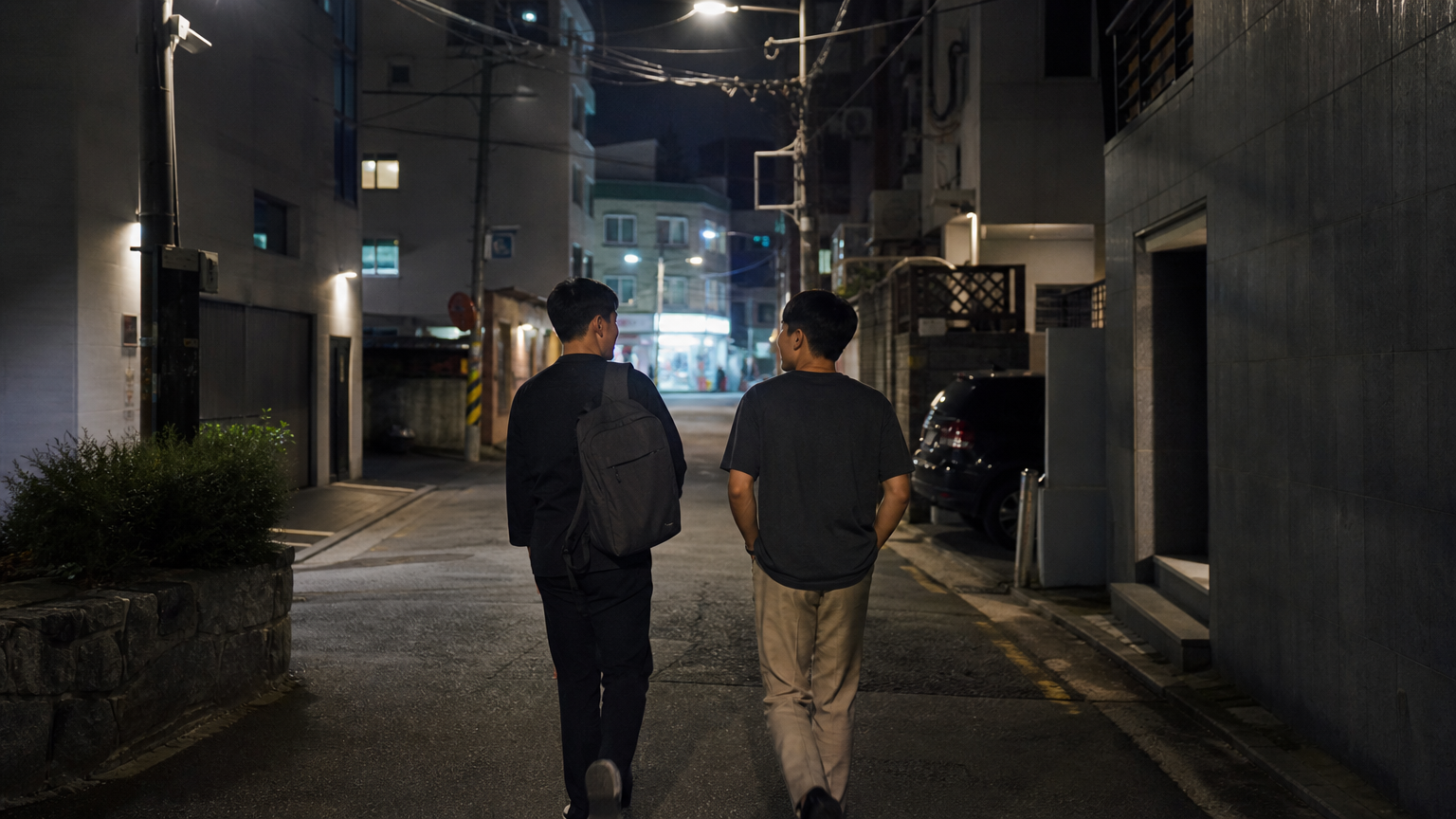
On the walk back he said the booth had felt strange for about a minute and then obvious. I said it had felt obvious to me for twenty years and strange for exactly as long as it took him to say that sentence at the door.
That is most of what travelling well is, I think. Somebody stands next to you in a place you know completely and describes it in a way you could not have.
FAQ
Is it rude to sing along while someone else has the microphone in Korea?
Joining in on a chorus is normal and usually welcome. Taking over the song is not. The distinction Koreans make is between supporting a performance and replacing it — if the person singing has stopped enjoying it, you have crossed the line.
Can I cancel a song someone else reserved?
You can, and it is one of the few things that will actually annoy people. The reservation queue is visible to everyone on screen, so removing an entry is a public act. Cancel your own freely.
Do I need to read Korean to find a song in a coin karaoke booth?
No. Most machines let you search by English title and artist, and the number pad works the same either way. Older machines in smaller booths can be harder, so search by artist rather than song title if you are struggling.
Are there enough English songs?
Yes, in any machine made this decade. The English catalogue is large, weighted heavily towards well-known pop and rock. Very recent releases and non-English foreign songs are the gaps.
Should I play the tambourine?
If it is handed to you, yes. It is how people participate without singing, and treating it as a consolation prize misreads the room.
Why did my remaining time suddenly go up?
Staff added it. Extra minutes at the end of a session are a common courtesy and are not charged. You are not expected to acknowledge it, and there is nobody to thank — that is rather the point.
References
-
The New York Times, "Sinatra Song Often Strikes Deadly Chord" (February 2010, Norimitsu Onishi) — reporting on karaoke-related deaths in the Philippines connected to the song "My Way"
-
Jeong, Korea, Noraebang in Korea: How It Actually Works — booth types, pricing, and going alone