Korean Dining Etiquette: The Rules Koreans Actually Follow (Not the Ones in Guidebooks)
A colleague of mine spent his first Korean company dinner in a state of quiet panic. He had read a list of rules on the plane. Do not do this, never do that, always do the other. By the time the meat arrived he was so busy auditing himself that he had barely eaten.
Nobody at that table noticed a single thing he was worried about. What they did notice, and mentioned to me afterwards with some affection, was that he kept trying to pour his own drink.
That gap is the whole subject. Most lists of Korean dining etiquette are collections of rules with no explanation, which means you cannot tell which ones matter. In practice almost all of them come from one idea, and once you have the idea you can stop memorising.
The one idea underneath
Here it is: at a Korean table, the younger person's hands do more work.
That is the engine. Pouring, serving, grilling, passing, refilling — those drift toward whoever is youngest or most junior, and they drift away from whoever is oldest. It is not servitude, and nobody enforces it. It is closer to how, in some cultures, the person who invited you insists on paying.
Once you hold that idea, most of what gets listed as Korean dining etiquette stops being arbitrary:
| The rule | What it is really doing |
|---|---|
| Wait for the eldest to lift their spoon | Marking who begins |
| Pour with two hands | Effort made visible |
| Never pour your own drink | Your neighbour watches your glass; you watch theirs |
| Turn your head away when drinking with elders | Distance, symbolically |
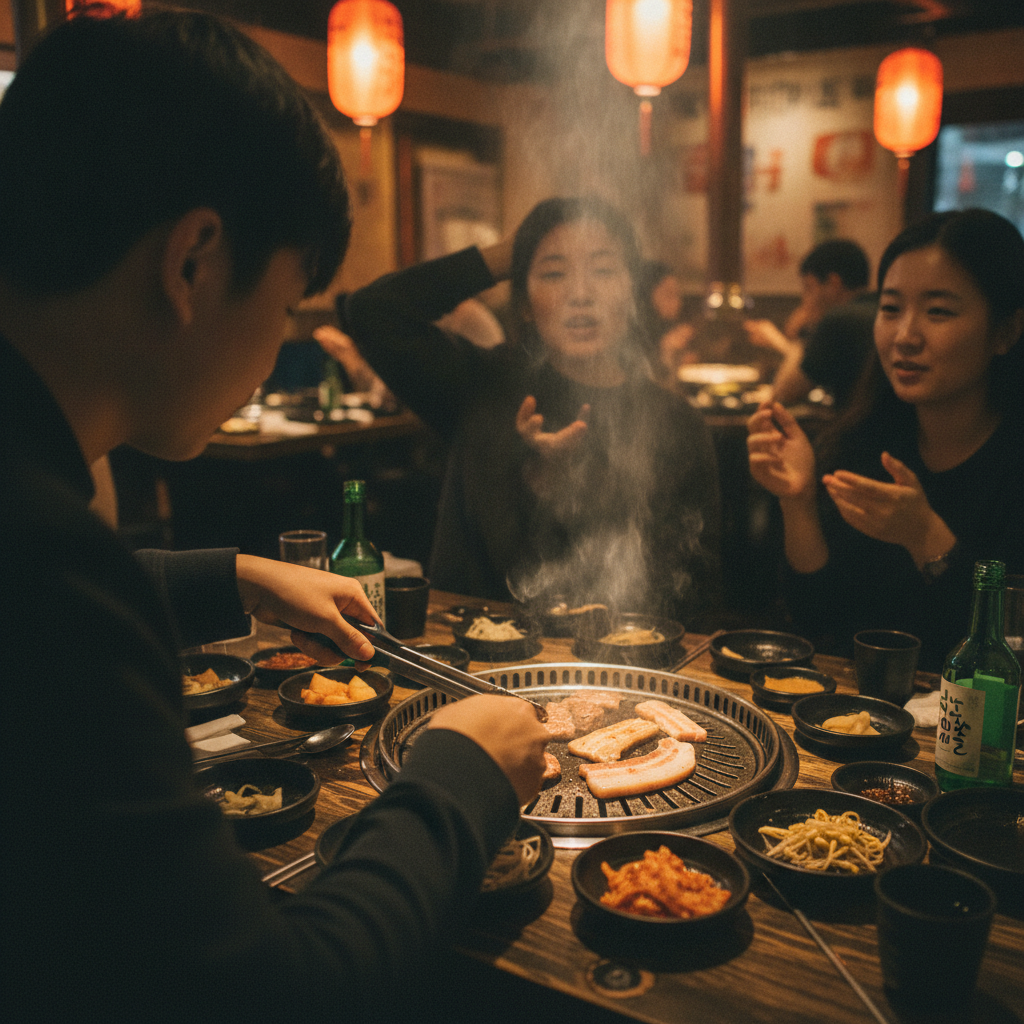
| Whoever is youngest tends the grill | Hands do the work |
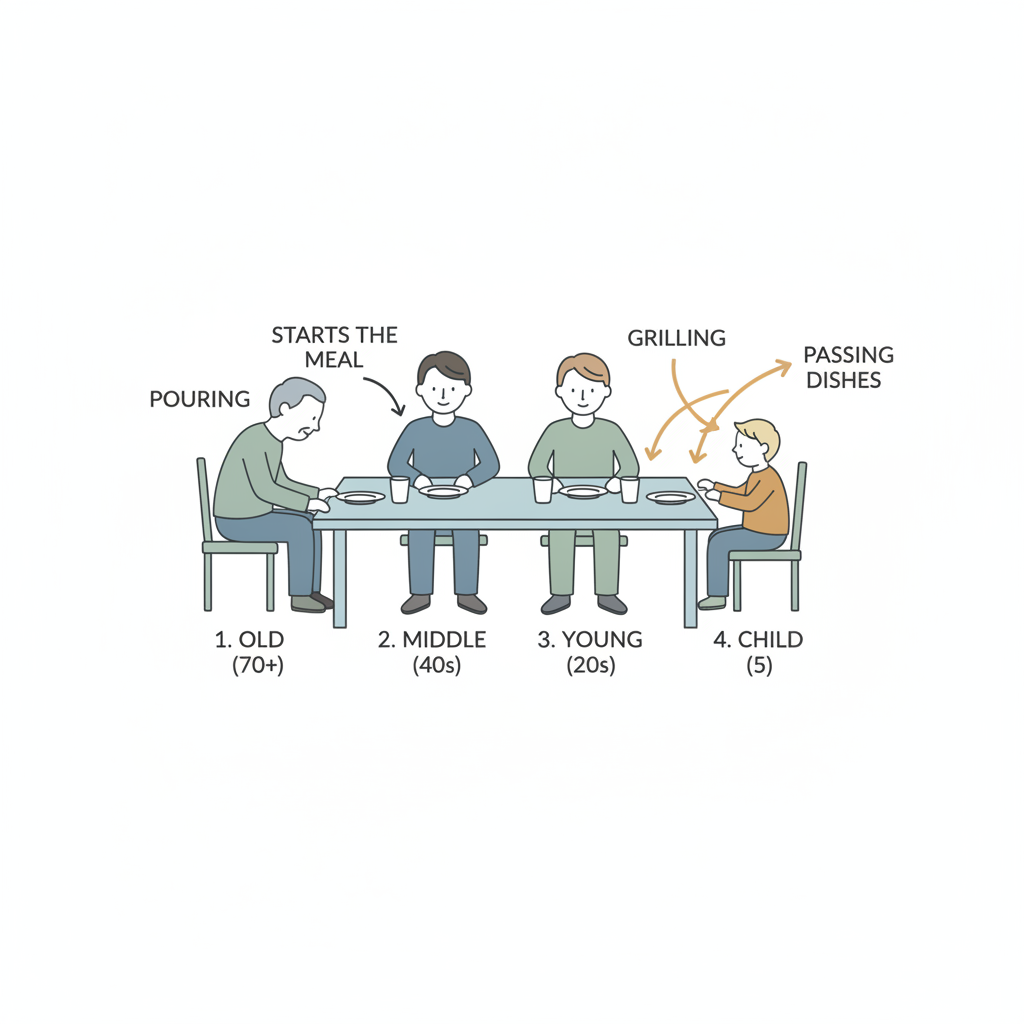
Korea's Heritage Service, writing about the traditional table, puts the sequence plainly: when eating together, you begin once the elder or the guest has picked up their spoon. Everything else in the list above is the same instinct applied to different objects.
The drinking part, which is where visitors actually get caught
Food etiquette is forgiving. Drinking etiquette is where people notice, because it is interactive — every pour involves two people.
Three things cover almost all of it:
Do not fill your own glass. If your glass is empty, someone will fill it. If theirs is empty, fill it. This is the single most useful thing on this page, and it is the one my colleague kept getting wrong.
Two hands when it matters. Pouring for someone older, or receiving from them, gets two hands — one on the bottle or glass, the other supporting your forearm or the base. Between friends of the same age, nobody bothers.
Turn away to drink with elders. When drinking in front of someone significantly senior, people turn their head to the side for the sip. You will see Koreans of every generation still doing this.
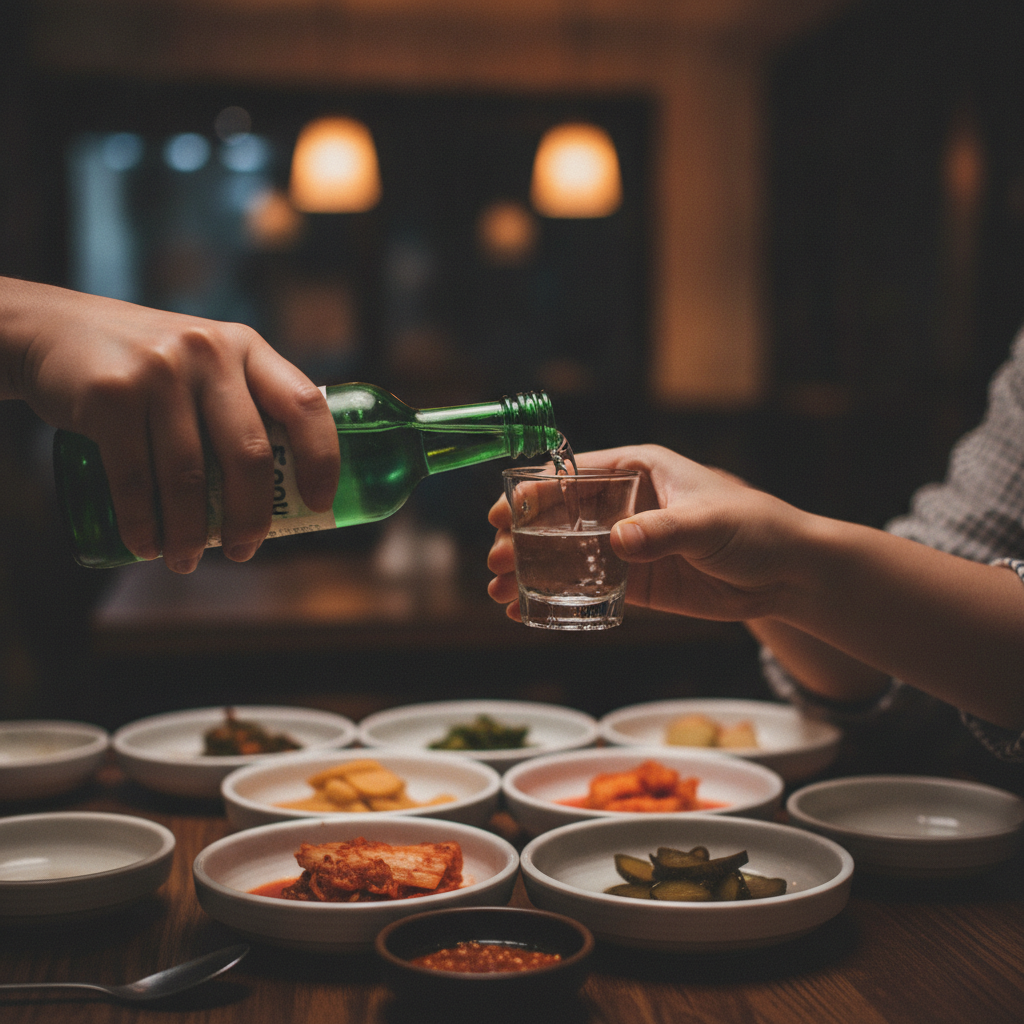
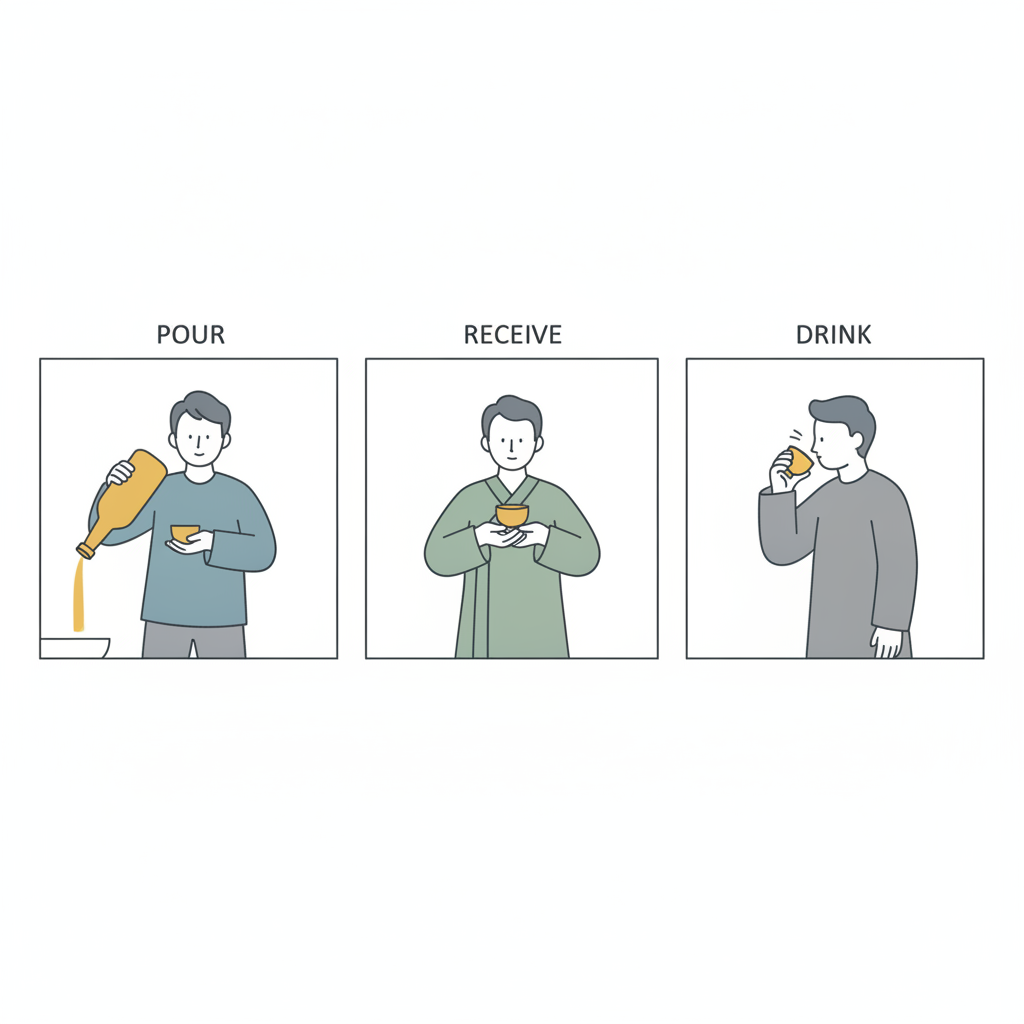
If you do nothing else from this article, watch your neighbour's glass. It reads as attentiveness in a way that no amount of correct chopstick handling will.
The one genuine taboo
Almost everything here is a soft preference. This one is not.
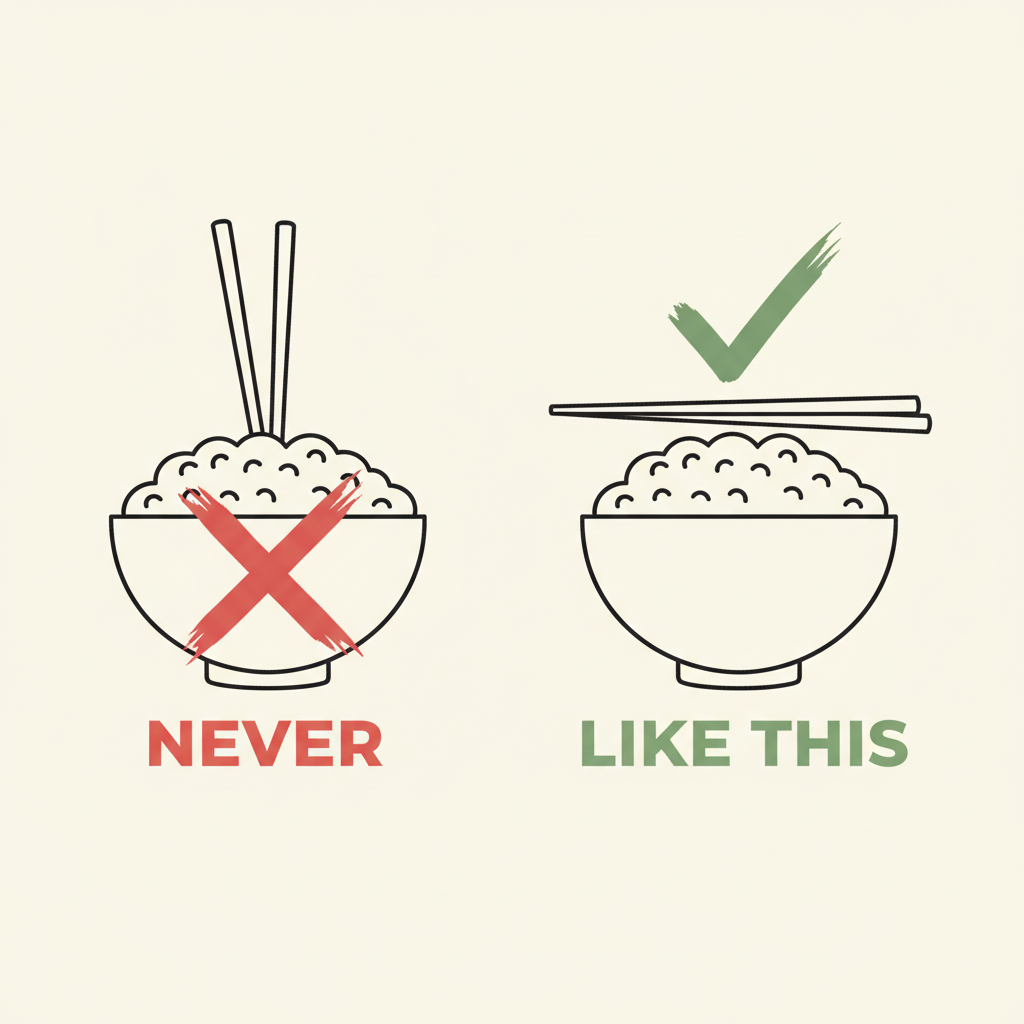
Do not stand your chopsticks or spoon upright in a bowl of rice. Rice with utensils standing in it is how food is offered to the dead at a memorial rite — a spoon planted upright reads as a grave marker. It is not rudeness so much as a bad omen appearing at the table, and the reaction is immediate.
Lay them across the rim of the bowl, or on the table beside it. That is all there is to it.
How the table is laid out
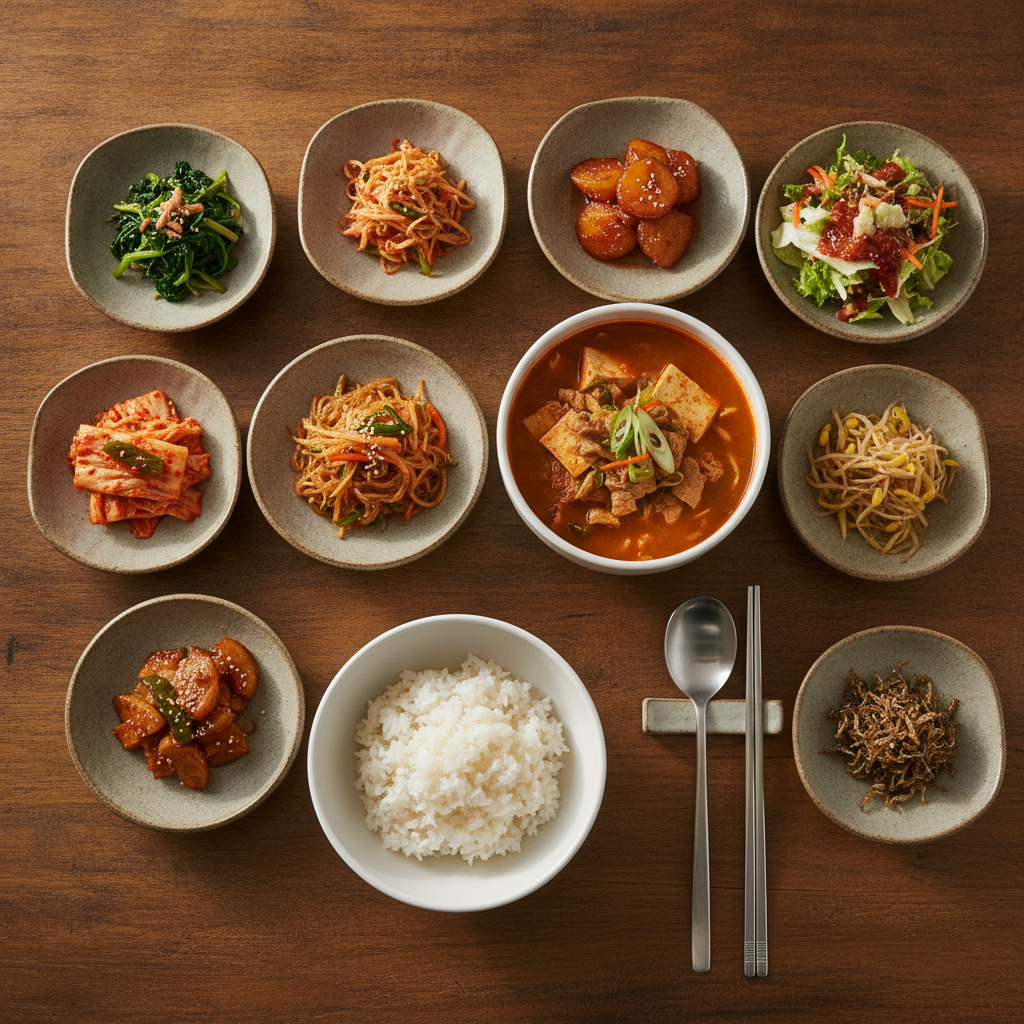
There is a fixed geometry to a Korean place setting, and knowing it means you can sit down without hesitating.
Rice goes on your left, soup on your right. The spoon sits to the right of the soup bowl, and the chopsticks to the right of the spoon. The Heritage Service describes taking a spoonful of soup or broth first, before moving to the other dishes.
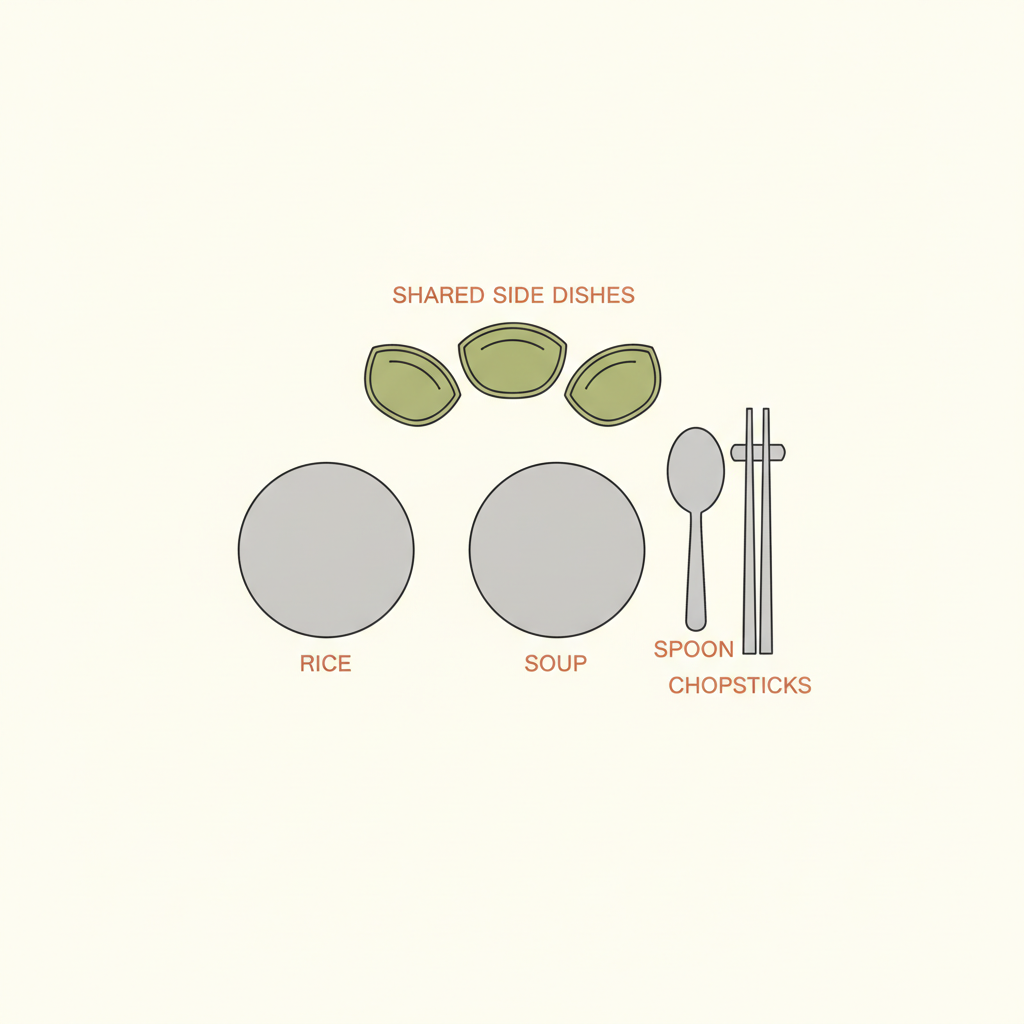
The spoon does more work here than visitors expect. Rice and soup are spoon territory; side dishes are chopstick territory. Holding both utensils in the same hand at once, or using them simultaneously, is the thing that looks off.
What you can stop worrying about
This is the half of most Korean dining etiquette lists that is either wrong or irrelevant, and my colleague wasted his evening on it.
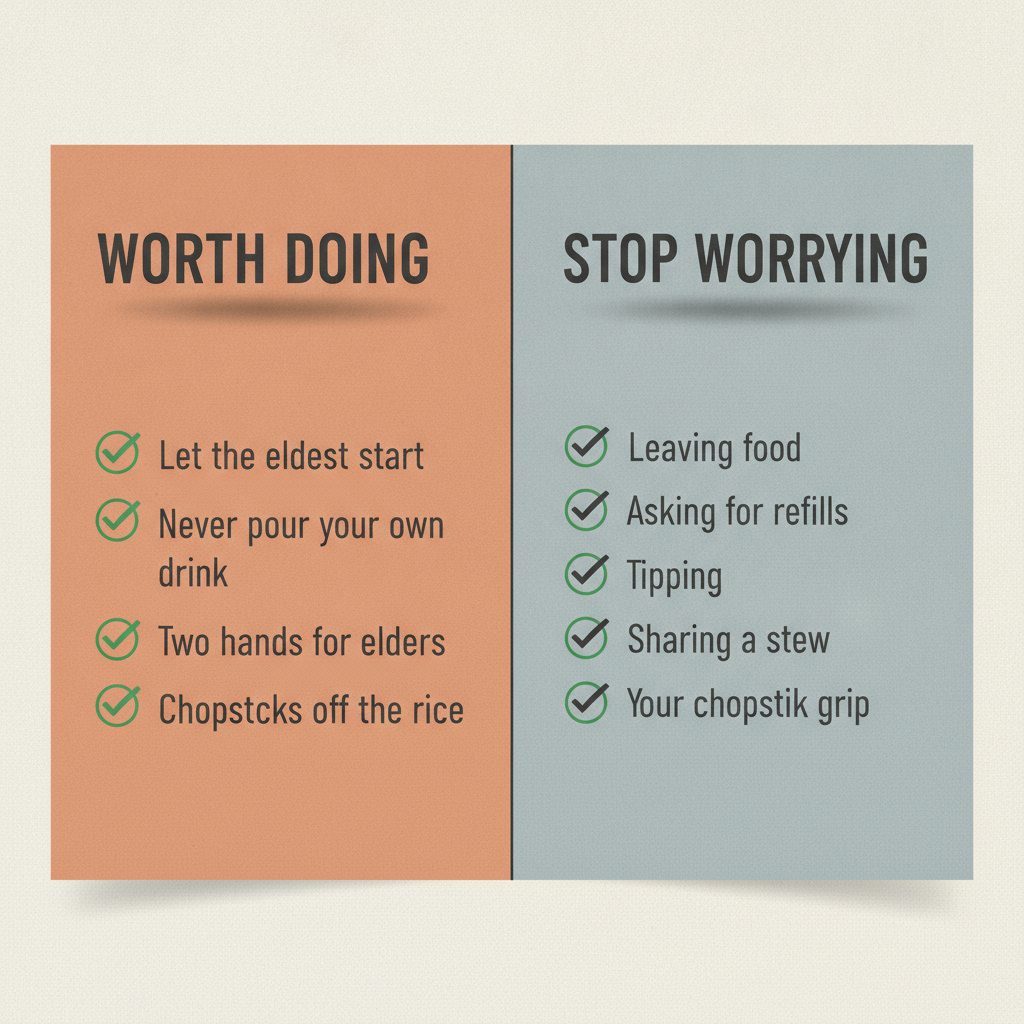
Leaving food. You will be given more than you can eat. That is deliberate — an abundant table is the host being generous, not a challenge. Leaving some behind is unremarkable.
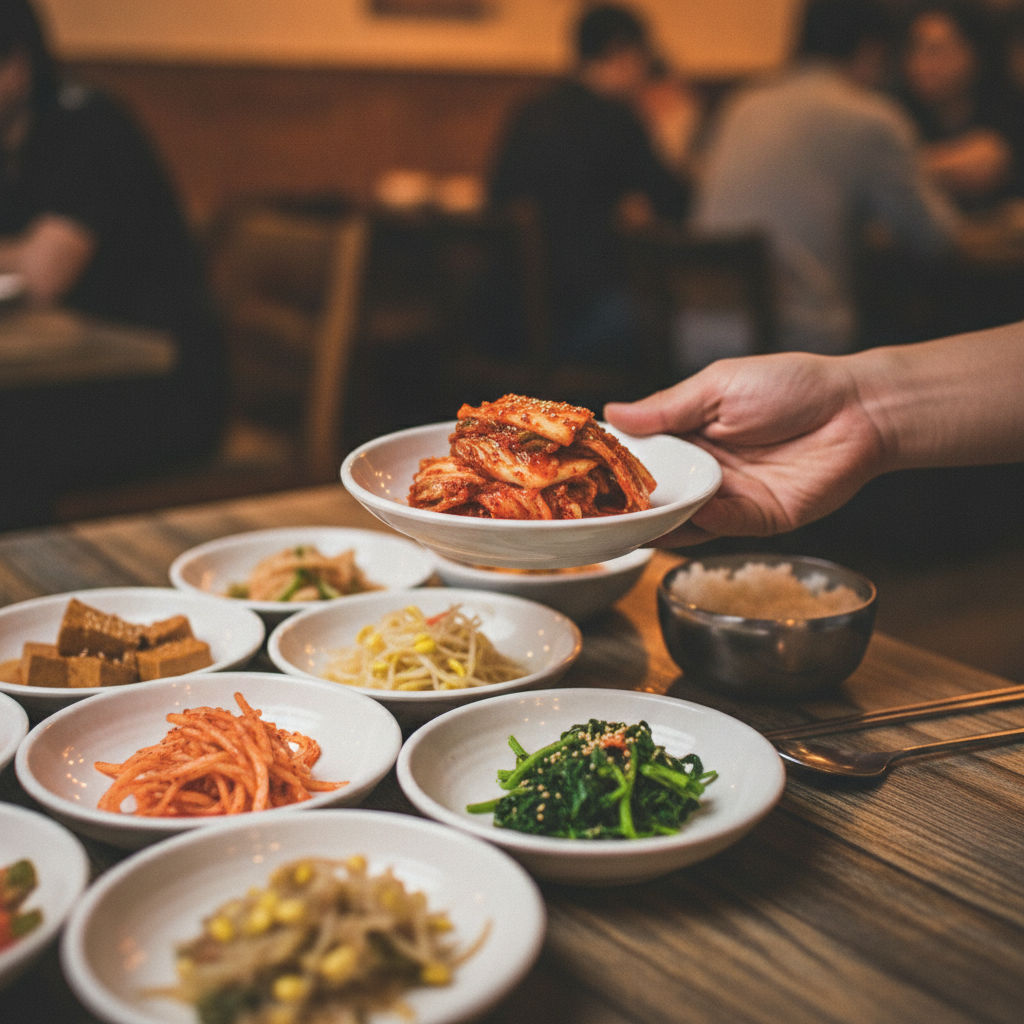
Side dishes. The small plates are included, not ordered, and refills are free. Asking for more kimchi is not cheeky; it is the intended use of the system.
Tipping. There is none. Not at restaurants, not on the bill, not left on the table. A tip left behind will often be chased down the street and returned to you.
Sharing. Communal stews with everyone's spoon in them are normal. If that is uncomfortable, ask for a small bowl — nobody minds, and plenty of Koreans do the same now.
Your accent, your chopstick grip, and every small mistake. Metal chopsticks are heavier and rounder than wooden ones and genuinely take practice. Nobody is scoring you.
FAQ
What is the most important rule of Korean dining etiquette?
Do not pour your own drink, and keep an eye on the glasses next to you. Everything else is more forgiving than that one. If you also wait for the eldest person to start eating before you do, you have covered the two things people actually register.
Is it rude to leave food on my plate?
No. Korean tables are set with more food than the group can finish, and that abundance is the point. Leaving some is normal and carries none of the "you did not like it" weight it might elsewhere.
Why can I not put chopsticks in my rice?
Utensils standing upright in rice are how food is presented to ancestors at memorial rites, and an upright spoon in particular evokes a grave marker. It is the one thing at a Korean table that produces a real reaction, so rest them on the bowl's rim instead.
Do I need to use two hands for everything?
No, only where seniority is in play — pouring for or receiving from someone older, and passing them something. Among people of a similar age nobody is counting hands. The gesture exists to make a bit of extra effort visible.
Should I tip at a Korean restaurant?
No. Tipping is not part of the culture and staff are not paid on the assumption of it. Leaving money on the table is more likely to cause confusion than pleasure, and someone may well run after you with it.
One more thing
Do not sit down with a checklist. Korean dining etiquette is not an exam, and the people at your table are far more interested in whether you are enjoying the food than in your grip.
If you remember one thing, make it the glass beside yours. Fill it before its owner asks, and you will have understood more than any list can teach.
If you are heading out for the evening: what the strength of soju actually means is worth knowing before the second round, and there is a cafe on every block for afterwards. For the bathhouse, there is a separate set of rules entirely. And if you want to know what to order in the first place, start with the street food.
Sources
- Korea Heritage Service, Monthly Heritage Love — Rediscovering Korean table manners (place setting and the order of eating): https://www.khs.go.kr/cop/bbs/selectBoardArticle.do?nttId=89598&bbsId=BBSMSTR\_1008&mn=NS\_01\_09\_01
Observations about drinking customs and present-day practice are my own, from tables I have sat at.