Soju Alcohol Percentage: How Strong It Really Is, and How Koreans Actually Drink It

Soju is weaker than it has ever been. In 2012 the standard green bottle was 19% alcohol. Today the best-selling one is 15.7%.
And yet the foreigners I take out still end up in worse shape than the Koreans at the same table, drinking the same thing. Every time.
The number on the bottle is not what does it. What does it is a set of habits nobody warns you about — the size of the glass, who fills it, and how often. So let me give you both halves: what the soju alcohol percentage actually is now, and what happens around it once you sit down.
The number has been falling for over a decade
Korean distillers have been in a quiet race downward for years. Lower strength sells better, so each round of renewals shaves off a little more.
| Year | Chamisul Fresh |
|---|---|
| 2012 | 19% |
| 2019 | 17% |
| 2024 | 16% |
| 2026 | 15.7% |
That is the flagship product from Hite Jinro, and the rest of the market moves with it. Jinro also sits at 15.7% after a change earlier this year, while Lotte Chilsung's Chum-Churum has held at 16%.
Here is where the main bottles stand now.
| Bottle | Strength |
|---|---|
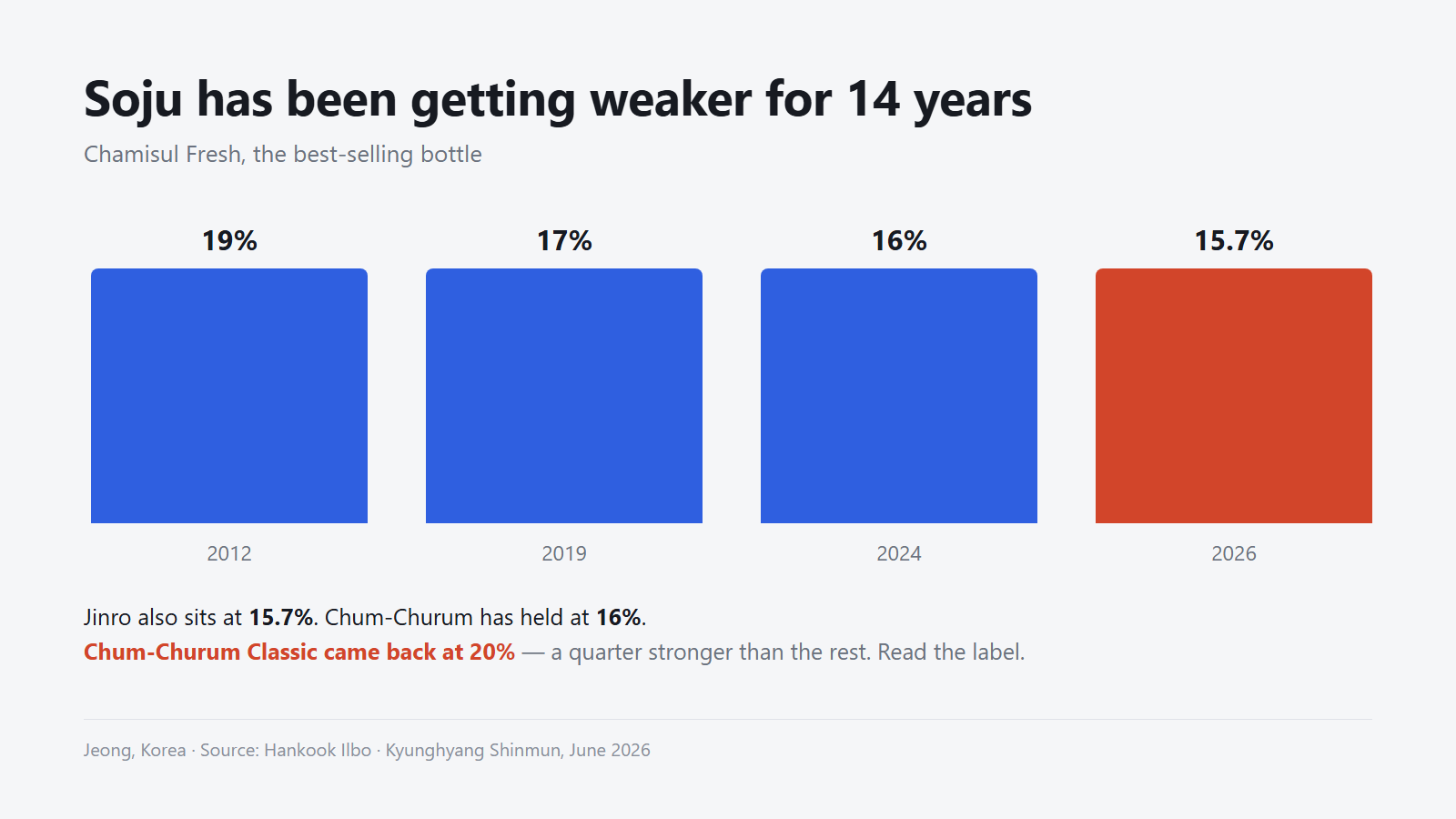
| Chamisul Fresh (참이슬 후레쉬) | 15.7% |
| Jinro (진로) | 15.7% |
| Chum-Churum (처음처럼) | 16% |
| Chum-Churum Classic (처음처럼 클래식) | 20% |
That last one matters. Chum-Churum Classic was relaunched in April 2026 at 20% — the old-style strength, deliberately. If you order it thinking all soju is now mild, you have picked a drink that is a quarter stronger than everything else on this list.
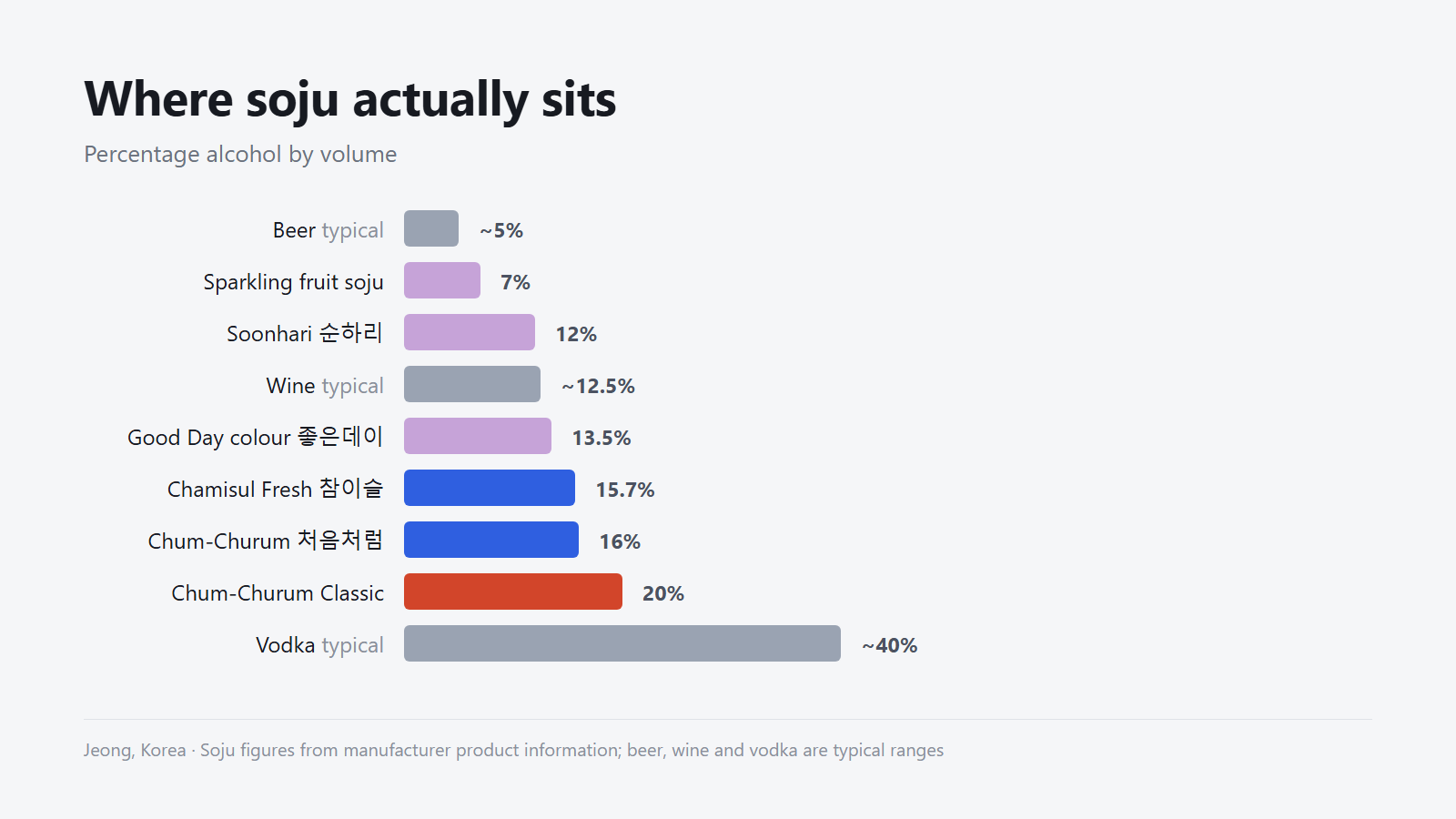
Source: Hankook Ilbo and Kyunghyang Shinmun, reporting the June 2026 reformulation.
Fruit soju is a different drink wearing the same clothes
The pastel bottles you see in convenience stores are not the same product category. They are liqueurs, sold under the soju name because the base spirit is the same.
-
Soonhari (순하리) sits around 12%.
-
Good Day colour series (좋은데이 컬러시리즈) runs about 13.5%.
-
Some sparkling versions drop as low as 7%.
They taste like fruit soda, which is exactly the problem. A 12% liqueur that goes down like juice is how people who "don't really drink" end up surprised. If you want the actual Korean drinking experience, the green bottle is the one. If you want something pleasant, the pink one is genuinely nice — just count it honestly.
The pour is what gets you, not the soju alcohol percentage
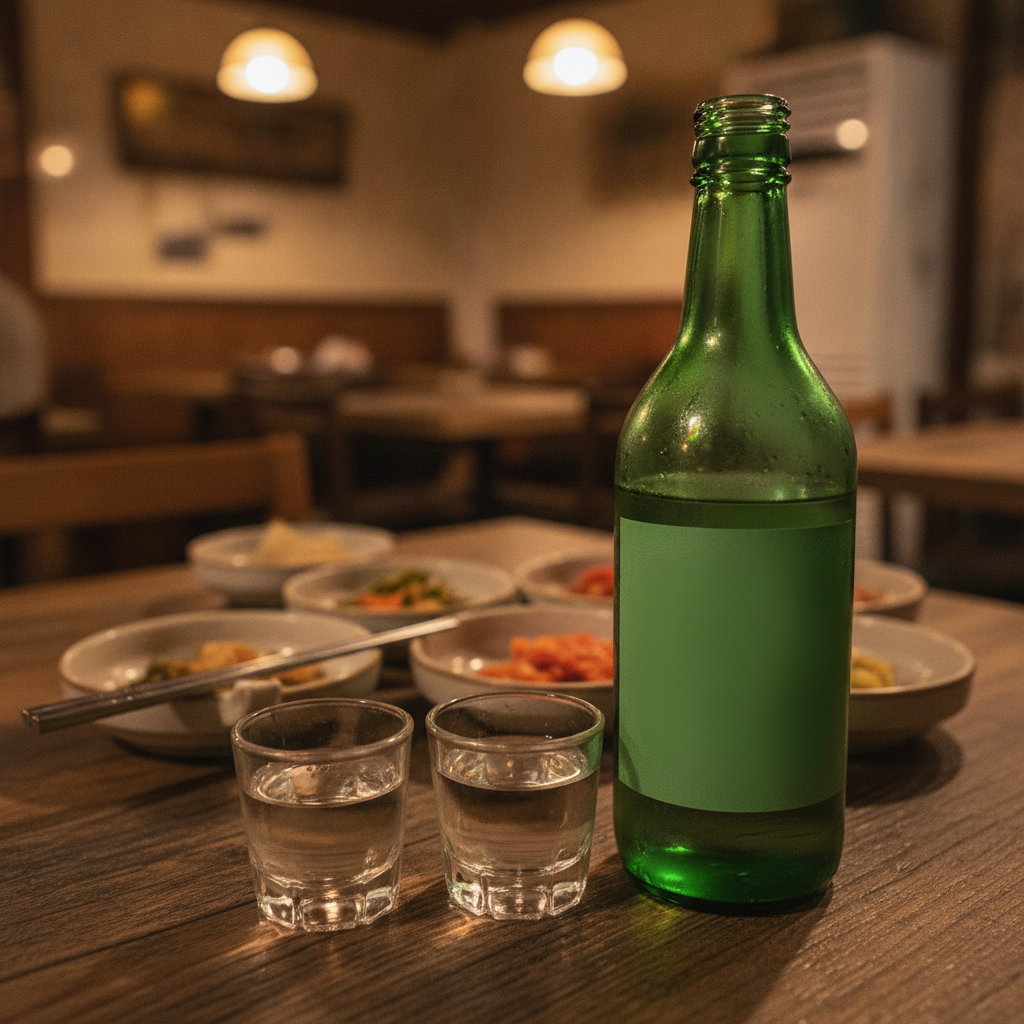
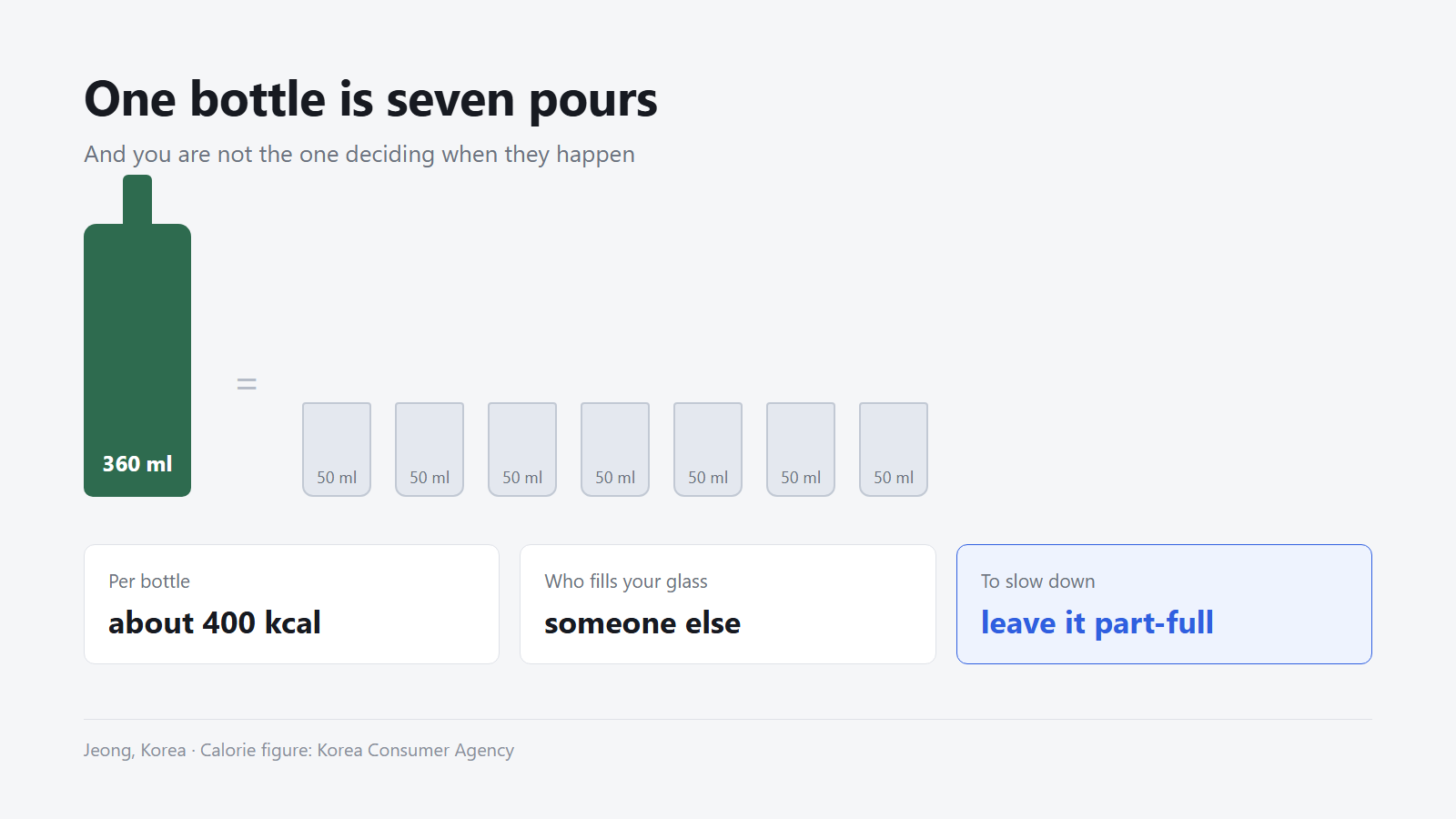
A standard bottle is 360 ml, and the small glasses hold about 50 ml. That is roughly seven pours per bottle.
Seven does not sound like much. But three things stack on top of it:
-
You do not pour your own. Someone else fills your glass, which means you are not tracking how many you have had. They are not tracking either.
-
An empty glass is an invitation. Leaving your glass full is the polite way to slow down. Draining it signals you are ready for another, and one will arrive.
-
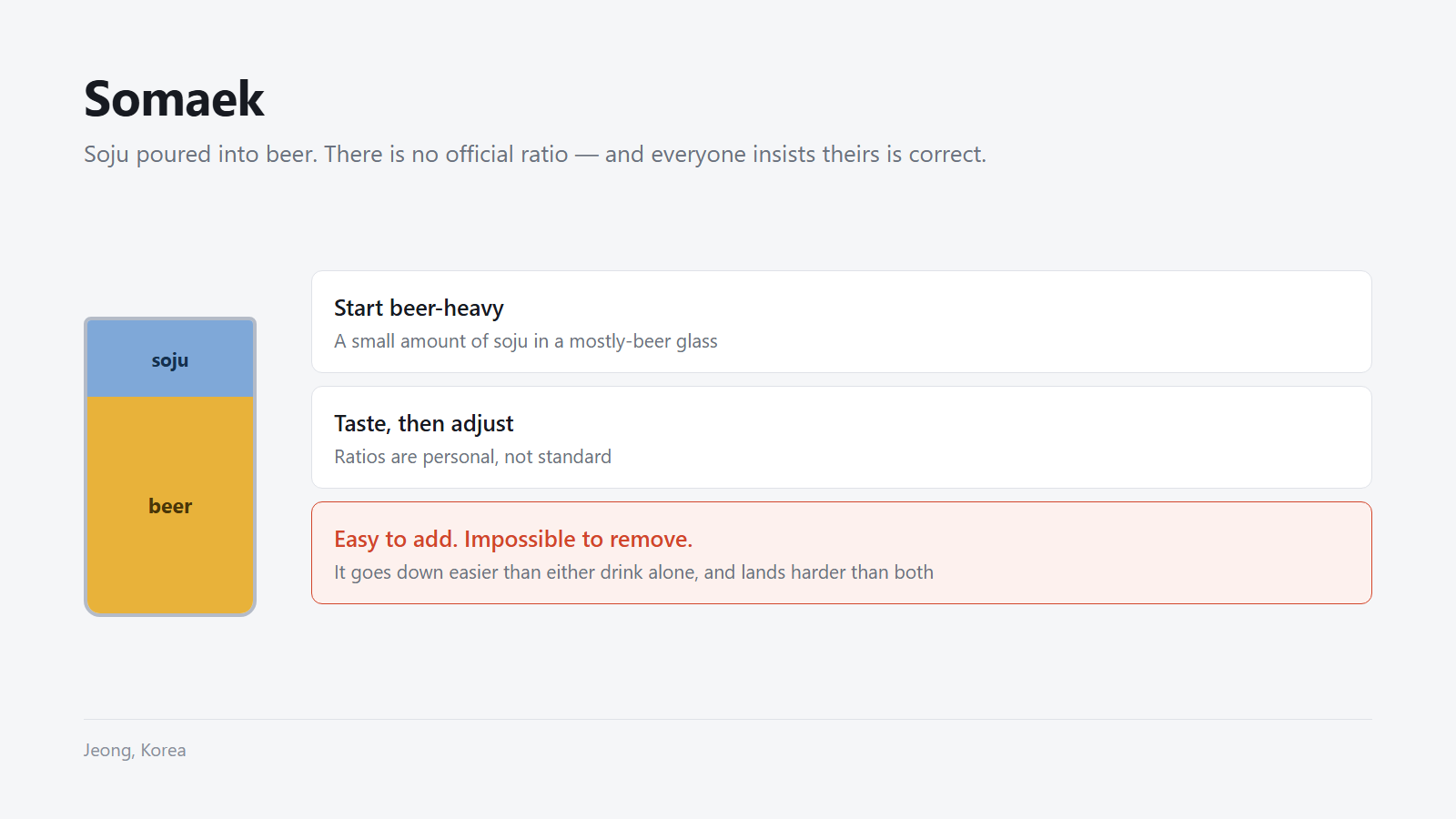
Somaek. Soju mixed into beer. The combination goes down easier than either alone and lands harder than both.
The Korean at your table has been calibrating against these habits since university. You have not. That gap is worth more than the three percentage points that came off the bottle since 2019.
My honest advice, the same one I give my friends: leave a little in the glass when you want to pause. Nobody will push, and nobody will comment. It is the accepted signal.
The pouring rules, which take about four minutes to learn
These are not formalities you can skip. They are how the table reads whether you are paying attention.
-
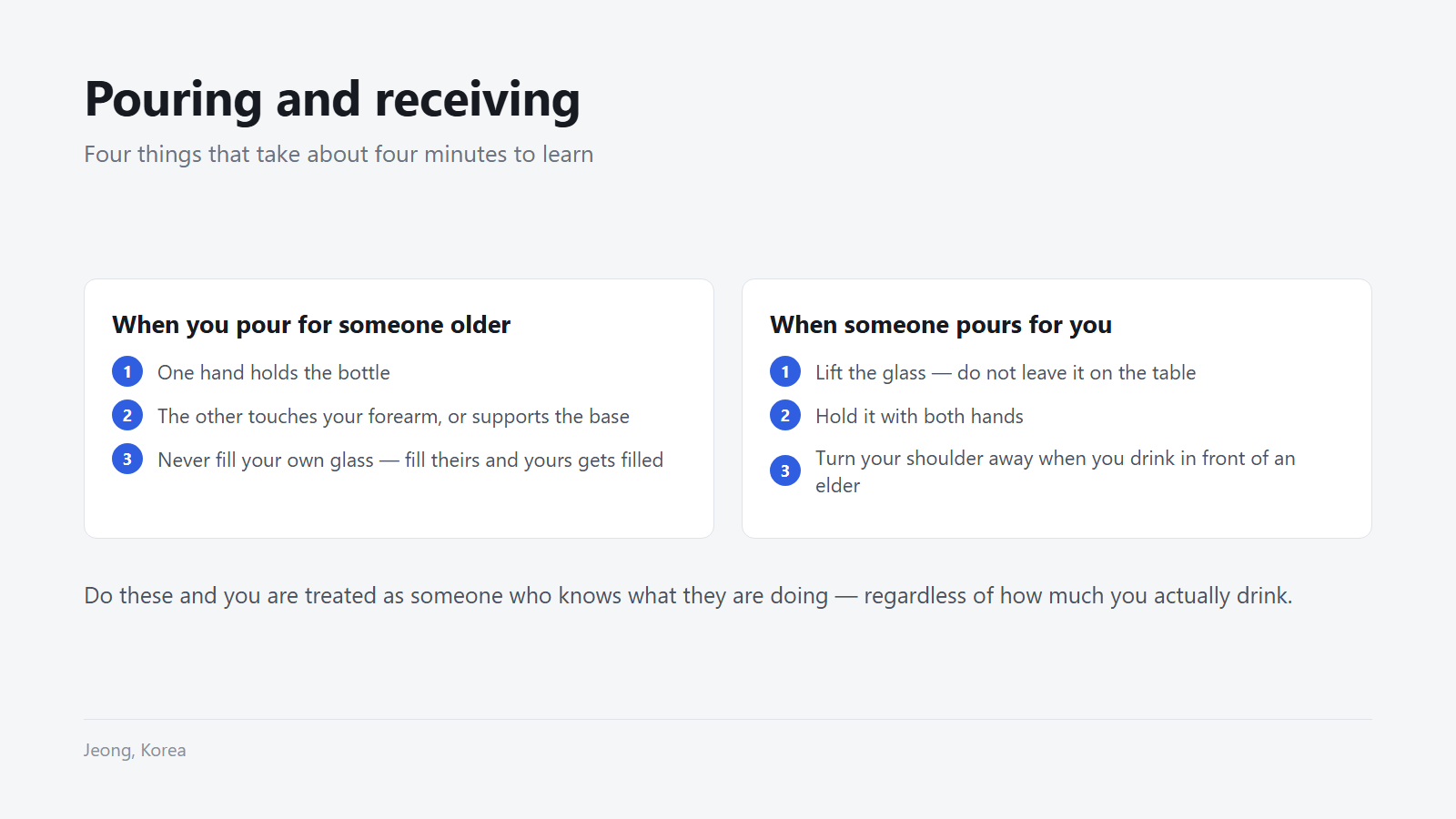
Pour with two hands when serving someone older or senior. One hand on the bottle, the other touching your forearm or the bottle's base.
-
Receive with two hands as well, holding your glass up rather than leaving it on the table.
-
Turn your head away when you drink in front of someone notably older. Shoulder turned, glass shielded. It looks odd the first time and stops feeling odd immediately.
-
Never pour your own glass. Fill other people's and yours gets filled. This is the whole mechanism.
Do these four and you will be treated as someone who knows what they are doing, regardless of how much you actually drink.
Where you buy it changes the price by five times
This is the part that surprises people most, and it is worth knowing before you order a second bottle.
| Where | Price for a 360 ml bottle |
|---|---|
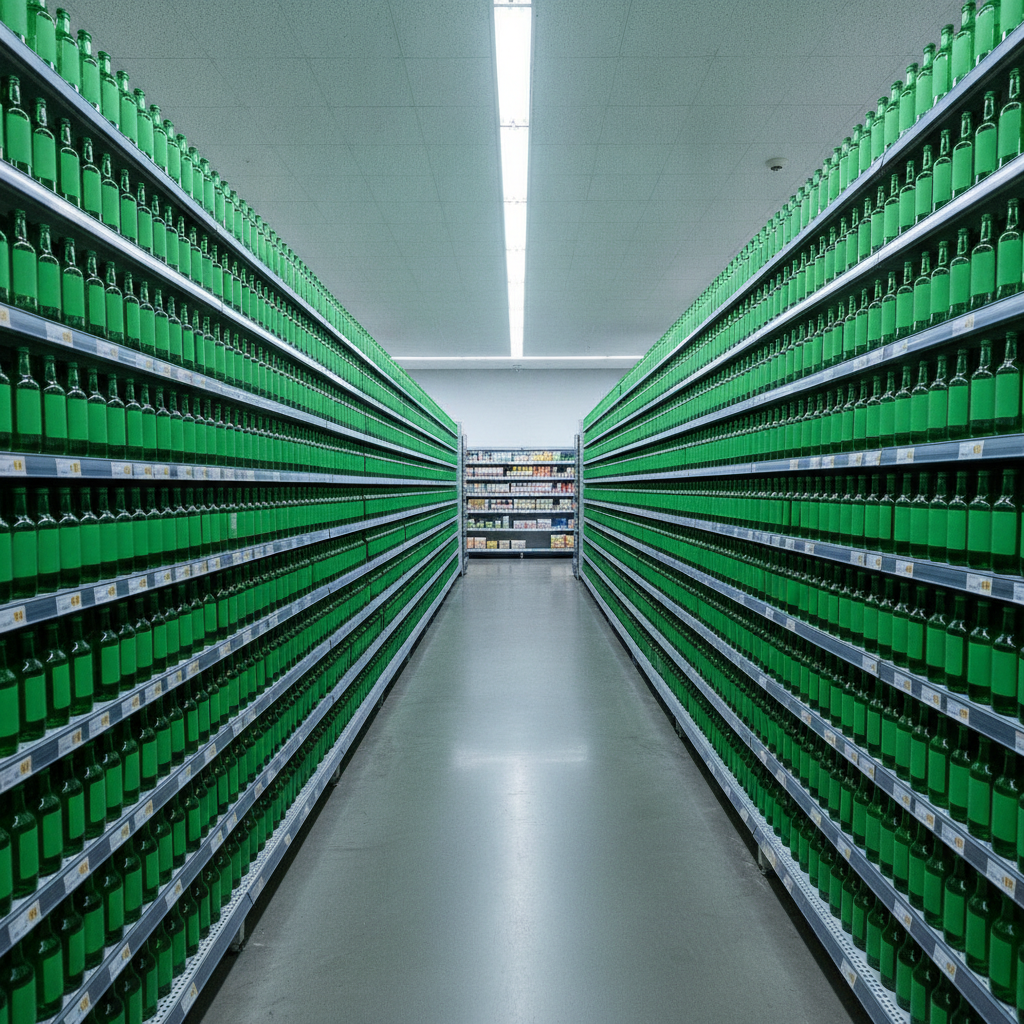
| Large supermarket | around 1,330 won |
| Convenience store | around 1,900 won |
| Restaurant | 6,000 won and up, often more |
Nothing about the liquid changes. The restaurant markup is simply how Korean restaurants price, and everybody accepts it — you are paying for the table, the side dishes, and the hours.
Which means: if you are drinking at a restaurant, drink at the restaurant and enjoy it. If you want to try four different bottles to compare, do that at a convenience store table or back at your accommodation. Nobody does a tasting flight at a barbecue place.
What it costs you the next morning
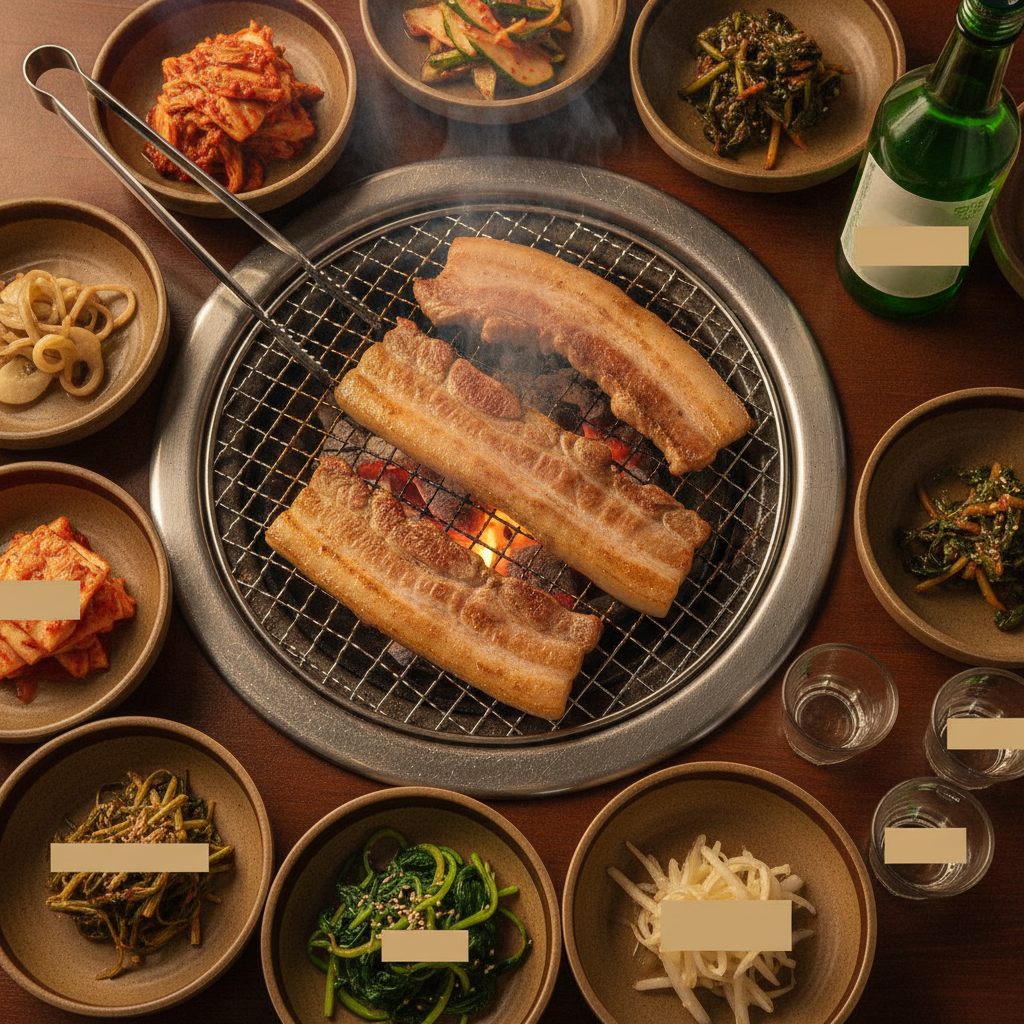
A 360 ml bottle is roughly 400 kcal, according to figures published by the Korea Consumer Agency. That is a meal's worth of calories with no food in it, which is part of why soju is almost never drunk alone here — it arrives with grilled meat, stew, or at minimum something salty.
That pairing is not decoration. Eating alongside is the single most effective thing you can do, and it is built into how the meal is ordered in the first place.
FAQ
How does the soju alcohol percentage compare to vodka?
Vodka is typically around 40%, so standard soju at 15.7% is a little under half as strong. But soju is drunk in 50 ml glasses, repeatedly, over a long meal — while vodka is usually either a small shot or diluted in a mixer. The per-glass difference matters less than the pace.
Is fruit soju really soju?
Legally it is classified as a liqueur, not soju, even though it is sold beside it and named after it. Strength runs roughly 7% to 13.5% depending on the product. It is a real alcoholic drink, just a much sweeter and weaker one.
Why does nobody fill their own glass?
Because filling each other's glasses is what keeps the table connected — it gives everyone a small reason to pay attention to everyone else. It also means you are never drinking alone at a shared table, which is the point of the whole ritual.
Has the soju alcohol percentage changed recently?
Yes. Chamisul Fresh dropped from 16% to 15.7% in June 2026, continuing a decline that has run since 2012. Chum-Churum stayed at 16%, and Chum-Churum Classic went the other way at 20%. Check the number on the label rather than assuming.
What is somaek and what is the ratio?
Somaek is soju poured into beer. There is no official ratio — people mix it to taste, and every group has someone who insists their proportion is correct. Start with a small amount of soju in a mostly-beer glass, because it is much easier to add than to remove.
Can I buy soju at any hour?
Yes. Convenience stores sell alcohol around the clock in Korea, with no late-night cutoff. The legal drinking age is 19 in Korean reckoning, and shops do check ID.
The short version
The soju alcohol percentage is 15.7% for the bottle you will most likely be handed, and that number has been drifting down for over a decade. It is not the thing to watch.
Watch the glass instead. Seven pours to a bottle, someone else doing the pouring, and an empty glass that refills itself. Leave a swallow in the bottom when you want to slow down, and you can stay at the table all night — which, honestly, is the entire point of the drink.
If you are heading out for the meal that goes with it, the street food guide covers what to eat alongside, and the convenience store guide covers the cheaper version of the same evening.
Sources
-
Hankook Ilbo — Chamisul Fresh reformulation to 15.7%: https://www.hankookilbo.com/news/article/A2026060209570004393
-
Kyunghyang Shinmun (English) — Chamisul alcohol content change: https://www.khan.co.kr/en/article/202606021829017/
-
Korea Consumer Agency — consumer price and product information: http://www.price.go.kr/tprice/portal/pricenews/pricereport/priceReportList.do
Product strengths and prices change with each reformulation. Check the label.