Seongsu-dong: The Shoemakers Moved Under the Train Tracks, and the District Wrote a Rent Rule

Seongsu gets described as the place where old shoe factories turned into cafés. That is only half of it. The shoe trade did not leave. Part of it sells from under the elevated train tracks now, and the district wrote itself a rule about rent.
Seongsu-dong sits on Line 2, between Ttukseom and Seongsu stations in Seongdong-gu. This guide covers which exit to use, the strips worth walking, how a shoe-making district became a café district, and the rent rule the district wrote to slow that change down.
One station, three strips
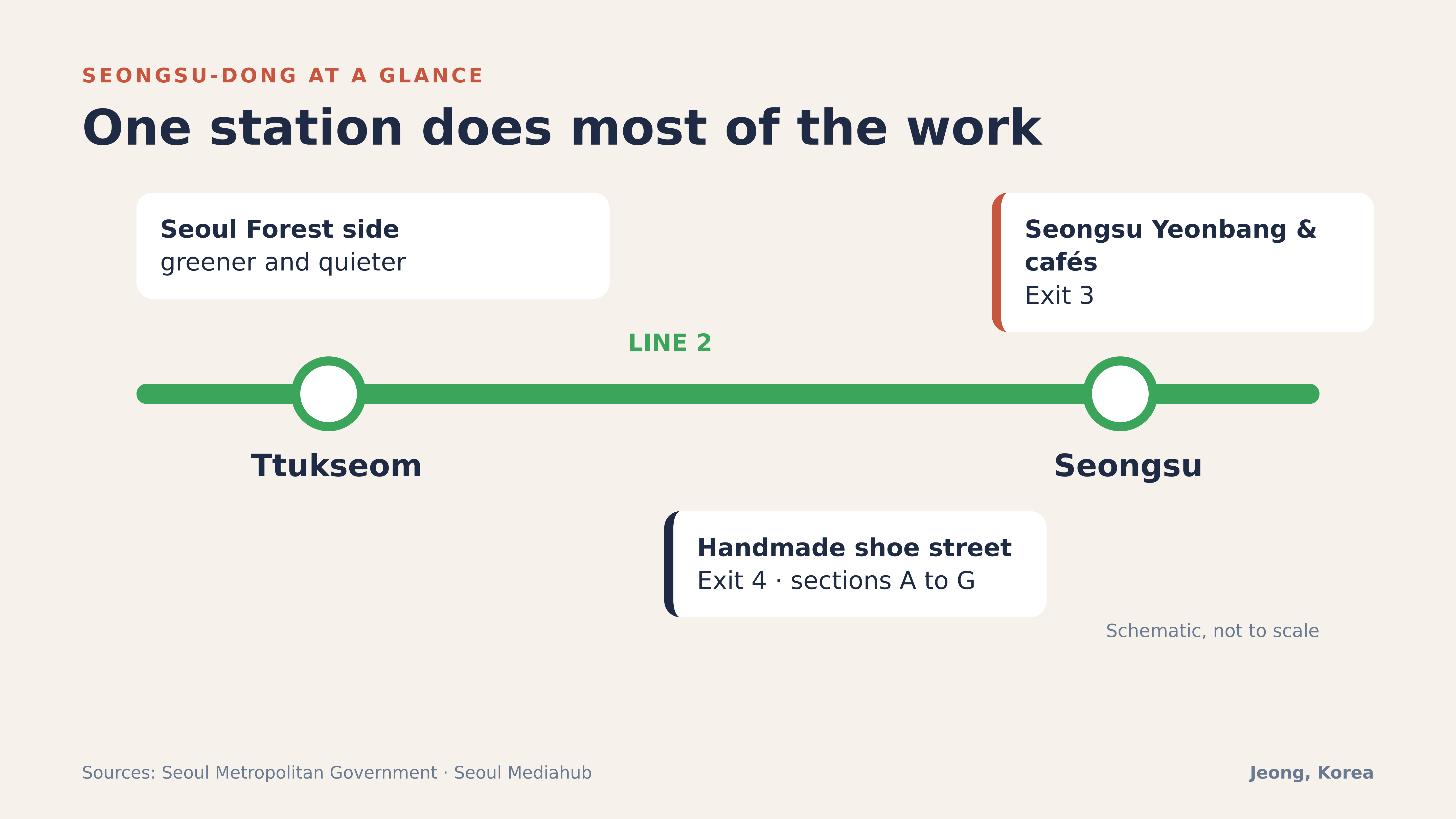
When friends ask me where to start in Seongsu-dong, the answer is one station: Seongsu, on Line 2. You do not need a plan beyond which exit you walk out of.
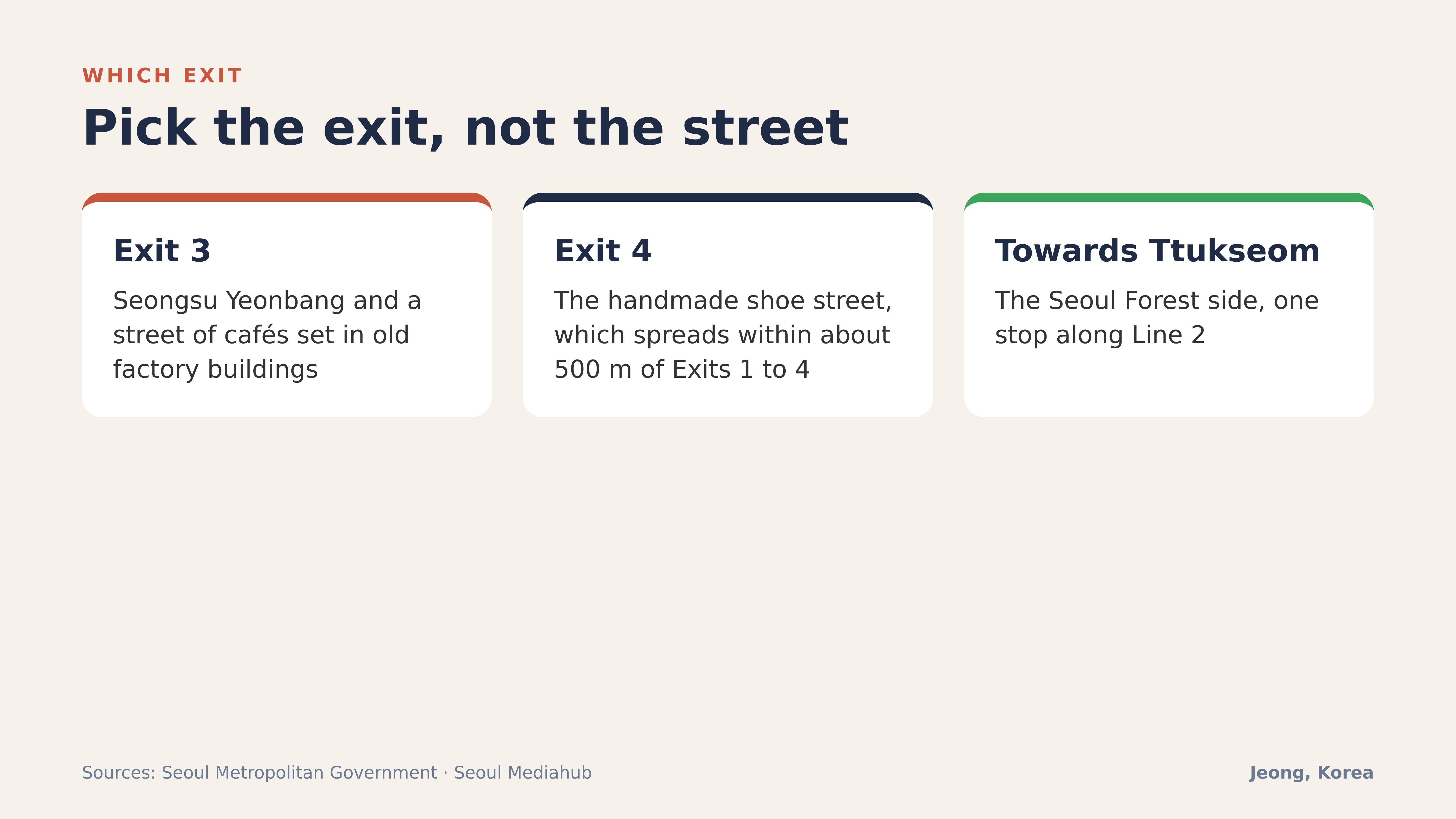
Exit 3 takes you towards Seongsu Yeonbang and a street of cafés set in old factory buildings. Exit 4 takes you to the handmade shoe street. Seoul's own English guide gives exactly those two directions: "Exit 3 of Seongsu Station" for Yeonbang and "Exit 4" for the shoe street, on its Seongsu Yeonbang and Handmade Shoe Street page.
The shoe street itself is bigger than one alley. The city's news site describes it as running from Seongsu Station towards Ttukseom Station, split into lettered sections from A to G, within about 500 metres of Exits 1 to 4.
The third strip is the Seoul Forest side, towards Ttukseom Station, which is greener and quieter.
| Where to head | What is there |
|---|---|
| Seongsu Station, Exit 3 | Seongsu Yeonbang and cafés in old factory buildings |
| Seongsu Station, Exit 4 | The handmade shoe street |
| Towards Ttukseom Station | Seoul Forest side, greener and quieter |
If Line 2 and its transfers are new to you, the Seoul subway map and transfer rules are worth reading before you set off.
So why are there shoes here at all?
It was a shoe district before it was a café district
The handmade shoe trade did not start in Seongsu. It walked here.
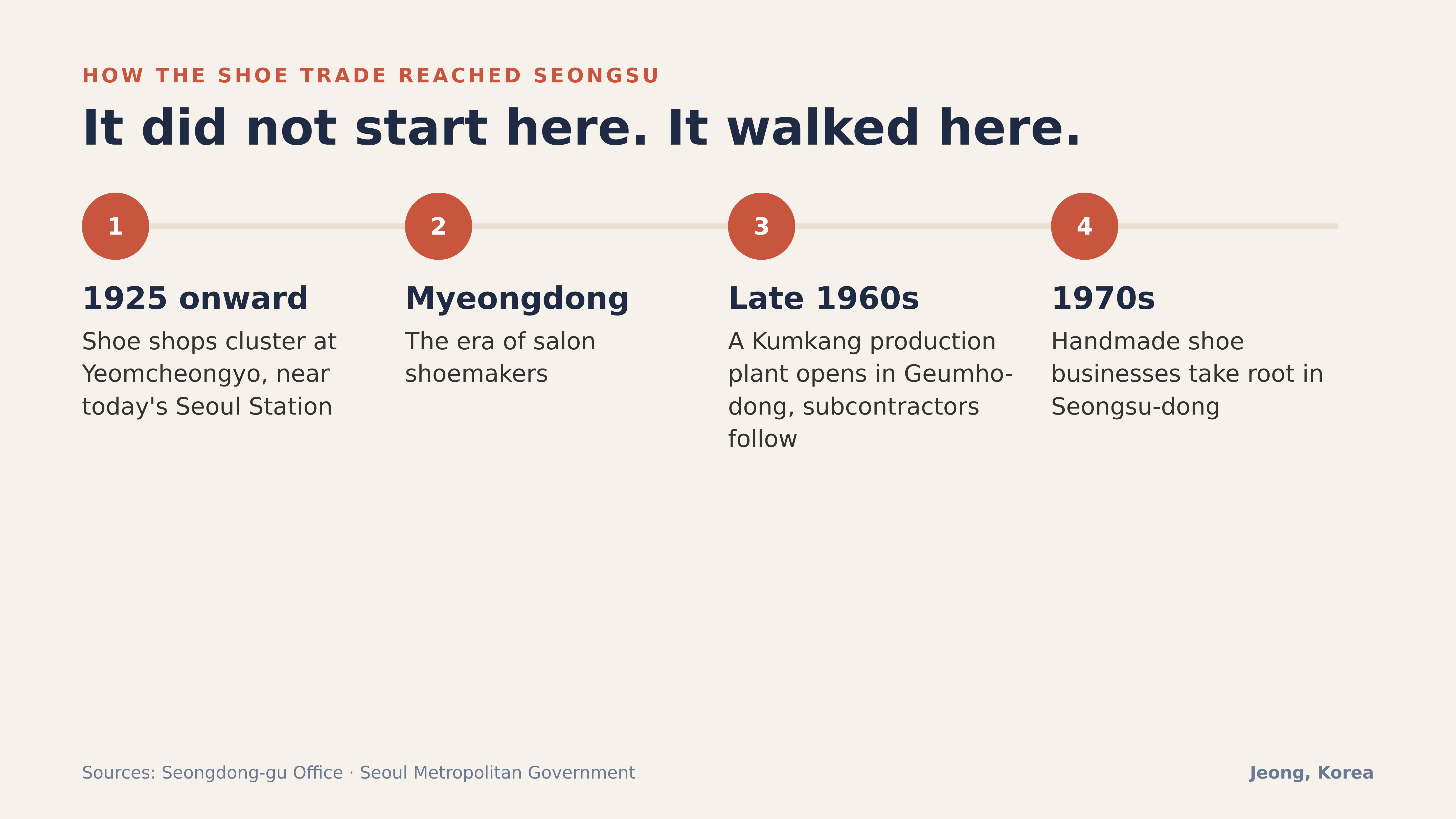
Seongdong-gu's own history of the trade begins at Yeomcheongyo, near what is now Seoul Station, where shoe shops clustered after the station opened in 1925. The trade then moved through the salon shoemakers of Myeongdong, and in the late 1960s a Kumkang shoe production plant opened in nearby Geumho-dong, with subcontract workshops settling around it.
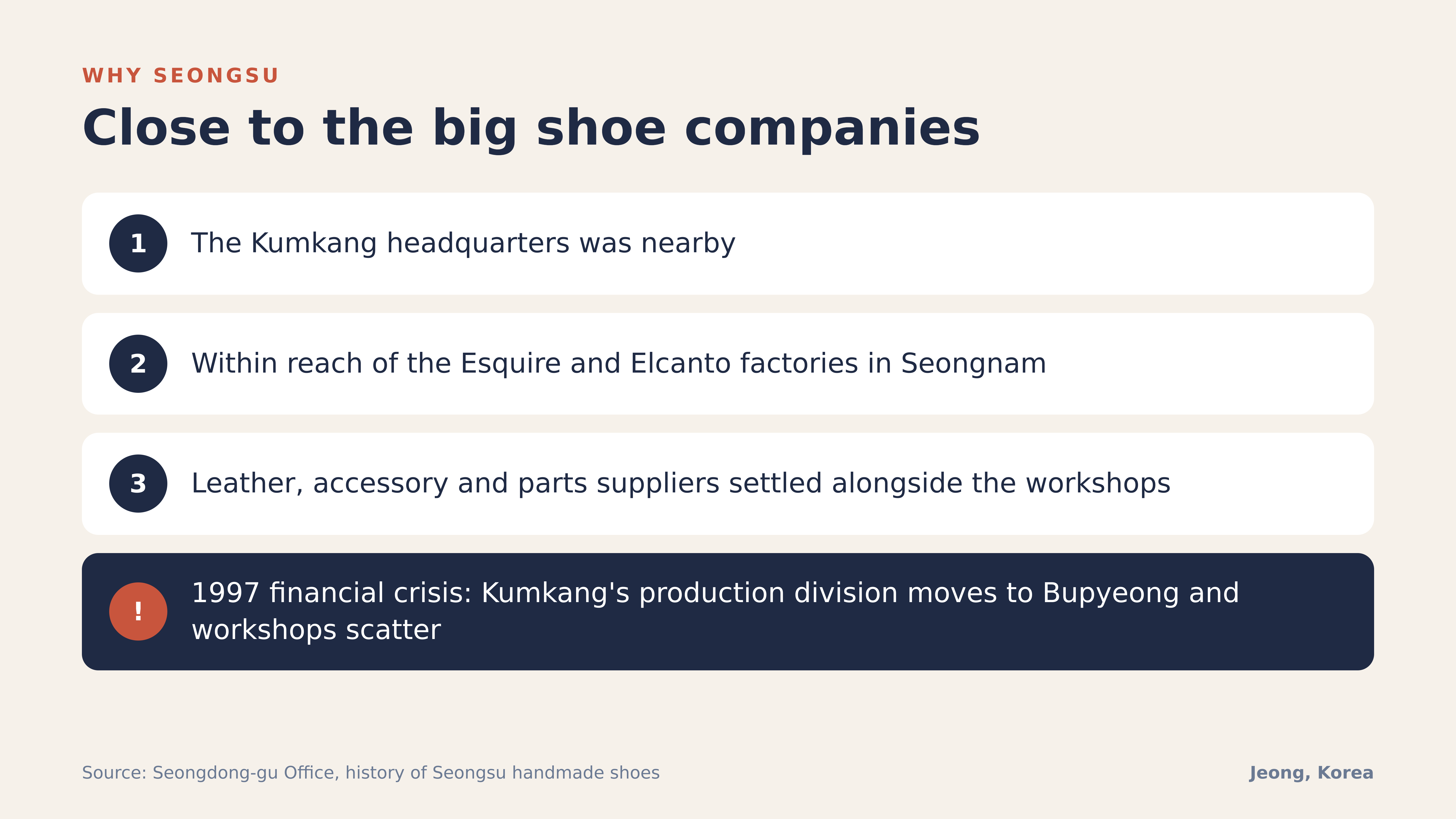
The district also explains why the workshops ended up in Seongsu specifically. Seongsu had the Kumkang headquarters nearby and was close to the Esquire and Elcanto factories in Seongnam, as the Seongdong-gu handmade shoe history page explains. When the 1997 financial crisis pushed Kumkang's production division out to Bupyeong, the workshops scattered, but the leather, accessory and parts suppliers had already put down roots here.
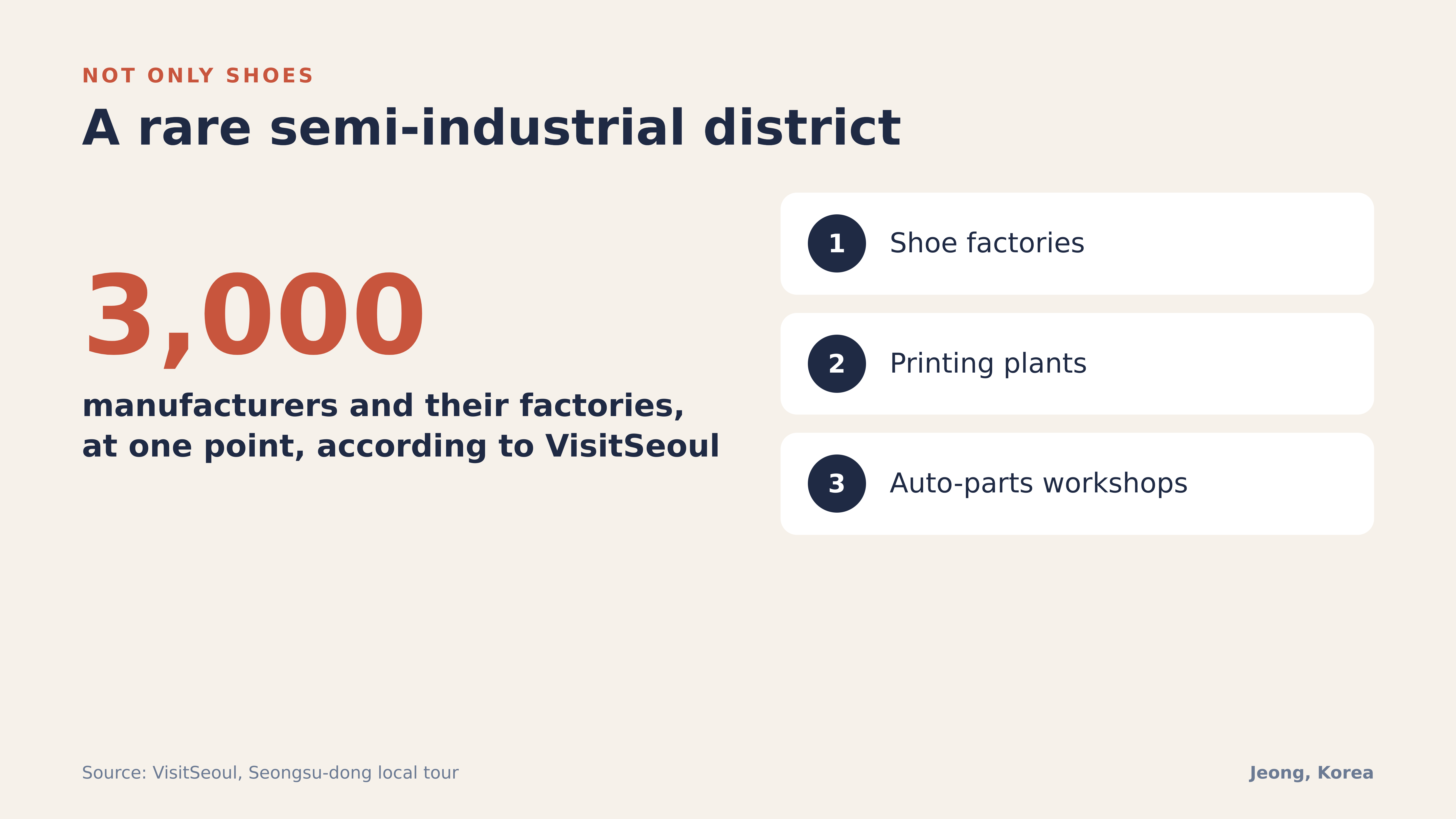
Shoes were never the only industry. Seoul's official tourism site describes Seongsu as "a rare semi-industrial district" that once held shoe factories, printing plants and auto-parts workshops, in its Seongsu-dong local tour feature. When manufacturing slowed, those buildings emptied, and that is where the cafés came in.
What happened when the cafés arrived?
The cafés came, then the rent, then a rule
The part most guides skip is that Seongdong-gu answered the rent problem with legislation.
In 2014 Seongsu was picked as a pilot area for urban regeneration, and artists and small businesses moved in quickly. On 24 September 2015 the district enacted Ordinance No. 1138, on community cooperation and sustainable development zones, which you can read on the National Law Information Center. A study of Seongsu in the Korean Geographical Society's journal records it as the first ordinance of its kind in the country.
| When | What happened |
|---|---|
| 2014 | Seongsu picked as an urban regeneration pilot area |
| 24 September 2015 | Ordinance No. 1138 enacted |
| September 2016 | First zone: Seoulsup-gil, Bangsongdae-gil, Sangwon-gil |
| August 2023 | Zone extended to almost all of Seongsu-dong |
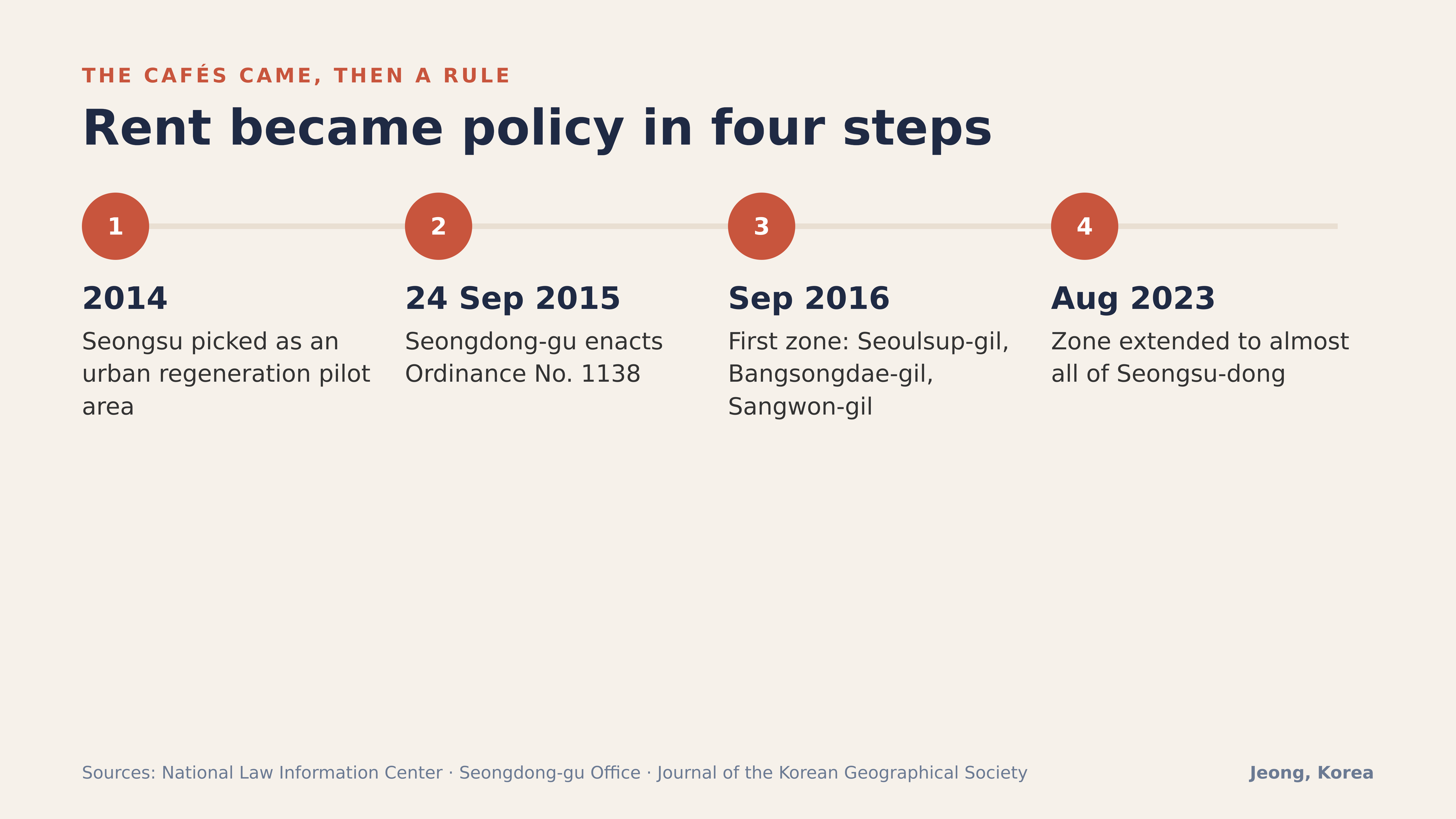
The ordinance works through zones. The first one, designated in September 2016, covered three streets near Seoul Forest: Seoulsup-gil, Bangsongdae-gil and Sangwon-gil. In August 2023 the district extended it to almost all of Seongsu-dong, with some redevelopment areas excluded, according to the Seongdong-gu gentrification page.
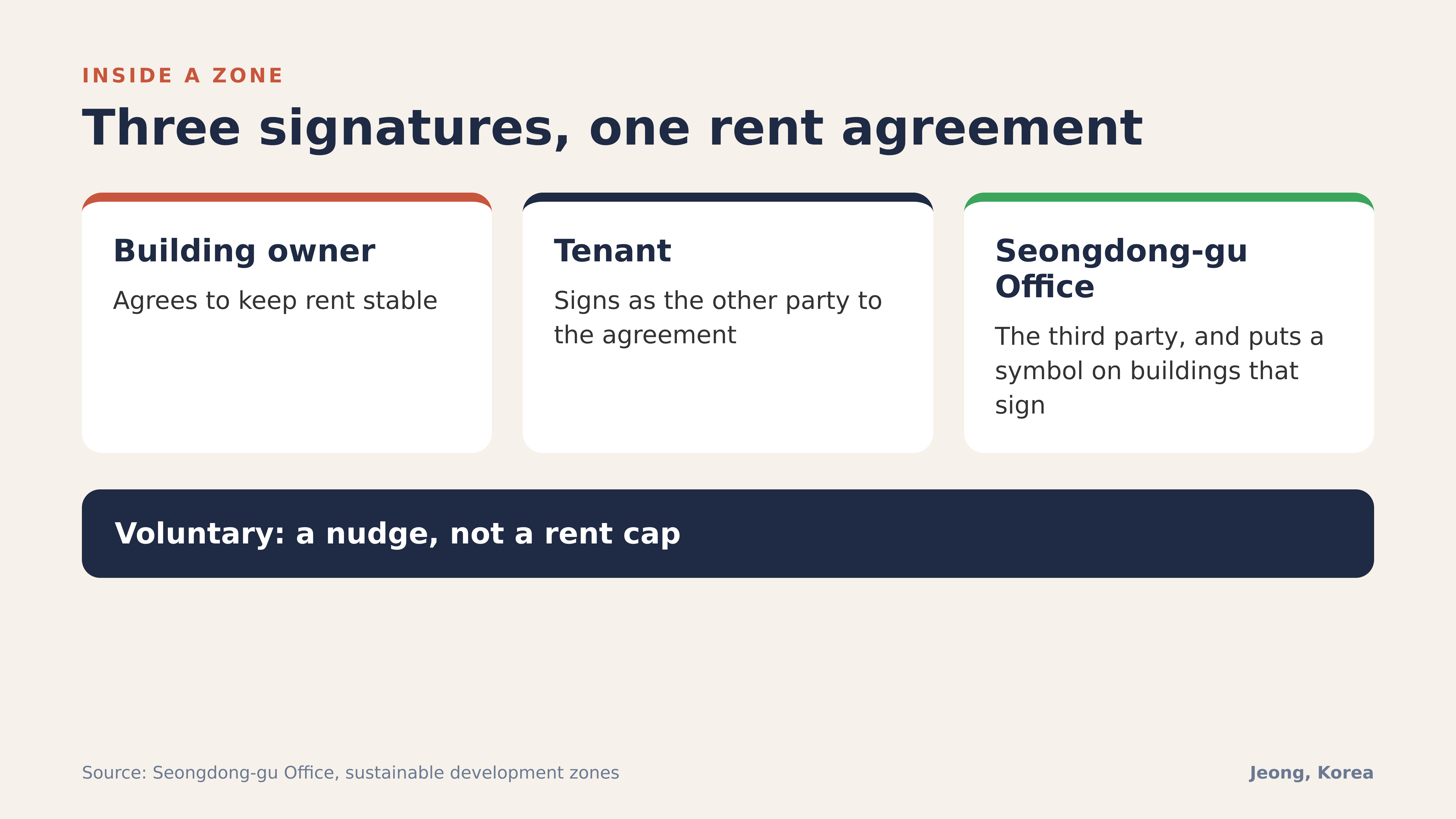
Inside a zone, the district encourages a three-way agreement between the building owner, the tenant and the district office to keep rent stable. Buildings that sign get a symbol to put up. It is voluntary, which matters: this is a nudge, not a rent cap.
It also travelled. The Seongdong Journal reported that a national law on local commercial districts was drafted on the basis of the 2015 ordinance and the policies around it, in its report on the law.
This is a different tool from the one Insadong uses. There, a Culture District protects specific trades; here, the lever is rent. How Insadong protects its trades is worth putting next to this if you want to see the two approaches side by side.
So did the shoemakers survive it?
The shoemakers are still here, just not where the cafés are
Some of them are, and you will find them if you know where to look.
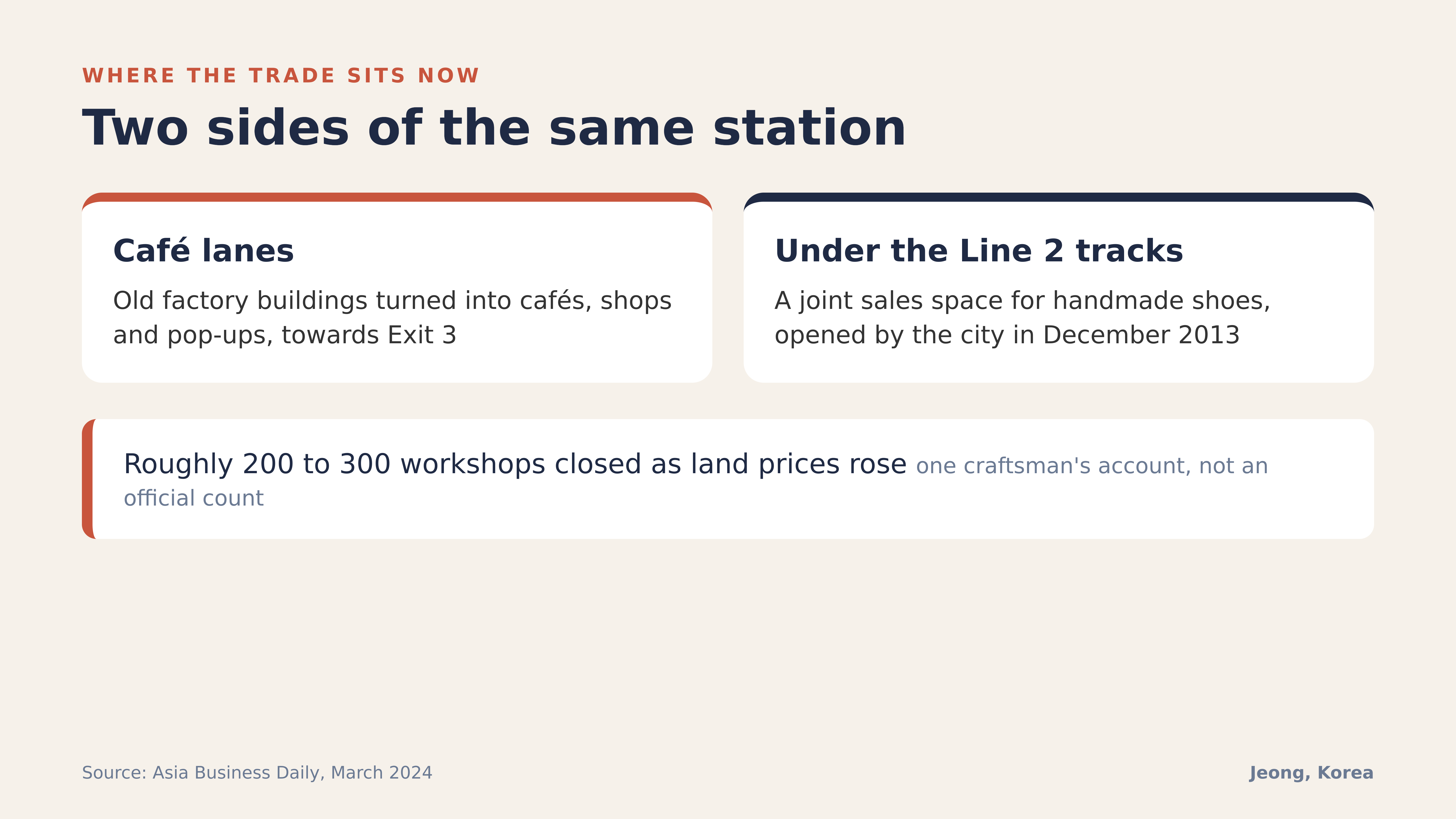
In December 2013 the city opened a joint sales space for handmade shoes under the elevated Line 2 tracks. A 2024 Asia Business Daily report found it quiet, and quoted a shoemaker who has worked since 1972 saying that roughly 200 to 300 workshops had closed as land prices rose, in its report on Seongsu's shoe workshops. That figure is one craftsman's account, not an official count. The same report said that of three new workshop slots advertised by the district that February, one drew no applicants.
The official listing still counts the trade in the hundreds, describing more than 350 finished-shoe makers and around 100 intermediate processing and materials businesses. That is the figure on the city's page; it does not give a date, so treat it as a listing rather than this year's number.
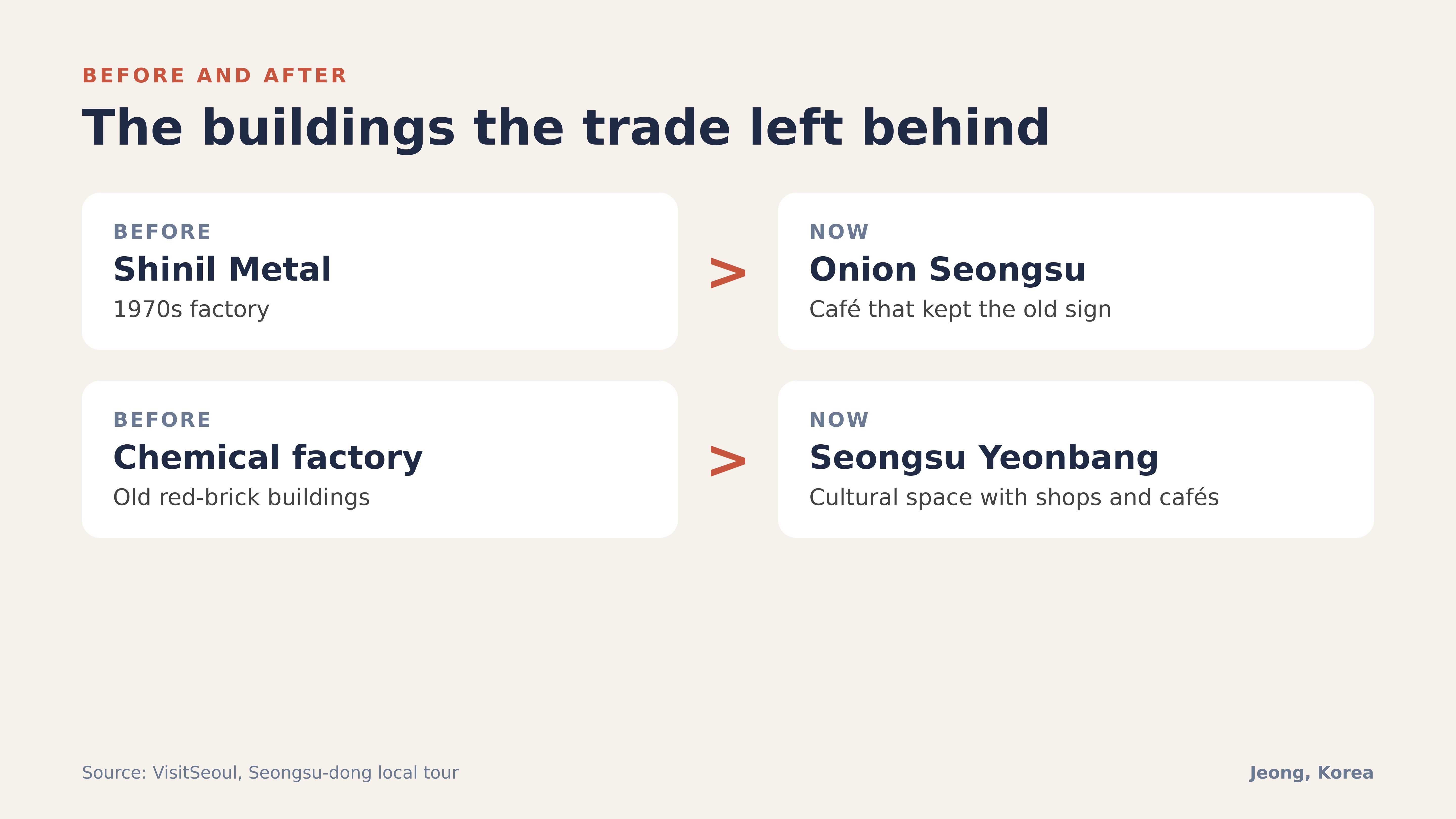
Meanwhile the factory buildings that emptied are the ones most visitors now come for. VisitSeoul's feature describes Onion Seongsu as a 1970s factory that kept its old sign, Shinil Metal, and Seongsu Yeonbang as a former chemical factory turned into a cultural space. Those two are the café district. The shoe street is on the other side of the same station, and a lot quieter.
What to actually do in Seongsu
A half day covers it, and you do not need a booking for any of this.
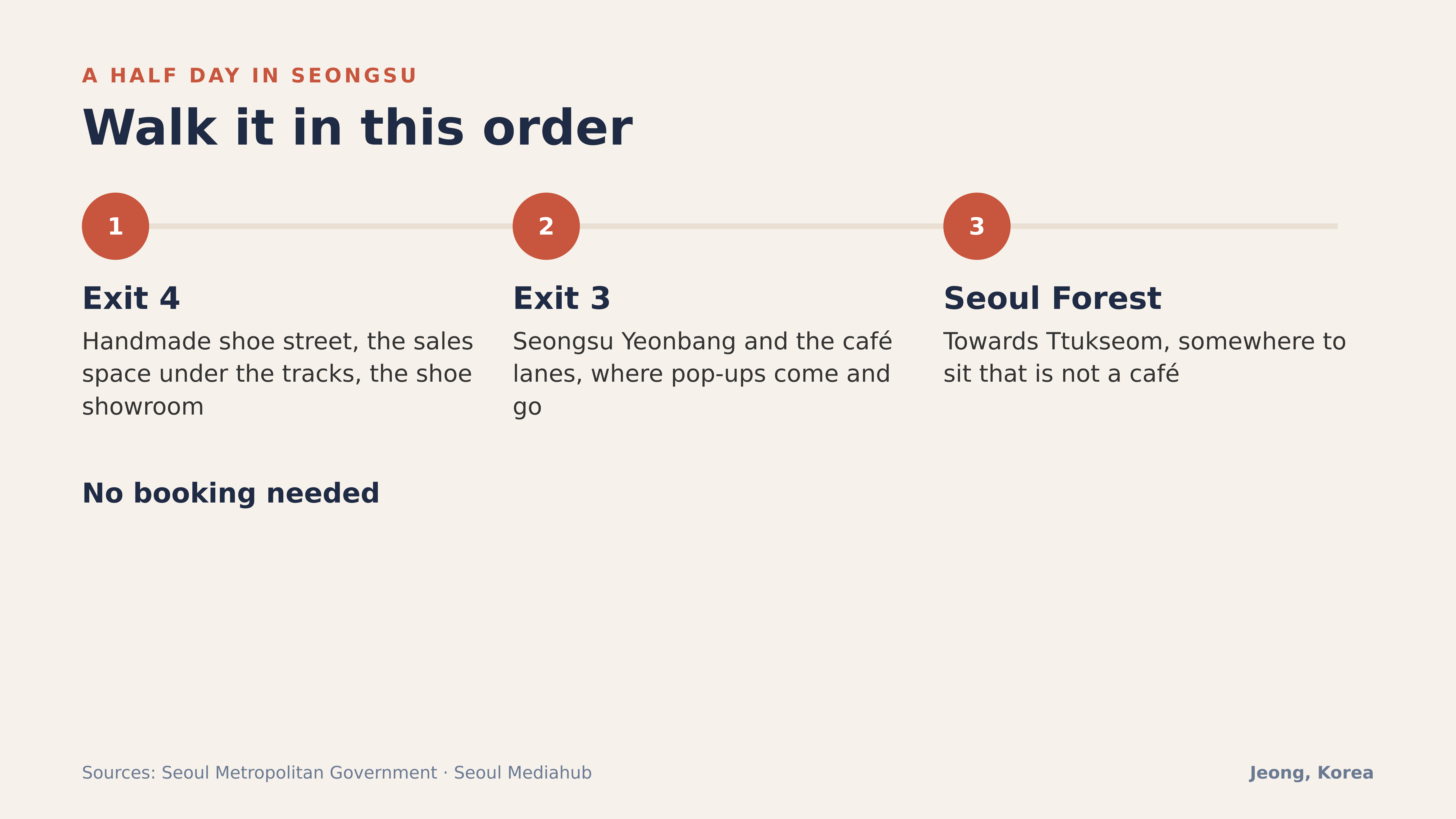
Start at Seongsu Station Exit 4 and walk the shoe street first. Look for the joint sales space under the tracks and the handmade shoe showroom along the street. The shoe street really begins inside the station: murals point the way, and craftsmen's footprints and signatures are displayed outside Exit 1, according to the Seoul Mediahub shoe street feature.
Then cross to the Exit 3 side for Seongsu Yeonbang and the café lanes. Pop-up stores come and go here, so I will not name one that might be gone by the time you arrive. Walk the lanes and you will pass several.
Finish at Seoul Forest, towards Ttukseom, when you want somewhere to sit that is not a café. If you are wondering why a city needs this many cafés in the first place, why Seoul has so many cafés covers it.
FAQ
Is Seongsu-dong worth visiting?
Yes, for a half day. Come for the cafés and pop-ups, but walk the handmade shoe street as well, because that is the part of Seongsu that explains the rest.
Which station is best for Seongsu?
Seongsu Station on Line 2. Use Exit 3 for Seongsu Yeonbang and the café lanes, and Exit 4 for the handmade shoe street. Ttukseom, one stop away, is closer to Seoul Forest.
Is the handmade shoe street still there?
Yes. The official listing describes more than 350 finished-shoe makers plus around 100 processing and materials businesses, though a 2024 report quoted a craftsman saying 200 to 300 workshops had closed as land prices rose.
Why is Seongsu called the Brooklyn of Seoul?
Because it is a former industrial district of factories and warehouses that filled up with cafés, studios and shops. VisitSeoul uses the name in its Seongsu feature.
What did Seongdong-gu do about rising rents?
It enacted an ordinance in 2015, designated sustainable development zones from 2016, and encourages voluntary rent-stability agreements between owners, tenants and the district office.
One sentence is enough
Seongsu-dong was a shoe and factory district before it was a café district, the shoemakers are still there under the Line 2 tracks, and Seongdong-gu wrote the country's first ordinance to slow rent from pushing tenants out.
References
-
Seoul Metropolitan Government — Seongsu Yeonbang and Seongsu-dong Handmade Shoe Street (exits, 1970s origin, business counts)
-
Seongdong-gu Office — history of Seongsu handmade shoes (Yeomcheongyo, Geumho-dong, reasons for Seongsu, 1997 move)
-
VisitSeoul — Seongsu-dong local tour (semi-industrial district, Onion Seongsu, Seongsu Yeonbang)
-
National Law Information Center — Seongdong-gu Ordinance No. 1138, enacted 24 September 2015
-
Seongdong-gu Office — sustainable development zones (first designation September 2016, extension August 2023, three-way agreements)
-
Journal of the Korean Geographical Society — study of Seongsu anti-gentrification policy (first in the country, 2014 pilot)
-
Seongdong Journal — national commercial district law based on the 2015 ordinance
-
Asia Business Daily, March 2024 — Seongsu shoe workshops, joint sales space opened December 2013
-
Seoul Mediahub — Seongsu-dong handmade shoe street feature (A–G sections, station murals)