Chuseok Food: It Is Not on Any Restaurant Menu, and Here Is Where I Actually Buy It

Every Chuseok food list hands you a recipe. That is not laziness. The food is not sold in restaurants. A recipe is the only honest thing left to give.
Chuseok falls on 25 September this year. Below is what Chuseok food actually is, why it never reaches a menu, and the four shops I buy it from every year — a rice cake shop, a supermarket holiday aisle, a market fry counter, and a convenience store at eleven at night.
I have watched this happen to visitors three years running. They arrive the week of the holiday, read about songpyeon and jeon all the way in from the airport, and then spend two days walking past restaurants that either are closed or have never served either dish in their lives. By the time they work out why, they are on the plane home.
So this article does the opposite of the recipe posts. I am not going to teach you to fold rice cakes in a hotel room. I am going to tell you what this food is actually for, why that keeps it off menus, and the four places I go to buy it every single year.
The holiday falls on Friday, 25 September 2026 this year, and the public holiday runs Thursday the 24th to Saturday the 26th. Those three days are written into Korean law — the Regulation on Public Holidays of Government Offices, Article 2, lists "the day before Chuseok, Chuseok, and the day after Chuseok" as a single block. That detail matters more than it sounds, and I will come back to it.
The food has a job, and the job is not dinner
Start here, because everything else follows from it.
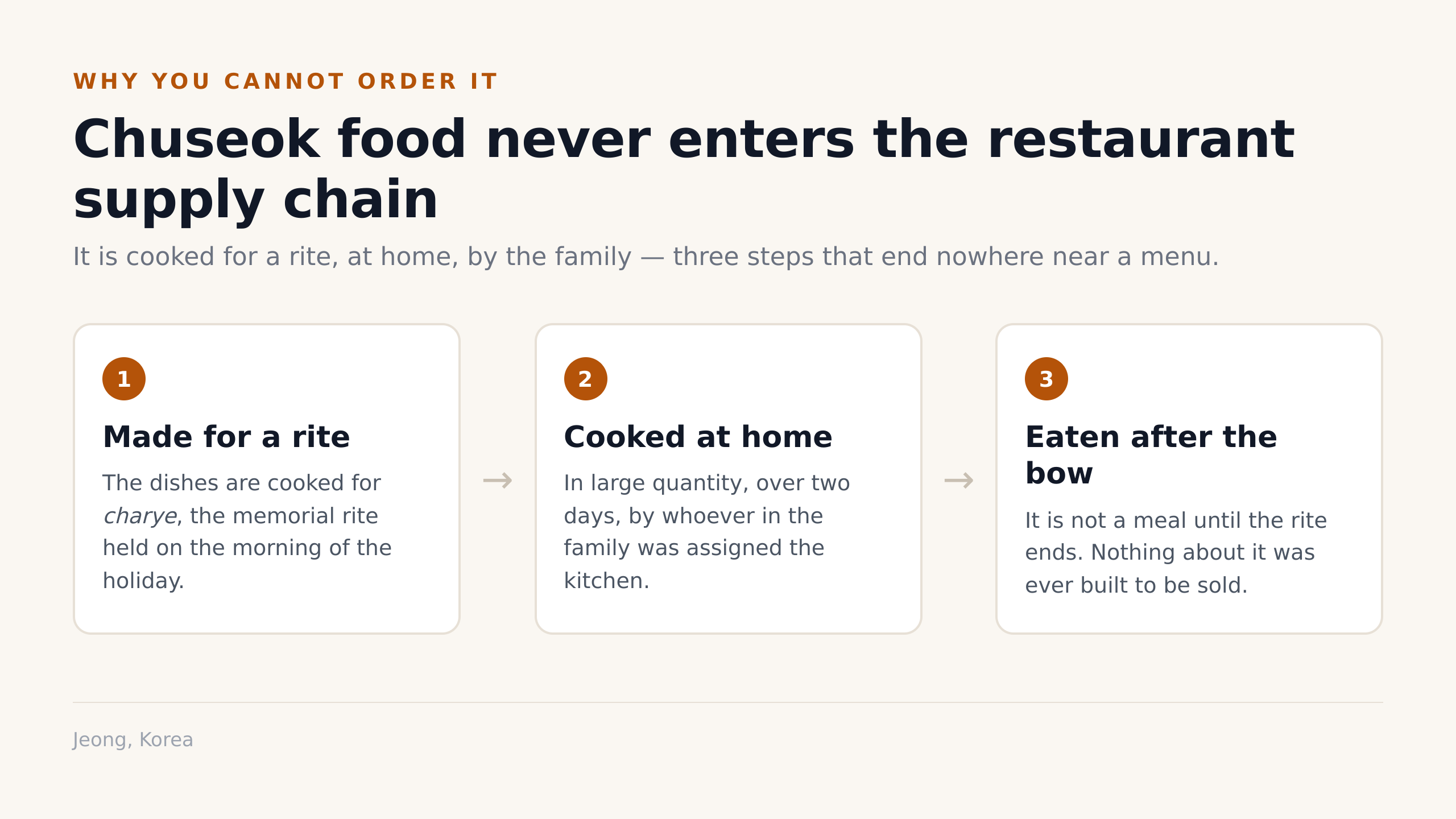
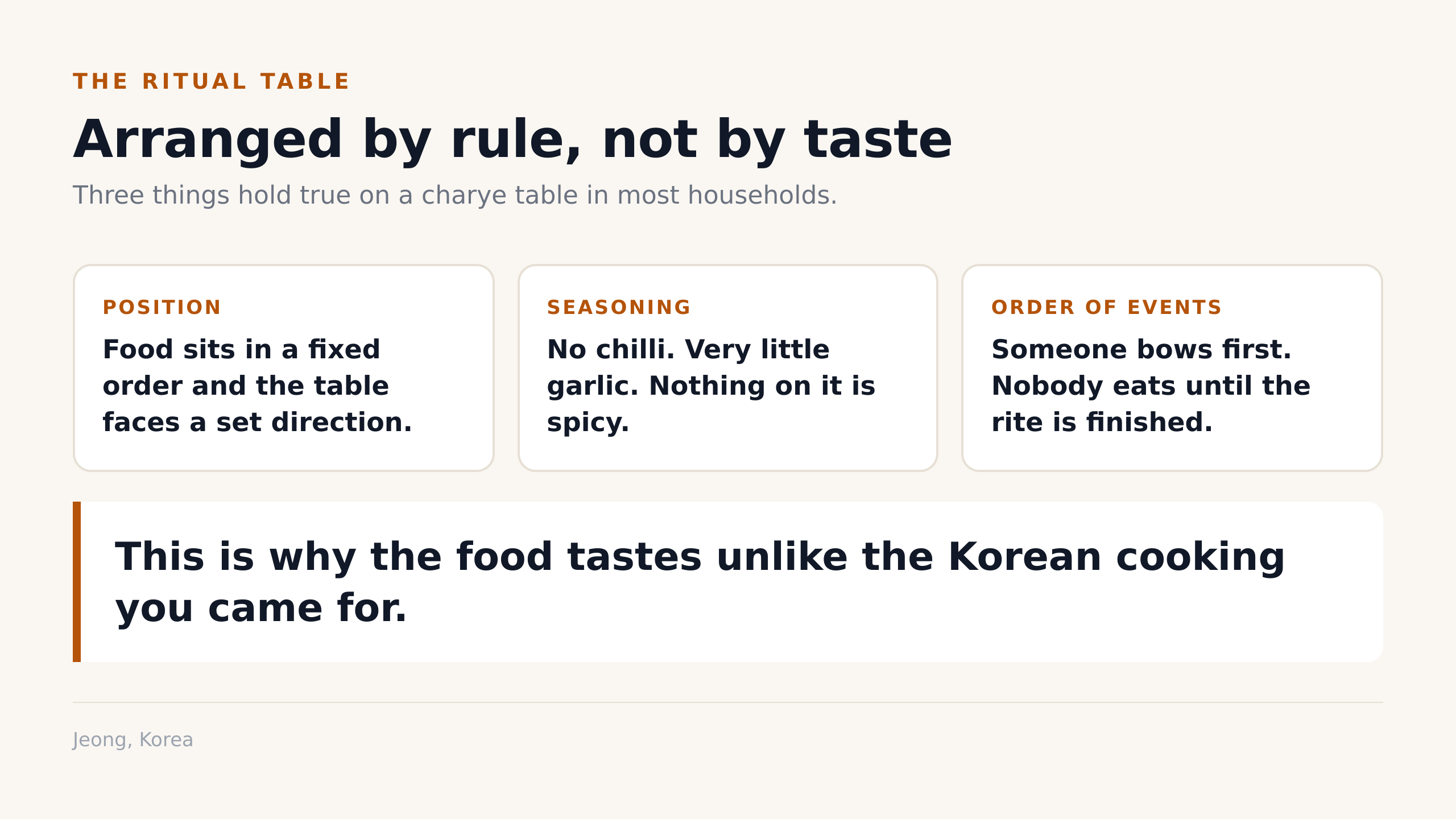
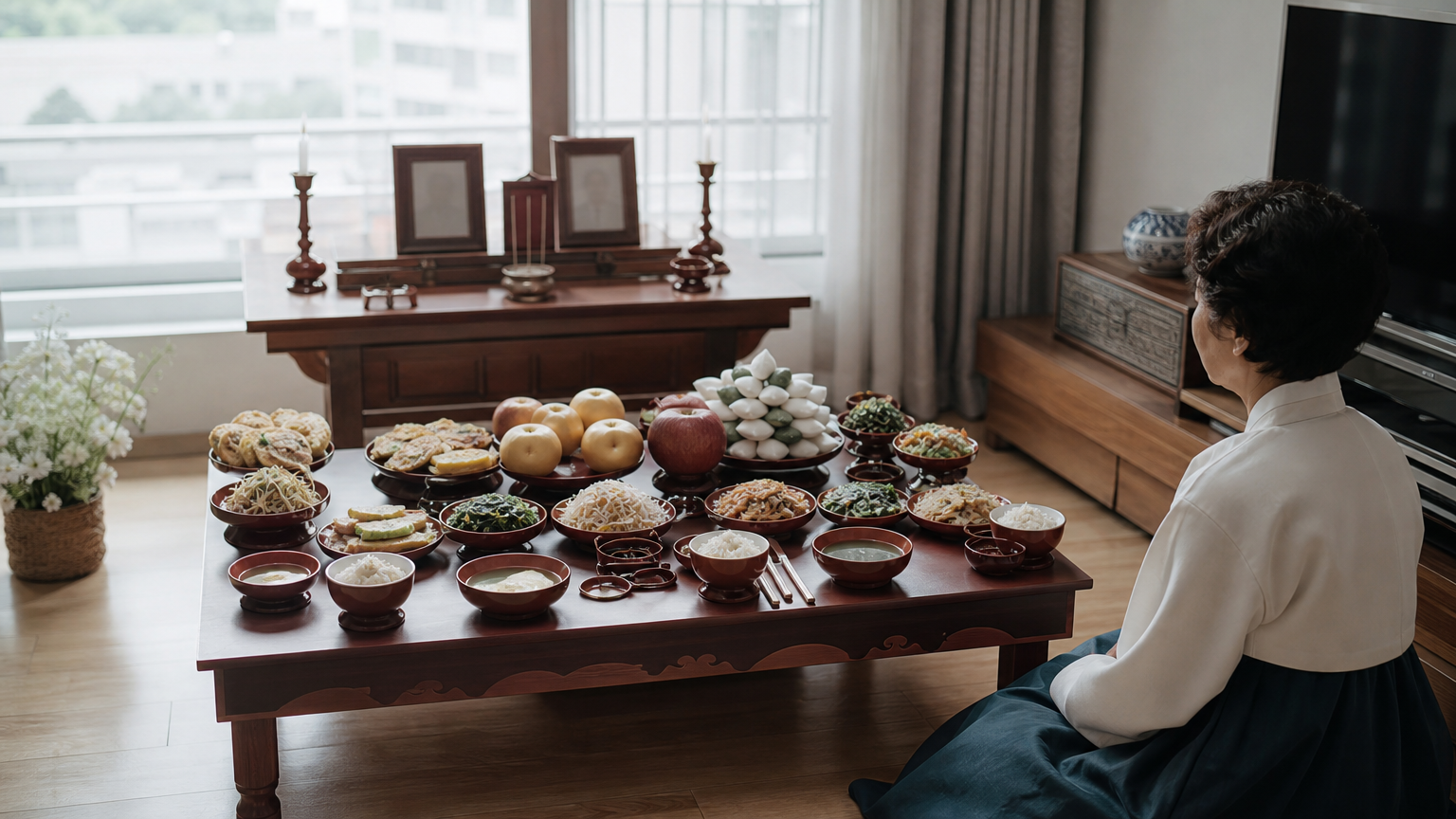
The dishes you have been reading about are ritual food. They are cooked for charye, the memorial rite a family performs on the morning of the holiday for the people in it who have died. The food is arranged on a table, in a fixed order, facing a particular direction. Someone bows. Only afterwards does anyone eat.
That is the reason no restaurant sells it. A restaurant sells you a meal. This food is not a meal until the rite is over — it is an offering that later becomes a meal. Nobody in Korea has ever thought of it as something you go out and order, any more than an American family would expect to buy a plate of Thanksgiving leftovers at a diner.
And because it is made at home, it is made in enormous quantity, over two days, by whoever in the family got assigned the kitchen. The law gives three days off partly so that people can get across the country and do exactly this. If you want to understand why an entire city empties out that week, the food is a large part of the answer — I wrote about what an empty Seoul during Chuseok actually looks like, and what closes separately, and the two pieces fit together.
So the first correction is this: you are not looking for a restaurant. You are looking for a shop.
Which raises a fair question — if it is all made at home, what is anyone actually eating?
What goes on the table is not what the family eats
Here is the part the recipe lists flatten, and it is the single most useful thing I can tell you.
The charye table and the Chuseok lunch are two different menus. They overlap, but they are not the same, and if you only know the first one you will order the wrong things.
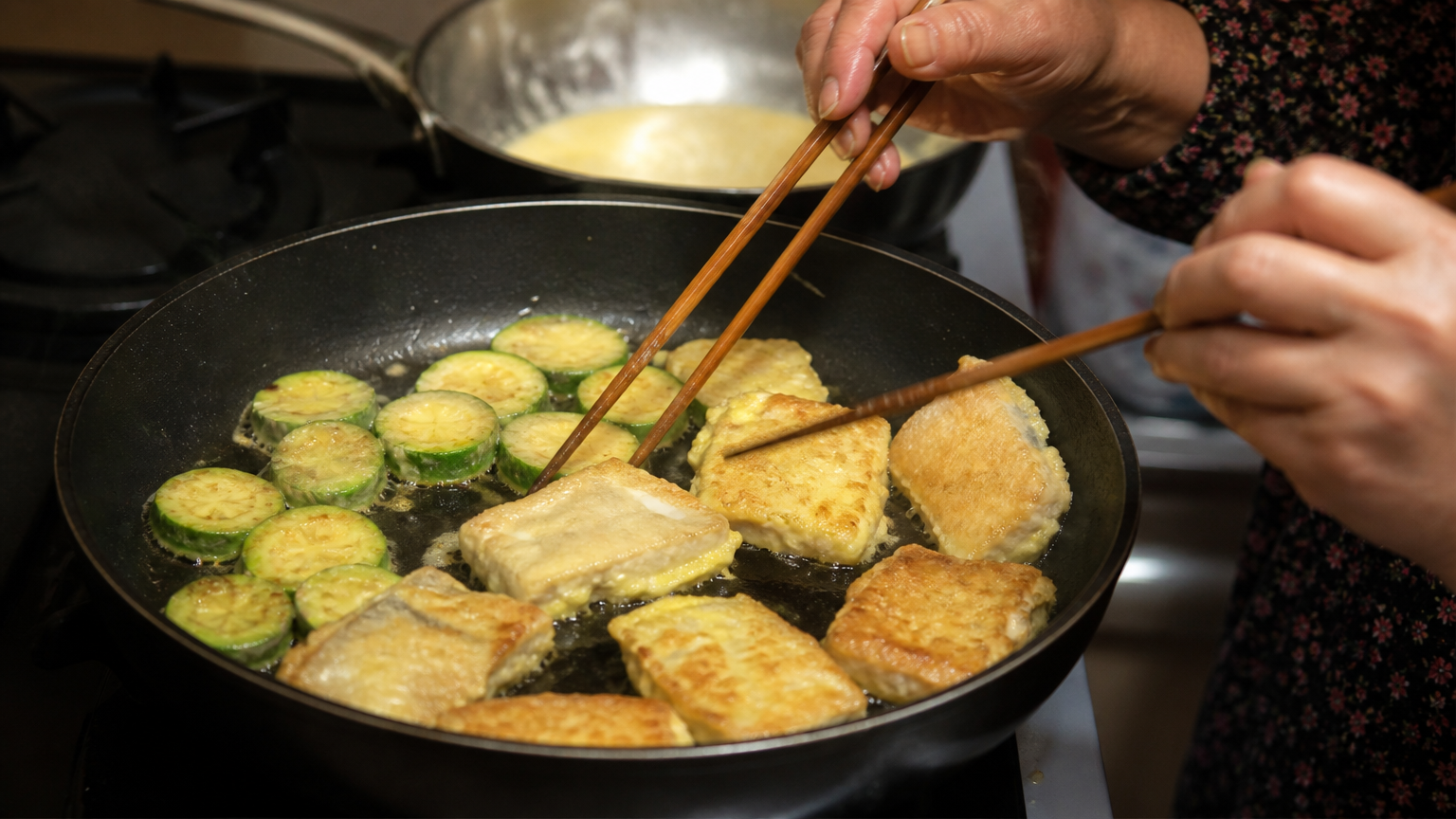
What goes on the ritual table is conservative and, honestly, fairly plain. Rice, soup, three kinds of seasoned vegetable, a few varieties of jeon — vegetables and fish dipped in egg batter and pan-fried — fruit, dried fish, and songpyeon. It is arranged by rule rather than by taste. Nothing on it is spicy. Nothing on it has garlic in the way a normal Korean dish does.
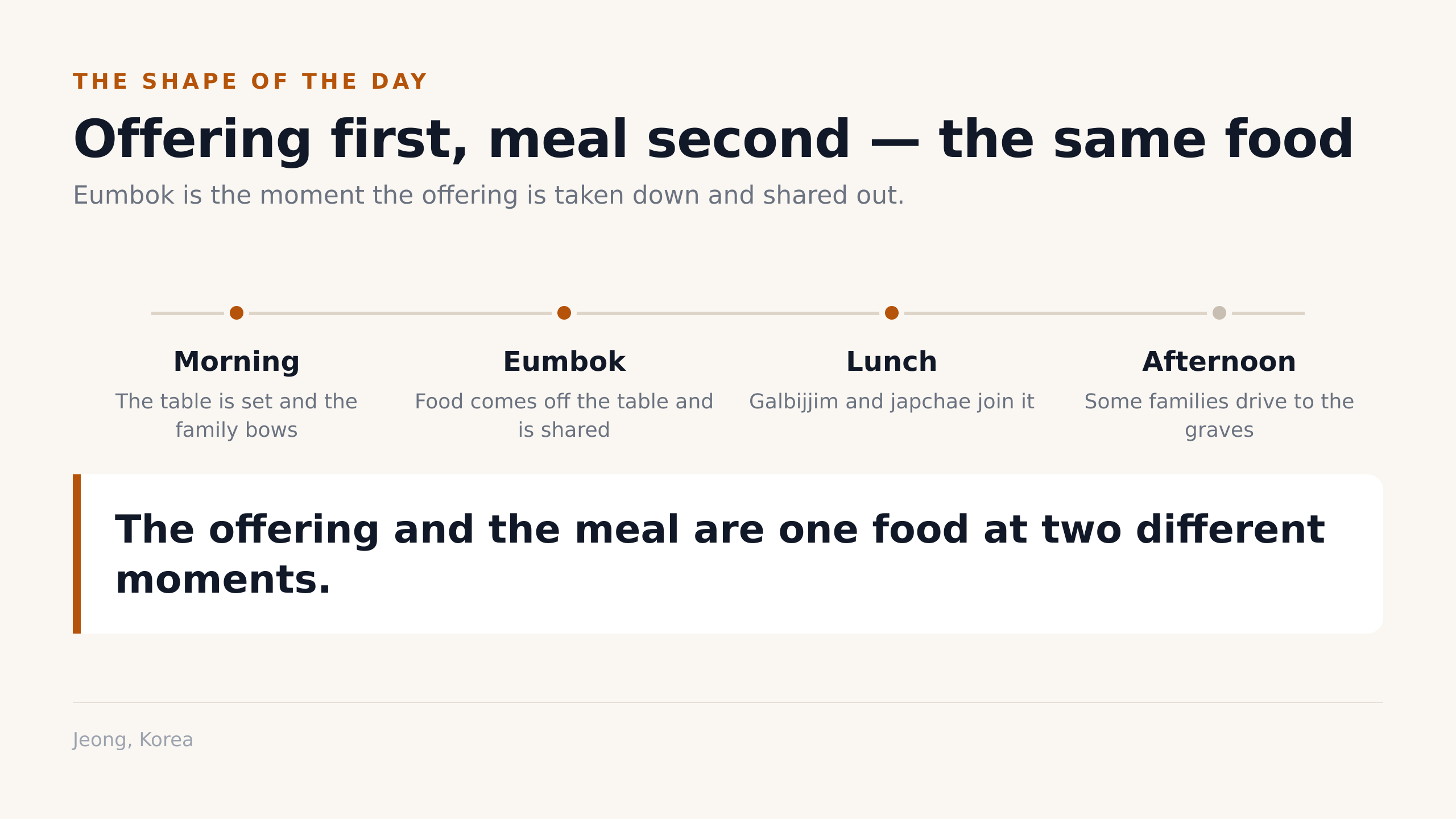
What the family actually fills up on afterwards is different. Galbijjim, braised short ribs, is the dish people look forward to. Japchae, sweet potato noodles with vegetables and beef, is on almost every table. Neither is a ritual dish in most households. They are there because it is a feast day and everyone came.
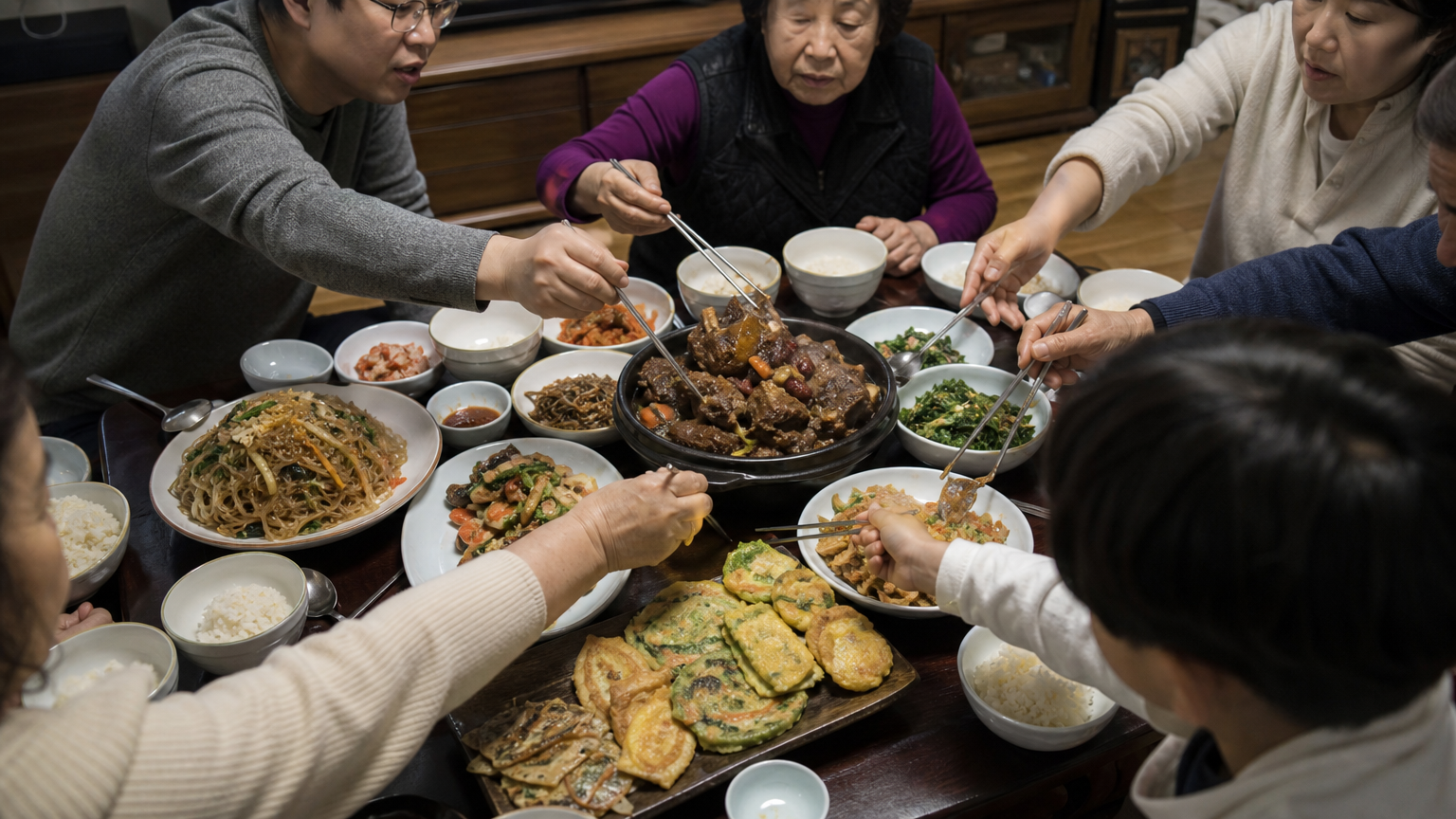
Then there is eumbok — the food is taken down off the table and shared out. That word is the whole logic of the day in one move: you offer it, then you eat it together. The offering and the meal are the same food at two different moments.
| Ritual table (charye) | What people eat | |
|---|---|---|
| Rice cakes | Songpyeon | Songpyeon |
| Fried | Jeon (vegetable, fish) | Jeon |
| Main | Steamed fish, dried fish | Galbijjim |
| Noodles | — | Japchae |
| Seasoning | No chilli, minimal garlic | Normal |
The practical upshot: the two dishes on both columns — songpyeon and jeon — are the two you can realistically buy. Galbijjim you can get in a restaurant any day of the year, holiday or not. Chuseok food, in the narrow sense, comes down to those two.
So where do I get them?
The four places I actually buy it
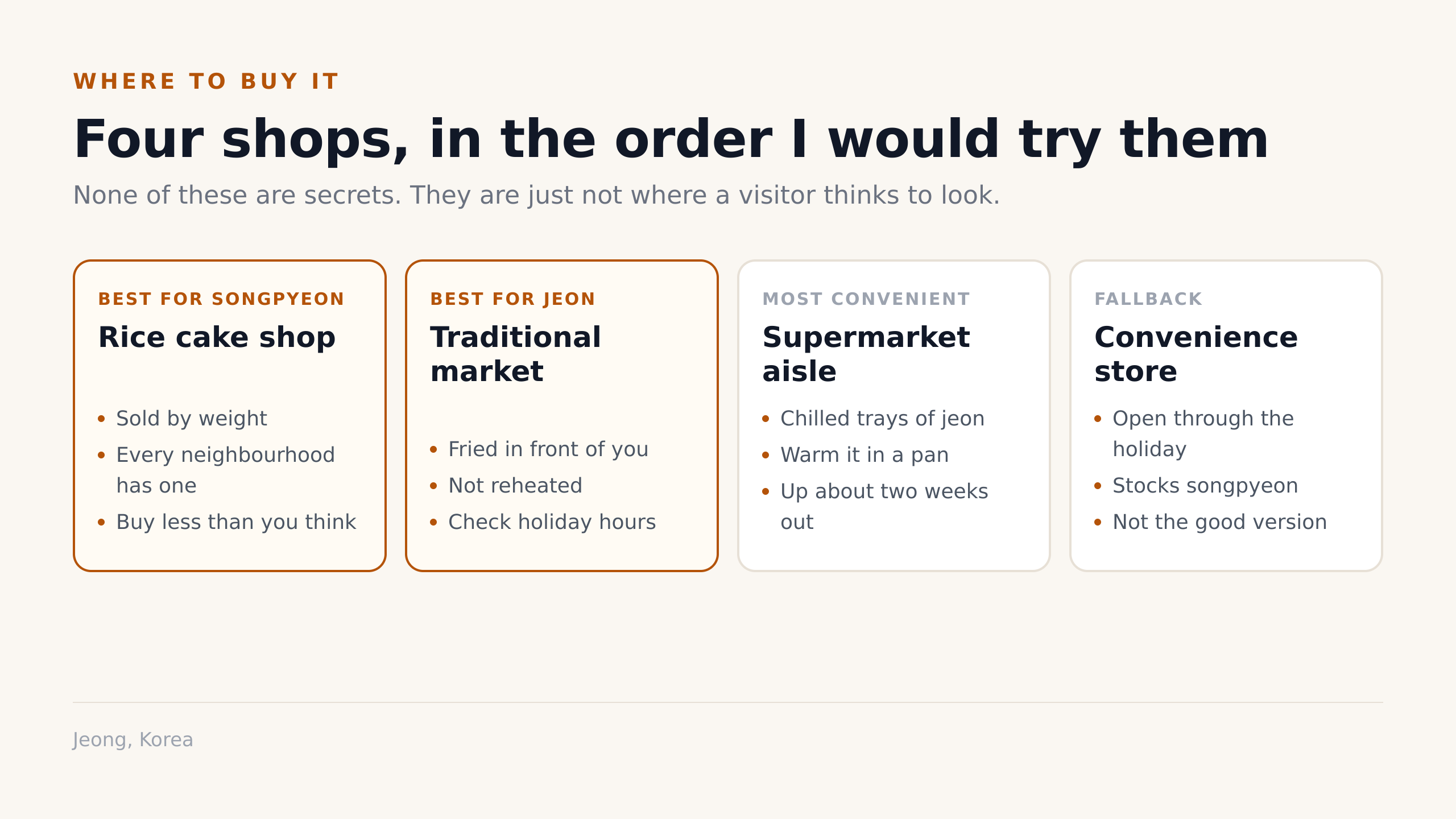
None of these are secrets. They are just not where a visitor thinks to look.
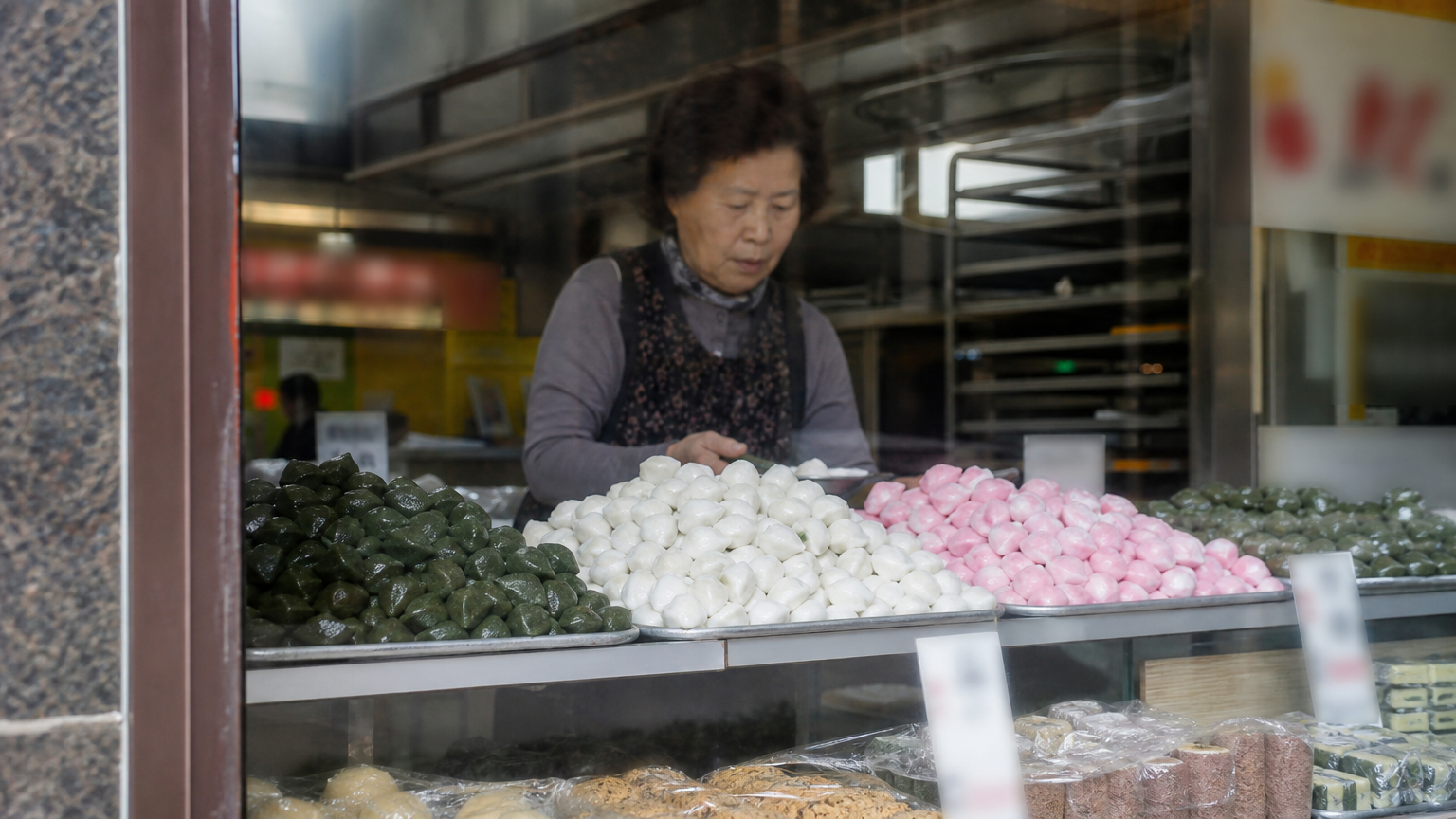
A rice cake shop — a tteokjip. This is the one people miss entirely. Every neighbourhood has one, they are usually the size of a garage, and in the ten days before the holiday the whole window is songpyeon. It is sold by weight. Point and hold up fingers; that transaction has never once required me to speak. Buy less than you think — it hardens by the next morning and it is not good cold.
The holiday aisle in a big supermarket. From about two weeks out, E-Mart and Lotte Mart clear a section near the entrance and fill it with the holiday range. Trays of assorted jeon sit in the chilled cabinet, ready to be warmed in a pan. This is what a lot of Korean families now do too, including mine, and nobody pretends otherwise.
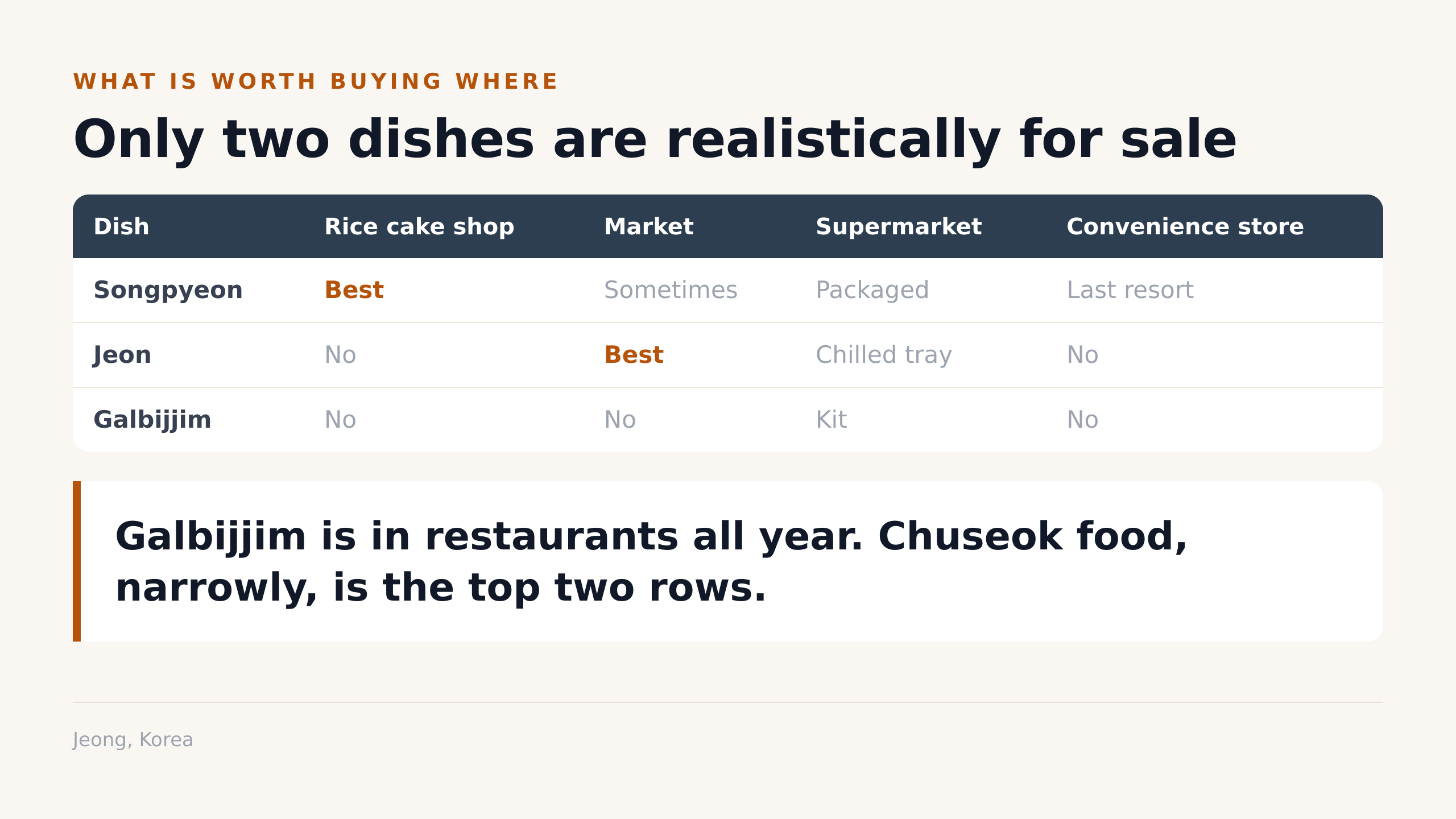
A traditional market, for jeon specifically. This is the best version of the food you can buy, because it is fried in front of you rather than reheated. Gwangjang Market, where the opening hours are three different answers is the obvious one in Seoul — check the hours before you go, because holiday week is exactly when they shift.
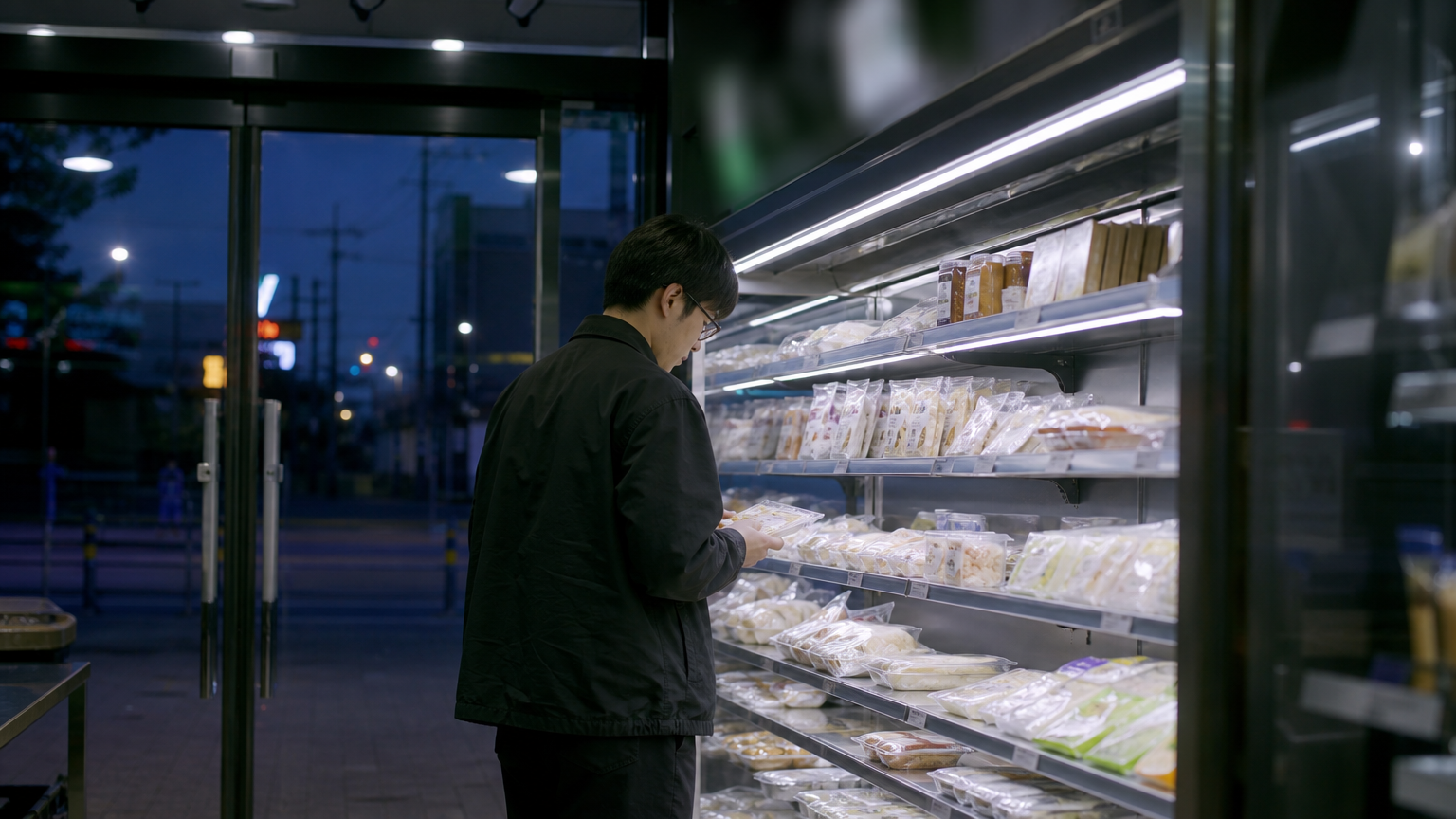
A convenience store, as the fallback. They stay open through the holiday when almost nothing else does, and they stock songpyeon for those few days. It is not the good version. It is available at eleven at night on the 25th when you have run out of options, which some years is the only criterion that matters. The rest of what is worth buying in one is in my guide to Korean convenience store food.
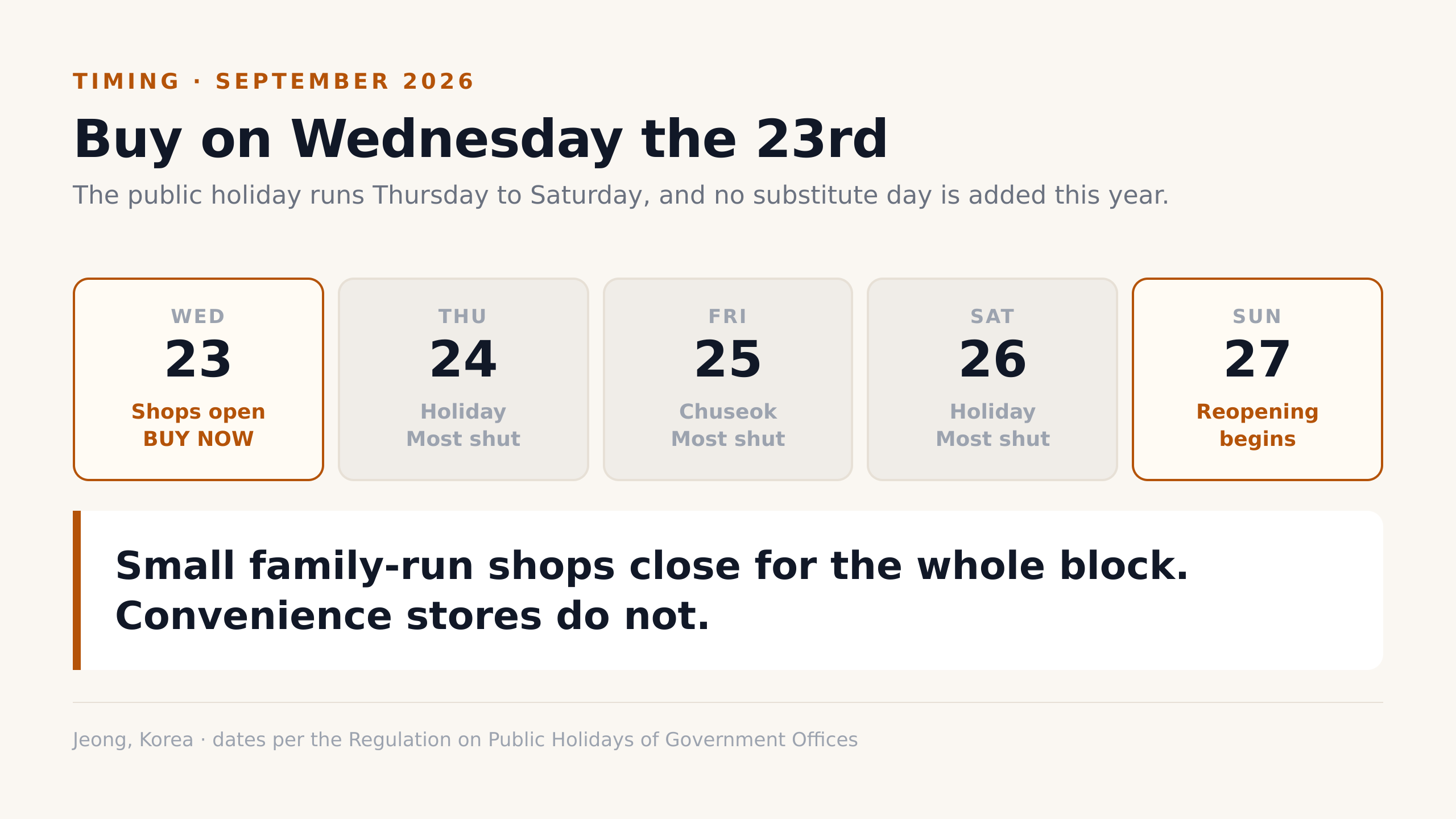
One more thing on timing, and this is the bit I promised to come back to. Because the holiday sits Thursday to Saturday this year, there is no substitute holiday added. Korean law grants one only when Chuseok collides with a Sunday — a Saturday does not count, even though for most other holidays it would. The practical effect for you: the shops start closing Wednesday evening and most reopen Sunday the 27th. Buy on Wednesday.
FAQ
Can I eat food from a charye table if I am invited?
Yes, and you are meant to. That is eumbok — the sharing of the food after the rite. Wait until someone hands it to you rather than taking from the table directly, and you will be fine.
Where can I buy songpyeon in Seoul?
A neighbourhood rice cake shop is the best option and there is one near wherever you are staying. Large supermarkets stock it for the two weeks before the holiday, and convenience stores carry it during the holiday itself.
Are restaurants open during Chuseok?
Chain restaurants, hotel dining and most places in tourist districts stay open. Small independent restaurants, which is most of them, close for two or three days because the owner has gone to their family. Assume anything family-run is shut on the 25th.
Is Chuseok food spicy?
The ritual dishes are deliberately not. No chilli, very little garlic. If you have been avoiding Korean food because you assumed all of it burns, this is the week that proves otherwise.
Chuseok food is the one thing in Korean cooking that money mostly cannot buy, because it was never built to be sold. That is not a problem to solve — it is the point of it. But the two dishes at the centre of it are sitting in a shop window about four minutes from your accommodation, and they will be gone by Sunday.
Go on Wednesday. Buy the songpyeon by weight, buy the jeon fried rather than chilled, and eat both the same day.