Bukchon Hanok Village: No Entrance Fee, and a 100,000 Won Fine

Entry is free. Getting the hour wrong costs 100,000 won.
Most Seoul itineraries put Bukchon Hanok Village in the same bracket as a palace or a tower. Look up the ticket price, add it to the budget, turn up when it suits you. Two of those three steps do not apply here, and the third one is where people get caught.
There is no ticket because there is no gate. What there is instead is a set of hours, written into a local designation, with a penalty attached to breaking them.
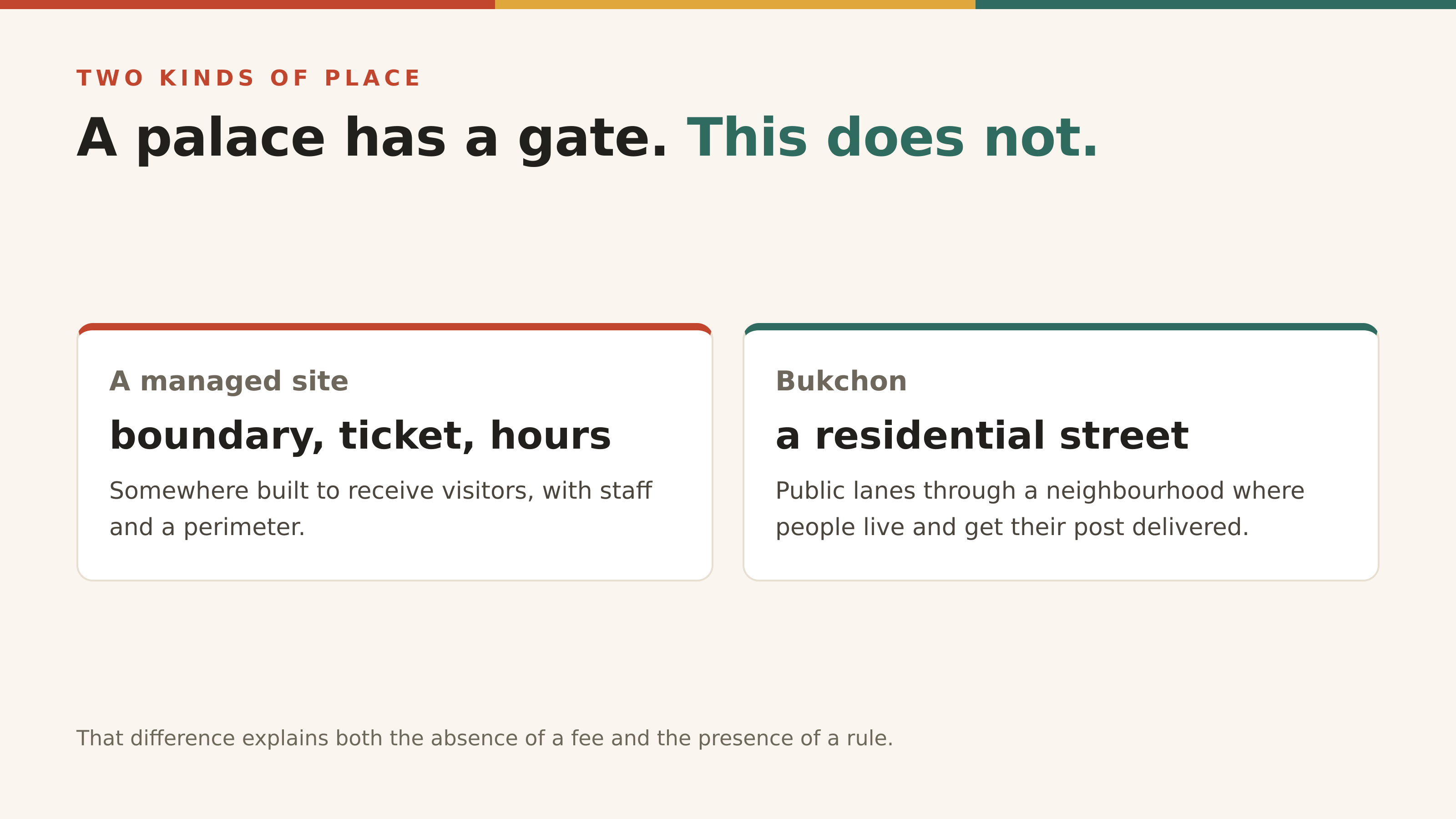
There is no entrance fee because it is not an attraction
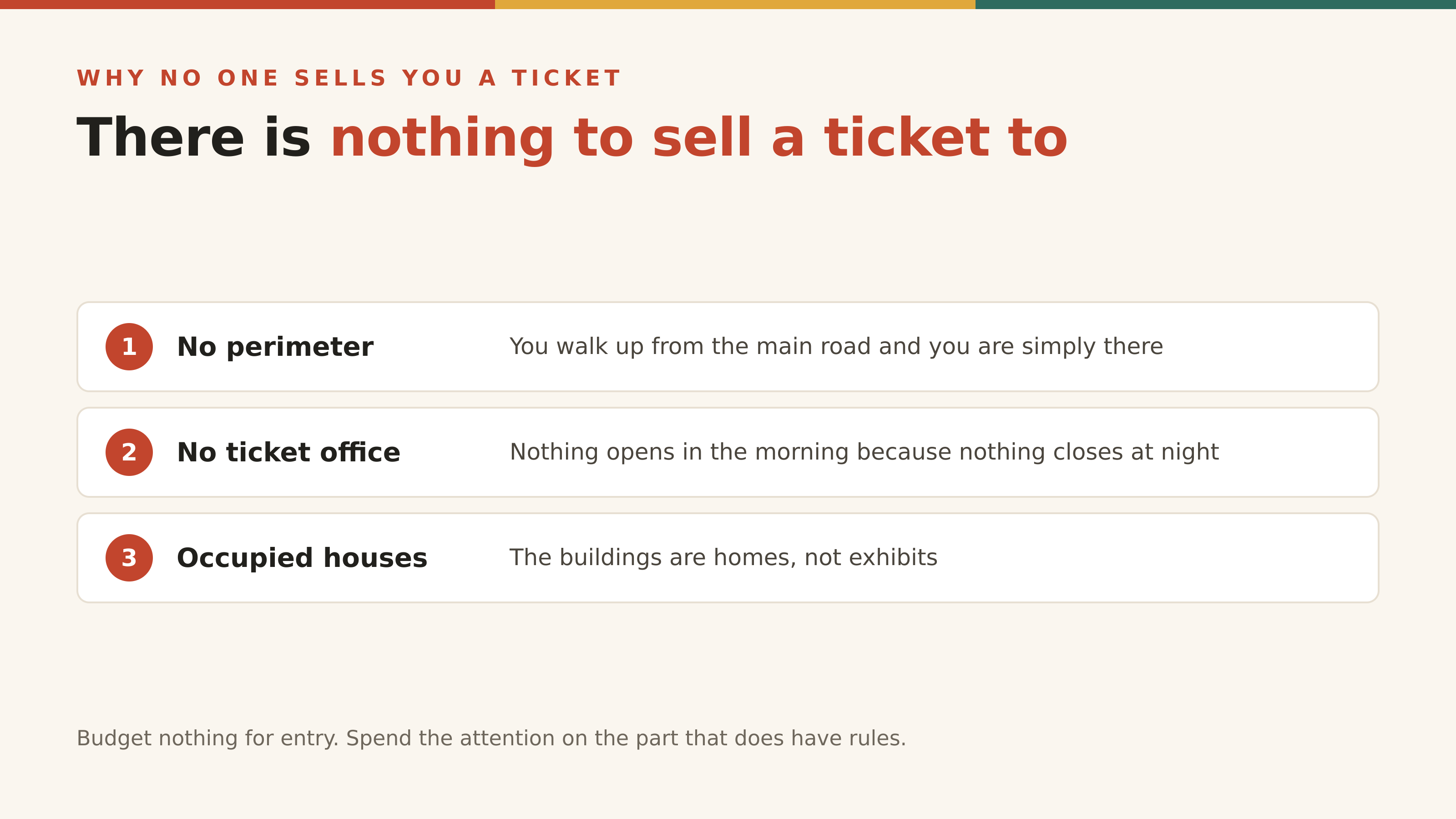
Nobody sells you a ticket to Bukchon Hanok Village because there is nothing to sell a ticket to.
The reason is simple and it changes how the whole visit should feel. These are not exhibition buildings. They are houses, on a hillside street, with people living inside them. The lanes are public roads through a residential neighbourhood that happens to be photogenic.
You can see it in how the place behaves. There is no perimeter, no ticket office, no opening ceremony in the morning, and no staff checking anything as you walk up from the main road. A palace has all of those because a palace is a managed site with a boundary. Bukchon has none of them because it is somewhere people get their post delivered.
So the entrance fee question has a short answer, and it is the easy half of the trip. Budget nothing. Then spend the attention you saved on the part that actually has rules.
If you want the contrast in one afternoon, the palace ten minutes away does work the way visitors expect, and Gyeongbokgung Palace tickets lays out what you pay and which day it closes.
If nobody is collecting money, what is there to get wrong?
The hours are real, and there is a fine behind them
Free to enter is not the same as open whenever you like.
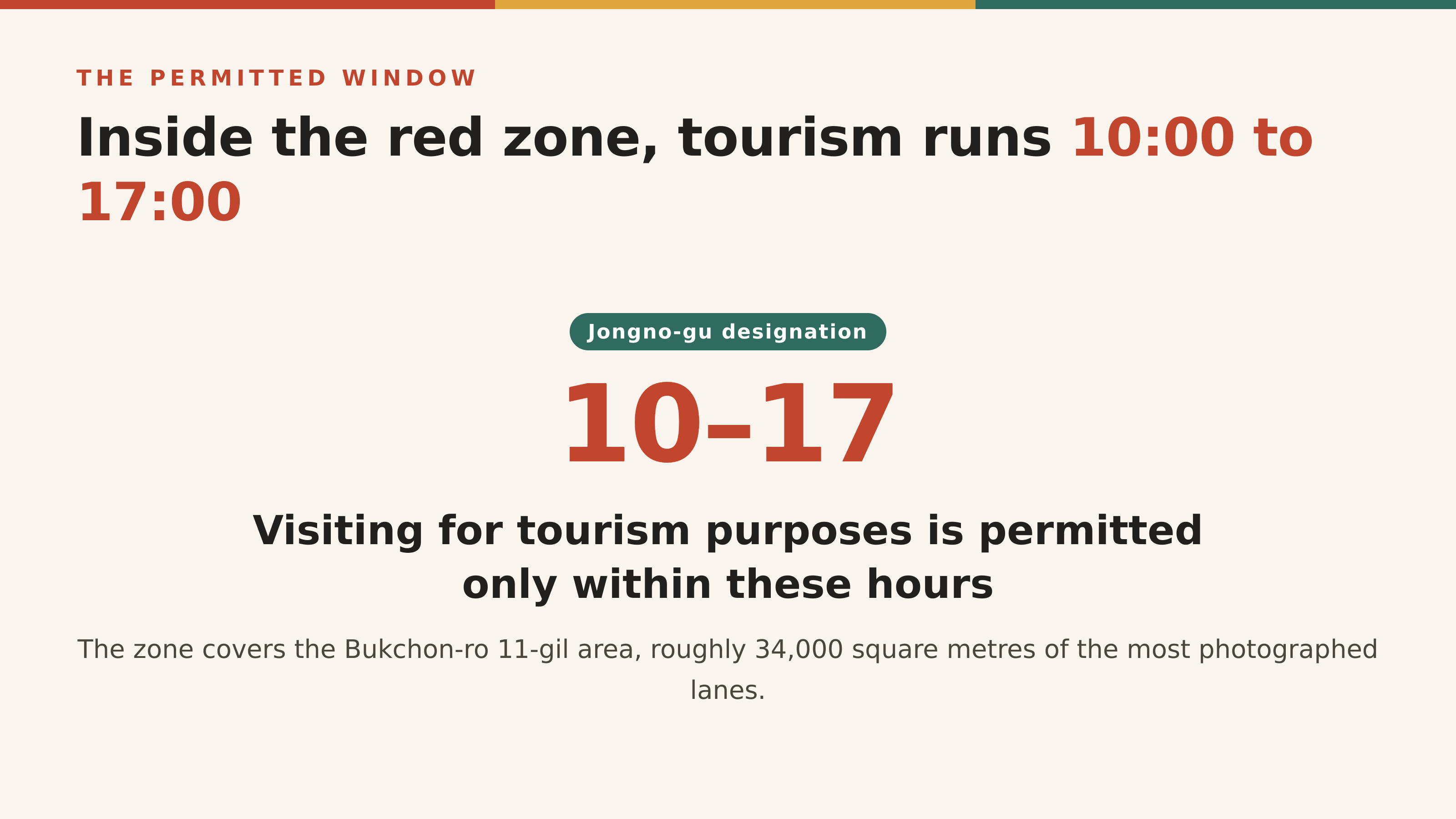
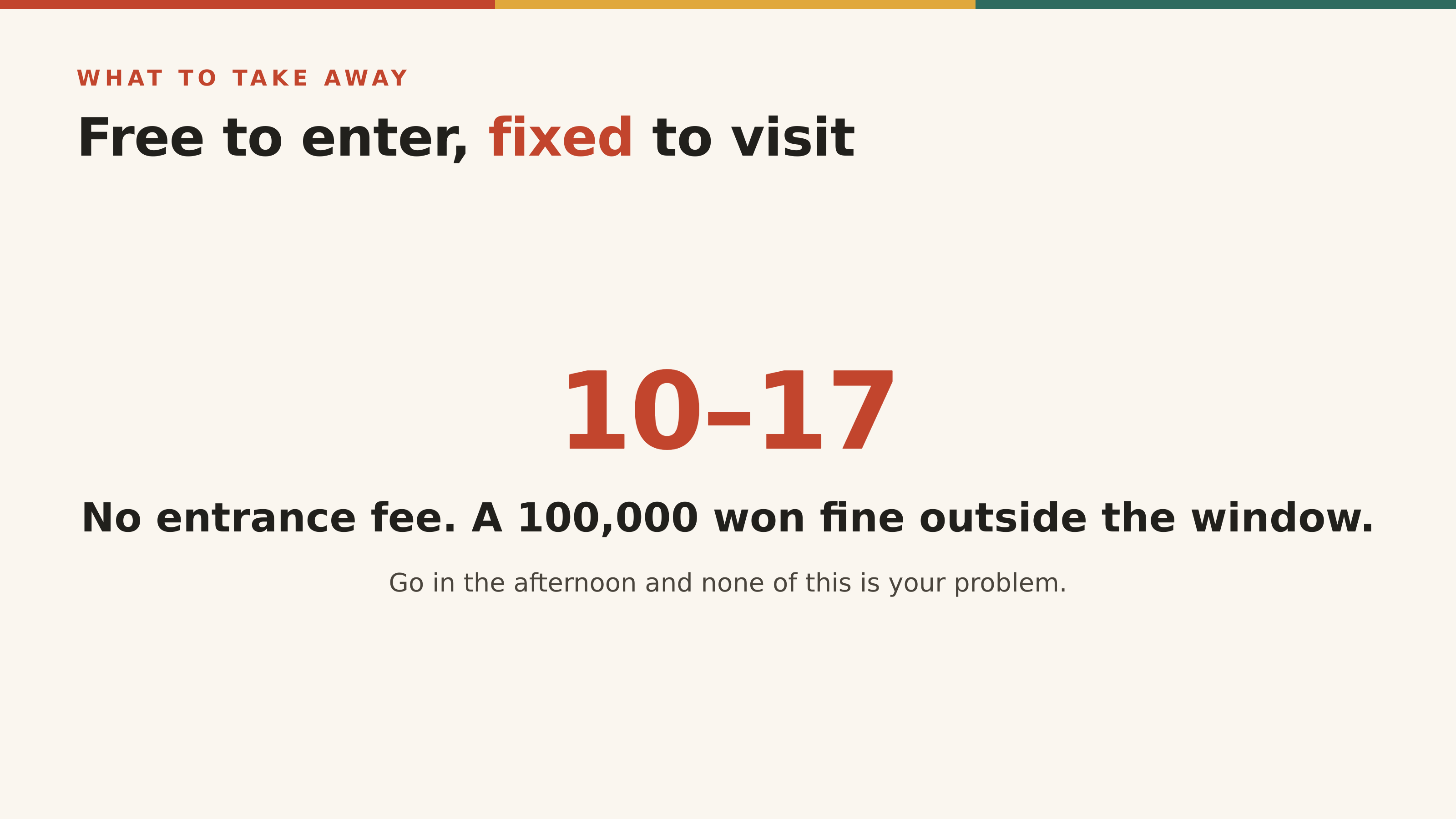
Because residents were carrying the cost of the crowds, Jongno-gu designated Bukchon a special management area and marked out a red zone covering the Bukchon-ro 11-gil area, roughly 34,000 square metres of the most photographed lanes. Inside that zone, visiting for tourism purposes is permitted from 10:00 to 17:00. Outside those hours, entering the zone for tourism can draw a fine of 100,000 won.
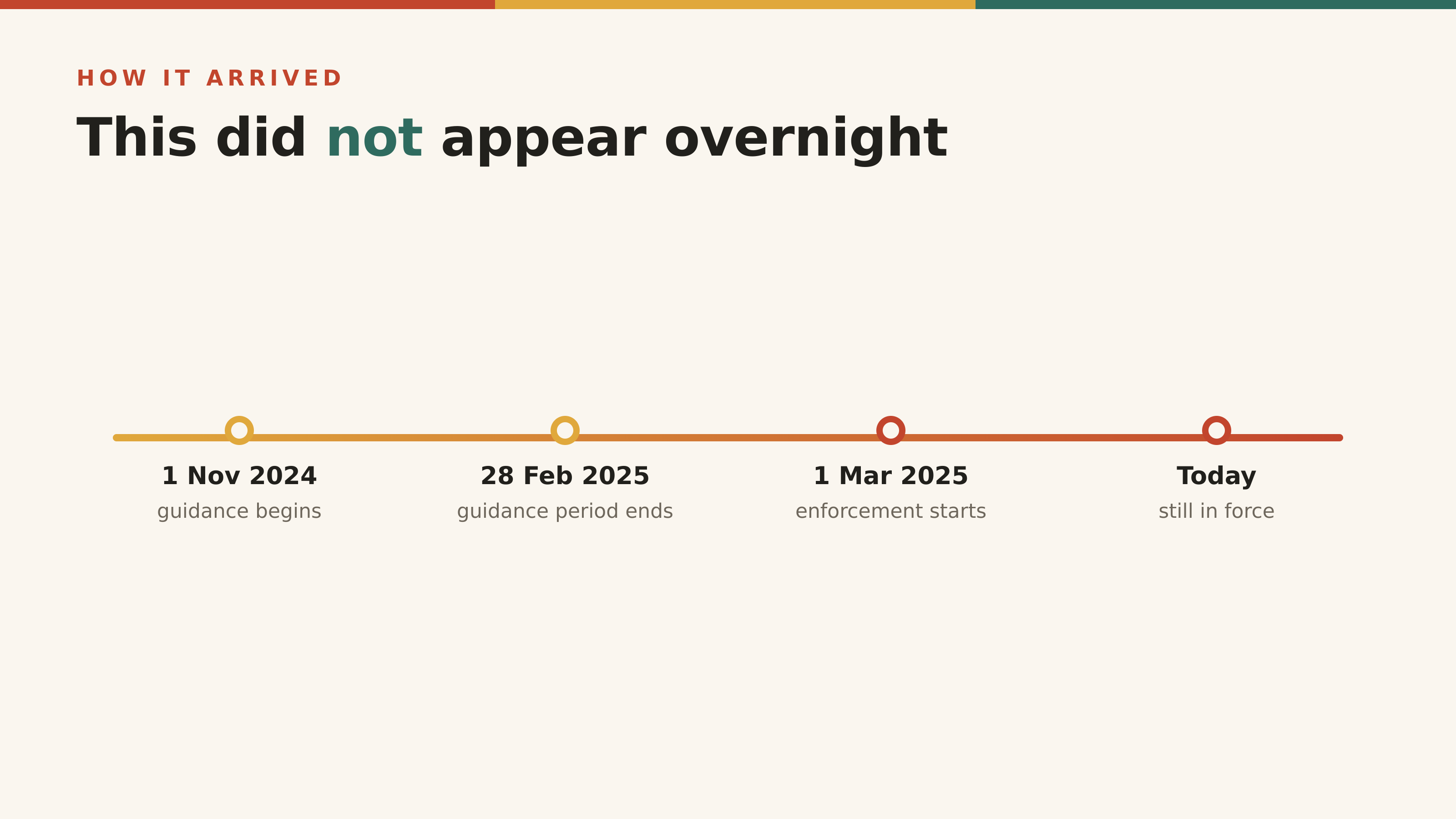
This did not arrive without warning. The restriction ran as guidance from 1 November 2024, and enforcement began on 1 March 2025. It remains in force.
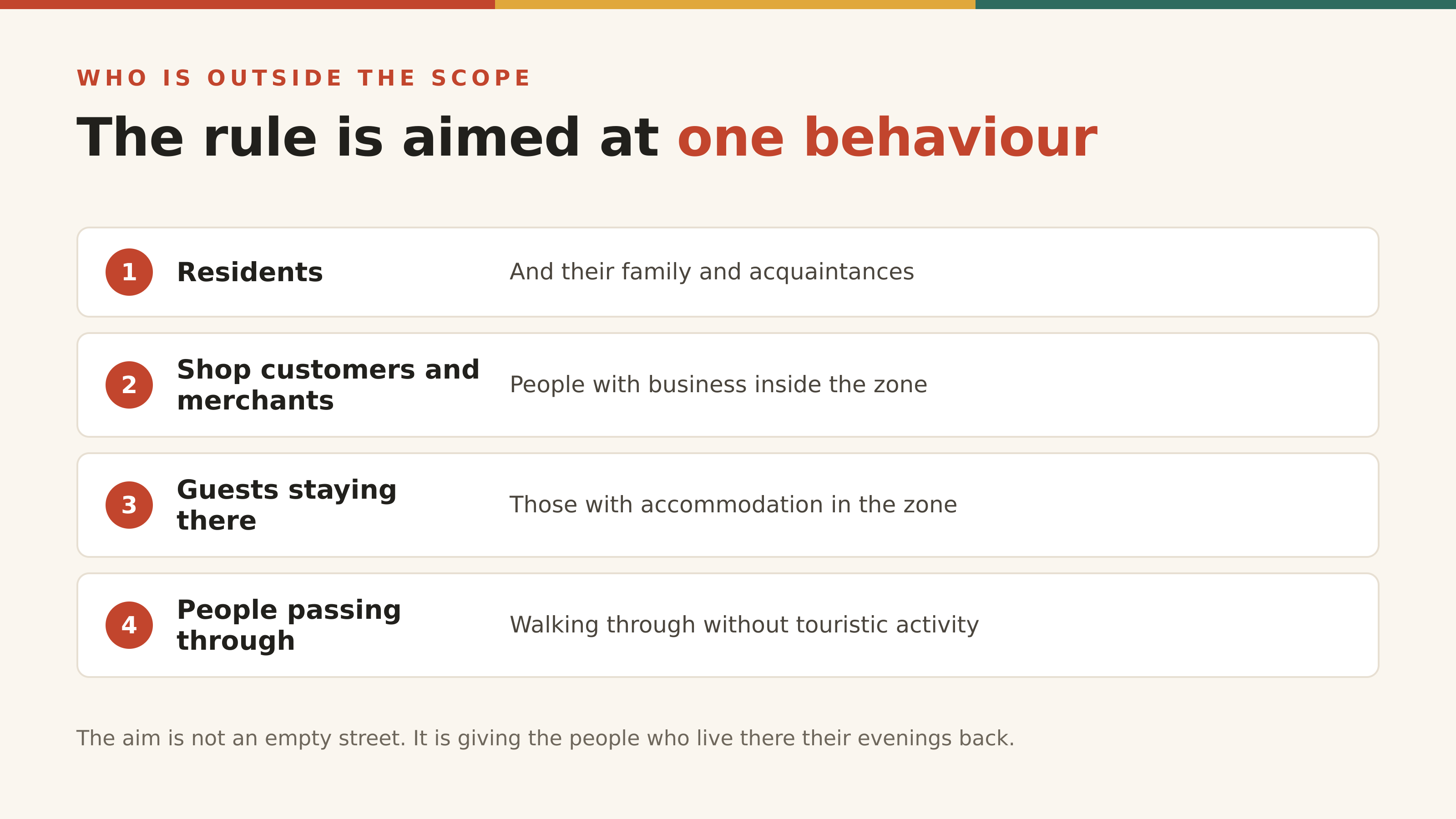
The exemptions tell you what the rule is actually aimed at. Residents of the zone, their family and acquaintances, customers of shops inside it, merchants, guests staying there, and people simply walking through without doing anything touristic are not the target. The rule is not trying to empty the street. It is trying to give the people who live there their evenings back.
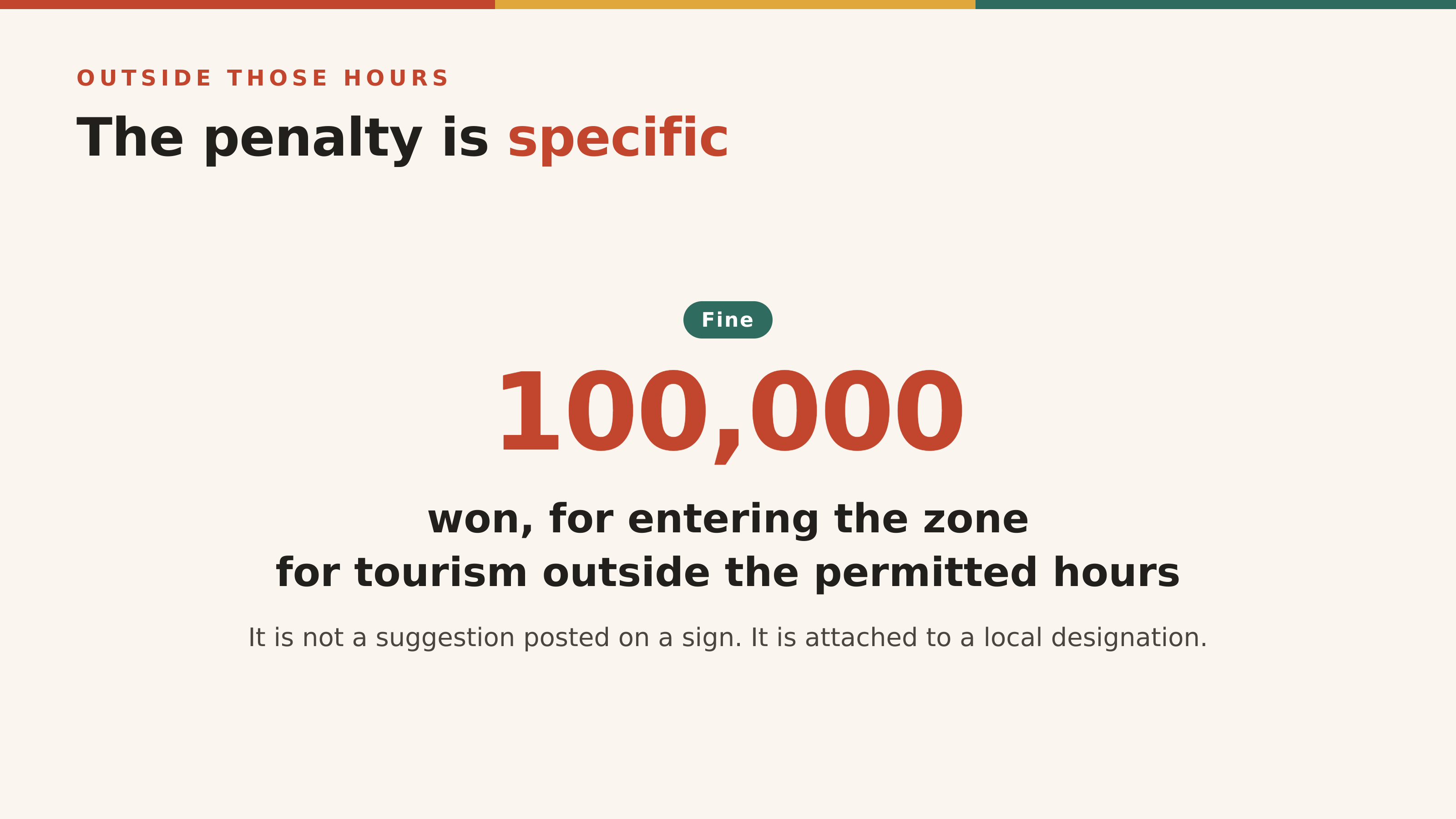
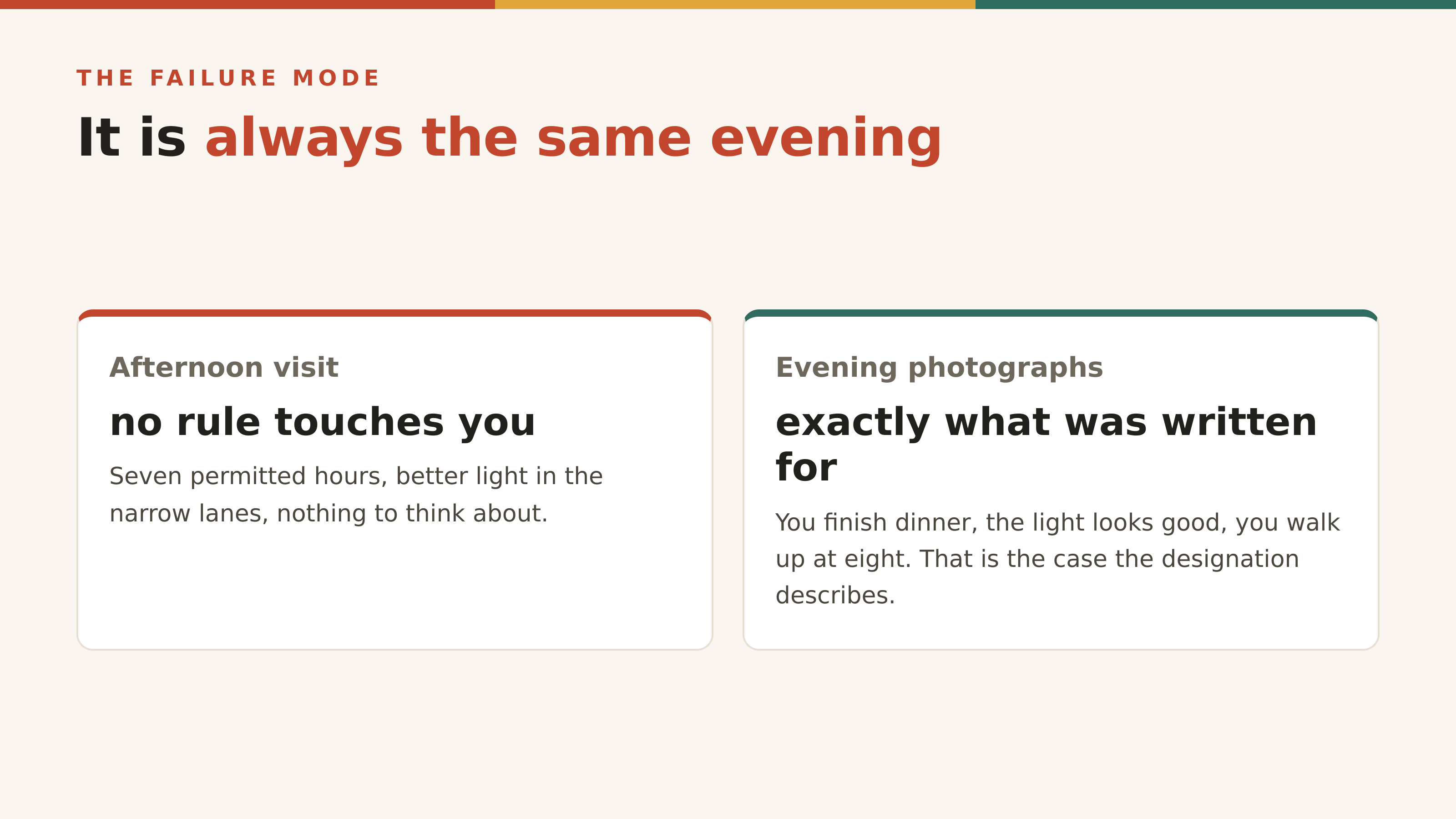
Which means the failure mode is specific and easy to fall into. You finish dinner, the light looks good, you walk up for photographs at eight in the evening. That is exactly the behaviour, in exactly the window, that the designation was written for.
So how do you fit it into a day without thinking about any of this?
Put it in the middle of the day and the rule never touches you
The whole problem disappears if Bukchon Hanok Village sits in your afternoon rather than your evening.
That works because the permitted window is a generous one for the kind of visit most people want. Seven hours is far more than the neighbourhood takes to walk, and the light in the middle of the day is better for the narrow lanes anyway, where a low evening sun mostly gives you silhouettes and shadow.
Three things to settle before you go.
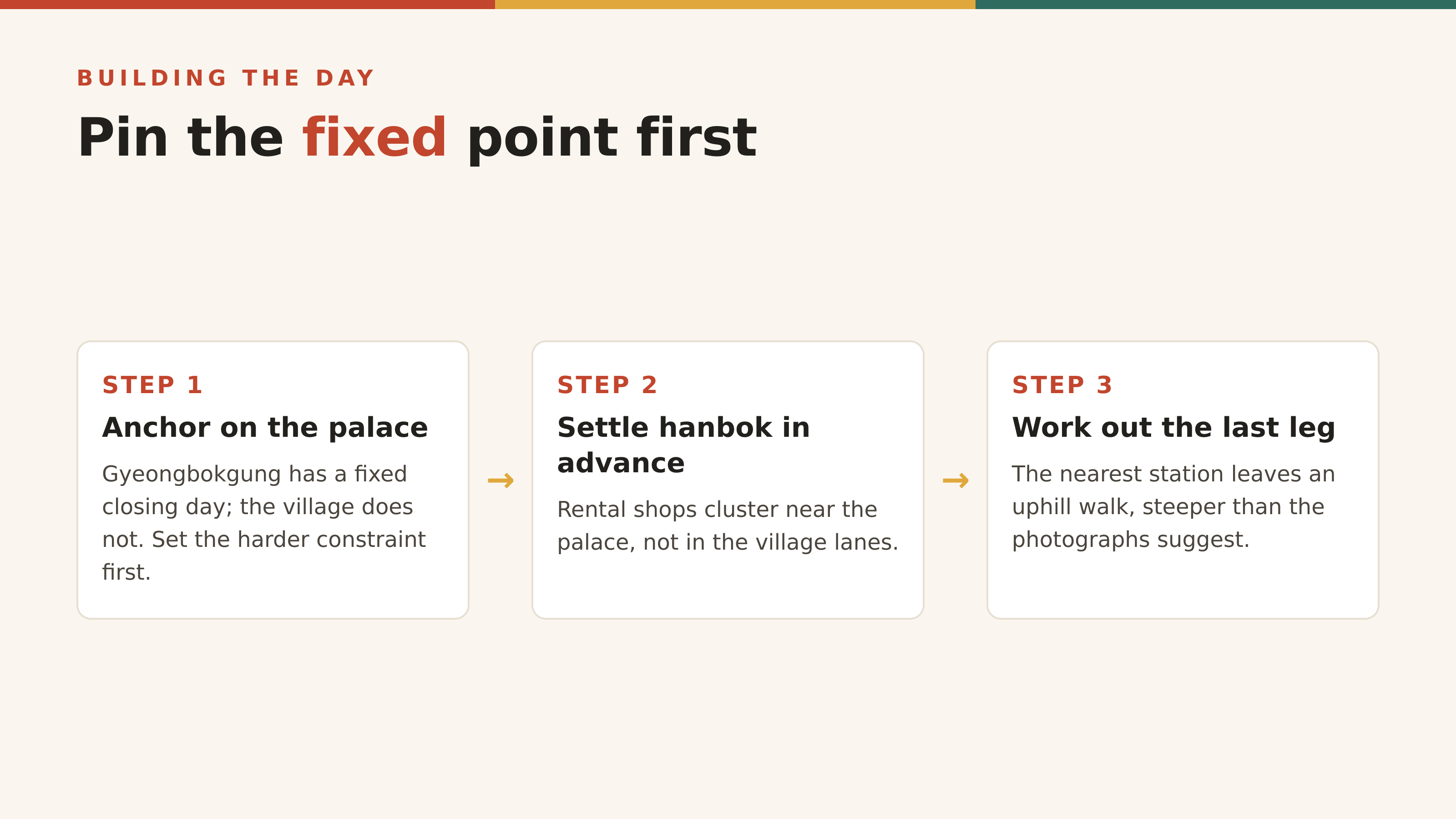
First, anchor the day on the palace, not the village. Gyeongbokgung and Bukchon are a short walk apart, and the palace has a fixed closing day while the village does not. Pin the harder constraint first and let the flexible one fit around it.
Second, decide about hanbok before you arrive, not on the street. Rental shops cluster around the palace rather than in the village lanes, and the rental has its own logic including what it does to palace admission. Hanbok rental in Seoul covers prices and the free-entry rule.
Third, work out the last leg before you set off. The nearest station leaves you with an uphill walk, and the lanes are steeper than photographs suggest. If you are still getting used to the network, Seoul subway map and transfer rules explains how the transfers and exits are numbered.
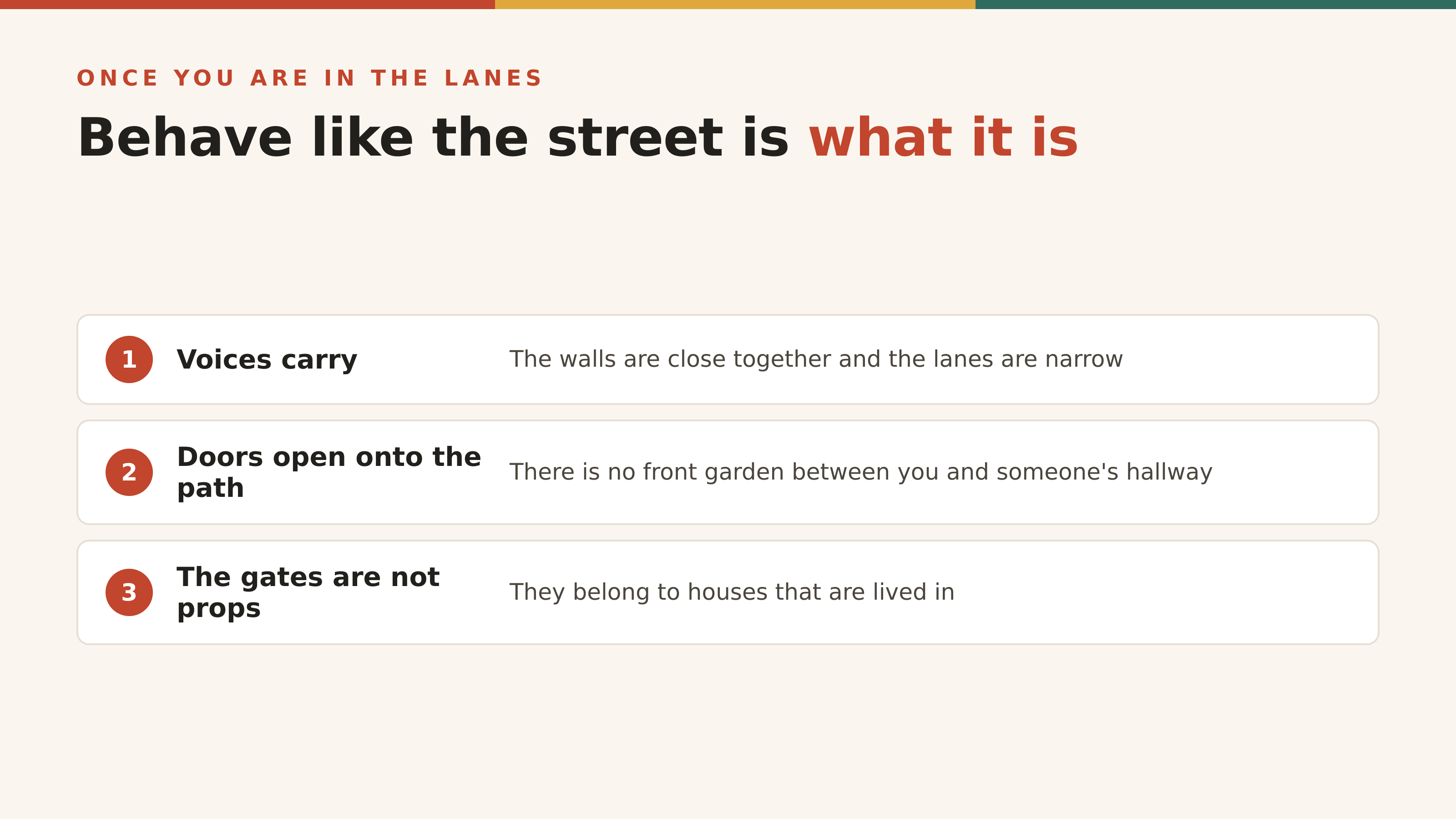
And when you are in the lanes, behave like the street is what it is. Voices carry between the walls, the front doors open directly onto the path, and the gates are not props.
What to take away
Bukchon Hanok Village has no entrance fee, and that is the least interesting fact about visiting it. The one that matters is the window: 10:00 to 17:00 inside the red zone, with a 100,000 won fine for tourism outside it, enforced since March 2025 and still standing.
Go in the afternoon and none of this is your problem. Turn up for evening photographs and you have walked into the one rule the neighbourhood decided to write down.
If you are planning the day around a palace, a hanbok fitting and a hillside walk, the order you do them in decides whether any of it feels rushed. Set the fixed points first.
FAQ
Is there an entrance fee for Bukchon Hanok Village?
No. It is a residential neighbourhood rather than a managed attraction, so there is no gate and no ticket. The costs on the day come from anything you do around it, such as a palace ticket or a hanbok rental, not from the village itself.
What hours am I allowed to visit?
Inside the designated red zone covering the Bukchon-ro 11-gil area, visiting for tourism purposes is permitted from 10:00 to 17:00. The restriction applies to that zone specifically rather than to every street in the wider district.
What actually happens if I go in the evening?
Entering the zone for tourism outside the permitted hours can draw a fine of 100,000 won. Enforcement began on 1 March 2025 after a guidance period from November 2024. Residents, their visitors, shop customers, merchants, guests staying in the zone and people passing through without touristic activity are outside the scope.
Can I take photographs there?
Within the permitted hours, yes, and that is most of what people come to do. Keep in mind that the doorways open straight onto the lane and that these are occupied homes, so the courtesy you would want on your own street applies.
References
- Bukchon special management area guidance, Jongno-gu Office