Gyeongbokgung Palace Tickets: 3,000 Won Is the Easy Part — the Tuesday and the Hanbok Are Not

Seoul's palaces close on Monday. Gyeongbokgung closes on Tuesday.
I have watched this happen from the other side of the road. A group walks up Sejong-daero on a Tuesday morning with the whole day planned around one building, and the gate is shut. Nobody misread a sign. They applied the rule that works in almost every city they have ever visited — museums rest on Monday — and Seoul quietly runs a different rule for this one place.
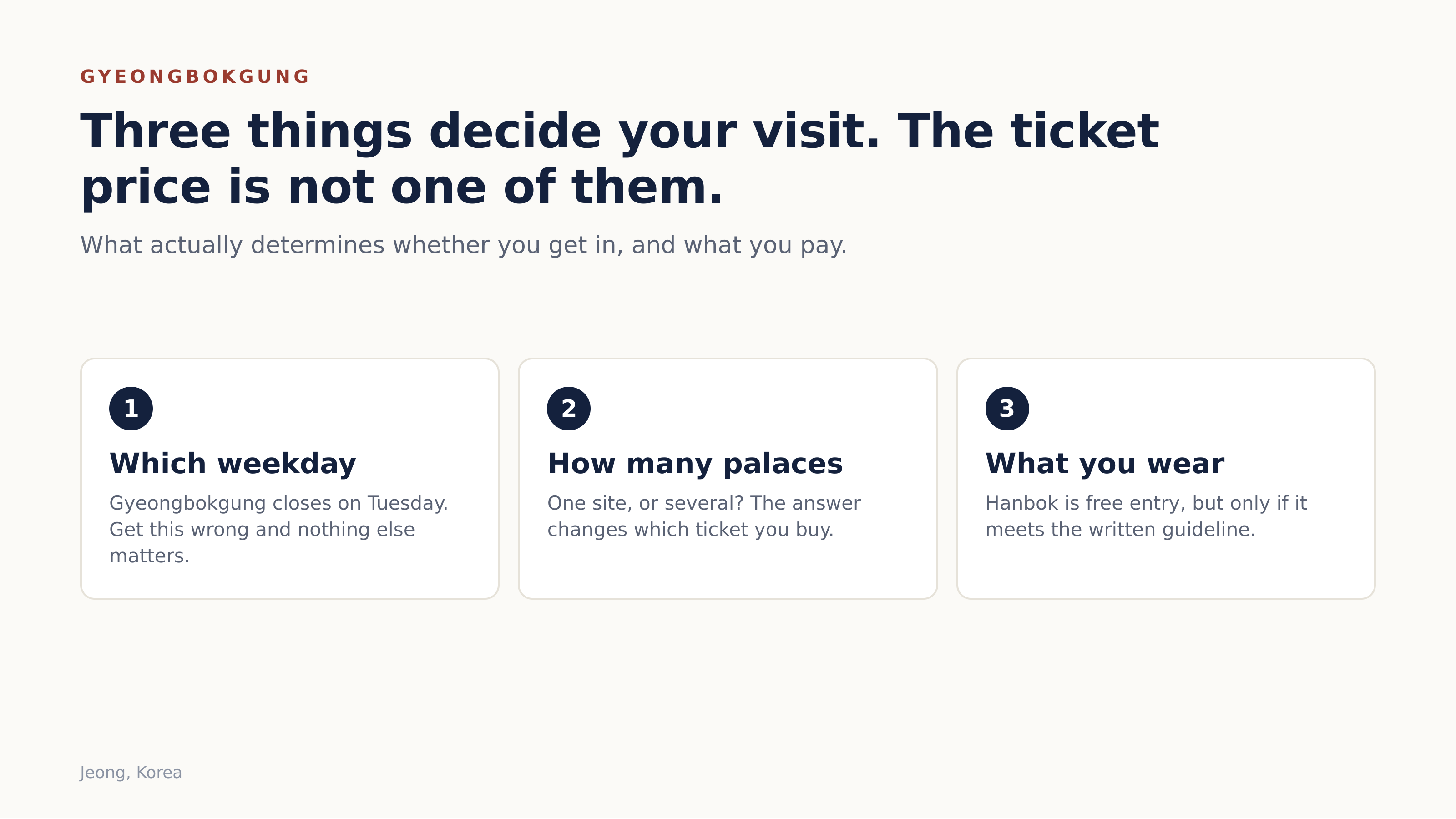
So this is not really an article about what Gyeongbokgung Palace tickets cost. The money is the least interesting part of the day. What decides whether you get in is which weekday you arrive on and, if you are hoping to walk in free, what you are wearing when you do.
The ticket is 3,000 won, and it has been for twenty years
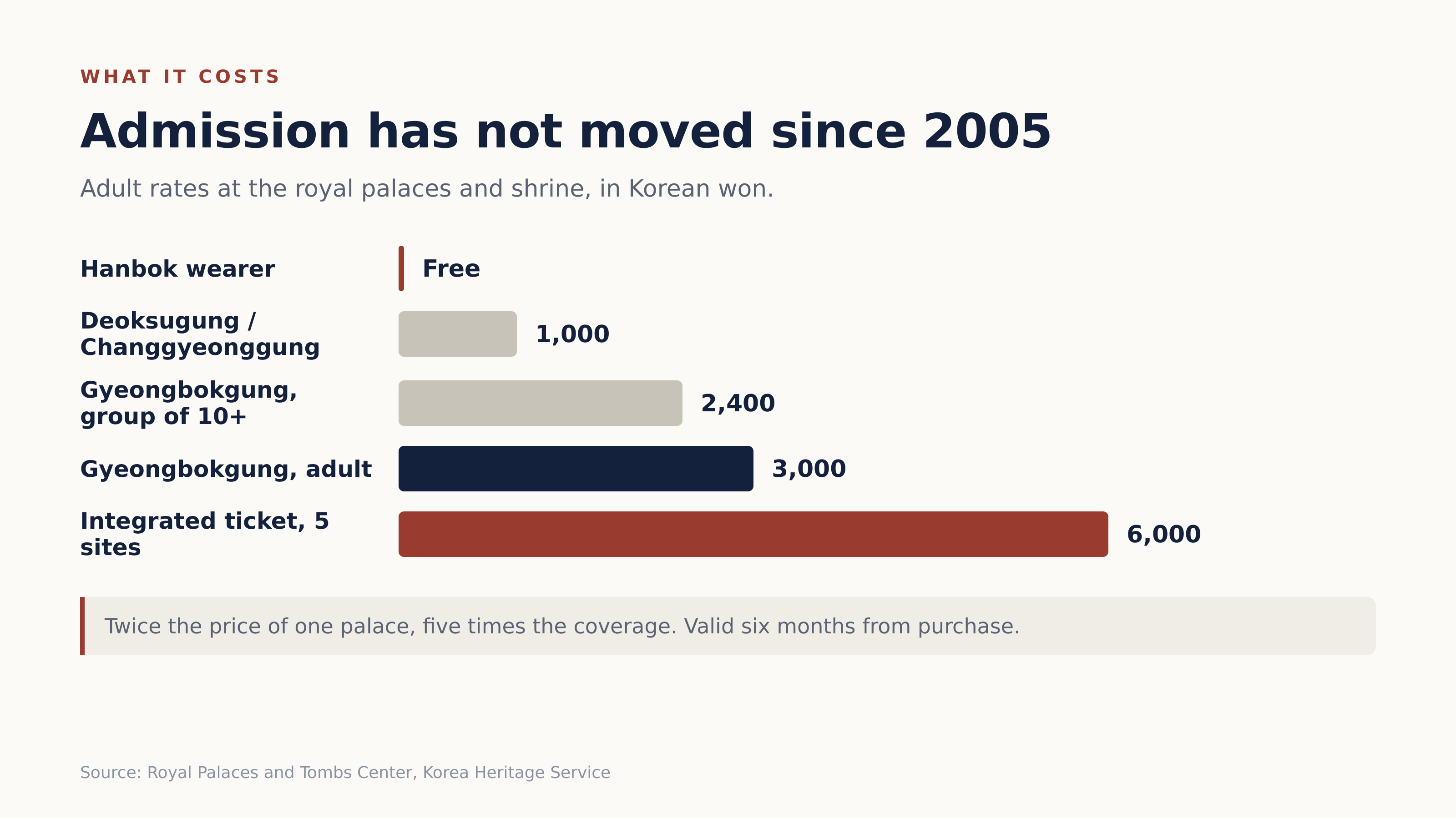
Gyeongbokgung Palace tickets cost 3,000 won for an adult. A group of ten or more pays 2,400 won each. That is the whole fee structure — there is no timed-entry tier, no premium line, no surcharge for the busy season.
The reason it is so cheap is that palace admission here is not priced by demand. It is set by the state agency that manages the royal palaces and tombs, and that agency has left the number alone since 2005. Twenty years of inflation have gone past a price that did not move. The other sites are cheaper still: Changgyeonggung, Deoksugung and Jongmyo are 1,000 won each.
One thing worth knowing if you are reading this late in the year. The agency has said it will announce a new admission standard in November 2026, with a view to applying it from 1 January 2027. That is under review rather than settled, so treat the 3,000 won as correct for now and worth re-checking if your trip falls in 2027.
The practical takeaway is that the fee is not the variable to optimise. You will spend more on the coffee afterwards. If you are working out how to reach the gate in the first place, our guide to reading the Seoul subway map and the transfer rules will do more for your morning than any ticket strategy.
So if the money is not the problem, what is?
The closing day is the thing that ruins itineraries
The weekday matters more than anything else in this article, because being wrong about it costs you the entire visit rather than a few thousand won.
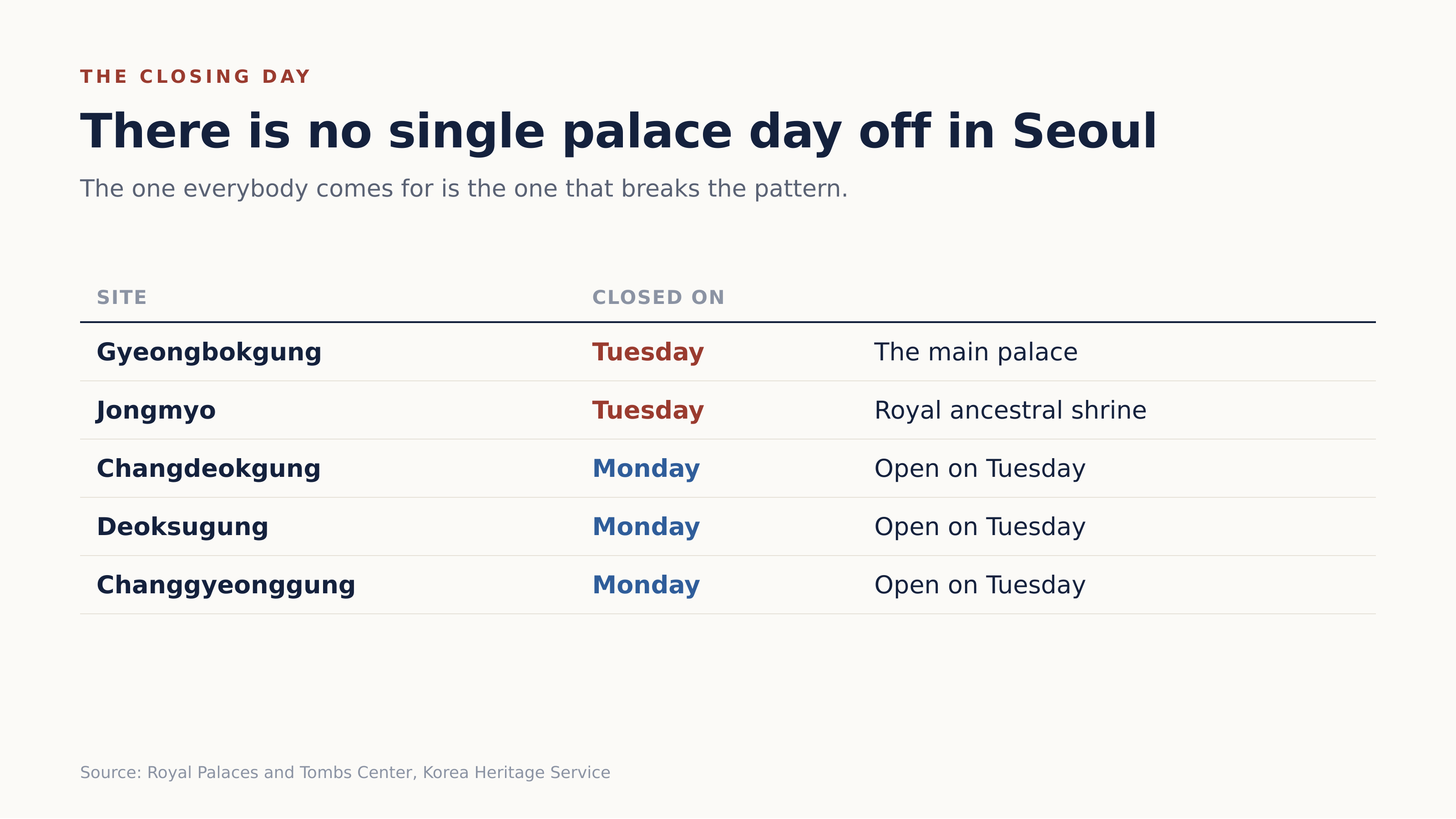
Gyeongbokgung closes on Tuesday. Changdeokgung, Deoksugung and Changgyeonggung close on Monday. Jongmyo, the royal ancestral shrine, closes on Tuesday like Gyeongbokgung. There is no single palace day off in Seoul, which is exactly why the assumption fails — people learn one closing day, apply it to all five sites, and lose a morning.
| Site | Closed on |
|---|---|
| Gyeongbokgung | Tuesday |
| Jongmyo | Tuesday |
| Changdeokgung | Monday |
| Deoksugung | Monday |
| Changgyeonggung | Monday |
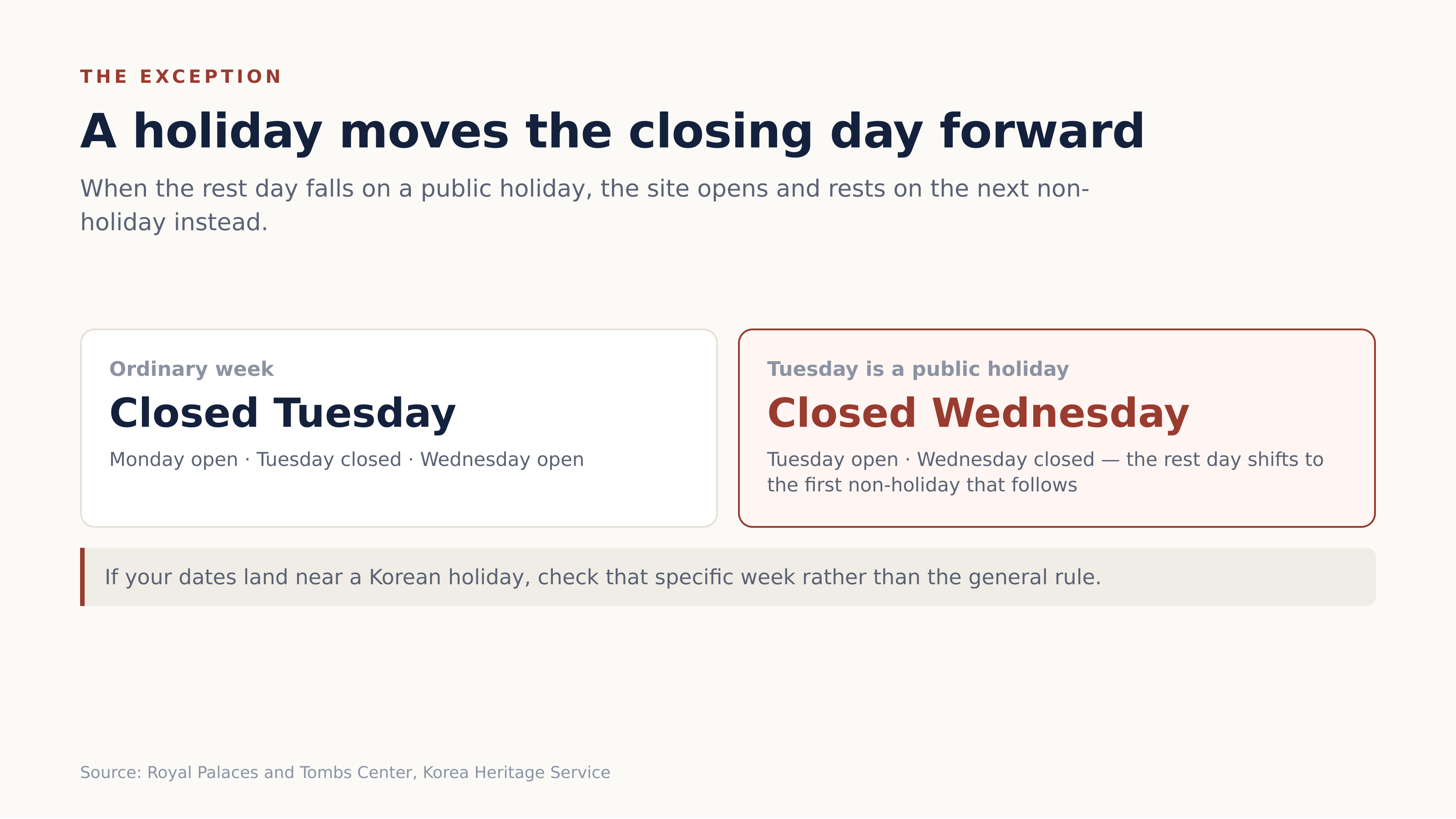
There is a second layer that catches people who did check. When a closing day falls on a public holiday, the site opens anyway — and then takes its day off on the first non-holiday that follows. So a Tuesday holiday means Gyeongbokgung is open on Tuesday and shut on Wednesday instead. If your dates land near a Korean holiday, look up that specific week rather than trusting the general rule.
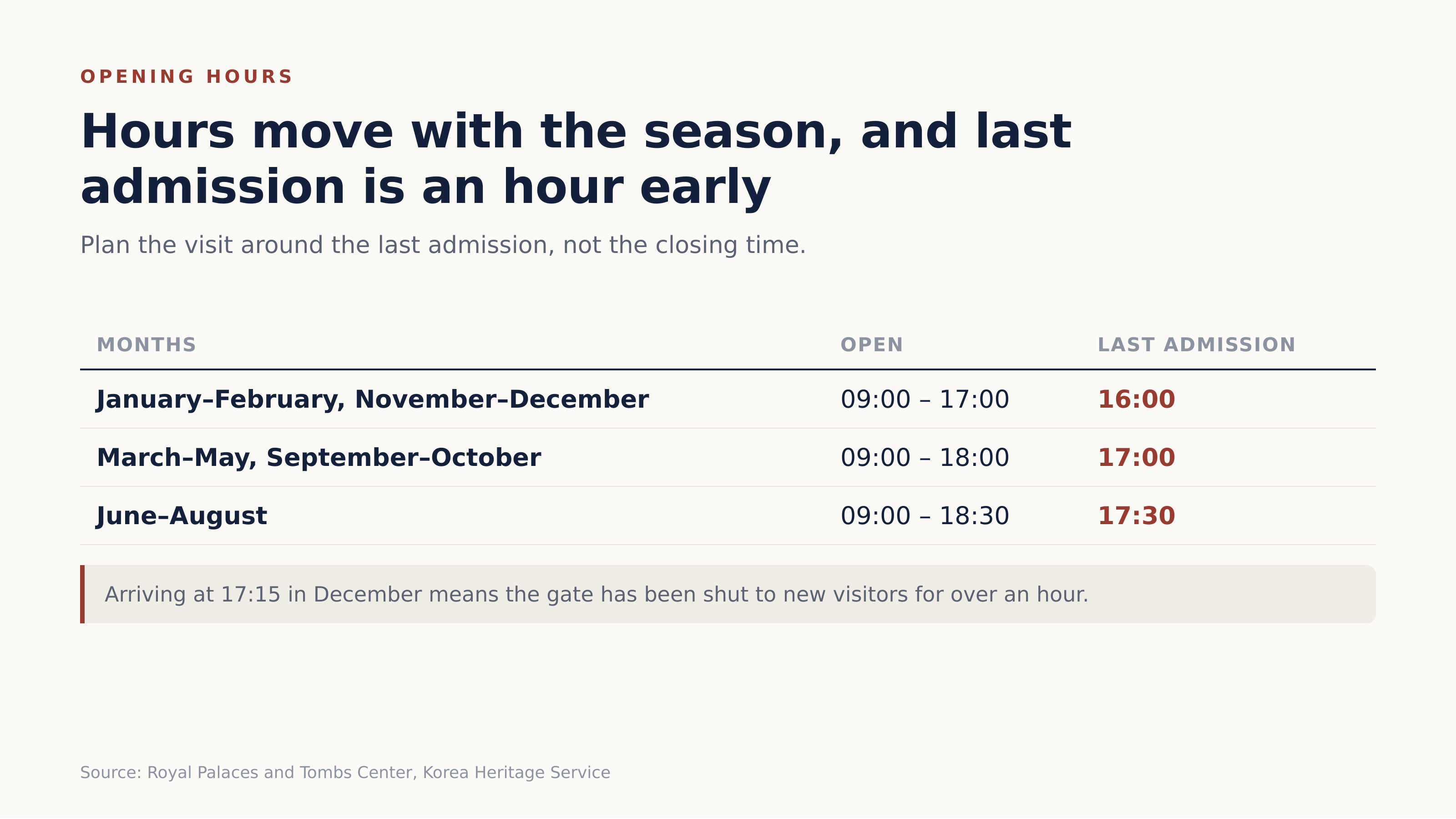
Opening hours move with the season as well, and the last admission is an hour before closing.
| Months | Open | Last admission |
|---|---|---|
| January to February, November to December | 09:00 to 17:00 | 16:00 |
| March to May, September to October | 09:00 to 18:00 | 17:00 |
| June to August | 09:00 to 18:30 | 17:30 |
Check the weekday before you book anything else into that day. And if you do land on an open morning, there is still the question of what you have on.
Hanbok gets you in free, and the rule is written down
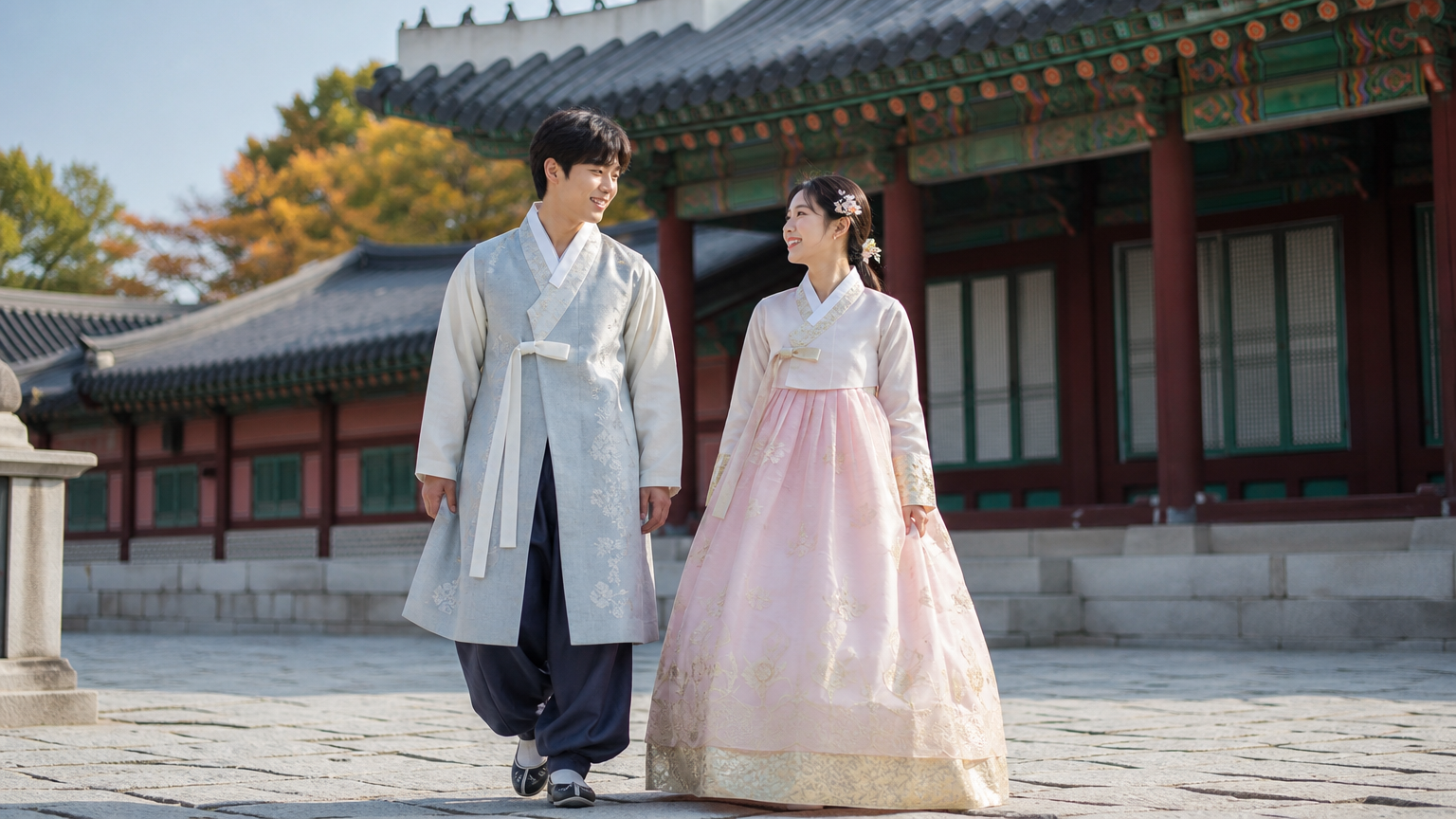
Wearing hanbok makes admission free, and that applies to foreign visitors as well as Koreans.
This is worth stating plainly because the other free categories do not work the same way. Visitors aged 24 and under, and those 65 and over, get in free — but that exemption is written for Korean nationals with ID. The hanbok exemption carries no nationality condition. For most people reading this, hanbok is the only route to a free ticket.
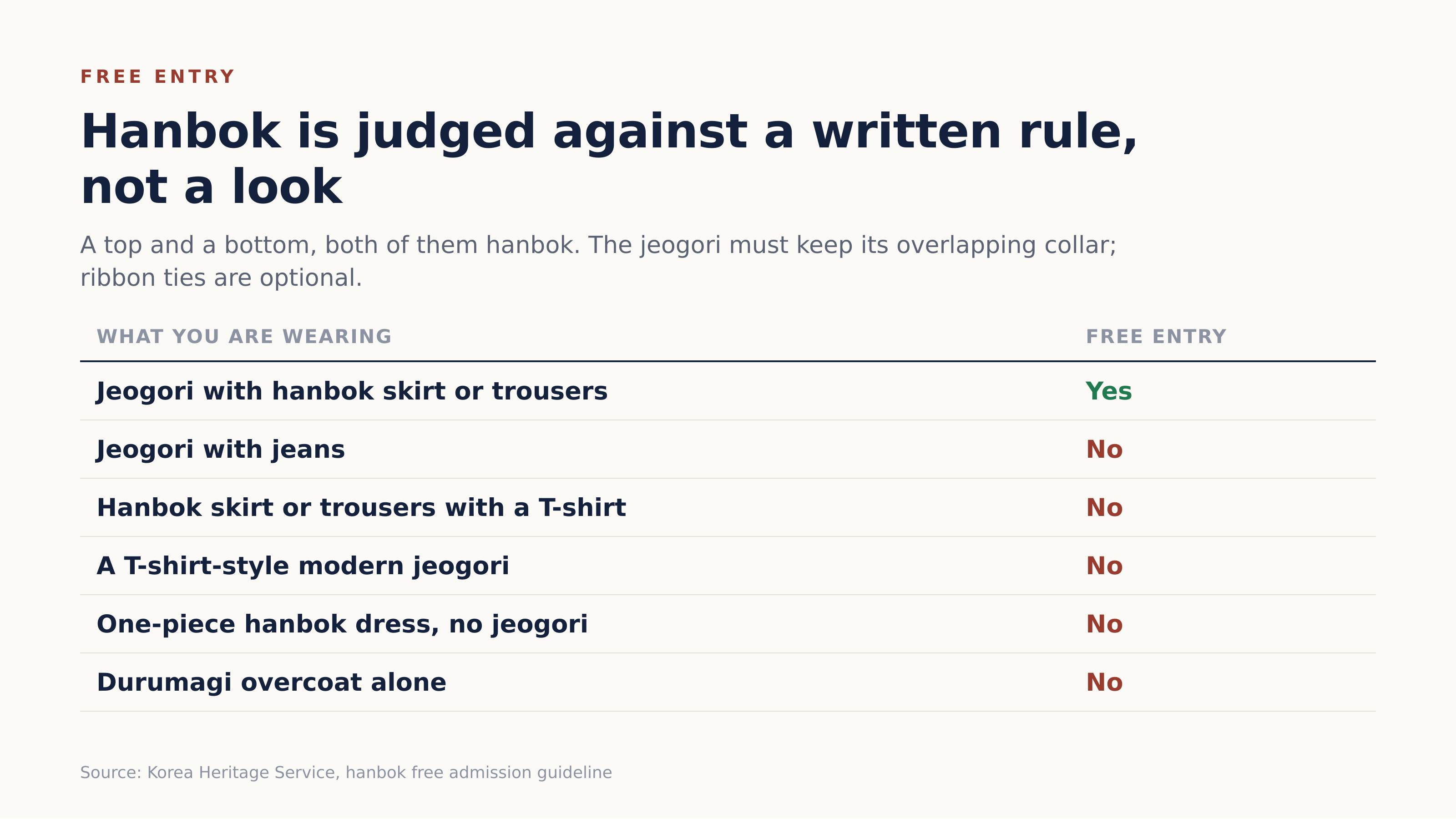
What trips people up is that wearing hanbok is not judged by vibe. The managing agency publishes an actual guideline, and rental shops near the gate do not all dress you to it. The rule starts from a simple principle: a top and a bottom, both of them hanbok. A jeogori, the jacket, has to keep its overlapping collar, though the ribbon ties are optional and the fastening method does not matter. Traditional hanbok and modern everyday hanbok both count.
These are the cases that get turned away at the gate:
| What you are wearing | Free entry |
|---|---|
| Jeogori with jeans | No |
| Hanbok skirt or trousers with a T-shirt | No |
| A T-shirt-style modern jeogori | No |
| A one-piece hanbok dress with no jeogori | No |
| Durumagi overcoat alone | No |
| Jeogori with hanbok skirt or trousers | Yes |
Skirts are unrestricted in style — wrapped or unwrapped makes no difference. Trousers need to be cut roughly like traditional sapok trousers. Men's hanbok for men and women's for women, as a matter of the stated principle.
So when you pick a rental, look at whether the set gives you a proper jeogori rather than the prettiest photograph. Our breakdown of hanbok rental in Seoul and the free-palace rule covers prices and where to go.
And if you are not going to wear hanbok, there is a cheaper way to look at this than buying one ticket at one gate.
The 6,000 won ticket that covers five places
If you plan to see more than two sites, buy the integrated ticket instead of paying at each gate.
It costs 6,000 won and covers the four palaces plus Jongmyo. The Huwon secret garden at Changdeokgung is excluded and booked separately. It stays valid for six months from the day you buy it, which means it does not have to be one exhausting day — you can spread it across a week, or across two separate trips inside the same half-year.
The arithmetic is blunt. Gyeongbokgung Palace tickets alone are 3,000 won. Two palaces bought separately already reach 4,000 to 6,000 won depending on which ones you pick. At three sites the integrated ticket has paid for itself and the remaining two cost nothing.
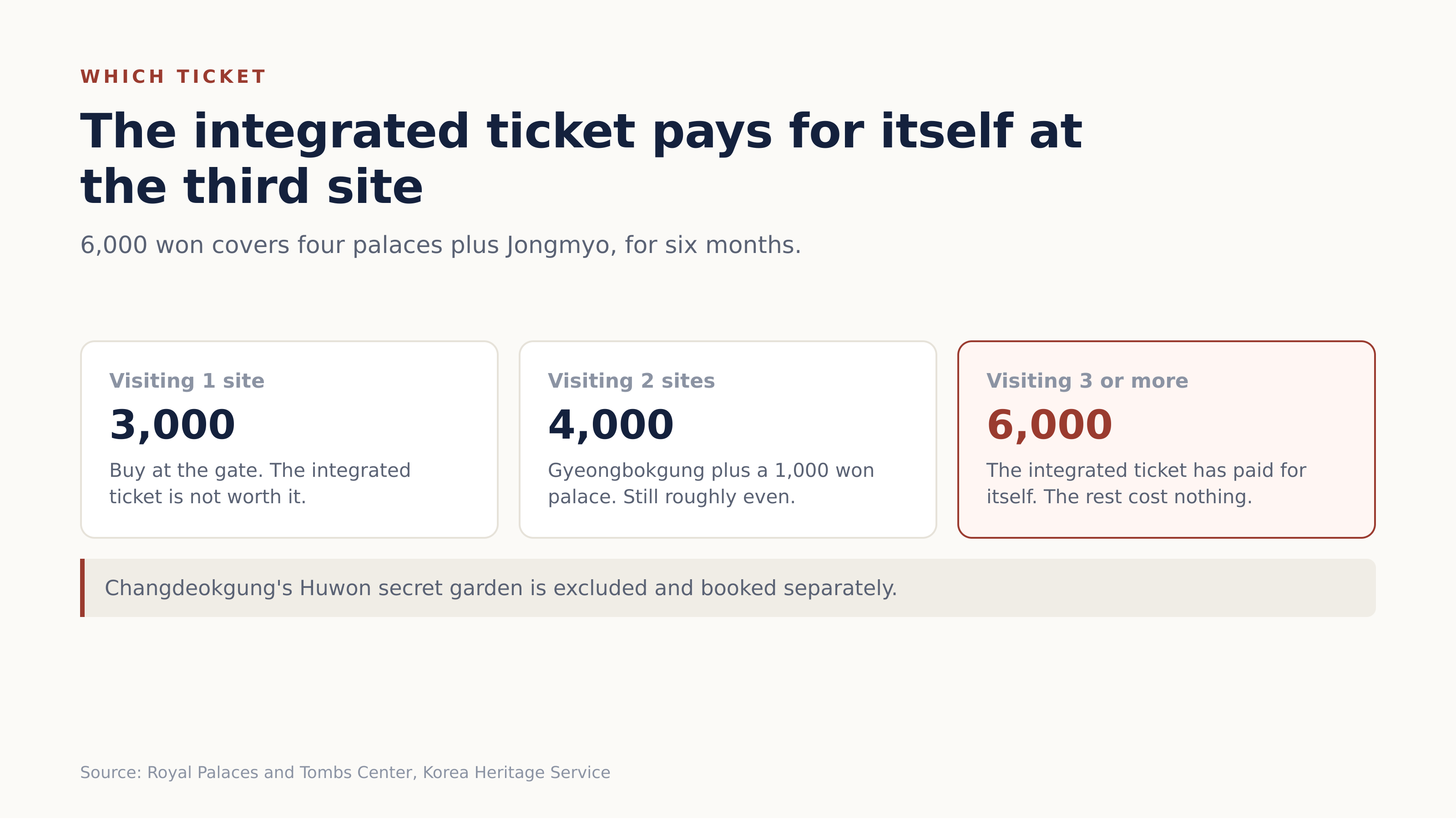
| Ticket | Price | Covers |
|---|---|---|
| Gyeongbokgung only | 3,000 won | One palace |
| Integrated ticket | 6,000 won | Four palaces plus Jongmyo, six months |
What this actually costs you
Here is the whole day in one line. Three thousand won gets you in, six thousand gets you into five places, and a hanbok gets you in for nothing — but none of that matters if you show up on a Tuesday.
Check the weekday first. Then decide whether you are seeing one palace or several. Then, if you want the free entry, look at the jeogori rather than the photograph.
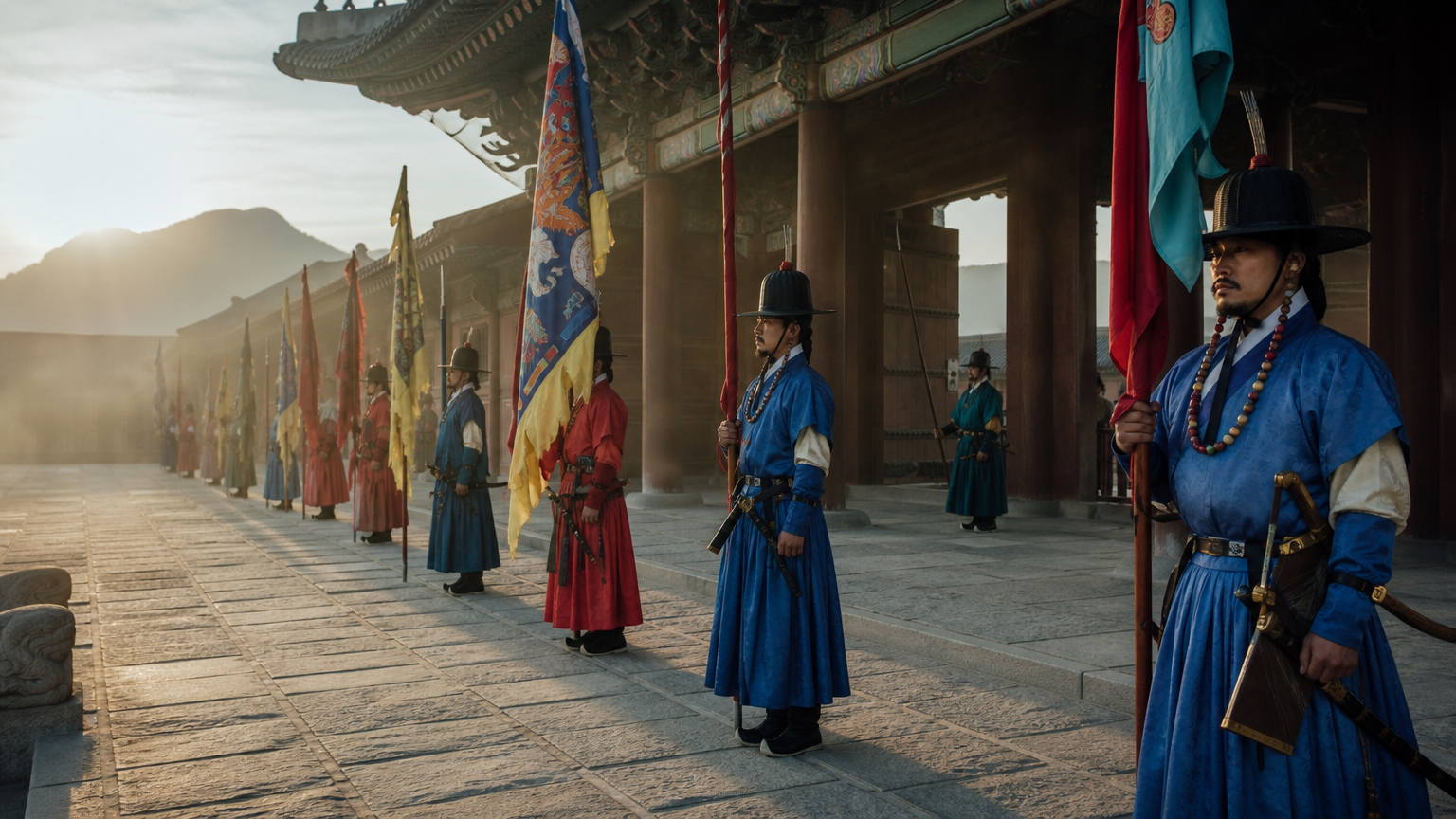
Gyeongbokgung Palace tickets are the cheapest decision you will make that day. It is a low bar. You do not need to book ahead, you do not need to plan a route, and you do not need to spend much. You need to get one weekday right.
FAQ
Do I need to book Gyeongbokgung Palace tickets in advance?
No. Admission is sold at the gate and there is no timed-entry system for general entry. Booking applies to specific programmes such as the Changdeokgung Huwon garden, which is a separate reservation and is not part of the integrated ticket.
Gyeongbokgung is closed on Tuesday, so is anything else open that day?
Yes. Changdeokgung, Deoksugung and Changgyeonggung all close on Monday, so they are open on Tuesday. Jongmyo is the exception, closing on Tuesday alongside Gyeongbokgung. A Tuesday in central Seoul is best spent at Changdeokgung or Deoksugung.
Will the hanbok I rent near the gate definitely qualify for free entry?
Not automatically. The guideline requires a jeogori with an overlapping collar worn with a hanbok skirt or trousers. A one-piece hanbok dress without a jeogori, or a T-shirt-style modern top, does not qualify. Ask the rental shop for a set that includes a proper jeogori.
Is the integrated ticket worth it on a short trip?
If you will visit three or more of the five sites, yes — it costs the same as two separate palace admissions. It is valid for six months, so you do not have to use it all in one day.
References
-
Royal Palaces and Tombs Center, Korea Heritage Service — admission fees, opening hours and closing days
-
Royal Palaces and Tombs Center, Korea Heritage Service — hanbok free admission guideline
-
Herald Business, 5 August 2026 — reporting on the review of palace and tomb admission standards