Shipping From Korea: What the Post Office Will Refuse, and the Duty Rule That Changed

The eight-hundred-dollar rule you are planning around does not exist any more.
For years the advice was the same everywhere. Keep the declared value under 800 US dollars, post it home, and it arrives without a customs bill. That was real, it was written into US law as the de minimis threshold, and an enormous amount of shopping advice was built on top of it. It has been suspended.
That is the half of this that changed underneath everyone. The other half never changed at all, and it catches more people: there is a list of ordinary things the Korean post office will simply not accept, and several of them are exactly what visitors buy.
If you are still at the stage of working out what is worth carrying home in the first place, What to Buy in Korea is the shopping half of this question. And if the boxes are the reason you are travelling light in the meantime, Luggage Storage in Seoul covers where to put them.
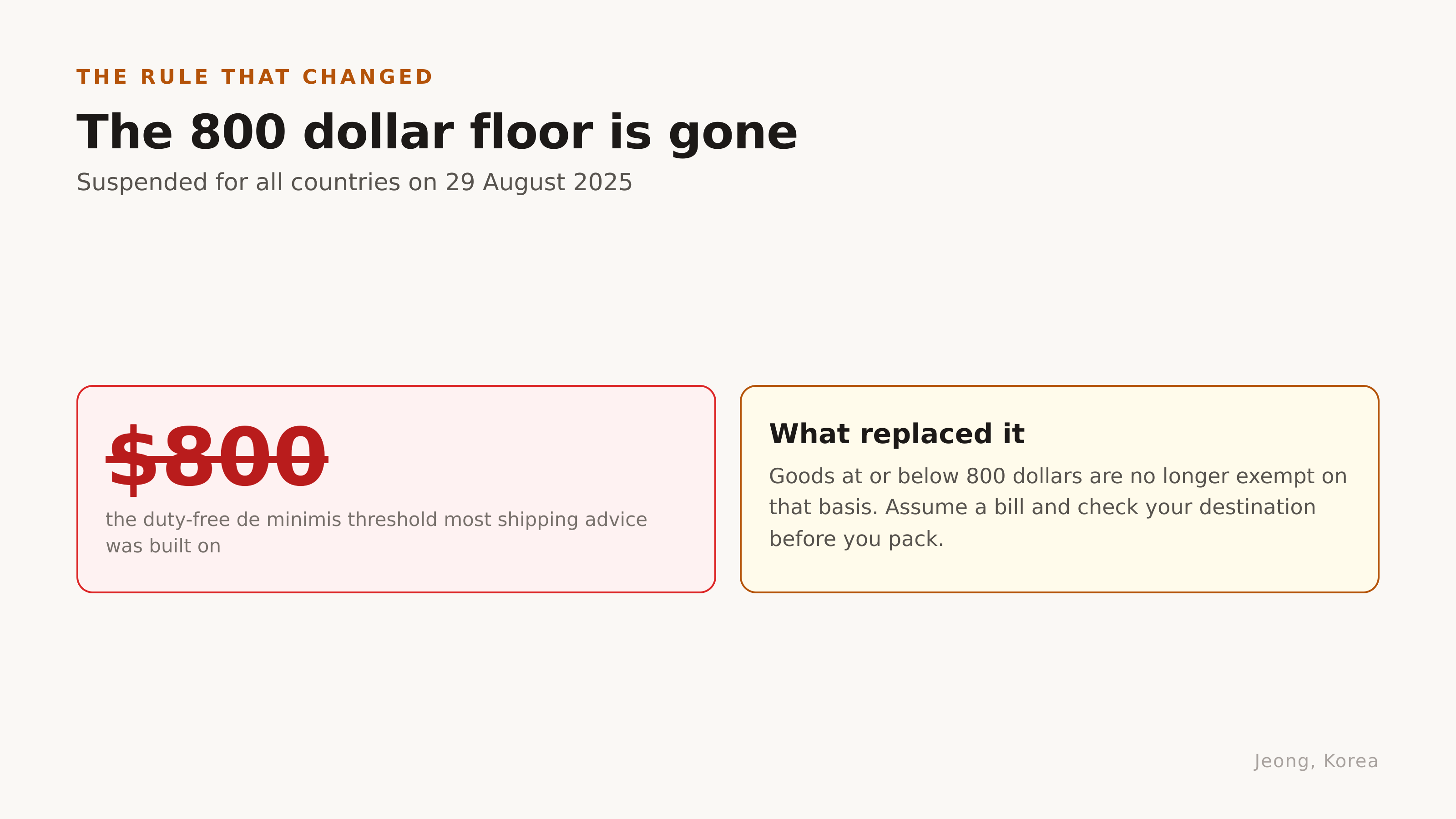
The duty-free floor is gone, and it went for everyone
Stop planning around the 800 dollar line.
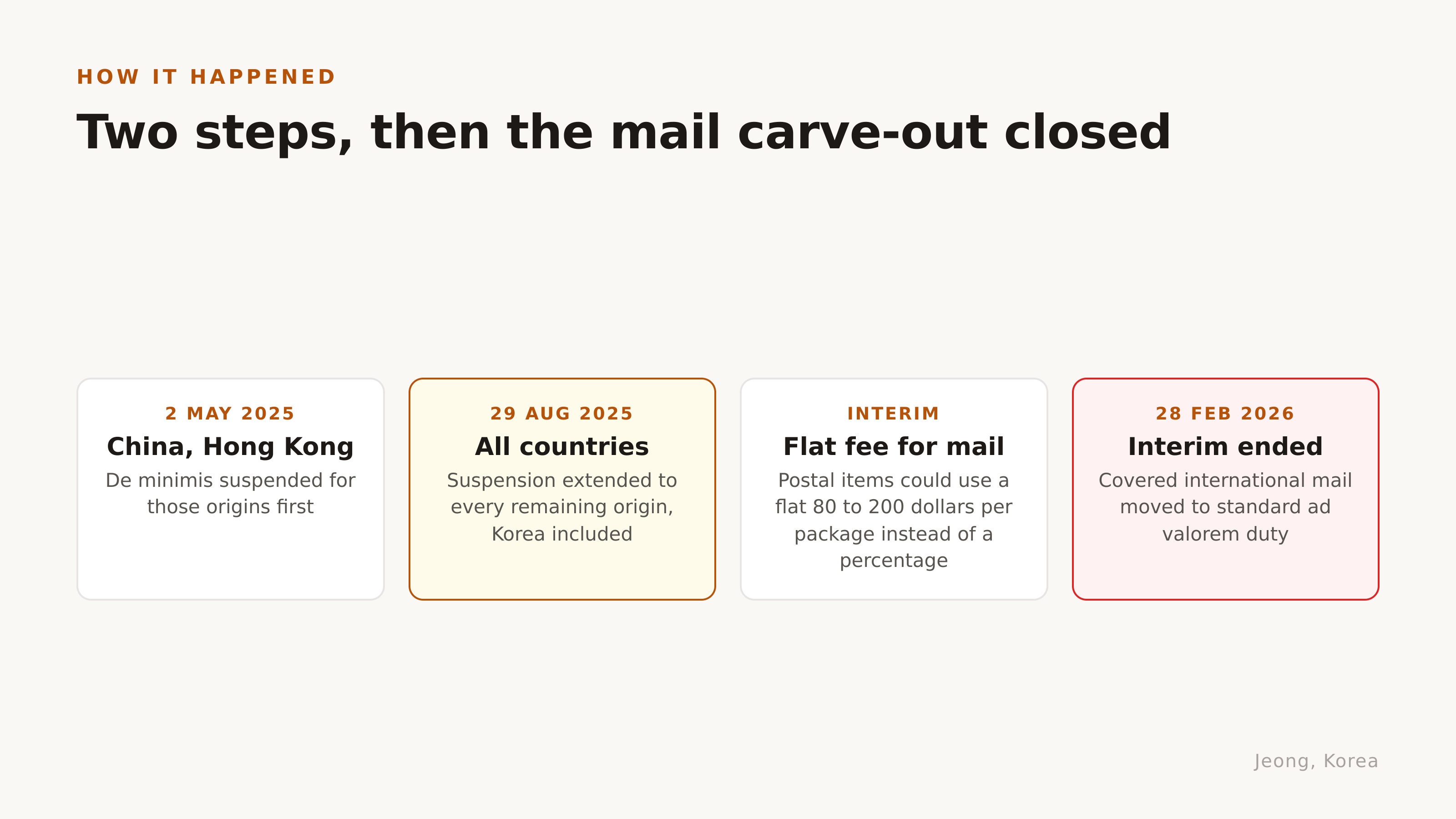
The reason is a policy change rather than an enforcement change. The United States suspended duty-free de minimis treatment for low-value shipments, and it did so in two steps: China and Hong Kong on 2 May 2025, then all remaining countries on 29 August 2025. Goods valued at or below 800 dollars are no longer exempt on that basis.
There was a transitional arrangement for international mail specifically, where postal shipments could use a flat per-package duty of somewhere between 80 and 200 dollars instead of a percentage. That was temporary. From 28 February 2026 covered international mail moved to the standard ad valorem method.
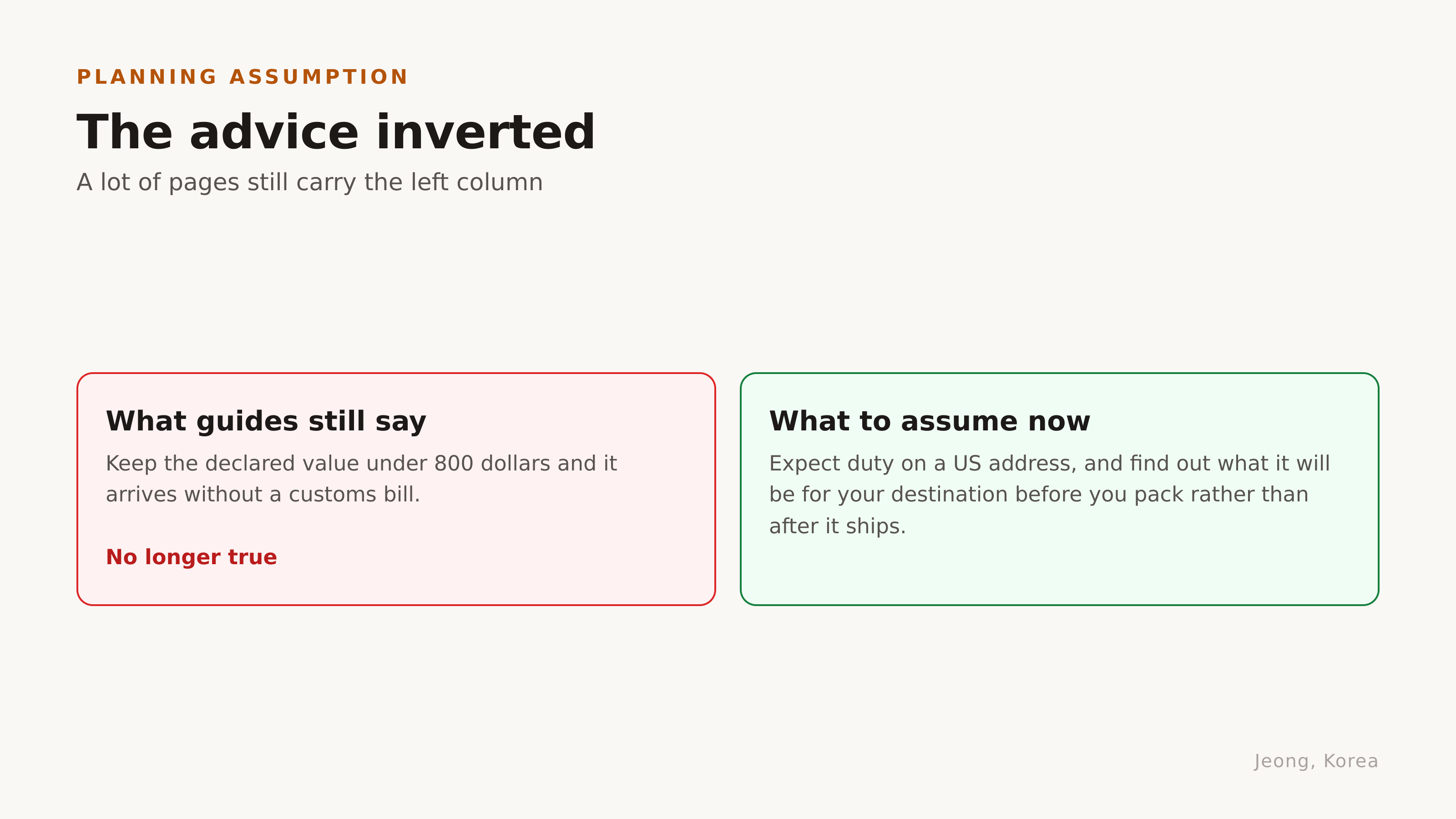
So the planning assumption for shipping from Korea has inverted. It is no longer "keep it under the line and it arrives clean." It is "assume a bill, and find out what it will be for your destination before you pack."
I want to be precise about the limits of that. This is the United States rule, and it is the one that changed most visibly. Every other destination has its own thresholds and its own treatment of gifts versus goods, and I am not going to pretend to know yours. What I can tell you is that the single most repeated piece of advice about shipping from Korea is now out of date for American addresses, and that a lot of pages still repeat it.
Which brings up the part nobody warns you about at all.
The post office refuses things long before customs sees them
Check whether it can be posted before you buy it.
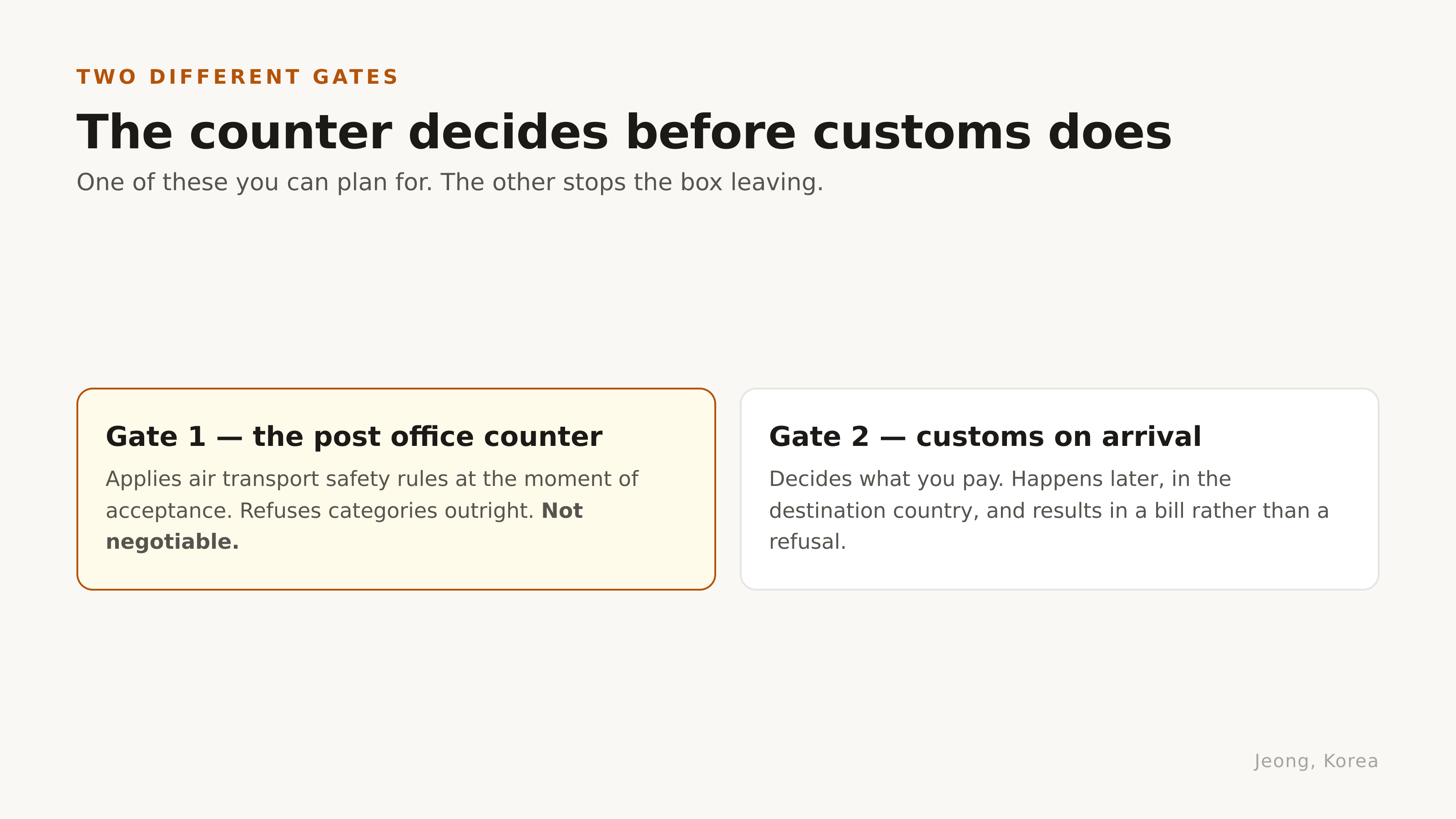
The reason is that acceptance and clearance are different gates. Customs decides what you pay. The counter decides whether the box leaves the country, and the counter is applying air transport safety rules, which are stricter and much less negotiable.
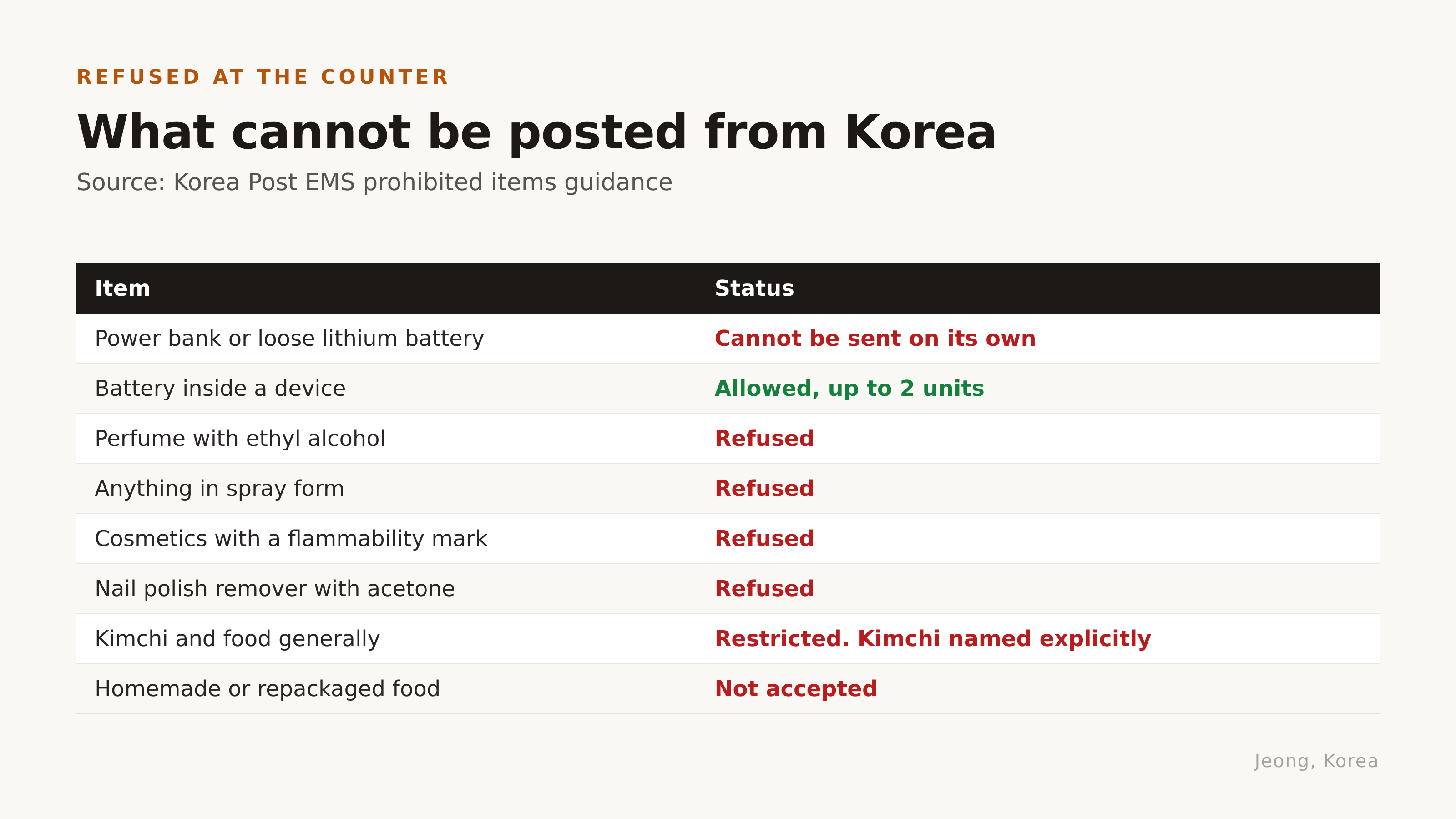
The list is specific and it lands squarely on souvenir shopping. Lithium batteries cannot be sent on their own, which rules out the power bank you bought at a convenience store; batteries installed inside a device are allowed, with a limit of two units. Perfume containing ethyl alcohol is refused. Anything in spray form is refused. Cosmetics carrying a flammability mark are refused, and so is nail polish remover containing acetone. Food is restricted, and the guidance names kimchi explicitly. Homemade or repackaged food in unmarked containers will not be accepted at all, and only factory-sealed, labelled product has a route.
| Item | Status |
|---|---|
| Power bank or loose lithium battery | Cannot be sent on its own |
| Battery inside a device | Allowed, up to 2 units |
| Perfume with ethyl alcohol | Refused |
| Anything in spray form | Refused |
| Cosmetics with a flammability mark | Refused |
| Nail polish remover with acetone | Refused |
| Kimchi and food generally | Restricted. Kimchi named explicitly |
| Homemade or repackaged food | Not accepted |
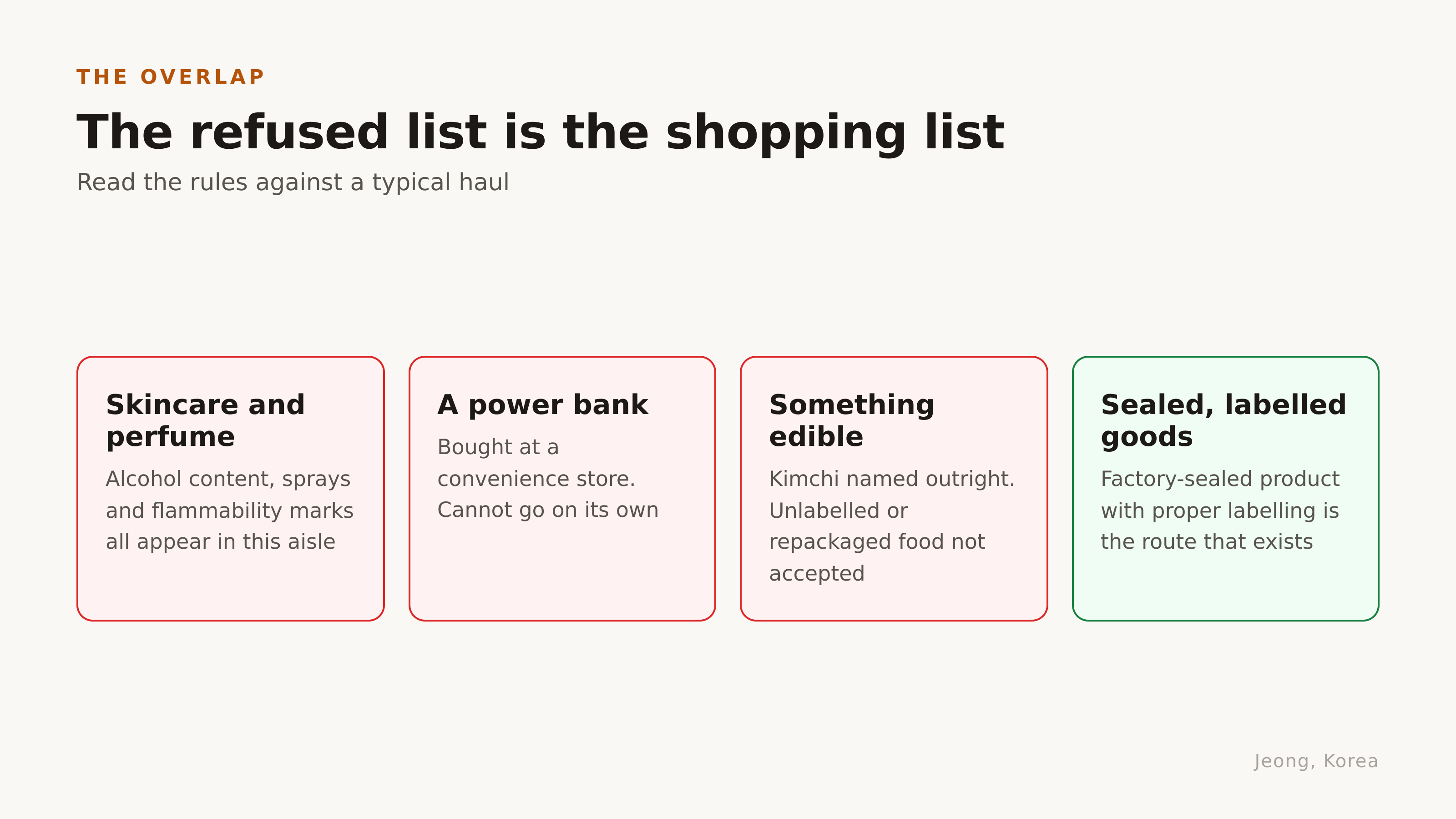
Read that list against a typical haul and the overlap is uncomfortable. Skincare, perfume, a power bank, and something edible to take home is close to the standard shopping list.
So the sequence has to change. Not buy, then discover at the counter. Check the category, then buy.
Cosmetics are the single biggest overlap here, and where you buy them affects what packaging you end up with: Olive Young Seoul: Which Store to Go To.
Which leaves the boring constraint that decides how many boxes you are sending.
Thirty kilos, and less than that for some countries
Plan the weight last, after you know what is actually allowed.
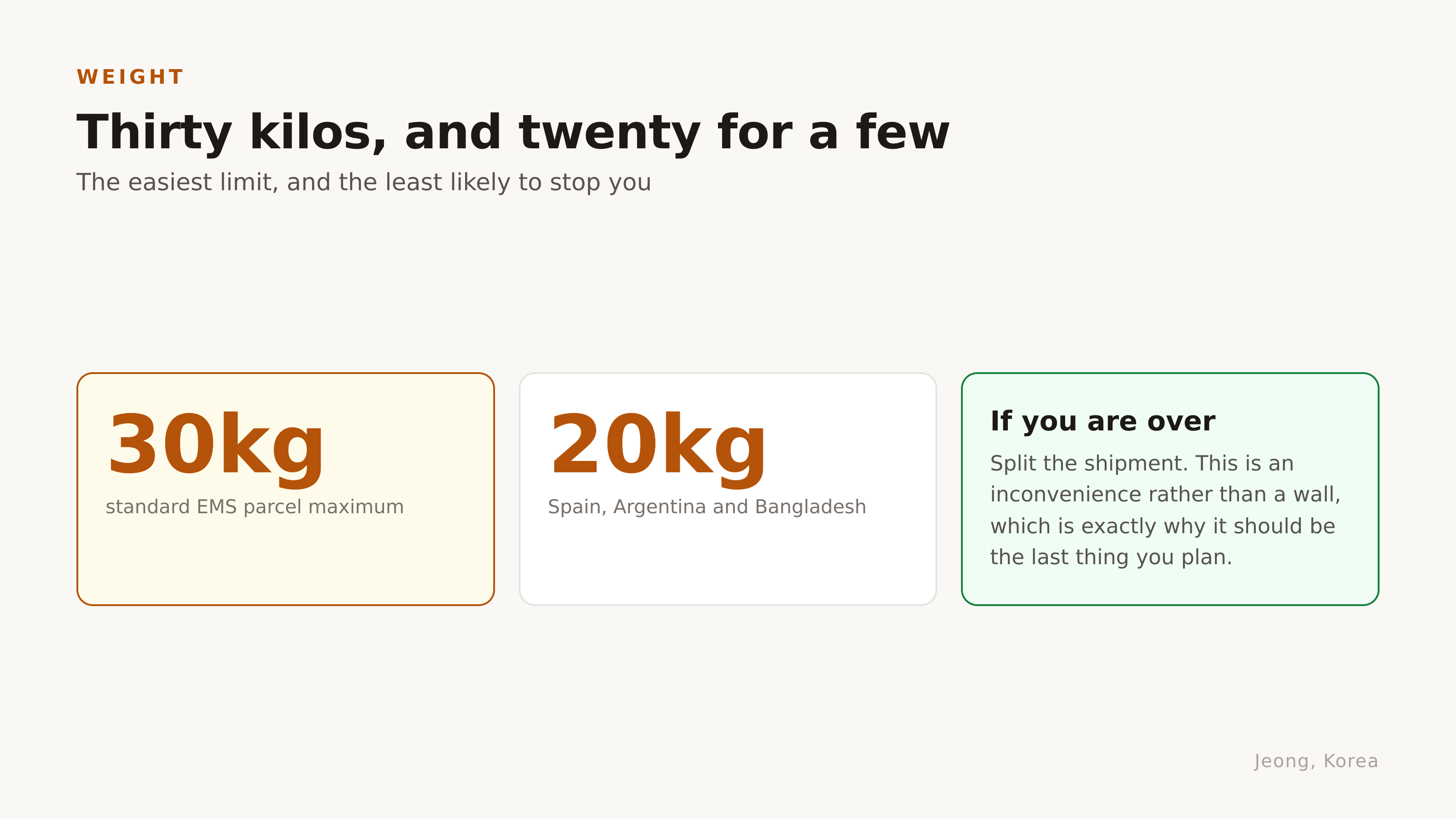
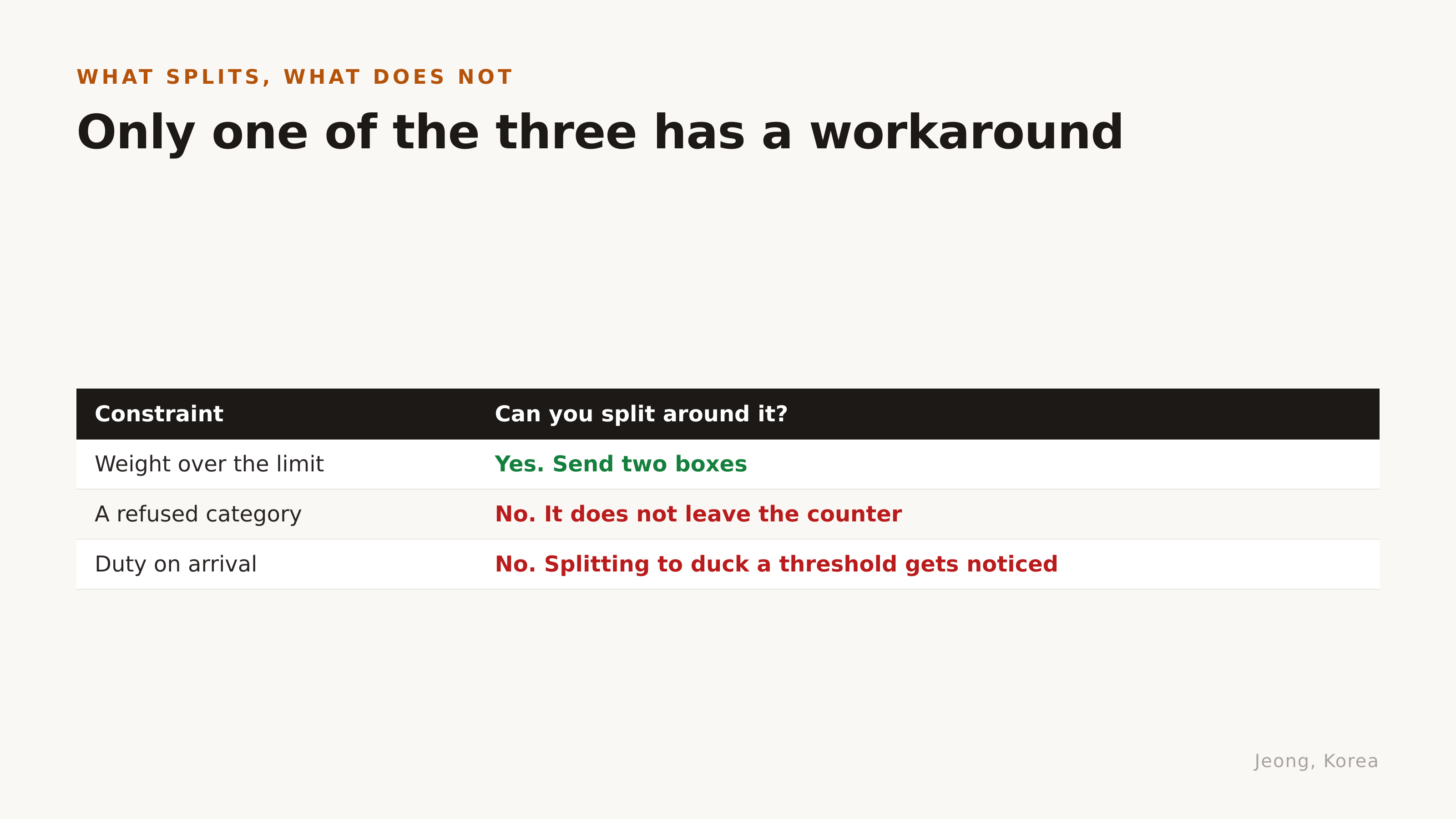
The reason is that weight is the easiest limit to work around and the least likely to stop you. EMS takes parcels up to 30kg. A few destinations are capped lower at 20kg, and the ones named are Spain, Argentina and Bangladesh. If you are over, you split the shipment, and splitting is an inconvenience rather than a wall.
Compare that with the other two constraints. A refused category cannot be split around. A customs bill cannot be split around either, and splitting a shipment to duck a threshold is the kind of thing that gets noticed rather than the kind of thing that works.
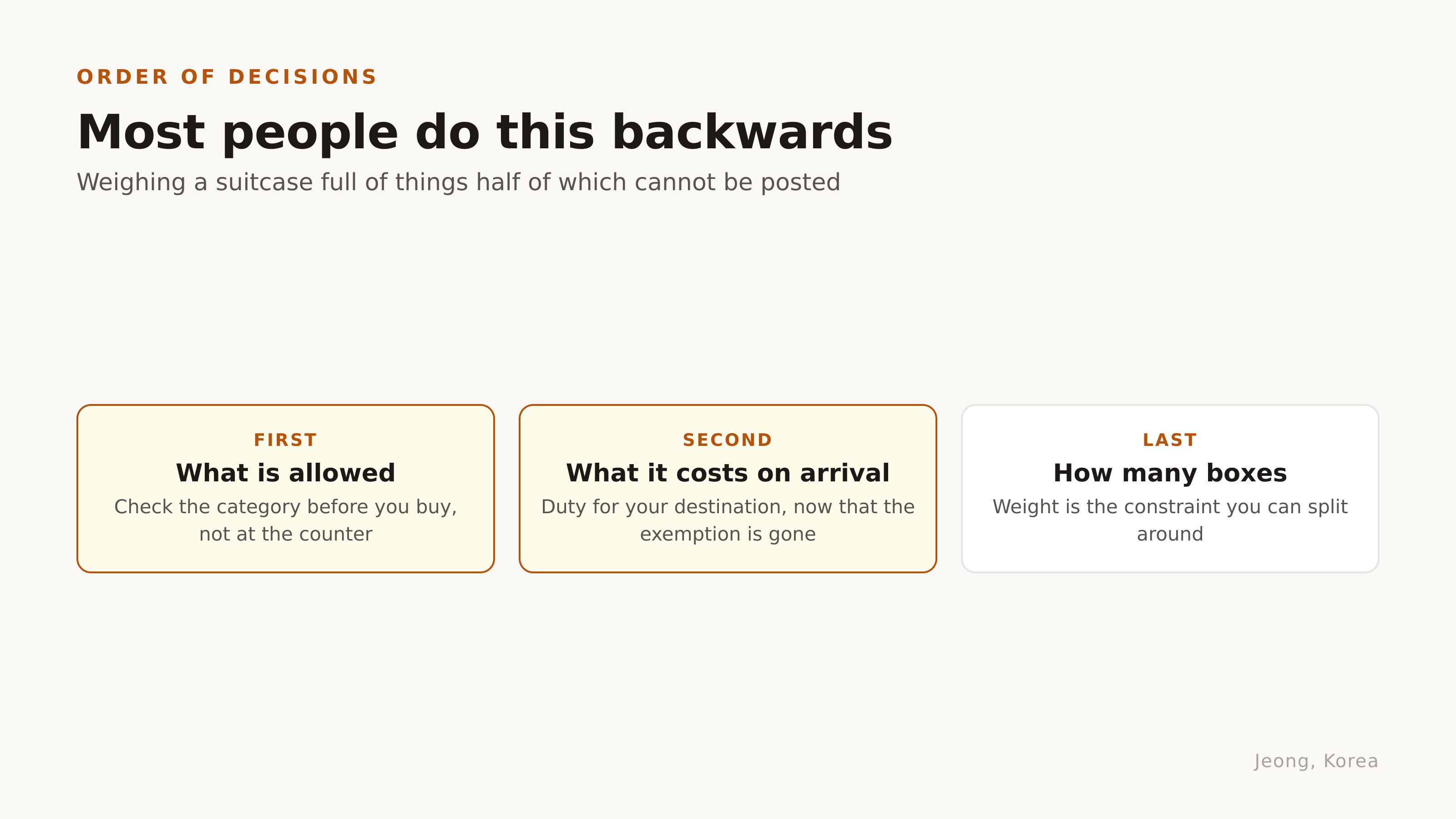
So the order of decisions for shipping from Korea runs: what is allowed to go, what it will cost on arrival, and only then how many boxes. Most people do it backwards, weighing a suitcase full of things half of which cannot be posted.
What to take from this
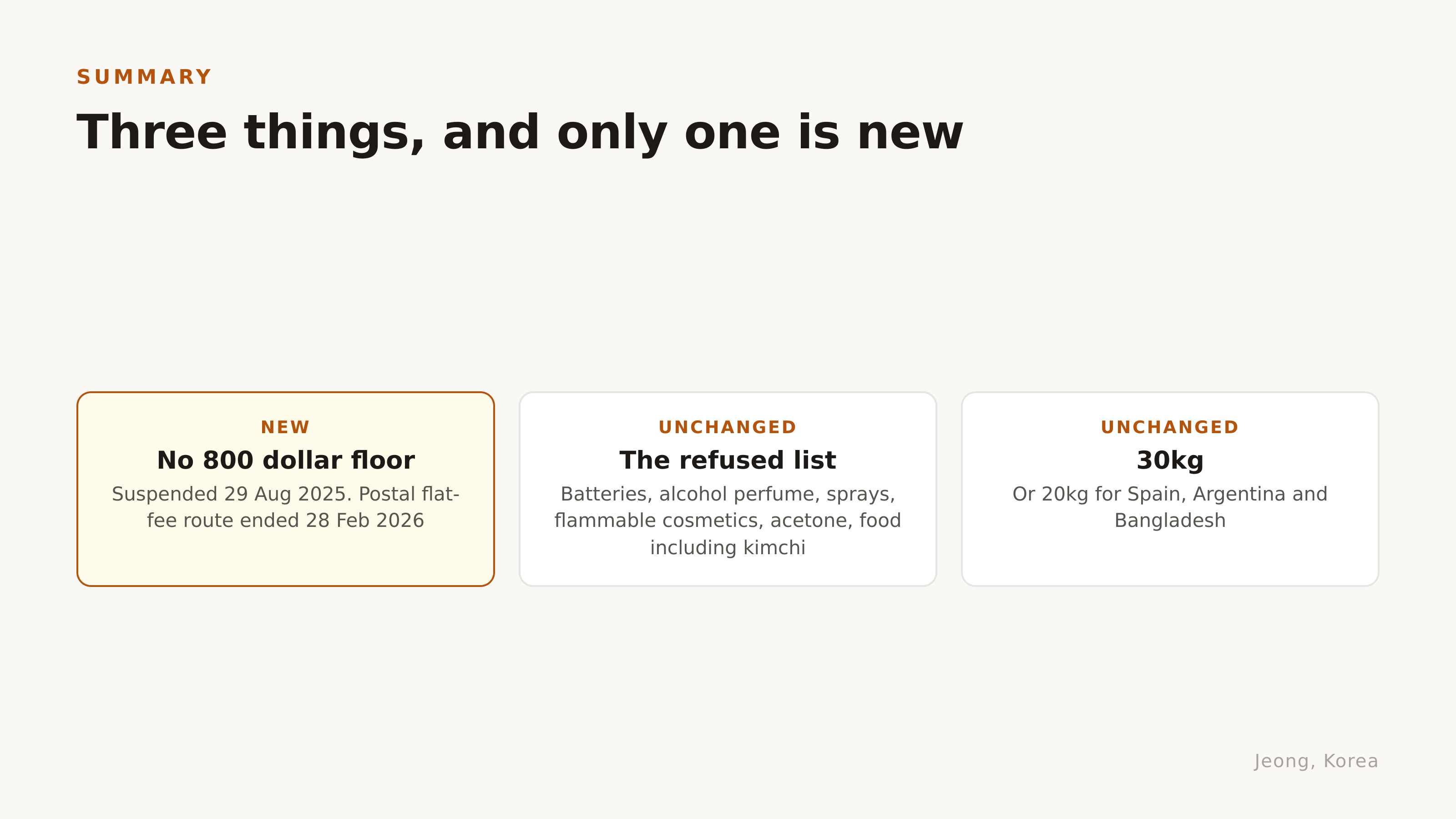
Three things, and only one of them is new.
The US duty-free floor at 800 dollars was suspended on 29 August 2025 for all countries, and the temporary flat-fee route for postal items ended on 28 February 2026. Assume duty on an American address rather than assuming exemption.
The post office refuses standalone lithium batteries, alcohol-based perfume, sprays, cosmetics with a flammability mark, acetone remover, and food including kimchi. That has been true throughout and has nothing to do with the tariff change.
And EMS tops out at 30kg, or 20kg for a handful of countries.
I am not telling you to stop shipping things home. Posting a box is still cheaper than a second checked bag for most people, and some of what is worth buying here genuinely does not exist elsewhere. What I am telling you is that the advice you have read was written under a rule that has since been withdrawn, and that the friendliest-looking items in your basket are the ones most likely to be turned away at the counter. Check both before you pack, not after.
FAQ
Is the 800 dollar duty-free limit still valid for shipping from Korea to the US?
No. Duty-free de minimis treatment was suspended for China and Hong Kong on 2 May 2025 and for all remaining countries on 29 August 2025. The temporary flat-fee option for international mail ended on 28 February 2026.
Can I post a power bank home?
No. Lithium batteries cannot be sent on their own. Batteries installed inside a device are permitted, with a limit of two units.
Can I send Korean food or kimchi?
Food is restricted and kimchi is named specifically as something that cannot be sent. Homemade or repackaged food in unmarked containers is not accepted. Factory-sealed and labelled product is the only route that exists.
What about perfume and cosmetics?
Perfume containing ethyl alcohol is refused, as are sprays, cosmetics carrying a flammability mark, and nail polish remover containing acetone. This is an air transport safety rule applied when your parcel is accepted, not a customs decision later.
How heavy can an EMS parcel be?
Up to 30kg. Spain, Argentina and Bangladesh are capped at 20kg.
References
출처 : Executive Order 14324, suspending duty-free de minimis treatment for all countries, effective 29 August 2025 출처 : US Customs and Border Protection guidance on international mail and the transition to ad valorem duty from 28 February 2026 출처 : Korea Post (ems.epost.go.kr), EMS prohibited items and weight limits