Korea Emergency Alert: Three Kinds of Siren, and Why You Cannot Turn It Off

Your phone just screamed in Korean. There are three kinds of that message. Only one of them means run.

If it happened on your first day here, you probably assumed something had gone wrong with the handset. It has not. Nothing is broken, nothing is malware, and you did not accidentally subscribe to anything.
What you received is a Korea emergency alert: a cell broadcast sent by a government body, pushed through your carrier, and displayed by your phone because Korean law requires the phone to display it. Most of them are routine. A few of them are not. Almost none of them arrive in English.
That combination is why visitors find these genuinely frightening: an alarm you cannot silence, in a script you cannot read, about something you cannot identify. So this is the whole system in one page, in the order that will help you at two in the morning.
It is not a malfunction. Your phone is doing what it was built to do.
The first thing to understand is that this is not a notification your phone chose to give you.
Article 38-2(6) of the Framework Act on the Management of Disasters and Safety puts the obligation on the equipment side. Telecommunications operators, broadcasters, and mobile phone and navigation device manufacturers must equip their products with the software or mechanical means to ensure that disaster forecasts and warnings are displayed without fail on the user's receiver screen.
Read what that is doing. It is not telling the government to try to reach you. It is telling the company that made your handset to guarantee the message lands on the glass.
That is why this does not behave like an app notification. There is no sender to block, no unsubscribe, and no permission you accidentally granted. The delivery path is built into the device.
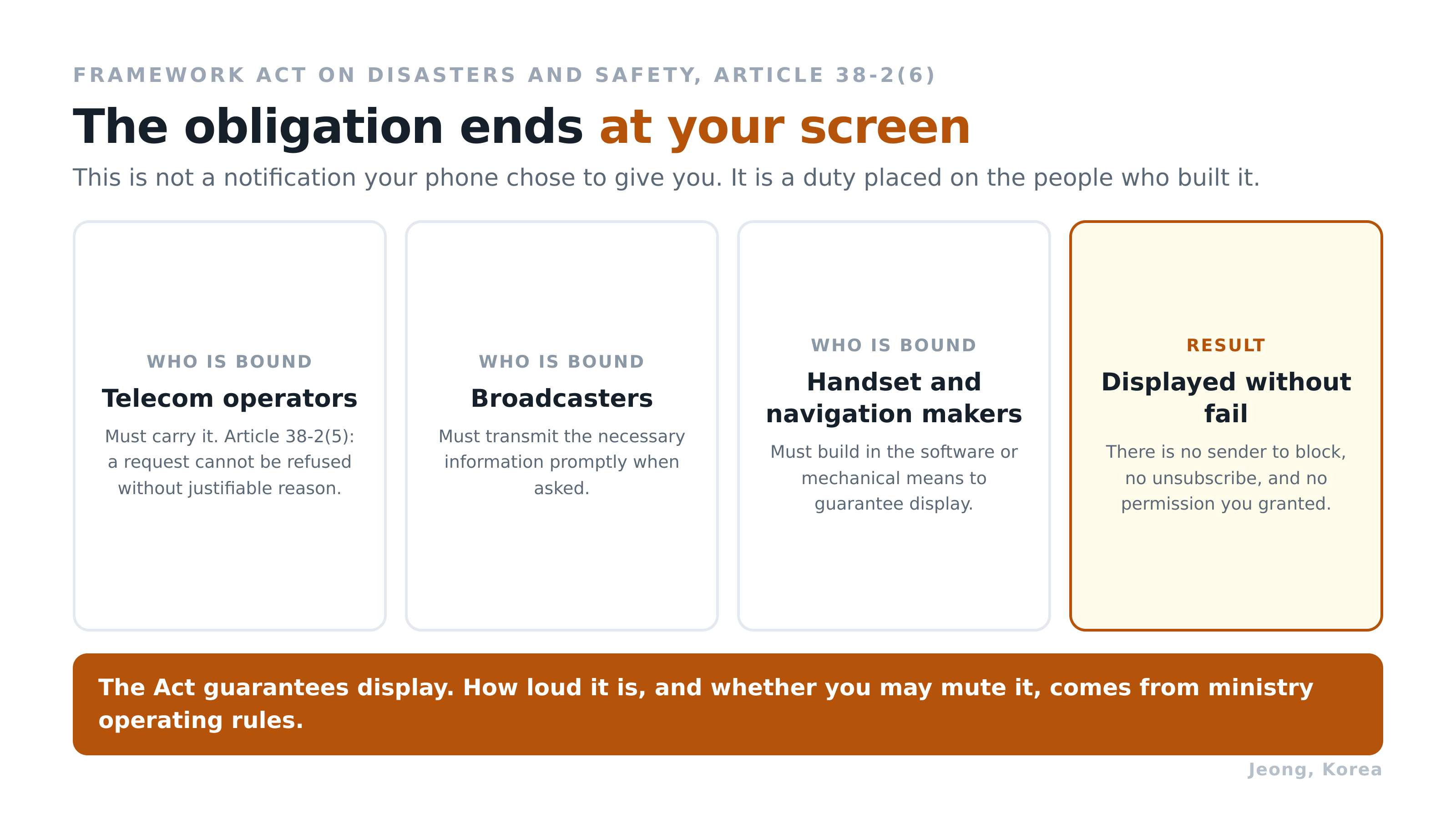
The same Act, at Article 38-2(3) and (5), covers the other end. Designated authorities may require major telecommunications operators to transmit the necessary information as text, and an operator that receives such a request must comply unless there is a justifiable reason not to. The carrier does not get to decide your message was not important enough.
One precision, because it matters and most explanations blur it. The Act guarantees display. The alarm behaviour is set elsewhere: which alerts scream, which ones chime, and which ones you are allowed to switch off comes from the Ministry of the Interior and Safety's operating rules for disaster message broadcasting and from how handsets implement them. Law puts it on your screen. Ministry rules decide how loudly.
That is also why this is one of the few things in Korea a foreign SIM does not change: Korea SIM Card: What You Are Actually Buying, and Why a Passport Is Enough
So if it is one legal obligation, why do the messages feel so inconsistent?
Because it is not one system. Three different bodies can push to your phone.
This is the part that explains the duplicates, the regional oddities, and the message that arrives twice in slightly different words.
Article 38-2(4) hands a specific category to the Korea Meteorological Administration: earthquakes, tsunamis and volcanic activity, plus heavy rain or typhoons above a scale set by Presidential Decree, and other natural disasters specified the same way. For those, the KMA issues the forecast, warning and notification itself.
Article 38-2(3) covers everything else, and it names the Minister of the Interior and Safety, provincial governors, and city mayors and district heads. Any of them can request that the message go out.
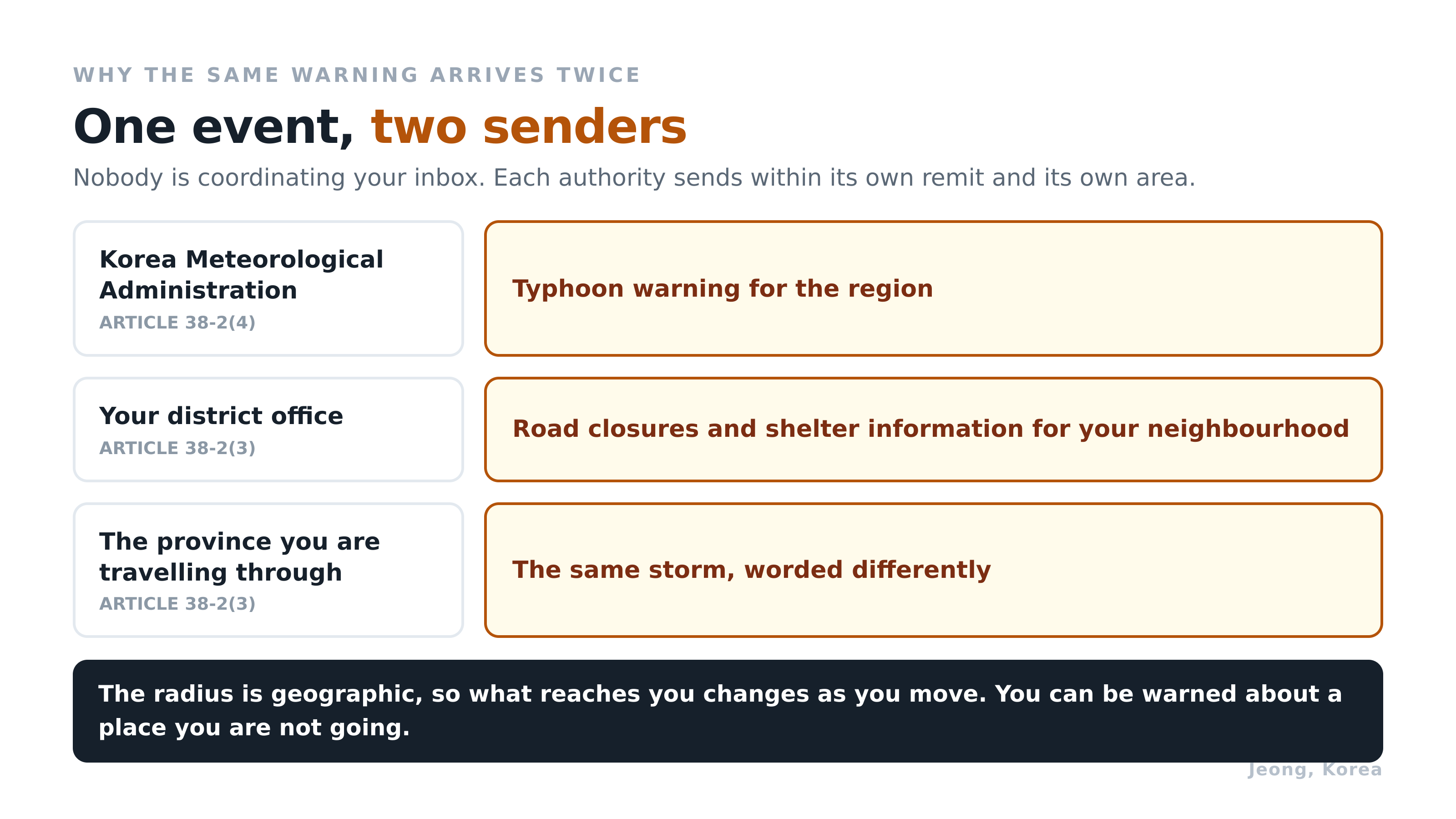
So a single evening can bring you a typhoon warning originating with the meteorological agency and a road-closure notice originating with a district office, and neither one knows what the other sent you.
| Who sent it | What they handle | Where it comes from |
|---|---|---|
| Korea Meteorological Administration | Earthquake, tsunami, volcano, major rain and typhoon | Article 38-2(4) |
| Ministry of the Interior and Safety | National-scale disaster and civil emergency | Article 38-2(3) |
| Province, city or district office | Local incidents, closures, local hazards | Article 38-2(3) |
That table is the answer to almost every "why did I get this" question. You are not on one mailing list. You are inside the broadcast radius of several authorities at once, and the radius is geographic, so it changes as you travel.
It also explains something visitors find absurd: you can get an alert about a place you are not going to, sent by an office whose area you happen to be standing in. That is working as designed. The system knows where your phone is, not where your day is heading.
The same agency that decides your typhoon alert also decides the other thing everyone plans around: Autumn in Korea: Don't Pick the Dates, Pick the Latitude
So which of these can you actually switch off, and which one should you never touch?
Three levels, and only one of them is truly locked
Under the Ministry of the Interior and Safety's operating rules for disaster message broadcasting, alerts are graded, and the grade decides both the noise and your control over it.
| Level | Sent for | Can you switch it off |
|---|---|---|
| 위급재난문자 (wigeup) | War and comparable national emergencies | No |
| 긴급재난문자 (gingeup) | Serious natural disasters, civil defence warnings | Yes |
| 안전안내문자 (anjeon annae) | Everyday disaster and safety information | Yes |
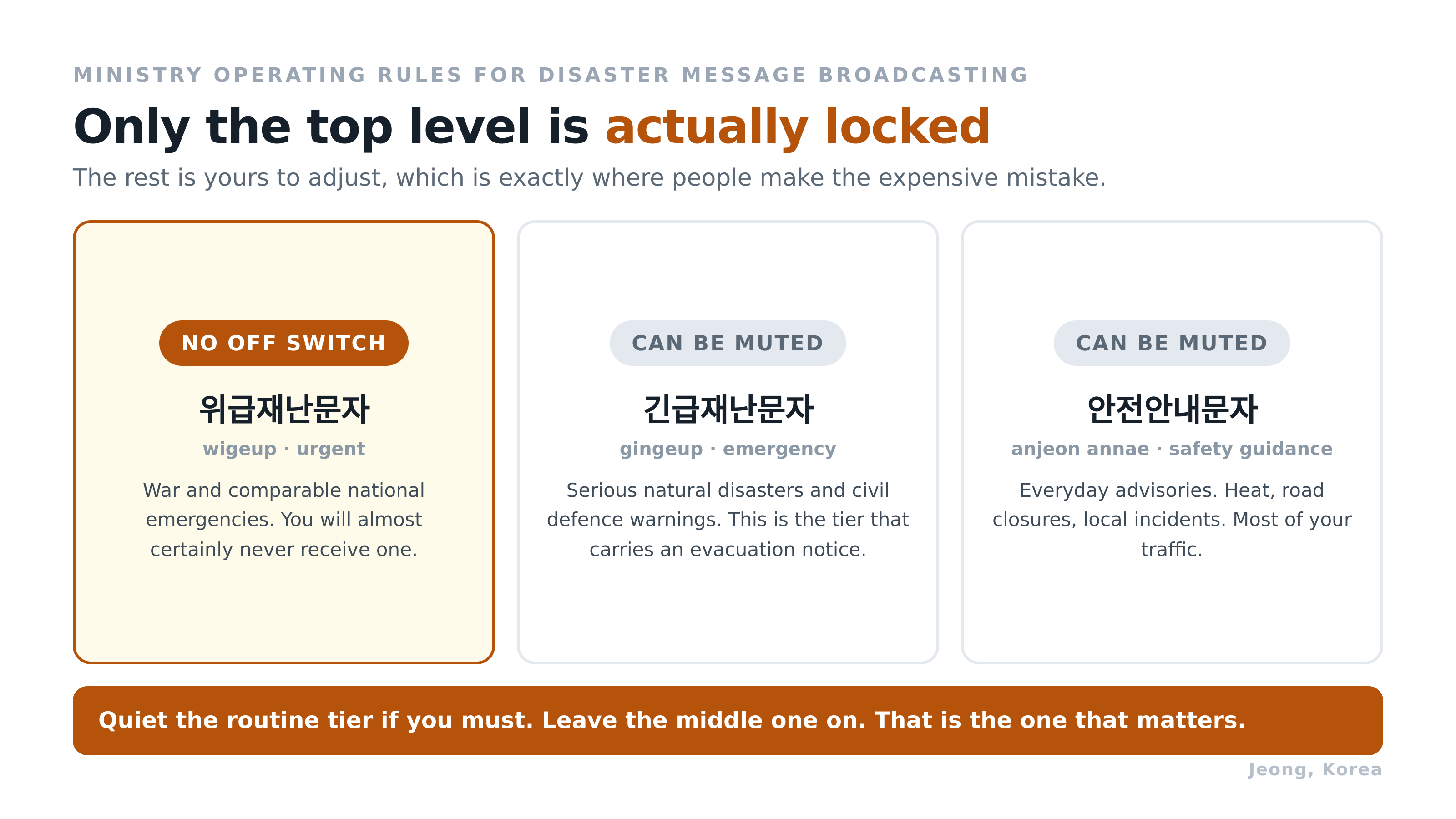
The top level is the one that cannot be disabled, and it is also the one you will almost certainly never receive. The second and third levels are where essentially all of your actual traffic lives, and both of them can be turned off in your phone's emergency alert settings.
Which brings me to the thing I would ask you not to do. Every foreigner who has been here a few weeks discovers that switching off the lower two levels makes the noise stop, and a lot of them do exactly that after the fourth heat advisory in a week. Seoul's own city media has run public campaigns asking people not to, and the reason is simple: the level you find annoying in August is the level that carries the evacuation notice.
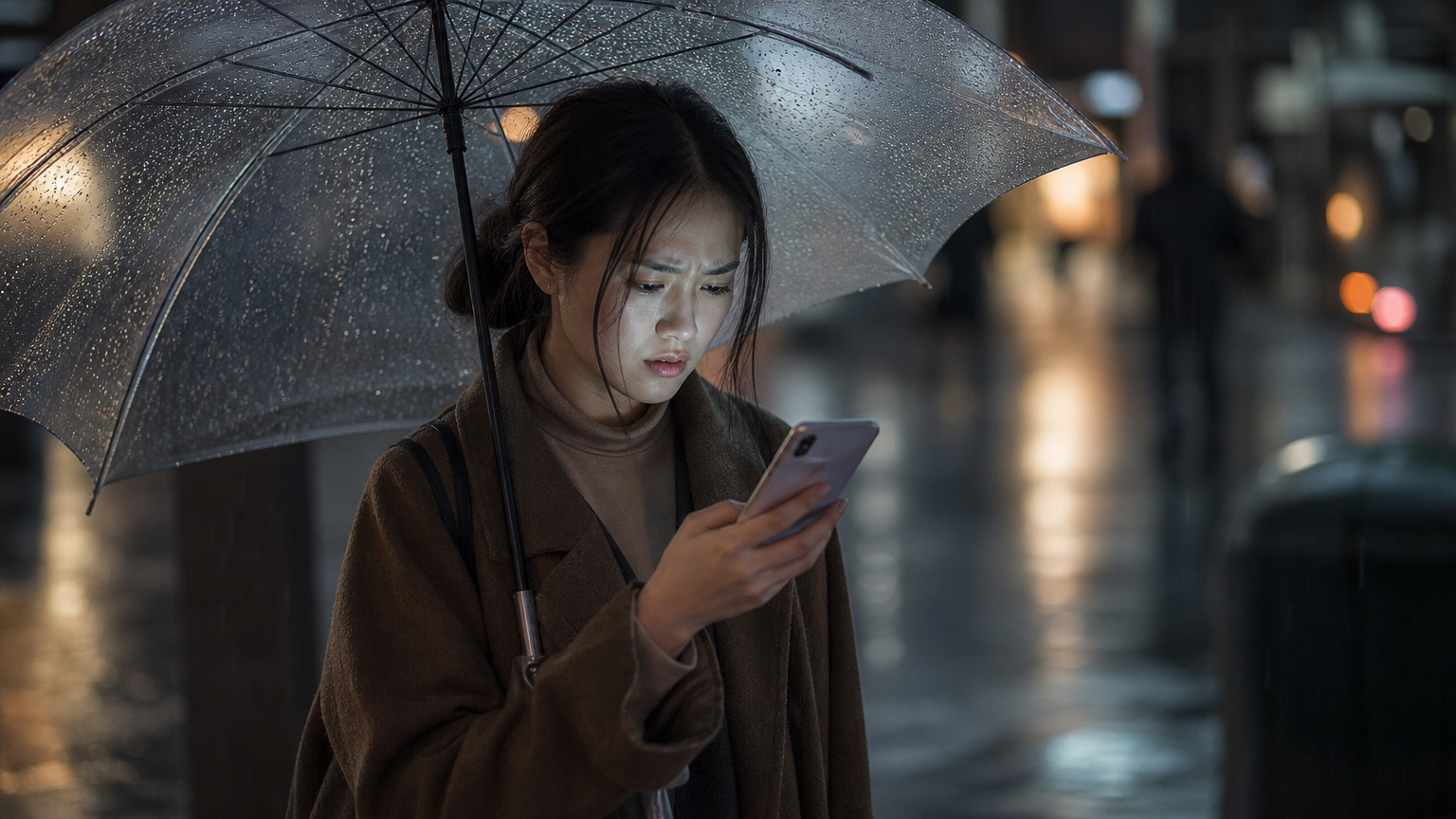
There is a middle path. On most handsets the two lower levels can be adjusted separately, so you can keep the serious tier and quiet the routine one, rather than switching the whole thing off. Look for the emergency alert settings in your phone's notification or safety menu; the exact location varies by manufacturer and by Android or iOS version, which is why I am not going to give you a menu path that will be wrong for your device.
Reading one when it arrives
The messages are sent in Korean. That is the practical problem, and there is no setting that fixes it.
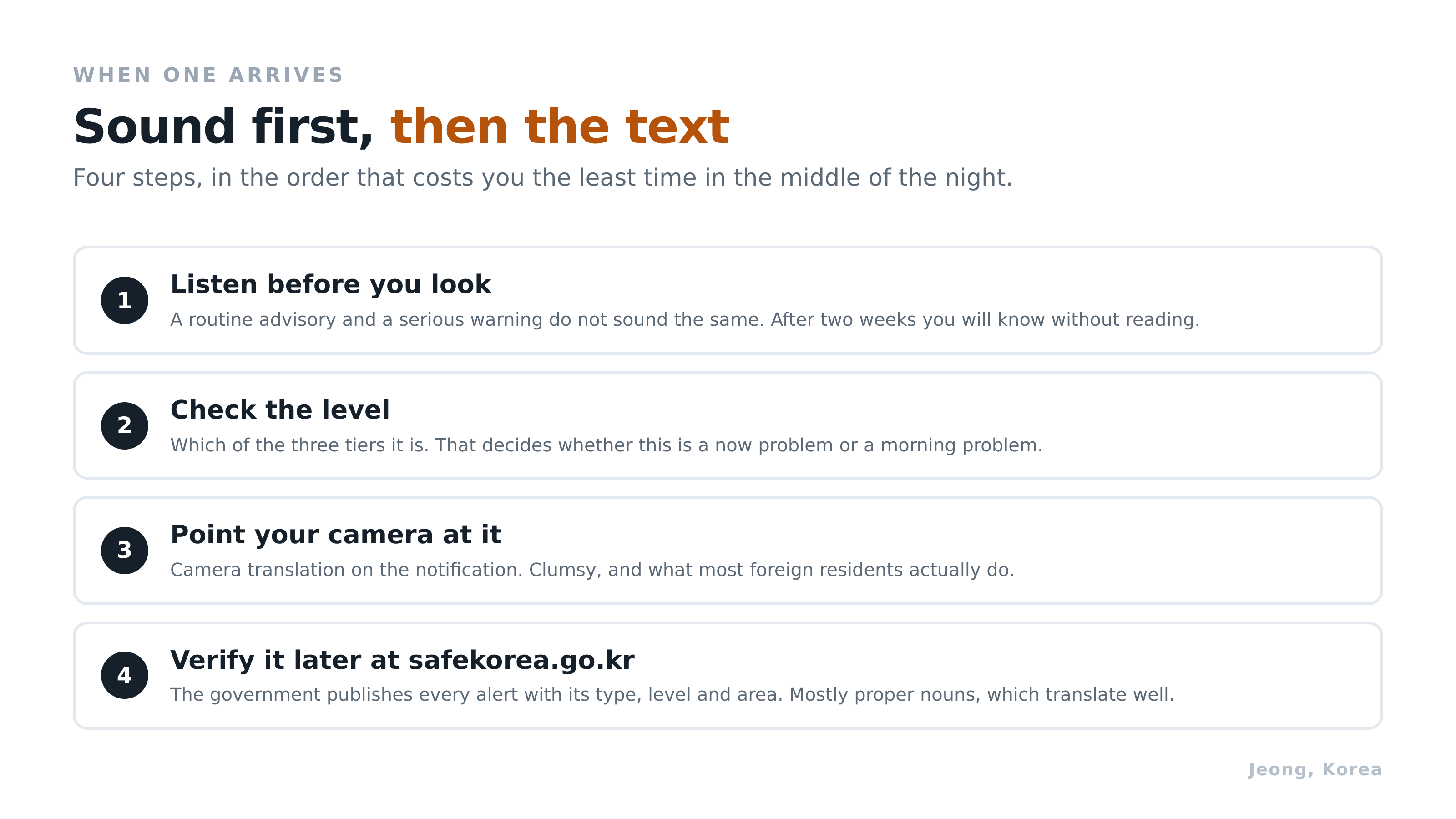
What works is the ordinary one: your phone's camera translation, pointed at the notification. It is clumsy and it is what most foreign residents actually do.
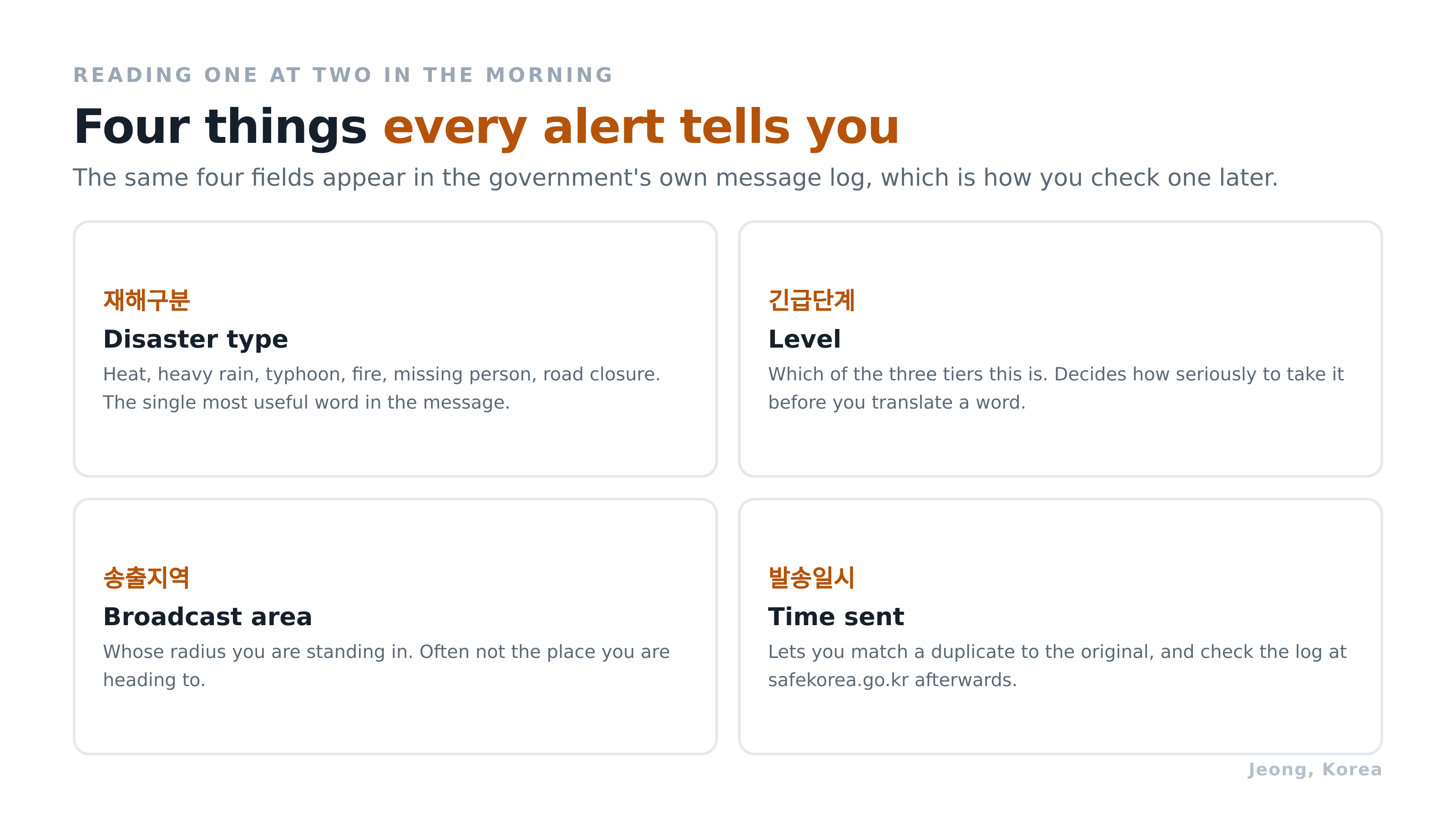
If you want to check whether a Korea emergency alert was real, or see what was sent in your area, the government publishes the message log itself at safekorea.go.kr. Every alert appears there with its disaster type, its level and its broadcast region. It is in Korean, but a message log is mostly proper nouns and timestamps, which translate far better than prose.
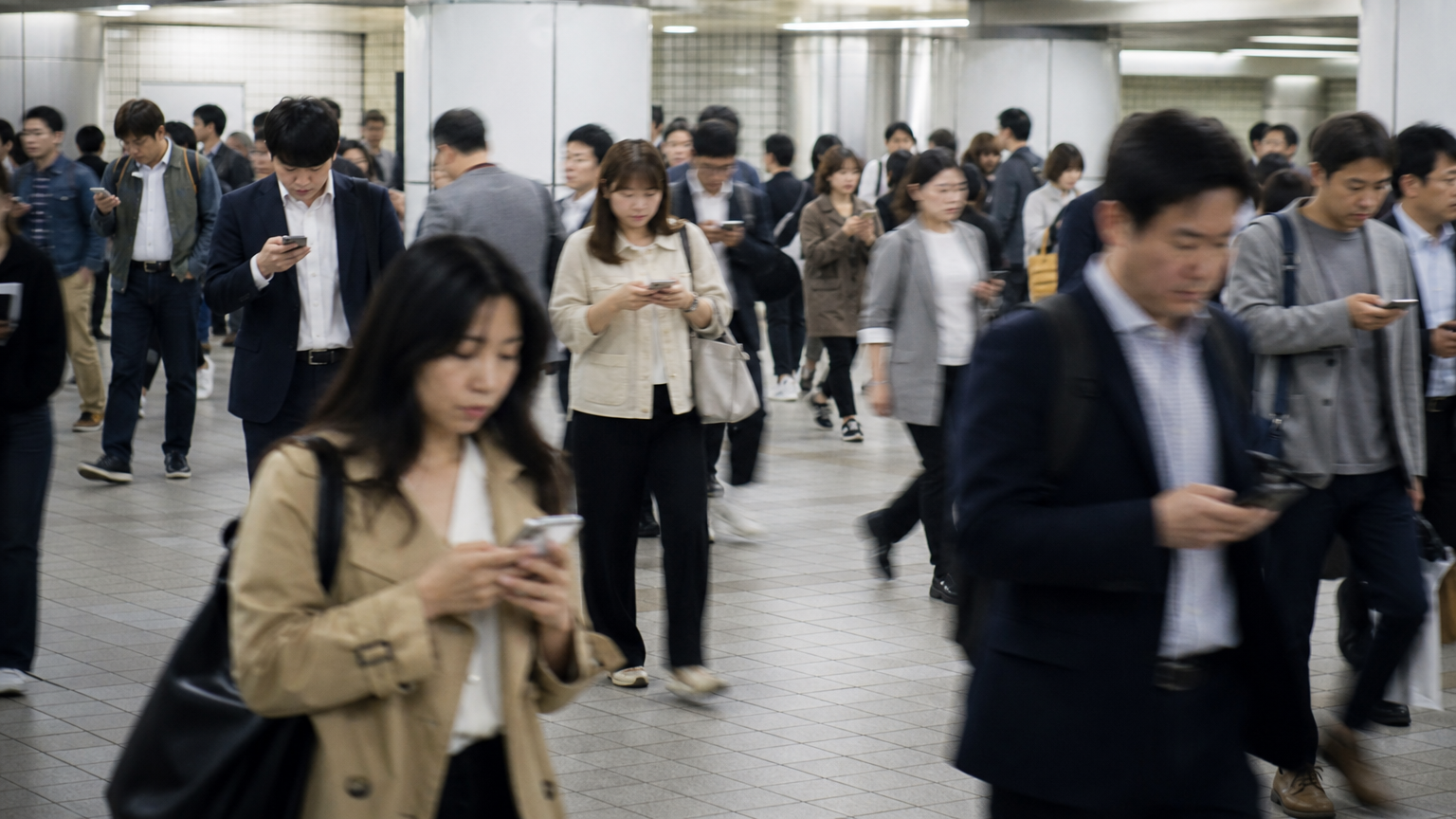
And there is a shortcut worth knowing for the middle of the night. Look at the sound before you look at the text. A routine advisory and a serious warning do not sound the same, and after two weeks here you will recognise the difference without reading a word. That is not a substitute for reading it. It is a way to decide whether to read it now or in the morning.
The short version
A Korea emergency alert is not spam, not a fault, and not something you opted into. A law makes your handset display it, several different authorities can send it, and a set of ministry rules decides how loud it is and whether you are allowed to mute it.
Three levels. The top one is locked and you will probably never see it. The other two are yours to adjust.
Here is the part I would actually worry about. The lower levels are easy to switch off, the relief is immediate, and nothing bad happens for months. Then one night something happens where you are staying, the notice goes out at the level you disabled, and your phone stays dark while everyone else's does not.
Quiet the routine tier if the heat advisories are wearing you down. Leave the serious one on.
FAQ
Why does my phone alarm even in silent mode?
Because delivery is built into the device rather than into an app. Article 38-2(6) of the Framework Act on the Management of Disasters and Safety requires handset manufacturers to ensure disaster warnings are displayed on the user's screen without fail. The alarm behaviour on top of that is set by ministry operating rules and by your handset maker.
Can I turn Korea emergency alert messages off?
The two lower levels, 긴급재난문자 and 안전안내문자, can be switched off in your phone's emergency alert settings. The top level, 위급재난문자, cannot. Adjusting the levels separately is better than disabling everything.
Why did I get the same warning twice?
Because more than one authority can send. Under Article 38-2(4) the Korea Meteorological Administration handles earthquakes, tsunamis, volcanoes and major rain and typhoons, while under Article 38-2(3) the ministry, provinces, cities and district offices handle the rest. Two bodies covering the same event will each send.
Are the alerts available in English?
They are sent in Korean. There is no reliable setting that converts them. Camera translation on the notification is what most foreign residents use, and the government message log at safekorea.go.kr lets you check what was sent in your area.
Is this the same as an earthquake alert?
Earthquake, tsunami and volcano alerts are a specific category assigned to the Korea Meteorological Administration under Article 38-2(4), rather than to the general disaster authorities. They arrive through the same channel on your phone.
Should I be worried when one arrives?
Usually not. The overwhelming majority are routine advisories about heat, road closures or local incidents. Check the level and the sound rather than assuming the worst, and treat the loudest tier as the one that deserves immediate attention.
Sources
Framework Act on the Management of Disasters and Safety, Article 38-2 (재난 및 안전관리 기본법) — National Law Information Center
Standards and Operating Rules for Disaster Message Broadcasting, Ministry of the Interior and Safety (재난문자방송 기준 및 운영규정) — for the message levels and their alert behaviour
National Disaster Safety Portal, safekorea.go.kr — official log of alerts sent, by type, level and region
Korean terms in this article: 위급재난문자, 긴급재난문자, 안전안내문자