Korea SIM Card: What You Are Actually Buying, and Why a Passport Is Enough

Data and a Korean phone number are sold to you as if they were one purchase. They are not, and almost every wall visitors run into here comes from that single confusion.
Here is what that wall looks like in practice. The taxi app installs but will not let you pay. The delivery app accepts your address and then refuses at the last screen. A ticket page asks for a verification code and there is nowhere for it to arrive. None of these are broken, and none of them are about your card. They are asking for something you did not buy.
So this is the piece worth reading before you land, rather than at the arrivals hall with a queue behind you.

The two things that are not the same thing
Almost everything sold to visitors is data. Very little of it is a number.
A data plan gives you the internet. It will run your maps, your messaging apps, your email and your browser perfectly well, and for a short trip that genuinely may be all you need. What it does not give you is a Korean mobile number that can receive a text message from a Korean company.
A number is a separate thing, and in Korea it functions as an identity credential rather than a way for people to call you. Korean services verify who you are by sending a code to a number registered in your name. No number, no verification, no account.
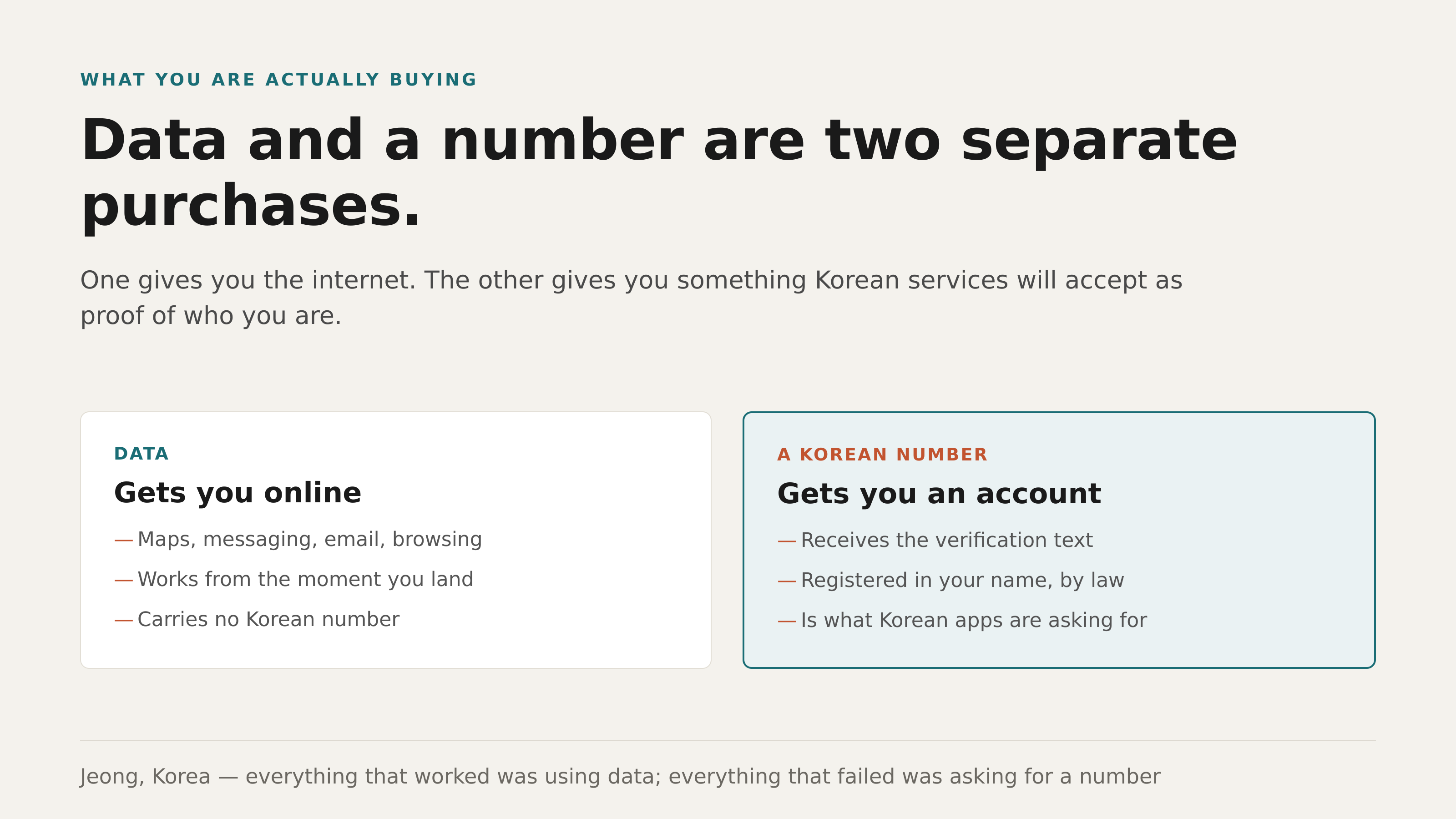
Once you see that split, the pattern in the apps stops looking random. Everything that worked was using data. Everything that failed was asking for a number.
So which of the things on sale actually comes with one?
The three things you can buy, and what each one leaves out
There are broadly three products sold as a Korea SIM card, and they are not tiers of the same thing.
The first is a data-only plan, usually delivered as an eSIM you activate with a code before you fly. It is the cheapest, it is the most heavily advertised to visitors, and it carries no Korean number at all. This is what most people buy without realising there was a choice.
The second is a prepaid SIM card with a number. You pay for a fixed period, you get a Korean mobile number that can receive verification texts, and it works for the length of the trip. It costs more than data alone, and it is the one that solves the app problem.
The third is a postpaid contract, the ordinary monthly plan a resident has. It is not a traveller's product and generally presumes you are staying, with a bank account and a residence behind it — that whole sequence is its own article.
| Product | Korean number | Suits |
|---|---|---|
| Data-only, usually eSIM | No | Short trips where maps and messaging are enough |
| Prepaid SIM | Yes | Anyone who wants Korean apps, delivery or ticketing to work |
| Postpaid contract | Yes | Living here rather than visiting |
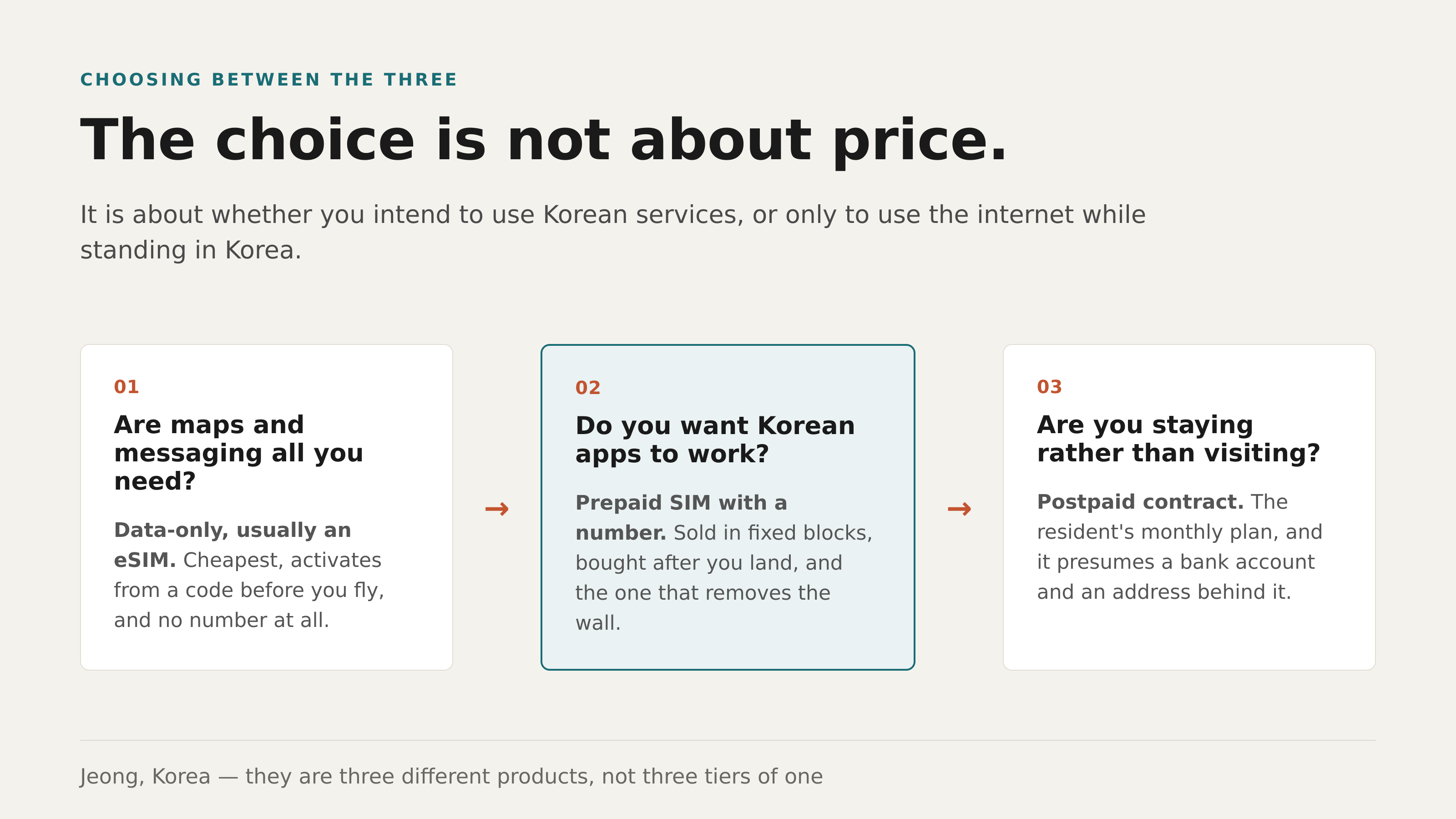
The decision is not really about price. It is about whether you intend to use Korean services or only to use the internet while standing in Korea.
And it is worth being concrete about which services those are.
What actually needs the number
The list is longer than people expect, and it is heavily weighted toward the things that make a trip easier.
Domestic ride-hailing is the clearest case. The app itself installs and shows you cars, and the barrier appears at payment and account registration — which is why we had to write a whole guide to getting a taxi without one. Food delivery is the same story, and again there are workarounds rather than a clean path.
Beyond those, verification tends to appear wherever money or a reservation is involved: domestic ticketing, some rail booking flows, restaurant reservation platforms, and most Korean shopping sites. It also appears at the point where a service wants to send you something — an order status, a booking confirmation, a driver's arrival.
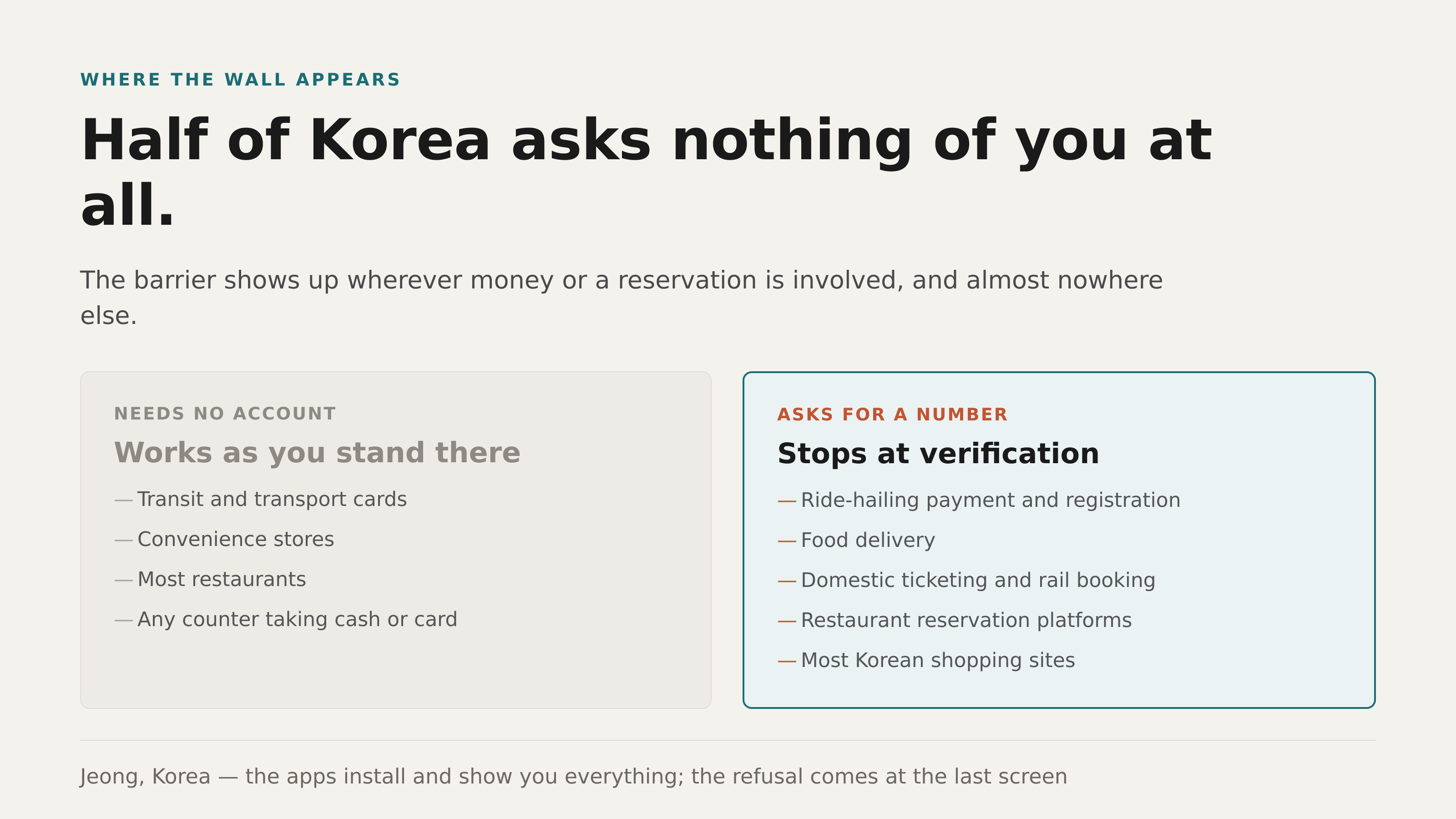
Two things are worth saying in the other direction, so this does not read as scaremongering. Foreign-issued cards fail here for reasons that have nothing to do with phone numbers, and that is a separate problem with a separate fix — we wrote it up. And a great deal of Korea works with no account at all: transit, convenience stores, most restaurants, and any counter where you simply hand over a card or cash.
Which raises the question everybody asks next, and gets the wrong answer to.
You do not need a residence card. A passport is enough.
This is the point where visitors are most often told something untrue, so it is worth going to the source.
Korean law requires mobile carriers to verify the identity of the person entering the contract. The enforcement decree of the Telecommunications Business Act sets out which documents satisfy that requirement, and it lists them by category. For foreign nationals, the accepted documents are a residence card, a resident registration card, a domestic residence report card — or a passport.
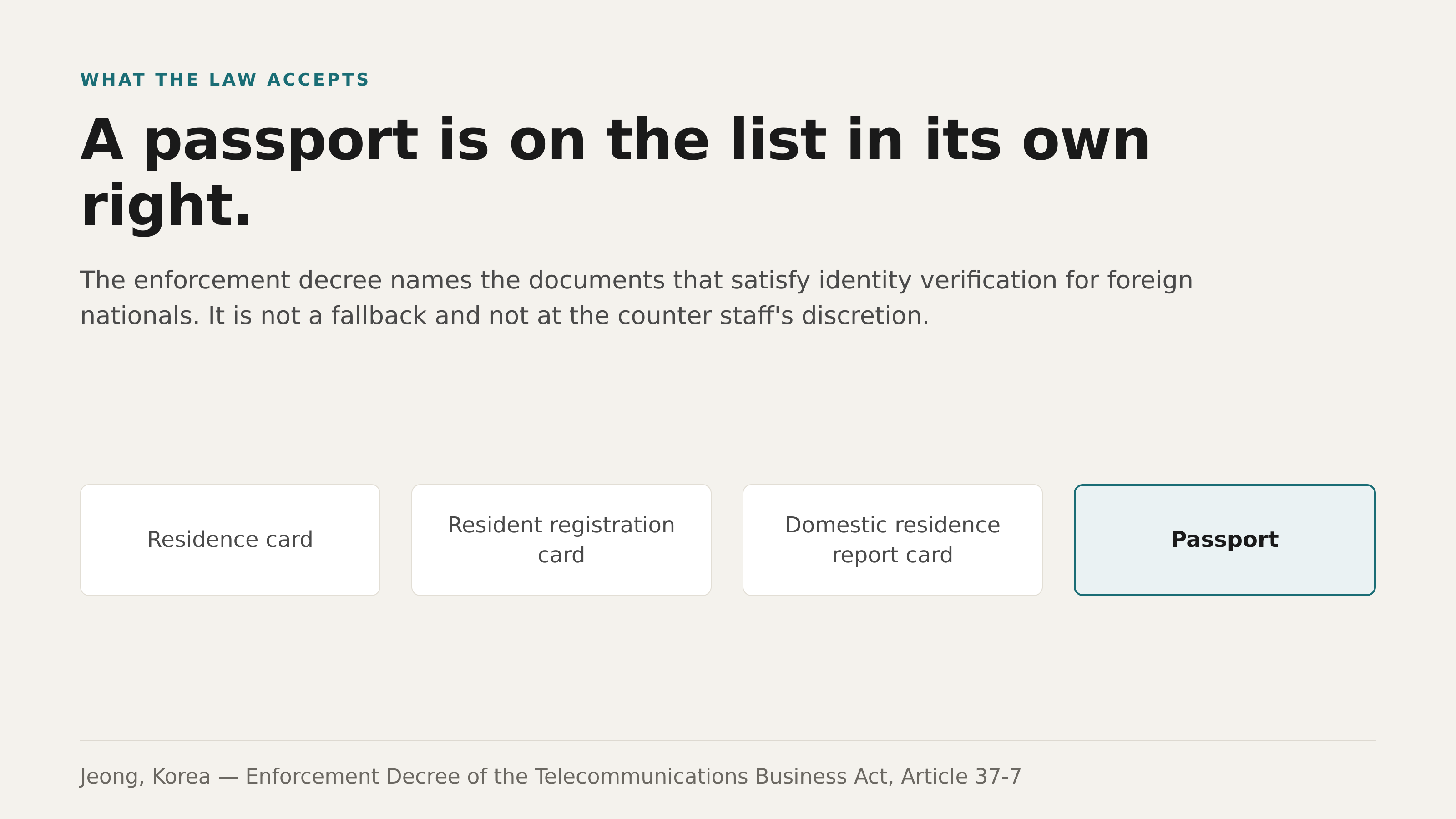
A passport is on that list in its own right. It is not a fallback and it is not at the counter staff's discretion. A visitor with no residence card and no Korean address can be verified with the document already in their pocket.
The same decree requires the carrier to check that the document is genuine through a fraud-prevention system, which is why the process takes a few minutes at a desk rather than being handed over like a packet of gum. That check is the reason the product exists in a regulated form at all, and it is also why an anonymous, unregistered Korean SIM card is not a thing you will find.
There is one practical caveat that has nothing to do with the law. Your handset has to accept the SIM card — an operator-locked phone from home will not, and that is a conversation to have with your own carrier before you fly rather than at a counter in Incheon.
Where and when to buy it
Buy the data before you fly if you want data. Buy the number after you land.
Data-only eSIMs are sold online, activate from a code, and are working by the time you are on the airport train. There is no advantage to waiting.
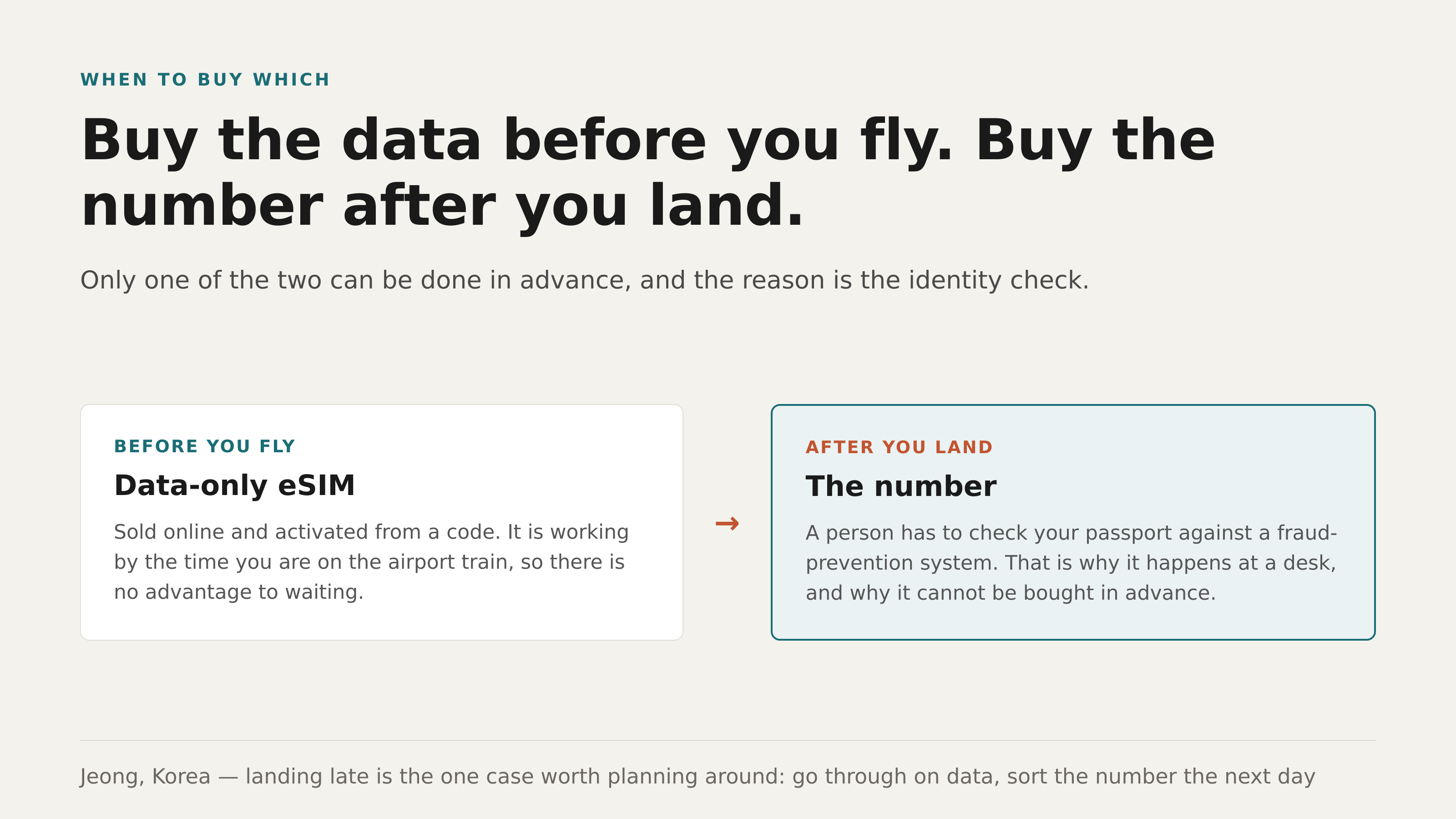
A number is different, because the identity check has to happen. Carrier and reseller desks sit in the arrivals areas of the main airports, and city branches will do the same thing. Arriving late at night is the one case worth planning around: get through the door on data, and sort the number the following day in the city, where nobody is queueing behind you and you are not making the decision while exhausted.
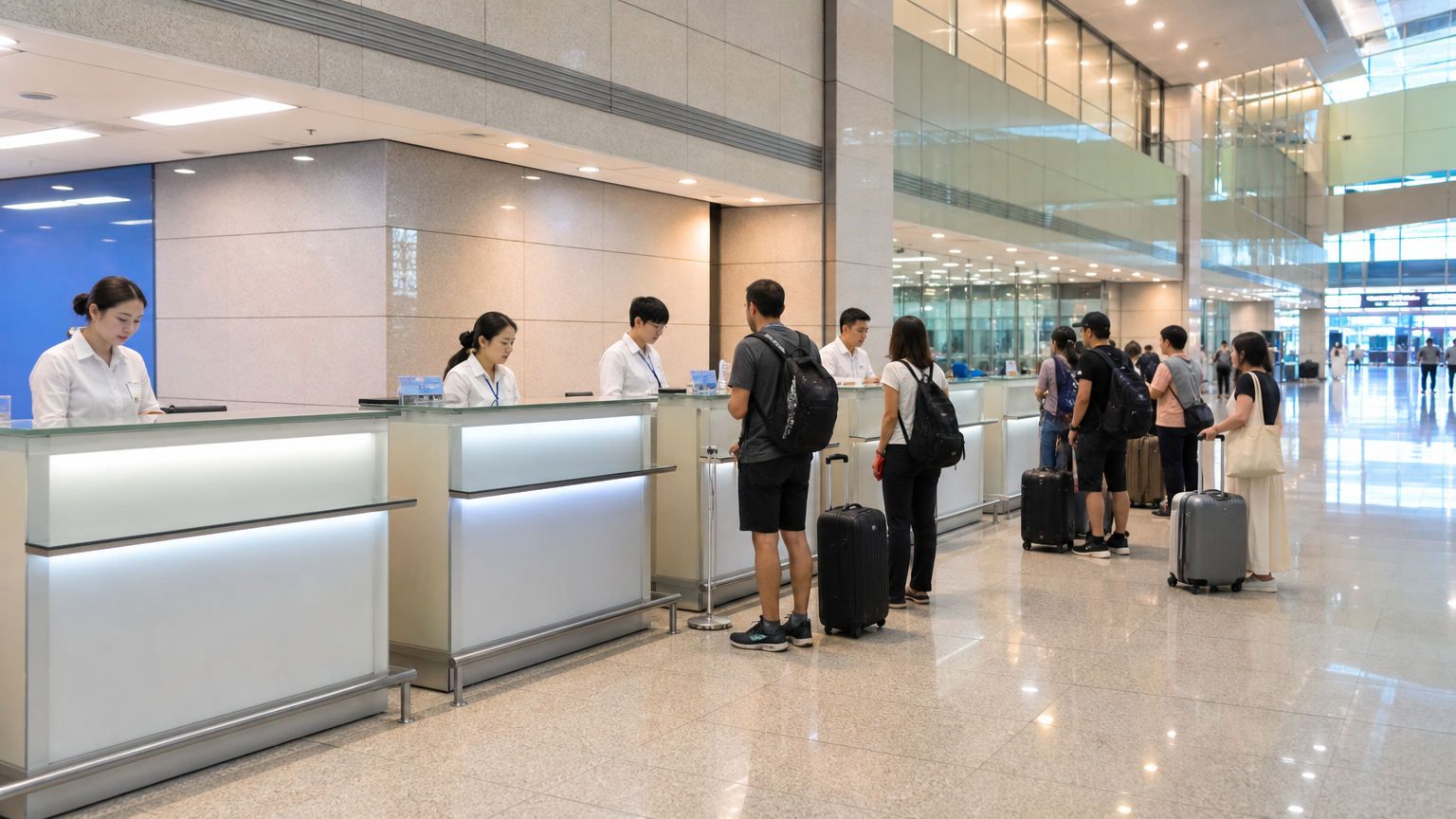
Bring the passport you entered on. Bring an unlocked phone. Decide in advance how long the trip is, because the prepaid periods are sold in fixed blocks and the sensible move is one block that covers the whole trip rather than an extension halfway through.
The short version
If the trip is four days of walking, photographs and maps, data alone is fine and cheap, and you will not miss the number.
If you are staying longer, moving between cities, or you want the same apps Koreans use to order dinner and call a car, buy the number. The extra cost is small next to the number of walls it removes, and the law lets you do it on a passport.
That does leave one thing unsolved, and it catches people who did everything right here: the payment itself. A Korean number gets you the account, and then a foreign card gets declined at the moment you use it. That failure has a different cause and a different fix, and it is the next thing worth knowing before you land.
FAQ
Does an eSIM give me a Korean phone number?
Usually not. Most eSIM products sold to visitors are data-only. Some resellers do offer a number as a separate or upgraded product, so the thing to check on the listing is whether a Korean number is included rather than assuming it is.
Do I need an alien registration card to get a Korean number?
No. The enforcement decree of the Telecommunications Business Act lists a passport among the documents that satisfy identity verification for foreign nationals, alongside a residence card, a resident registration card and a domestic residence report card.
Can I get by with no Korean number at all?
For a short trip, often yes. Transit, shops and restaurants need nothing. What you lose is the Korean app layer — ride-hailing payment, food delivery, and most reservation and ticketing flows.
Should I buy at the airport or in the city?
Data before you fly, since an eSIM activates from a code. A number can be done at an airport desk or a city branch. If you land late, going through on data and sorting the number the next day is the calmer route.
Why does it take longer than buying a SIM elsewhere?
Because the carrier is legally required to verify your document, and to check it against a fraud-prevention system. That is a regulated step rather than a queue problem.
Will my phone work with a Korean SIM card?
Only if it is unlocked. A handset locked to a carrier at home will not accept one, and that is worth resolving before you travel rather than at the counter.
How long do prepaid periods run?
They are sold in fixed blocks rather than by the day. Work out the length of the trip first and buy one block that covers it, rather than planning to extend partway through.
References
-
Telecommunications Business Act (전기통신사업법), Article 32-4 — identity verification on conclusion of a subscription contract
-
Enforcement Decree of the Telecommunications Business Act (같은 법 시행령), Article 37-7 — the documents that satisfy identity verification, including, for foreign nationals and overseas Koreans, a residence card, a resident registration card, a domestic residence report card or a passport; and the requirement to check document authenticity through a fraud-prevention system
-
Jeong, Korea, Korea Taxi App Guide — what the barrier looks like without a number
-
Jeong, Korea, Food Delivery Apps in Korea — the same barrier in a different app
-
Jeong, Korea, Living in Korea as a Foreigner — where a postpaid contract sits in the settling-in sequence
-
Jeong, Korea, Why Your Foreign Card Gets Rejected in Korea — the separate problem waiting at the payment screen