Motel in Korea: What Koreans Actually Use Them For (and Why the Photos Look Like That)

Every Korean knows what a motel is for. Almost no visitor does, and that gap is the entire reason the photographs look so strange to you.
You have probably seen them by now. They sit a few floors up on ordinary streets, they cost a fraction of what the hotels cost, and the room photos have something slightly off about them — coloured lighting, an enormous bathtub, a wall-mounted screen far bigger than the room needs. So you close the tab and book the hotel, because you cannot tell what you would be walking into.
The rooms look like that for a reason, and the reason is not the one you are assuming.
The product that has no English name
A Korean motel sells two different things out of the same building.
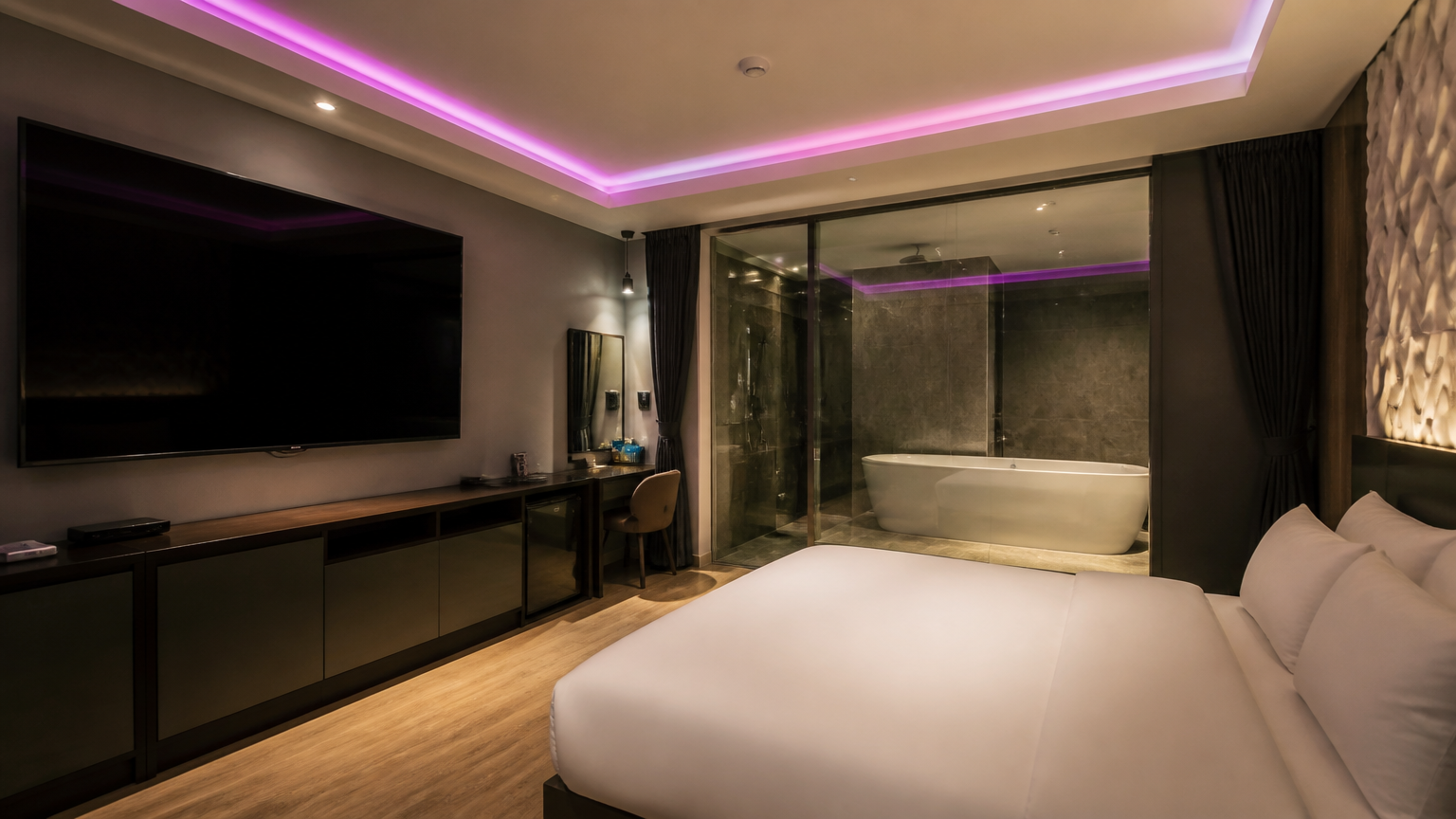
One of them is the night, which is what you were trying to buy. The other is called 대실 — the room, by the hour, for an afternoon. There is no clean English word for it, which is exactly why it does not appear on the international booking site you were looking at, and why nothing there explains the photographs.
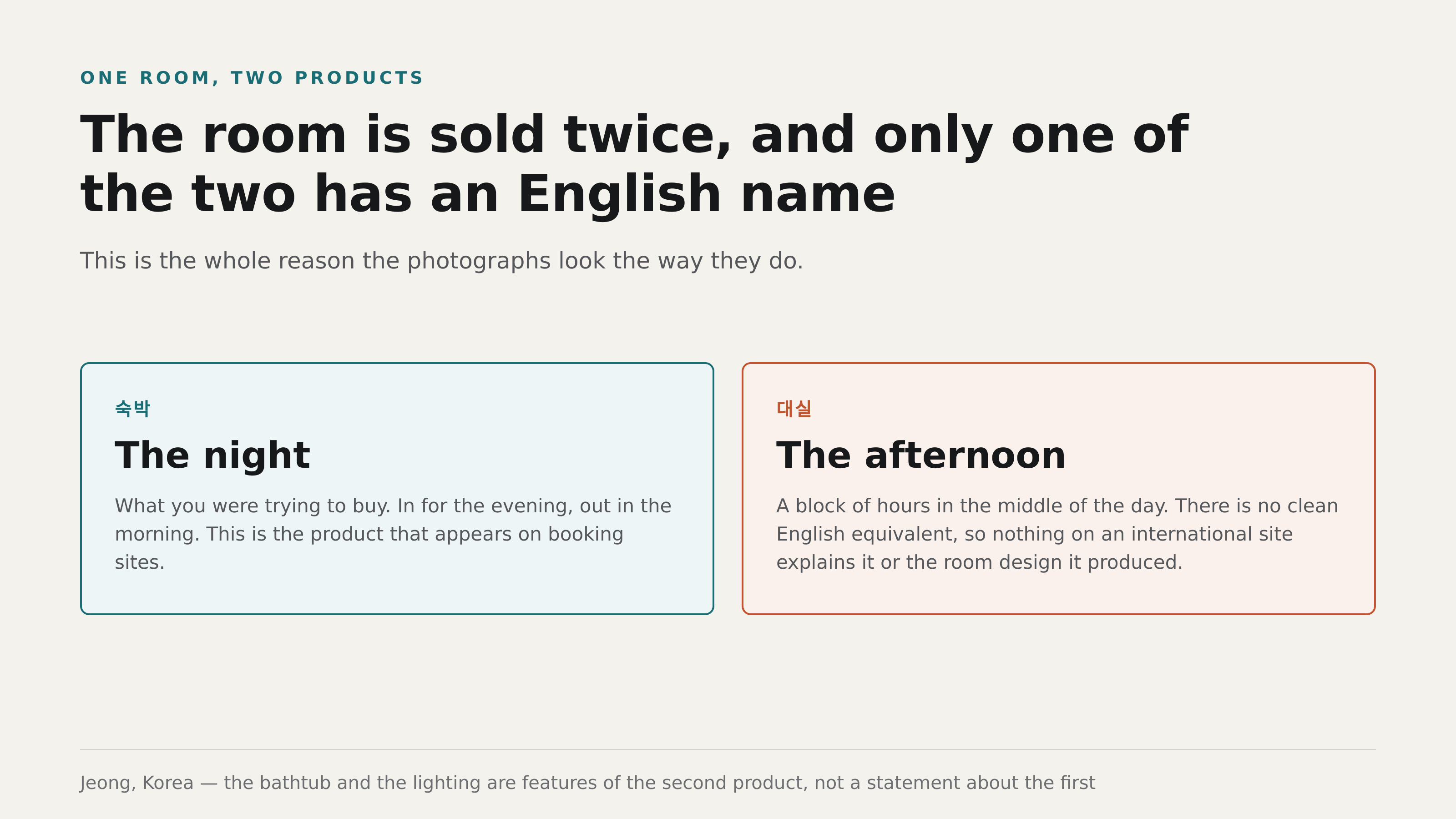
Once you know the second product exists, the room design stops being mysterious. The bathtub, the lighting, the oversized screen — those are features of a room that also gets sold as a few private hours in the middle of a day. They are not a signal about who stays overnight.
Koreans use the daytime product for a wider range of things than visitors assume, and the overnight product for the most ordinary reasons imaginable: a work trip, a wedding in another city, a last train that was missed. If you have ever wondered where Korean domestic travellers stay when they are not on holiday, this is largely the answer.
It is worth saying plainly, because the mistranslation runs the other way too. The word is not a euphemism. It is infrastructure — in the same way a jjimjilbang doubles as somewhere to sleep, without that being the strange thing about it.
So if it is ordinary, why does none of it show up in the star ratings you know how to read?
Korea has a star system. A motel is not in it.
This is the part that resolves most of the confusion, and it is a matter of which register a building is written into.
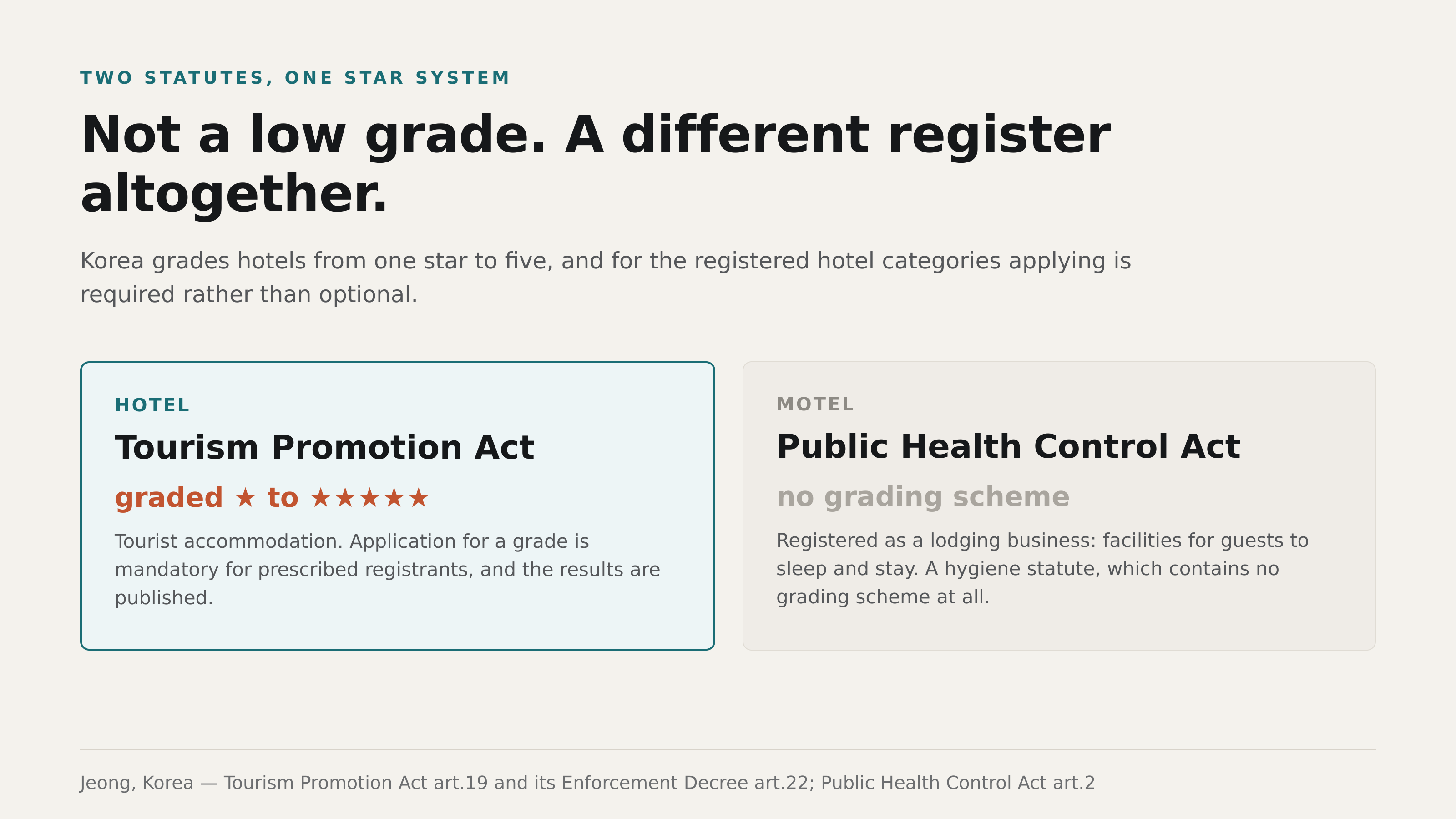
Korea runs a statutory hotel grading system, and it goes from one star to five, exactly as you would expect from home. It is not a marketing badge that a business chooses to buy. Under the Tourism Promotion Act, the Minister of Culture, Sports and Tourism sets the grades, and for the registered hotel categories — the ordinary tourist hotel among them — applying for a grade is required, not optional. The results are published, so a hotel's grade is something you can look up rather than something you have to take on trust.
What you were looking at is not a low grade in that system. It is not in that system at all.
Hotels are registered under the Tourism Promotion Act as tourist accommodation. The buildings you were looking at are registered under an entirely different statute, the Public Health Control Act, in a category called simply "lodging business" — an establishment providing facilities for guests to sleep and stay. That law is about hygiene and premises, not about tourism, and it carries no grading scheme.
| Motel | Hotel | |
|---|---|---|
| Registered under | Public Health Control Act, as a lodging business | Tourism Promotion Act, as tourist accommodation |
| Star grade | Outside the scheme entirely | One to five stars, and applying is mandatory for registered hotels |
| What the law regulates | Hygiene and premises | Tourism standards, facilities and service |
That same statute splits lodging into two kinds, and the distinction is useful when you are reading listings: one has cooking facilities in the room and one does not. The kind in question is the second. If a listing calls itself a residence and has a kitchenette, it is registered under the first.
So the absence of stars tells you which ledger the building sits in. It does not tell you the sheets are worse.
Which leaves the practical question. What actually happens when you walk up to one?
Checking in, and what the machine in the lobby is
Increasingly there is no person at the desk, and that is a feature rather than a shortfall.
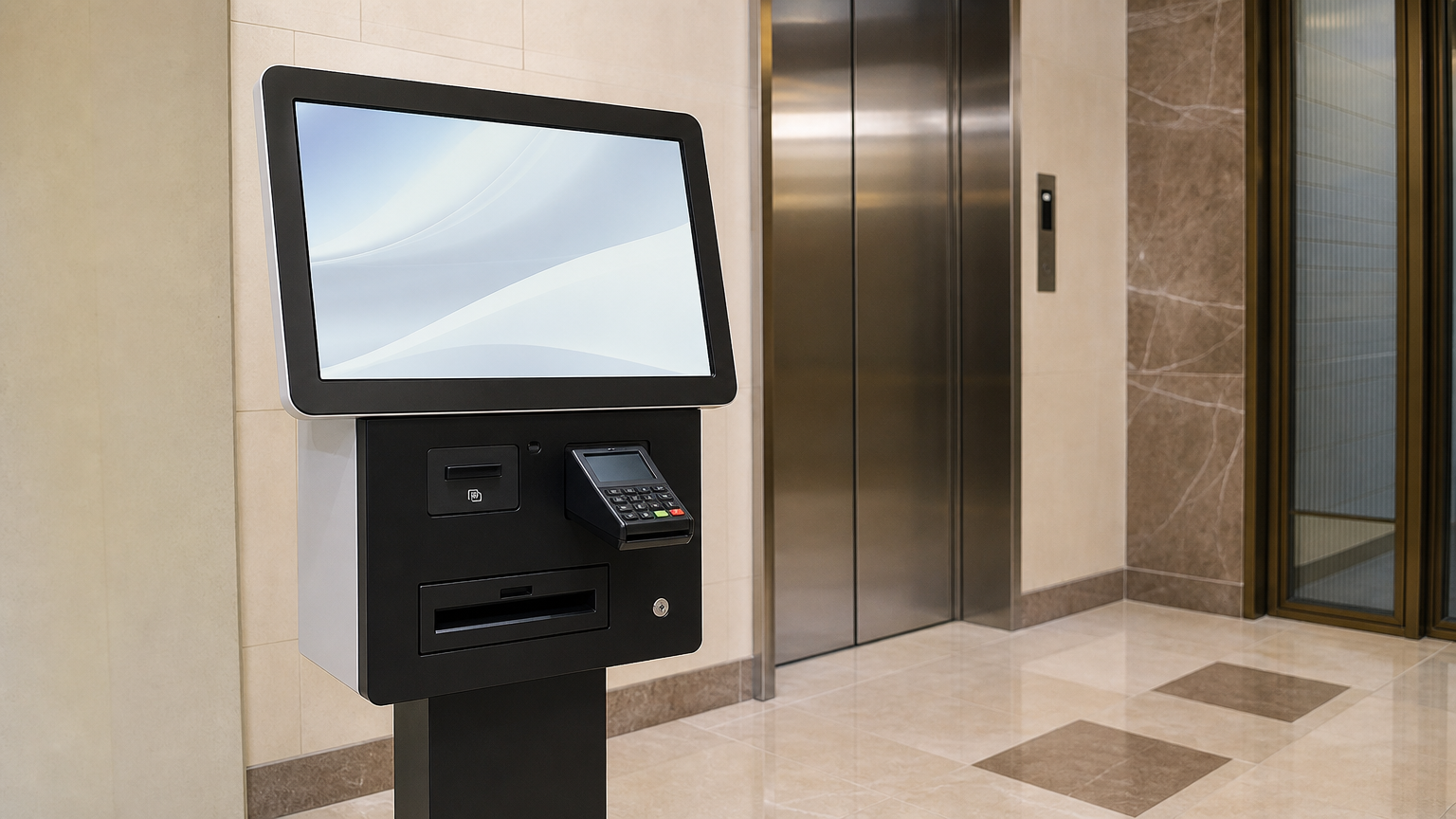
Many now run check-in through a kiosk in the entrance. You choose between the two products on the screen — the night or the daytime block — pay, and a key or a code comes out. If a member of staff is there at all, they are usually behind a small window rather than a counter.
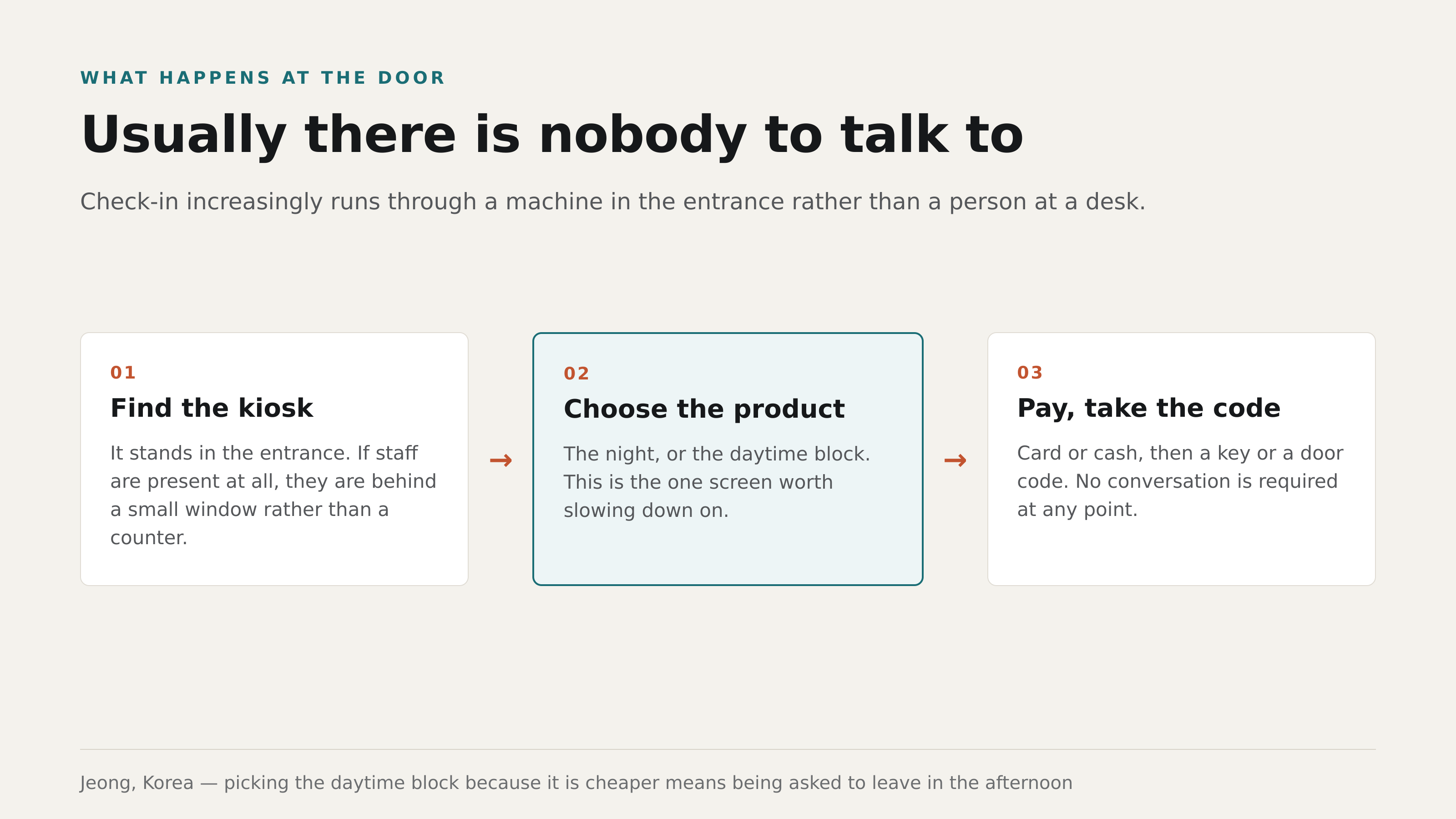
The screen is the thing to slow down on, because choosing wrong is the one mistake that actually costs you. Picking the shorter product because it is cheaper means being asked to leave in the afternoon.
Carry cash as a backup even where cards are accepted. Foreign-issued cards fail in Korea more often than visitors expect, for reasons that sit in the Korean payment network rather than with your bank — we wrote that up separately, and a kiosk is a bad place to discover it.
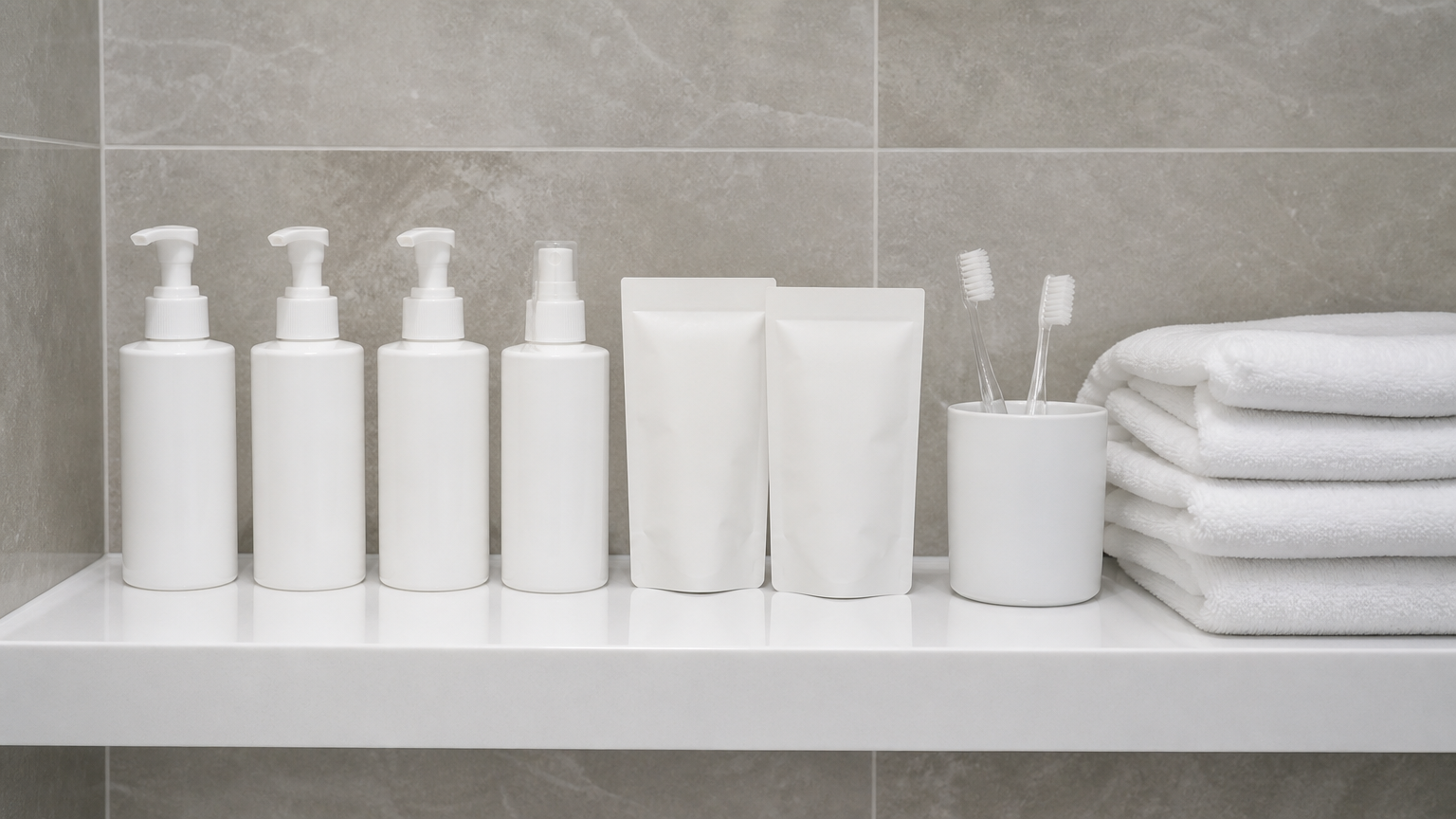
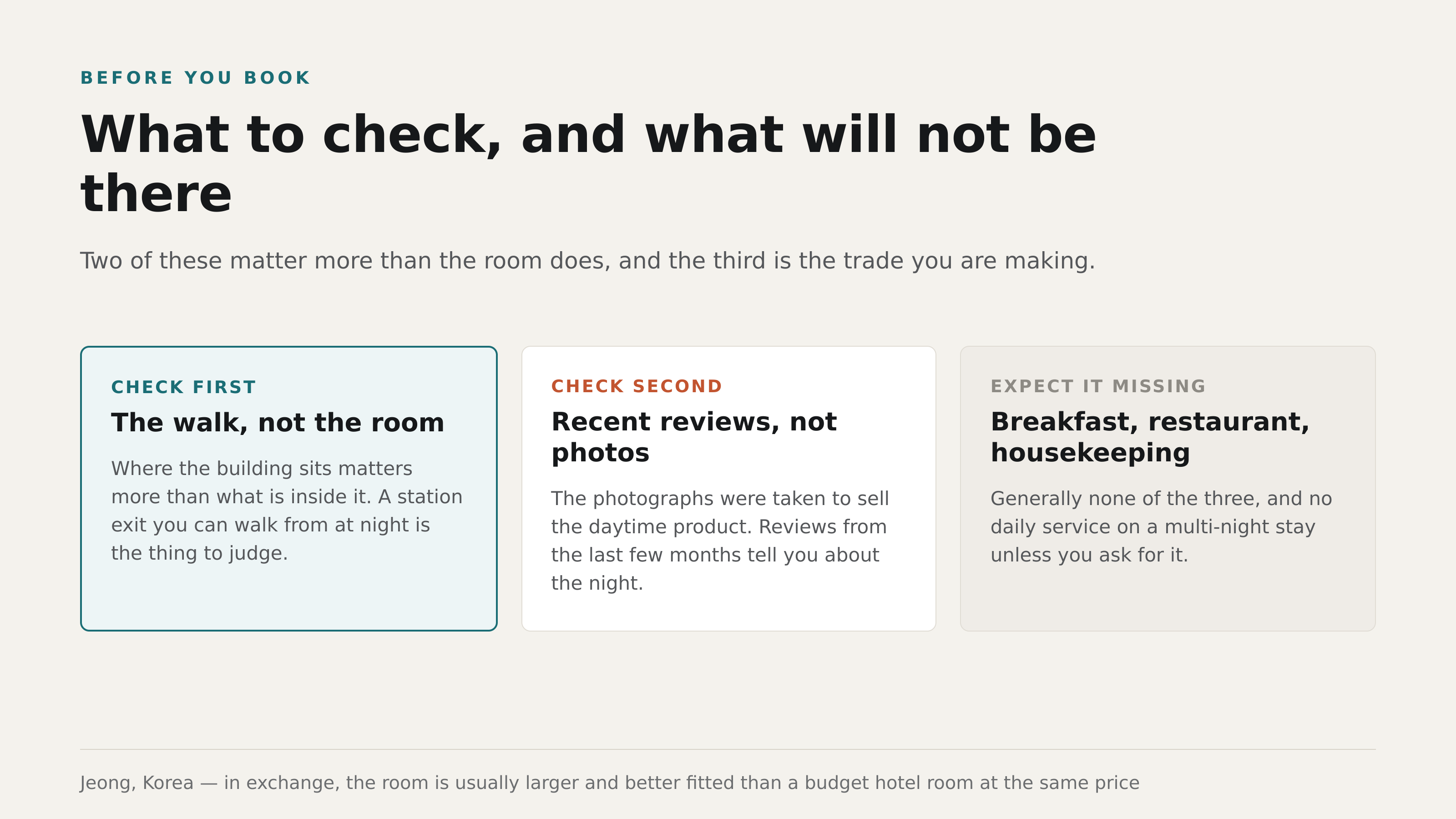
A few things to expect that differ from a hotel of the same price abroad. There is generally no breakfast and no restaurant. There is often no daily housekeeping on a multi-night stay unless you ask. What there usually is, in exchange, is a room noticeably larger than a budget hotel room, a very good shower, fast internet, and a shelf of complimentary toiletries that borders on excessive.
And then the question that stops most people from booking at all.
Going alone, and why they may ask for ID
Yes, and the ID question has a specific legal source that is worth knowing, because it is the opposite of what people assume.
Korean law prohibits businesses from letting minors stay overnight together in a way that amounts to running a disorderly premises, and from providing a place for that purpose. That is a provision of the Youth Protection Act, and it is aimed at operators rather than guests. An operator checking identification is complying with it.
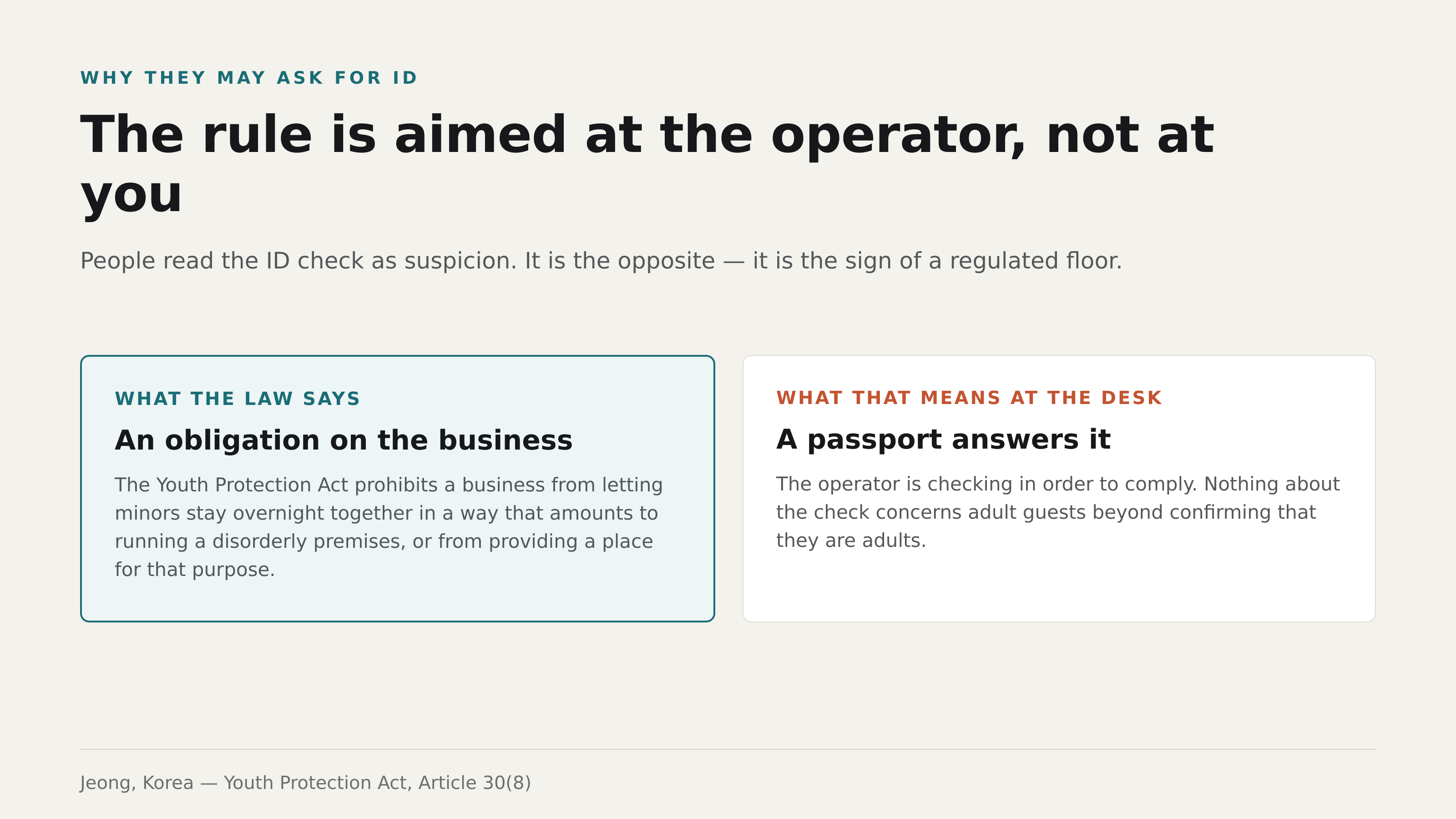
Read that the right way round. Identification is being checked because there is a rule about who may not be there — which is a statement about the floor being regulated, not about it being disreputable.
The practical experience of staying alone is unremarkable. Rooms are individually accessed, there is no shared space to pass through, and a kiosk check-in means there may be no conversation at all. The privacy that visitors read as suspicious is the same privacy that makes it comfortable to arrive somewhere at midnight by yourself.
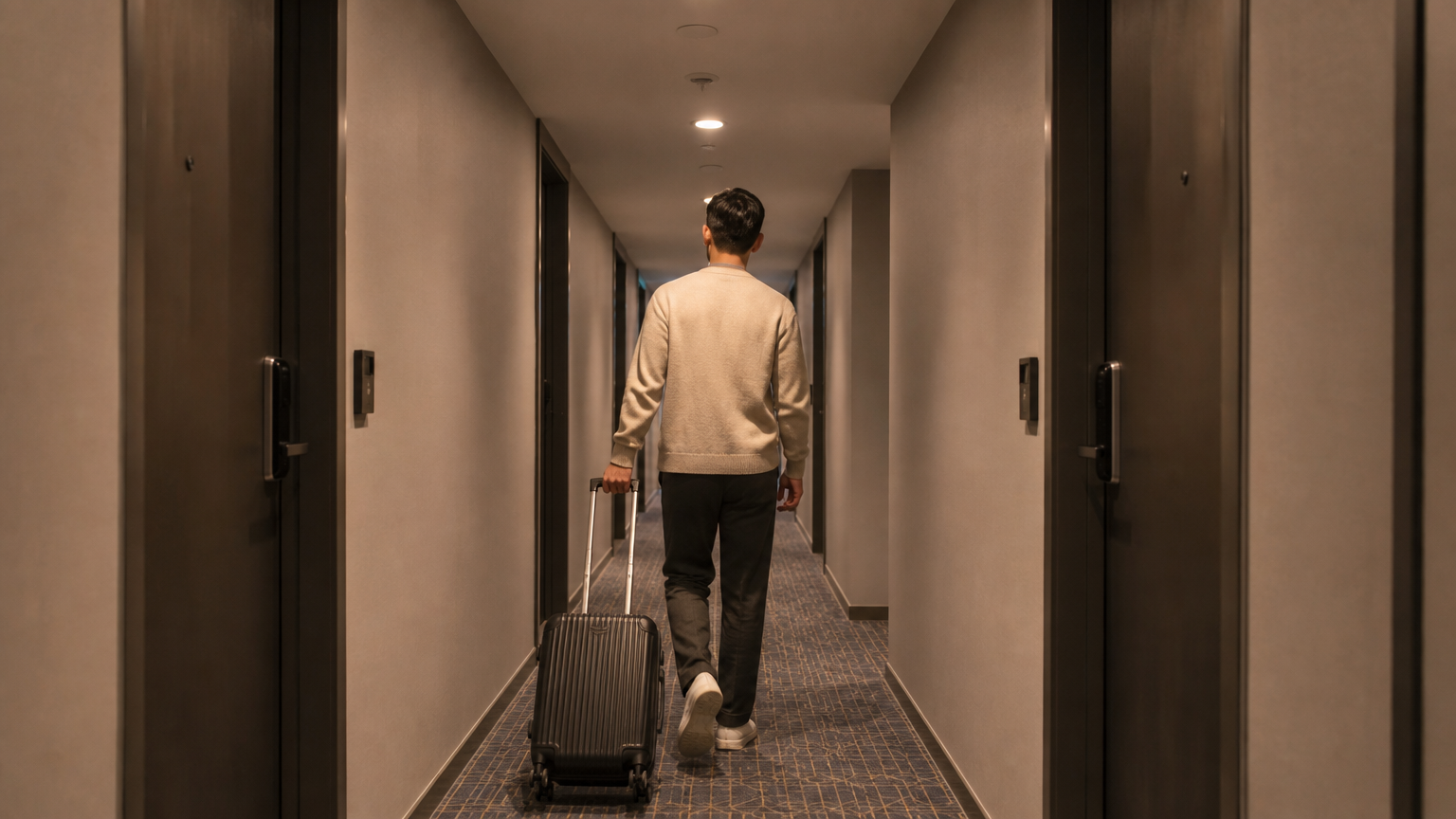
Two things worth doing anyway, and they apply to any accommodation in a country you do not know. Look at where the building actually is before you book — a station exit you can walk from at night matters more than the room does, and the subway map is easier to read than it looks. And read recent reviews rather than the photographs, because the photographs were taken to sell the other product.
What it comes down to
The two sit under different statutes: one a lodging business under a hygiene law, the other tourist accommodation under a tourism law with a mandatory star grade attached. Both are places where a person sleeps, and only one of them is in a system that hands out stars.
The photographs look the way they do because the same room is sold twice, once by the night and once by the afternoon. That is all that was ever going on.
You do not have to make a decision about this in advance. Put a single night in the middle of a trip — a night between two cities, or the one before an early flight — and see what you actually get for the money. If it is not for you, you have lost one night. If it is, you have found the thing Korean travellers have been quietly using the whole time you were paying hotel rates.
FAQ
What is 대실?
The daytime product: a room rented for a block of hours rather than overnight. It has no direct English equivalent, which is why it rarely appears on international booking sites and why the room photographs can look puzzling.
Is a Korean motel a love hotel?
No, though the same building sells a daytime product that has given rise to that reputation abroad. Overnight, it is ordinary accommodation, and it is what a great many Korean domestic travellers use for work trips, weddings and journeys between cities.
Can I stay in one alone?
Yes. Rooms are individually accessed, there is no communal space to cross, and where check-in runs through a kiosk there may be no interaction with anyone at all.
Why would they ask for my ID?
Because the Youth Protection Act places obligations on operators regarding minors staying overnight on their premises. The check is compliance aimed at the business, not scrutiny of you. A passport answers it.
Do I need to book in advance?
Often not, and walking in is normal. Booking ahead is still worth it in a small city during a festival or a public holiday, when everything fills.
Why do motels have no star rating?
Because the star system belongs to a different statute. Grades of one to five stars are set under the Tourism Promotion Act for registered hotel categories, and applying is mandatory for those. That category is registered under the Public Health Control Act as a lodging business, which is outside that scheme altogether.
What is the actual difference from a hotel?
Legally, the statute each is registered under, and whether a star grade applies. Practically, expect a larger room and better fittings than the price suggests, and no breakfast, no restaurant and no daily housekeeping unless you ask.
References
-
Public Health Control Act (공중위생관리법), Article 2(1)(2) — definition of the lodging business, being the provision of facilities for guests to sleep and stay
-
Enforcement Decree of the Public Health Control Act (같은 법 시행령), Article 4 — the split of lodging businesses into those without cooking facilities in the room and those with them
-
Tourism Promotion Act (관광진흥법), Article 3(1)(2)(a) — hotel business as a category of tourist accommodation, and Article 19 — grading of tourist accommodation, mandatory application for prescribed registrants, and publication of results
-
Enforcement Decree of the Tourism Promotion Act (같은 법 시행령), Article 22 — the registrant categories required to apply, and the five-tier grade scale from one to five stars
-
Youth Protection Act (청소년 보호법), Article 30(8) — prohibition on operating or providing premises for minors to stay overnight together in a manner amounting to a disorderly business
-
Jeong, Korea, Jjimjilbang in Seoul — the other place Koreans sleep that is not a hotel
-
Jeong, Korea, Why Your Foreign Card Gets Rejected in Korea — why to carry cash for a kiosk check-in
-
Jeong, Korea, Seoul Subway Map — judging a location before you book it