Korean Phrases That Actually Get Used (and the Ones Textbooks Teach by Mistake)

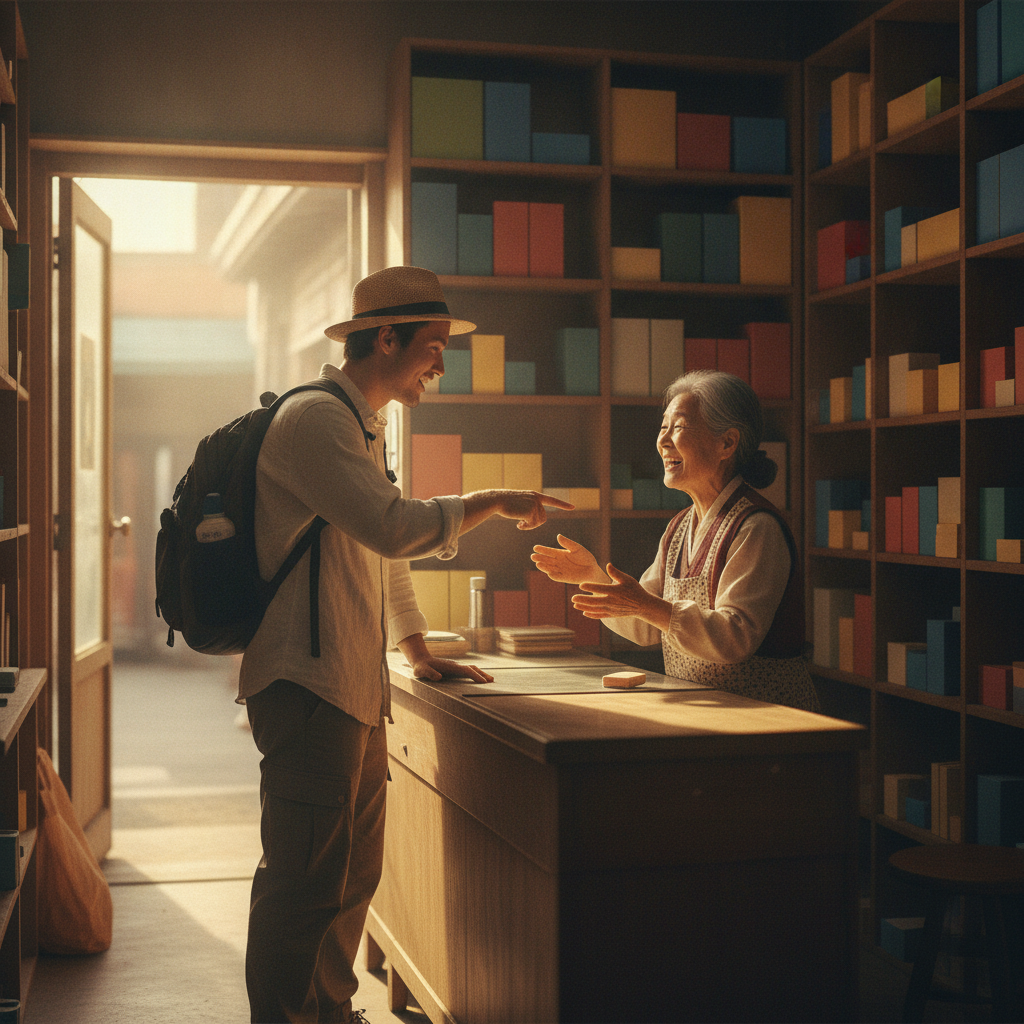
A friend of mine studied Korean for three months before visiting. The first thing she said to a restaurant owner was a full, grammatically perfect sentence asking for a menu.
The owner blinked, laughed, and handed her a menu. Then she told me afterward, kindly, that my friend had spoken to her the way a news anchor speaks to a nation.
Nothing went wrong. But nothing landed either. And that gap — between correct Korean and the Korean people actually use — is what this is about.
More than 550,000 people applied to take the Korean proficiency exam in 2025, which tells you how many are studying. It does not tell you which twelve words would carry an entire week here. So here are the korean phrases I would give a friend the night before they land.
The textbook problem
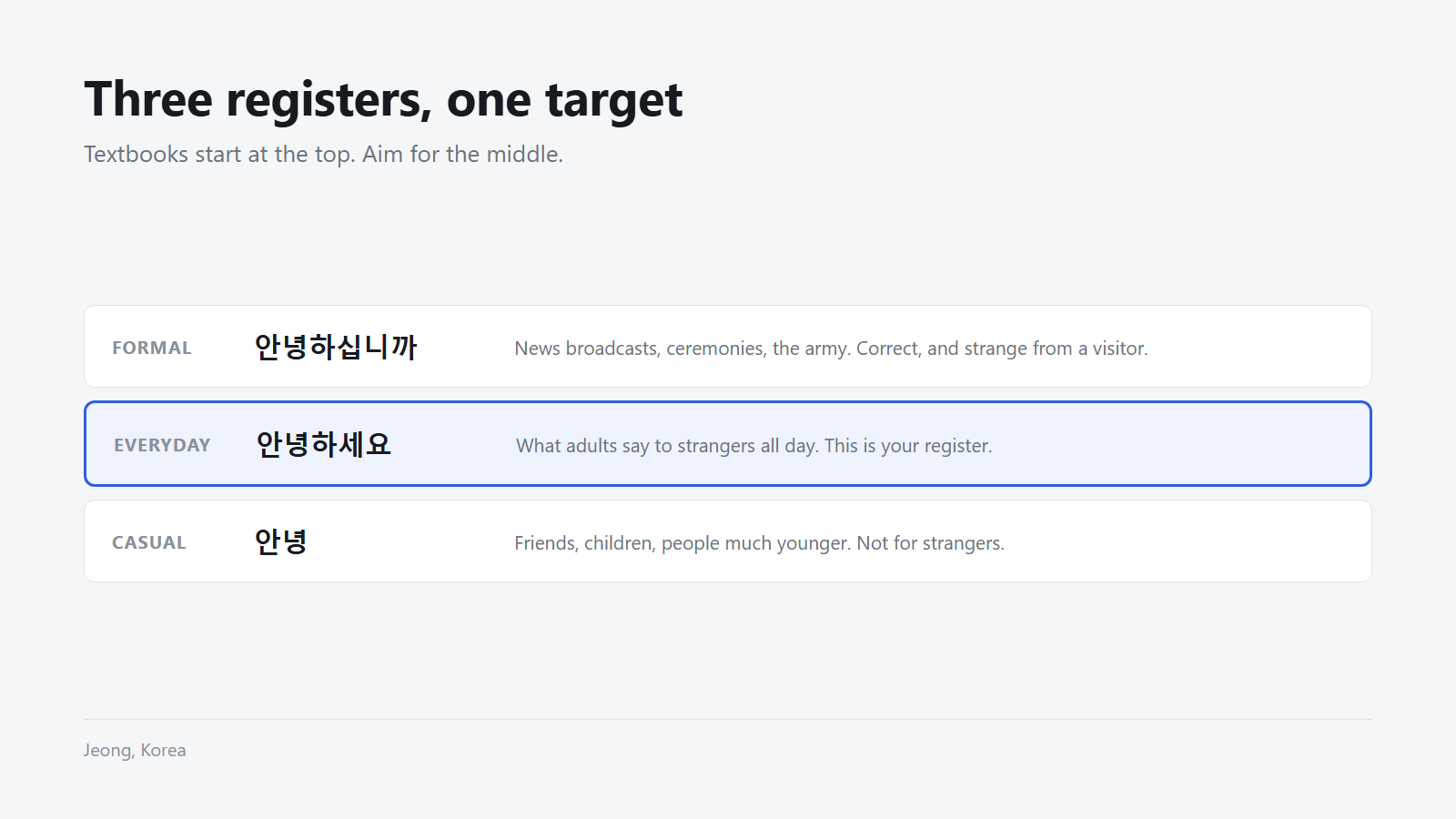
Korean textbooks teach the most formal register first, because it is the safest and the easiest to grade. The result is that learners arrive speaking a version of Korean that is technically flawless and socially odd — like ordering coffee in Shakespearean English.
Here is the pattern, using the same meaning at three levels.
| What you want to say | Textbook version | What people actually say |
|---|---|---|
| Hello | 안녕하십니까 (an-nyeong-ha-shim-ni-kka) | 안녕하세요 (an-nyeong-ha-se-yo) |
| Thank you | 대단히 감사합니다 | 감사합니다 (gam-sa-ham-ni-da) |
| Excuse me, over here | 실례하지만 여쭤보겠습니다 | 저기요 (jeo-gi-yo) |
| Please give me this | 이것을 주시겠습니까 | 이거 주세요 (i-geo ju-se-yo) |
| Goodbye | 안녕히 계십시오 | 안녕히 계세요, or a small nod |
The right-hand column is not slang or sloppy. It is the register that adults use with strangers all day, every day. Aim there.
The twelve that carry a whole trip
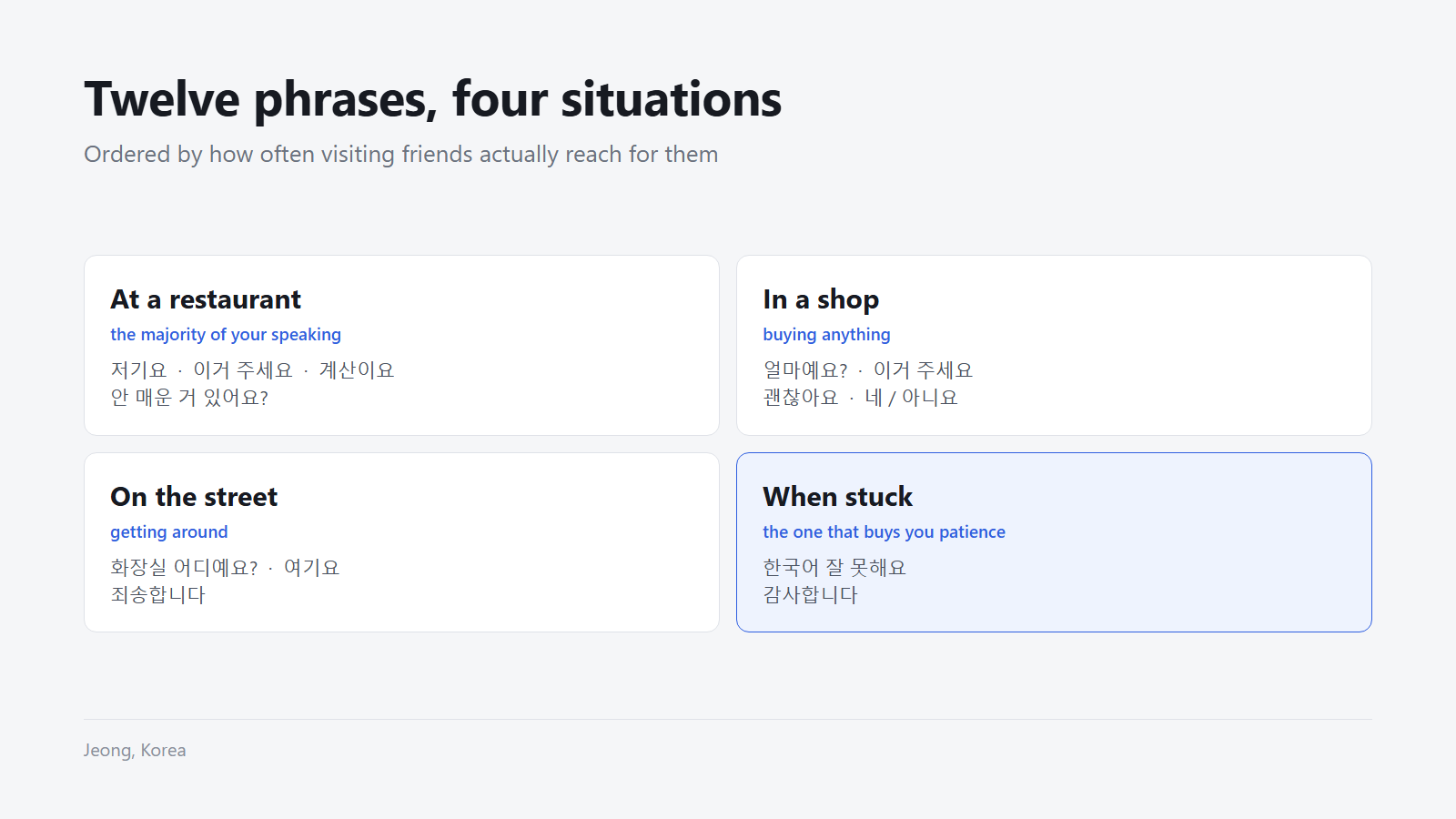
If you learn nothing else, learn these. I have ordered them by how often my visiting friends actually reach for them.
| Korean | How to say it | When |
|---|---|---|
| 저기요 | jeo-gi-yo | To get any staff member's attention. The single most useful word here |
| 이거 주세요 | i-geo ju-se-yo | "This one, please" — point at it. Works for menus, shops, everything |
| 감사합니다 | gam-sa-ham-ni-da | Thank you |
| 죄송합니다 | joe-song-ham-ni-da | Sorry, or excuse me for bumping into you |
| 얼마예요? | eol-ma-ye-yo | How much is it? |
| 계산이요 | gye-san-i-yo | "The bill" — said toward the counter, not the table |
| 네 / 아니요 | ne, a-ni-yo | Yes and no |
| 괜찮아요 | gwaen-chan-a-yo | "It's fine" or "no thanks" — enormously versatile |
| 여기요 | yeo-gi-yo | "Over here" or "here you go" |
| 화장실 어디예요? | hwa-jang-sil eo-di-ye-yo | Where is the toilet? |
| 안 매운 거 있어요? | an mae-un geo iss-eo-yo | "Is there something not spicy?" |
| 한국어 잘 못해요 | han-gug-eo jal mot-hae-yo | "I don't speak Korean well" — buys you patience instantly |
Two of these deserve a note. 저기요 is what you say instead of waving or saying "excuse me" in English. Korean restaurants expect to be called, and staff will not hover at your table waiting. Saying it feels rude the first time. It is not. Not saying it is what leaves you sitting there.
And 한국어 잘 못해요 does more work than any phrasebook suggests. The moment you say it, people slow down, switch to gestures, and often pull out a translation app. You are not admitting failure. You are handing them a way to help you.
Reading the sounds without learning Hangul
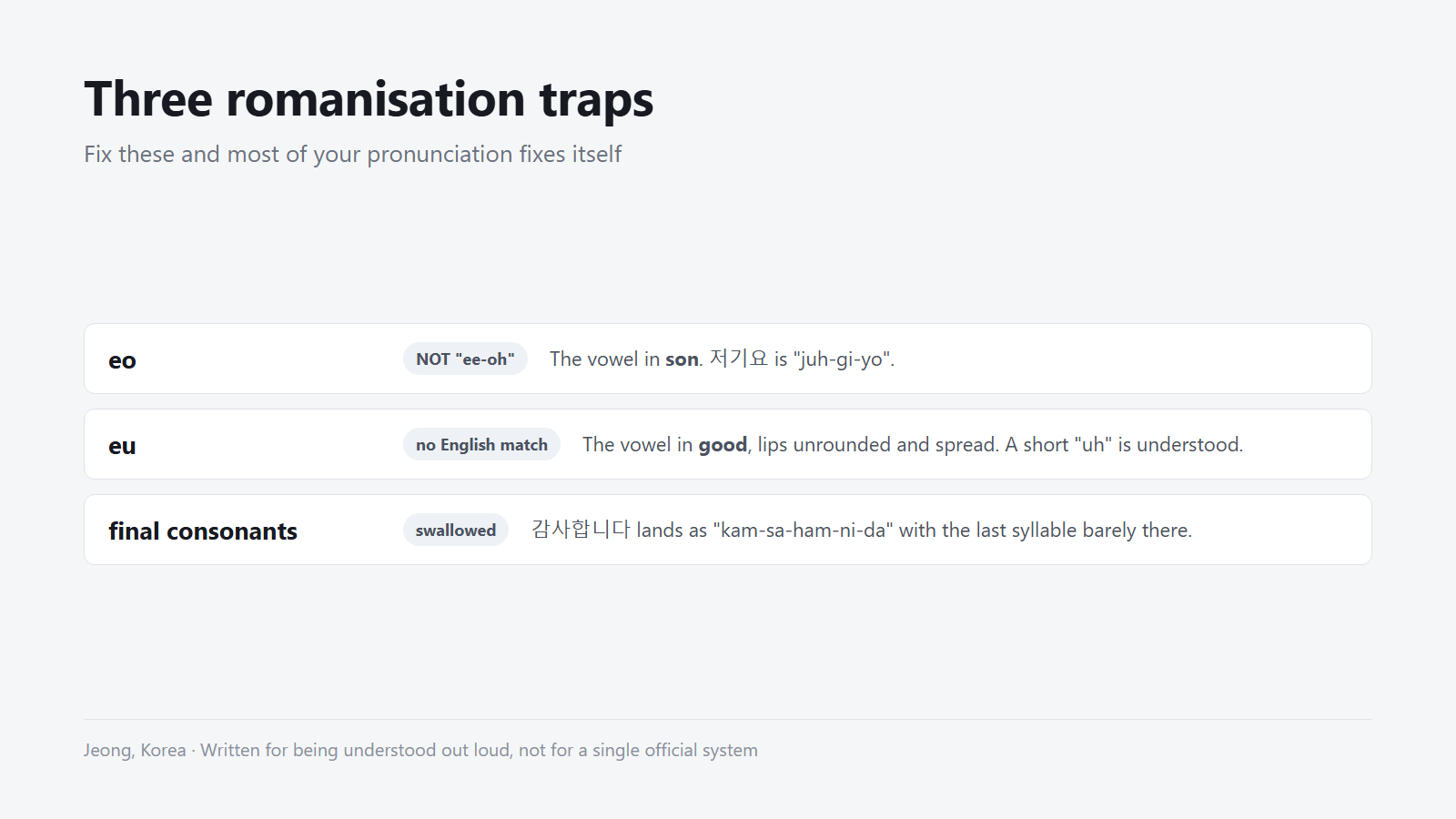
You do not need to read Korean for a one-week trip. But the romanisation you see on signs will mislead you in three specific ways, and knowing them fixes most of your pronunciation.
-
"eo" is not "ee-oh". It is closer to the vowel in son. So 저기요 sounds like "juh-gi-yo", not "jee-oh-gi-yo".
-
"eu" has no English equivalent. Make the sound in good with your lips unrounded and spread. Or just say a very short "uh" and you will be understood.
-
Final consonants get swallowed. 감사합니다 sounds like "kam-sa-ham-ni-da" with the last syllable barely there. Do not over-pronounce it.
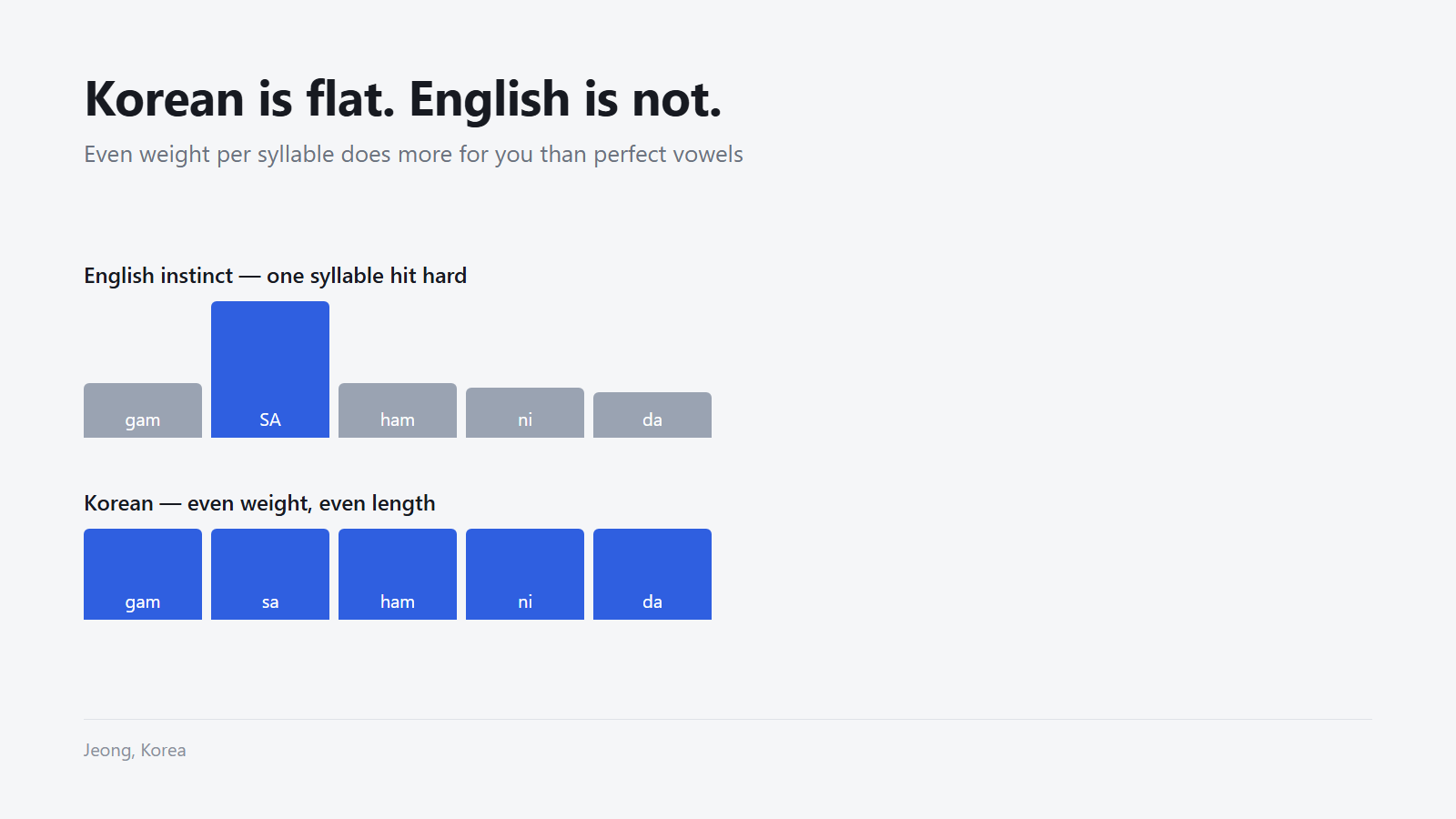
One more thing that surprises people: there is no strong stress in Korean. English speakers instinctively hit one syllable harder. Korean is much flatter. If you give each syllable roughly even weight and even length, you will sound dramatically more comprehensible than if you get every vowel right but keep an English rhythm.
One layer of politeness is all you need
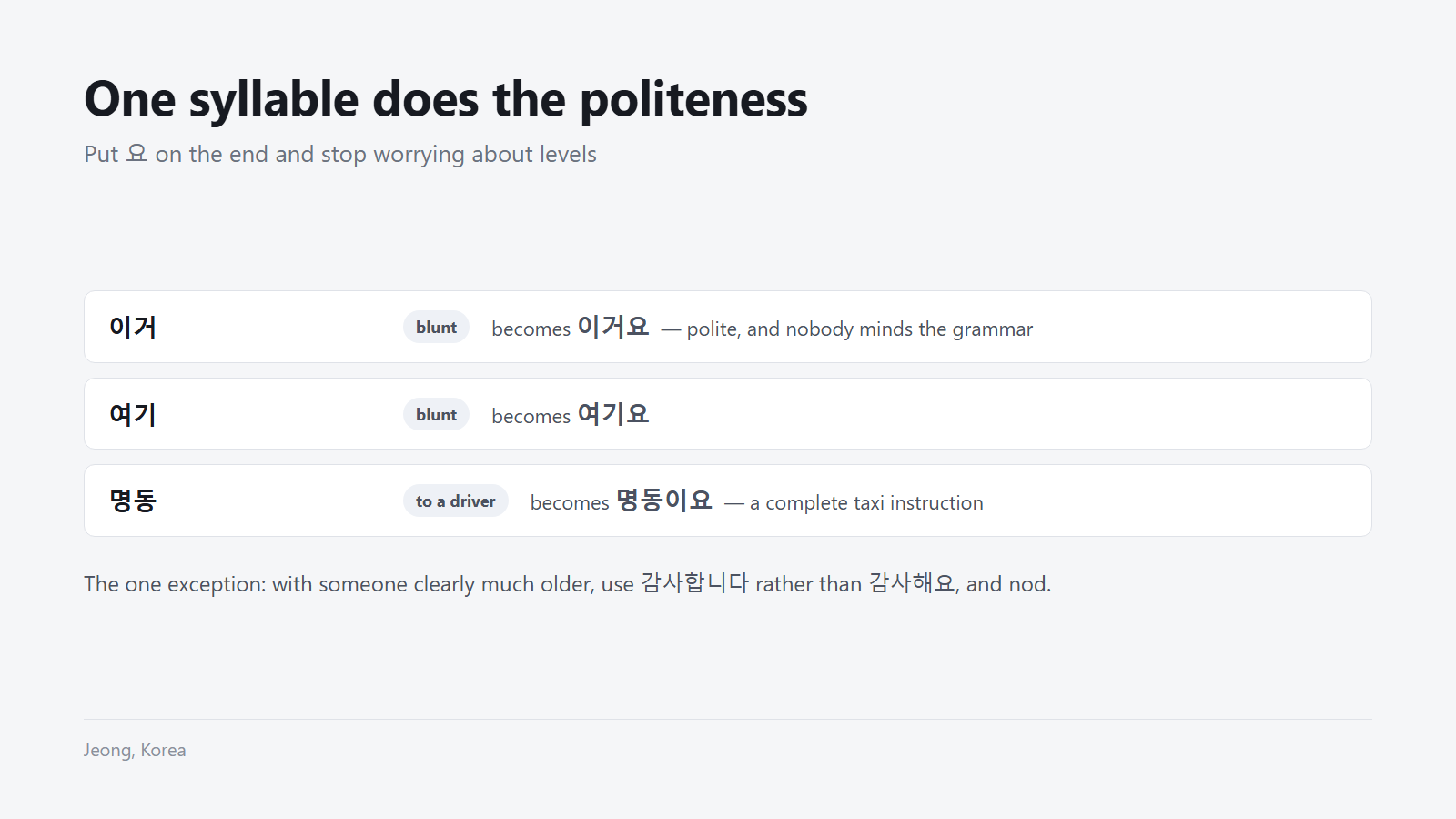
Korean has several politeness levels, and learners tie themselves in knots over which to use. For a visitor the answer is simple: put 요 (yo) on the end of things and stop worrying.
That single syllable turns a blunt statement into a polite one. 이거 becomes 이거요. 여기 becomes 여기요. It is not perfect grammar in every case, and nobody will mind. It signals that you are trying to be polite, and that signal is what actually matters.
The one situation where you might reach higher is speaking to someone clearly much older, such as a grandmother running a market stall. There, 감사합니다 rather than 감사해요, and a small bow of the head. That is the whole adjustment.
What not to say
A short list, because these come up constantly.
-
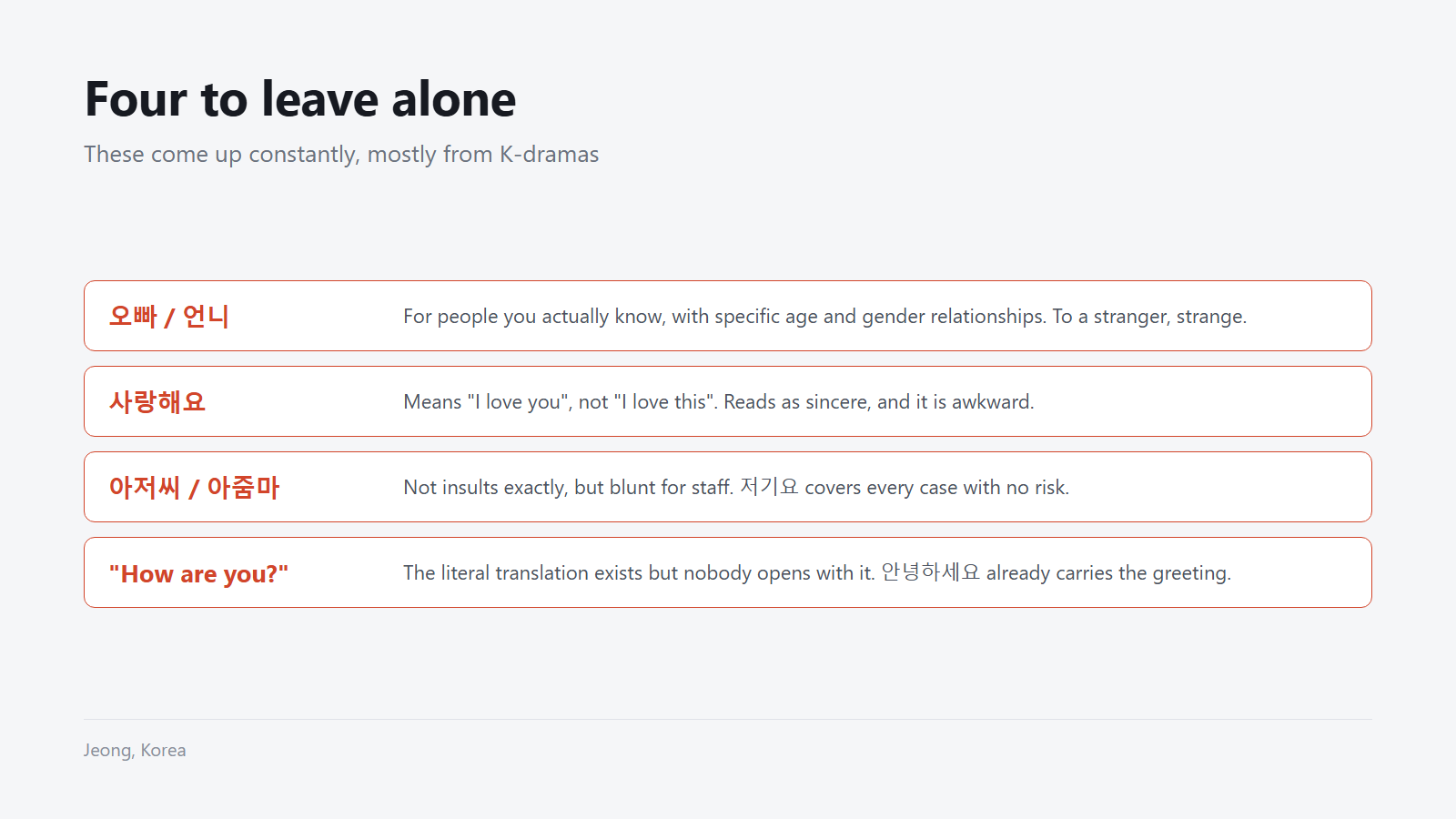
Do not use 오빠 or 언니 with strangers. K-dramas make these look like friendly words. They are for people you actually know, with specific age and gender relationships. To a stranger they are strange at best.
-
Do not say 사랑해요 as a joke. It means "I love you", not "I love this". It reads as sincere and it is awkward.
-
Skip 아저씨 and 아줌마 for staff. They are not insults exactly, but they are blunt. 저기요 covers every case with no risk.
-
Do not translate "How are you?" The literal version exists but nobody opens with it. 안녕하세요 already carries the whole greeting.
Where you will actually use them
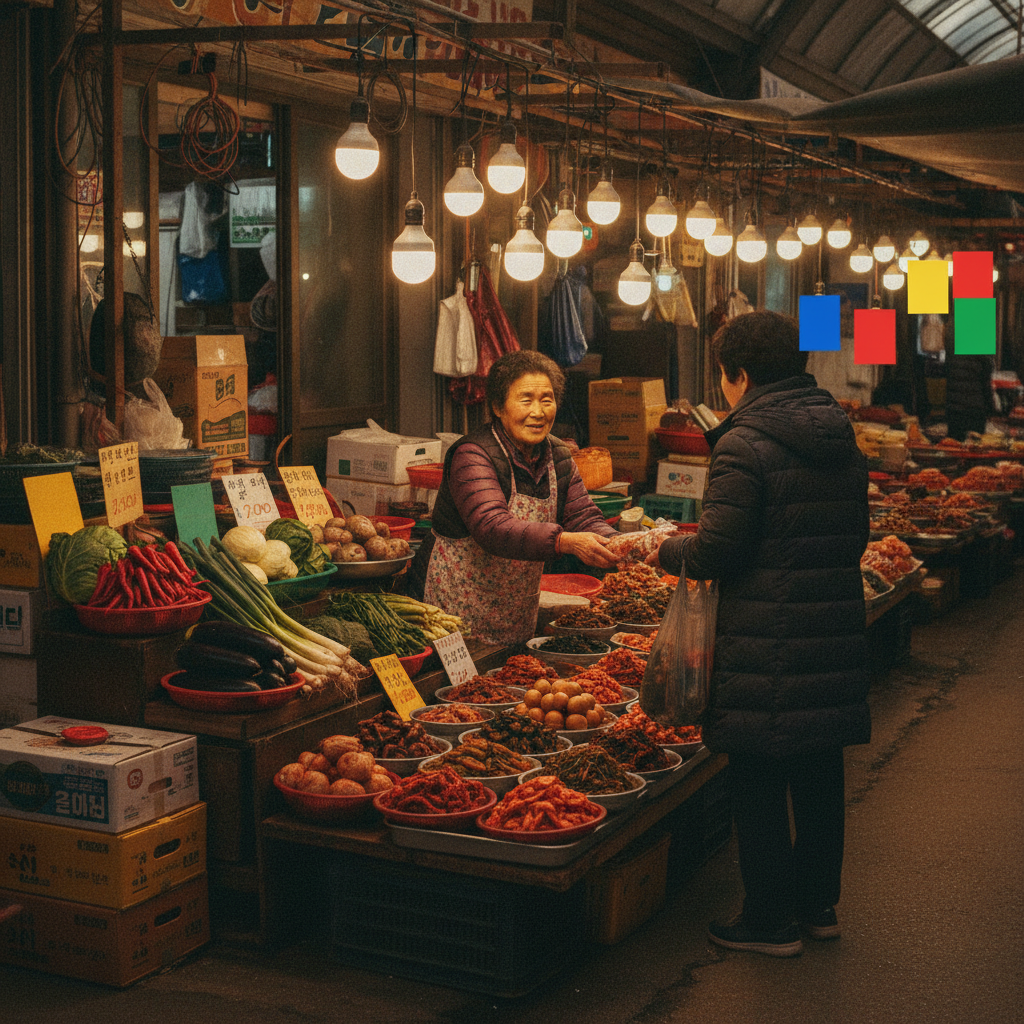
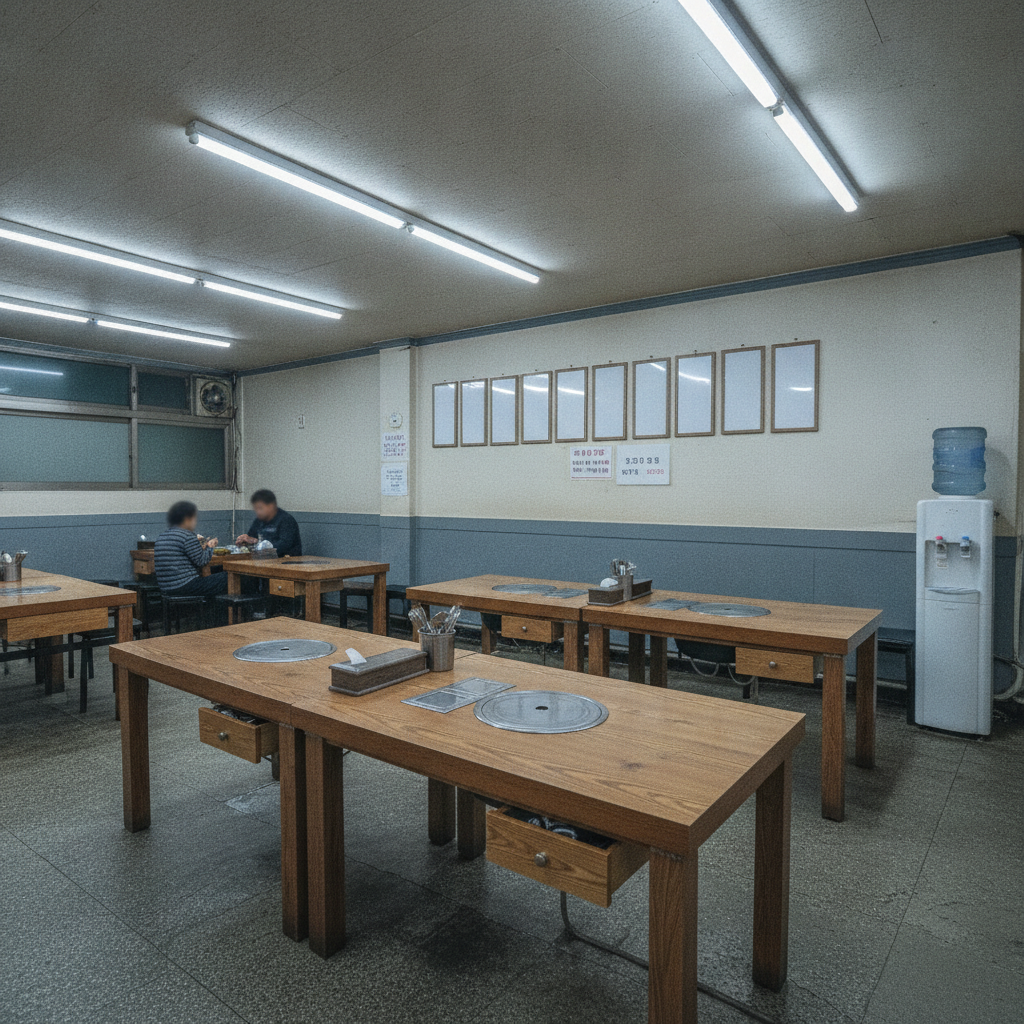
Restaurants and small shops, overwhelmingly. Big chains and department stores have English-capable staff and card-driven flows where you barely speak at all. The places where a few korean phrases change your day are the small ones: the market stall, the neighbourhood restaurant with a laminated menu, the taxi.
In restaurants, the sequence is nearly always the same. Sit down, call 저기요, point and say 이거 주세요, eat, then say 계산이요 toward the counter and pay there rather than at the table. If you want the rest of the table rules, the dining etiquette guide covers them.
In taxis, say the destination and add 요, as in "명동이요". Then show the map on your phone. Between those two things you will never end up in the wrong place. The taxi app guide covers the payment side.
Translation apps, honestly
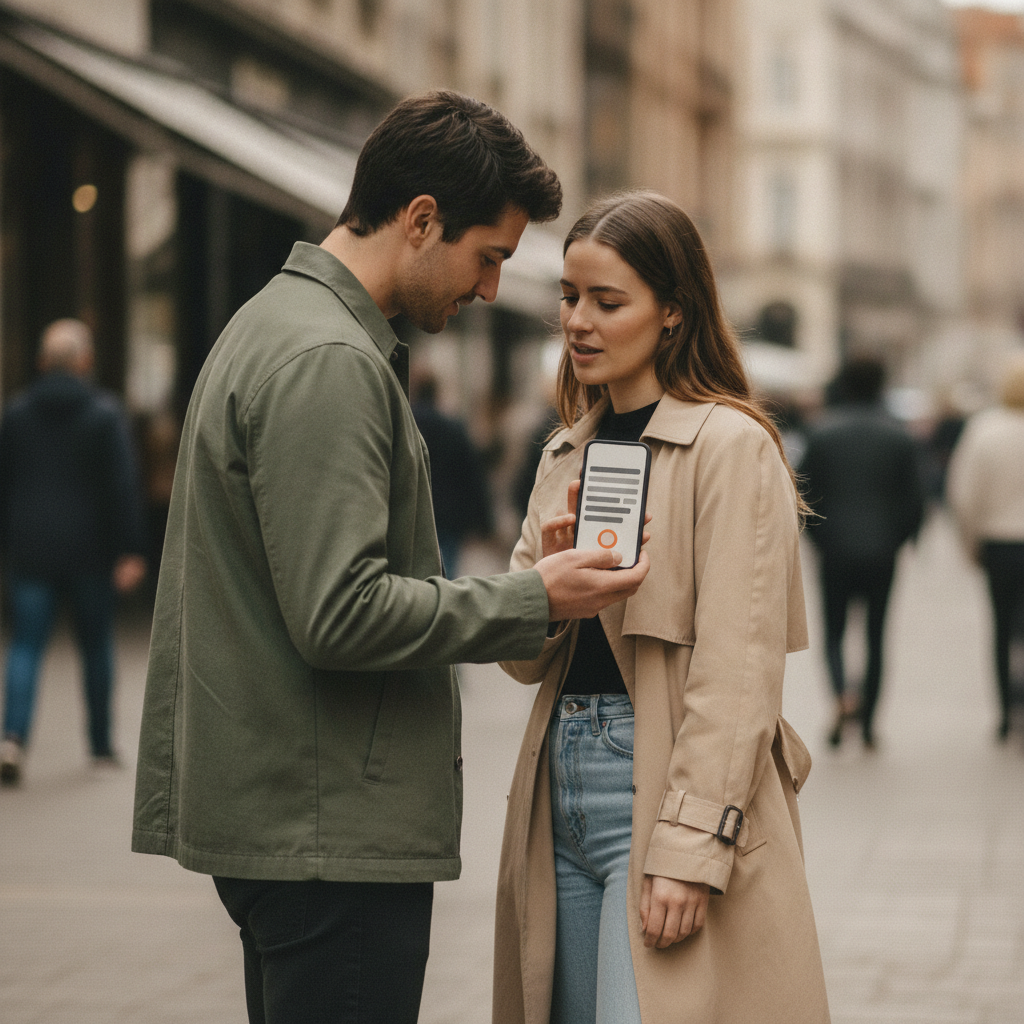
Use them. Nobody here thinks less of you for it, and Korean people pull out translation apps constantly when speaking to foreigners.
The one thing worth knowing: speak in short, complete sentences. Translation quality collapses on long English sentences with clauses. "Where is the bathroom" translates cleanly. "I was wondering if you could possibly tell me where I might find the bathroom" does not.
Papago handles Korean noticeably better than the general-purpose alternatives, and it works offline once you download the language pack. Download it before you land, not while standing in a shop with no data.
FAQ
Do I need to learn Hangul before visiting Korea?
No. Signs in Seoul are bilingual, transit is fully signposted in English, and menus in tourist-facing areas usually have pictures or English. Learning to read Hangul takes a few hours and is genuinely useful if you plan to return, but it is not a requirement for a first trip.
Which korean phrases should I learn first if I only have one day?
저기요 for getting attention, 이거 주세요 for ordering, 감사합니다 for thank you, and 얼마예요 for how much. Those four cover ordering, buying, and being polite, which is most of what a visitor needs to say out loud.
Will people speak English to me?
In central Seoul, often, especially younger staff, hotels, and anywhere used to visitors. Outside those settings, less so. The gap is not hostility; many people studied English for years but rarely speak it and are nervous about making mistakes. Starting in Korean, even badly, usually relaxes everyone.
Is it rude to speak Korean badly?
The opposite. Attempting Korean is read as respect, and mistakes are forgiven completely. The only thing that lands badly is using the wrong register with someone much older, and even that is minor when you are visibly a visitor.
What is the deal with 저기요? It feels rude to shout it.
It is not shouting and it is not rude. Korean service works on being summoned rather than being checked on, so staff genuinely wait for it. Say it at normal volume toward the counter. You will feel strange for about ten minutes and then it will feel obvious.
Should I bow?
A small nod of the head when saying thank you or hello covers everything a visitor needs. The deeper bows you see are for specific formal situations. Nobody expects them from you, and over-bowing reads as odd rather than polite.
The short version
Learn 저기요 and 이거 주세요 and you can eat anywhere in this country. Add 감사합니다 and 얼마예요 and you can shop. Add 한국어 잘 못해요 and people will meet you more than halfway.
That is five korean phrases. Everything else is a bonus, and the textbook version can wait until you decide to come back properly.
If you are working out the rest of the practical layer, the first-30-days guide is the one to read next.
Sources
- Korea.net and the National Institute for International Education, on Korean proficiency exam applicant numbers and the 2026 exam schedule: https://www.korea.net/NewsFocus/Society/view?articleId=279830
Romanisation here is written for English speakers rather than following a single official system, because the goal is being understood out loud.