Sending a Parcel Inside Korea: The Counter Takes Two Minutes, the Receipt Is the Part That Matters

You can hand a box to a convenience store clerk and walk out in two minutes. What you are holding when you walk out decides everything that happens if the box never arrives.
Most people throw that slip away before they reach the door.
Sending something across Korea is one of those errands that sounds harder than it is. You picture a post office, a queue, a form in Korean, and a clerk asking questions you cannot answer. In practice the whole thing happens at a counter you already walk past every day.
The part nobody explains is what happens afterwards. Korean courier companies operate under standard terms of service written by the Fair Trade Commission, and those terms quietly decide how much you get back if your box is crushed, and how long you have to say something. Both answers depend on a slip of paper you were handed at the counter.
Say you have just moved apartments in Seoul and need to send two boxes to a friend in Busan. One holds clothes. The other holds a laptop you paid 1.8 million won for. We will follow those two boxes through the whole process.
The counter is usually a convenience store
You have three realistic options, and they are not equally convenient.
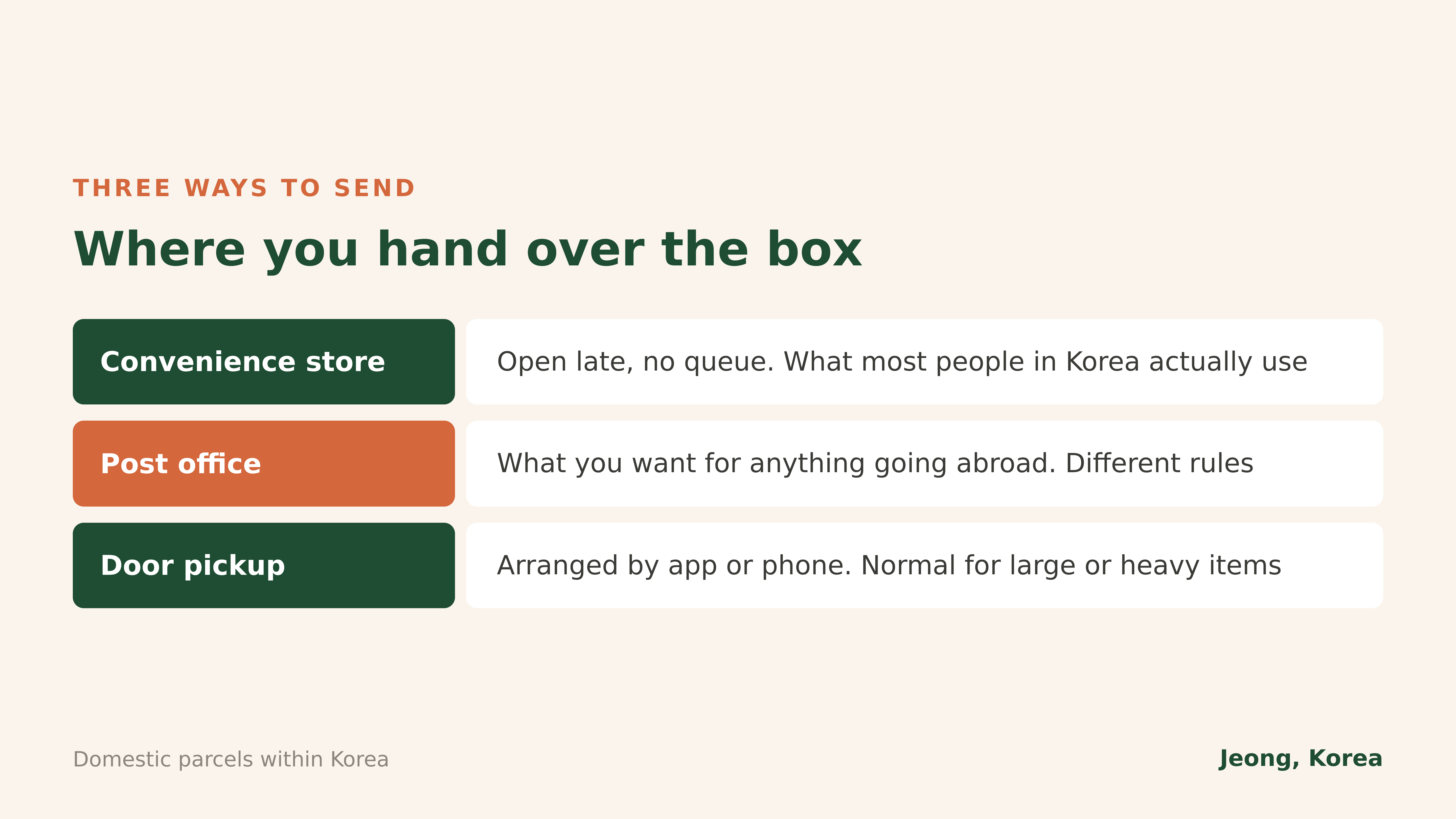
The first is a convenience store counter. You bring the box already taped shut, the clerk weighs it, you type the recipient's name, address and phone number into a small screen, and you pay. This is what most people in Korea actually do, because the stores are open late and there is no queue.
The second is the post office, which is what you want for anything going abroad. That is a different process with different rules, and I wrote it up separately in Shipping From Korea: What the Post Office Will Refuse, and the Duty Rule That Changed.
The third is a pickup at your door, arranged through an app or by phone. This is the normal choice for large or heavy items.
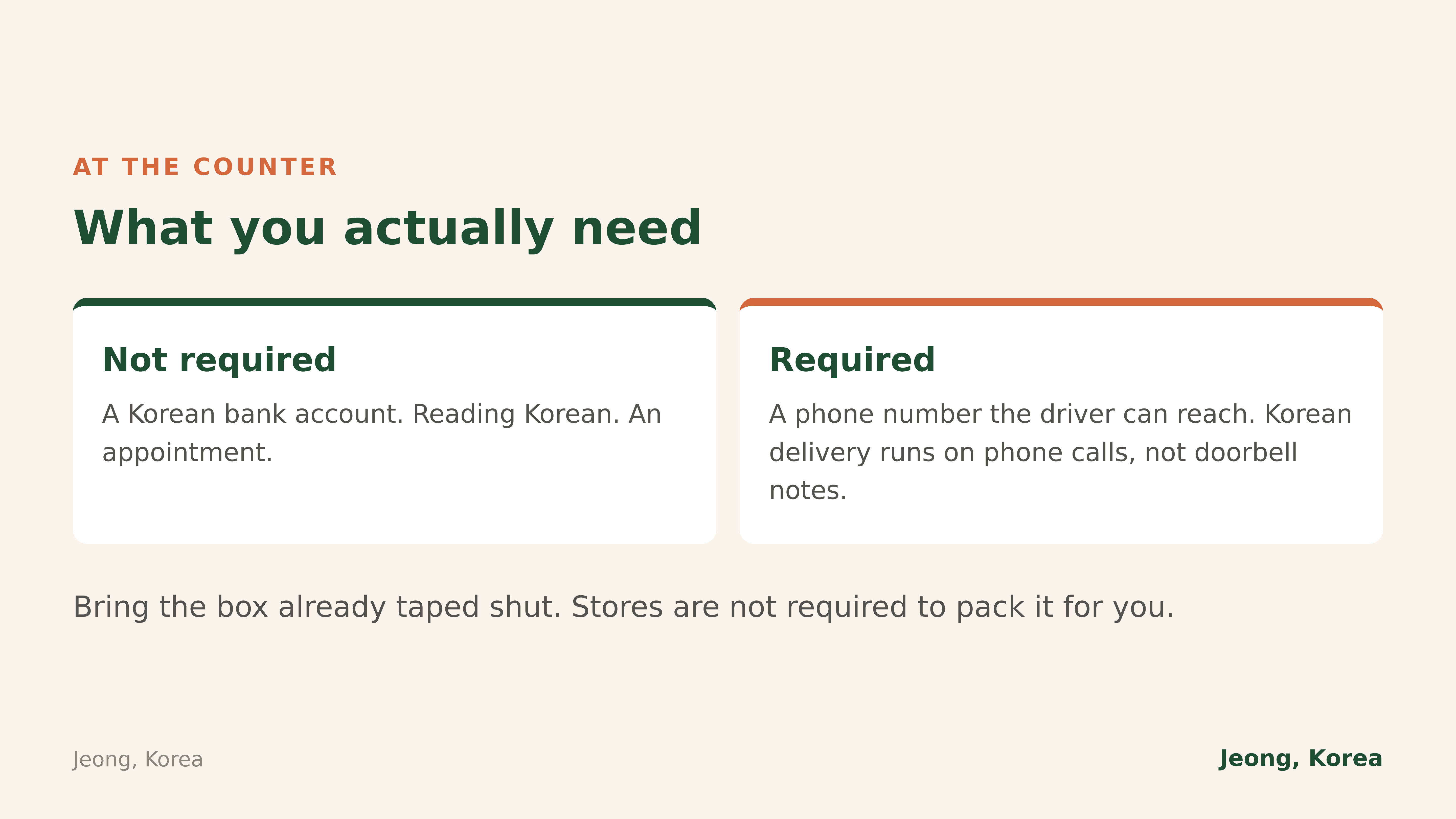
For the convenience store route, you do not need a Korean bank account and you do not need to read Korean to complete the screen. What you do need is a phone number the driver can reach, because Korean delivery runs on phone calls rather than doorbell notes. A Korean number is far easier here than a foreign one.
So what happens to the two boxes after they leave the counter?
The clothes and the laptop are not covered the same way
Here is the part that surprises people.
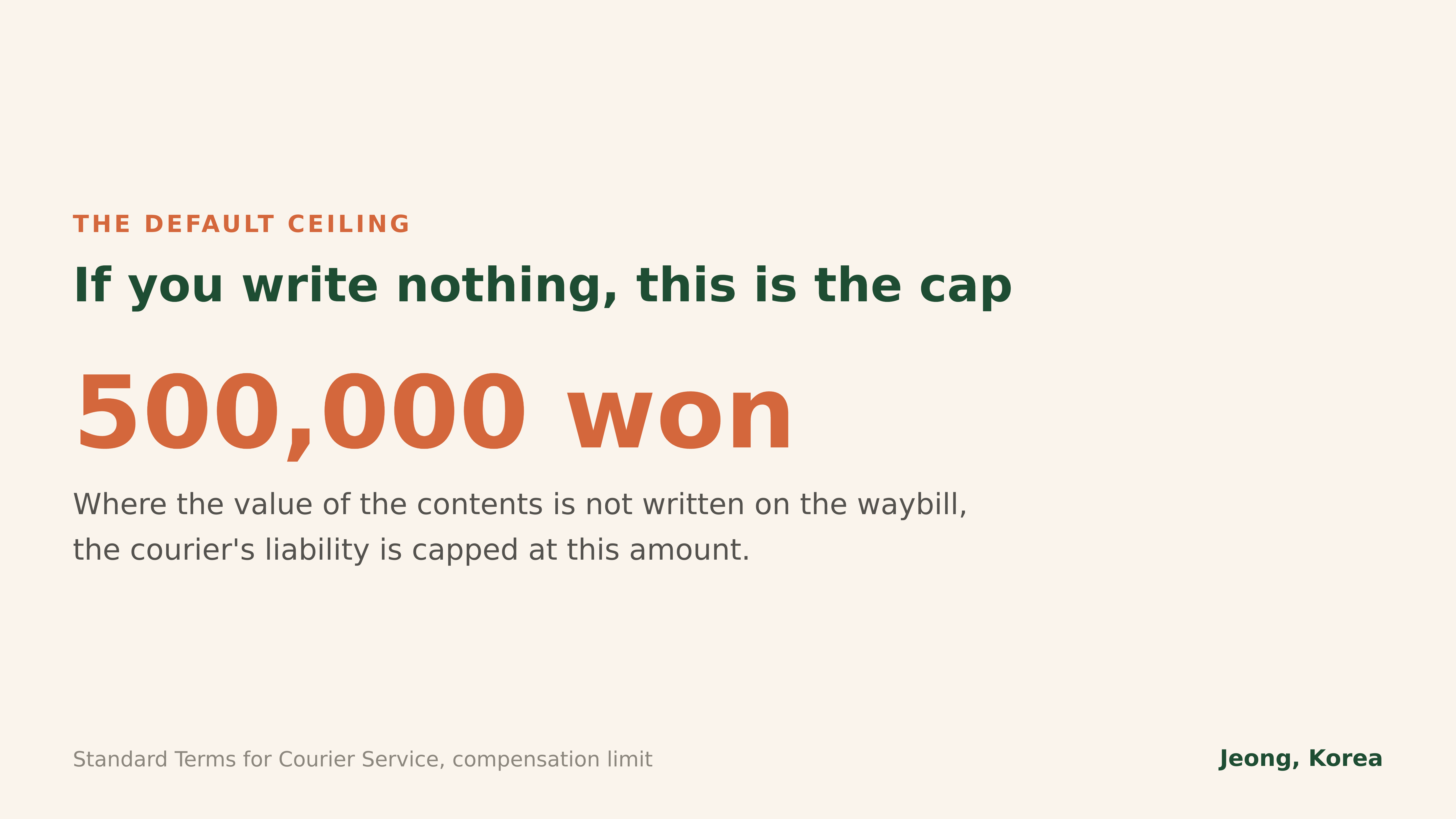
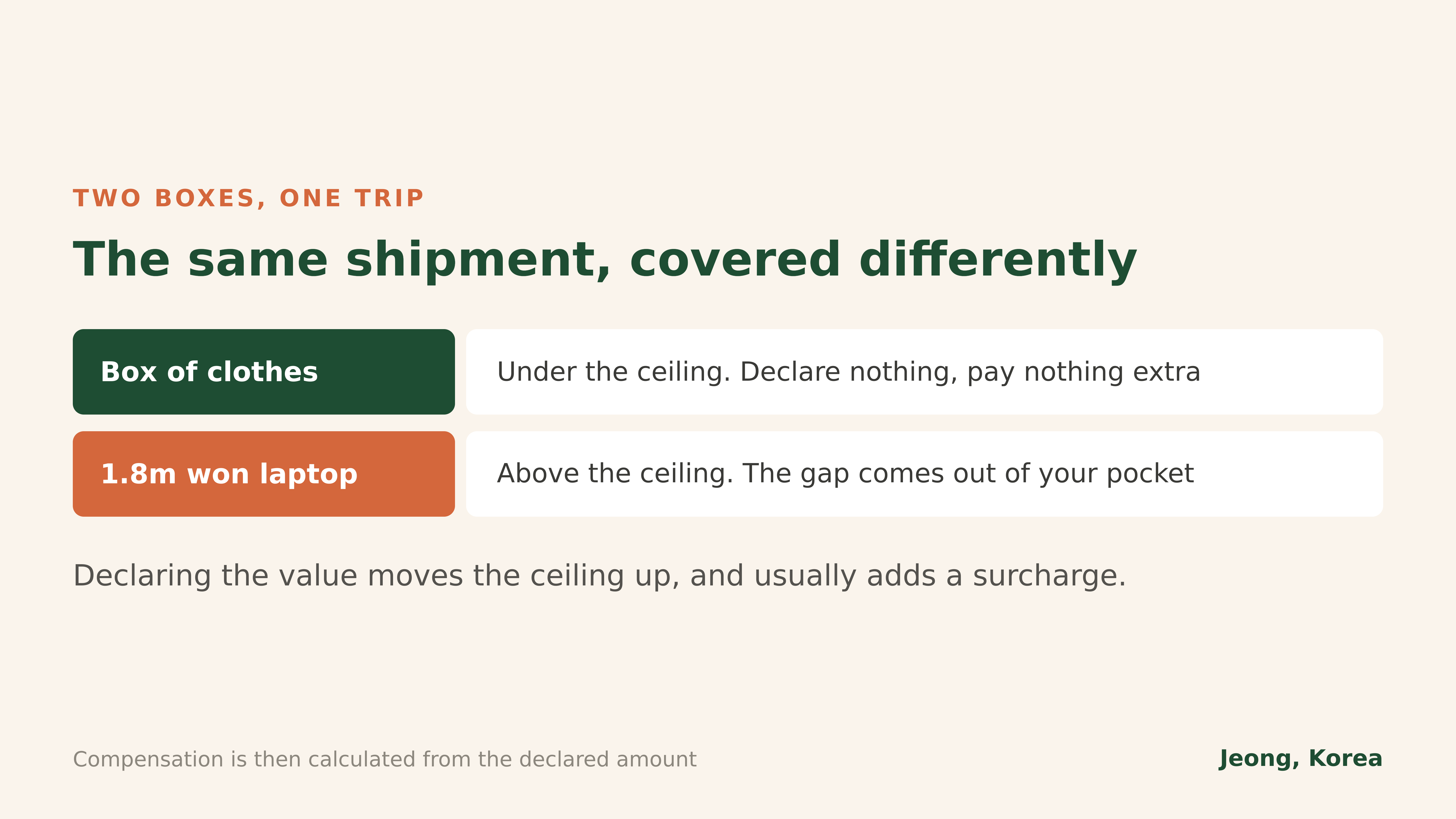
Under the standard terms, if you do not write the value of the contents on the waybill, the courier's liability is capped at 500,000 won. That cap applies no matter what was inside. Your clothes are fine under that ceiling. Your 1.8 million won laptop is not, and the gap comes out of your pocket.
If you do declare the value, compensation is calculated from the amount written on the waybill instead. Declaring a higher value usually means paying a surcharge, and when you pay that surcharge the ceiling moves up to the top of the value bracket you paid for.
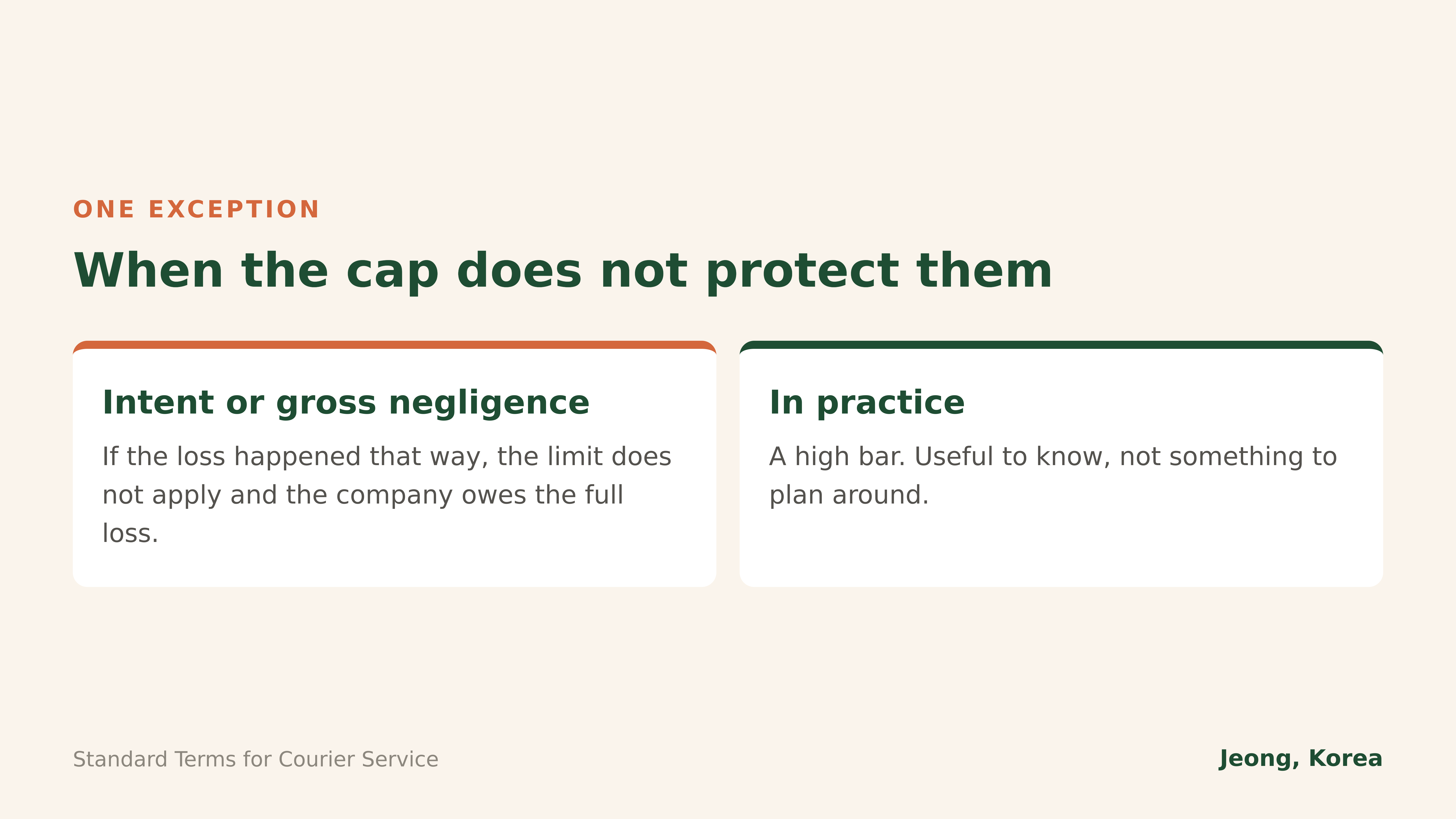
There is one exception that works in your favour. If the loss happened through the company's intent or gross negligence, the cap does not protect them and they owe the full loss. That is a high bar and not something to plan around, but it exists.
The practical version is short. For the box of clothes, do nothing. For the laptop, declare the value at the counter and accept the surcharge.
And what if something does go wrong?
You have fourteen days, and the clock has already started
This is the deadline that catches people.
If part of the shipment is missing or damaged, you have to tell the courier within fourteen days of the recipient receiving the parcel. Miss that window and the company's liability for it is gone, regardless of how clearly the damage was their fault.
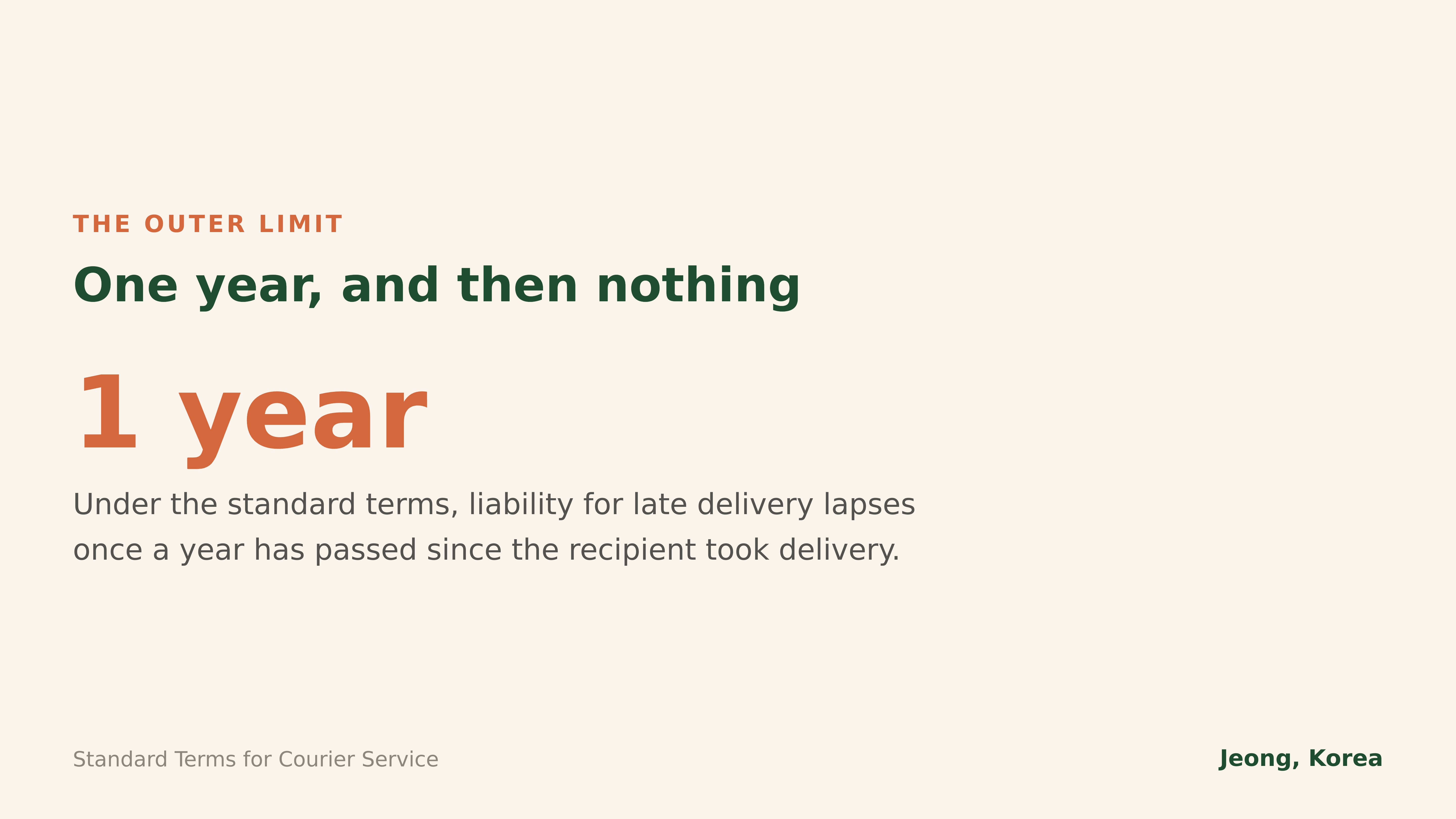
There is an outer limit too. Under the standard terms, liability for late delivery lapses once a year has passed since the recipient took delivery.
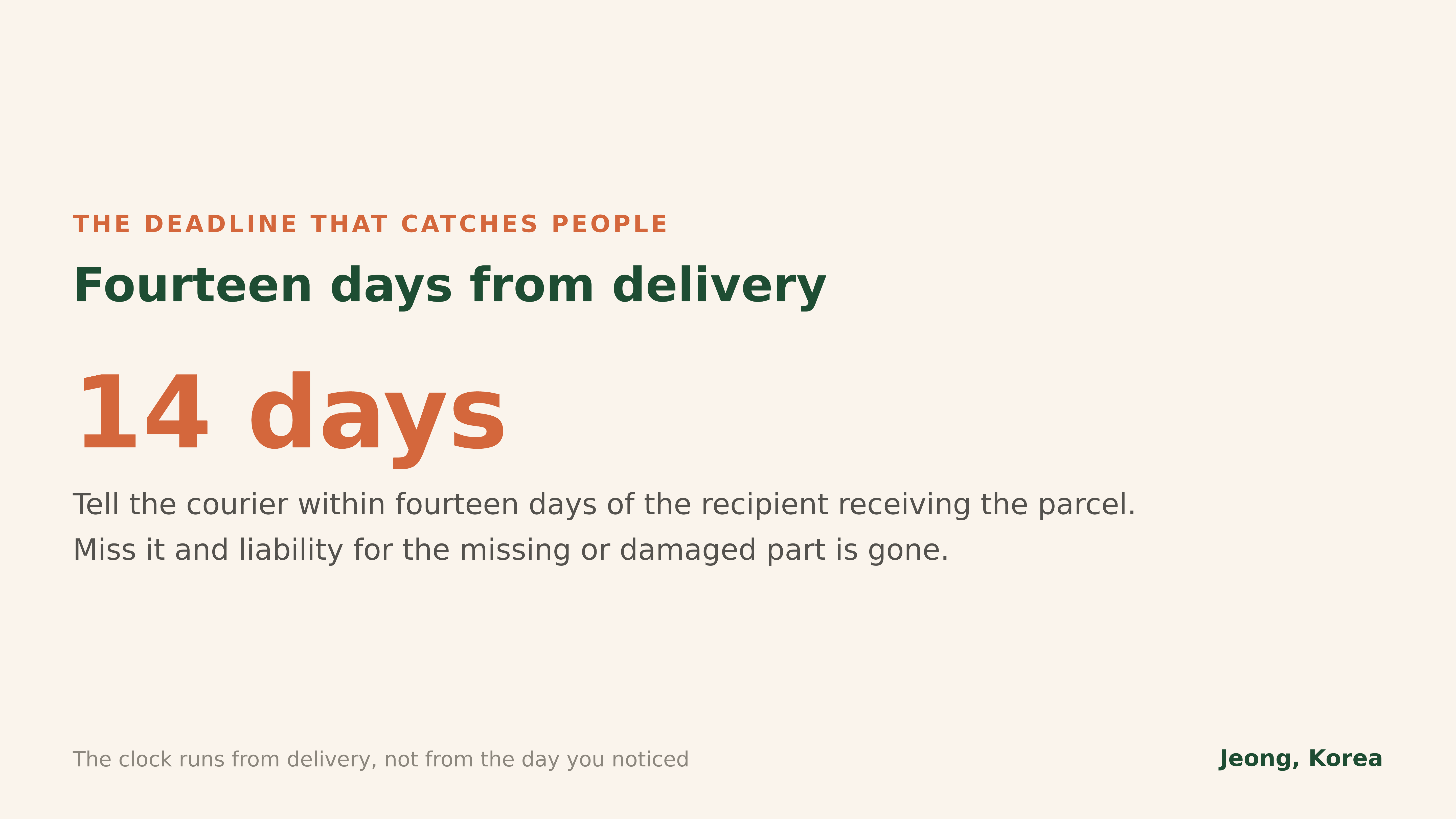
Two things follow from this. Keep the receipt or the tracking number until the box has arrived and been opened, and open the box while the delivery is recent rather than leaving it in a corner for three weeks. The fourteen days run from delivery, not from the day you noticed.
If your friend in Busan opens the laptop box and finds a cracked screen, the first move is a phone call to the courier, not a complaint to the seller.
What to actually do at the counter
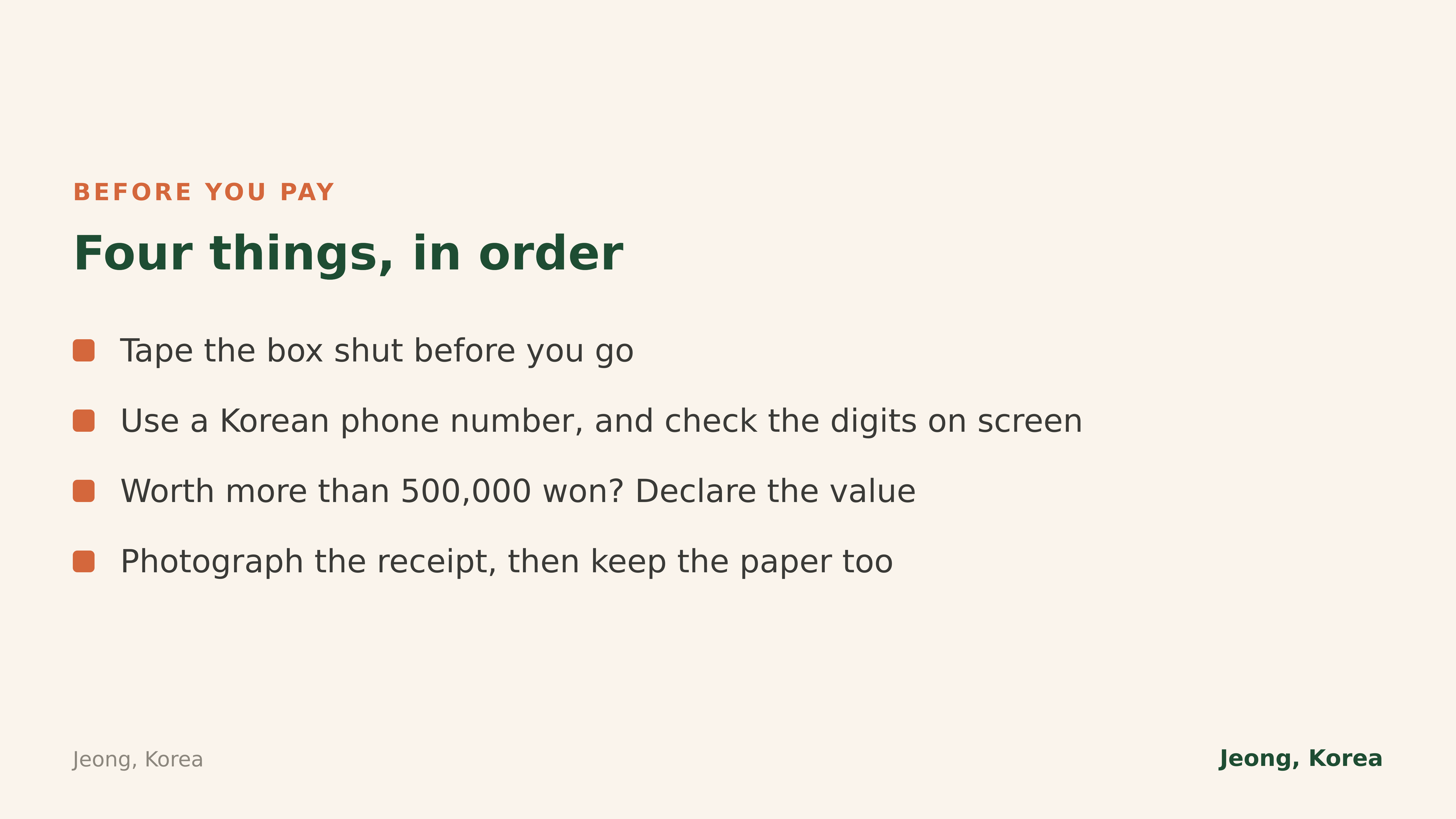
Four things, in order.
-
Tape the box shut before you go. Convenience stores are not required to pack it for you.
-
Use a Korean phone number for the recipient, and check the digits on the screen before you pay.
-
If the contents are worth more than 500,000 won, say so and declare the value.
-
Photograph the receipt with your phone, then keep the paper as well.
Unstaffed parcel lockers work the same way for pickup, with one difference: they hold the box only for a limited time before it goes back to the depot, so the recipient needs to know it has arrived. If you are juggling bags with nowhere to put them in the meantime, Luggage Storage in Seoul: Lockers, Prices, and the Last-Day Problem covers the short-term options.
FAQ
Can I send a parcel without a Korean phone number?
You can complete the transaction, but delivery in Korea depends heavily on the driver phoning ahead. A foreign number often fails at that step. If you have any Korean number available, use it for the recipient field.
What does it cost?
Price depends on size and weight rather than distance, and rates differ between companies. Anywhere in the country costs roughly the same, which is not true in most countries.
Can I send food?
Ordinary packaged food is fine. Anything frozen or chilled needs a cold-chain service, and a normal parcel will not keep it cold.
The box arrived but something inside is broken. Who do I call?
The courier company, and within fourteen days. Photograph the box and the contents before you move anything.
The short version
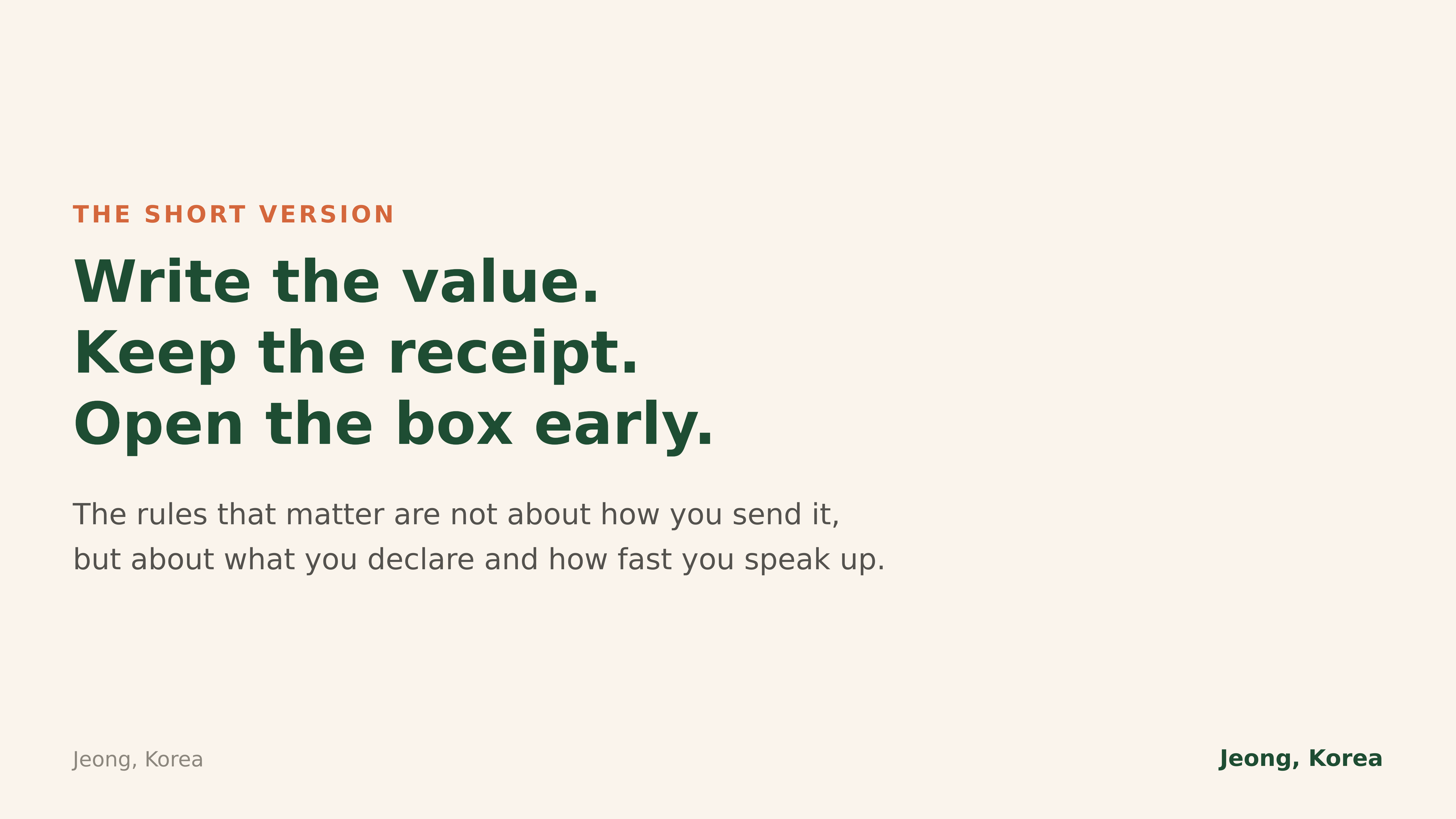
Sending a parcel inside Korea is a two-minute errand at a counter you already know. The rules that matter are not about how you send it but about what you declare and how fast you speak up afterwards.
Write the value if it is worth more than 500,000 won. Keep the receipt. Open the box early.
References
-
Standard Terms and Conditions for Courier Service, Korea Fair Trade Commission Standard Form No. 10026. Compensation limits, the fourteen-day notice rule and the one-year limitation are set out there.
-
Korea Ministry of Government Legislation, Easy Law guide to courier accidents.