Chuseok Is Not "Korean Thanksgiving" — and the Holiday Law Shows Why
Thanksgiving is a meal with the living. Chuseok starts with a meal for the dead. The translation loses that.
Almost every English guide calls it Korean Thanksgiving, which gets you the harvest and nothing else. Below is what the day is actually built around, why it runs three days instead of one, and what that means if you are in Korea on 24 to 26 September.
I want to be careful here, because the translation is not malicious and it is not even wrong in a narrow sense. Both holidays sit at the end of a harvest. Both empty out the cities and fill up the motorways. Both involve a family eating far too much in a house that is too small for everyone who came.
But a translation is a promise about what you will find, and this one sends you looking for the wrong thing. If you arrive expecting Thanksgiving, you will notice the food and miss the reason for it.
The overlap is the harvest, and the overlap ends there
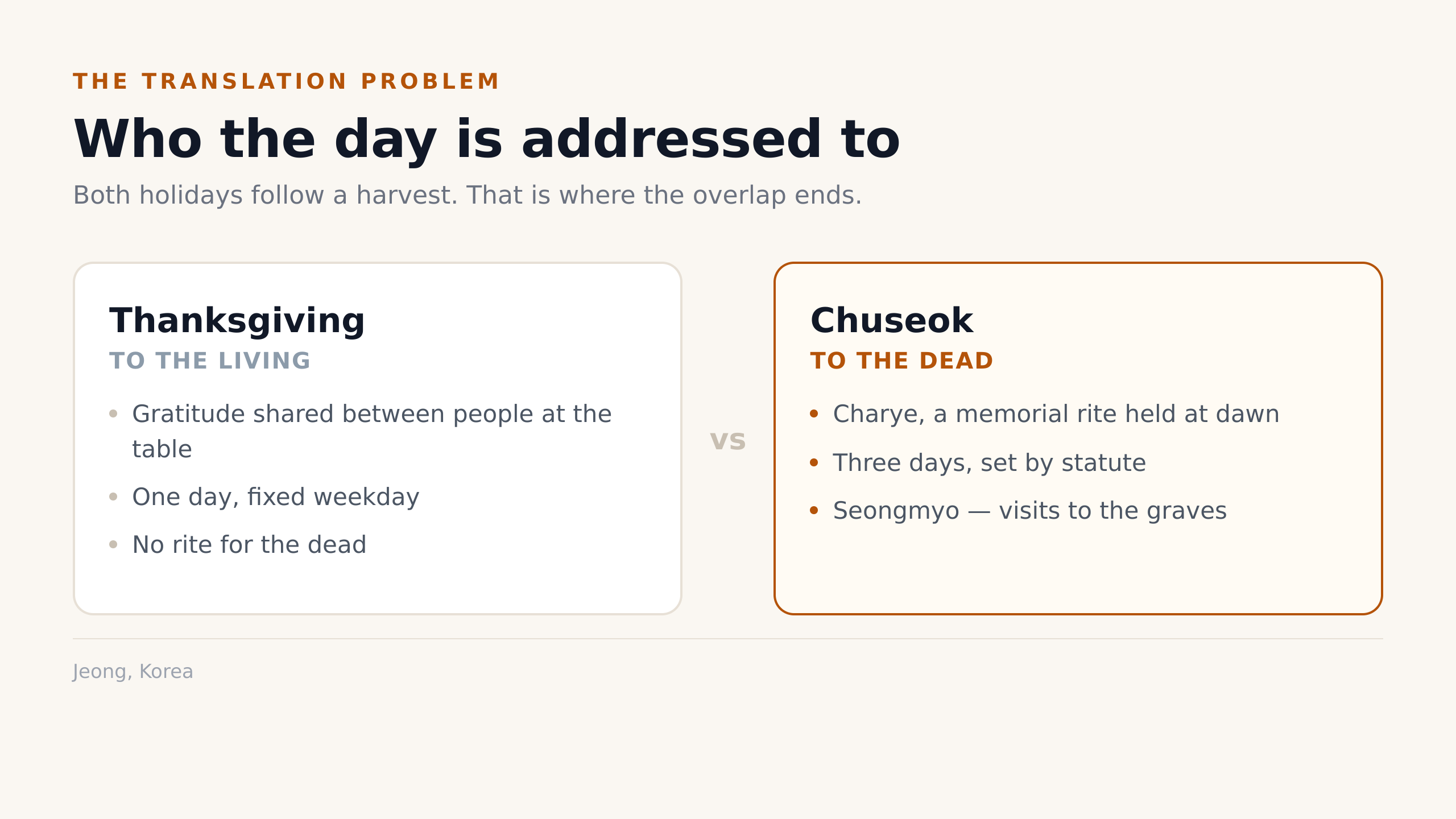
Here is the difference in one sentence: Thanksgiving is addressed to the people at the table. Chuseok is addressed to the people who are not.
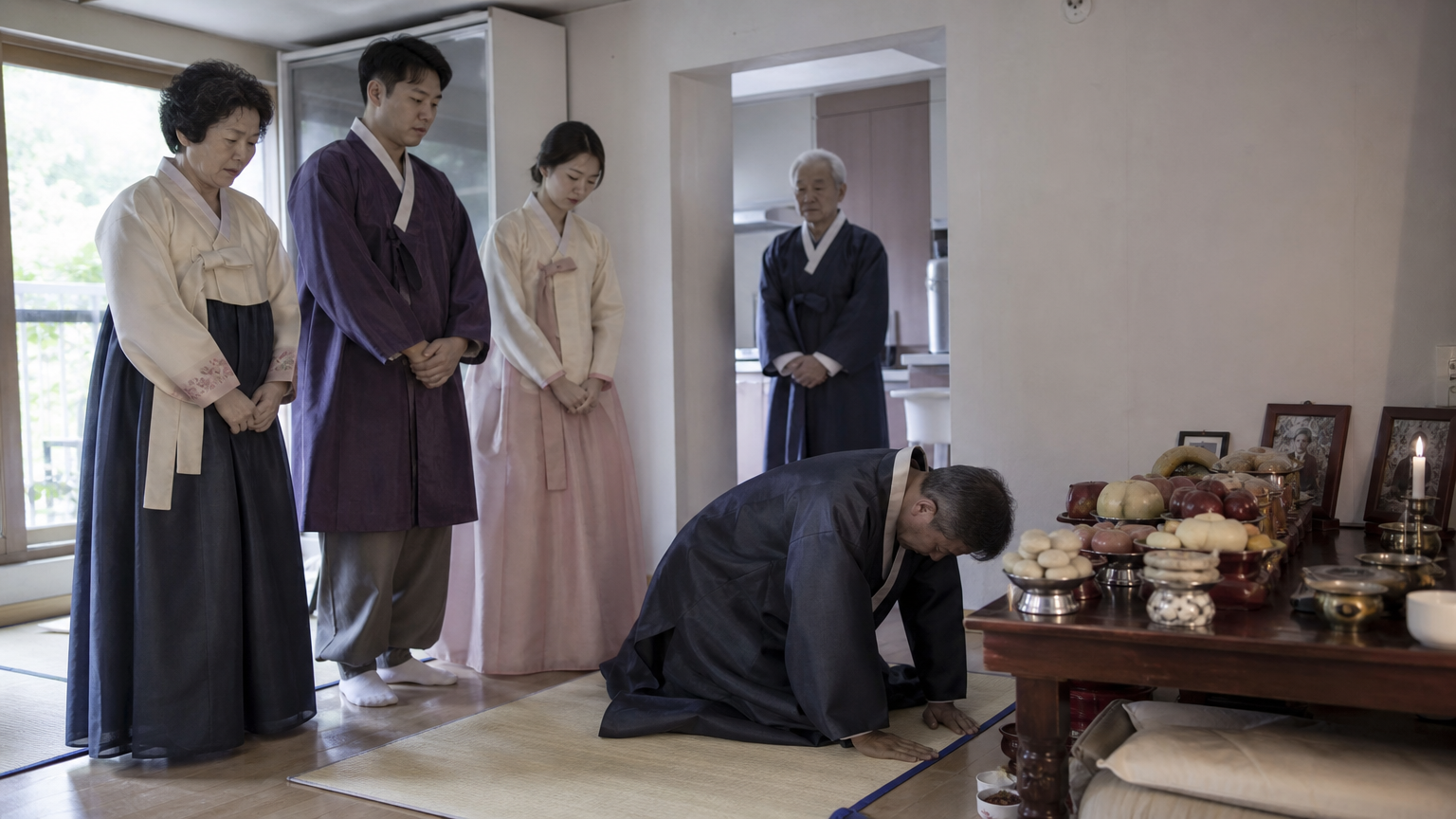
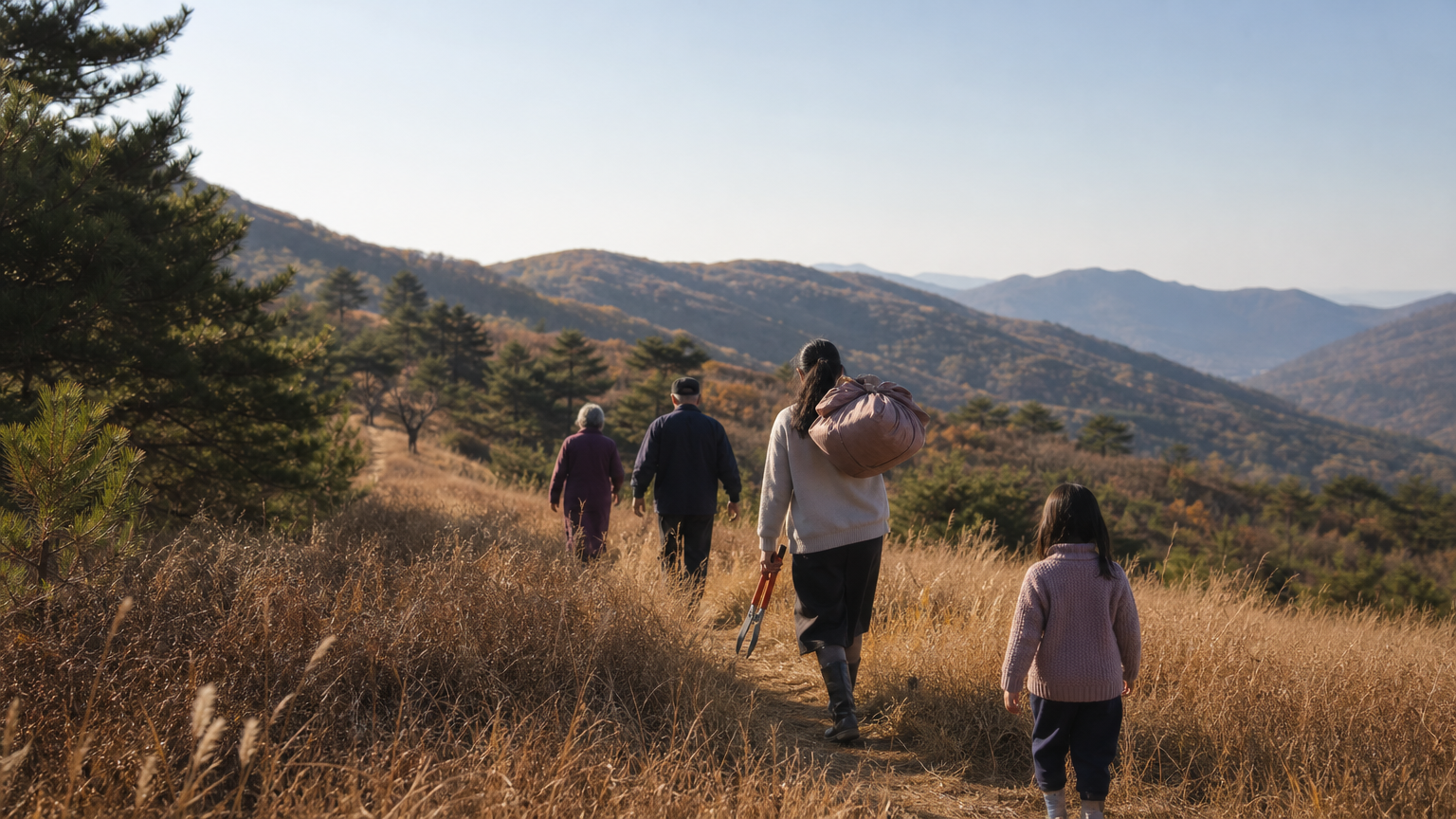
The morning of the holiday begins with charye, a memorial rite. A table is set with food arranged in a fixed order, facing a particular direction, for the family members who have died. Someone bows. Nobody eats until it is done. Later in the day many families drive to the graves themselves — seongmyo — to cut the grass back and bow again.
That is the load-bearing part of the day. Everything a visitor recognises from Thanksgiving — the traffic, the enormous lunch, the relatives asking when you plan to get married — is arranged around it.
So when the English name says Korean Thanksgiving, it takes the part that translates easily and drops the part that does not. Gratitude for a harvest is a feeling shared between living people. Charye is an obligation owed to dead ones. Those are not the same holiday wearing different clothes.
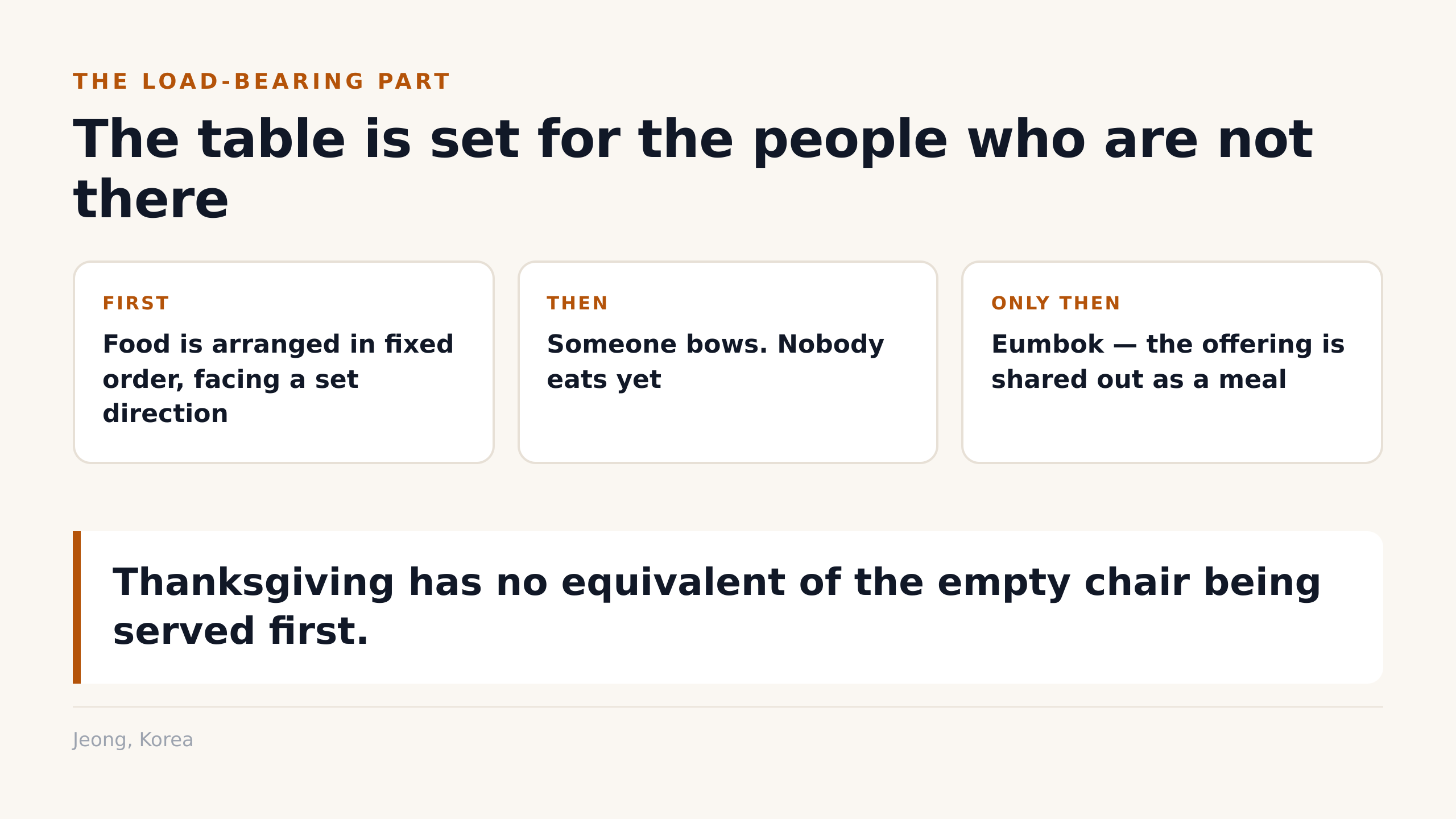
The clearest way to see it: Thanksgiving has no equivalent of the empty chair being served first.
And if the two were really the same shape, they would be the same length. They are not — and the reason is written down.
It is three days, and Korean law names which three
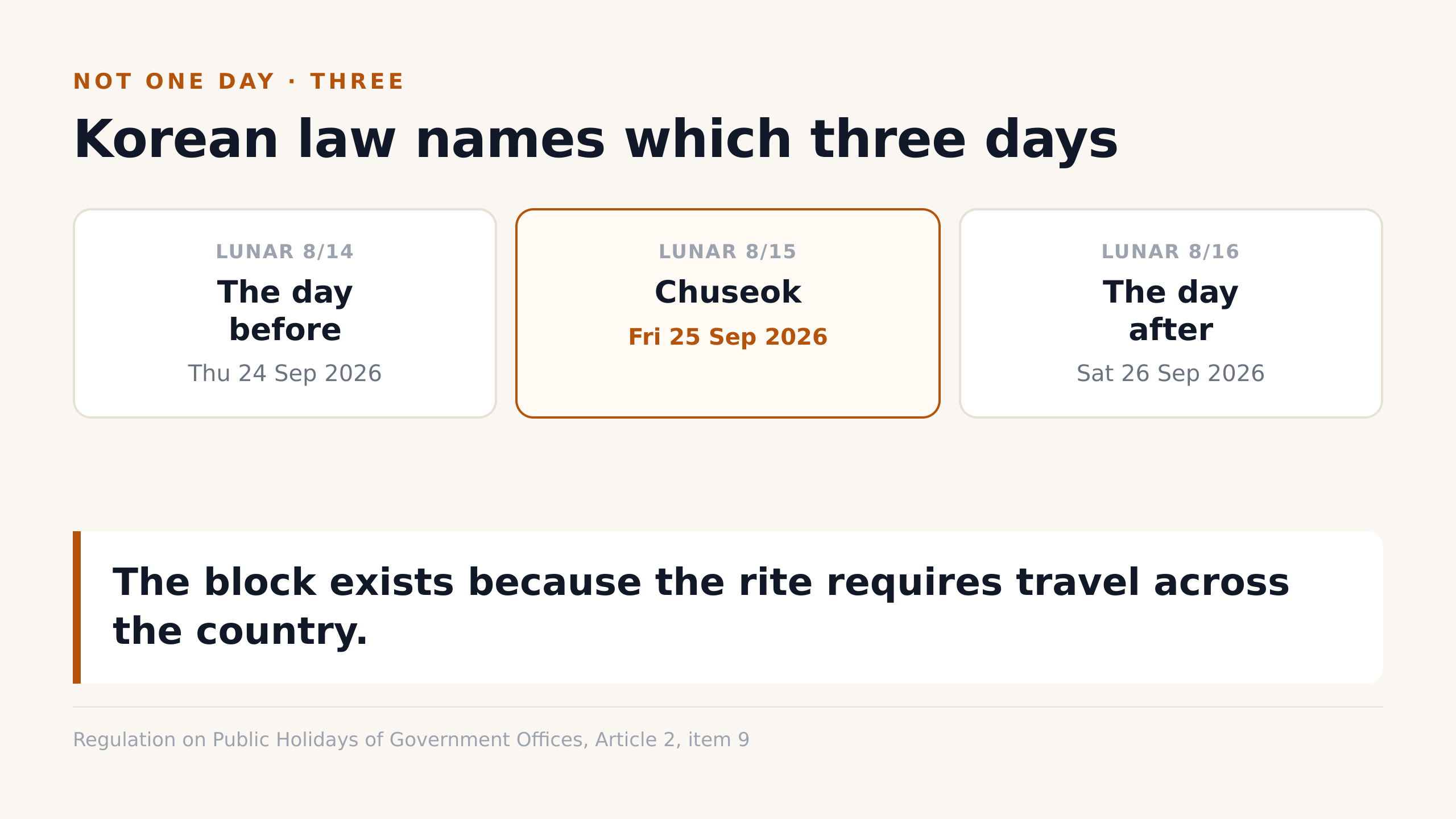
American Thanksgiving is one day, a Thursday, with a Friday that most people take off by convention. Chuseok is three days, and they are three days because a statute says so.
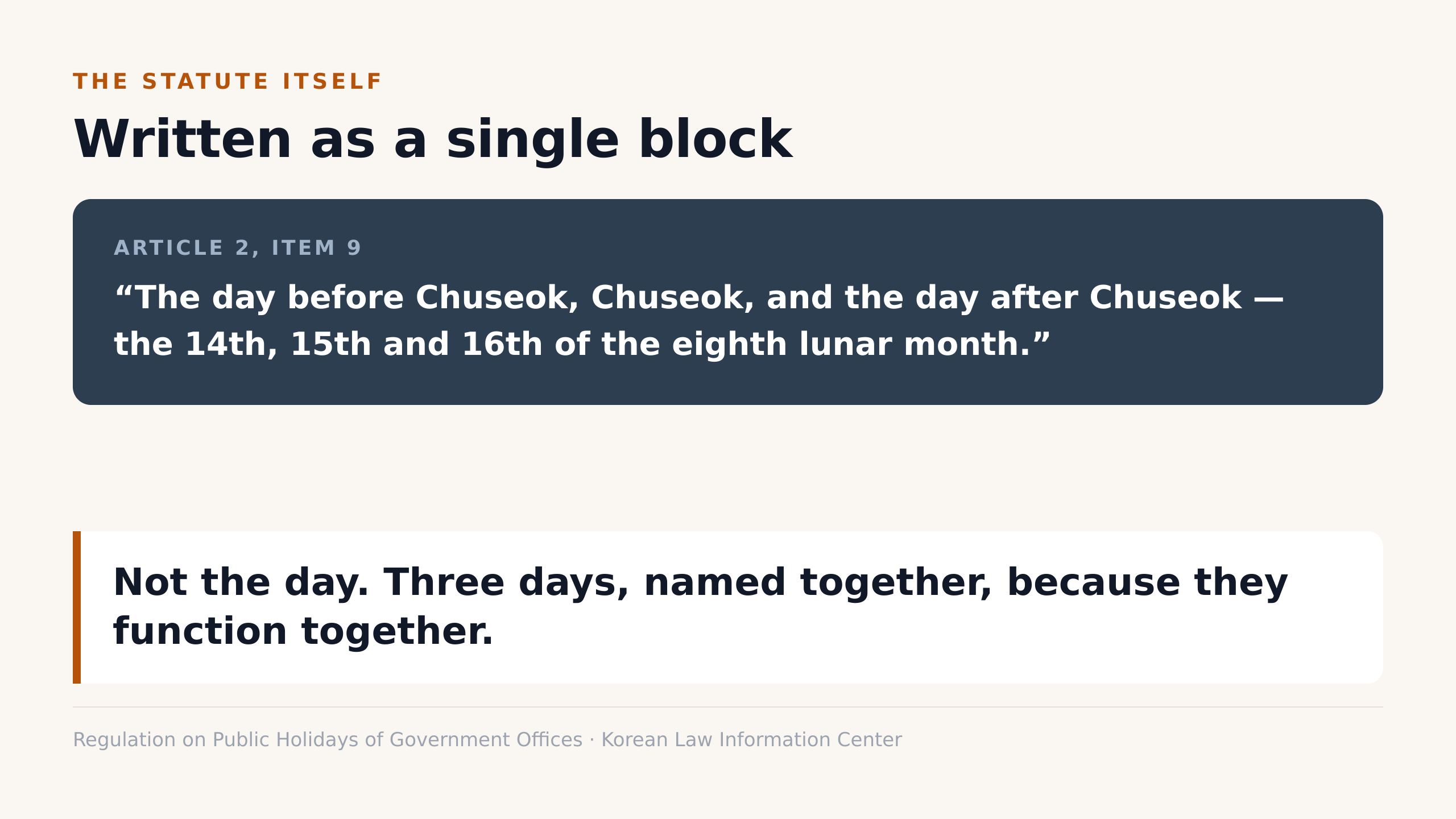
The Regulation on Public Holidays of Government Offices lists, at Article 2, item 9: the day before Chuseok, Chuseok itself, and the day after Chuseok — the 14th, 15th and 16th of the eighth lunar month. Not the day. The block of three.
That is not administrative tidiness. It is the state acknowledging that the rite requires travel. You cannot drive to a grave in another province, perform charye at dawn, and be back at work, so the law gives you the day before and the day after.
| Thanksgiving (US) | Chuseok | |
|---|---|---|
| Length | One day | Three days, by statute |
| Centre of the day | Shared meal | Rite for the dead (charye) |
| Calendar | Fixed weekday, November | Lunar, moves each year |
| Grave visits | No equivalent | Seongmyo, common |
| 2026 dates | Late November | 24 to 26 September |
There is a second thing buried in the same regulation, and it is the detail I find most telling.
Article 3 sets out when a substitute holiday gets added. For most holidays — national days, Children's Day, Christmas — one is granted if the date falls on a Saturday or a Sunday. For Chuseok and Lunar New Year, it is granted only if the date falls on a Sunday. A Saturday does not count.
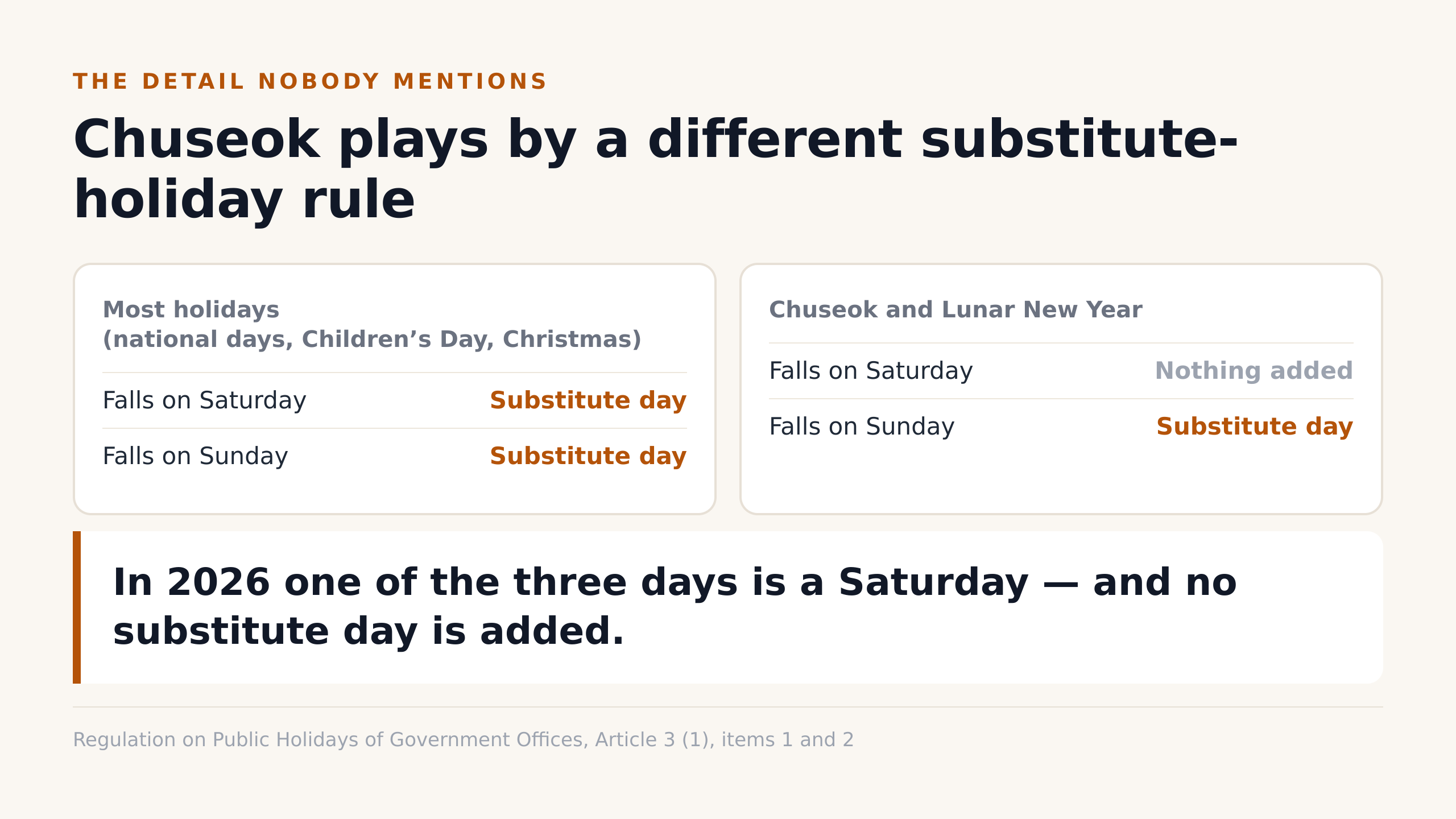
This year that rule has teeth. The holiday runs Thursday 24 to Saturday 26 September 2026, so one of the three days lands on a Saturday — and no substitute holiday is added. For a different holiday, it would have been.
Read that as a statement about what the days are for and it makes sense. The other holidays are days off, so losing one to a weekend is worth compensating. These three are not days off. They are days you are expected to be somewhere doing something, and the state is not going to hand you a spare one.
If you want a second example of Korean law formally saying one thing while everyday practice runs on an older logic, the way Korean age changed in 2023 and nobody quite stopped counting the old way is the same shape of story.
So what do you actually do with all this?
What it changes for you, if you are here
Three practical things follow, and none of them require you to care about ancestor rites in the slightest.
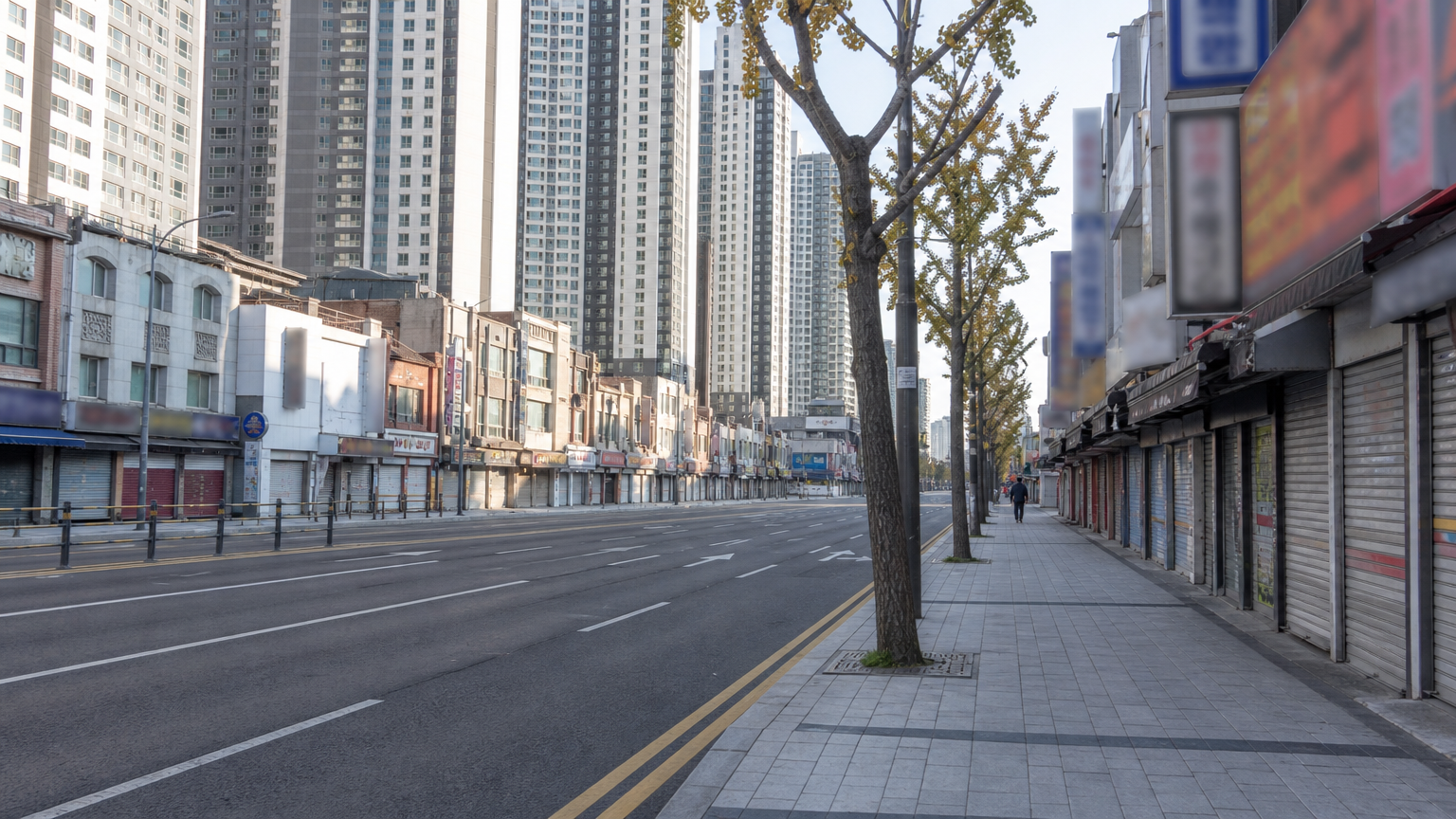
Expect the country to be somewhere else. Not closed — relocated. Roughly half of Seoul goes to the province their family is from. That produces the strangest and, in my view, best version of the city, which I have written about in what an empty Seoul during Chuseok is like and what actually closes.
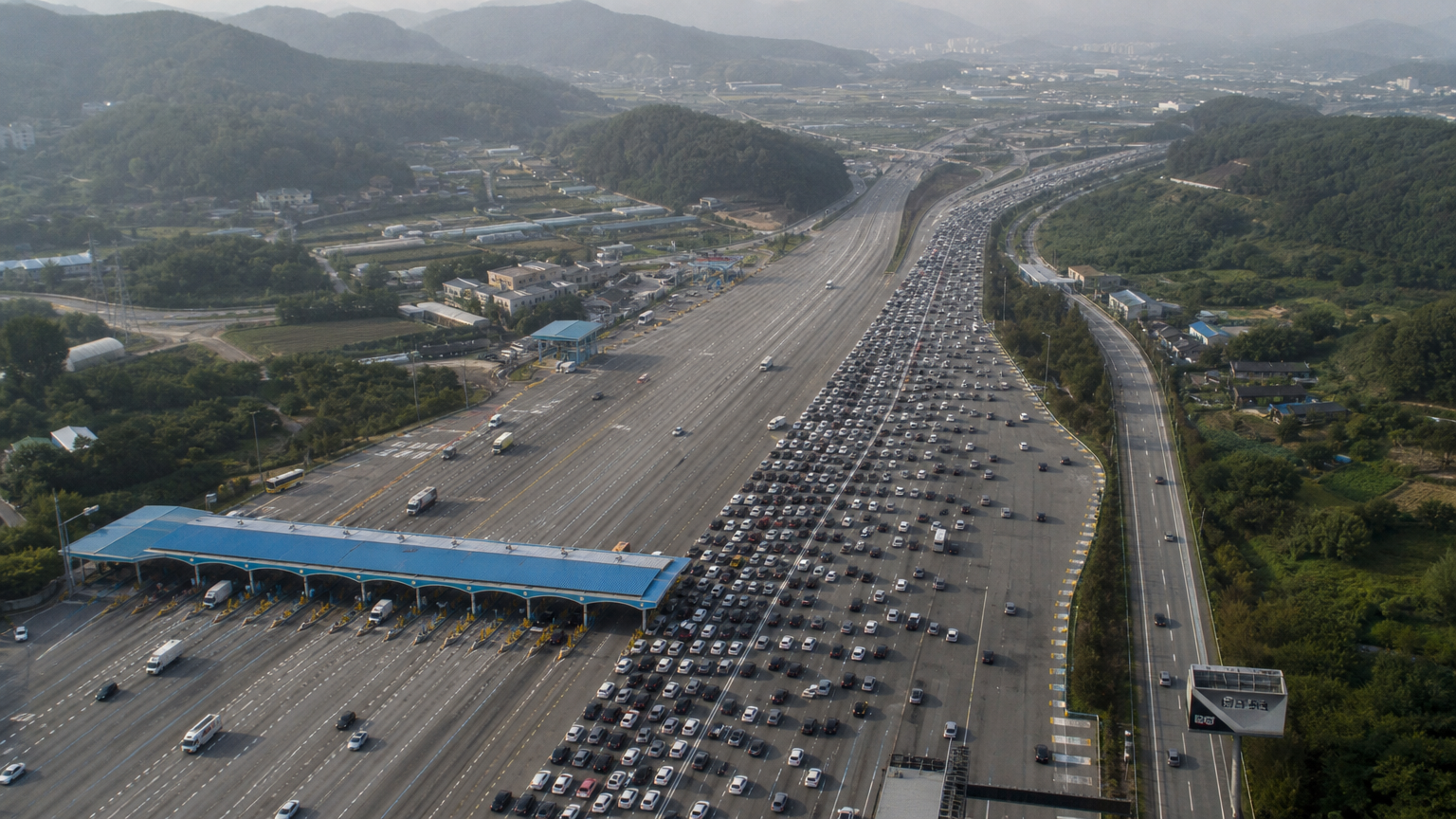
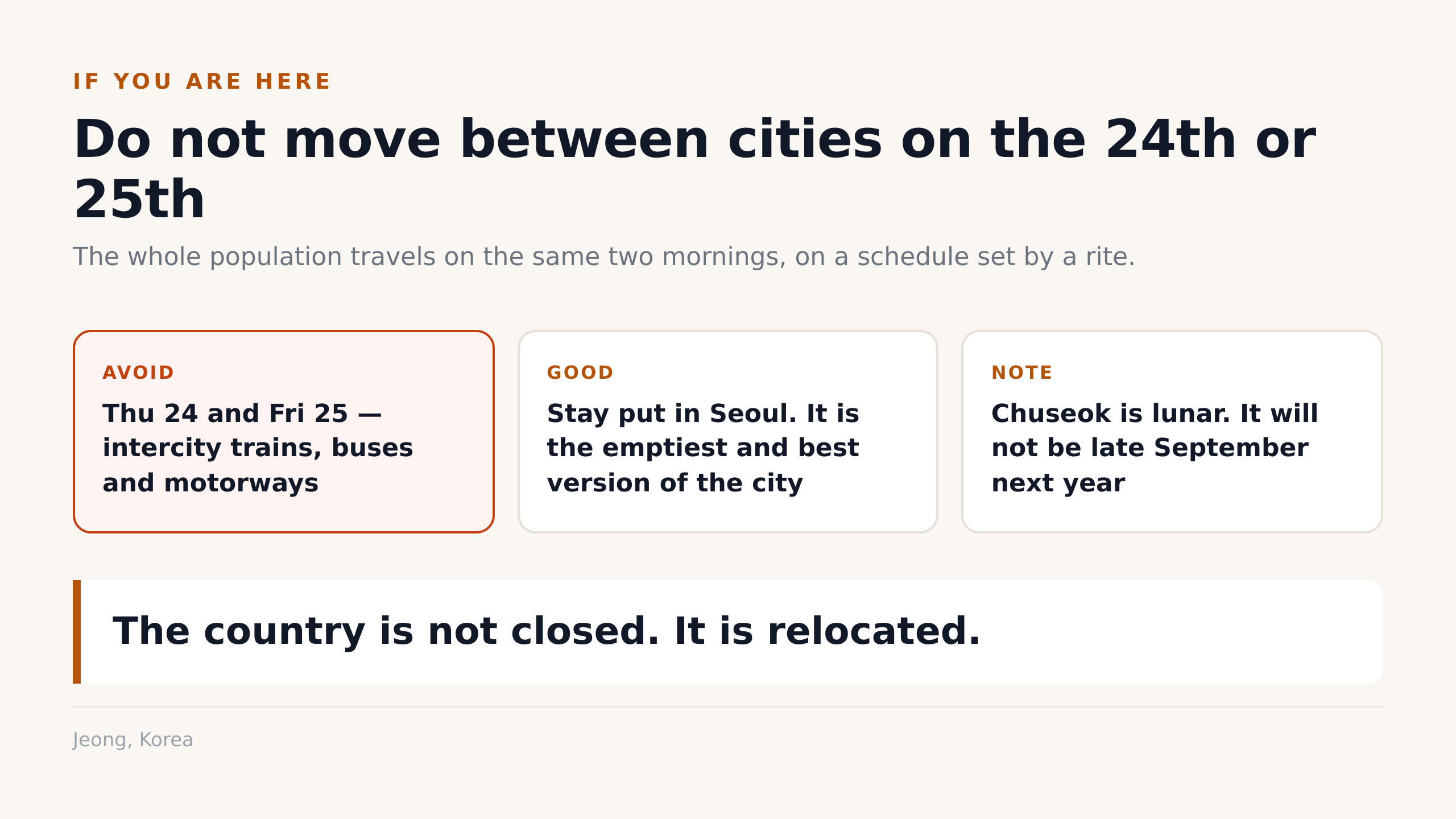
Do not plan to travel between cities on the 24th or the 25th. Everyone is doing it at once, on the same two mornings. That is not a Thanksgiving-scale rush; it is the whole population moving on a schedule set by a rite.
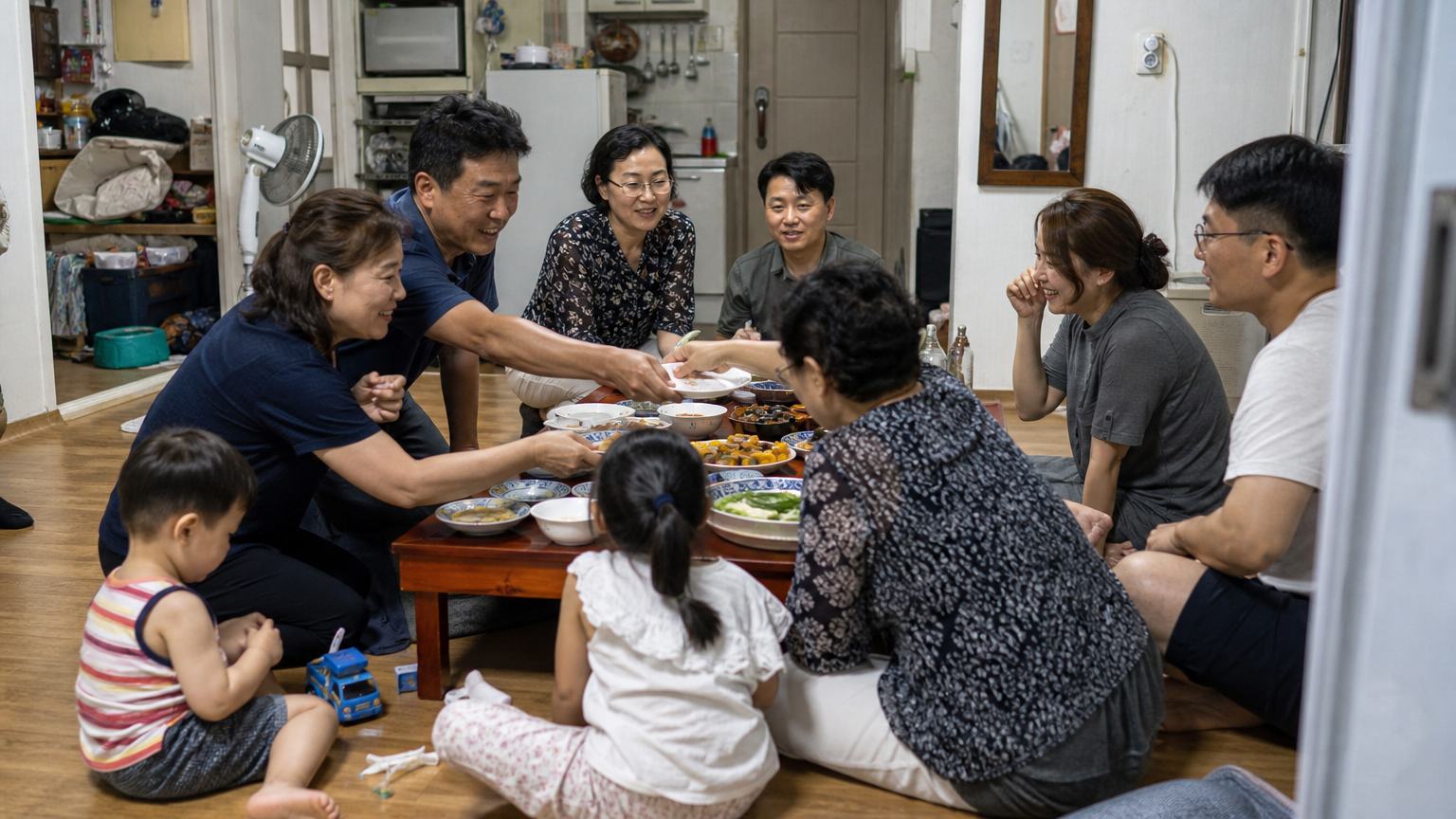
If you are invited into a home, you are being invited into the second half of the day. The rite happens in the morning among family. What you are joining is eumbok, the meal made from the food that was offered. Arriving in the afternoon is not being fobbed off with the leftovers. It is the part that was always meant to be shared outward.
One calendar note, because it catches people: Chuseok moves. It follows the lunar calendar, so it is late September this year and will not be next year. If you are planning around the autumn generally, Korea in October and the long weekends that decide your trip covers where the rest of the season's dates fall.
FAQ
Is Chuseok really Korean Thanksgiving?
Only in the sense that both follow a harvest. Chuseok is centred on charye, a rite for deceased family members, and on visits to ancestral graves. Thanksgiving has no equivalent to either.
How long is Chuseok?
Three days. Korean law defines the holiday as the day before Chuseok, Chuseok, and the day after — in 2026, 24 to 26 September.
Why is there no substitute holiday in 2026?
Because one of the three days falls on a Saturday, and for Chuseok the regulation grants a substitute day only when the date falls on a Sunday. Several other Korean holidays do get one for a Saturday; Chuseok and Lunar New Year do not.
Do all Korean families still perform charye?
No, and the share is falling. Plenty of families now travel, or skip the rite, or hold a simplified version. But the calendar and the traffic are still built around it, whether or not a given household performs it.
I am not arguing that anyone should stop saying Korean Thanksgiving. It is a useful handle, and there is no better two-word phrase in English.
But it is a handle, not a description. If you are here for those three days, the thing worth noticing is not the size of the lunch. It is that the lunch was set out for someone else first, and that a country of fifty million people arranged its calendar, its motorways and its statute book around making that possible.
Look for the table facing the wrong way. That is the holiday.