Renting an Apartment in Seoul: The Two Steps That Decide Whether You See Your Deposit Again

You wire a stranger the largest sum of your life. Then you move in. Then you hope.
That is not a dramatic way of putting it. It is the normal way people rent here. A deposit of ten million won on a small studio is ordinary, and the number climbs fast from there. You will wire it, get a signed contract back, and that will feel like the end of the process.
It is not. The contract proves you agreed on something. It does almost nothing, on its own, to get your money back if the building is sold, or if the landlord borrowed against it and stopped paying.
What protects the money is not the paper. It is two short errands, and both of them happen at a counter in a government office that takes about fifteen minutes to walk to. Almost nobody explains them to foreigners, because Koreans learn them from their parents and assume everyone knows. This is the part of renting an apartment in Seoul that actually matters, so I am going to walk through it in the order you will need it.
Do both errands on the day you move in, at the same counter
Go to the 동 주민센터 (dong jumin senteo, your neighbourhood community service centre) the day you get the keys, and ask for two things at once.
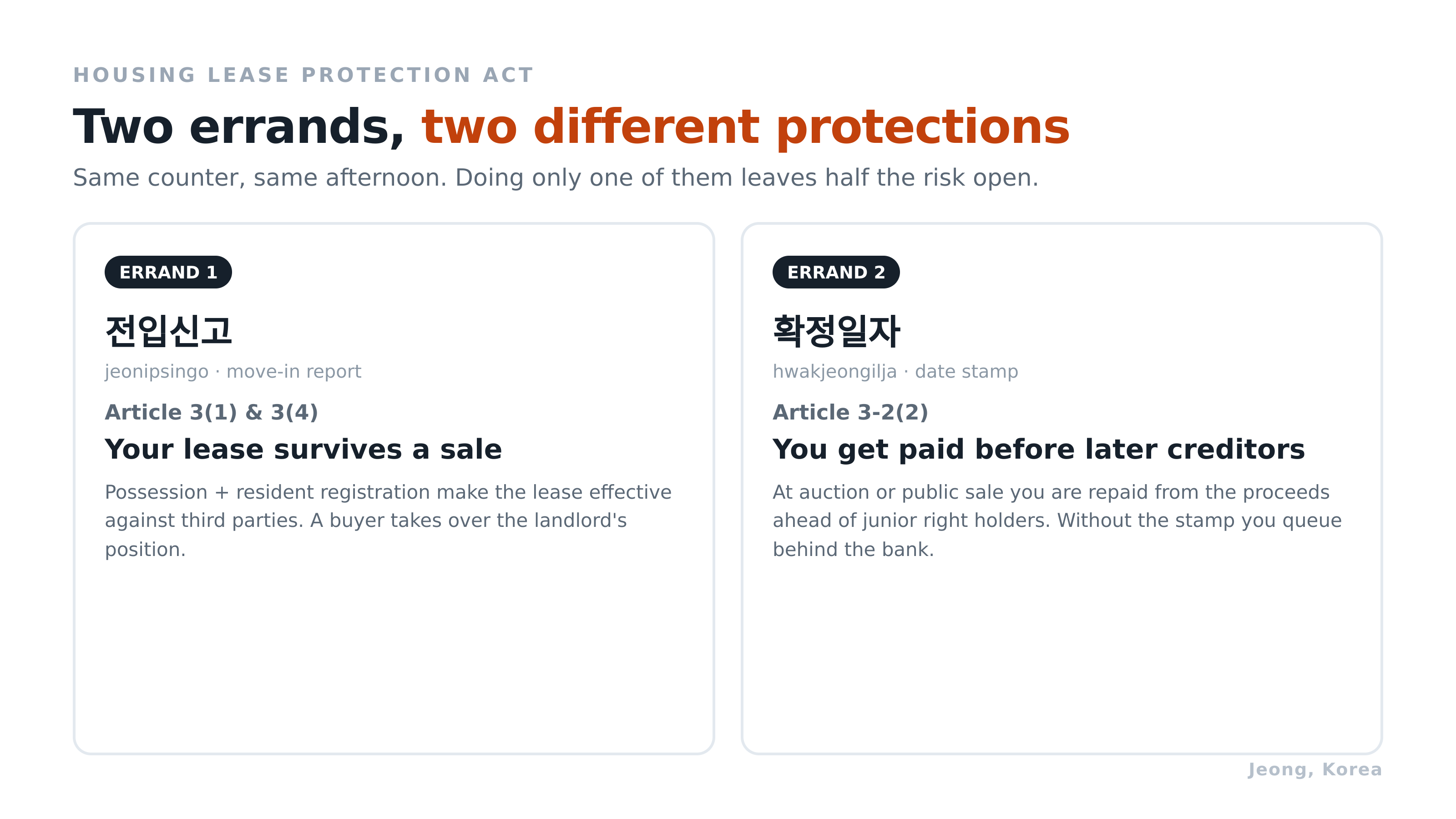
The first is 전입신고 (jeonipsingo), a move-in report. You are telling the government this address is now where you live. The second is 확정일자 (hwakjeongilja), a date stamp put directly onto your lease contract. You hand over the contract, they stamp it, you take it home.
They are two different things and they protect you from two different disasters, which is exactly why people who only do one of them get hurt.
Why the move-in report matters: under Article 3(1) of the Housing Lease Protection Act, a lease takes effect against third parties once the tenant has taken possession of the home and completed resident registration, even with no registration of the lease on the property register. The same clause says filing the move-in report counts as completing resident registration. In plain terms, once you have the keys and you have filed, your lease follows the building. Article 3(4) says a buyer of a leased home is deemed to have taken over the landlord's position. The building can change hands and your lease is still your lease.
Why the date stamp matters: Article 3-2(2) says a tenant who has met those conditions and holds a lease contract bearing a 확정일자 date stamp gets paid ahead of later creditors out of the proceeds if the property goes to auction. Without the stamp you are just another person owed money, standing behind the bank.
So the move-in report keeps you in the apartment. The date stamp gets you paid. You want both, and you want them the same afternoon.
| What you do | Korean name | What it actually buys you |
|---|---|---|
| Move-in report | 전입신고 | Your lease survives a sale of the building |
| Date stamp on the contract | 확정일자 | You are paid before later creditors at auction |
| Register check before signing | 등기부등본 | You find out what is already owed on the place |
Both errands are done at the same window, they cost almost nothing, and you need your passport, your residence card if you have one already, and the signed contract. If your residence card has not arrived yet, go anyway and ask. The move-in report is the one that is time-sensitive.
More on the first month of paperwork here: Living in Korea as a Foreigner: Your First 30 Days, In the Right Order
So why does the timing matter so much that I keep saying "the same day"?
The protection starts the next day, and that gap is where people lose money
Read Article 3(1) again slowly. The lease takes effect against third parties from the day after the tenant completes possession and registration.
Not that afternoon. The next day.
Why the law is written that way is a technical matter about how registrations are timestamped, but the effect on you is simple and unforgiving. If you file your move-in report on a Tuesday, your protection begins Wednesday. Anything registered against the property on Tuesday, including a new mortgage the landlord takes out that same morning, sits ahead of you forever.
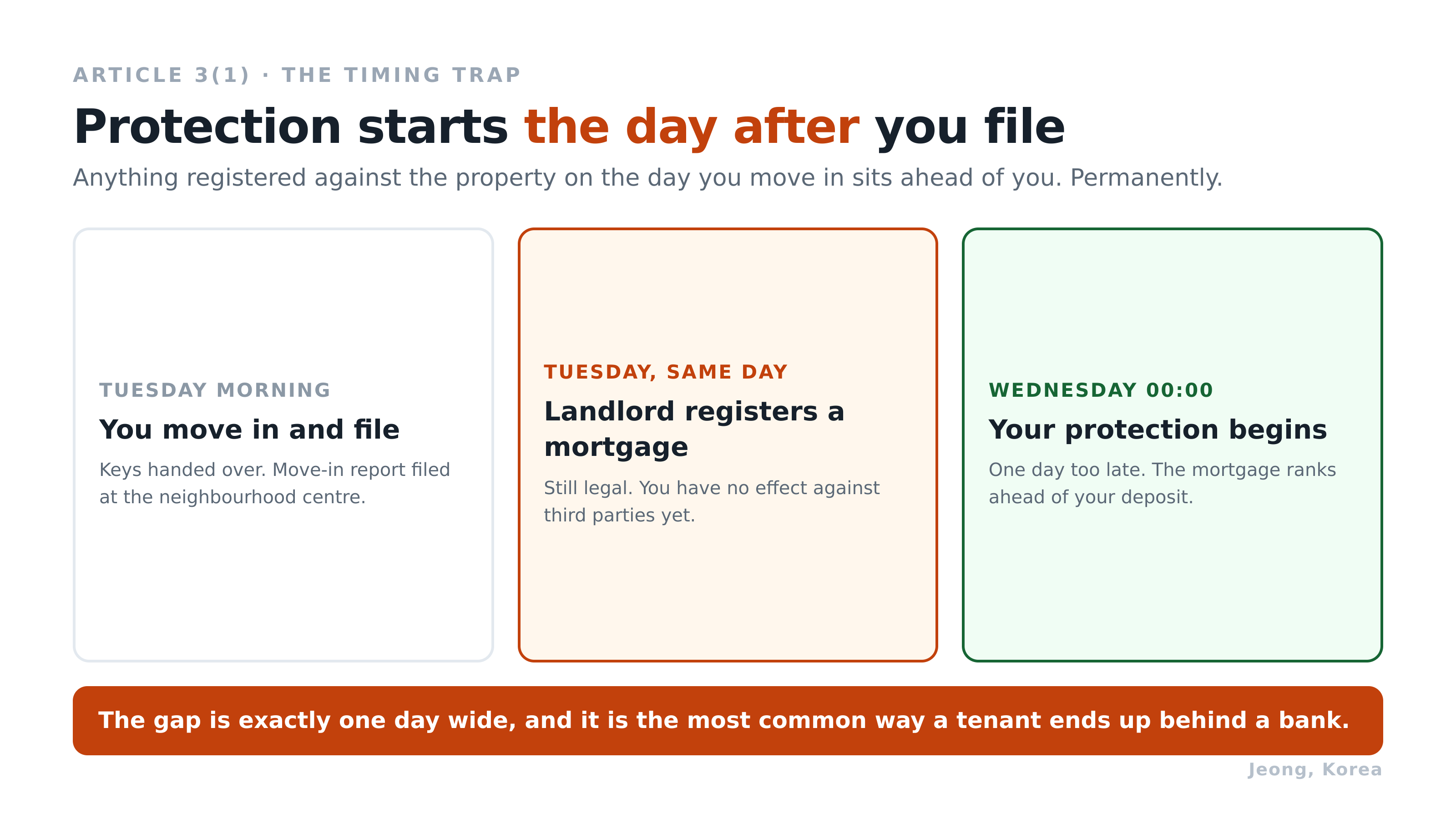
That is not a hypothetical. It is the single most common way tenants here end up behind a bank they never met. The gap is one day wide and it is fully legal.
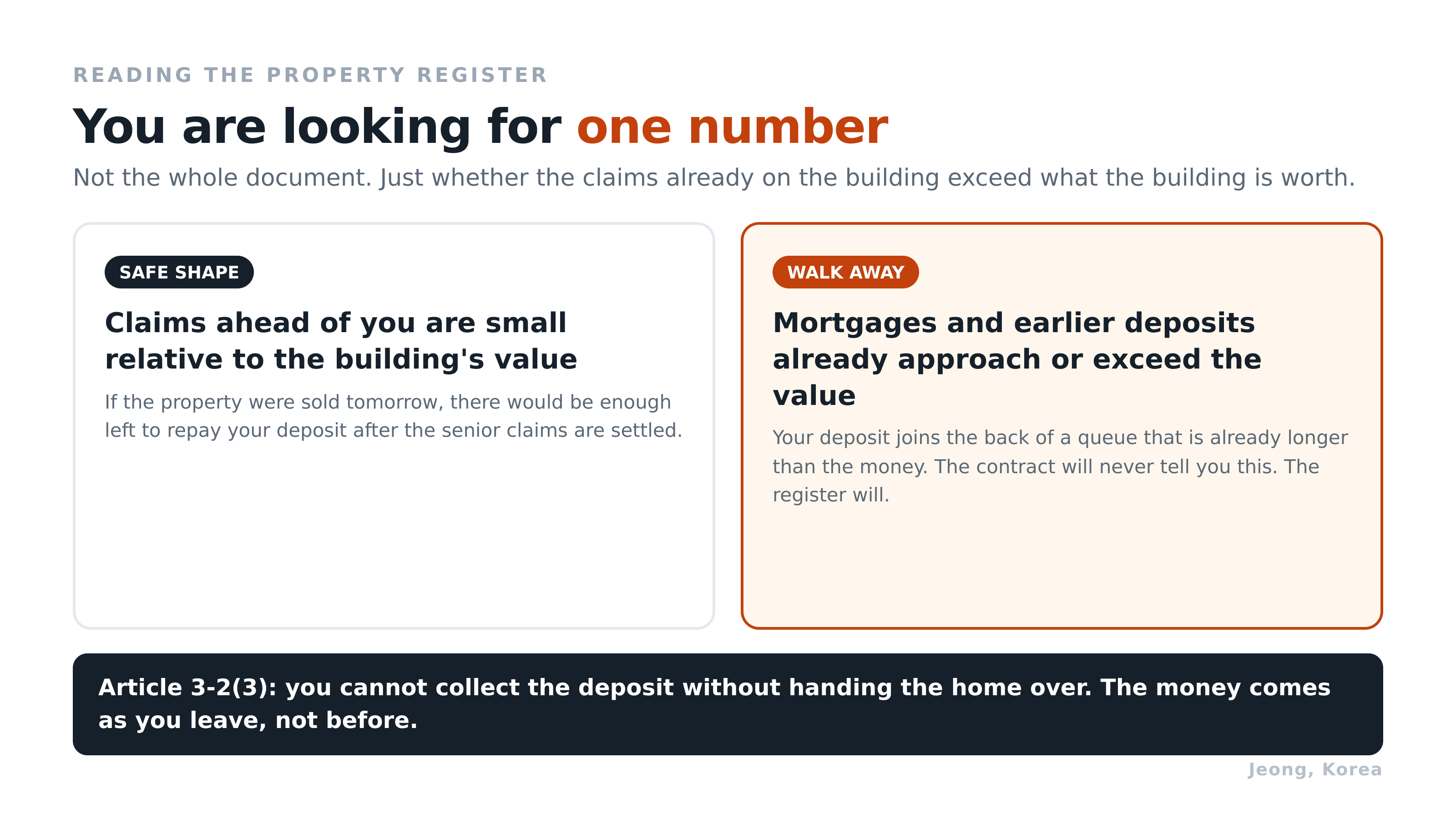
There is a second timing detail people miss. Article 3-2(3) says a tenant cannot collect the deposit under that priority right without handing the home over to the buyer. You do not get to sit in the apartment and hold the deposit hostage at the same time. When the money comes, it comes as you leave.
So: file on day one, and do not let the agent talk you into "we'll sort the paperwork next week." There is no version of next week that is better than today.
Which raises an obvious question. Is there anything you can do before you sign?
Yes, and hardly any foreigner knows to ask for it
There is a check written into the same Act that lets you see what is already owed on the apartment before you commit.
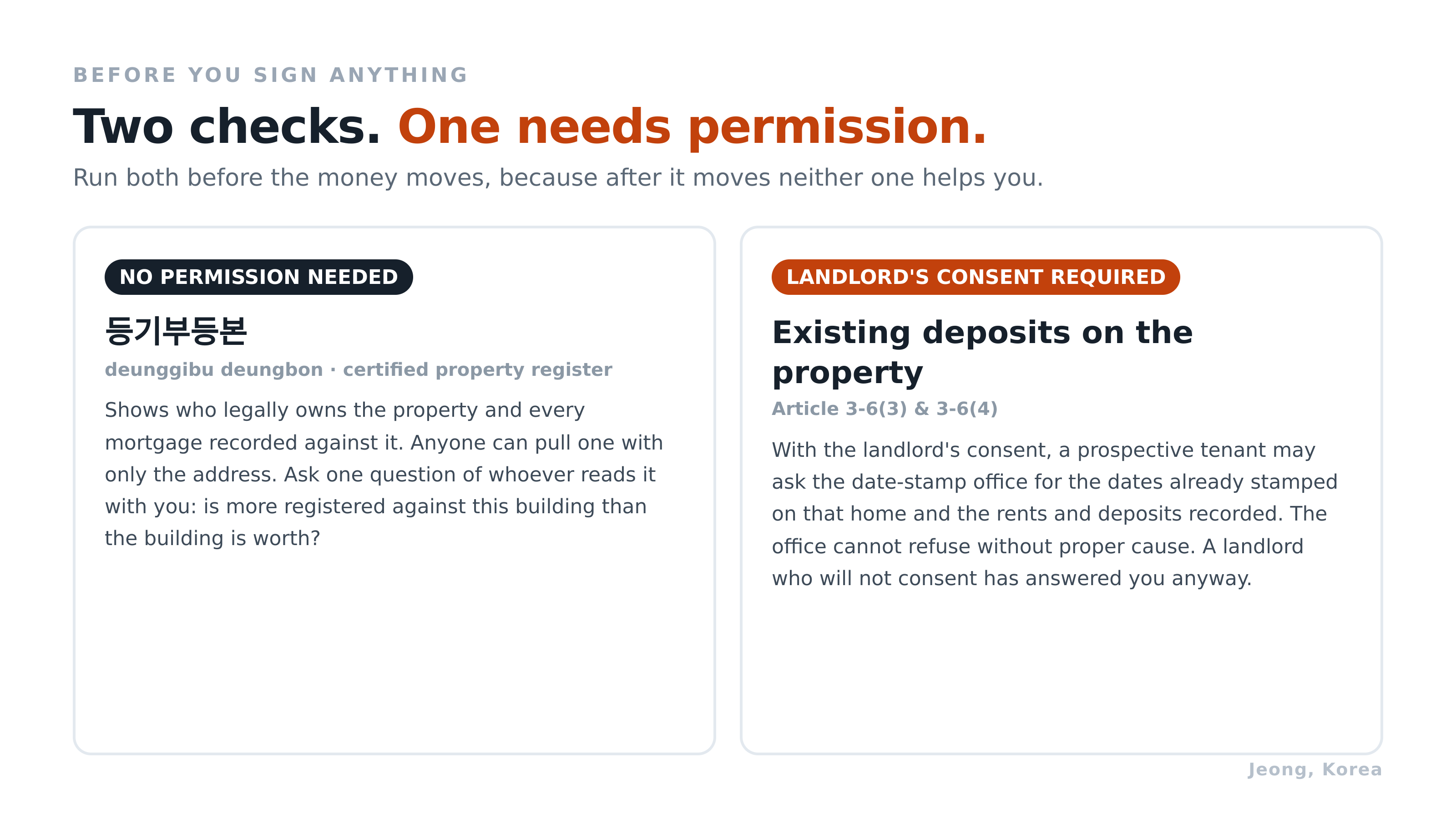
Article 3-6(4) says a person who intends to enter into a lease may, with the landlord's consent, ask the office that issues date stamps for information about that home: the dates already stamped on it, and the rents and deposits recorded. Article 3-6(3) says the office cannot refuse without proper cause.
Think about what that means. Before you sign, you can find out how many other tenants have a claim on this building and how big those claims are. If the answer is "three tenants ahead of you, one hundred million won each, on a building worth two hundred," you have learned something the contract will never tell you.
The catch is in the phrase "with the landlord's consent." You have to ask, and he has to agree. A landlord with nothing to hide will shrug and agree. A landlord who refuses has told you something too.

Run the property register check alongside it. The 등기부등본 (deunggibu deungbon), the certified property register extract, shows who legally owns the place and what mortgages are recorded against it. Anyone can pull one. You do not need permission for that one, only the address.
Reading a Korean property register in Korean is genuinely hard the first time, so this is the one step worth asking a Korean friend or a second agent to look at with you. Ask them one question: how much is already registered against this building, and is it more than the building is worth?
If you are still moving money into the country to pay for all this: Currency Exchange in Seoul: Where Koreans Actually Change Money
What the money words actually mean
Two words will be in every listing you look at, and mixing them up is expensive.
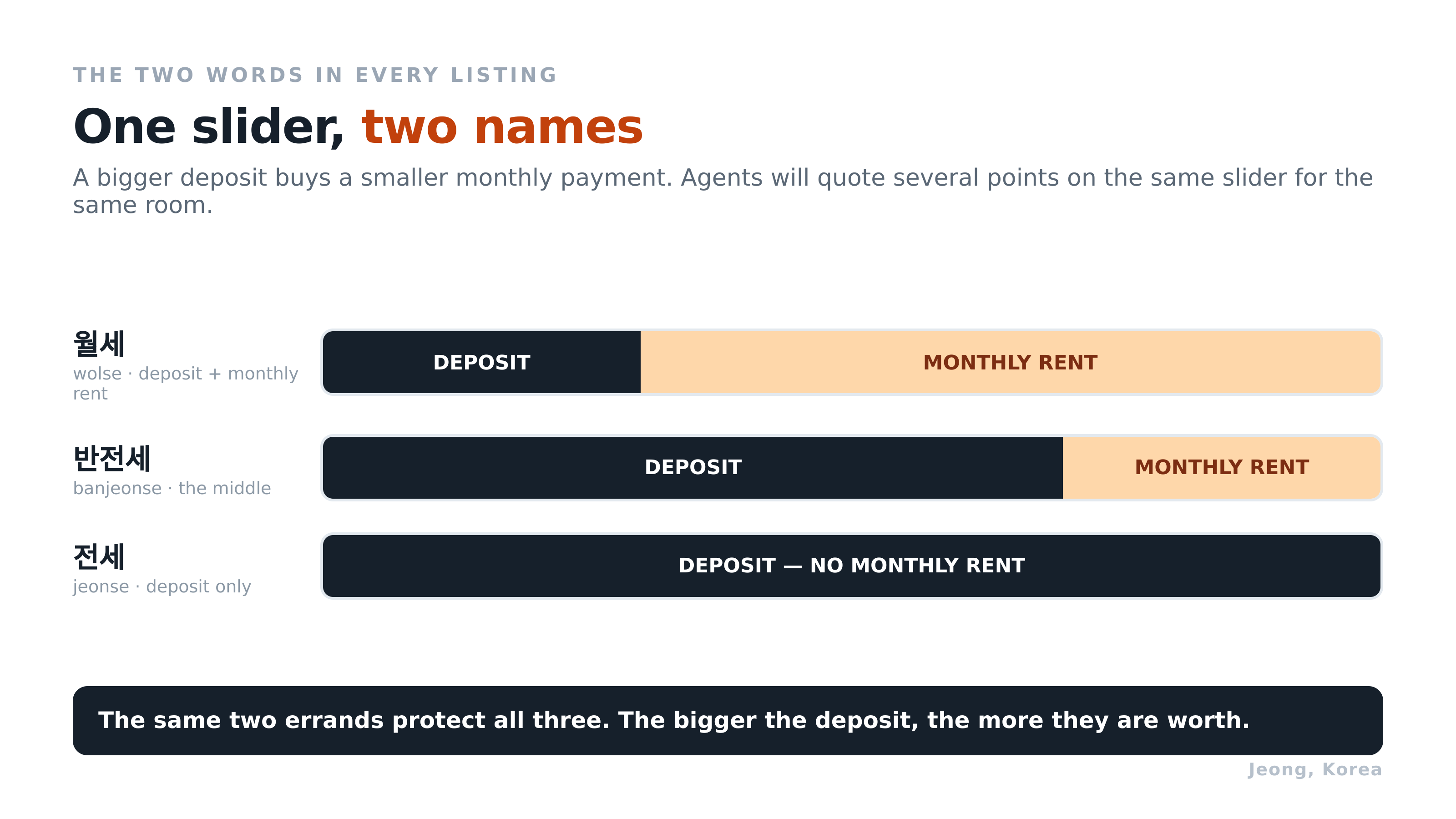
월세 (wolse) is a deposit plus monthly rent. The deposit is large by international standards and the monthly rent is smaller because of it. Most people arriving from abroad rent this way. The two go on a slider: a bigger deposit buys a smaller monthly payment, and agents will quote you several points along that slider for the same apartment.
전세 (jeonse) is a deposit and no monthly rent at all. You hand over a very large lump sum, live there for the contract term, and get the sum back at the end. The landlord's return is whatever he does with your money in the meantime.
I am not going to quote you numbers for either, because rents here move and a figure I write today is wrong by the time you read it. Ask two agents in the neighbourhood you actually want and compare what they quote for the same room. That gives you a real number for this month, which is the only kind worth having.
What I will say is that the protections above apply the same way to both. The bigger the deposit, the more the two errands are worth, which is why jeonse tenants are the ones who get hurt worst when the paperwork is skipped.
The short version
Renting an apartment in Seoul is not risky because Korean landlords are worse than landlords anywhere else. It is risky because the thing that protects you is not the contract, and nobody hands a foreigner that piece of information on arrival.
Three things, in order.
Before you sign, pull the property register, and ask the landlord for consent to check the deposits already recorded on the place. On the day you get the keys, go to the neighbourhood centre and file the move-in report. At the same counter, in the same visit, get the date stamp on your contract.
That is it. Three errands, one of them free, none of them longer than an afternoon. Do them and your deposit sits behind a law. Skip them and it sits behind nothing.
If you are reading this before you have signed anything, you are in the best possible position. Go and do the register check today, while saying no still costs you nothing.

FAQ
Do I need a residence card before I can file a move-in report?
Go to the neighbourhood centre and ask, bringing your passport and the signed contract. Do not delay the visit waiting for a card to arrive, because the protection under Article 3(1) begins the day after you file, and every day you wait is a day you are unprotected.
Can I get the date stamp later if I forget?
You can get it later, but the priority it gives you runs from the date stamped, not from the date you moved in. A stamp obtained three months late sits behind everything registered in those three months.
Does my lease survive if the landlord sells the building?
Under Article 3(4) of the Housing Lease Protection Act, a buyer of a leased home is deemed to have taken over the landlord's position. That protection depends on you having completed possession and the move-in report first.
What is 반전세?
It is the middle of the slider between wolse and jeonse: a deposit much larger than a typical monthly-rent deposit, with a much smaller monthly payment. It is a pricing arrangement rather than a separate legal category, and the same two errands protect it.
Is renting an apartment in Seoul possible without a Korean guarantor?
Yes. Guarantor requirements are a landlord's own policy rather than a legal rule, and they vary by landlord and by neighbourhood. Ask the agent before viewing so you are not surprised at the contract table.
Sources
Housing Lease Protection Act, Articles 3, 3-2 and 3-6 (주택임대차보호법) — Korean Law Information Center, National Law Information Center
Korean terms in this article: 전입신고, 확정일자, 등기부등본, 월세, 전세, 반전세, 동 주민센터