Currency Exchange in Seoul: Where Koreans Actually Change Money (Not the Airport)

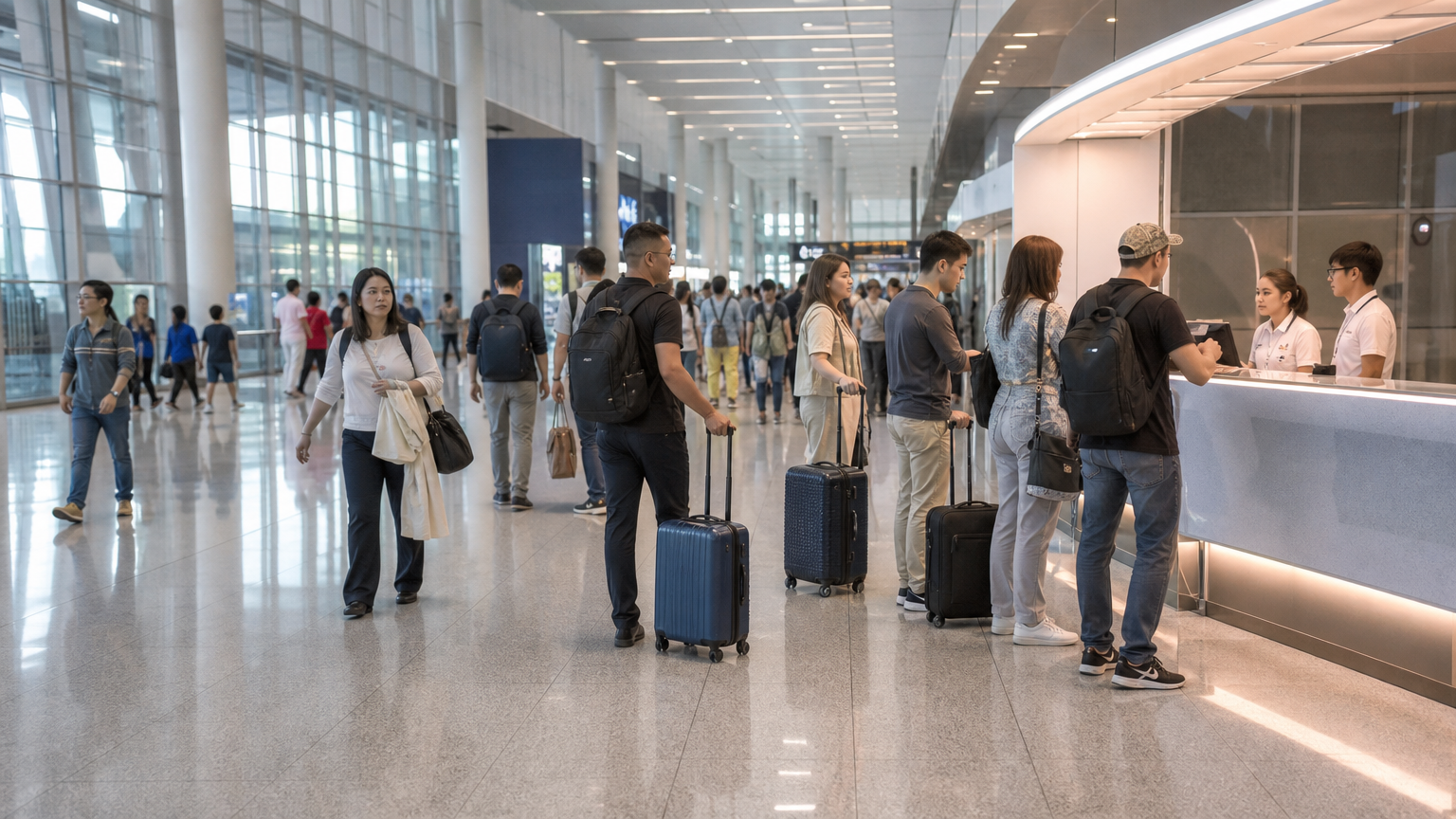
Watch the arrivals floor at Incheon for a while and you will see the same thing over and over. Foreign passengers stop at the exchange counter. Korean passengers walk straight past it.
It is not that we are all carrying the perfect amount of cash. It is that we learned, at some point, that the counter in front of you and the counter in the city are not selling the same thing at a different price. They are selling the same thing at a different rate, and the rate is the part nobody teaches you to look at.
This is the piece I wish someone had handed my friends before they landed.
The rate on Google is not a rate you can get
Search for the won against your currency and you will get one clean number. That number is the mid-market rate, and no counter anywhere will give it to you. It sits in the middle of two prices — the price at which cash is sold to you, and the price at which cash is bought from you.
The distance between those two prices is where the exchange counter makes its money. Everything else in this article is about how wide that distance is in different places.
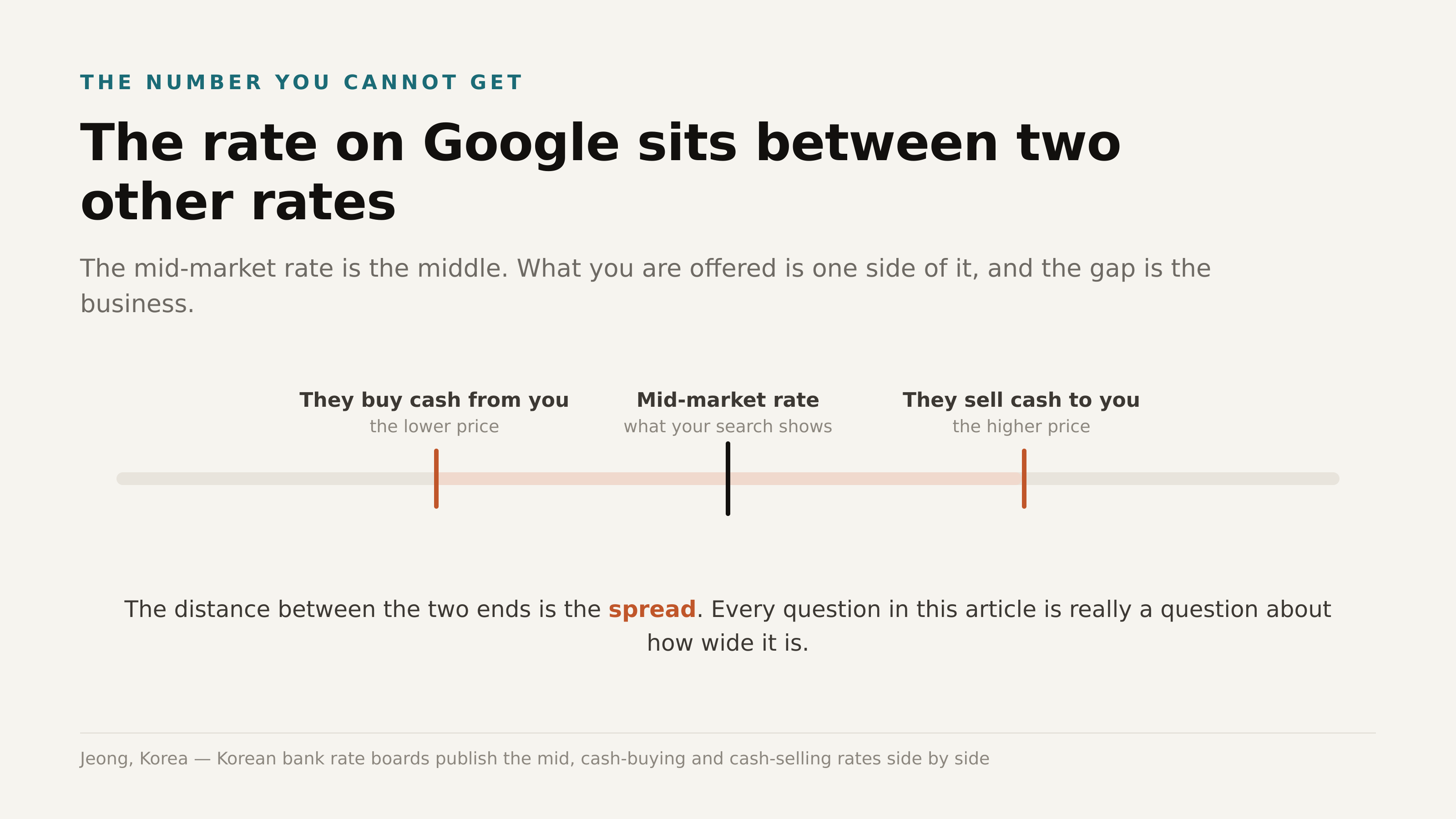
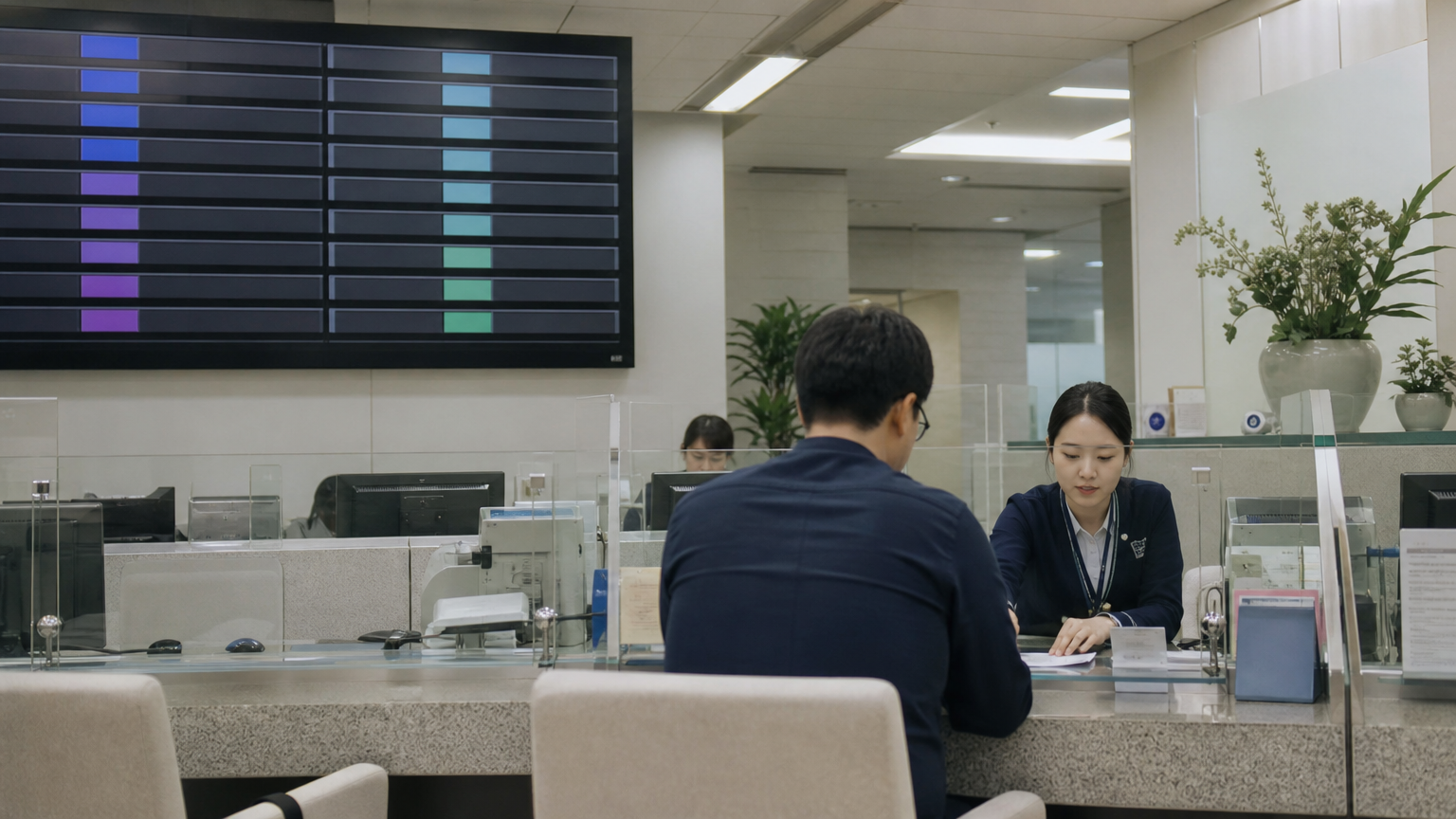
Korean banks publish all of this. Their rate boards show the mid rate, the cash-buying rate, and the cash-selling rate side by side, and once you have seen the three numbers together the whole thing stops being mysterious.
우대율 — the discount that is not advertised
Here is the concept that makes Koreans behave differently from visitors, and it does not translate cleanly.
Korean banks apply a preferential rate, 우대율, which is a discount on the exchange margin itself. Not on the amount. On the margin.
If a bank gives you 90% 우대, you are paying 10% of the spread you would otherwise have paid. The advertised rate on the board does not change. What changes is how much of the gap between the mid rate and the cash rate you actually absorb.
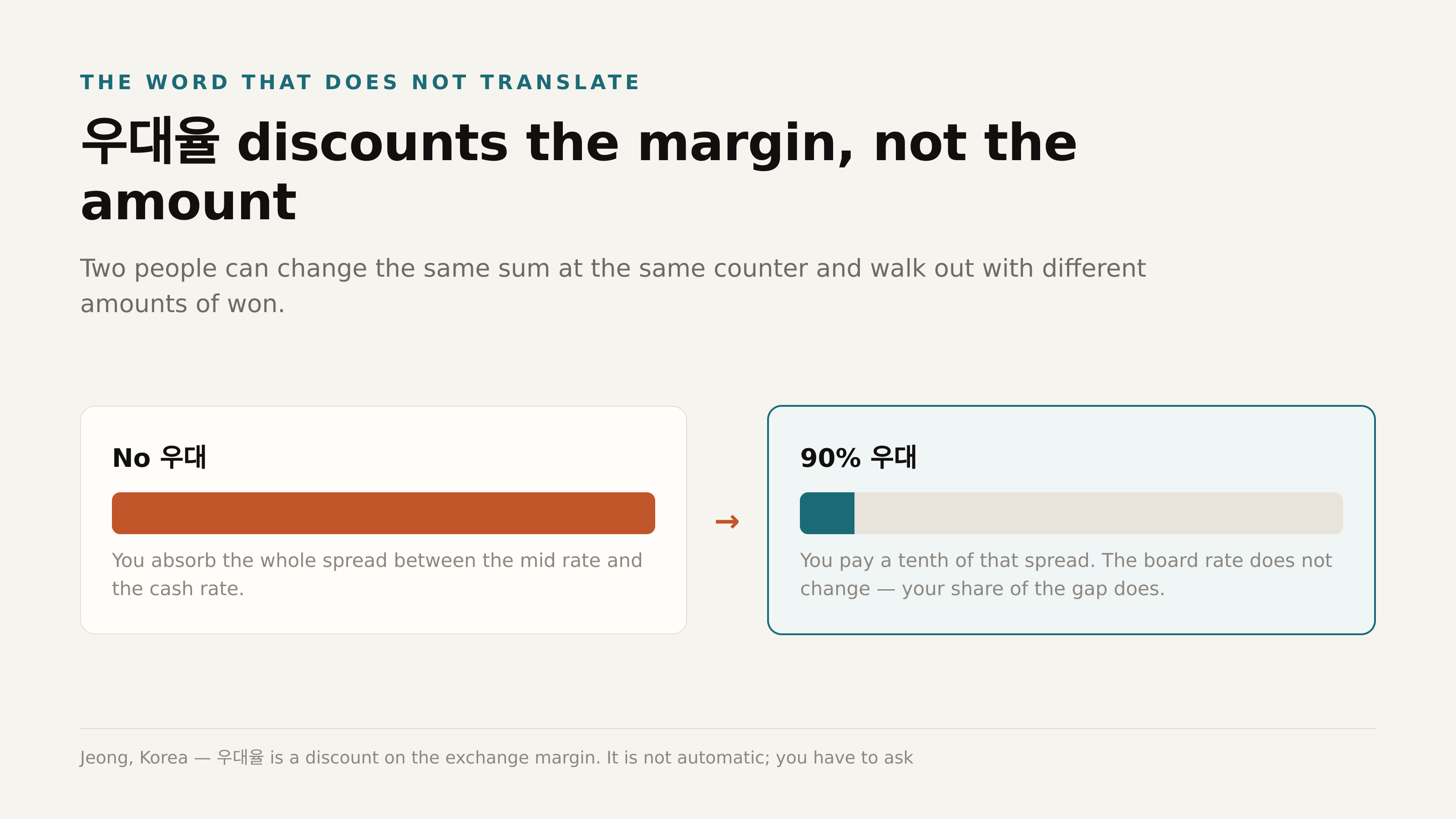
This is why two people can change the same amount at the same branch on the same afternoon and walk out with different amounts of won. One of them asked, or had an account, or used the bank's app beforehand. The other took the board rate.
Nobody at the counter will volunteer it. Asking is normal and expected.
Airport, bank branch, licensed money changer
| Where | How the rate usually sits | When it makes sense |
|---|---|---|
| Airport counter | Least favourable of the three | You need cash in the next thirty minutes |
| Bank branch in the city | Middle, and improves sharply if you get 우대 | You are staying a while, or changing a large amount |
| Licensed money changer (Myeongdong and similar) | Often the most favourable for cash | You have cash, you are in the city, and the amount is meaningful |
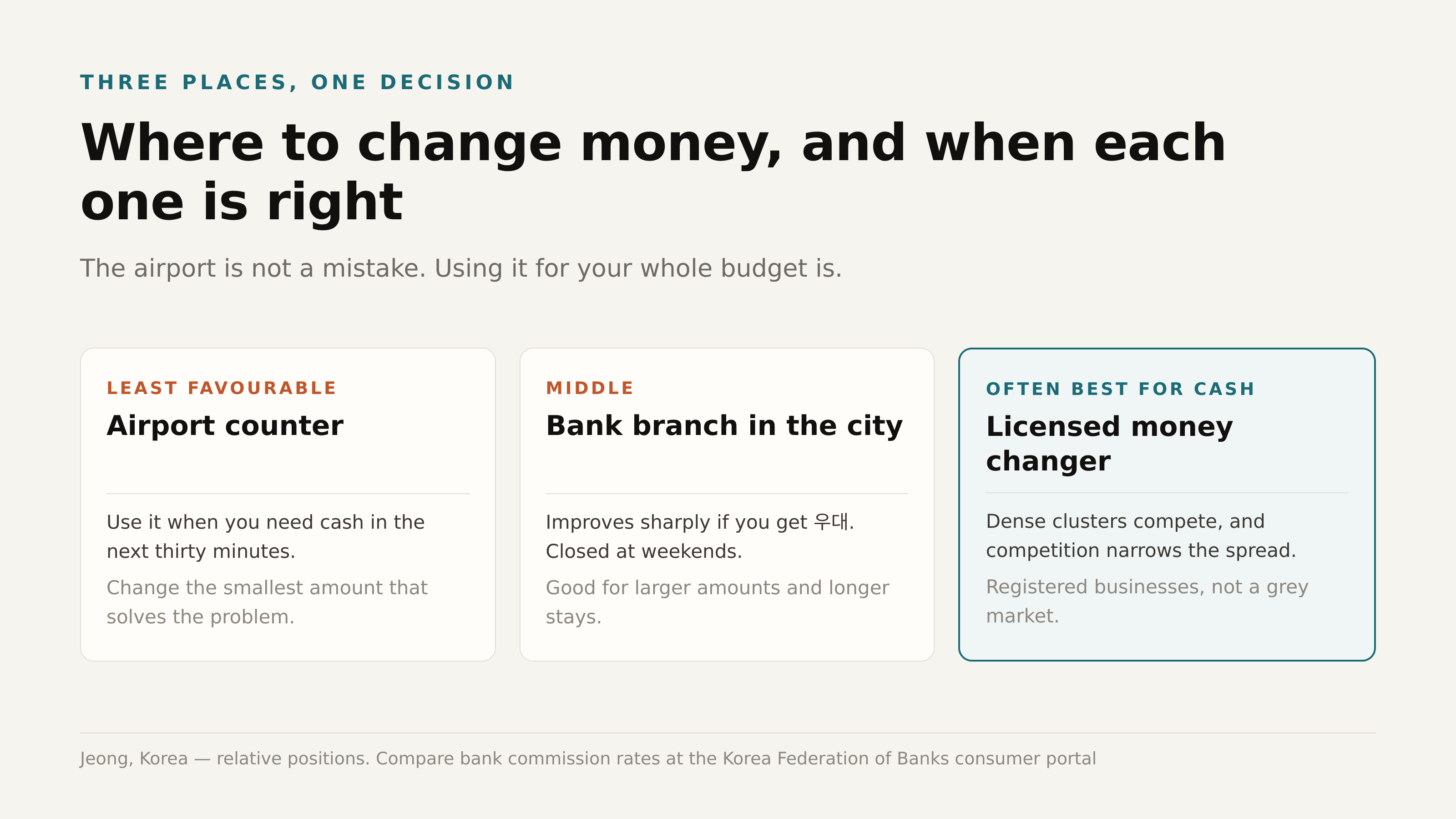
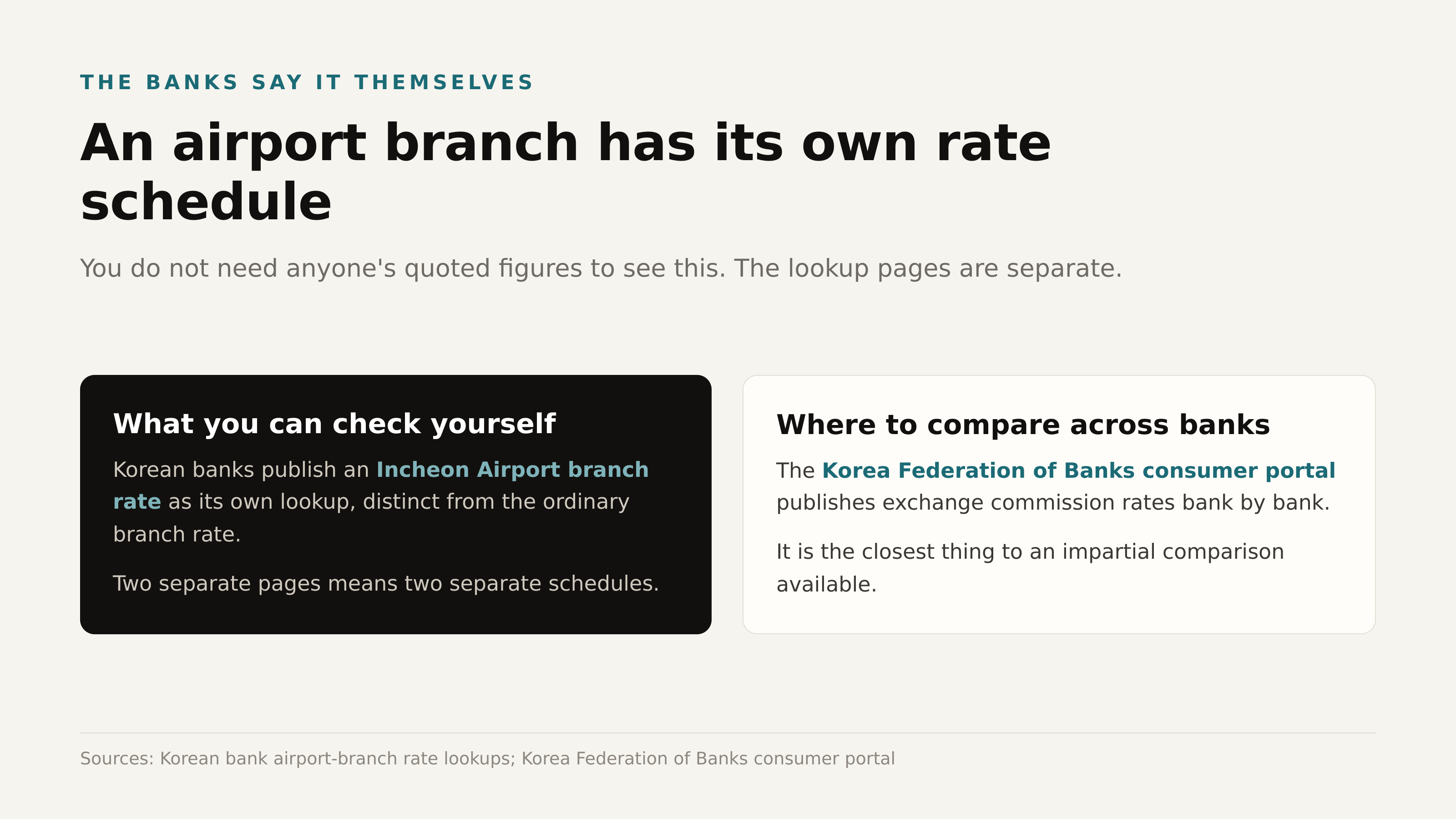
There is a detail that gives the airport away without needing a single quoted figure: Korean banks operate their airport branches on a separate rate schedule from their city branches, and publish them separately. A bank that lists an "Incheon Airport branch rate" as its own lookup, distinct from its normal rate, is telling you plainly that the two are not the same.
You can compare across banks yourself. The Korea Federation of Banks runs a consumer portal that publishes exchange commission rates by bank, which is the closest thing to an impartial comparison you will find.
How to tell a legal money changer from one that is not
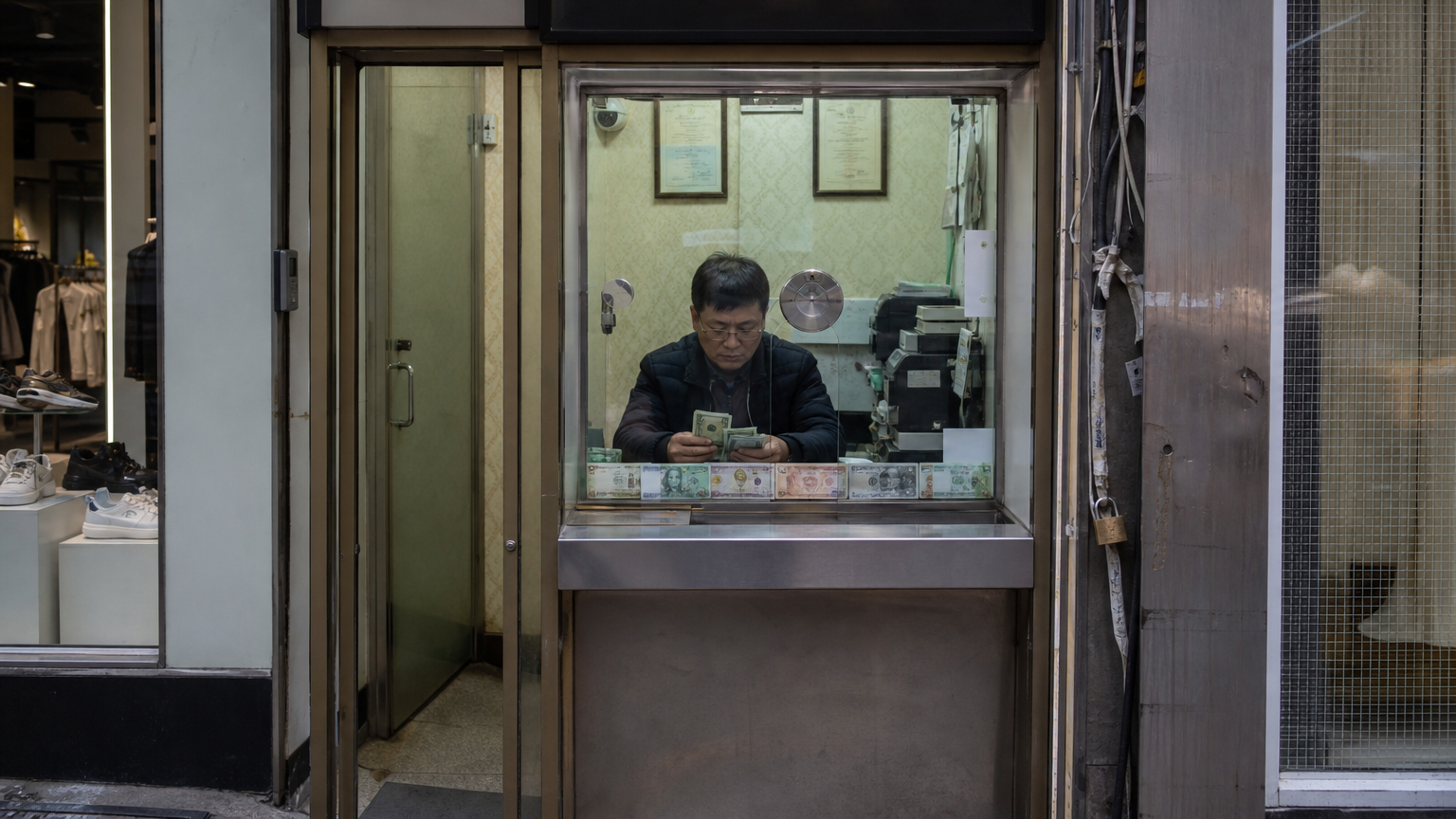
The counters in Myeongdong that look informal — a small booth, a hand-written board, someone counting notes — are, when they are legitimate, a regulated business.
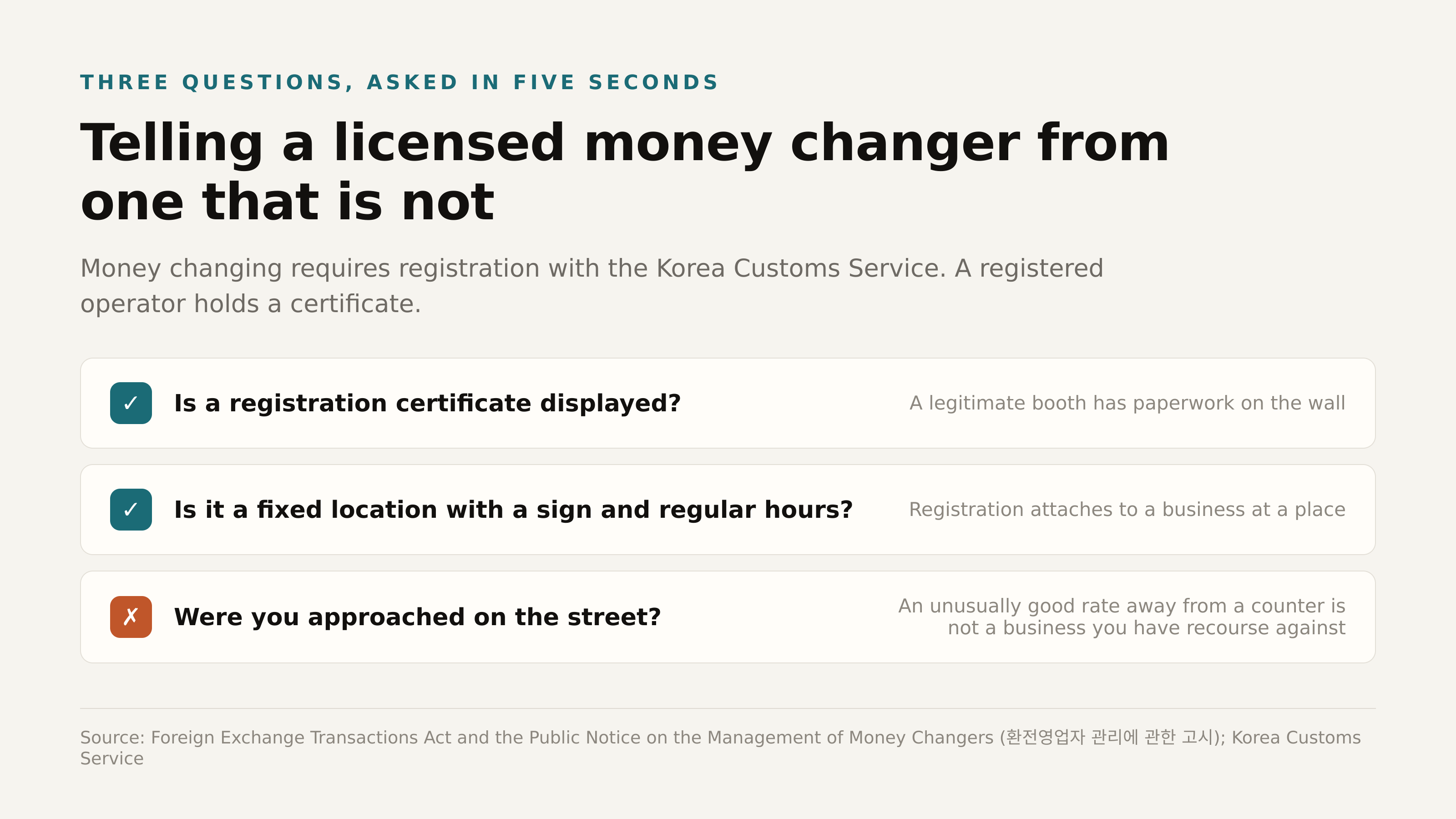
Money changing in Korea requires registration with the Korea Customs Service, under the Foreign Exchange Transactions Act and its accompanying rules on the management of money changers. A registered operator holds a registration certificate issued under that framework. Operating without it is an offence, not a technicality.
So the practical test is simple, and it is the one Koreans apply without thinking about it:
-
Is there a registration certificate displayed? A legitimate booth has paperwork on the wall. An operation with nothing on display is one to walk away from.
-
Is it a fixed location with a sign, open regular hours? Registration attaches to a business at a place.
-
Are you being approached on the street? Someone offering you an unusually good rate away from a counter is not a business you have any recourse against.
The good rates in Myeongdong are not the grey market. They are ordinary registered businesses with lower overheads than an airport terminal. There is no reason to go looking for anything less official than that.
Why Myeongdong specifically
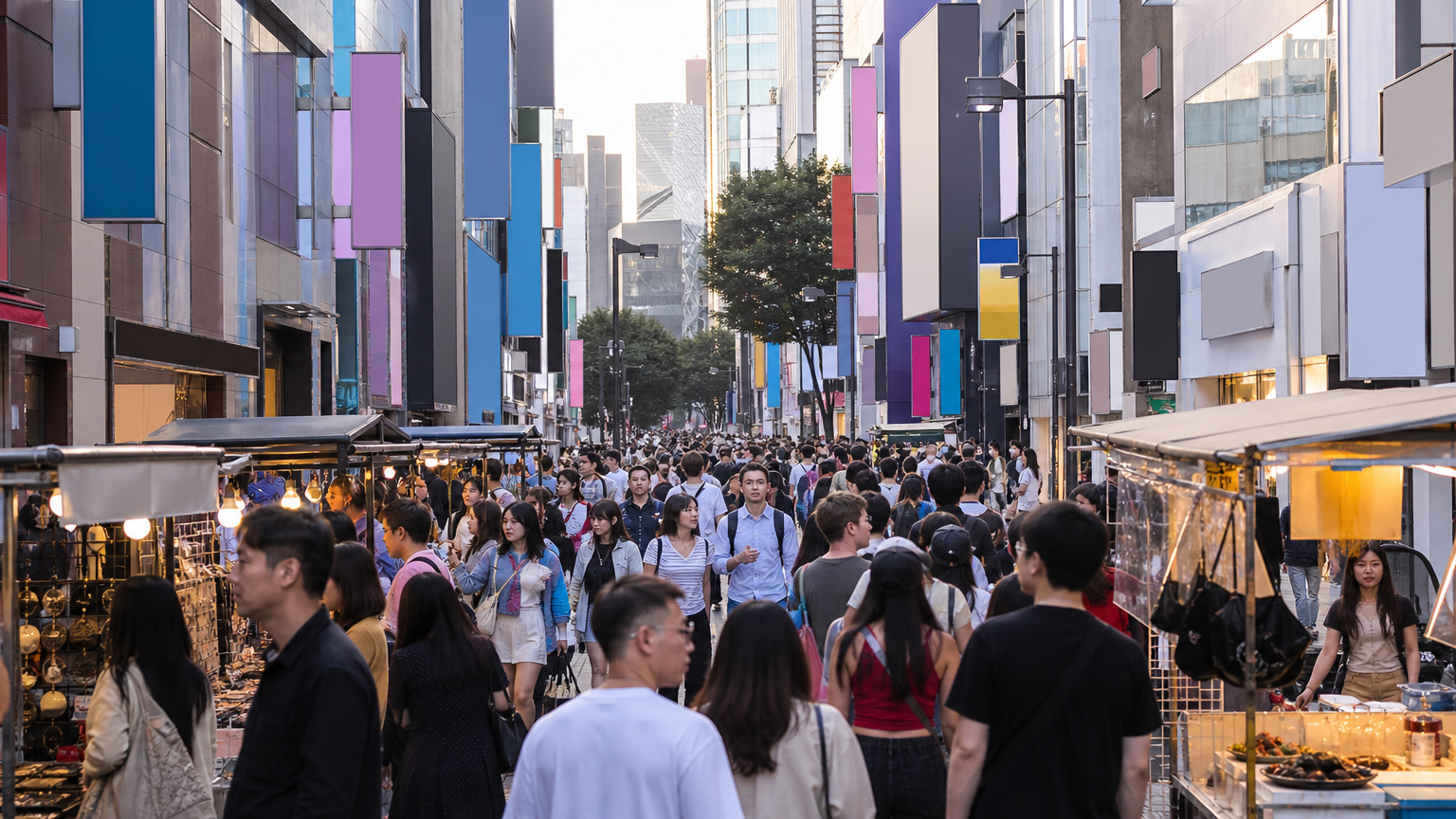
Because of density. A concentration of small operators competing for the same walk-past traffic drives spreads down, and Myeongdong has had that concentration for decades. It is the same reason the electronics prices in Yongsan used to be what they were.
That is also the limit of the advice. The rate is good there because of competition, not because of the neighbourhood's magic, so the same logic applies to any dense cluster of licensed counters. Outside those clusters, a bank branch is usually your better option.
How much cash do you actually need
Less than you think, and more than zero.
Korea is close to cashless for ordinary spending. Card works nearly everywhere, and transit runs on a tap. But foreign-issued cards fail here more often than visitors expect, in ways that are specific to the Korean payment network rather than to your bank — we wrote that up separately, because it catches people out constantly.
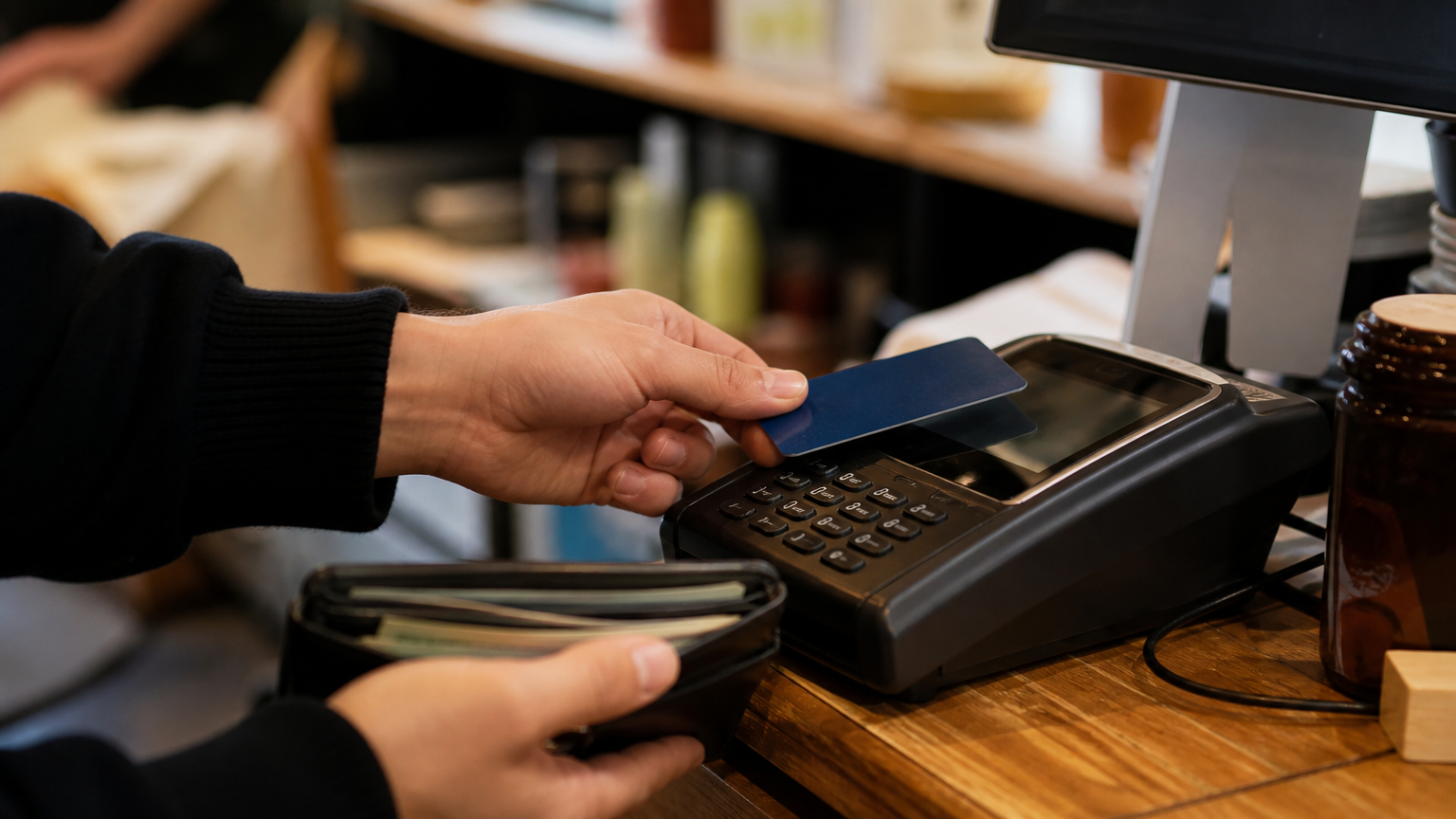
The practical shape most people land on: change a small amount at the airport to cover transport and the first day, then do the real currency exchange in the city once you are not tired and standing in a queue.
That is the actual Korean behaviour, by the way. It is not that we never use the airport counter. It is that we use it for the smallest amount that solves the immediate problem, and we do the rest somewhere with a better rate.
Changing won back at the end
Two things worth knowing before your last day.
The buy-back rate is a separate rate, and the spread applies again in the other direction. Changing money twice always costs you twice.
And bank branches are closed at weekends. If you fly out on a Sunday with a pocket full of won, the airport counter is your only option, at the airport's rate. Koreans plan the last currency exchange around this. Spend the small notes, keep the amount you are converting back deliberately low, and do it on a weekday if the flight allows it.
FAQ
Is it a bad idea to change money at Incheon Airport?
For a small amount to get you into the city, it is fine and it is what most people should do. For the bulk of your budget, the airport rate is the least favourable of the realistic options, and the banks themselves signal this by publishing airport branch rates separately from city rates.
Are the money changers in Myeongdong safe?
The registered ones are ordinary regulated businesses. Money changing requires registration with the Korea Customs Service, and a legitimate operator displays its certificate. A fixed booth with visible paperwork is fine. Someone approaching you on the street is not.
What is 우대율?
A discount on the exchange margin rather than on the amount you are changing. Ninety percent 우대 means you pay ten percent of the spread you would otherwise pay. It is not automatic — ask for it.
Should I use an ATM instead of a currency exchange counter?
Withdrawing won directly can work well, but it stacks your own bank's foreign transaction fee and the ATM operator's fee on top of a conversion rate you do not control. Compare it against a counter rather than assuming it is cheaper.
Can I change leftover won back to my own currency?
Yes, at banks and at licensed counters, at the buy-back rate. You lose the spread a second time, so convert only what you genuinely will not spend.
Do I need to bring cash to Korea at all?
Some. Card coverage is excellent but foreign-issued cards are rejected more often here than visitors expect, and a small cash reserve solves that problem instantly.
References
-
Foreign Exchange Transactions Act and the Public Notice on the Management of Money Changers (환전영업자 관리에 관한 고시) — registration of money changing businesses with the Korea Customs Service, and issuance of the registration certificate
-
Korea Customs Service (관세청) — operations manual for registered exchange businesses, and guidance on unlawful money changing
-
Korea Federation of Banks consumer portal — published comparison of exchange commission rates by bank
-
Jeong, Korea, Why Your Foreign Card Gets Rejected in Korea — why a cash reserve is still worth carrying