Dentist in Korea: What It Actually Costs, and How to Check Before You Sit Down

The thing that keeps people out of a dental chair is almost never the drill. It is not knowing the number.
I have watched friends here put off a chipped tooth for months, not because they were frightened of the treatment but because nobody could tell them whether it would come to fifty thousand won or five hundred thousand. In their own countries they would have known roughly, the way you know roughly what a haircut costs. Here they knew nothing, so they waited.
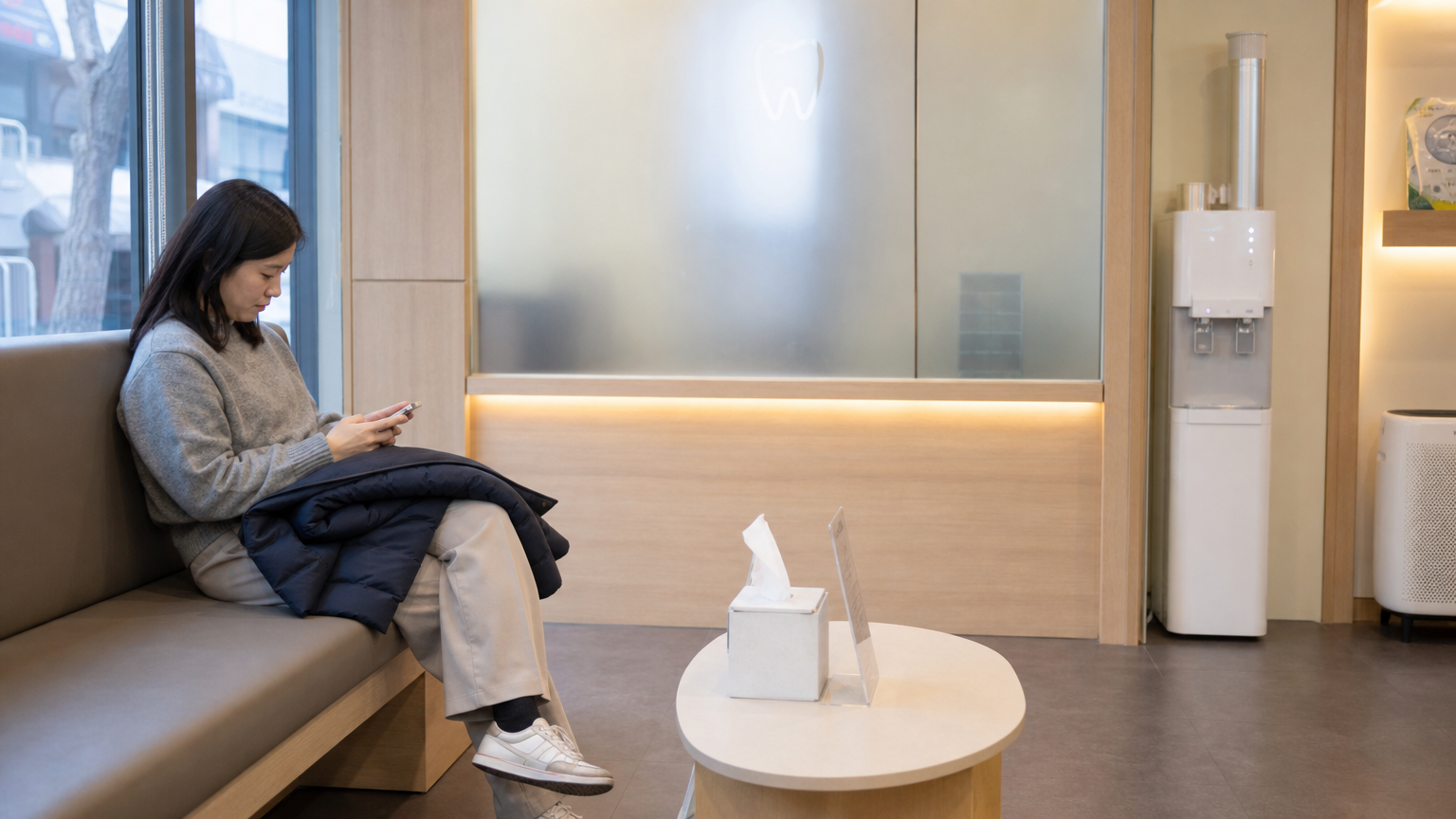
What I want to explain is the thing Koreans do that visitors and residents mostly do not: we look the price up first. It is published. It has been published for years. Almost no English-language guide mentions it.
The one thing that is definitely covered
Start with the good news, because it is the part that surprises people most.
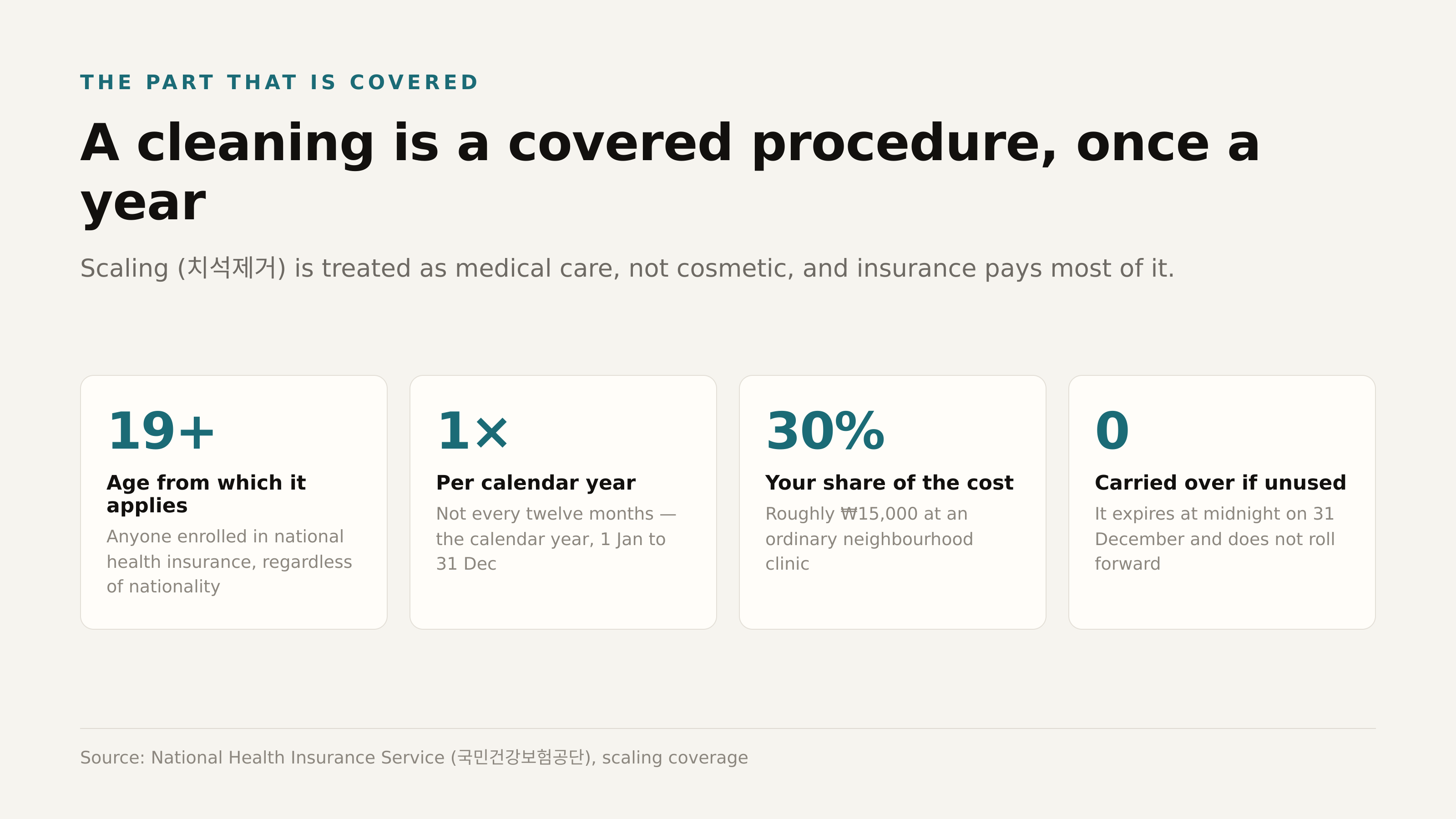
If you are on Korean national health insurance and you are 19 or over, a scaling — a cleaning, treated here as a medical procedure called 치석제거 — is covered once per calendar year. You pay the standard 30% patient share, which lands somewhere around ₩15,000 at a normal neighbourhood clinic.
Two details about that sentence do the real work.
"Per calendar year" does not mean "every twelve months." The clock is the calendar, running 1 January to 31 December. If you had one in December, you can have another one in January. If you have not used this year's, it disappears at midnight on 31 December and you do not get it back.
It applies to you if you are insured, regardless of nationality. Korean national health insurance is not a citizenship benefit. If you are enrolled — through an employer, or as a local subscriber after the qualifying residence period — this is yours on the same terms as anyone else's.
Every December, Korean clinics fill up with people using the benefit before it expires. If you have been in Korea a while and never used it, that is a free-standing reason to book.
Why the same treatment has wildly different prices
Here is the structure nobody explains, and it is the whole game.
Korean dental work splits into two categories, and they behave completely differently.
| Covered (급여) | Not covered (비급여) | |
|---|---|---|
| Who sets the price | The state, nationally | Each clinic, individually |
| Does it vary between clinics | No | Yes, enormously |
| What you pay | A fixed share, usually 30% | The full amount |
| Typical examples | Scaling, extractions, basic fillings, X-rays | Implants, orthodontics, whitening, veneers, most cosmetic work |
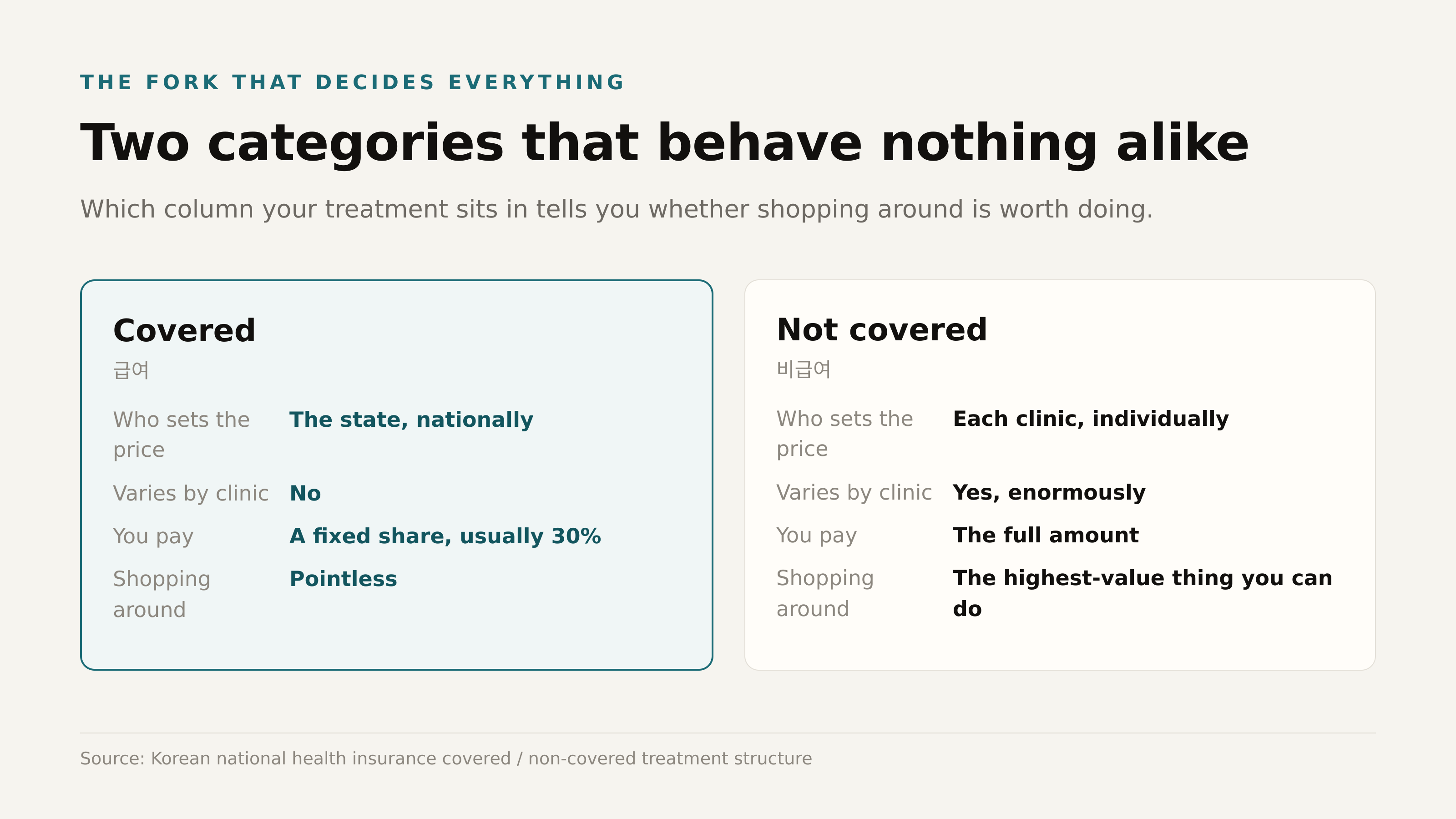
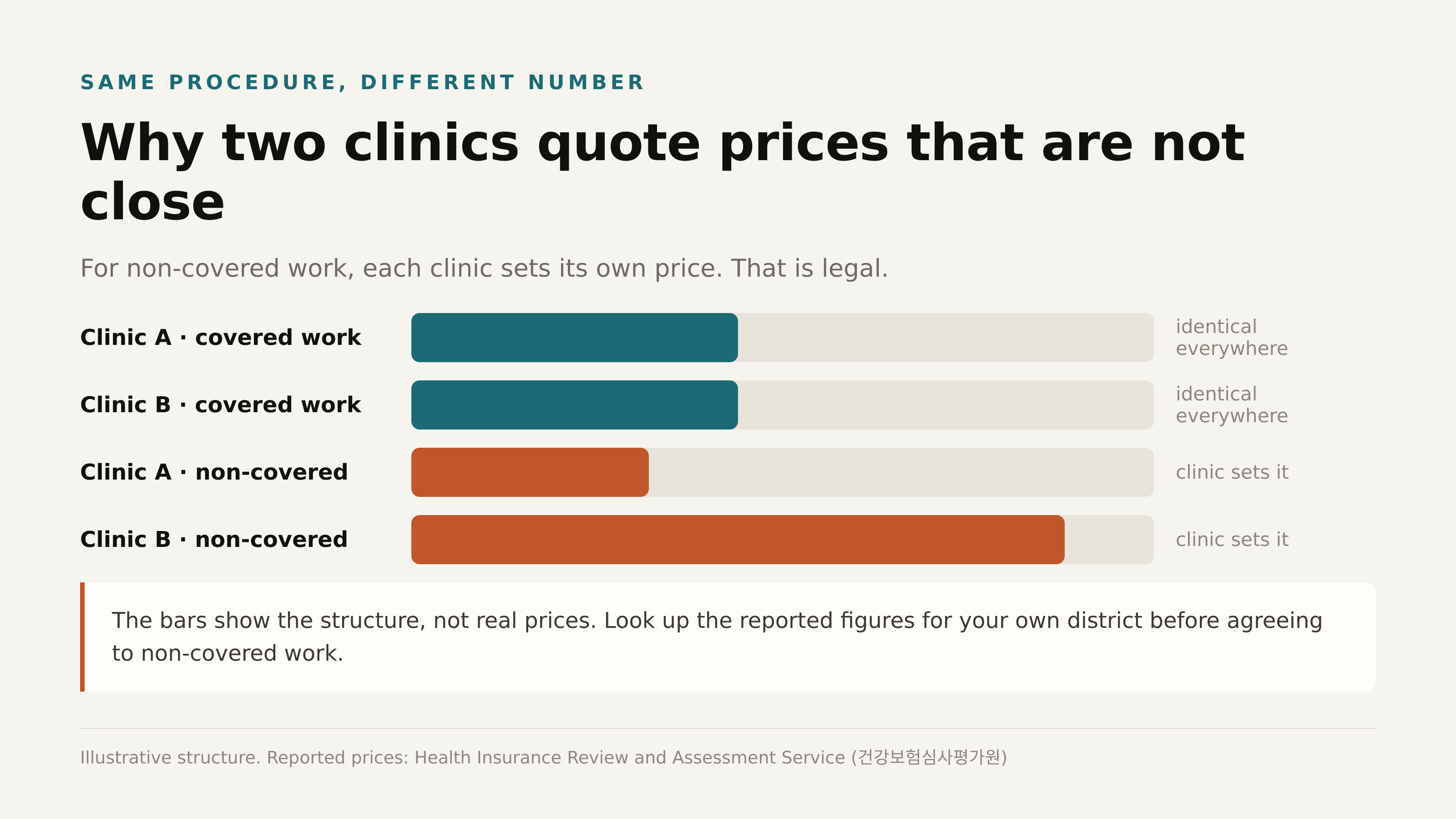
For anything in the left column, shopping around is pointless — the price is the price, everywhere. For anything in the right column, shopping around is the single highest-value thing you can do, because two clinics a subway stop apart can quote you numbers that are not remotely close to each other.
This is not clinics behaving badly. Non-covered prices are legally theirs to set. The system's answer to that is not price control. It is disclosure.
How to check the price before you go
The Health Insurance Review and Assessment Service — HIRA, 건강보험심사평가원 — runs a public database of non-covered prices. Clinics are required to report what they charge, and the database shows you what each one charges for each procedure.
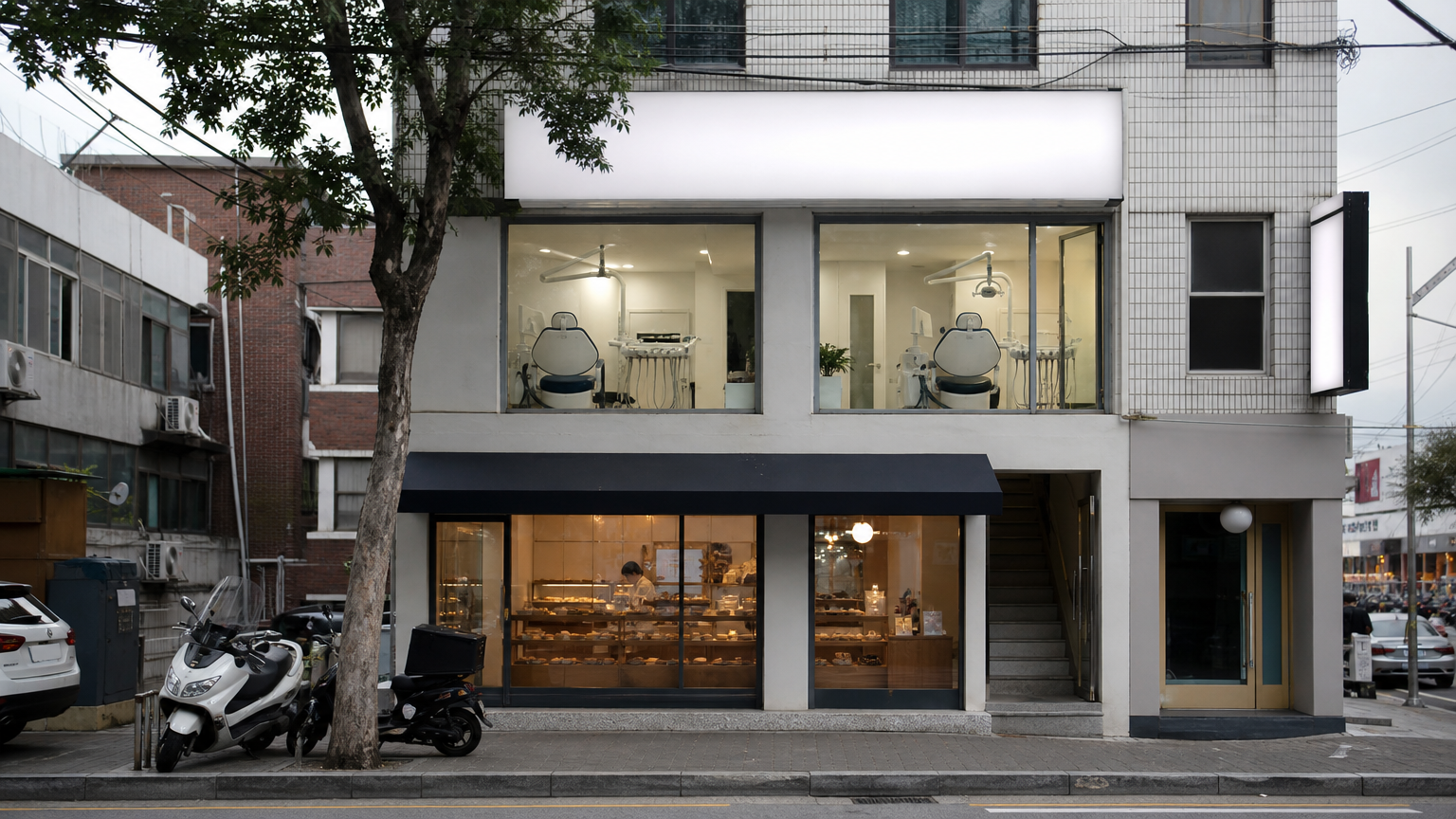
As of 2026 this includes small neighbourhood clinics, which is the change that matters. It used to cover mostly hospitals, which was not much help when the place you were actually going to was a two-chair 의원 above a bakery. Now the local ones are in there too.
You go to hira.or.kr, find the non-covered price section, choose your procedure and your district, and you get a list of clinics with their reported prices.
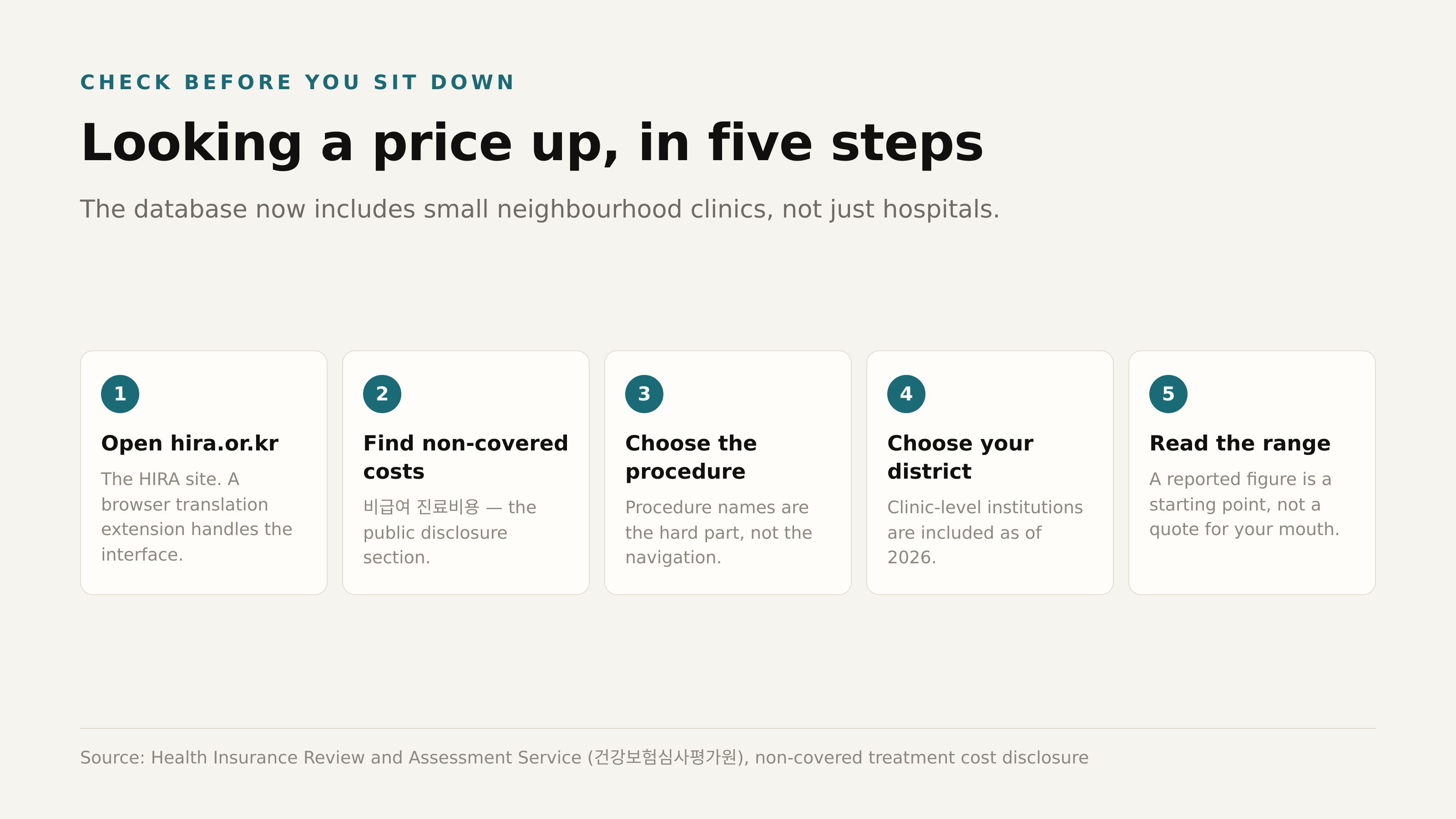
Two honest caveats.
The interface is Korean, and it is not a friendly one. A translation extension gets you most of the way, and the procedure names are the hard part rather than the navigation.
And a reported price is a starting figure, not a quote. What you actually pay depends on your mouth. But knowing that the clinics near you report a range, and where the one you were about to walk into sits inside that range, changes the conversation entirely.
의원 or 병원 — the sign tells you the size
The last character of a clinic's name is not decoration.
-
치과의원 — a small clinic, usually one to three dentists. Where most Koreans go for most things.
-
치과병원 — a dental hospital, larger, with departments and specialists. Where you go for surgery or complicated work.
-
대학병원 — a university hospital. Longest wait, highest prices, and where you go if something is genuinely wrong.
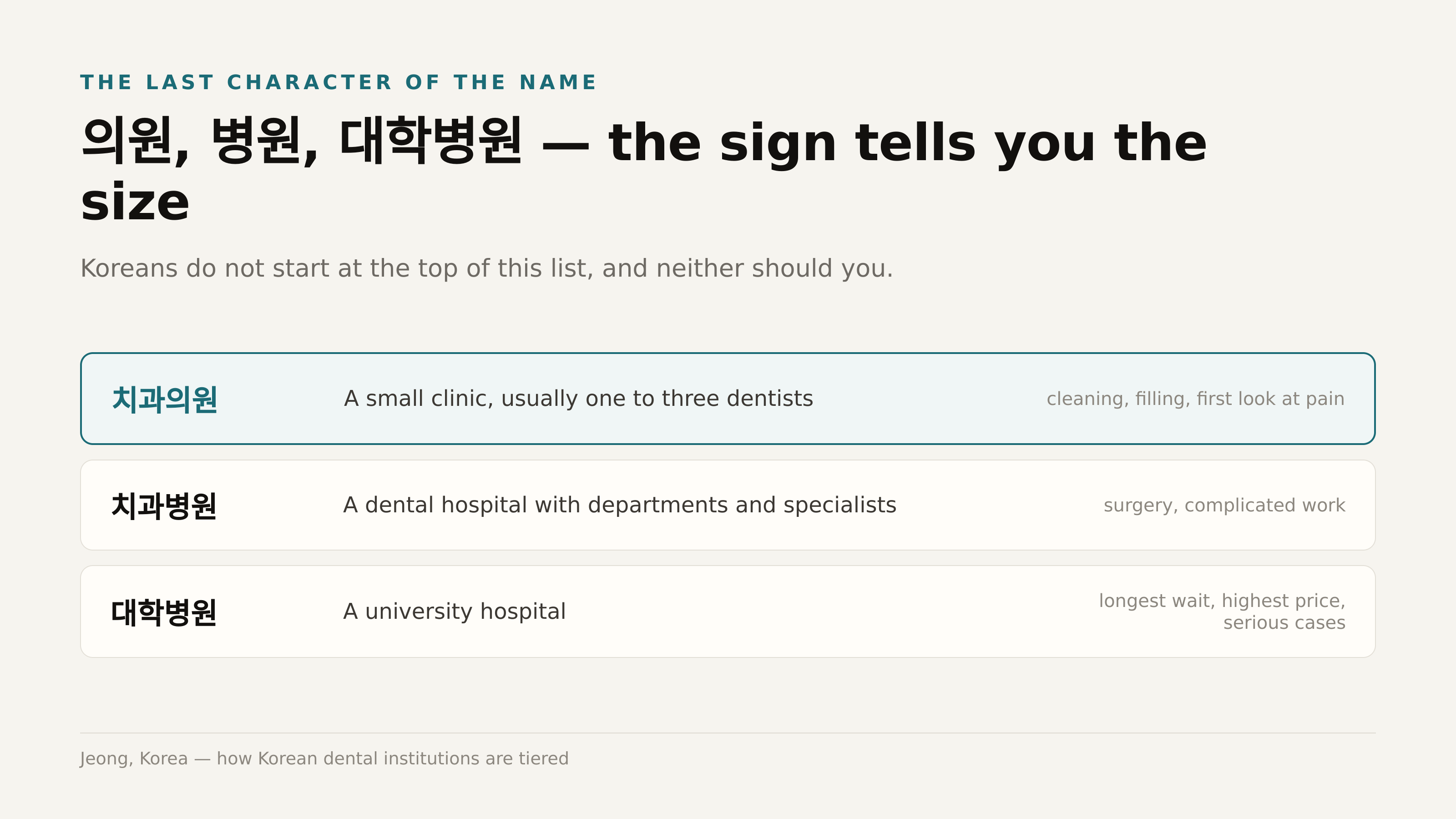
For a cleaning, a filling, or a first look at something that hurts, the small clinic is the right answer and the cheapest one. Koreans do not start at the top of that list and neither should you.
Finding a dentist in Korea who works in English
There is a formal register for this. Clinics that treat international patients can register as foreign-patient-attracting institutions, and the registry is public and searchable.
Registration is not a quality rating. It tells you the clinic has set itself up to handle non-Korean patients — paperwork, consent, usually some English capability. That is a different question from whether they are good, and you should still read reviews.
In practice, in Seoul, the density of English-capable dental care is highest around Gangnam, Itaewon, and the university districts. In smaller cities it thins out fast, and the workable approach is to bring a Korean-speaking friend or use a translation app on your phone. Dentists deal with pointing more than most doctors do, and pointing works.
What the first visit actually looks like
Walk-ins are common at small clinics and often fine on a weekday morning. For anything scheduled, call or book through the clinic's channel.
You will be asked for your Alien Registration Card if you have one, and for your insurance status. If you are not insured — a visitor, or between jobs — say so at the desk before treatment starts, not after. The uninsured price for a covered procedure is the full amount rather than 30%, and it is better to hear that number in advance.
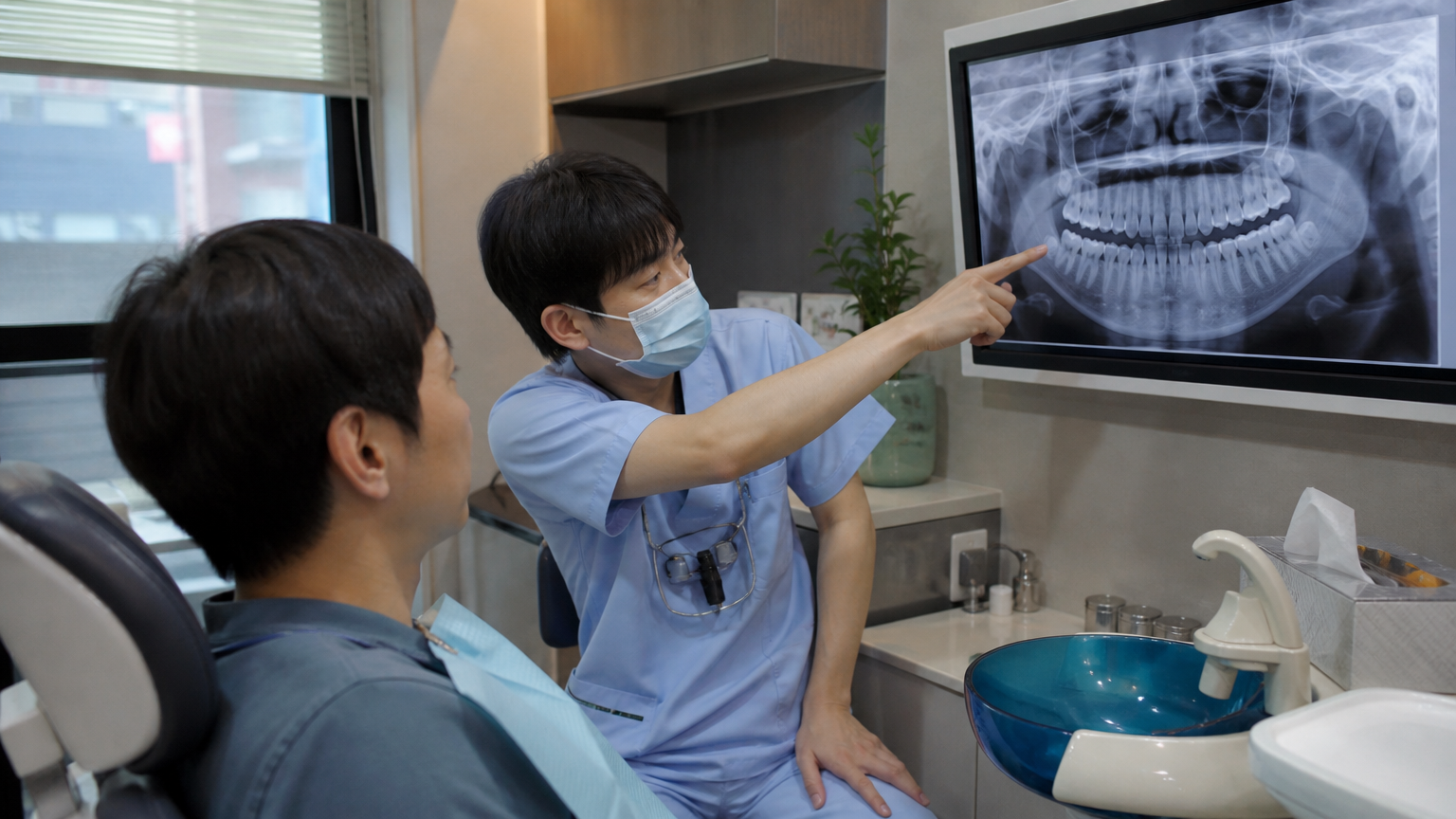
An X-ray usually happens on the first visit. Expect the dentist to look, describe what they see, and give you a plan with a price attached. That plan is where you ask which items are covered and which are not — a direct question, in those terms, gets a direct answer.
What I would actually do
If you live here and you are insured: use the annual cleaning, this year, at the nearest small clinic. It costs about the same as lunch and it makes the clinic a known quantity for the day something is wrong.
If something already hurts: go to a 치과의원 first, get the X-ray and the plan, and only then look up the non-covered items in the plan on HIRA before agreeing to anything expensive.
If you are visiting and considering treatment while you are here: check the price database and the foreign-patient registry before you book, and be honest with yourself about whether you will be in the country long enough for the follow-up appointments.
The dental care here is good and the covered part is genuinely cheap. The part that catches people out is not the treatment. It is walking in without knowing which column you are standing in.
FAQ
How much does a dentist in Korea cost without insurance?
For covered procedures you pay the full amount rather than the usual 30% share, so a cleaning that would cost an insured patient around ₩15,000 costs considerably more. For non-covered work such as implants or whitening, insured and uninsured patients pay the same, because insurance was never covering it.
Is teeth cleaning really covered by insurance?
Yes. Anyone 19 or over on national health insurance is covered for one scaling per calendar year at the standard 30% patient share. It resets on 1 January and does not carry over.
Can foreigners use Korean national health insurance at the dentist?
Yes, on the same terms as anyone else, provided you are enrolled — through an employer or as a local subscriber. Coverage follows enrolment, not nationality.
Why did two clinics quote me completely different prices for an implant?
Because implants are non-covered, which means each clinic sets its own price legally. This is exactly the situation the public price database exists for.
How do I find a dentist in Korea who speaks English?
Check the register of clinics approved to treat international patients, and concentrate your search in areas with a large foreign population. Registration indicates the clinic is set up for non-Korean patients, not that it is better clinically.
Do I need an appointment?
Often not at a small clinic, particularly on a weekday morning. For anything beyond a first look, book.
References
-
National Health Insurance Service (국민건강보험공단) — scaling coverage: once per calendar year for those aged 19 and over, at the standard patient share
-
Health Insurance Review and Assessment Service (건강보험심사평가원), non-covered treatment cost disclosure — public database of clinic-by-clinic prices, expanded to include clinic-level institutions in 2026
-
Jeong, Korea, Gangnam Dermatology: What the Prices Actually Depend On — the same covered/non-covered structure, applied to skin clinics