Gangnam Dermatology: What the Prices Actually Depend On, and How to Check Before You Go

A friend of mine flies in from the Philippines a few times a year, and every visit she goes to the same skin clinic near Sinsa. The first time, she asked me what it would cost. I am Korean, I live here, and I could not tell her — because from the outside, nobody can.
That is not a figure of speech. Pricing a skin clinic in Seoul from the outside is genuinely hard. Search in English for what a treatment costs and you will get a page of results written by clinics, by booking agencies, and by sites that earn a commission when you book. They all quote numbers. The numbers do not agree with each other, and none of them are the number you will be asked to pay.
So this post does something different. I am not going to recommend a clinic and I am not going to give you a price list. I am going to explain what the price is made of, and then show you the two government databases that let you check a real clinic's real posted price before you walk in.
I am not a doctor. Nothing here is medical advice — it is the practical, money-and-paperwork half that the clinics have no reason to explain to you.
What is actually on the menu
Gangnam dermatology clinics sell a lot of things, but almost everything sits in one of four families. Knowing which family you are in stops you comparing two prices that were never comparable.
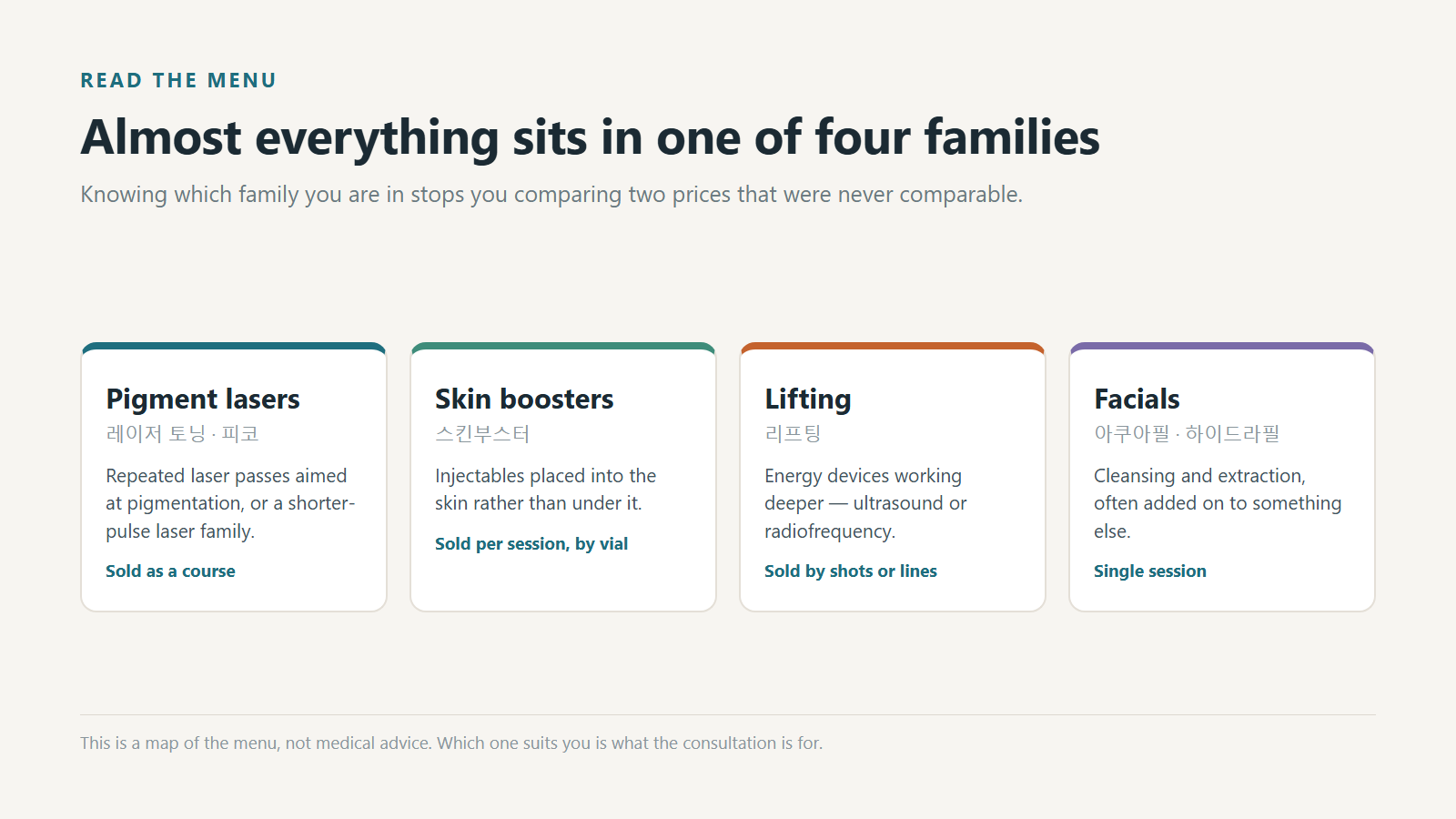
The Korean names are worth learning, because the reception desk uses them and the English translation on the website is often looser than the Korean.
| Korean | What it is | Usually sold as |
|---|---|---|
| 레이저 토닝 (laser toning) | Repeated low-energy laser passes, aimed at pigmentation | A course of sessions |
| 피코 (pico) | A shorter-pulse laser family | Per session or a course |
| 스킨부스터 (skin booster) | Injectables placed into the skin rather than under it | Per session, by vial |
| 리프팅 (lifting) | Energy devices that work deeper — ultrasound or radiofrequency | Priced per number of shots or lines |
| 아쿠아필 / 하이드라필 | A cleansing and extraction facial | Single session, often an add-on |
None of that tells you whether a treatment is right for you. That is what the consultation is for, and a clinic that skips straight past it to a package price is telling you something about itself.
Why one name can mean three different prices
This is the part that confuses everyone, including Koreans. Two clinics can advertise the same procedure name at prices that differ by a factor of three, and neither of them is lying.
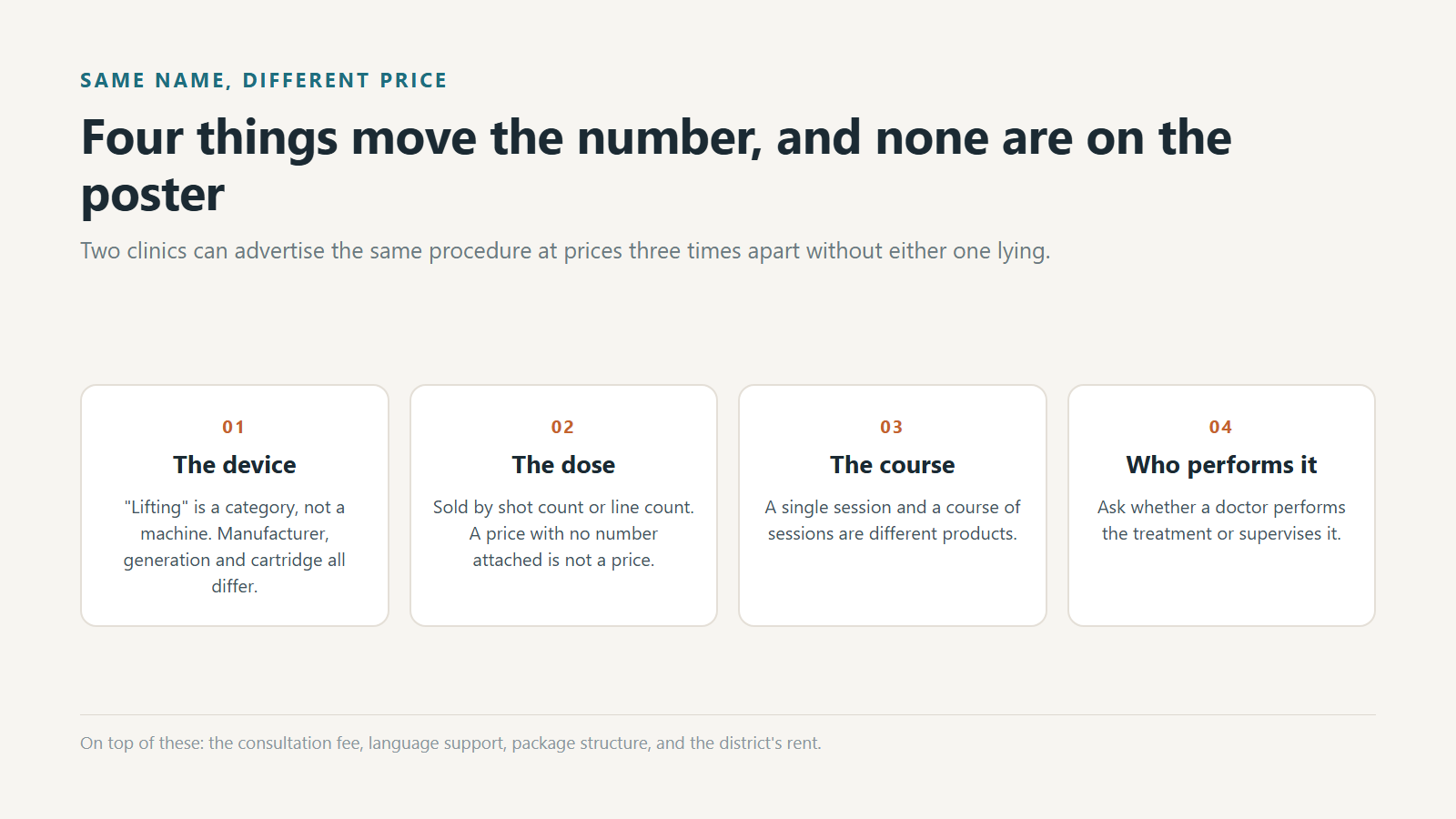
The device is not the same. "Lifting" is a category, not a machine. Different manufacturers, different generations of the same machine, different consumable cartridges. The name on the poster is often the category; the price is set by the hardware.
The dose is not the same. Energy treatments are commonly sold by shot count or by line count. A quoted price with no number attached to it is not a price.
The course length is not the same. Pigment work is usually a series. A per-session price and a course price are different products.
Who holds the handpiece is not the same. Ask whether a doctor performs the treatment or supervises it.
And then there are the costs that sit outside the treatment itself:
| Beyond the procedure | What to expect |
|---|---|
| Consultation | Often charged separately, and often credited against treatment booked the same day |
| Interpretation | Clinics that provide dedicated language support may price that in |
| Packages | Bulk courses are cheaper per session and harder to walk away from |
| Location | Central Gangnam rents are not free, and the price reflects it |

The price is published. Here is where.
Now the useful part, and the reason I wrote this.
Korean law requires clinics to disclose their non-covered prices. That applies to every skin clinic in Seoul, from a single-doctor practice to a chain. Cosmetic dermatology is almost entirely 비급여 — outside national health insurance — which means the clinic sets the price, and also means the clinic has to make that price visible rather than quote you something on the day.
There are two places to look.
1. The clinic's own posted list. Every clinic keeps a 비급여 진료비용 (non-covered treatment cost) list. It is usually on the clinic's website and displayed inside the building. You can ask for it at reception, before the consultation, and you are entitled to see it.
2. The national database. The Health Insurance Review and Assessment Service — 심평원, HIRA — collects and publishes these prices. This mattered less in the past because only larger hospitals had to report. That changed: the current standard took effect on 23 February 2026 and extends the reporting duty down to clinic-level institutions (의원급) — the neighbourhood dermatology clinics — while the list of published items grew from 564 to 616.
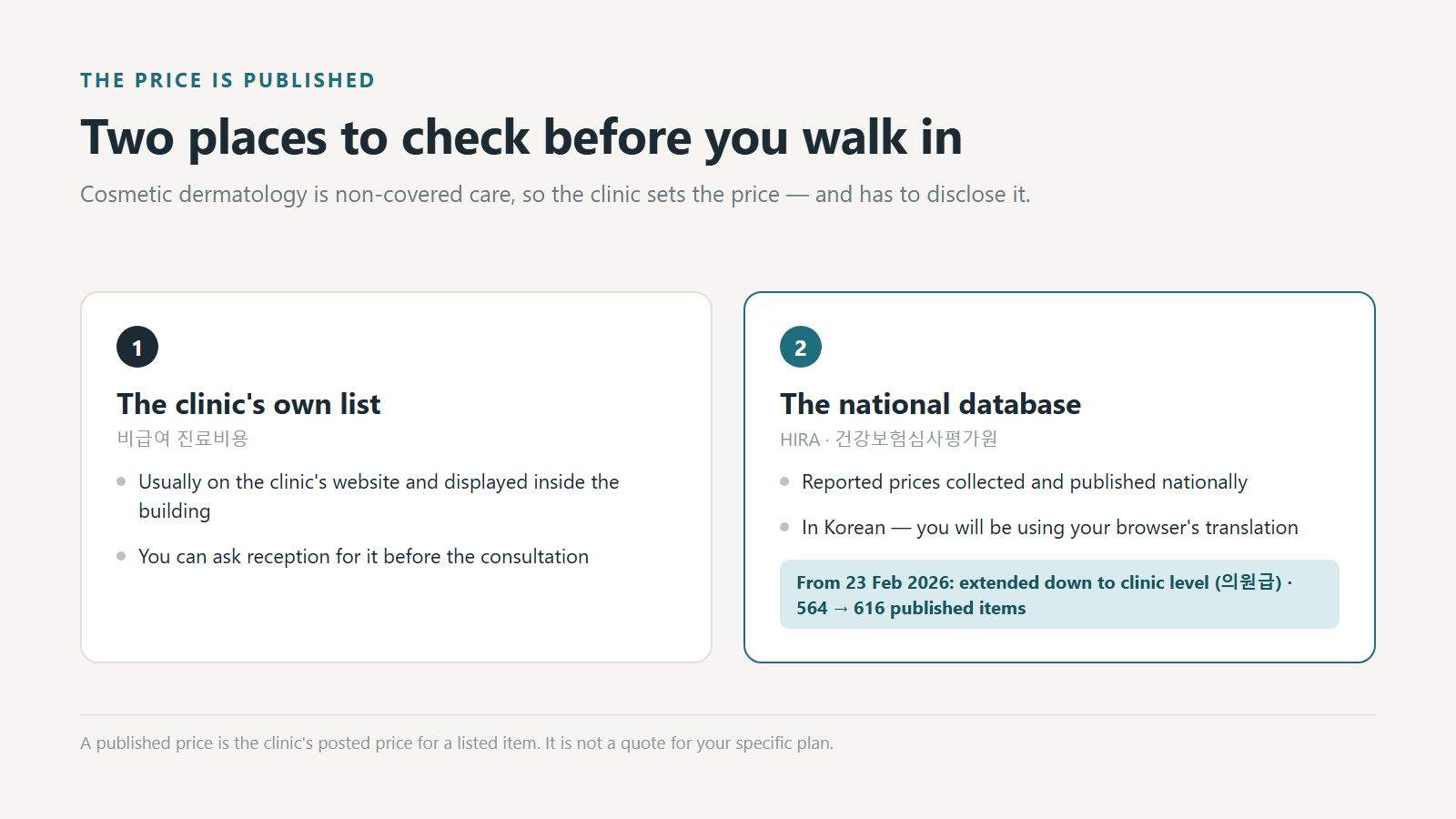
In practice that means the small Gangnam clinic your friend recommended is now inside the same public database as a university hospital.
Two honest caveats. The database is in Korean, so you will be leaning on your browser's translation. And a published price is the clinic's posted price for a listed item — it is not a quote for your specific plan, which will depend on the dose and course you actually agree to.

Check that the clinic is registered to treat you
This is the check almost nobody makes, and it is the one I would not skip.
Korea has a registration system for medical institutions that treat foreign patients, created under the Act on the Support of Overseas Expansion of Healthcare and Attraction of Foreign Patients. Registration is not a quality ranking. It is a floor, and the floor is made of two things:
-
at least one specialist in the relevant department, and
-
medical malpractice insurance or membership of a medical mutual-aid association.
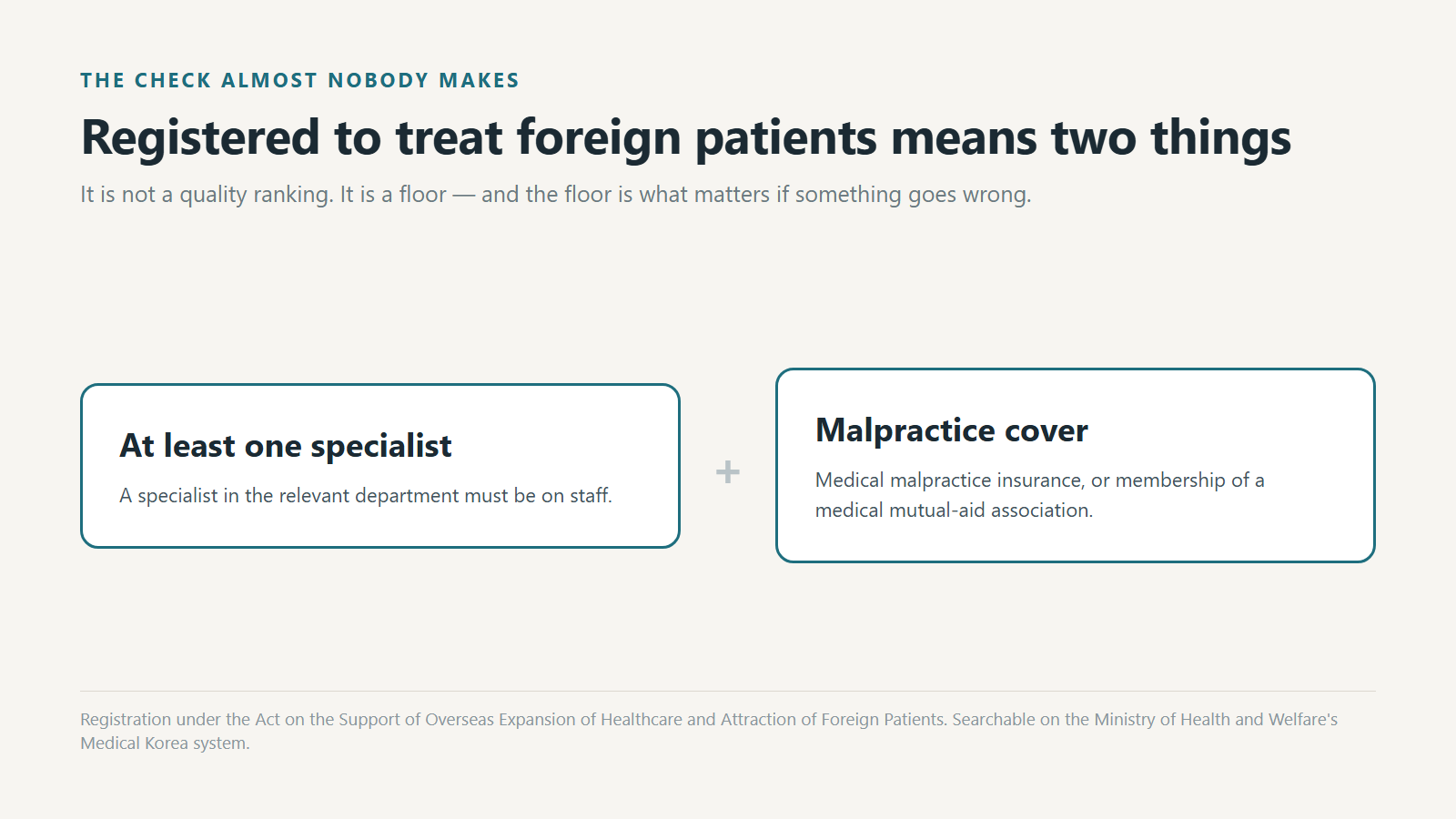
That second one is the reason to care. If something goes wrong, the difference between a registered and an unregistered institution is whether there is cover behind it.
You can look up registered institutions on the Medical Korea system run by the Ministry of Health and Welfare. It takes two minutes and it is the single highest-value thing on this page.
What to ask before you sit down
My friend now does all of this without thinking, and her appointments go faster than mine.
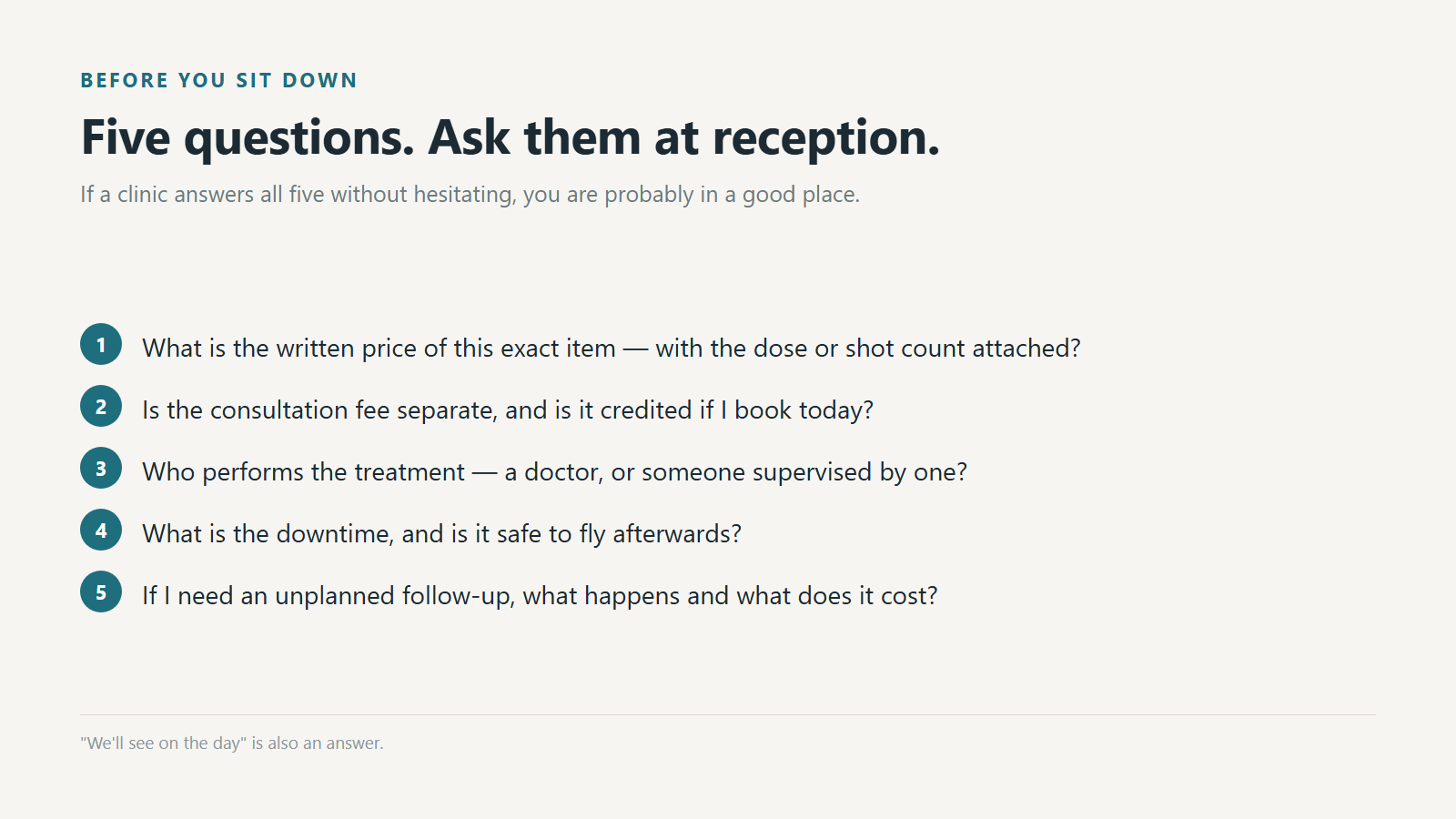
Ask for the written price of the specific item, with the dose or shot count attached. Ask whether the consultation fee is separate and whether it is credited if you book. Ask who performs the treatment. Ask what the downtime is before you fly. And ask what happens — and what it costs — if you need a follow-up you did not plan for.
If a clinic answers all five without hesitating, you are probably in a good place. If the answer to any of them is "we'll see on the day," that is information too.
What I tell my friend
She goes back to the same clinic every time, and when I asked her why, she did not say the results. She said they always tell her the price first.
That is a low bar. It is also, from the outside, surprisingly hard to find — which is why the two databases above are worth the ten minutes before you book any Gangnam dermatology appointment.
You are not trying to find the best skin clinic in Seoul from a search page. You are trying to walk in already knowing what the number should be.
FAQ
Is there a foreigner price at Korean skin clinics?
Prices for non-covered treatments are set by each clinic, not by nationality. What can differ is the package you are offered — clinics with dedicated language support may price that service in. Asking for the clinic's posted non-covered price list is how you check what the standard figure is.
Can I look up what a clinic charges before I go?
Yes, in two ways. Every skin clinic in Seoul must disclose its non-covered treatment prices, so you can ask reception for the list. Nationally, HIRA publishes reported non-covered prices, and since the standard that took effect on 23 February 2026 this now includes clinic-level institutions, across 616 published items.
Is a consultation fee charged separately?
Often, and it is frequently credited against treatment booked on the same visit. Ask before the consultation rather than after it.
How do I know a Gangnam dermatology clinic can legally treat foreign patients?
Look it up on the Ministry of Health and Welfare's Medical Korea system. Registered institutions must have at least one specialist in the relevant department and carry malpractice insurance or mutual-aid cover.
Do clinics in Gangnam speak English?
Some do and some do not, and it is not correlated with price. Clinics registered for foreign patients are more likely to have language support, but confirm it when you book rather than assuming.
How long before a flight should I book a treatment?
Ask the clinic about downtime for the specific treatment during the consultation. This varies enough between procedures that a general answer would be useless, and it is exactly the kind of question a consultation exists to answer.
References
-
Ministry of Health and Welfare, press release on checking non-covered treatment prices via HIRA
-
Korea Law Information Center, Standard on the reporting and disclosure of non-covered treatment costs — administrative rule, effective 23 February 2026
-
Health Insurance Review and Assessment Service, non-covered treatment cost information
-
Ministry of Health and Welfare, Medical Korea — registration of institutions attracting foreign patients