Korean Hangover Soup: Which Bowl to Order (From Someone Who Needs It Often)

I get bad hangovers. Not the kind you power through with water and a walk. The kind where the morning has to be handled.
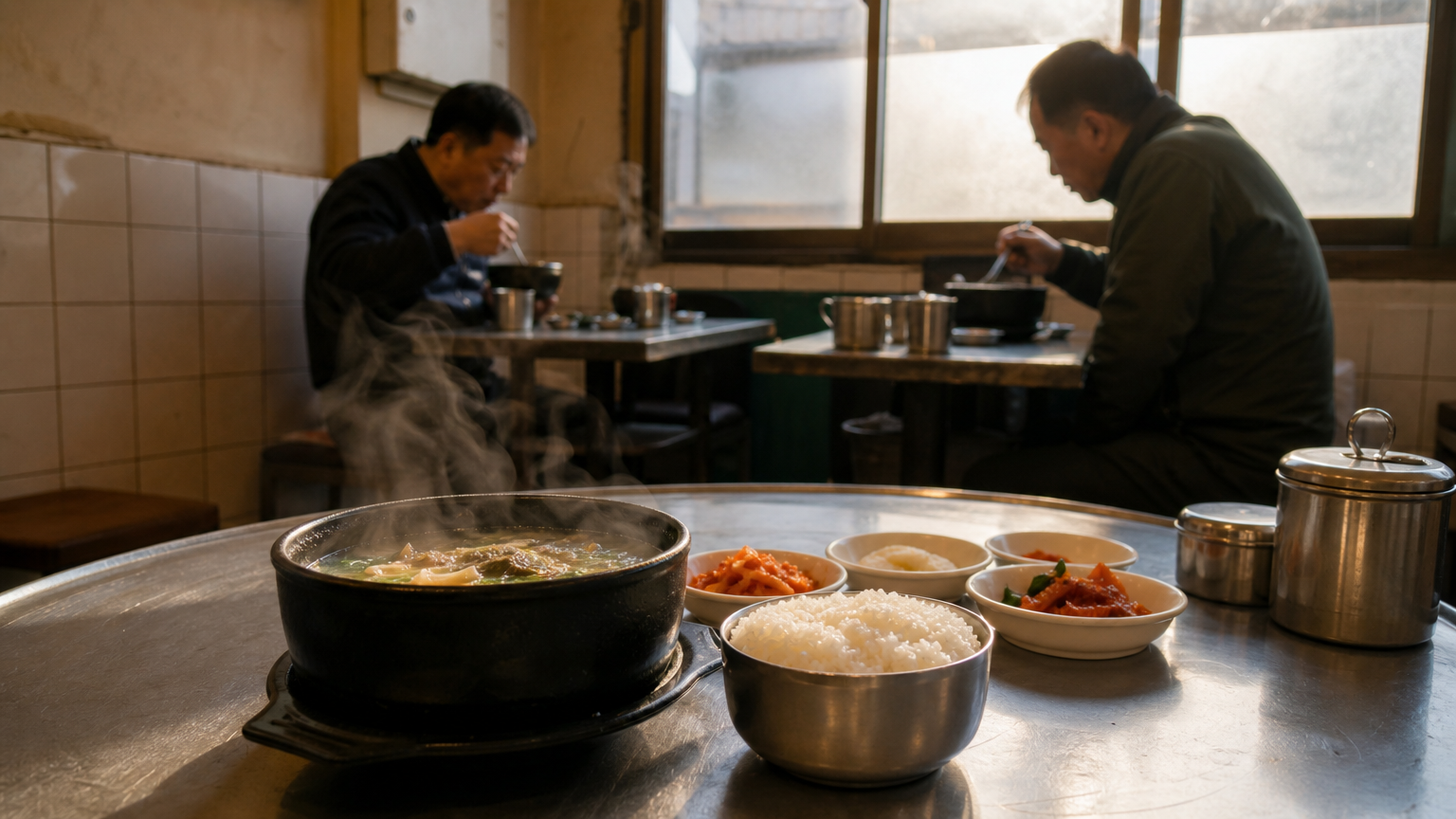
So I have a routine, and it is not the one the guides describe. Most mornings after, I want kongnamul-guk, a clear bean sprout soup. Some mornings I go to a seolleongtang place in Sinsa instead and let a bowl of white ox bone broth do the work.
Neither of those is what an English article means when it says korean hangover soup. That gap is the reason I am writing this.
The word does not translate
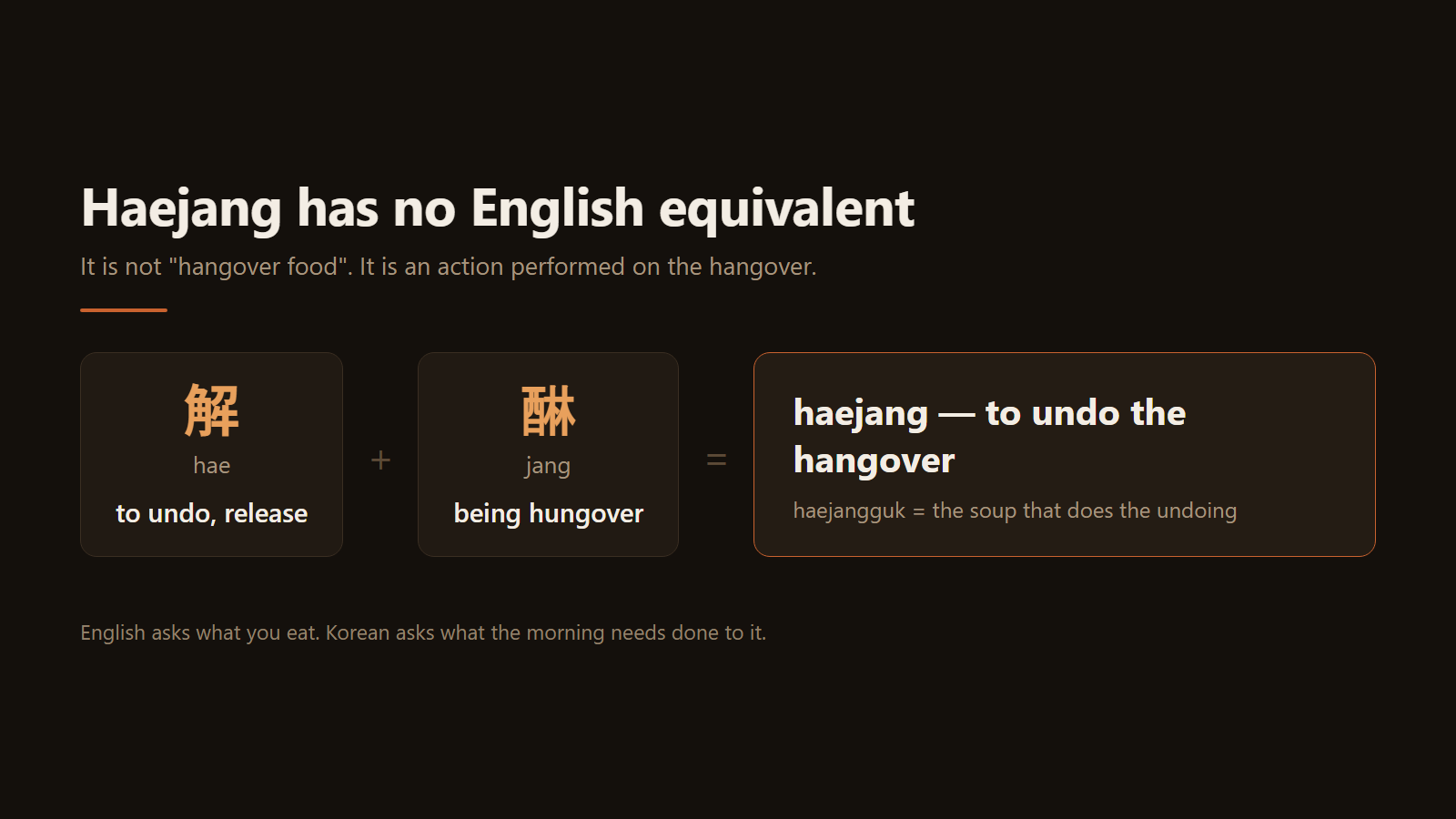
Haejang (해장) is two pieces: hae, to undo or release, and jang, the state of being hungover. So haejangguk is not "soup you eat when hungover". It is soup that undoes the hangover, as an action, done to you.
English has no single word for this. That sounds like trivia, but it changes what you are looking for. You are not shopping for a flavour. You are looking for the thing that gets the morning open again, and Koreans are extremely relaxed about what qualifies.
The idea is old. The oldest related record is a Goryeo-era soup called seongjutang, literally "wake-from-drink soup". The word haejangguk itself shows up in the Joseon period, and one common account traces the modern bowl to the port of Incheon, where the bones and offal left over from foreign buyers' cuts got simmered into soup and sold to labourers.
The five bowls the guides will list
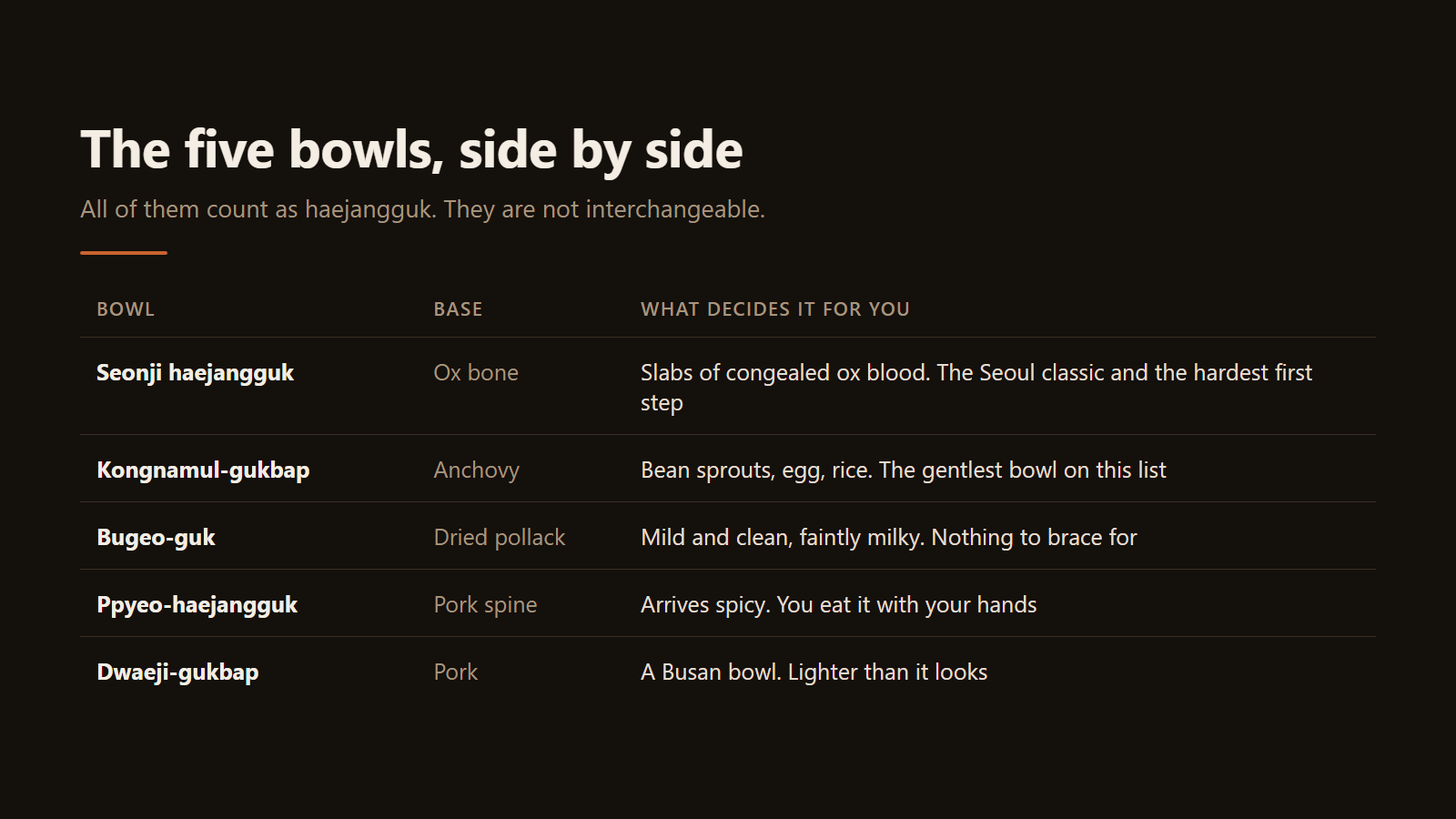
These are the ones you will find on any English list, and they are all real. Here is what actually separates them.
| Bowl | What is in it | How it feels |
|---|---|---|
| Seonji haejangguk | Ox bone broth, cabbage, and slabs of congealed ox blood | The Seoul classic. Heavy, iron-rich, the hardest sell |
| Kongnamul-gukbap | Bean sprouts in a clear anchovy broth, egg, laver, rice | The gentlest. Jeonju is the home of it |
| Bugeo-guk | Dried pollack, tofu, beaten egg | Mild, clean, faintly milky |
| Ppyeo-haejangguk | Pork spine with meat still on it, chilli, spring onion | The spicy one. You work at it with your hands |
| Dwaeji-gukbap | Pork broth over rice, a Busan speciality | Lighter than it looks |
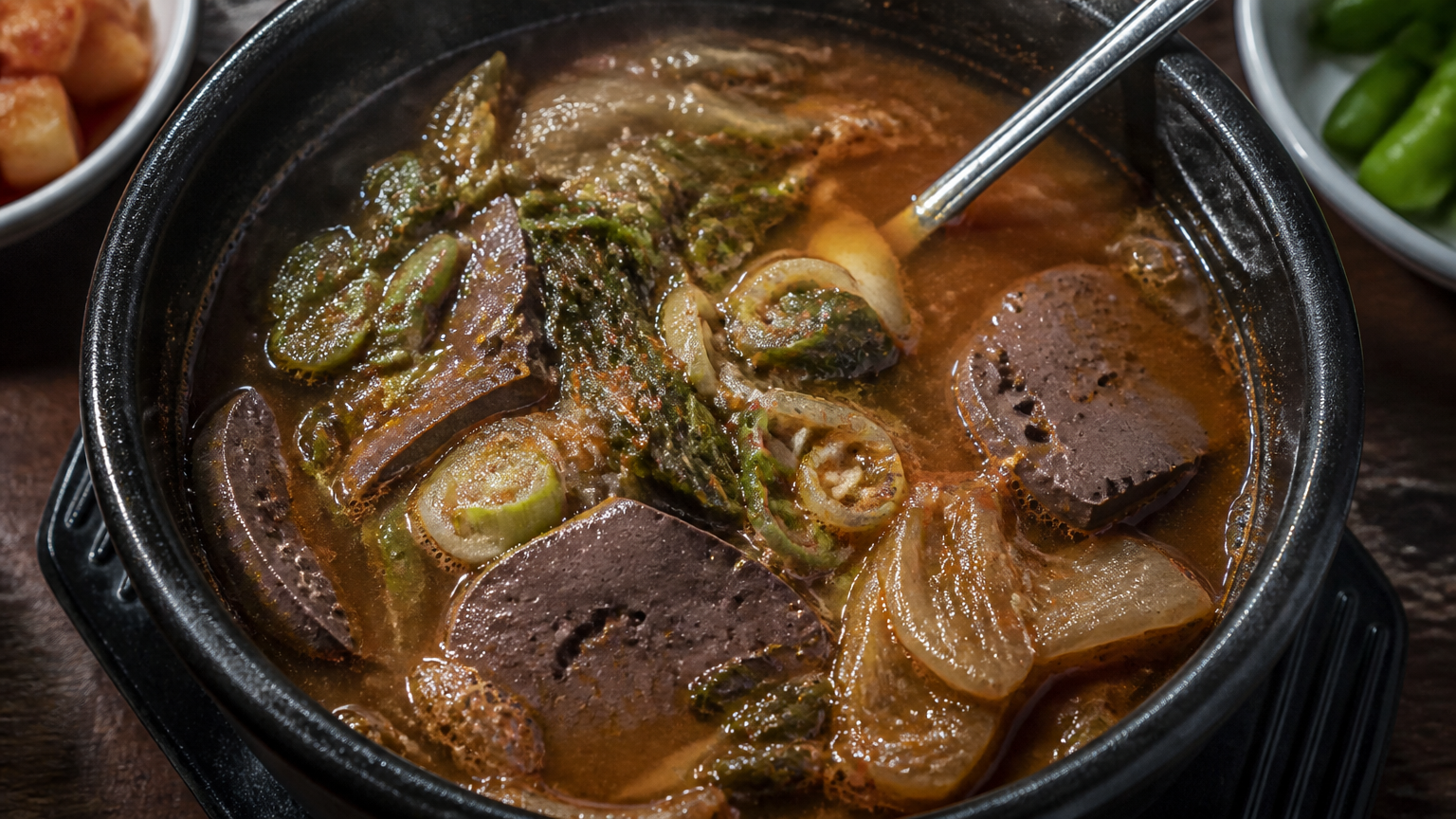
About the seonji. It is congealed ox blood, cut into slabs, and the texture is closer to a savoury custard than to anything you are bracing for. I am not going to tell you it is fine and you will not notice. You will notice. It is also the bowl Koreans mean when they say haejangguk with no qualifier, and a shop in Jongno has been serving it for the better part of ninety years.
If that is a wall for you, it is a wall. There are four other rows in that table.
You decide how spicy it gets
This is the part that almost never makes it into English guides, and it is the most useful thing here.
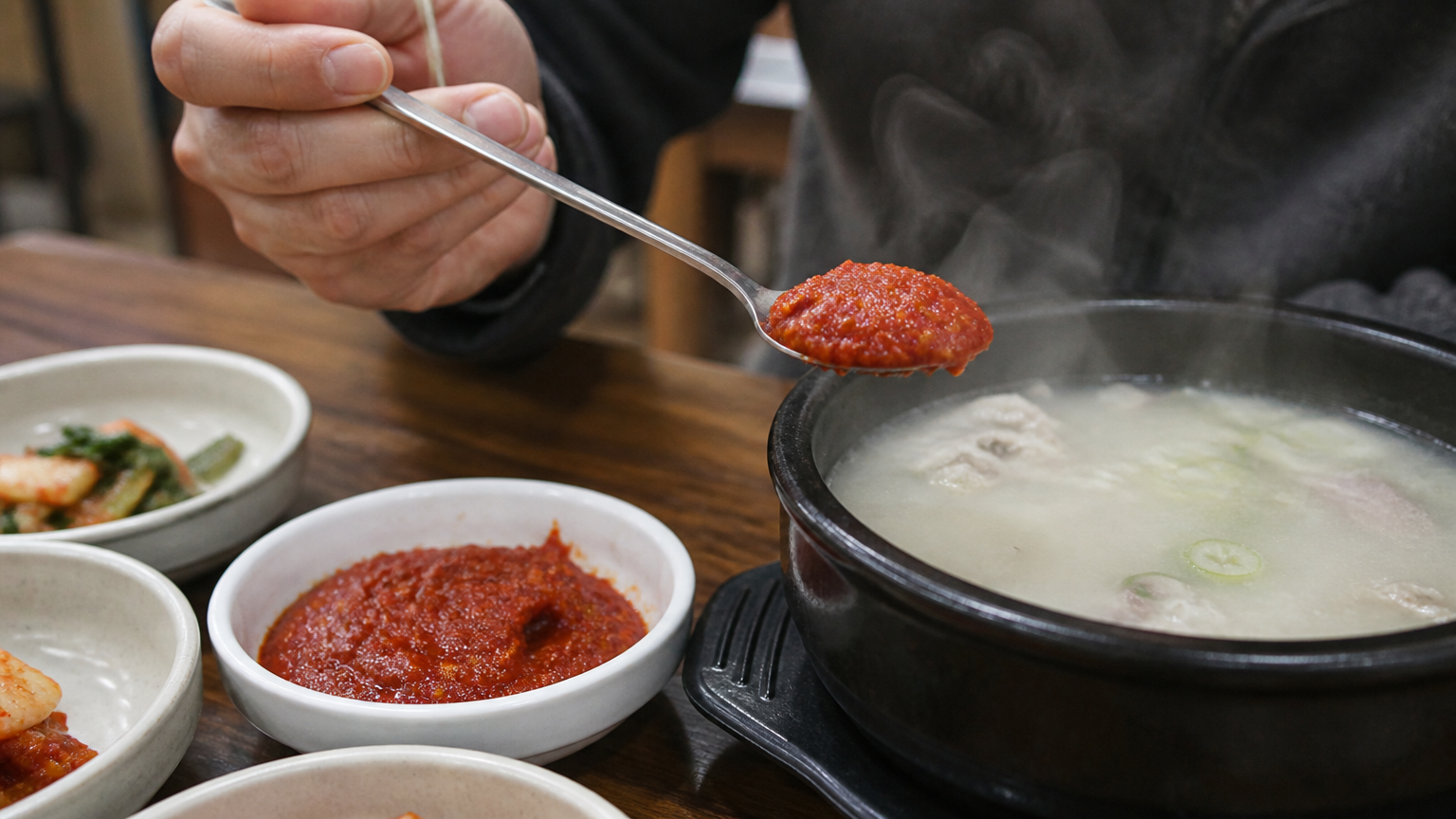
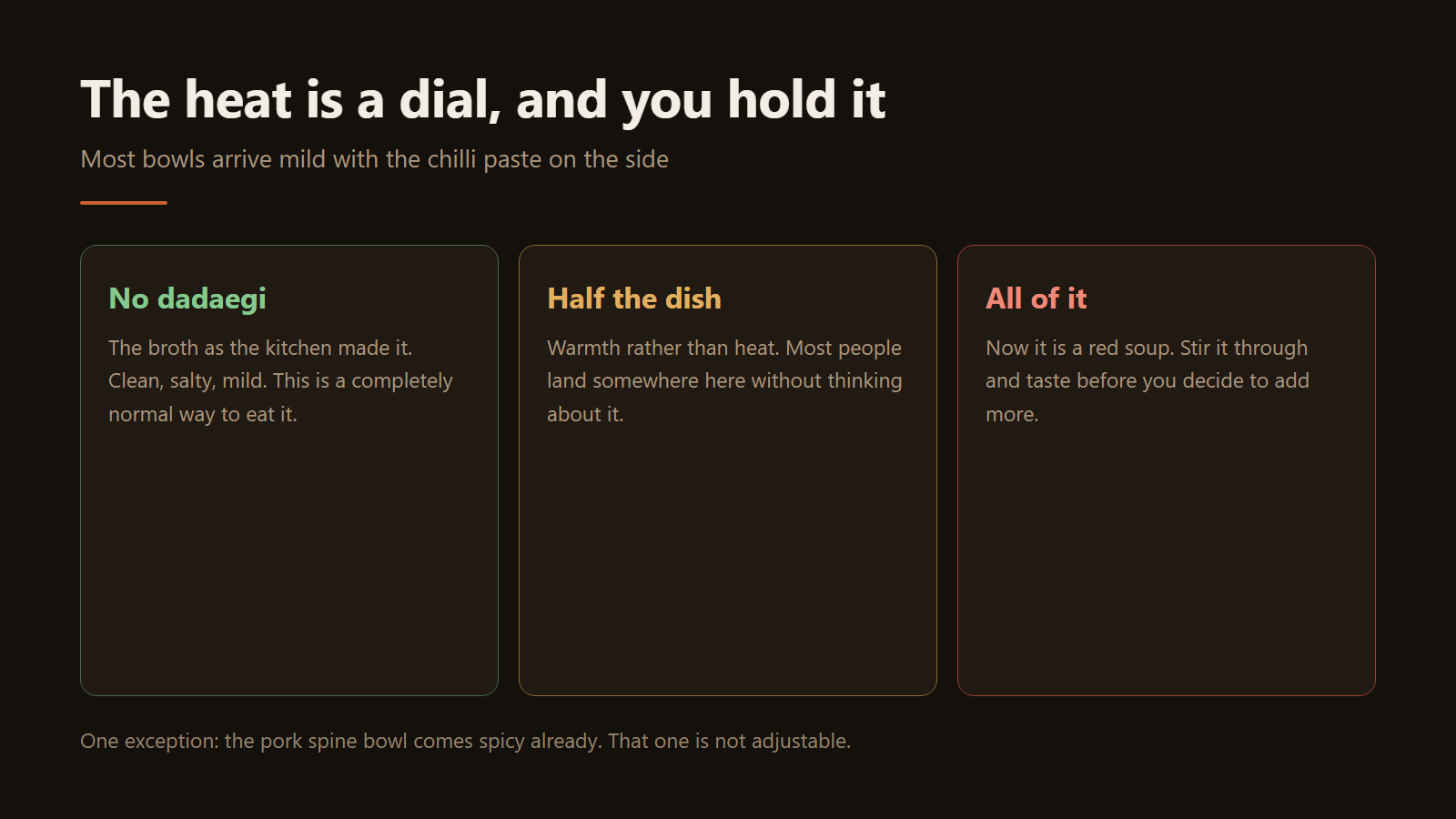
Most of these bowls arrive mild, with a small dish of dadaegi on the side. Dadaegi is a red seasoning paste. You stir in as much as you want, or none.
So "is it spicy" has no fixed answer. The heat is a dial, and you are holding it. Order first, taste, then decide. Nobody is watching to see whether you used it.
What I actually order
Here is where I stop describing the category and tell you what I do.
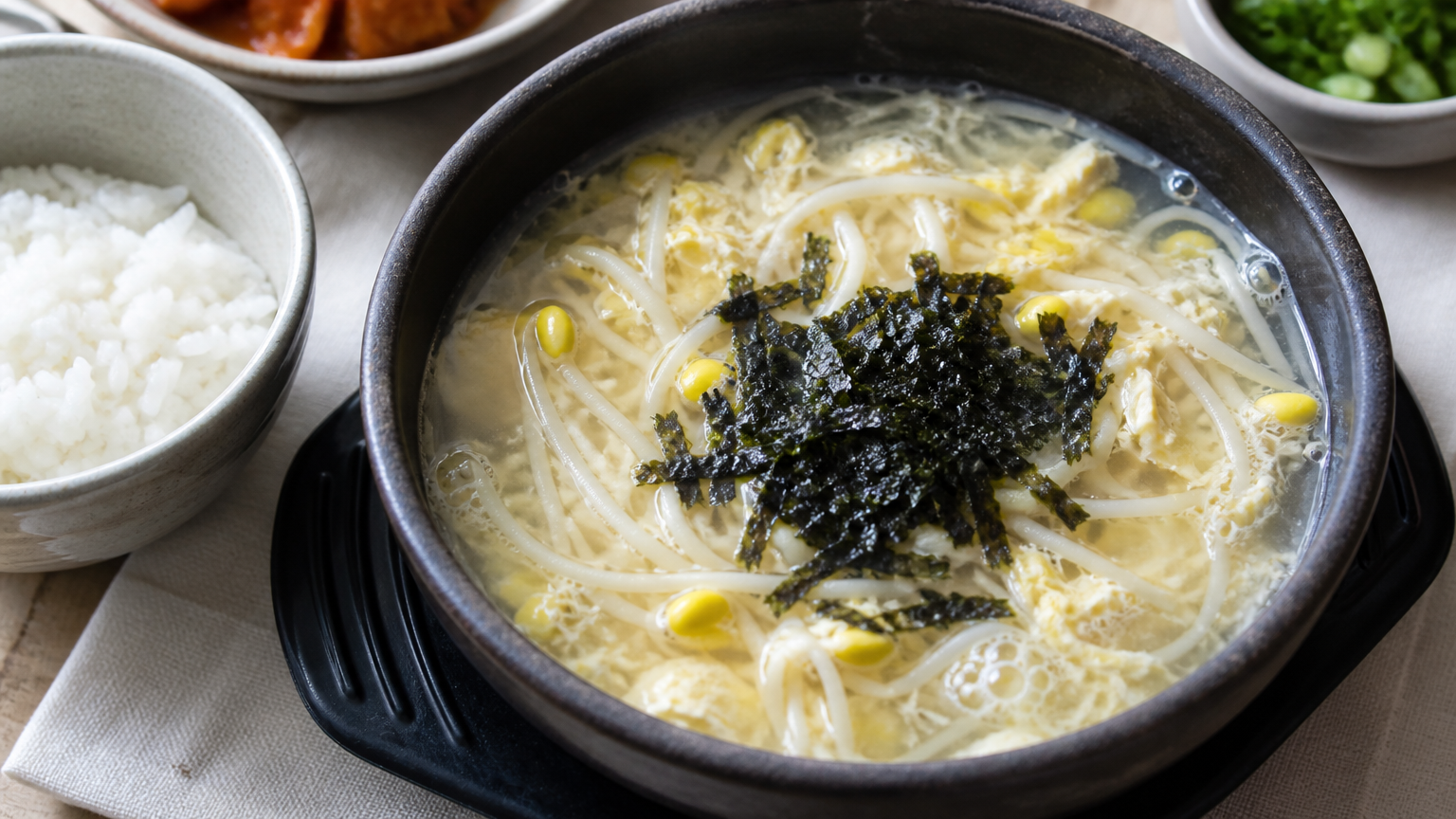
Kongnamul-guk, most of the time. Bean sprouts, clear broth, egg stirred in, rice going soft at the bottom. When my head is bad I do not want to negotiate with a bowl, and this one asks nothing of me.
Seolleongtang, when I want the heavier version. There is a place in Sinsa I go to, Yeongdong Seolleongtang, and the entire menu is seolleongtang and suyuk. That is it. Two things. The broth is milky white, the noodles and beef are already in there, and you salt it yourself at the table because it arrives deliberately underseasoned.
It is across from the ganjang gejang alley, if you have been to the crab place in Sinsa I wrote about. Same few streets.
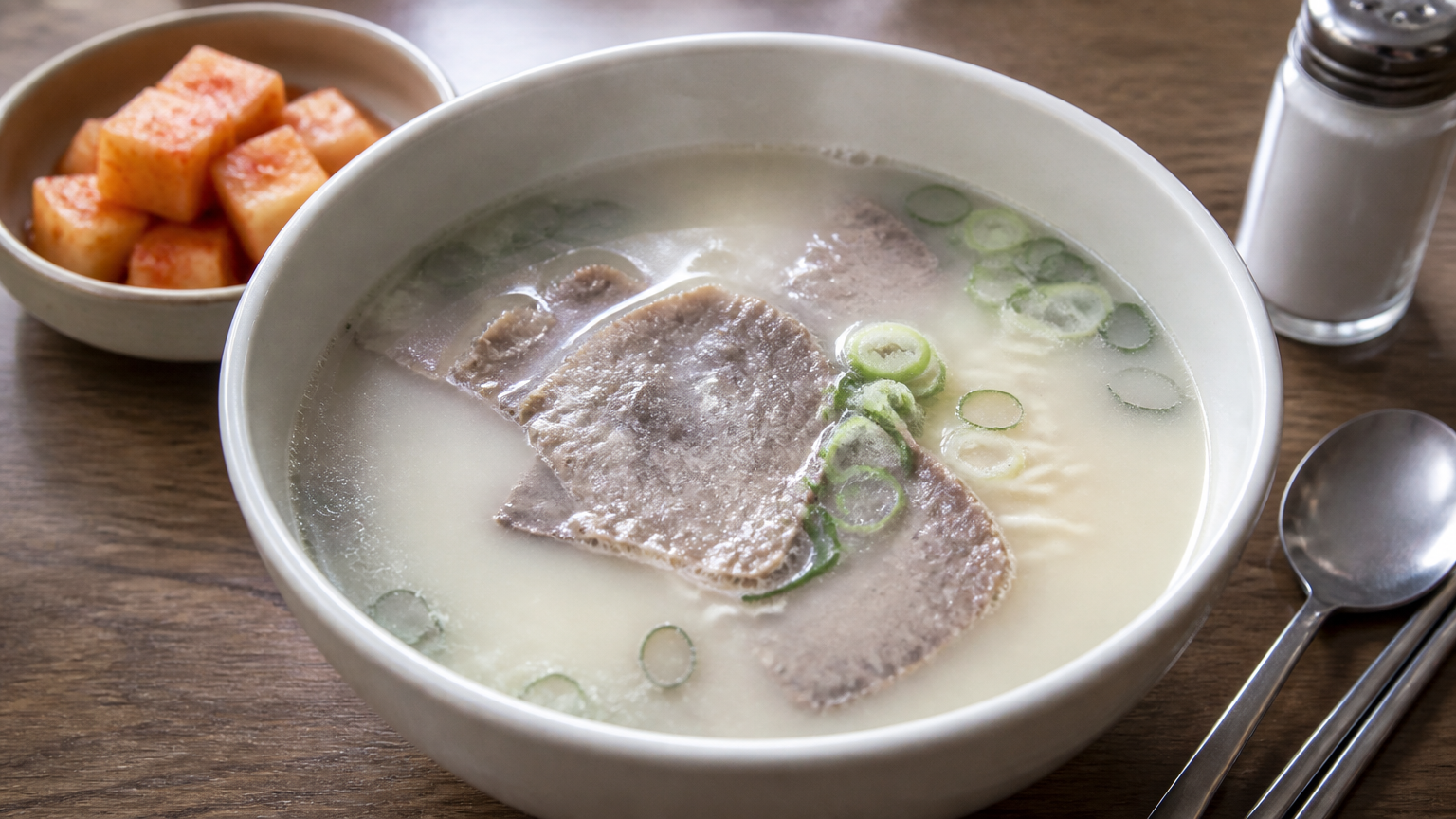
Notice that seolleongtang is not on the table above. It is not classified as haejangguk. Koreans eat it as haejangguk constantly.
The bowl no guide will put on the list
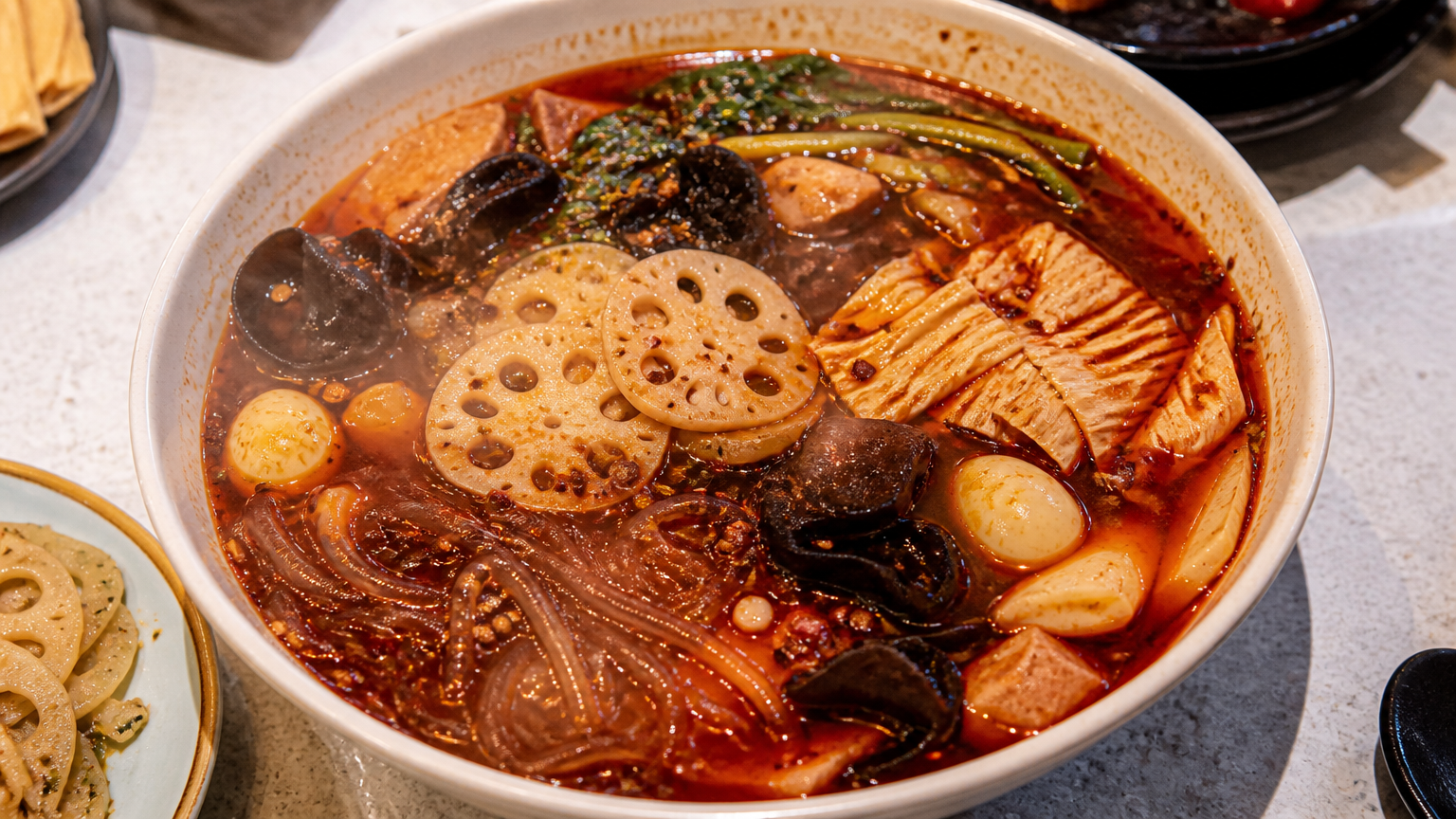
I worked at a Japanese company for a while, and whenever colleagues came over from Tokyo I would get asked the same morning question. Along with the bean sprout soup, the thing I ended up recommending most was maratang.
Maratang is Chinese. You pick your own ingredients from a fridge, they get weighed, and they come back in a numbing chilli broth. It arrived here properly in the mid-2010s, spread out of the university districts, and is now on every busy street in Seoul.
It is not traditional. It is not on any haejangguk list. And plenty of people here eat it the morning after anyway, because a hot, aggressive, salty broth does the job that a hot, aggressive, salty broth does.
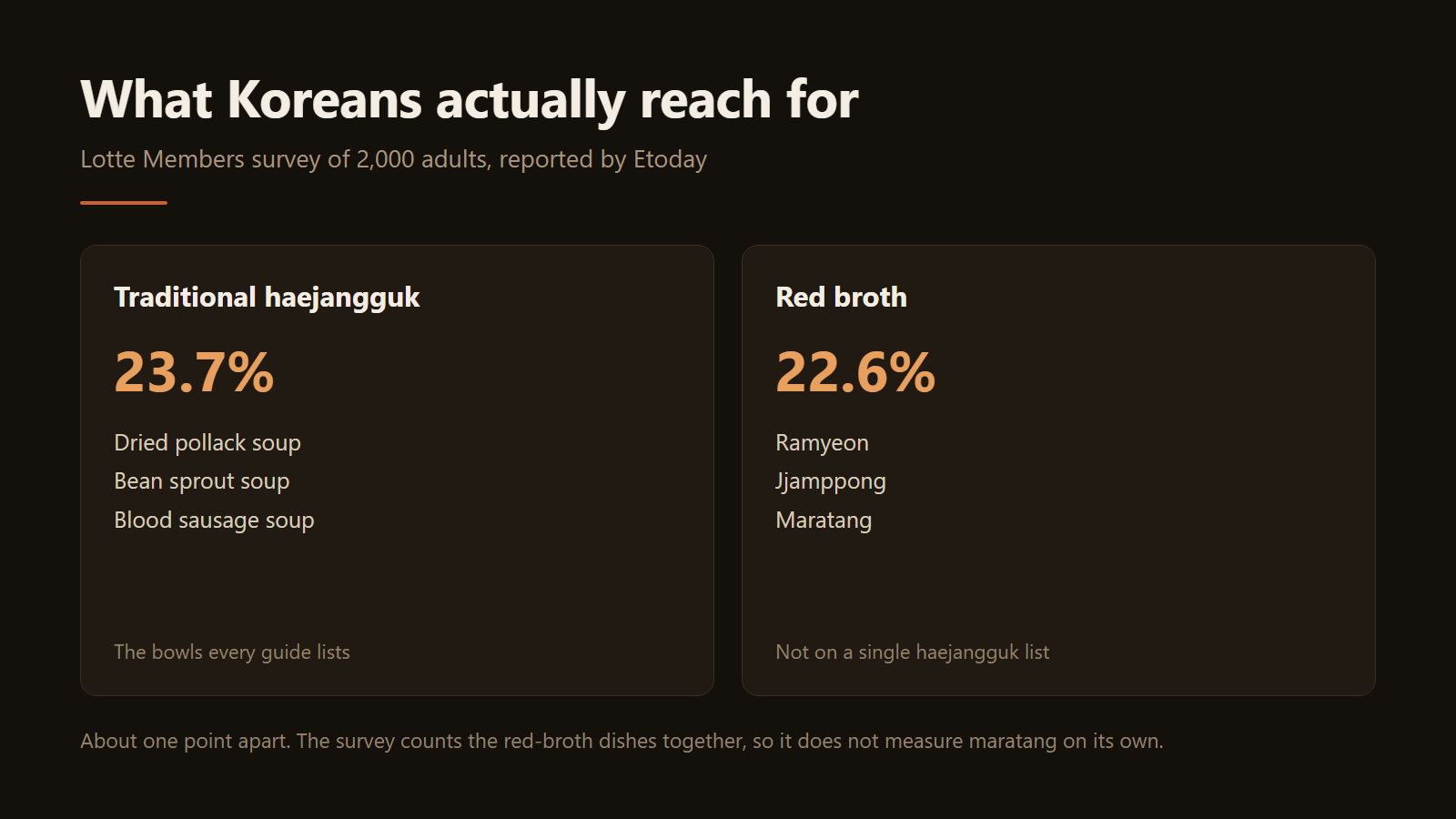
That is not only my habit. In a Lotte Members survey of 2,000 adults, reported by Etoday, the traditional soups came first at 23.7 percent, and red-broth dishes came second at 22.6 percent. The second category is ramyeon, jjamppong and maratang counted together, so it does not tell us how maratang does on its own. What it does tell us is that the gap between the classic bowl and the red broth is about one point.
If you watch Korean mukbang videos you have already seen this. Maratang after a night out is its own genre now.
So I am telling you about it because it is what I actually recommend, and because the numbers do not treat it as an oddity either.
Haejang is a time of day more than it is a dish
Put the last two sections together and the rule falls out.
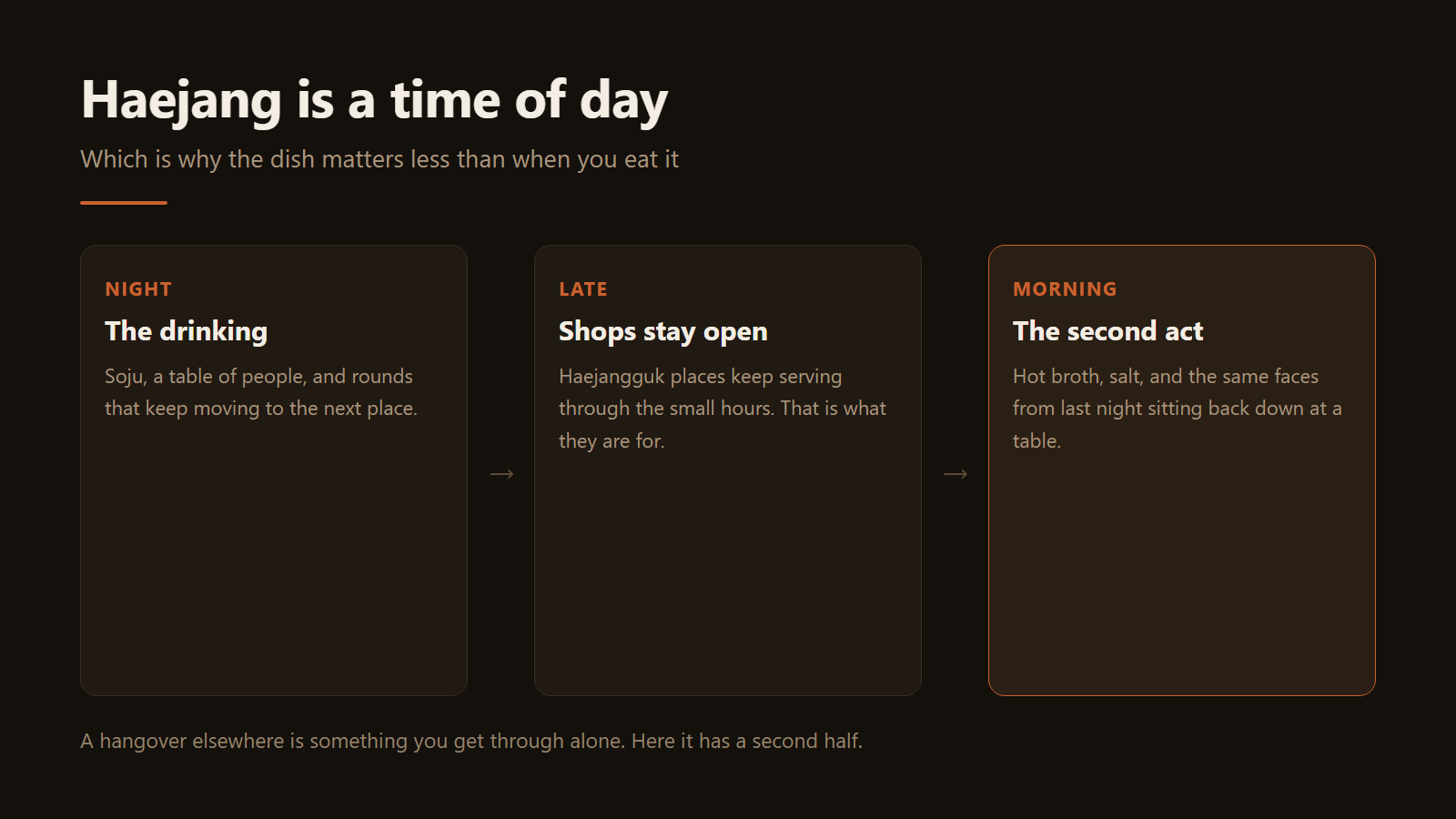
The traditional five, seolleongtang, maratang, and the jjamppong somebody in your group will insist on: what they share is not an ingredient. It is hot broth, salt, and the fact that you are eating it the morning after, usually with the people you were drinking with the night before.
That is why the survey splits almost evenly. People are not choosing a cuisine. They are choosing a temperature and a time.
That last part is the piece that goes missing in translation. A hangover in most places is something you get through alone. Here it has a second act, at a table, with the same faces. That is why these shops open early and why some of them never really close.
If you want to know how you ended up needing this, I have written about how strong soju actually is elsewhere.
If you cannot choose
Get the kongnamul-gukbap.
It is mild, it is cheap, it is everywhere, there is nothing in it you have to be brave about, and the dadaegi is sitting right there if you want to make it interesting. Nobody has ever regretted starting there.
Then next time, if you are curious, point at the seonji and find out.
FAQ
Which Korean hangover soup is the mildest?
Kongnamul-gukbap, the bean sprout soup with rice. Clear broth, egg, no strong flavours and nothing unfamiliar in it. Bugeo-guk, made with dried pollack, is a close second.
What is seonji?
Congealed ox blood, served in soft slabs. The texture is closer to a savoury custard than to meat. It is the centre of the Seoul-style bowl and it is the single most common reason visitors switch to something else.
Is Korean hangover soup spicy?
Usually not by default. Most bowls come mild with a dish of dadaegi, a red seasoning paste, on the side so you can add heat yourself. The pork spine version is the exception and arrives spicy already.
Do I have to eat it in the morning?
No, but that is when Koreans eat it, and it is when these shops are busiest. Many open very early or stay open through the night, because that is the point of them.
Is there a vegetarian version?
Not really. Bean sprout soup is the closest, but the broth is usually built on anchovy or beef. Ask before you order rather than assuming.
Does it actually cure a hangover?
It rehydrates you, it is salty, and it is hot, which is most of what helps. Bean sprouts are the one with an actual folk claim attached. Treat it as a good morning rather than as medicine.
Sources
Sources: Korea Tourism Organization, Korea Tourism Organization, Yeongdong Seolleongtang, Etoday, on a Lotte Members survey