Kkotgedang, Sinsa: A Korean's Review of the Ganjang Gejang Place Only Foreigners Know

Sinsa is my neighbourhood. I walk past this place.
A Japanese friend told me once that there was a famous gejang restaurant in Sinsa, and said it the way you say something the other person obviously already knows. I did not know. To me it was one more door on a street I walk down without looking at.
Then I started noticing who was going through that door. Foreign customers, and a lot of them, far more than anything else on that block was pulling in.
So I looked it up. Japanese guidebooks list this place. Chinese travel apps list it. Tabelog has it, Konest has it, Hanchao has it down to the second branch.
English guides have nothing.
There is, of course, a more famous soy crab restaurant a few minutes from Sinsa Station. Pro Ganjang Gejang is the one most people name first, and I thought about going there instead. I did not, for two reasons. It is already thoroughly covered for foreign visitors, which is the opposite of the gap I am describing. And it is priced dish by dish rather than as a set: two medium female crabs are listed at ₩92,000, with the crab stew a separate ₩90,000, so the meal I ended up eating that night would have run well past what I paid. I cannot tell you how the food is there. I have not been. This is about the place I actually sat down in.
So I walked in myself, on a Sunday night, assuming what you would probably assume: that Kkotgedang is one of those Korean restaurants that simply is not set up for foreign guests. No English menu, no way to ask a question, a wall of Korean and a lot of pointing.
The tablet sitting on my table offered four languages, and one of them was English.
The gap is not the restaurant. The gap is that nobody wrote this down in English.
Two people, a Sunday night, ₩161,000. The tablet runs in English, calling a staff member and asking for more seaweed are ₩0 buttons on it, and the online listing shows you only half the menu. Here is the full receipt, and what it actually buys.
Naver Shows You Half the Menu
Before I went, I did what you would do: I looked up the prices online. Then I sat down, opened the tablet, and the numbers did not match.
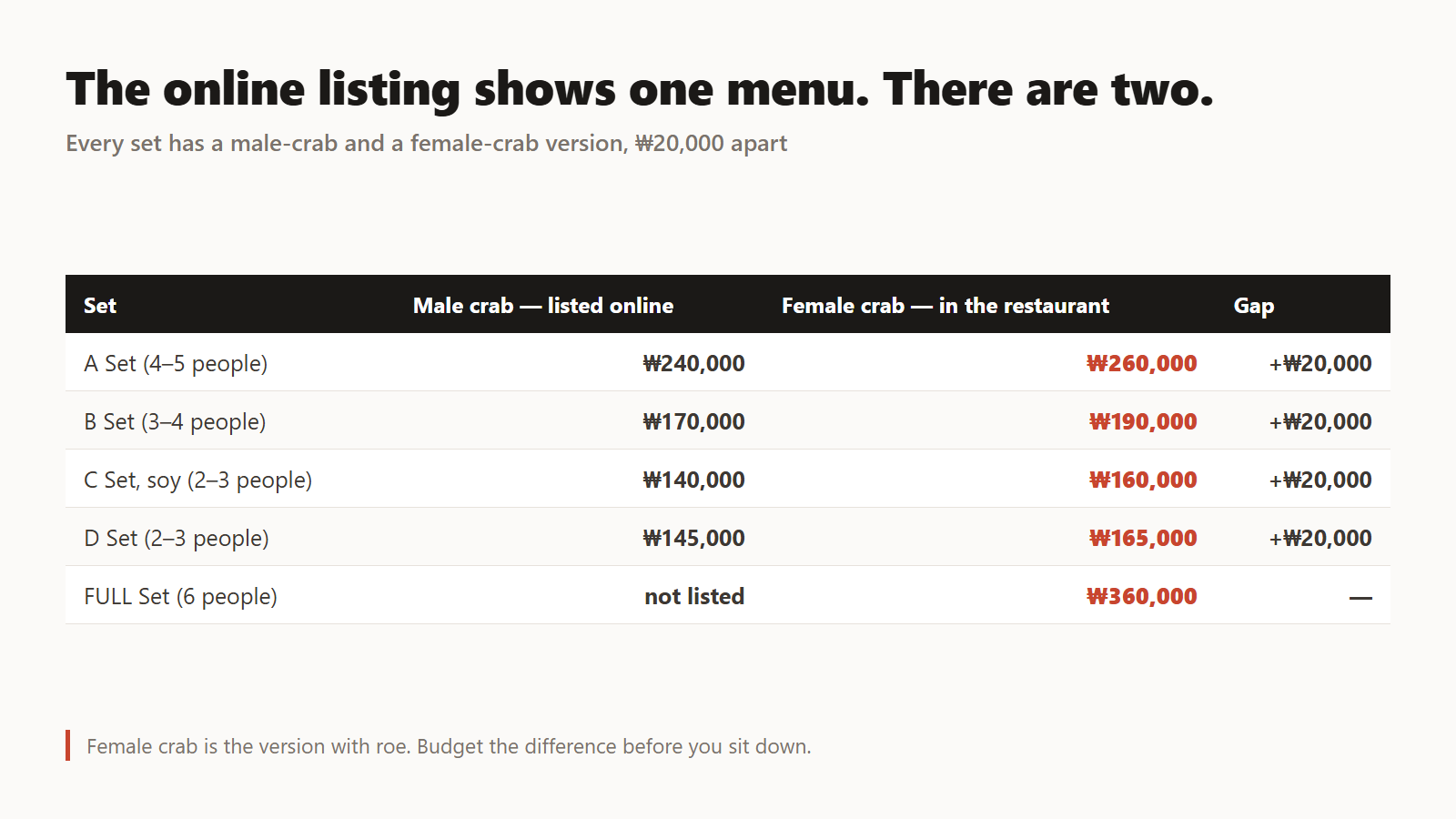
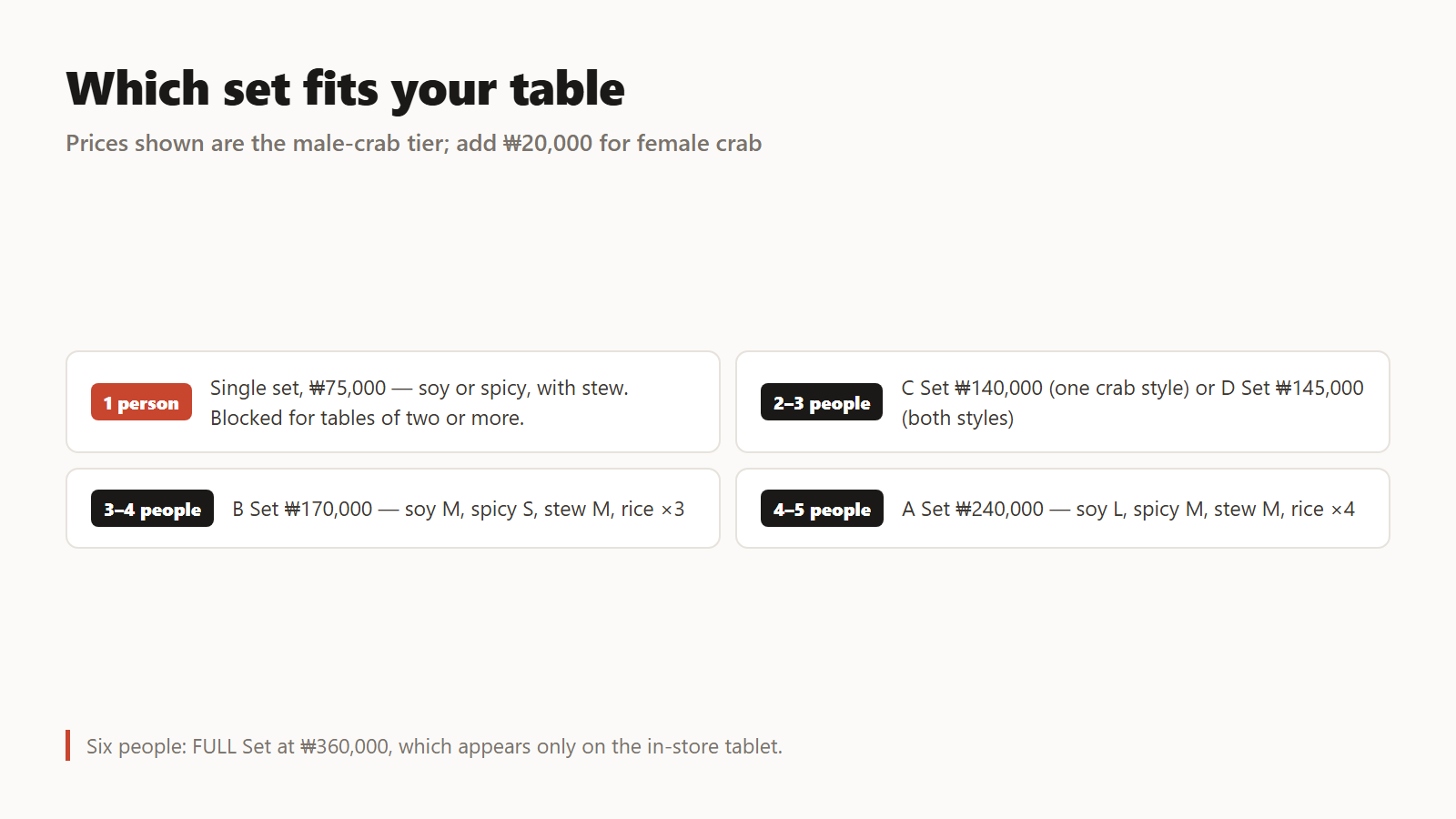
Kkotgedang runs two parallel set menus, and the online listing only shows one of them. Every set comes in a male-crab version and a female-crab version. The female crab sets cost ₩20,000 more, every time, across the board.
| Set | Male crab (listed online) | Female crab (in the restaurant) |
|---|---|---|
| A Set (4–5 people) | ₩240,000 | ₩260,000 |
| B Set (3–4 people) | ₩170,000 | ₩190,000 |
| C Set, soy (2–3 people) | ₩140,000 | ₩160,000 |
| C-1 Set, spicy (2–3 people) | ₩140,000 | ₩160,000 |
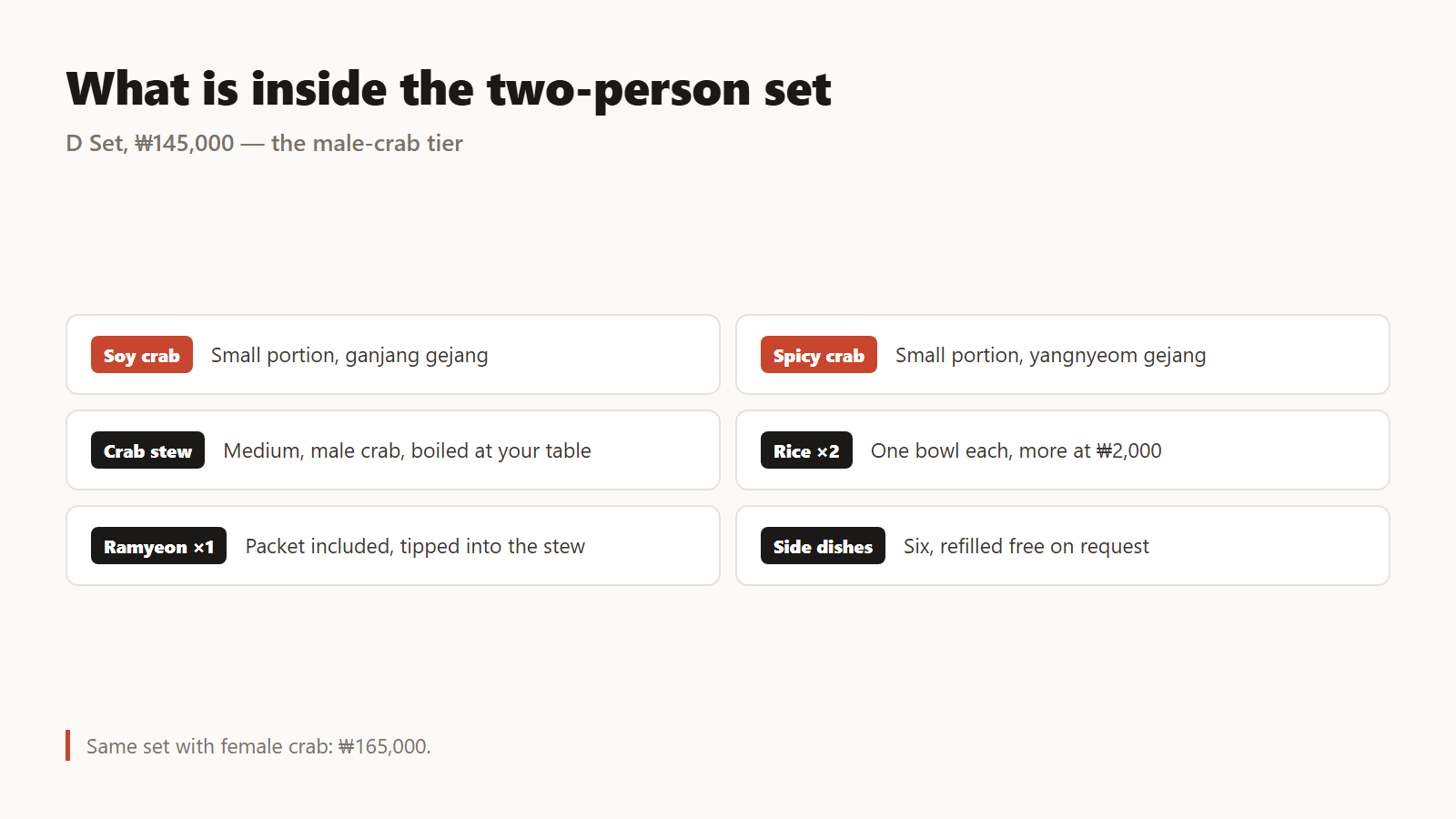
| D Set (2–3 people) | ₩145,000 | ₩165,000 |
| FULL Set (6 people) | not listed online | ₩360,000 |
The FULL Set does not appear online at all. The party sizes are wrong too: the online listing calls D Set a two-person set, while the tablet and my receipt both say two to three.
Female crab is the one with roe. If you have seen a photo of ganjang gejang with orange roe packed into the shell and that is the reason you are going, you want the female version, and you should budget the extra ₩20,000 before you sit down.
What Two People Actually Pay
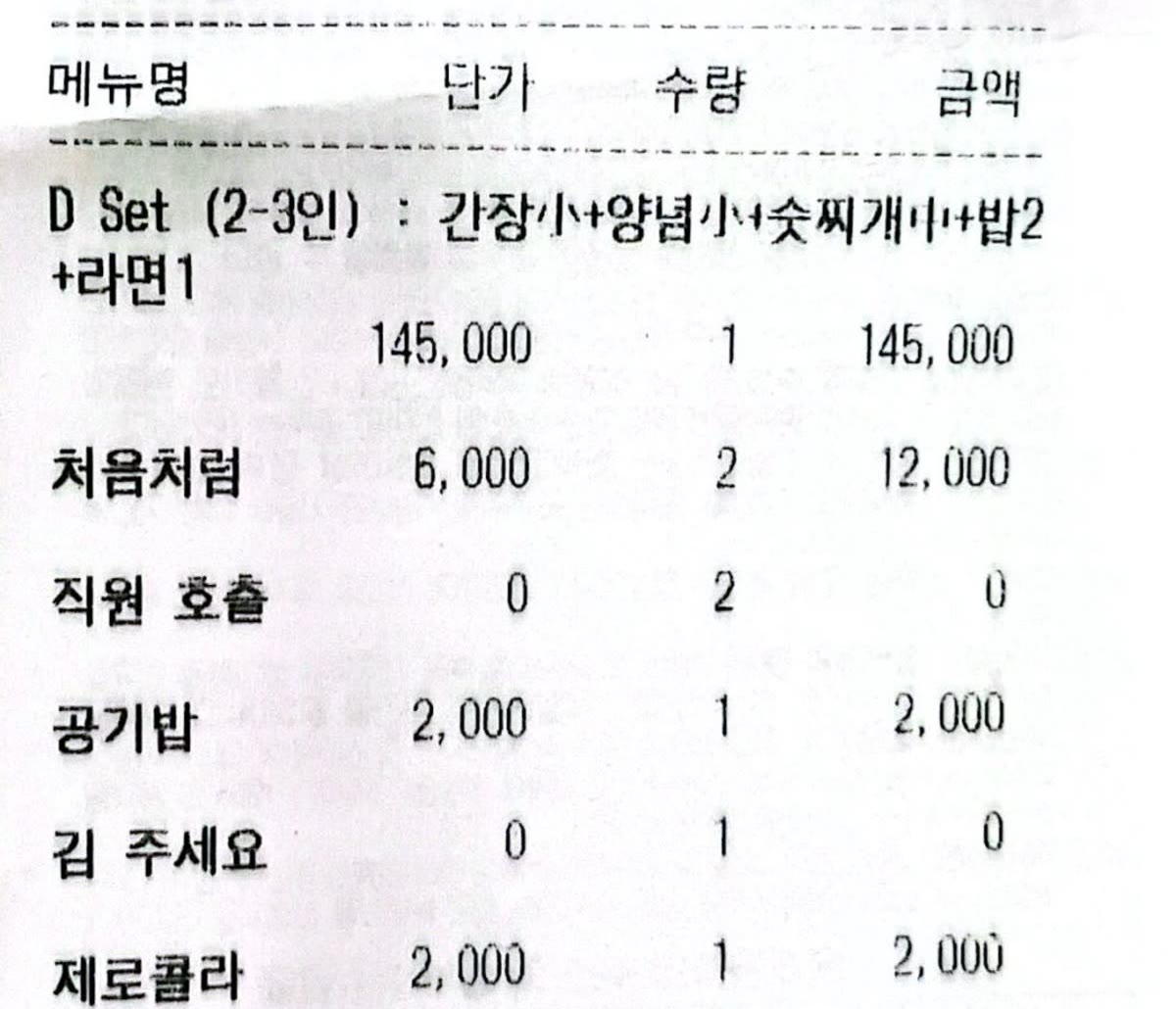
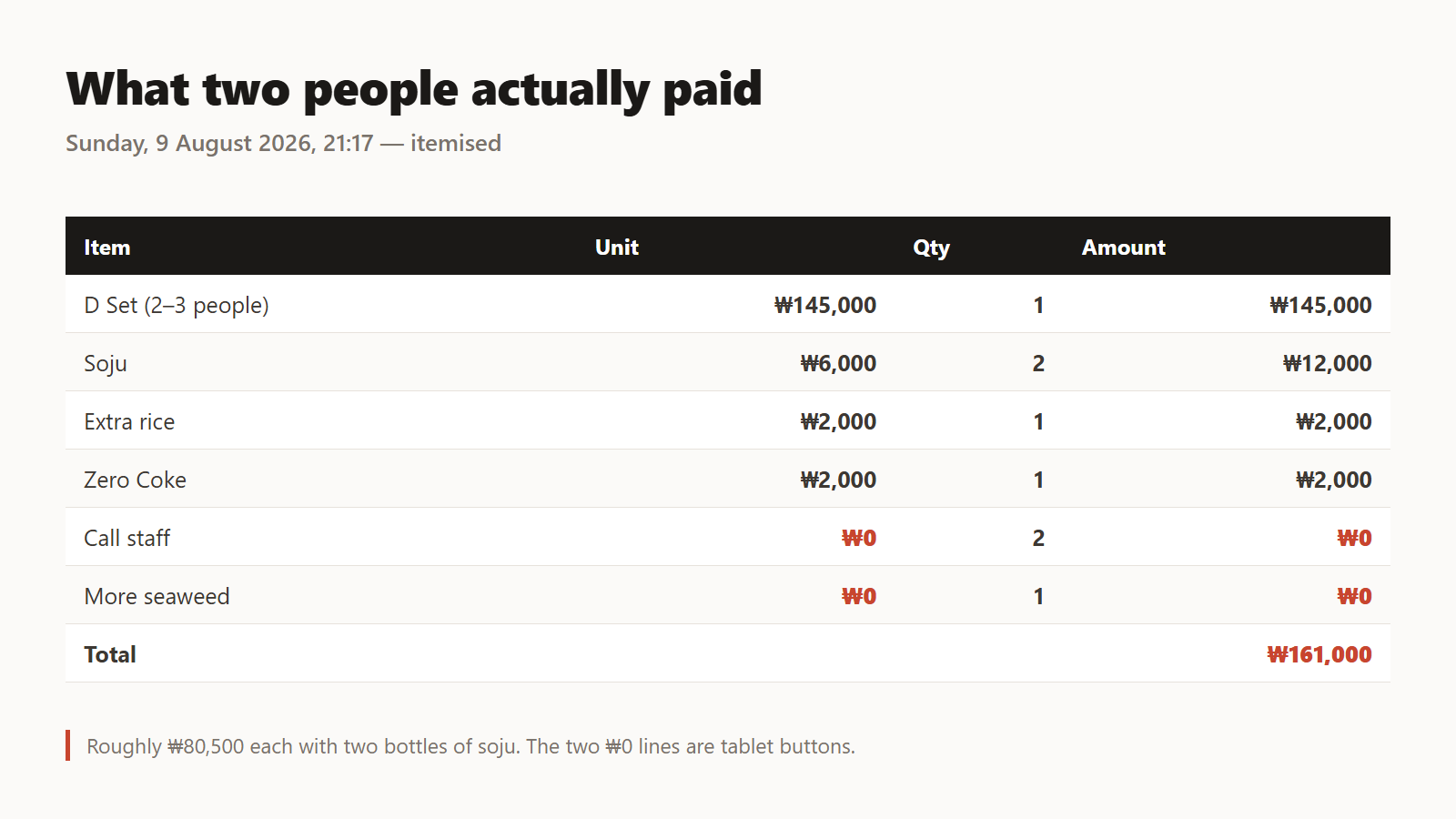
Here is my receipt, in full. Two adults, Sunday night.
| Item | Unit | Qty | Amount |
|---|---|---|---|
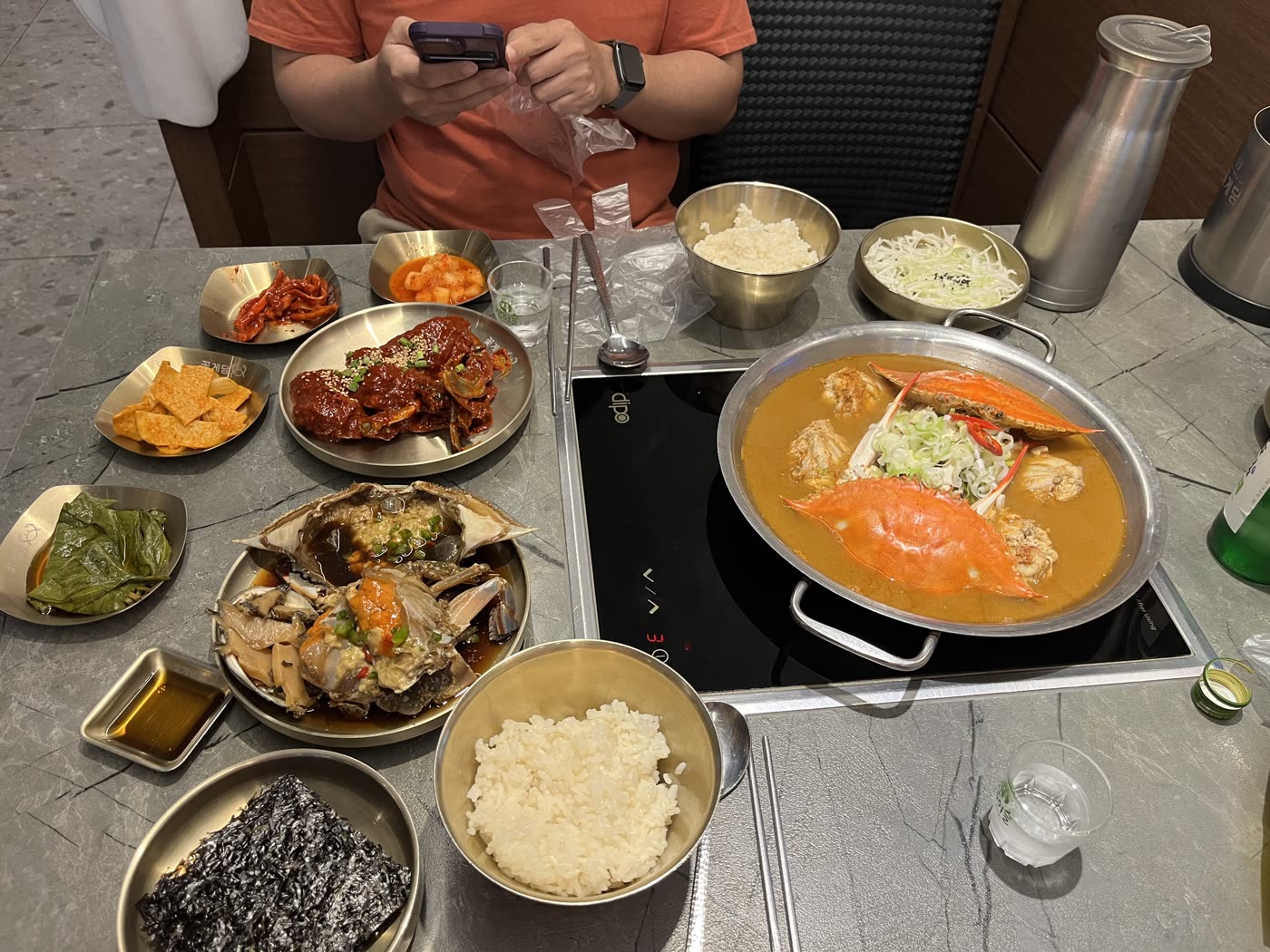
| D Set (2–3 people): soy S + spicy S + male crab stew M + rice ×2 + ramyeon ×1 | ₩145,000 | 1 | ₩145,000 |
| Chum-Churum soju | ₩6,000 | 2 | ₩12,000 |
| Extra rice | ₩2,000 | 1 | ₩2,000 |
| Zero Coke | ₩2,000 | 1 | ₩2,000 |
| Call staff | ₩0 | 2 | ₩0 |
| More seaweed | ₩0 | 1 | ₩0 |
| Total | ₩161,000 |
That is roughly ₩80,500 per person with two bottles of soju. Without alcohol you land around ₩74,500 each.
This is not a cheap meal, and I would rather you know that now than find out at the counter. Gejang is raw crab cured in soy or chilli sauce, it is priced like seafood, and a set built for two people is the floor, not a splurge.
I want to be straight about this, because you are hearing it from a Korean rather than from a visitor converting currency: that is a high price here too. ₩80,500 a head is not a casual dinner for anyone I know in Seoul, and nobody local walks into this kind of meal without deciding on it first.
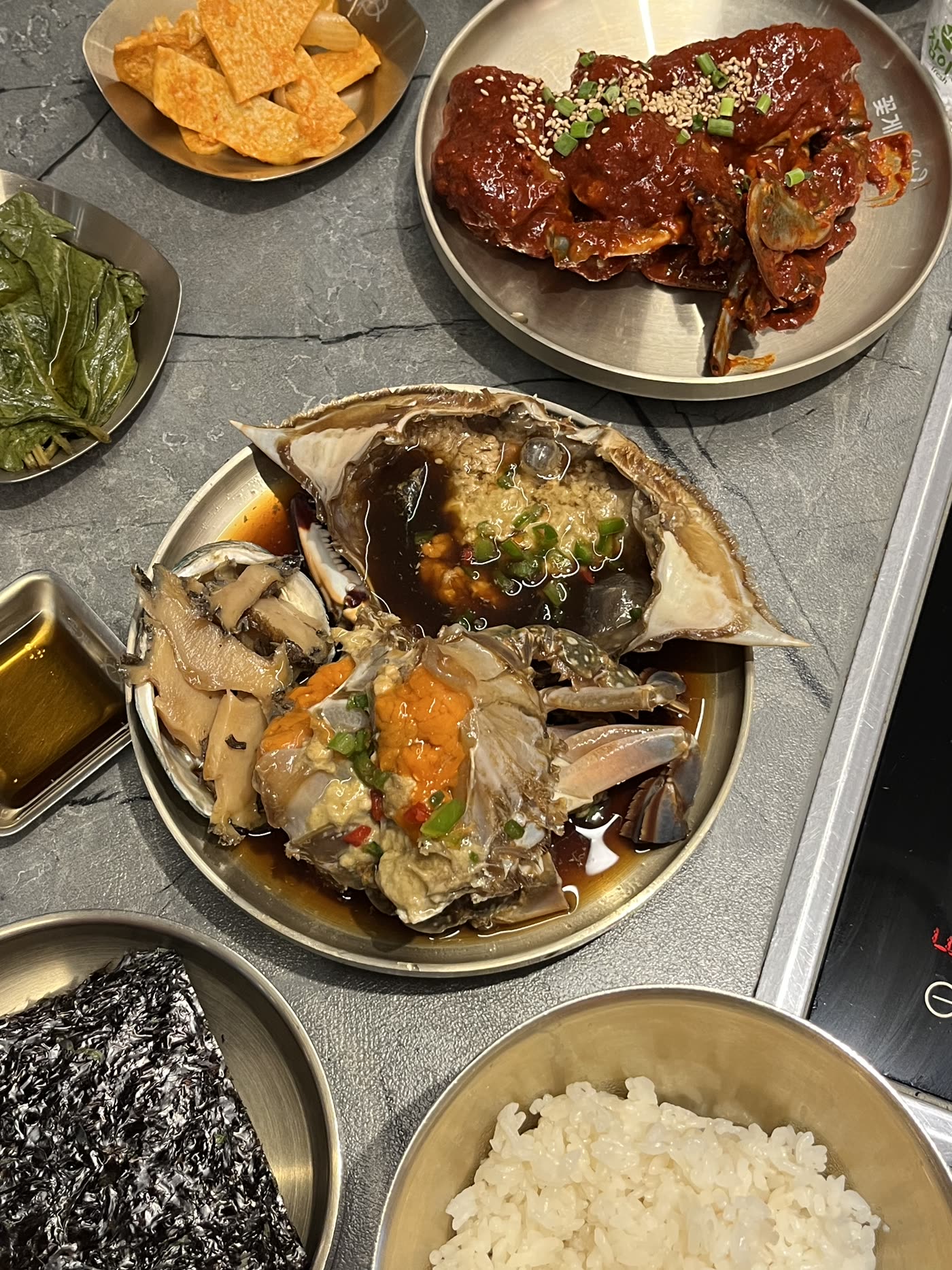
And it earns the number. The soy-cured crab is cold and clean and tastes of the sea rather than of soy sauce. The roe scraped out of the shell into hot rice would justify the set on its own. The stew that arrives afterwards is not filler bulking out the bill, it is the second half of the meal. I have paid less than this elsewhere and wished I had not.
Two Lines on My Receipt Cost ₩0
Look at the bottom of that table again.
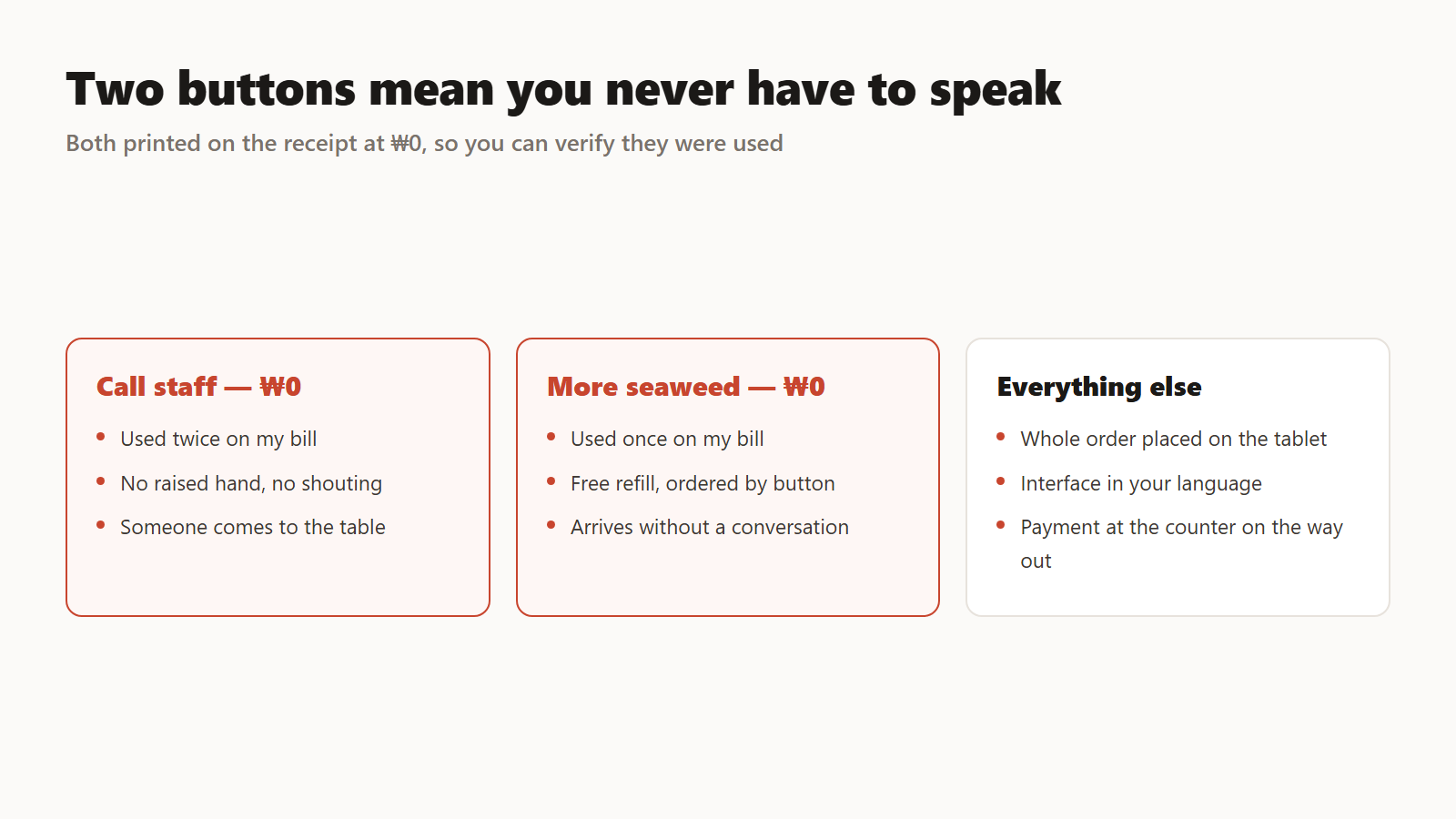
Call staff — ₩0, used twice. More seaweed — ₩0, used once.
Those are buttons on the tablet. I did not raise my hand, I did not catch anyone's eye, and I did not say a word in Korean to get a staff member to the table or to get the seaweed refilled.
If you have ever sat in a Korean restaurant working up the nerve to shout across the room, that is the part worth knowing. The awkward moment has been engineered out of this place, and it is sitting there in English.
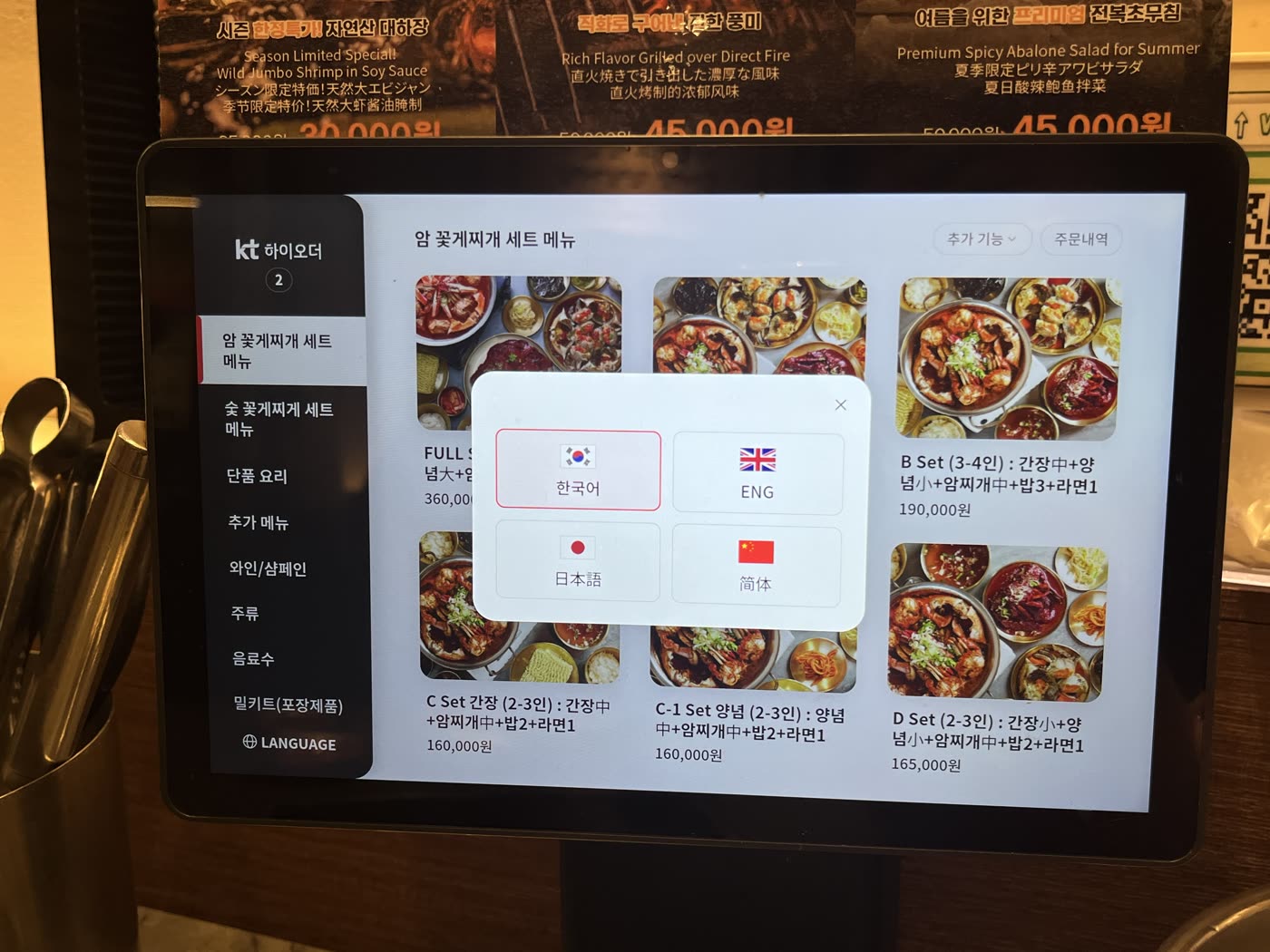
The Tablet Speaks Four Languages
The ordering tablet is a KT HiOrder unit. There is a globe icon marked LANGUAGE in the bottom-left corner, and it opens onto four options: Korean, ENG, Japanese, and Simplified Chinese.
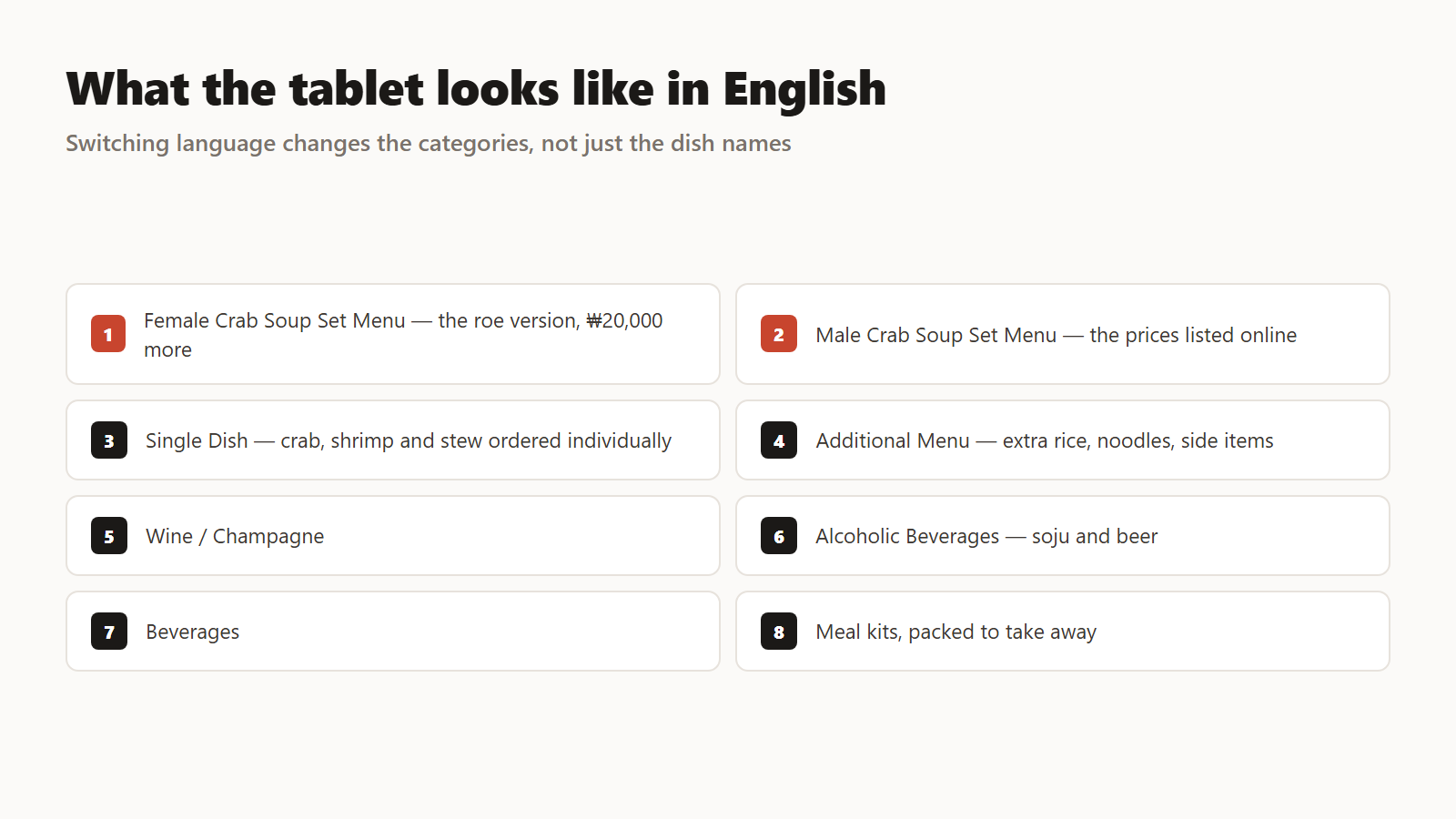
Switch it to English and the whole interface follows, not just the dish names. The categories become Female Crab Soup Set Menu, Male Crab Soup Set Menu, Single Dish, Additional Menu, Wine / Champagne, Alcoholic Beverages, and Beverages.
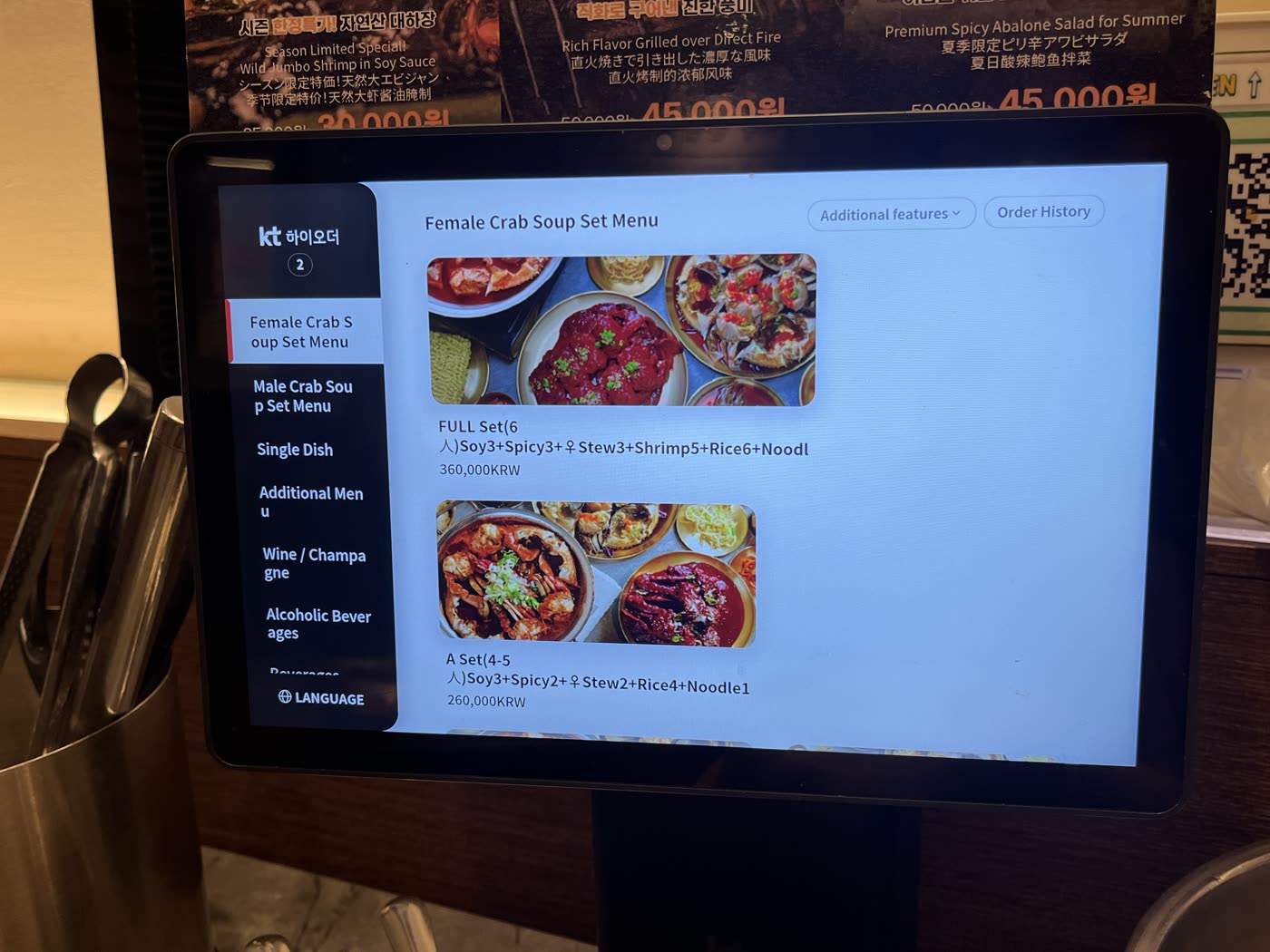
The set descriptions are compressed but readable once you know the shorthand. A Set reads as Soy3+Spicy2+♀Stew2+Rice4+Noodle1 at ₩260,000. Soy means soy-marinated crab, Spicy means the chilli-marinated version, ♀ marks the female-crab stew, and the numbers are portions.
I have used plenty of English menus in Seoul that were clearly run through a translator once in 2019 and never touched again. This one is maintained. It uses the ♀ and ♂ symbols to solve a distinction that English does not have a short word for, which is a small sign that somebody thought about it.
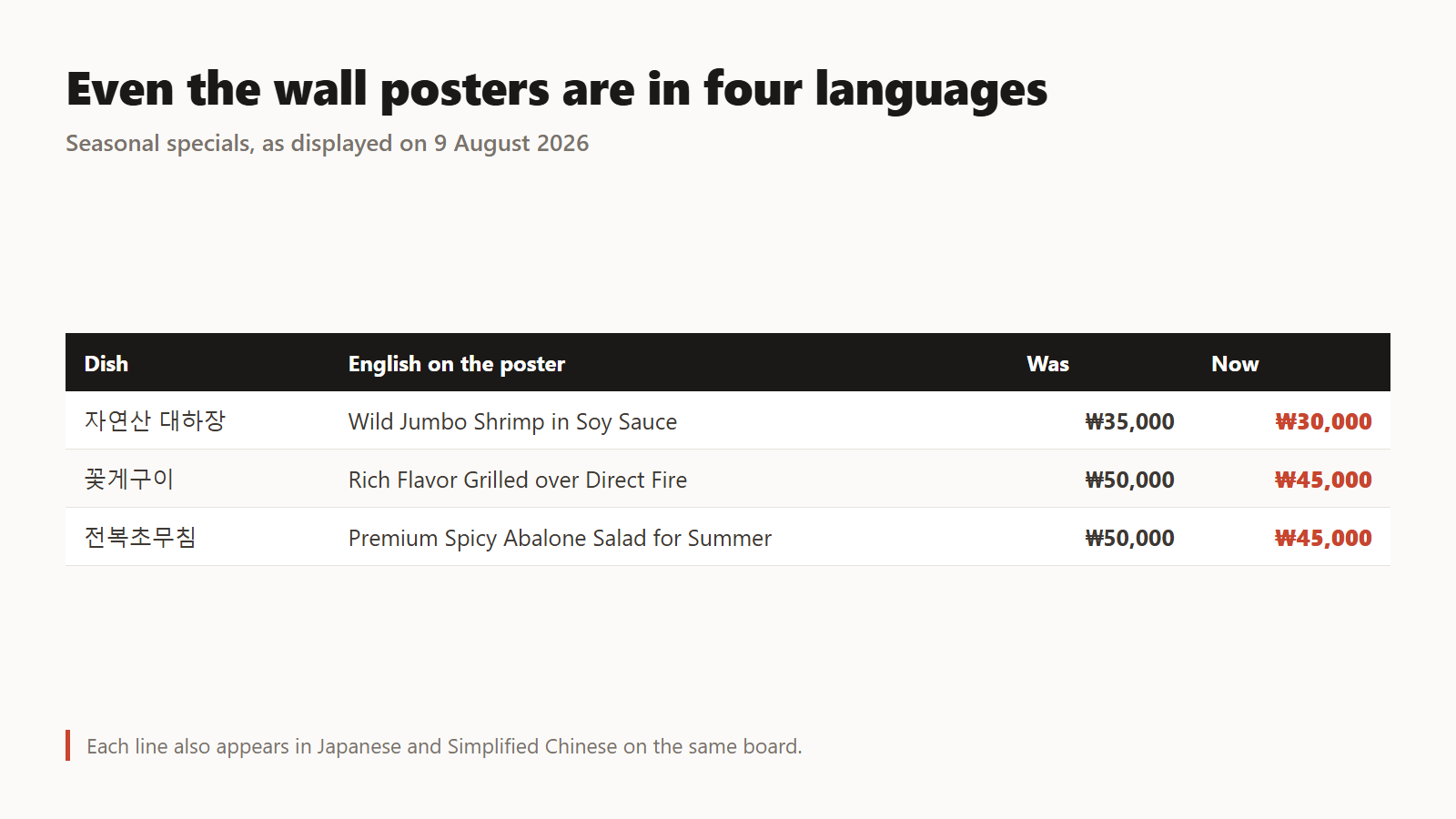
The seasonal posters on the wall are in the same four languages. The wild jumbo shrimp in soy sauce was marked down from ₩35,000 to ₩30,000, and the grilled blue crab from ₩50,000 to ₩45,000, in Korean, English, Japanese and Chinese on the same board.
Soy or Spicy? I Picked Spicy
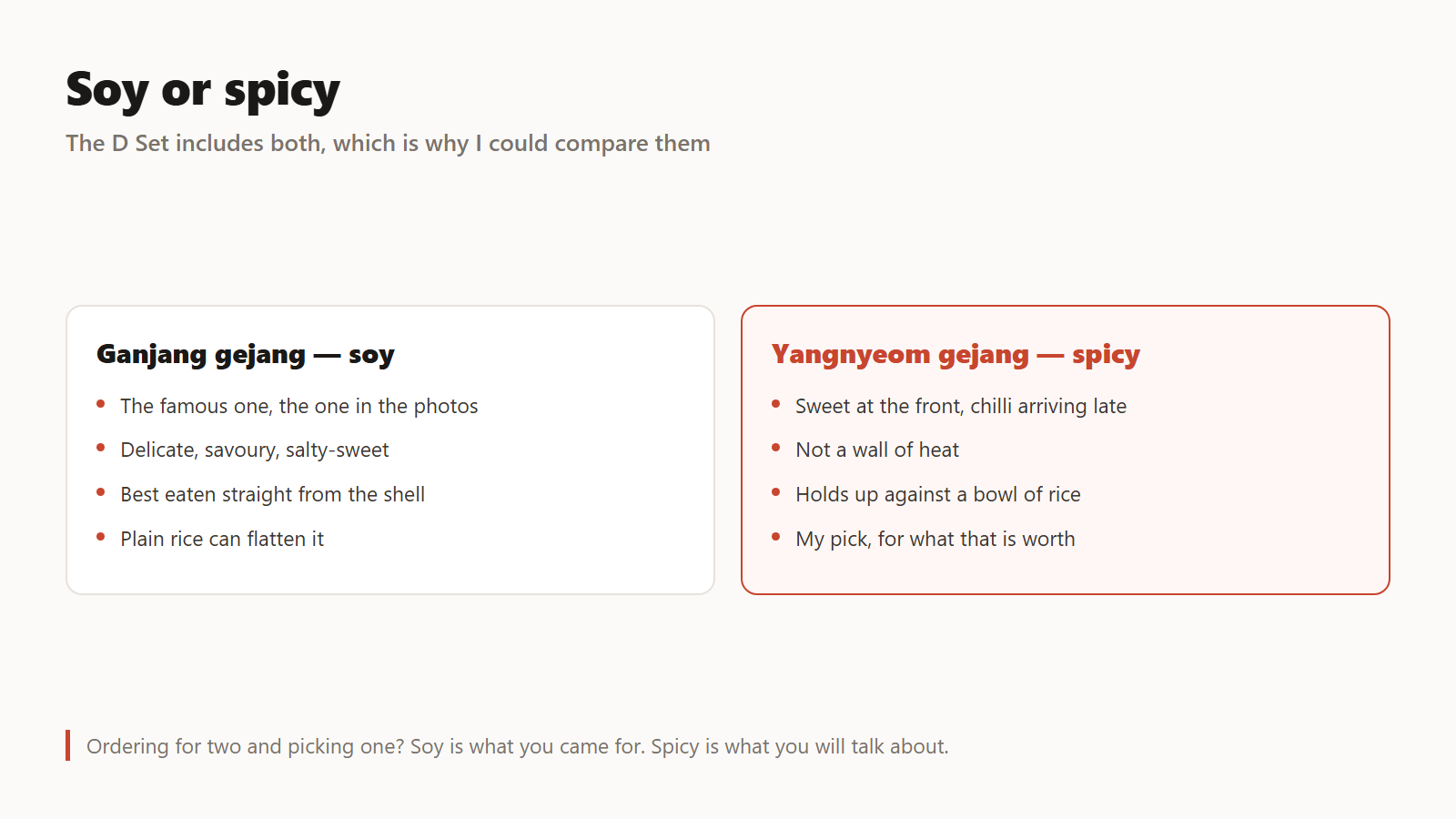
Almost everyone arrives wanting ganjang gejang, the soy-marinated one. It is the famous one, it is the one in the photos, and it is the one people call the rice thief. I wrote a longer piece on what ganjang gejang is and where else to eat it if you want the wider list.
I ordered the D Set specifically because it comes with both, and I preferred the spicy one.
I will not pretend that is a universal verdict. I am Korean and I grew up on chilli, so my baseline is not yours. But the spicy version at Kkotgedang is not a wall of heat. It is sweet at the front with the chilli arriving late, and it holds up better against a bowl of plain rice than the soy version does, because the soy crab is delicate and the rice can flatten it.
If you are ordering for two and you can only pick one, the honest answer is that the soy crab is the one you came for and the spicy one is the one you will talk about afterwards. Which is a good argument for the set that includes both.
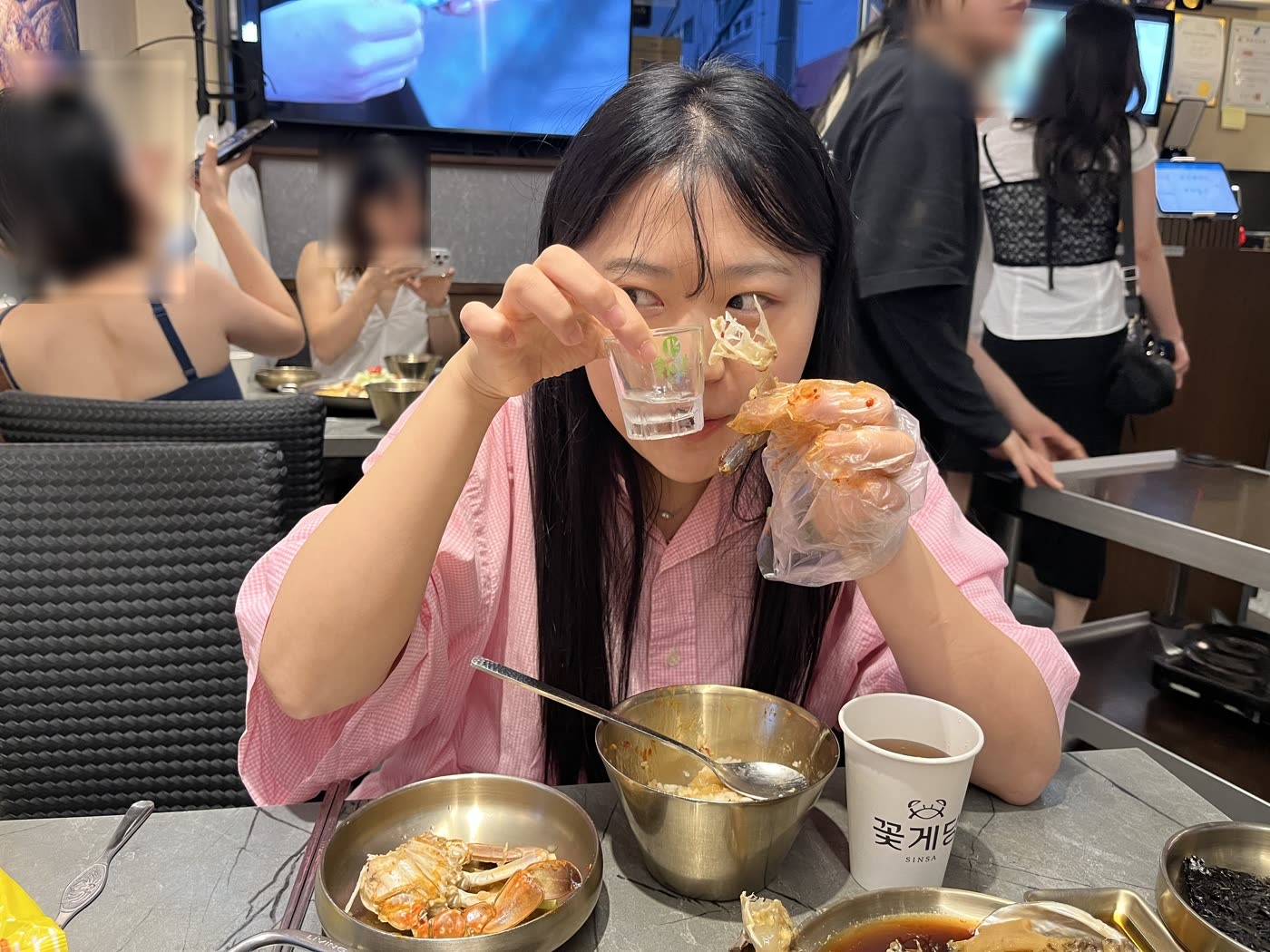
One more thing, and it explains the two bottles on my receipt: order soju with it. Cold soju against soy-cured crab is the pairing this meal is built for. The soju is clean and faintly sweet, the crab is cold and salty, and each one resets your mouth for the other. Once the spicy crab and the stew are going, it keeps the heat from stacking up on you. If you drink at all, do not skip this. It is ₩6,000 a bottle and it is the best value on the bill.
How the Meal Actually Runs
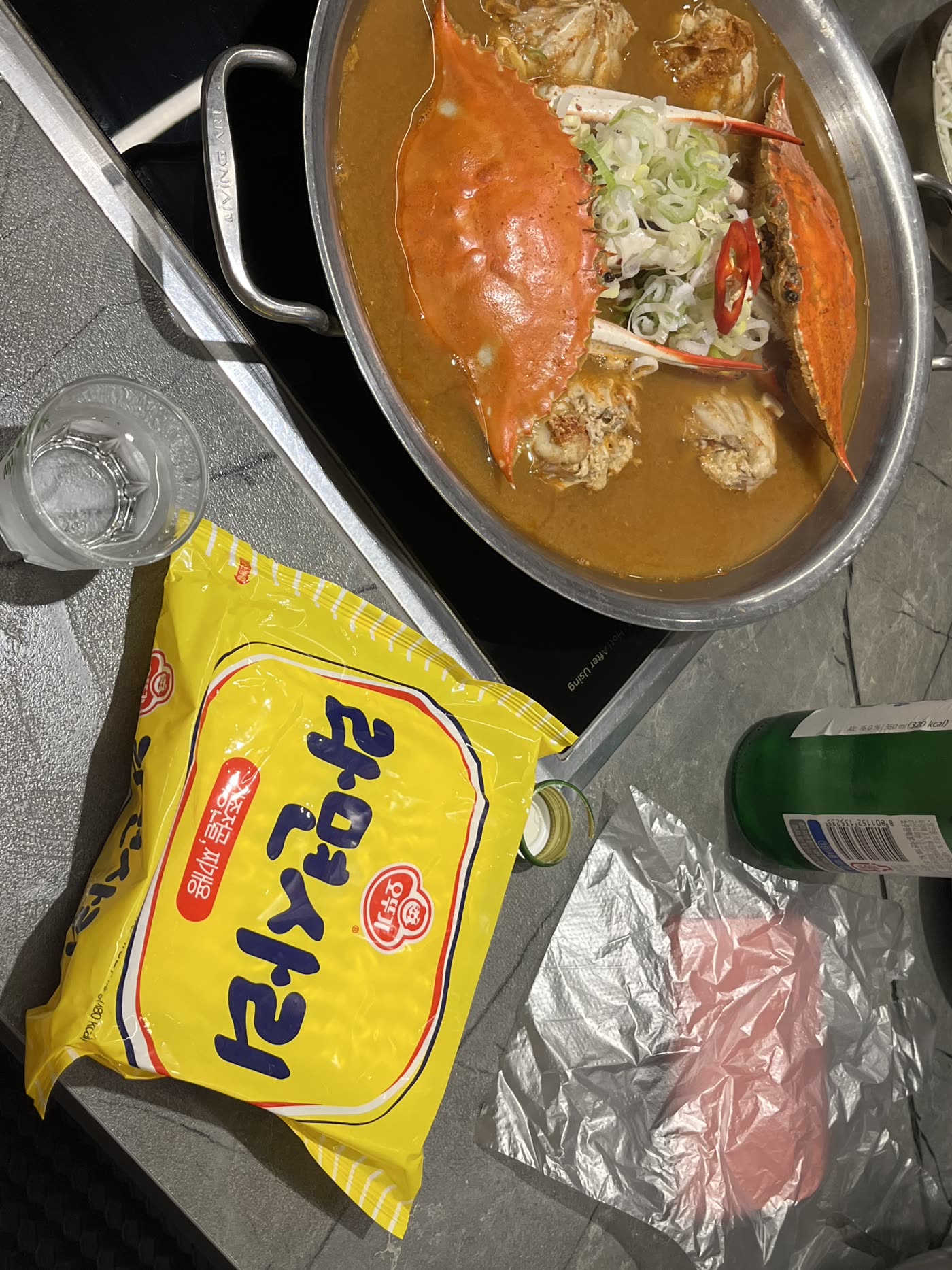
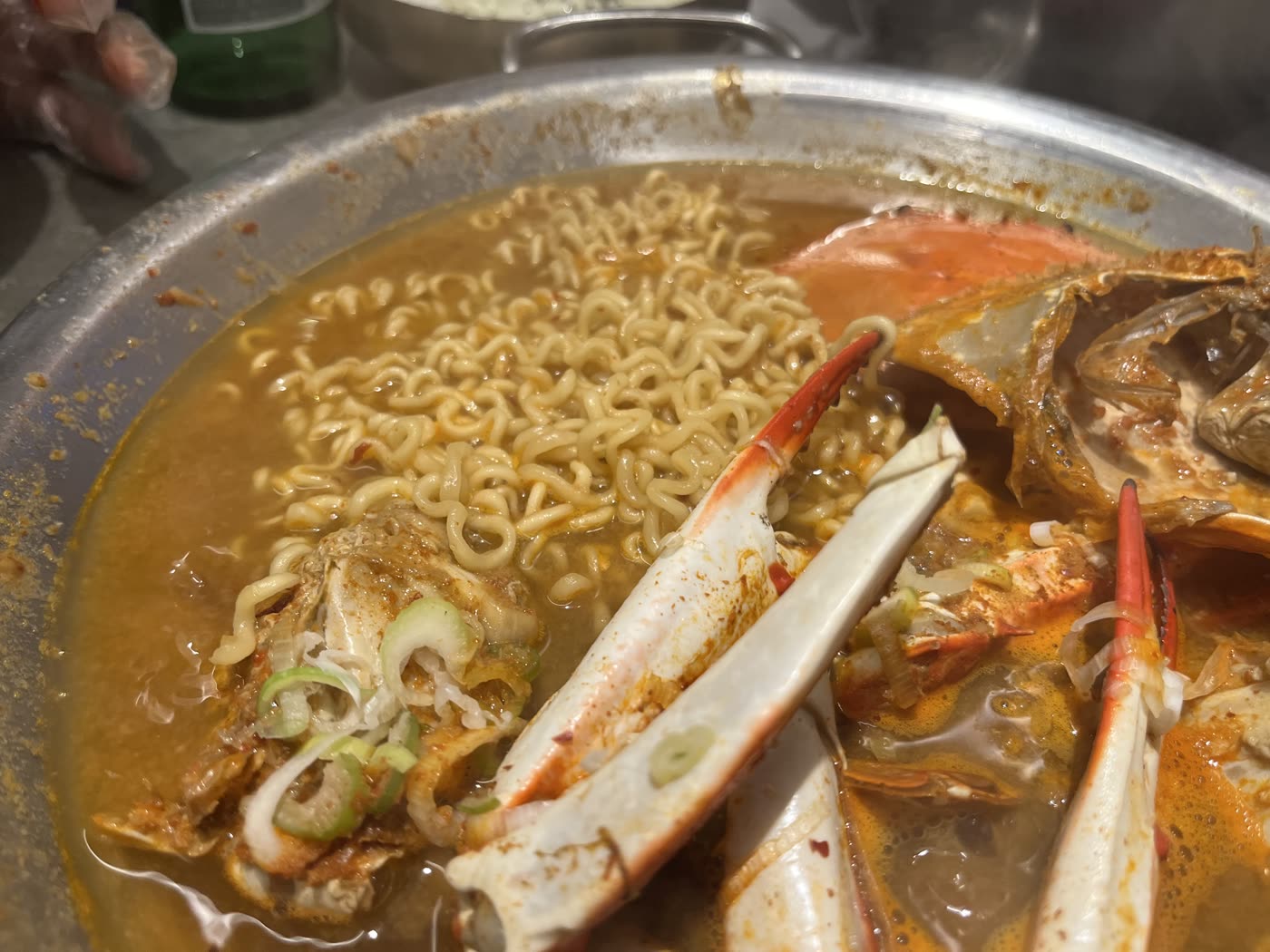
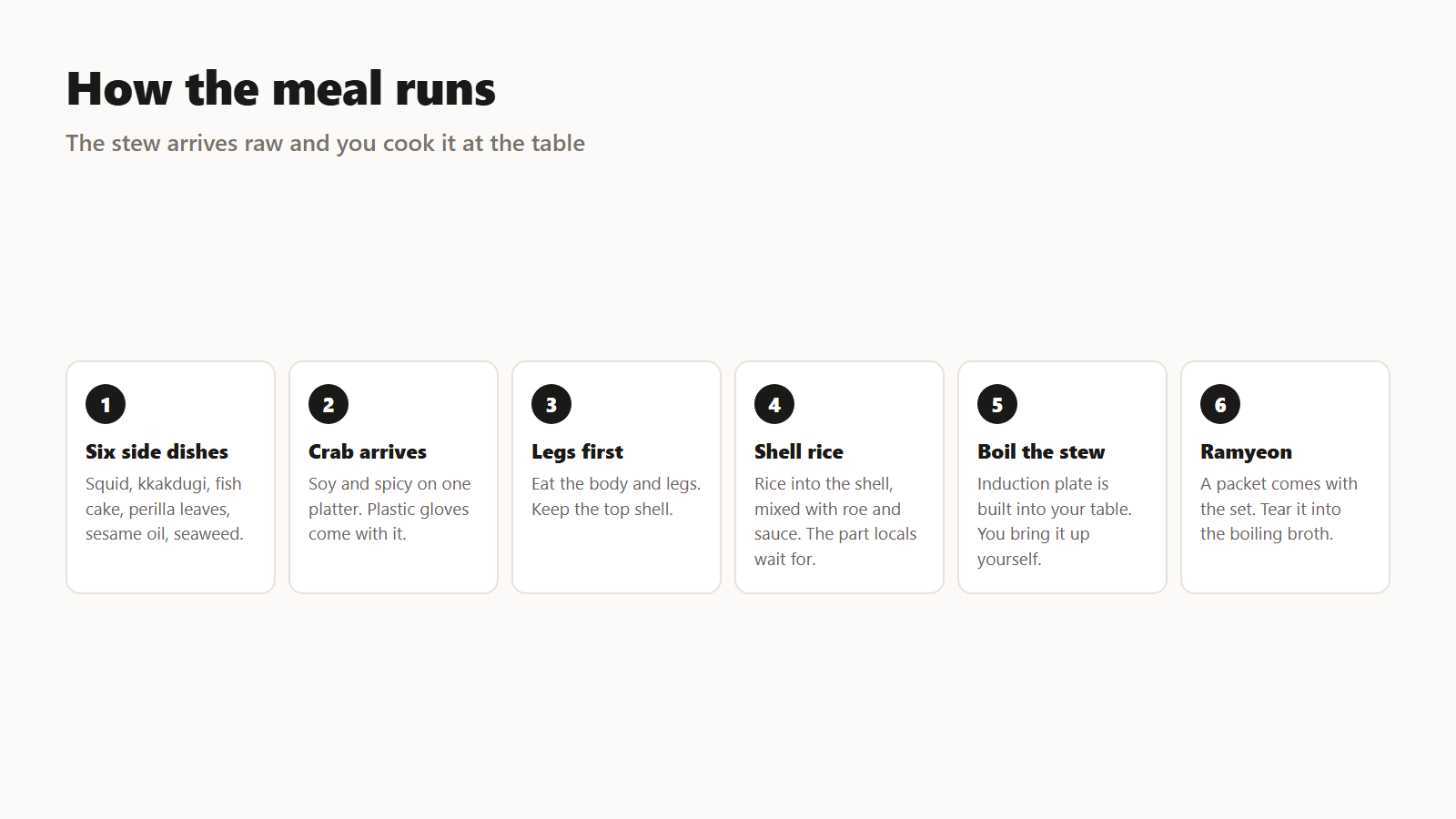
The sequence caught me slightly off guard even as a Korean, because the stew arrives raw and you cook it yourself.
-
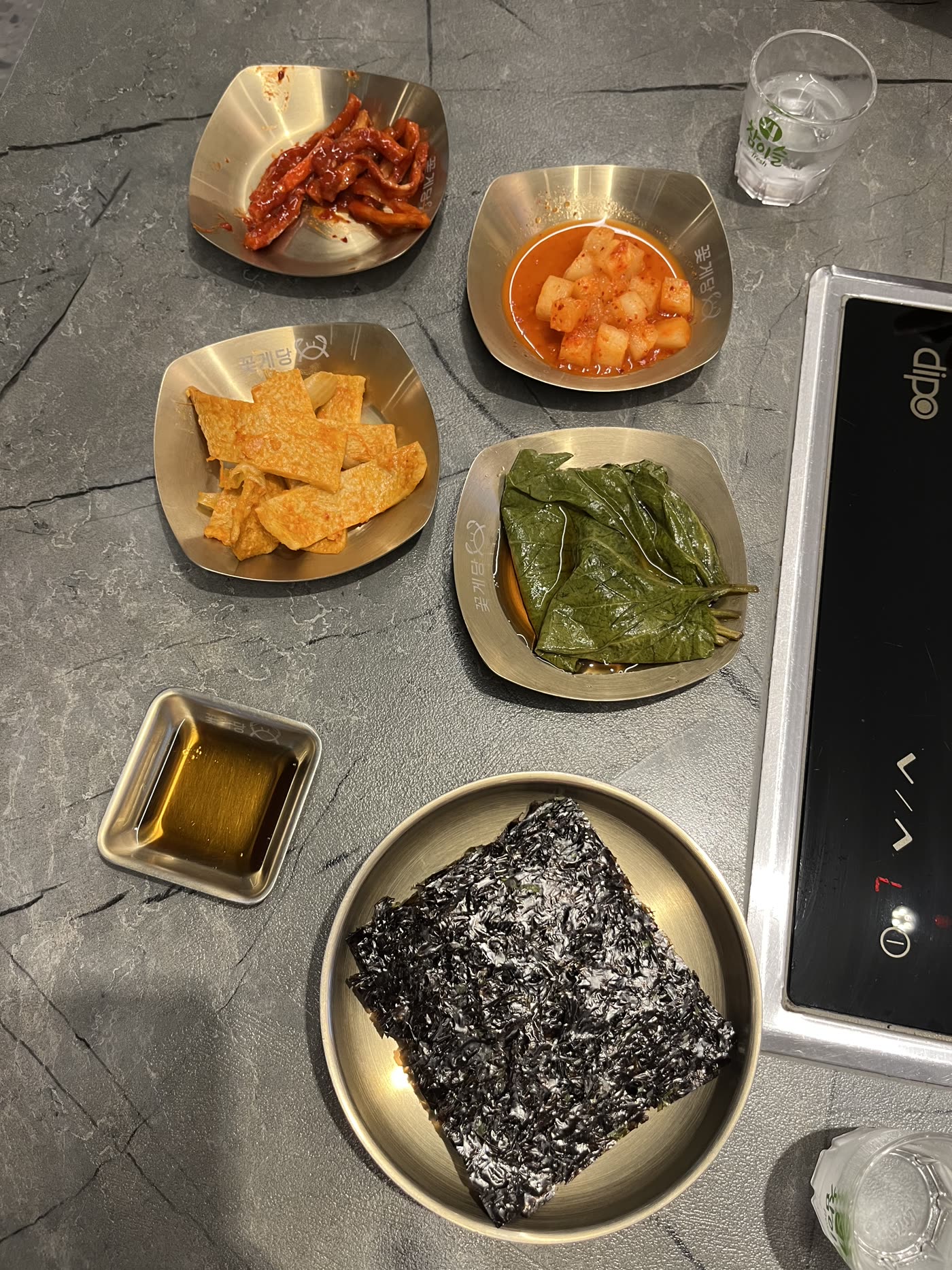
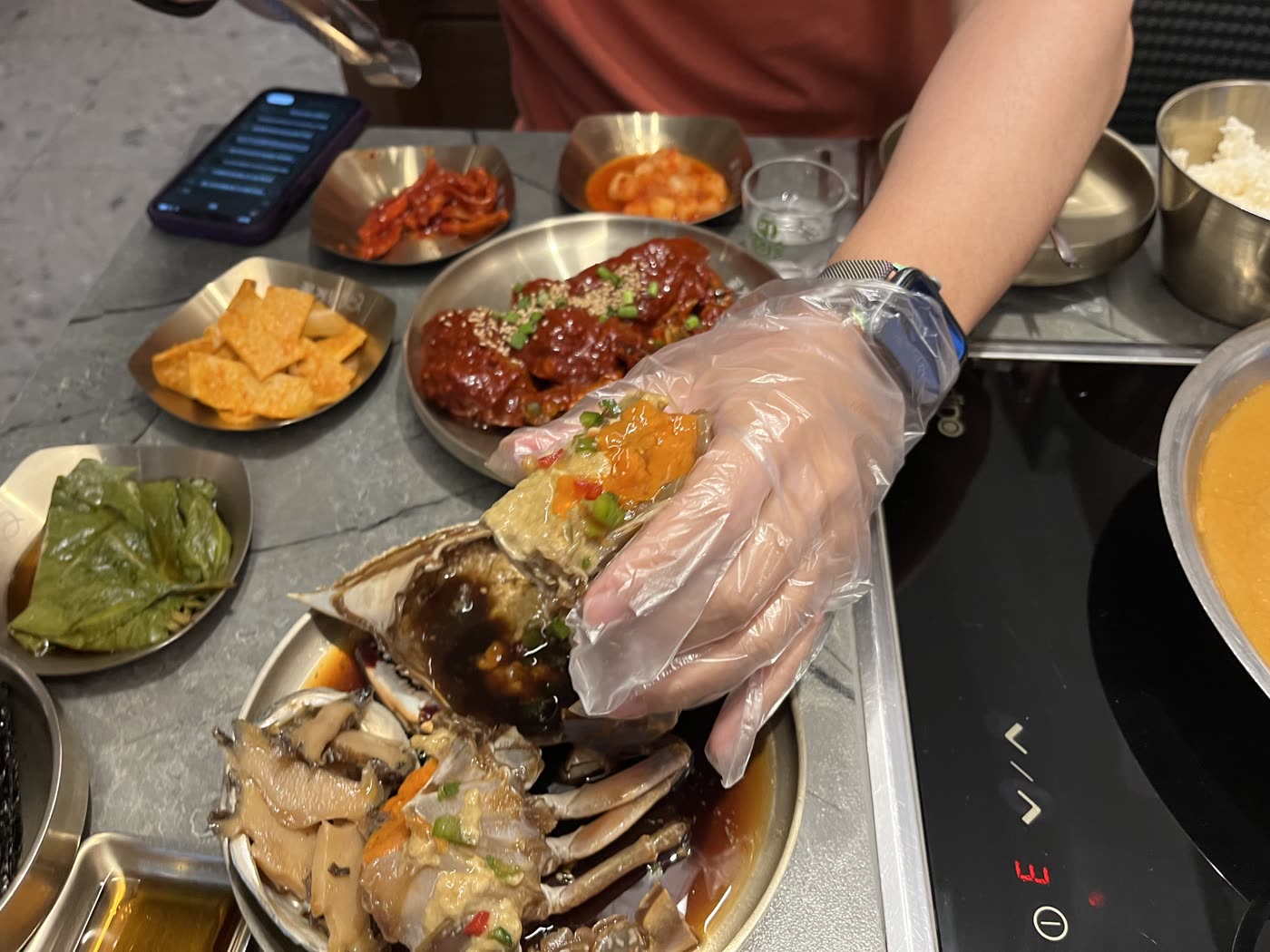
Six side dishes land first: seasoned dried squid, kkakdugi radish kimchi, stir-fried fish cake, pickled perilla leaves, a dish of sesame oil, and seaweed.
-
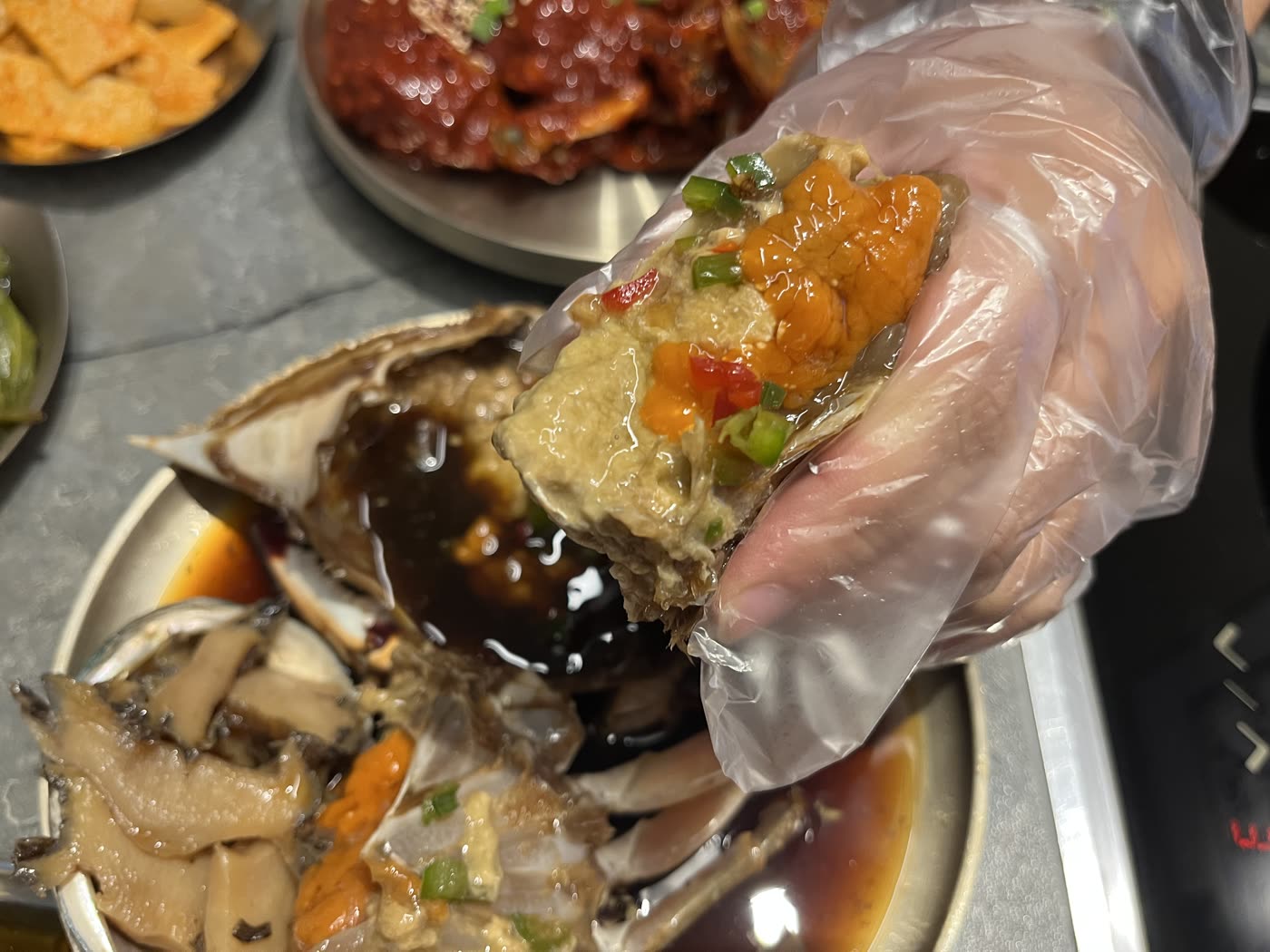
The soy and spicy crab arrive on a metal platter. Plastic gloves come with them. Put them on.
-
Eat the legs and body first, then keep the top shell.
-
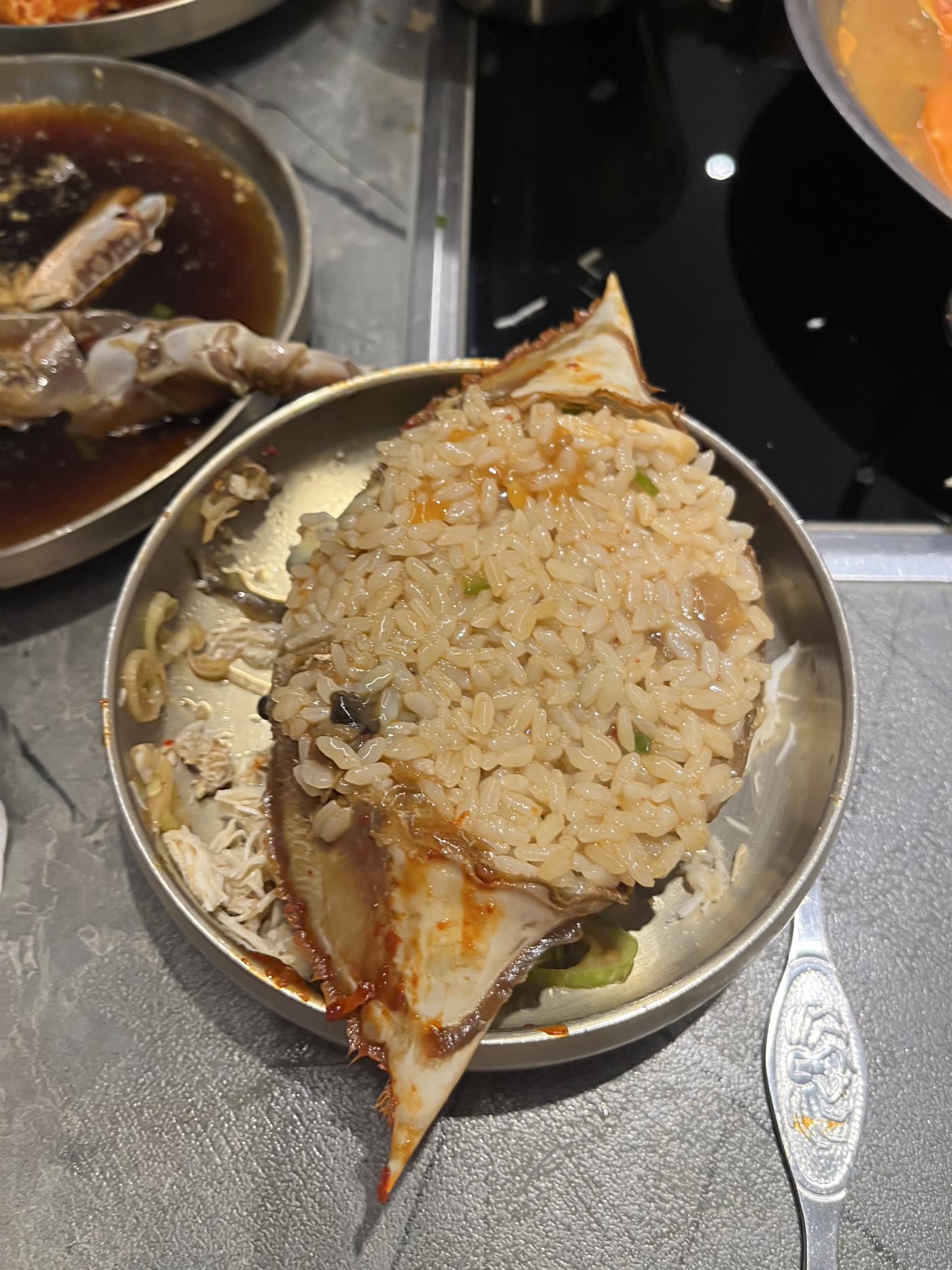
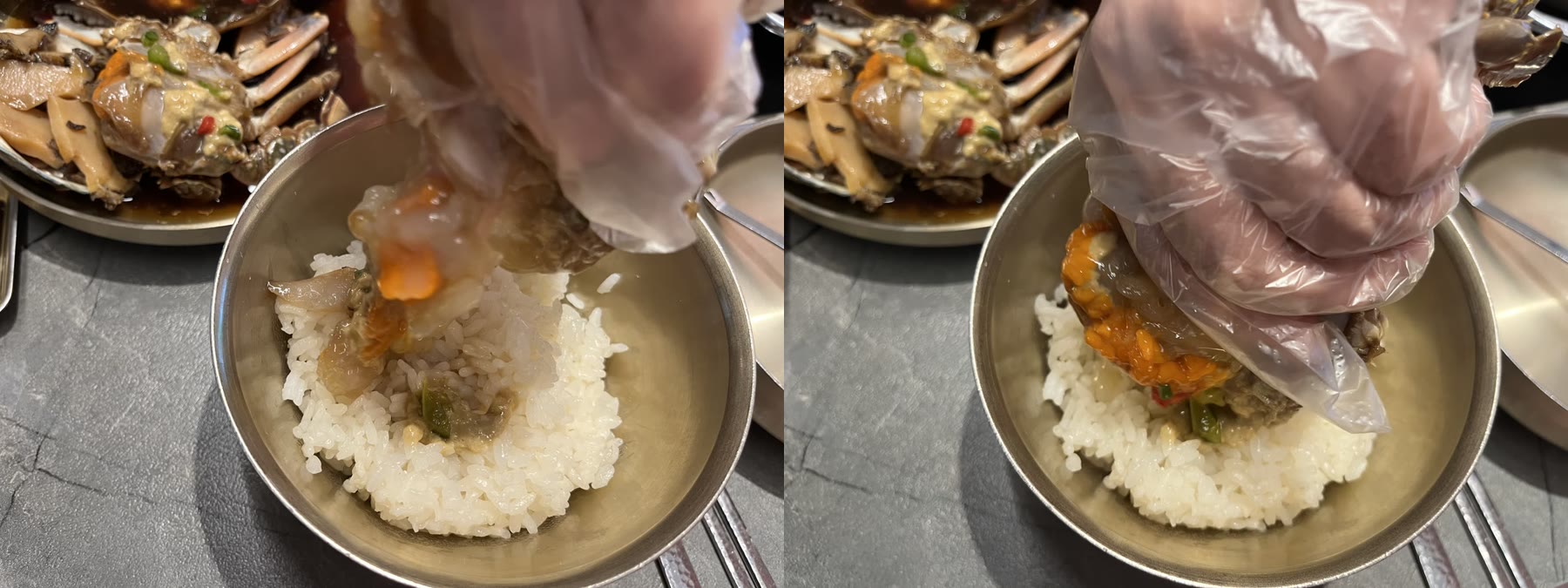
Scrape your rice into that shell, mix it with the roe and sauce pooled inside, and eat it straight out of the shell. This is the part locals wait for.
-
The crab stew goes on the induction plate built into your table and you bring it to a boil yourself.
-
A packet of instant ramyeon comes with it. Tear it in when the stew is going and let the noodles finish in the broth.
Do You Need a Reservation?
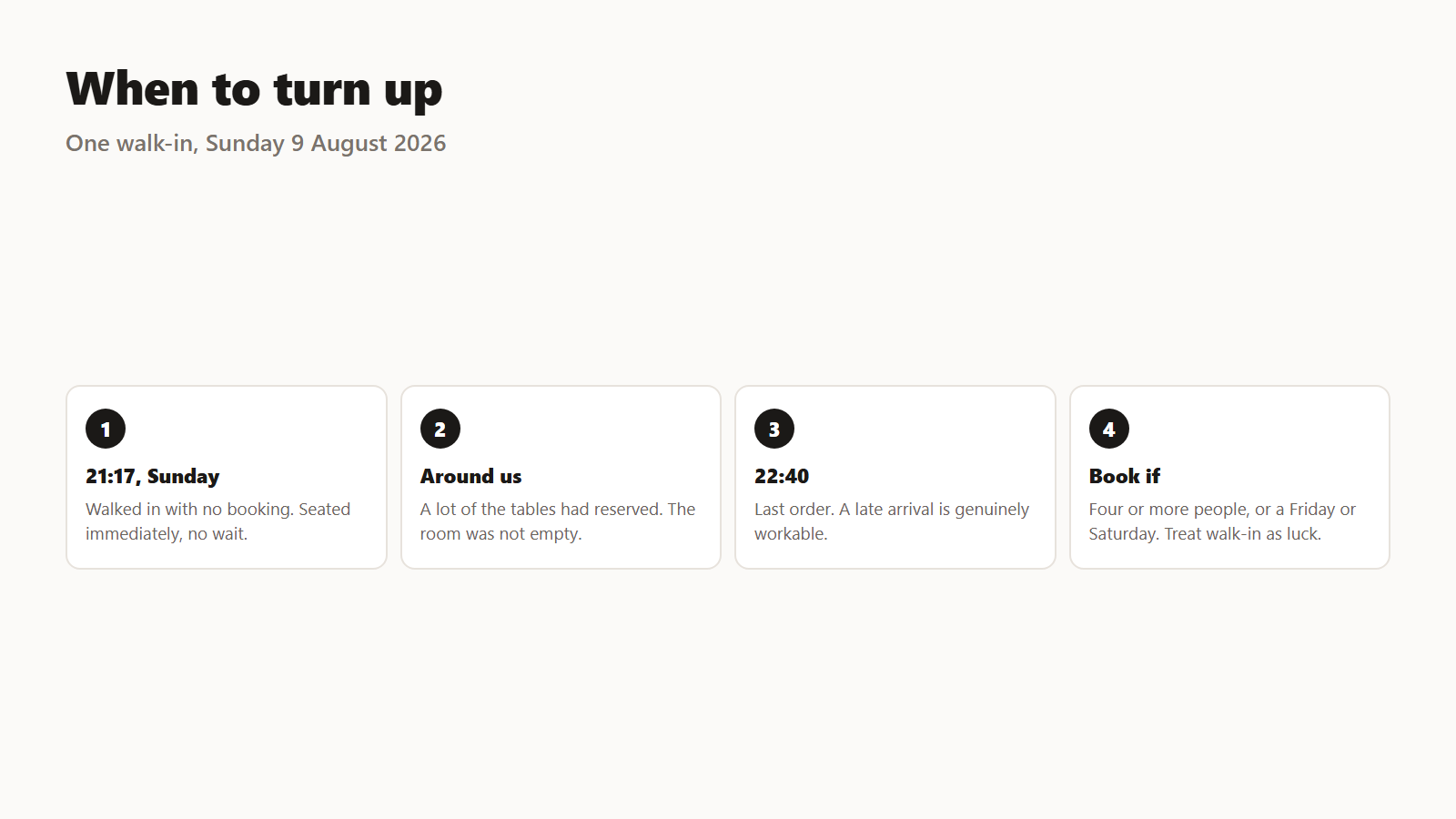
I walked in at 21:17 on a Sunday and was seated with no wait.
That said, I could hear enough of the floor to know that a lot of the tables around me had booked. Last order is 22:40, so a late arrival is genuinely possible, but if you are coming as a group of four or more, or on a Friday or Saturday, treat the walk-in as luck rather than a plan.
One Person Can Eat Here
There are two single-diner sets, one built around soy crab and one around spicy, both at ₩75,000, each including the crab stew.
The catch is written into the menu: those sets cannot be ordered if there are two or more of you at the table. They exist so that a solo diner is not forced into a ₩145,000 two-person set, not as a cheaper route for a couple.
FAQ
Do I need to speak Korean to eat at Kkotgedang?
No. The table tablet runs in English, Japanese and Simplified Chinese as well as Korean, and it includes buttons to call a staff member and to request more seaweed. You can complete a full meal without speaking.
How much should two people budget?
Around ₩150,000 to ₩165,000 for the food alone, depending on whether you take the male or female crab set. Soju is ₩6,000 a bottle and extra rice is ₩2,000. My two-person bill with two bottles came to ₩161,000.
Is the female crab set worth ₩20,000 more?
If you are going for the roe, yes, because that is the version that has it. If you mainly want the soy-cured crab meat and the shell rice, the male crab set gives you the same experience for less.
Can one person eat here?
Yes, using one of the two ₩75,000 single sets. They are blocked for tables of two or more.
Where is it?
11 Gangnam-daero 160-gil, Gangnam-gu, Seoul, on the ground floor. Last order is 22:40. There is parking and a valet service.
The Drink Nobody Orders
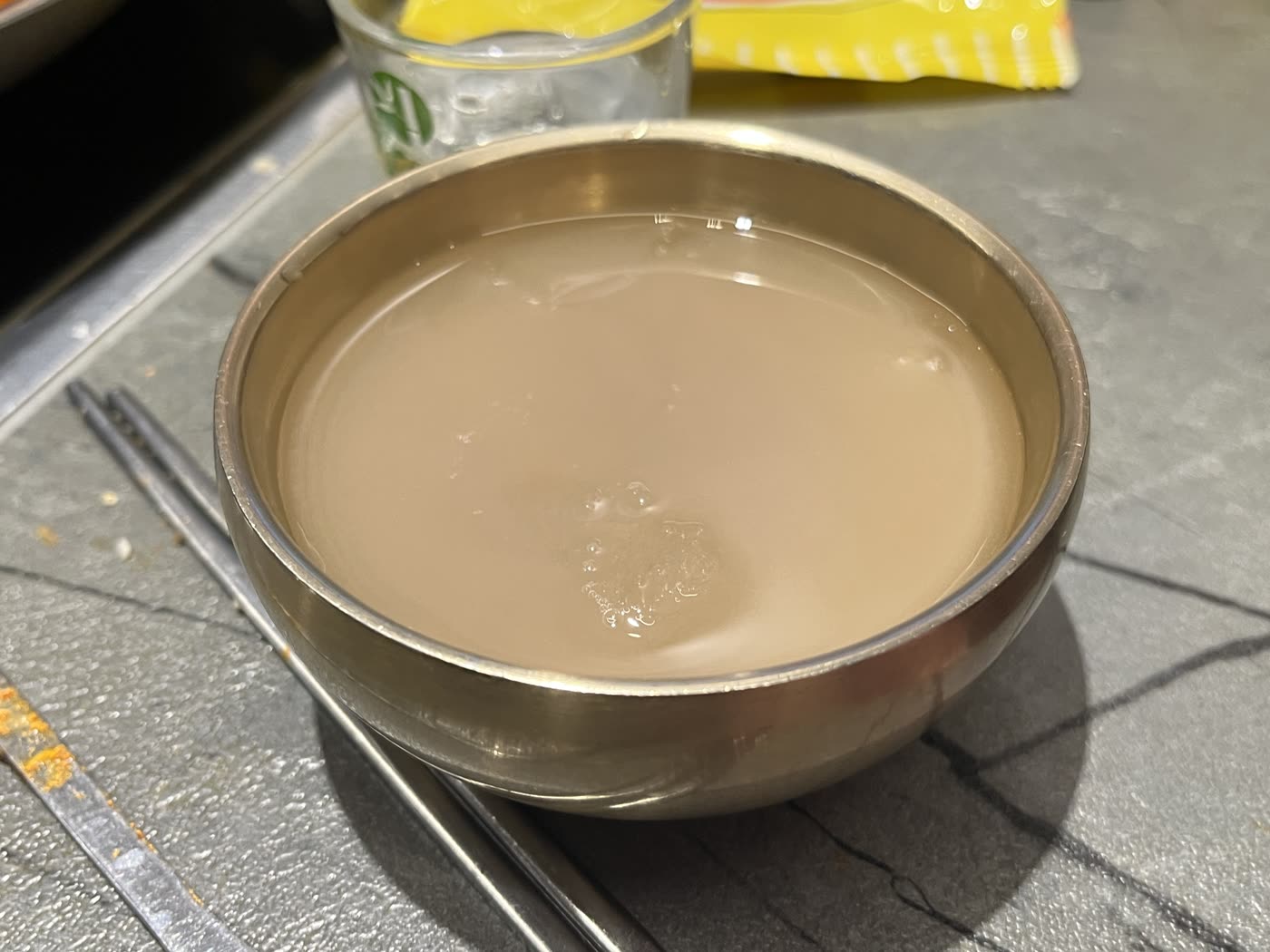
We had finished the crab, finished the shell rice, and eaten most of the ramyeon out of the stew. Someone came over and set down two small bowls of a cloudy, pale sweet drink.
I had not ordered it. It is not on the tablet. It is not on my receipt, which is how I know it was not a mistake in my favour.
It was sikhye, sweet rice punch, the thing served cold at the end of a heavy meal in Korea because the malt is supposed to settle your stomach. Nobody announced it and nobody explained it. It just arrived, the way it arrives at the end of a meal at someone's house.
That is the part I cannot put on a price list for you, and it is the reason I am writing this up instead of just linking the menu.
Prices are what I paid on 9 August 2026 and what the restaurant's own listing showed on 11 August 2026. Menus and prices change, so treat these as a guide rather than a quote.
Sources: Naver Place listing, Kkotgedang Sinsa main branch, checked 11 August 2026; the restaurant's in-store tablet menu and wall posters, photographed 9 August 2026; my own itemised receipt, 9 August 2026; Pro Ganjang Gejang Sinsa prices as listed on Diningcode, checked 11 August 2026.