Buying Glasses in Korea: Only an Optician May Make Them, and You Cannot Order Them Online

Korea is one of the easiest places in the world to walk into a shop and walk out an hour later wearing new glasses. The prices are reasonable, the shops are everywhere, and nobody will rush you.
But two rules decide the whole experience, and neither of them is written on the door. One is about who is allowed to make your glasses. The other is about where you are allowed to buy them, and it is the reason the cheap online price you found cannot be used here.
Here is how it actually works.
Only a licensed optician may make your glasses
Korean law creates a licence called an optician, 안경사 (angyeongsa). The rule is short: if you are not an optician, you may not make glasses, and you may not open a shop that sells glasses or contact lenses.
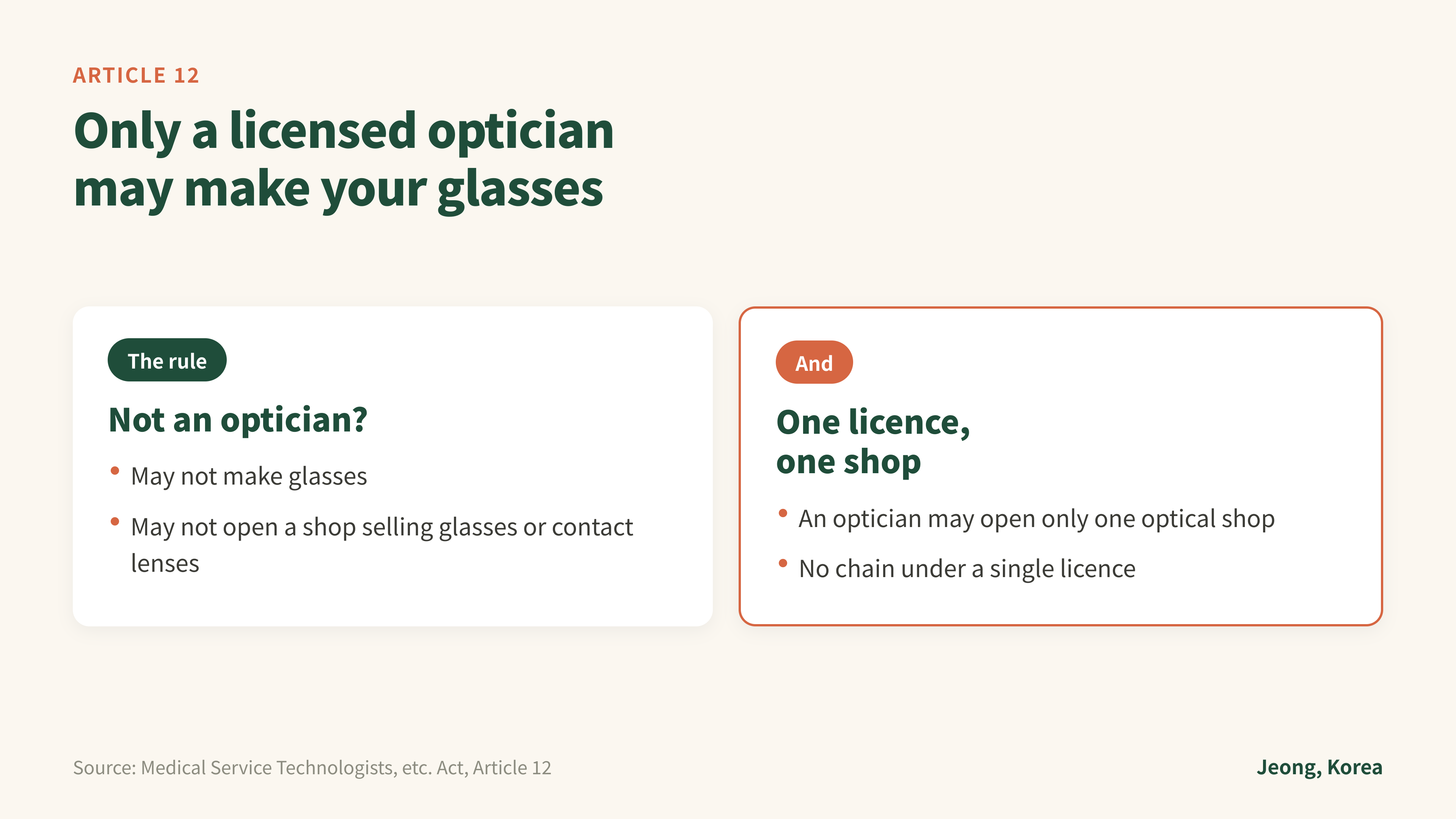
That is not a professional guideline. It is the opening line of the article that governs optical shops, and it is the reason every optical shop in Korea looks broadly the same. An optician may also hold only one shop. There is no chain where one licence covers twenty branches.
So the person measuring your eyes and fitting the frame is a licence holder, not a shop assistant. This is worth knowing for a practical reason: you can ask them technical questions and expect a real answer.
If the licence decides who makes your glasses, what decides where you can buy them?
You cannot buy prescription glasses or contacts online
This is the part that surprises people, and it saves an argument later.
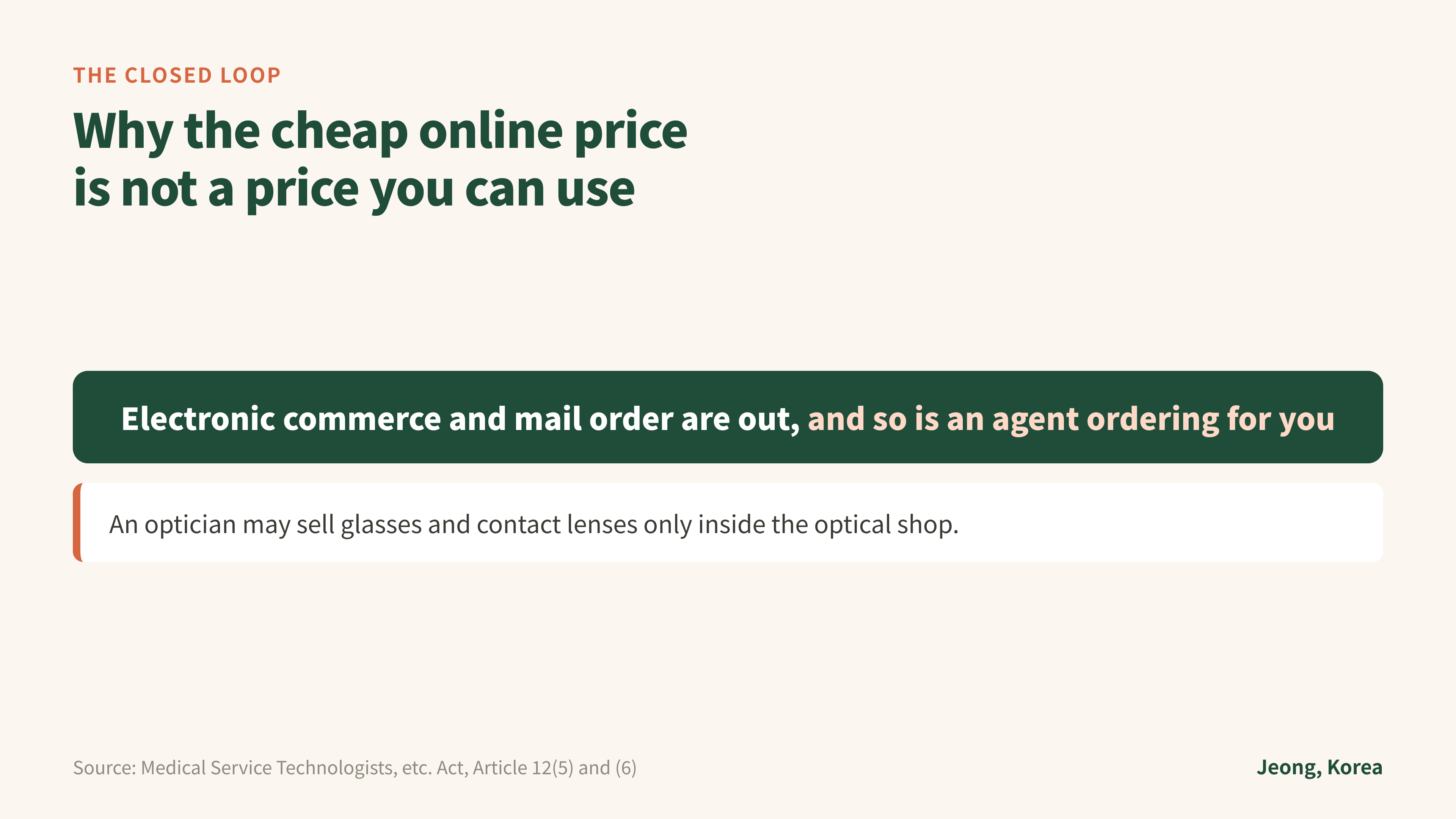
The law says that nobody may sell glasses or contact lenses by electronic commerce or mail order. It then closes the obvious workaround in the next line: buying or delivery agency services that order from a seller's online shop on your behalf are also not allowed. And an optician may sell only inside the optical shop.
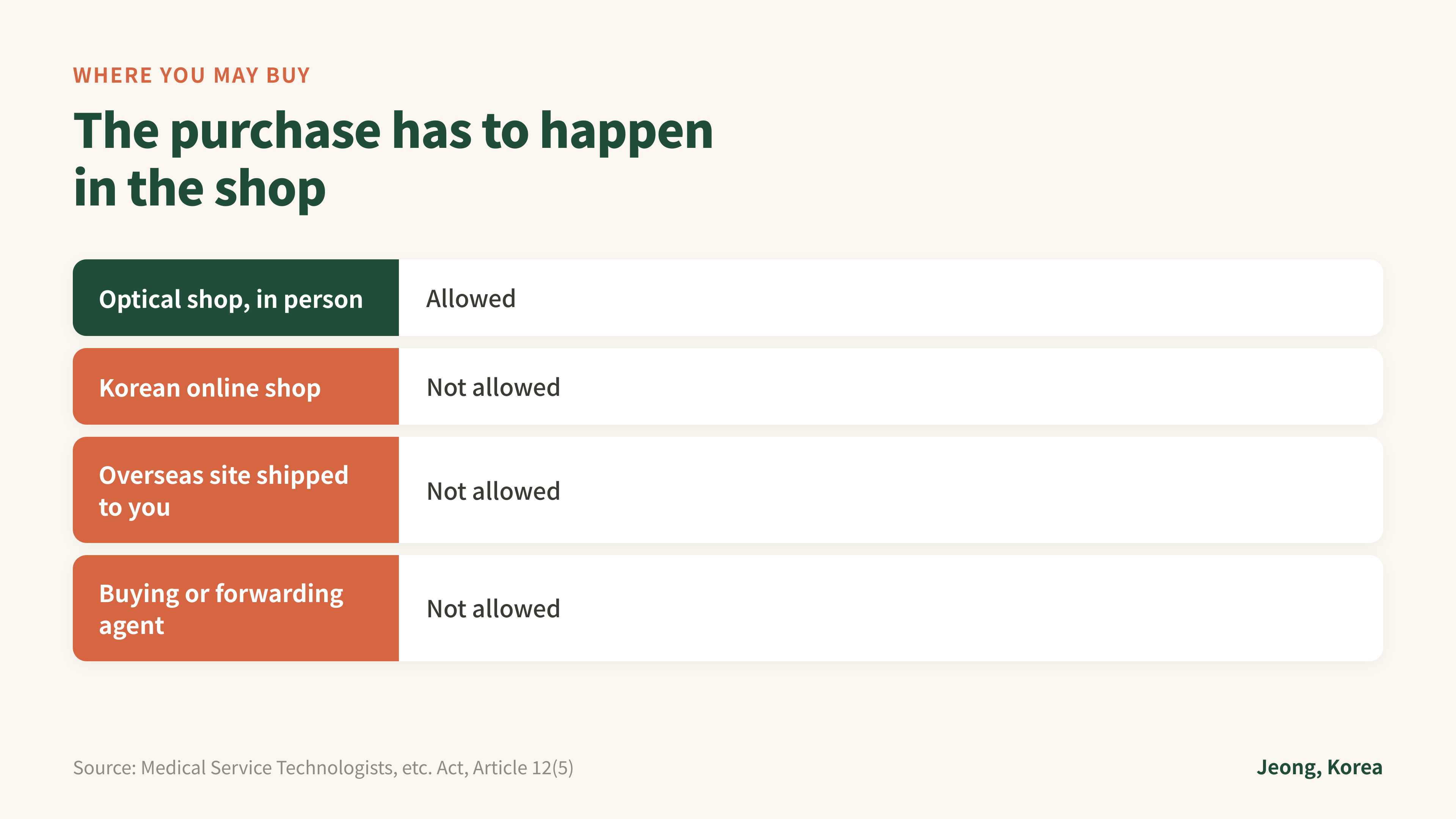
| Where | Glasses and contact lenses |
|---|---|
| Optical shop, in person | Yes |
| Korean online shop | Not allowed |
| Overseas site, shipped to you | Not allowed |
| Buying or forwarding agent ordering for you | Not allowed |
Two things follow from this. The overseas price you are comparing against is not a price available to you while you are in Korea. And if you wear contact lenses, you cannot restock them by ordering from home the way you might elsewhere. You go to a shop.
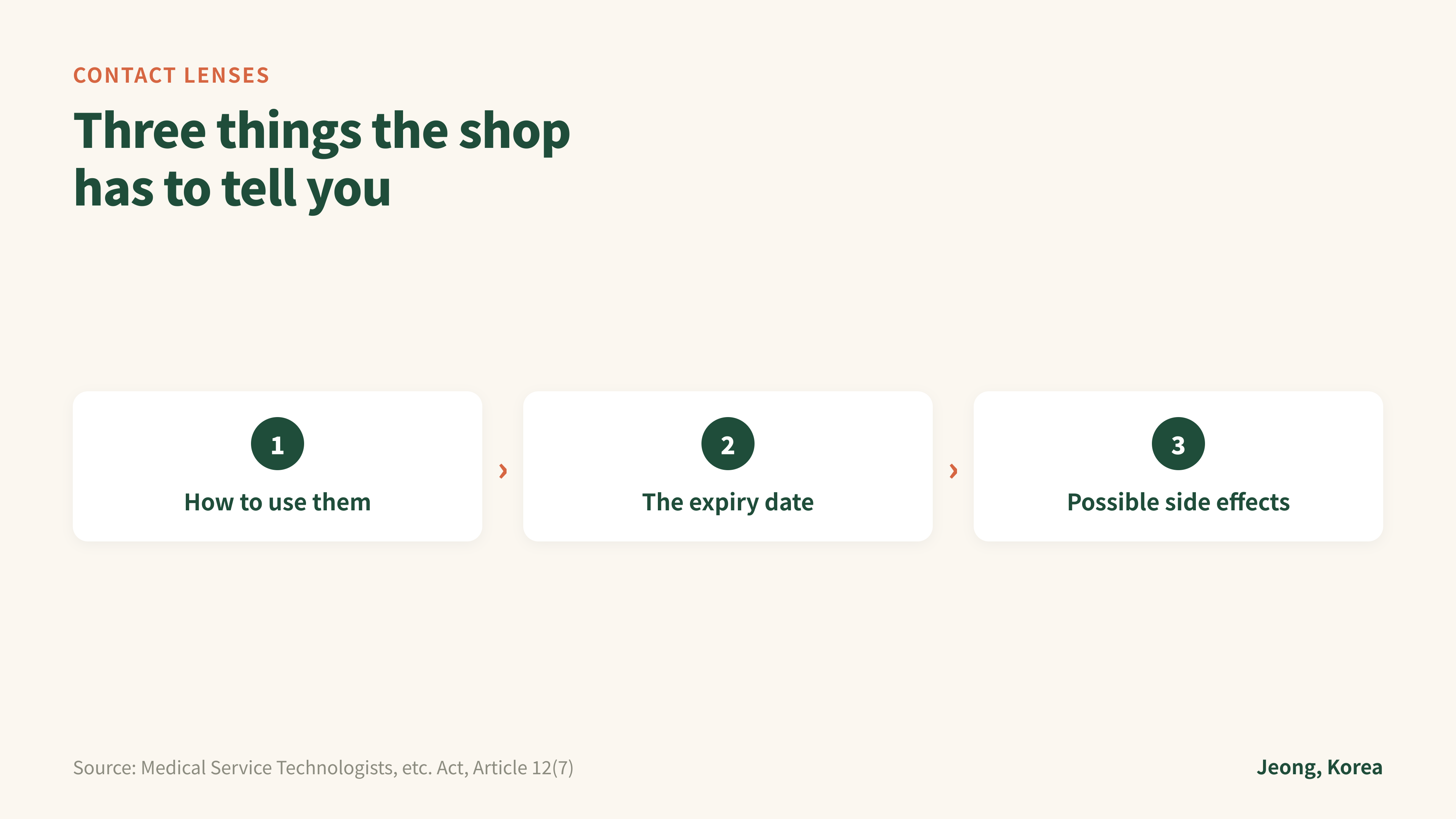
Contact lenses come with one more duty attached. When an optician sells you lenses, they have to tell you how to use them, the expiry date and the possible side effects. If that feels like a long conversation for a small purchase, that is the law working.
So the shop tests your eyes and sells you the glasses. Does that make it an eye exam?
The test at the shop is real, but it is not an eye exam
An optician is allowed to test your sight for the purpose of setting the lens power. That is written into their scope of work.
What is excluded is just as clear, and it is the useful part. Two kinds of testing are outside an optician's scope: any test that uses drugs, and objective refraction testing done without an autorefractor.
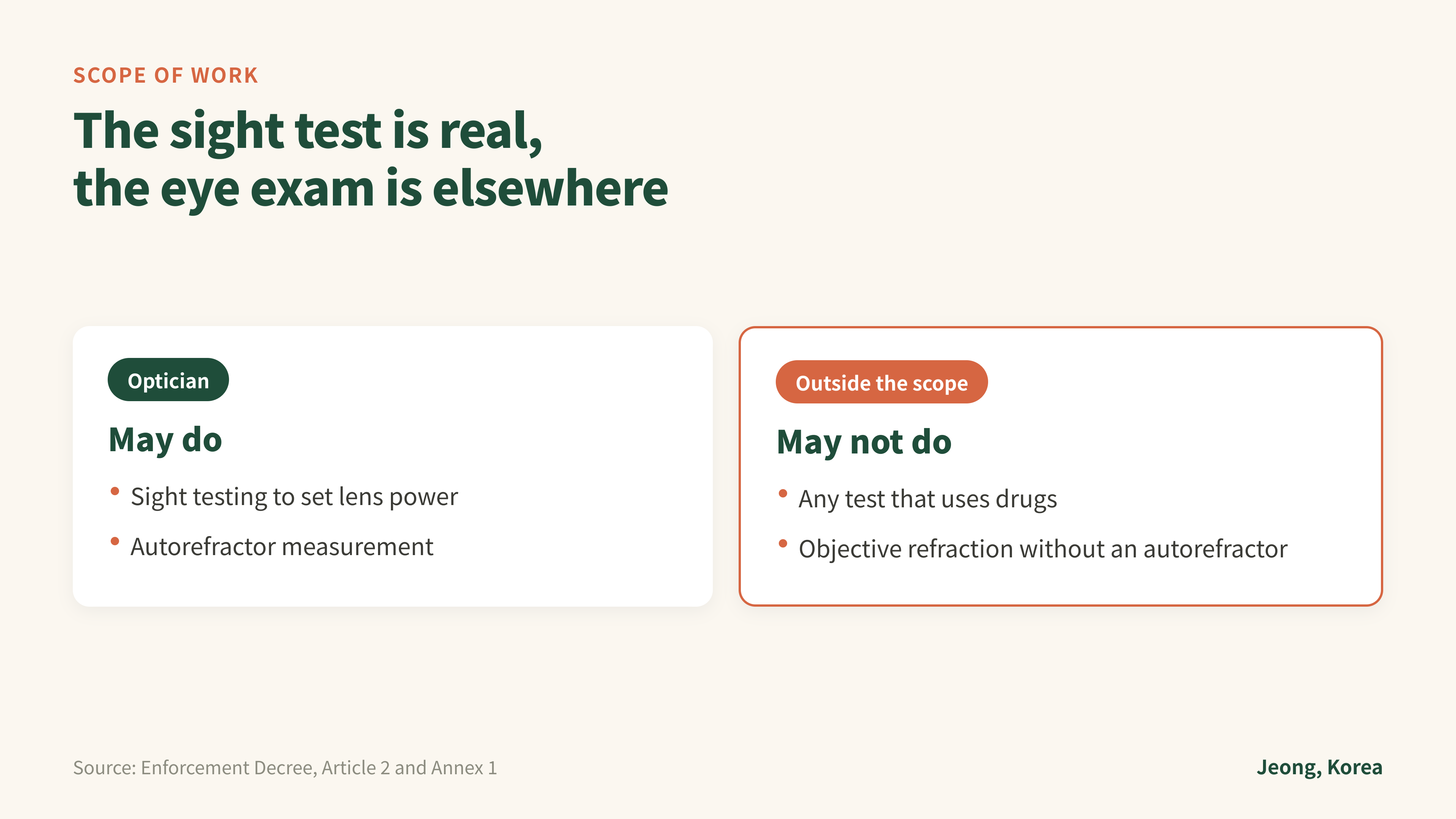
In plain terms, the machine you rest your chin on is fine. Eye drops that widen your pupils are not. If something about your vision is changing, or your eyes hurt, or you are being told your prescription has moved a lot in a short time, that belongs at an eye clinic, not an optical shop.
That is the same logic Koreans use for everything else medical, and we start small. Korean clinics are organised so that you go to the small one first, and an eye clinic is exactly that kind of place.
There is one group for whom the shop is never the first stop.
Under six, a doctor comes first
If the person needing glasses is six or younger, the optician may only make the glasses, or sell the contact lenses, according to a doctor's prescription.
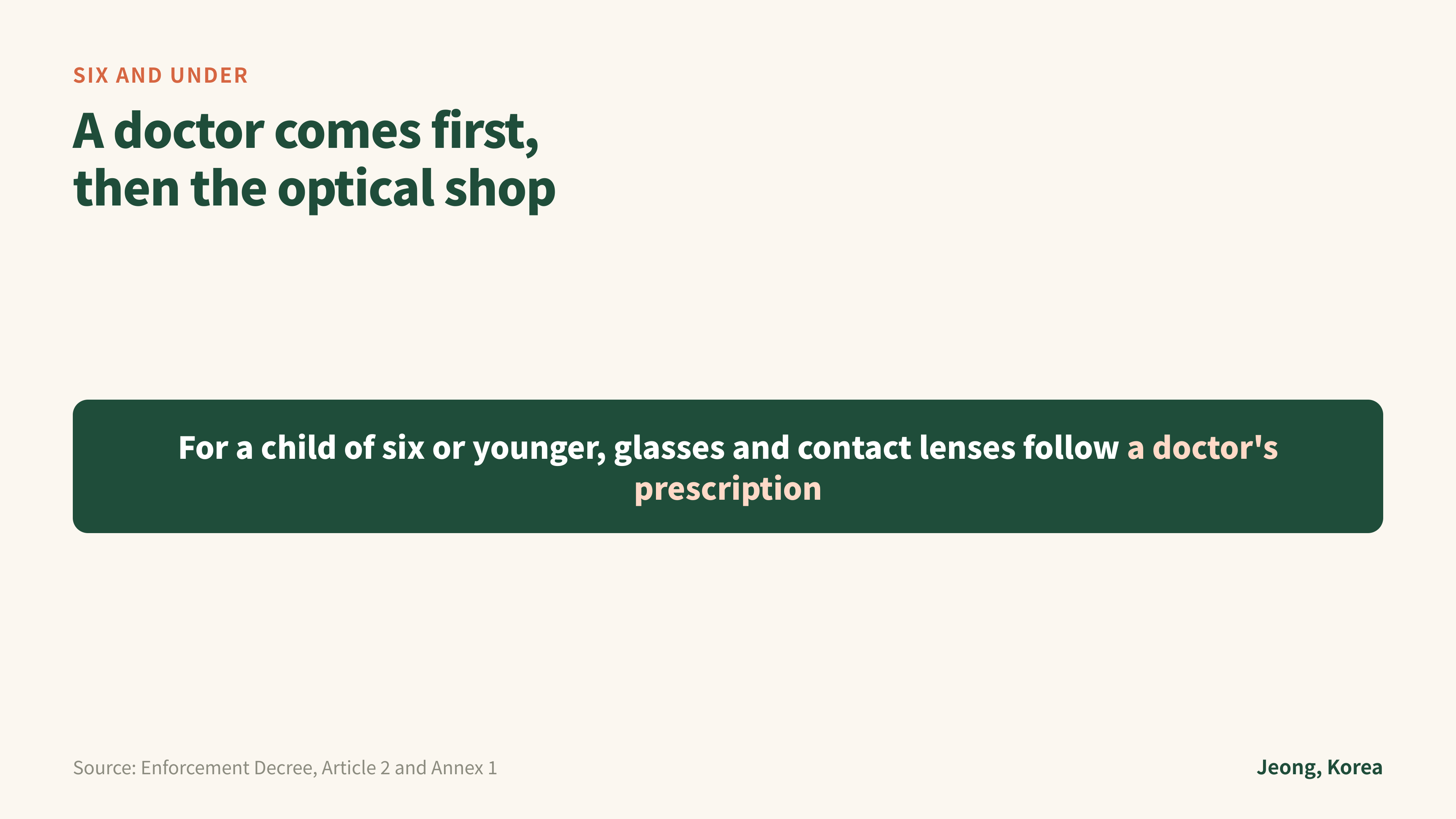
There is no way around this and no reason to want one. Small children cannot reliably report what they see, and the tests that tell an ophthalmologist what is happening are the ones an optician is not permitted to do.
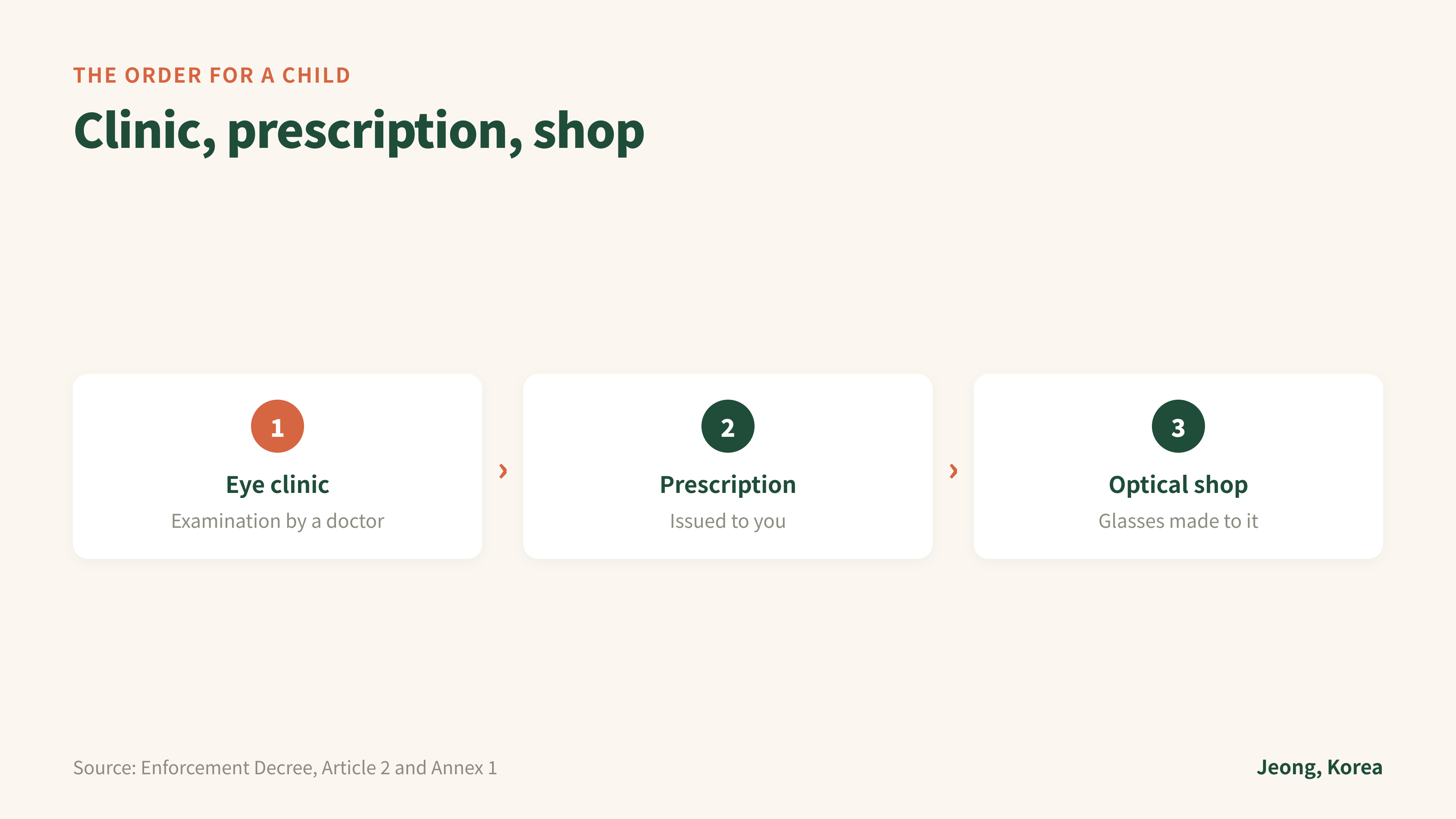
So for a young child the order is: eye clinic first, prescription in hand, then the optical shop.
What about lenses that are not for vision at all?
Coloured lenses count as contact lenses
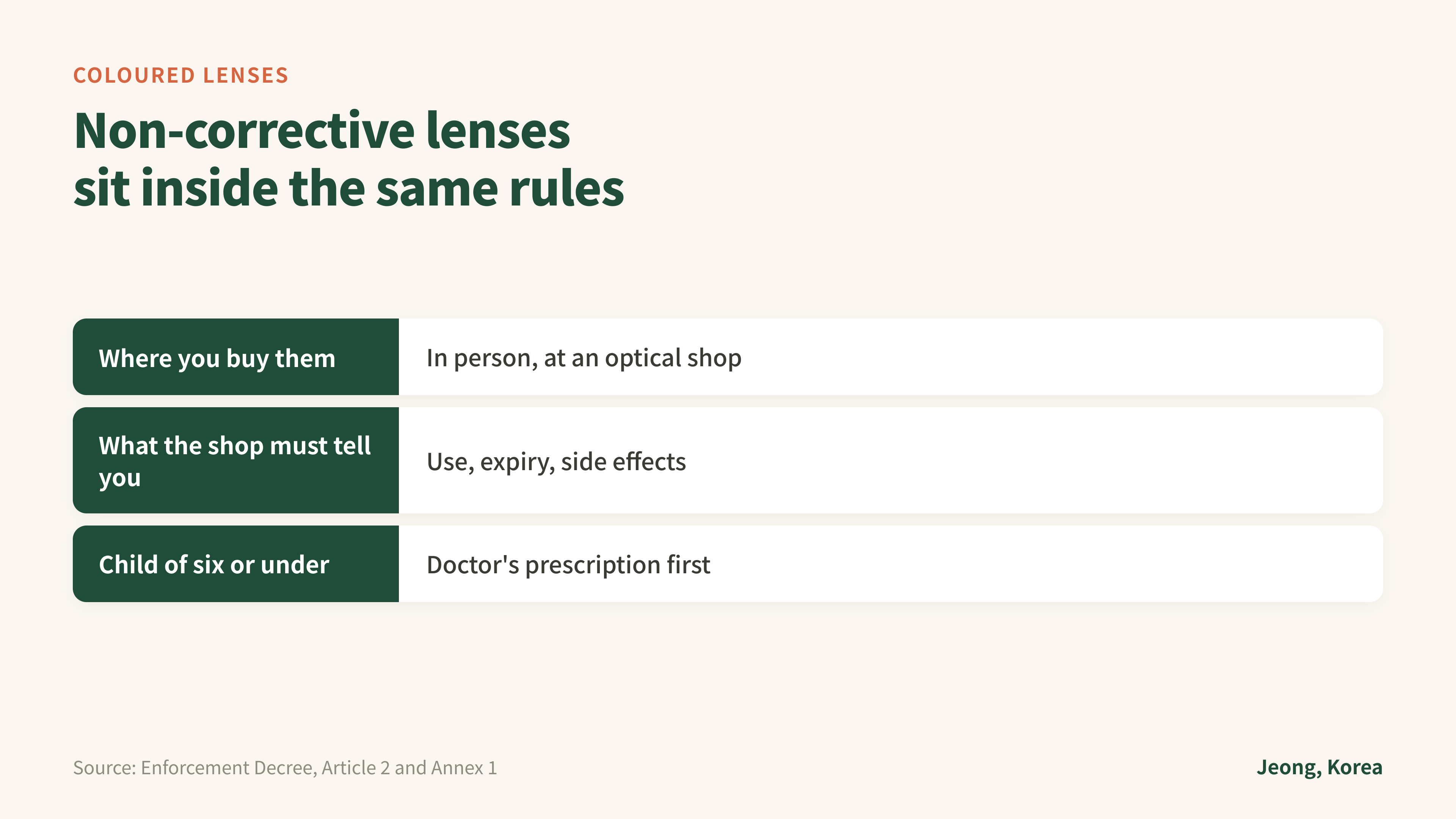
Decorative lenses with no corrective power, sometimes sold abroad as a cosmetic item, sit inside the same rules here. The optician's scope of work covers contact lenses including those that are not for vision correction.
That means the same three things apply. You buy them in person at an optical shop, not online. The shop has to brief you on use, expiry and side effects. And for a child of six or under, a doctor's prescription comes first.
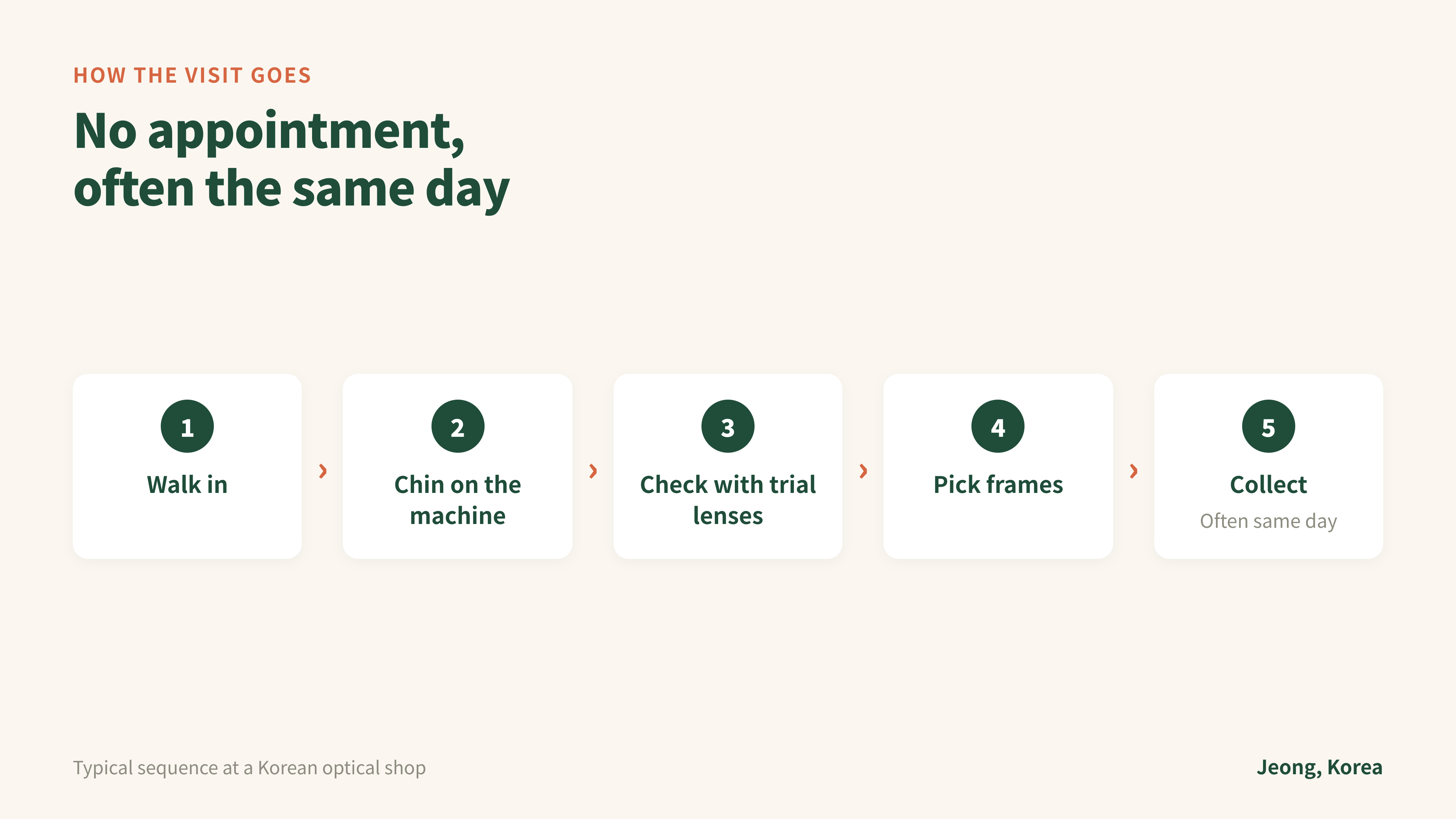
How the visit actually goes
Nothing here needs Korean.
-
Walk in. No appointment.
-
Sit at the machine and rest your chin. This takes a minute.
-
The optician checks the result against a chart, usually with trial lenses.
-
Pick frames. Prices are on the frames or on a list.
-
They tell you when to come back. Simple prescriptions are often ready the same day.
A few words help.
| Korean | Say it like | Meaning |
|---|---|---|
| 안경원 | angyeongwon | optical shop |
| 시력검사 | siryeok-geomsa | sight test |
| 도수 | dosu | lens power |
| 렌즈 | renjeu | lens |
| 안과 | anggwa | eye clinic |
Bring your current glasses. The shop can read the prescription straight off them, which settles the question faster than any conversation.
FAQ
Can I buy glasses online in Korea?
No. Selling glasses and contact lenses by electronic commerce or mail order is not allowed, and neither is using a buying or forwarding agent to order them from an online shop for you.
Do I need a prescription from a doctor to get glasses in Korea?
Generally no. An optician may test your sight to set the lens power. The exception is a child of six or younger, where a doctor's prescription is required first.
Can an optician use eye drops during the test?
No. Sight testing using drugs is outside an optician's scope of work. That belongs at an eye clinic.
Are coloured contact lenses treated differently?
No. The optician's scope covers contact lenses including non-corrective ones, so the same in-person purchase rule and the same briefing on use, expiry and side effects apply.
The short version
Only a licensed optician may make your glasses, and only one shop per licence. You cannot buy prescription glasses or contact lenses online in Korea, from a Korean site or a foreign one, and an agent cannot do it for you either. The sight test at the shop is legitimate but it is not a medical eye exam, and anything involving drops or a changing prescription belongs at an eye clinic. For a child of six or under, see a doctor first.
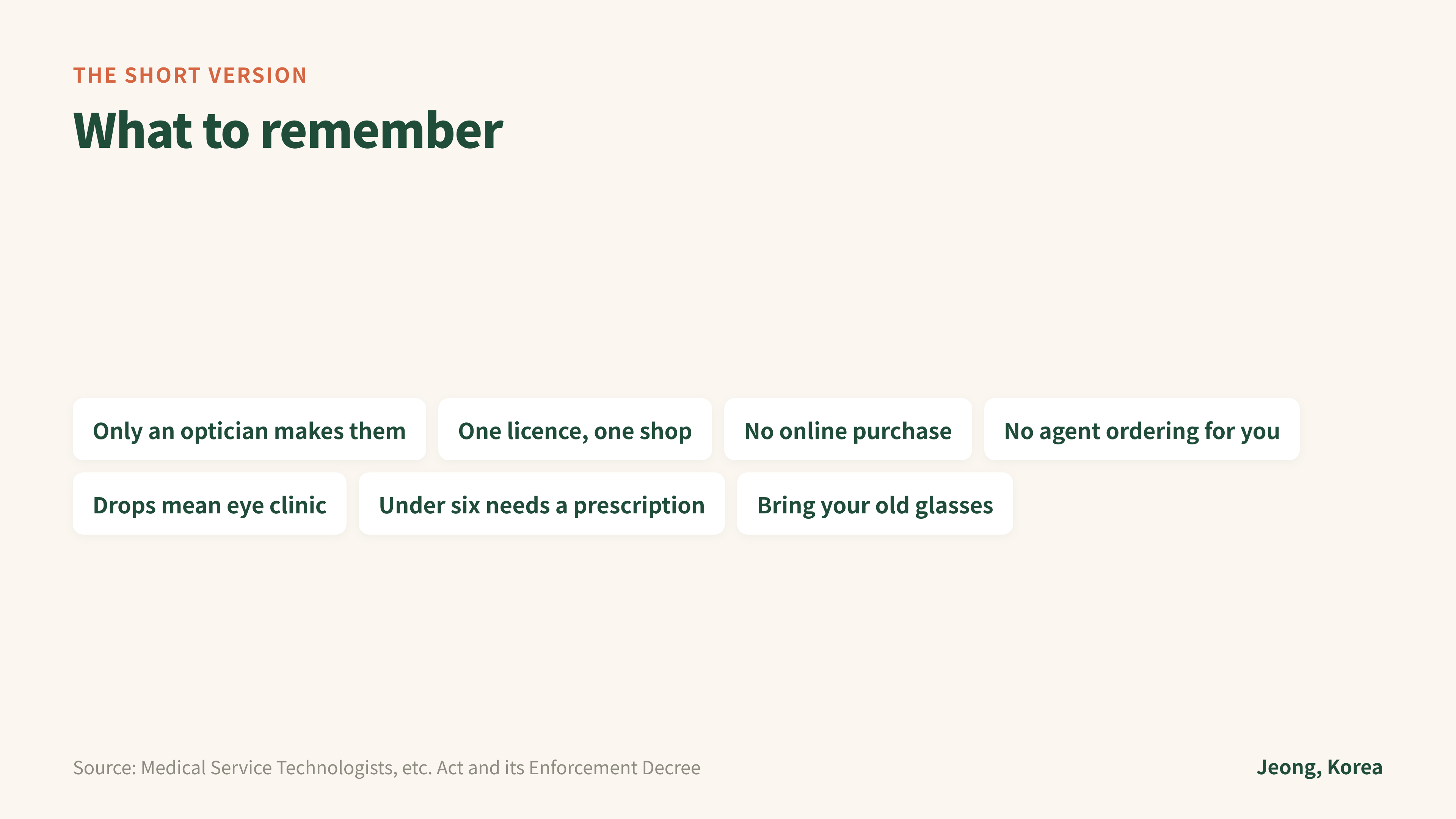
Walk in with your old glasses, and let the machine do the talking.
References
-
Medical Service Technologists, etc. Act, Article 12 (registration of optical shops and restrictions on sales) : Korea Law Information Center
-
Enforcement Decree of the Medical Service Technologists, etc. Act, Article 2 and Annex 1 (scope of work of an optician) : Korea Law Information Center