Euljiro, Seoul: The Bars Grew Out of a Tool Market, and the Famous Street Tables Came Off the Road in 2022

In November 2022, the district office cancelled the permits for the plastic tables that fill every photo of Nogari Alley. The alley is still there, and so are the pubs. The picture people come looking for is not.
That is worth knowing before you plan an evening around it. This is a practical guide to Euljiro Seoul: where Nogari Alley actually is, what changed on that street after 2022, why a beer alley sits inside a working tile, hardware and printing district, and how to spend one evening there without chasing a photo that has already gone.
Nogari Alley is by exit 4, and the tables in the photos are gone
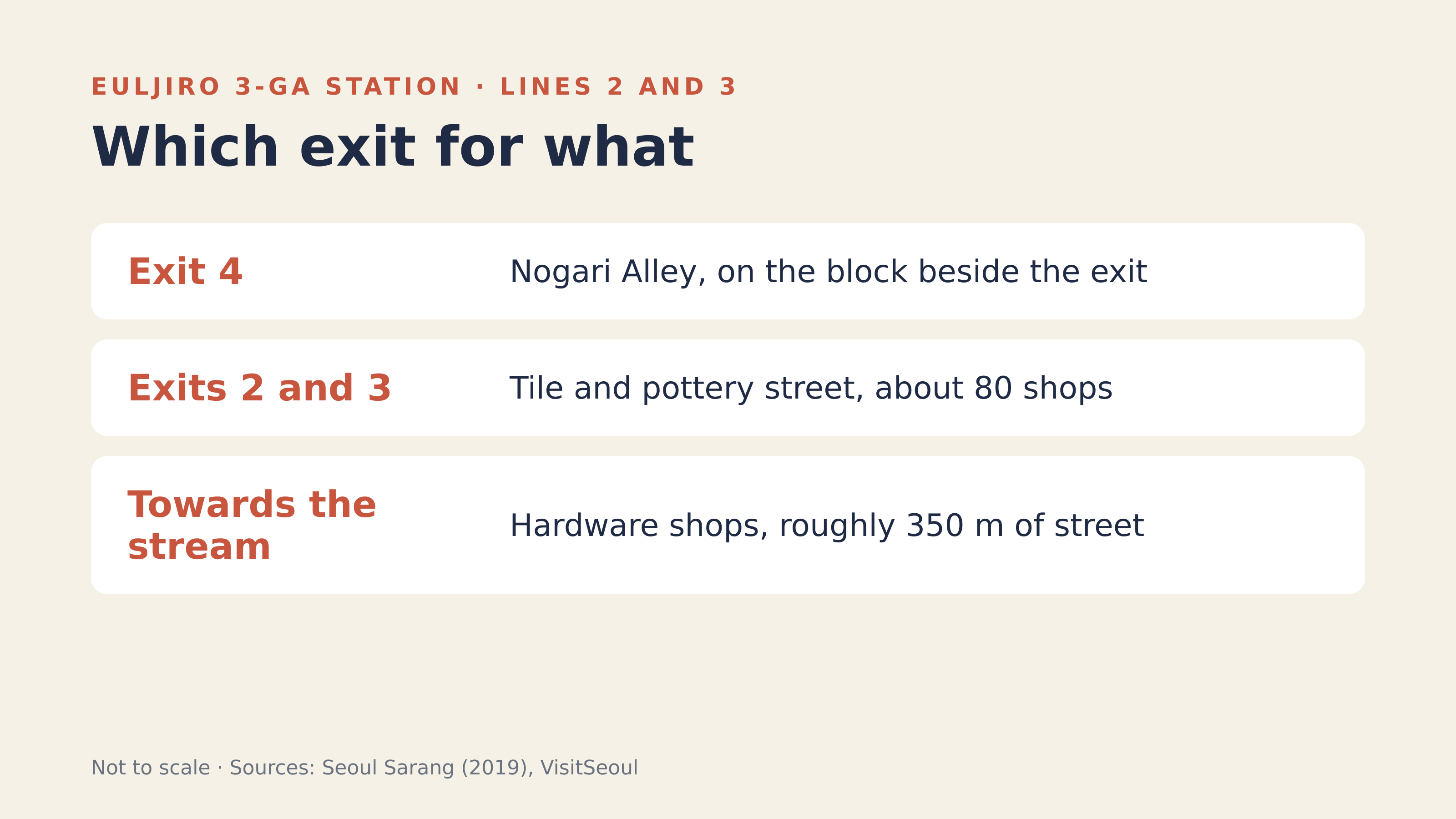
The alley is a short walk from Euljiro 3-ga Station, which is on Lines 2 and 3. Seoul's own city magazine puts it plainly: it is "near exit 4 of Euljiro 3-ga Station" (Seoul Sarang, August 2019, my translation). Come up at exit 4, and the pubs are on the block beside you.
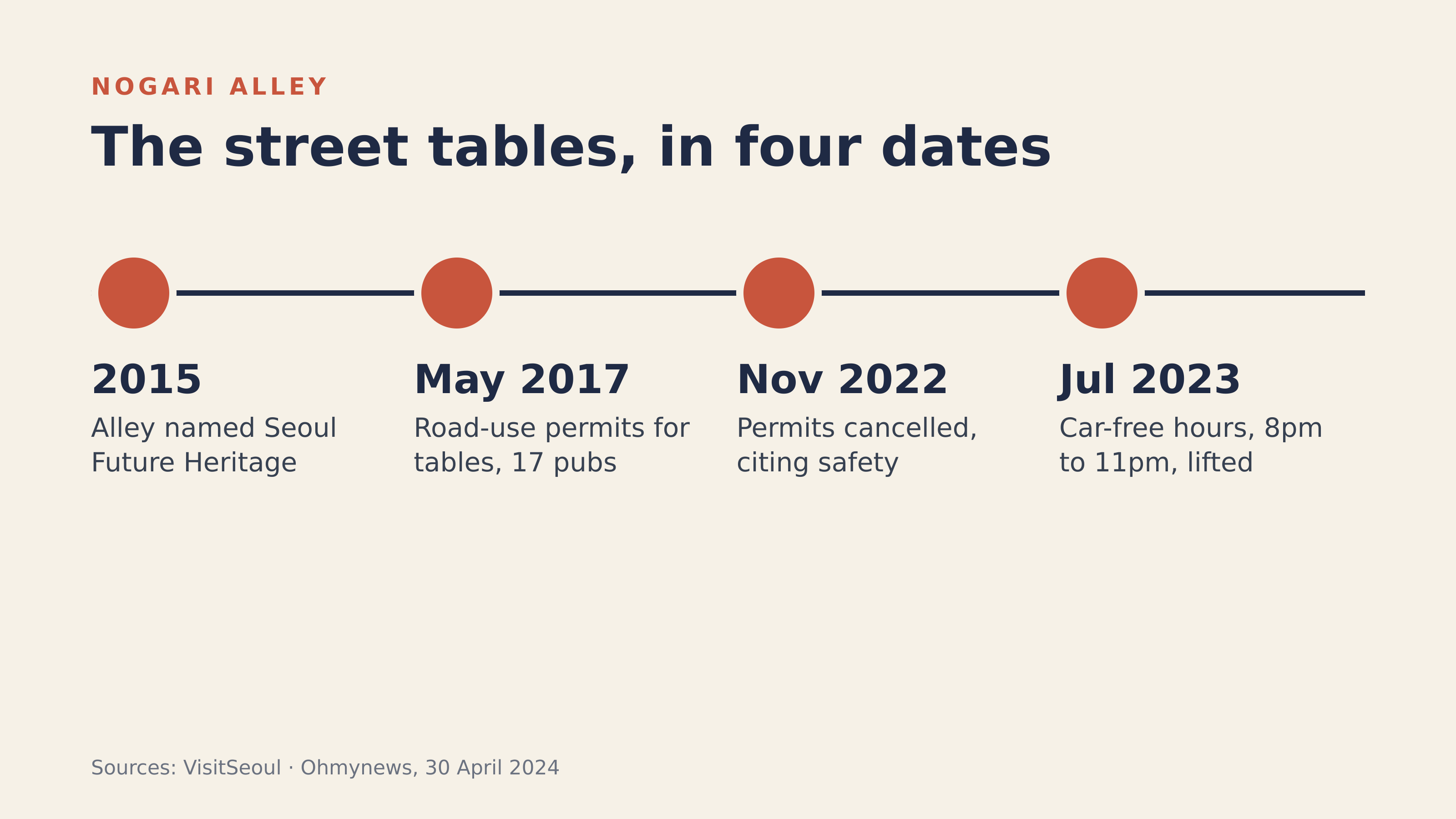
The famous scene, rows of plastic tables filling the road after dark, was never the natural state of the street. It was permitted. In May 2017 the Jung-gu district office gave road-use permits for outdoor tables to 17 pubs here, so that the alley could be developed as a sight and kept as a piece of city heritage.
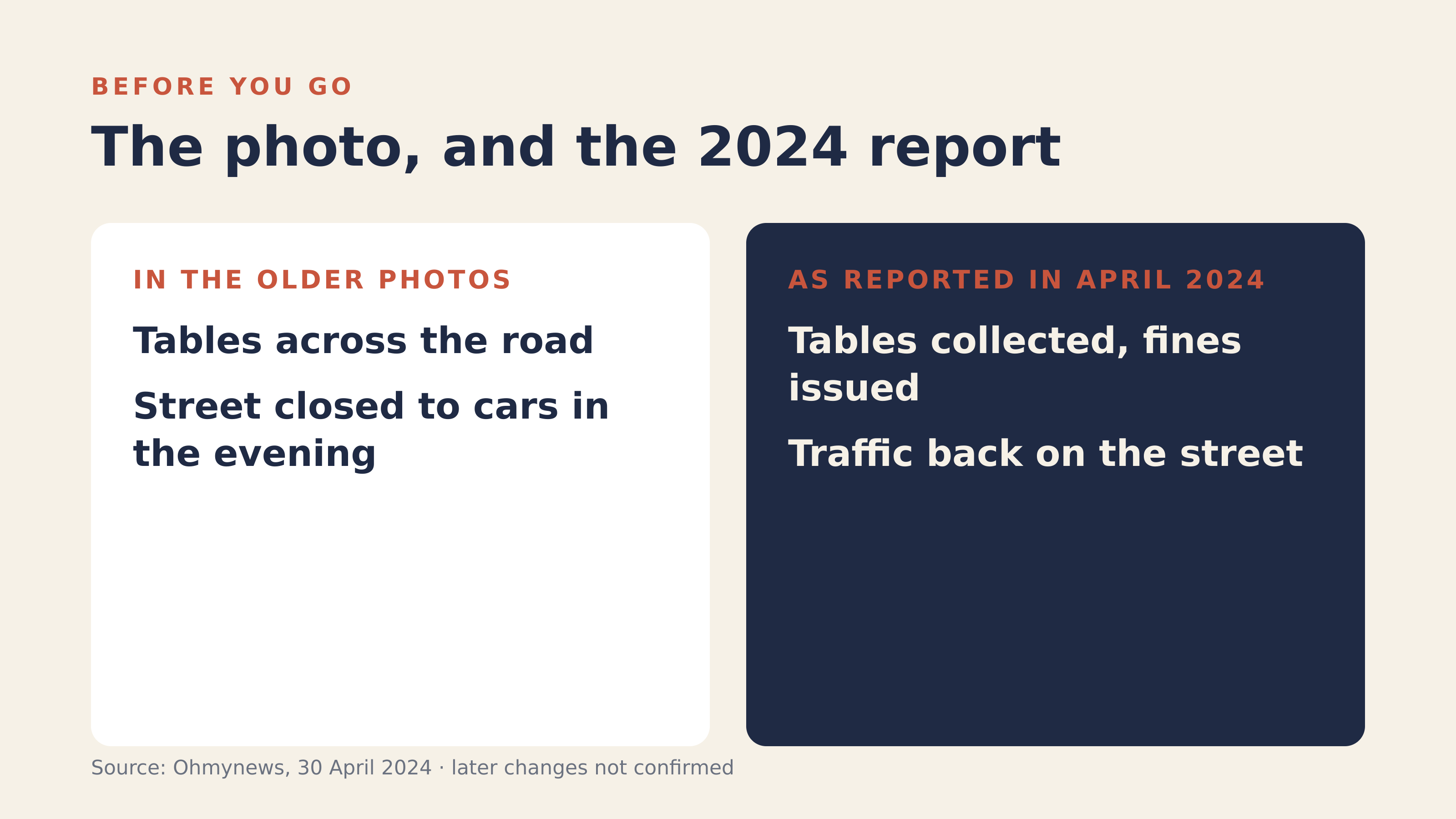
That arrangement ended with the redevelopment around it. Ohmynews reported in April 2024 that the district office "cancelled the outdoor road-use permits in November 2022" (Ohmynews, 30 April 2024, my translation), citing safety, and had been collecting tables and issuing fines since. The same report says the car-free hours, which had closed the street to traffic from 8pm to 11pm, were lifted in July 2023.
I cannot tell you whether anything has been relaxed since that report, and I will not pretend to. What I can tell you is that the tables were a permit, the permit was withdrawn, and a guide written before 2022 is describing a street that no longer operates that way.
So go for the alley and the pubs, not for the photograph. If you have not drunk at a Korean table before, Korean drinking culture: the rules are real, and so is the way out covers the pouring and the rounds, so this guide does not repeat them.
So why is a beer alley sitting in the middle of a tool market?
The tools came first, and the beer followed the workers
Before Euljiro was anybody's night out, it was where Seoul went to get things made and fixed. The hardware, the tile and the printing all arrived before the pubs did.
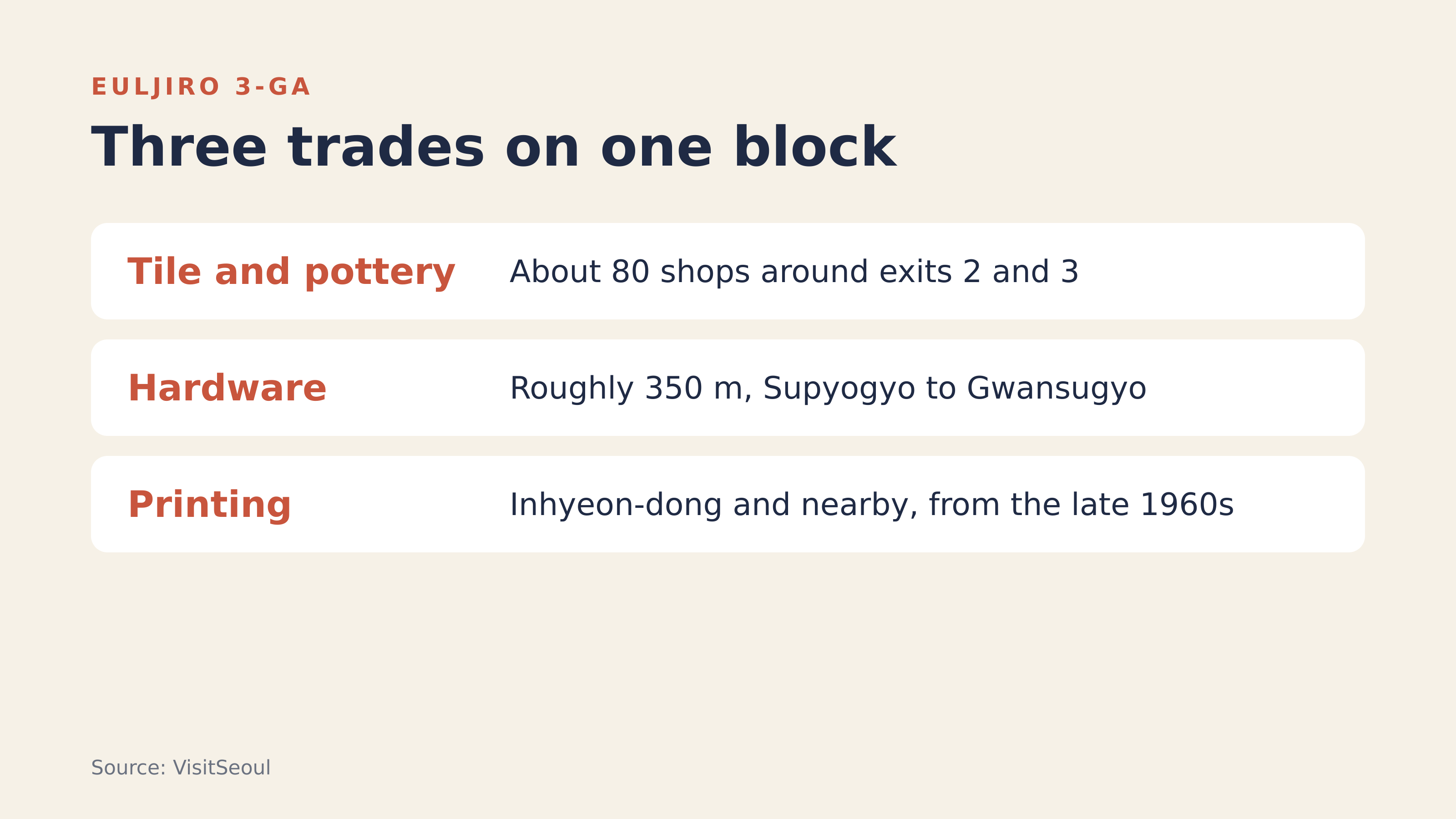
Seoul's tourism organisation lays out the order. After the Cheonggyecheon stream was covered over in 1961, hardware sellers filled roughly 350 metres of street between the Supyogyo and Gwansugyo bridges. Around exits 2 and 3 there are about 80 tile and pottery shops. Printing shops settled in Inhyeon-dong and the neighbouring blocks from the end of the 1960s, and Jung-gu designated the area a special industrial street so that those trades would stay in the city centre.
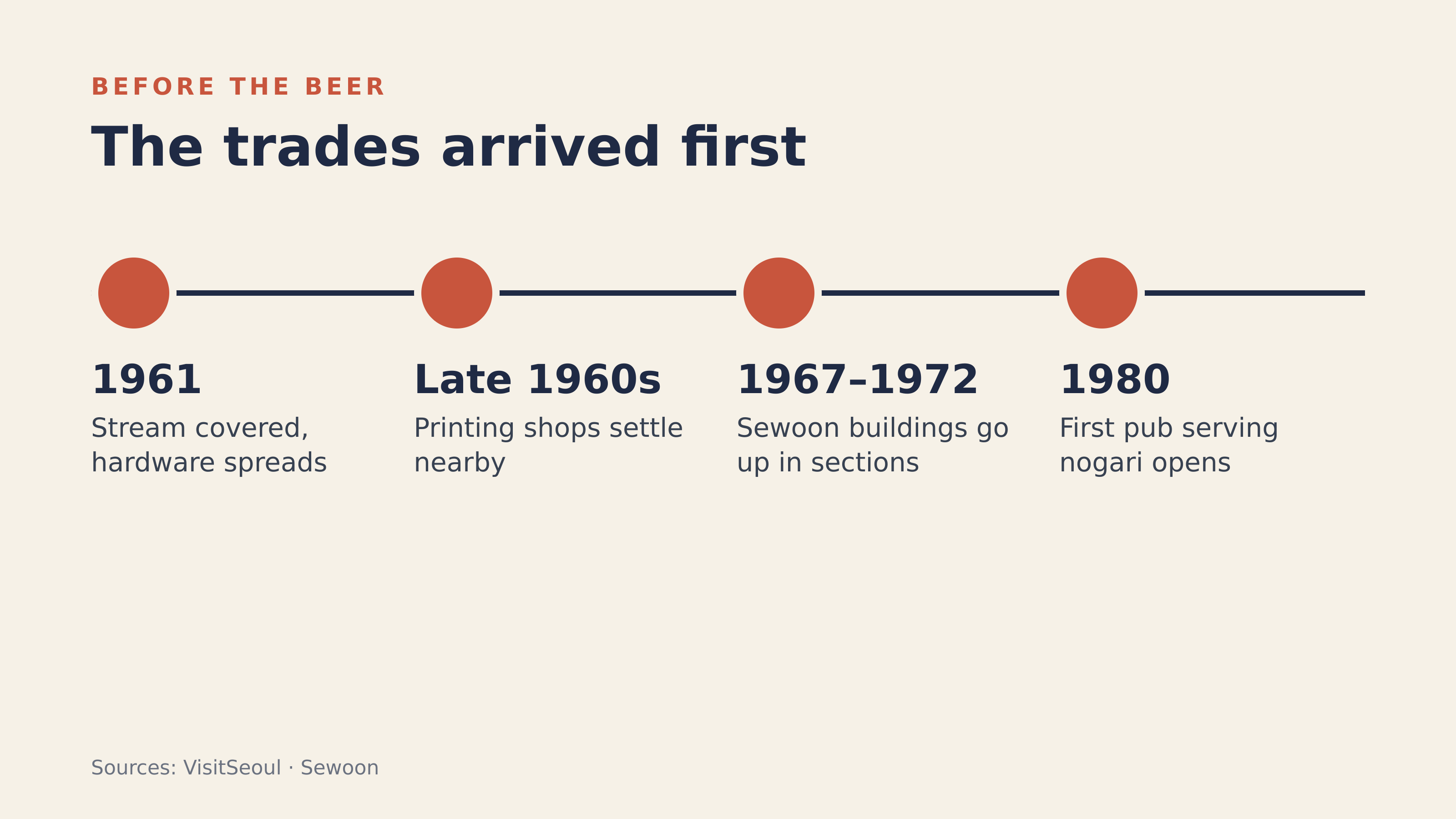
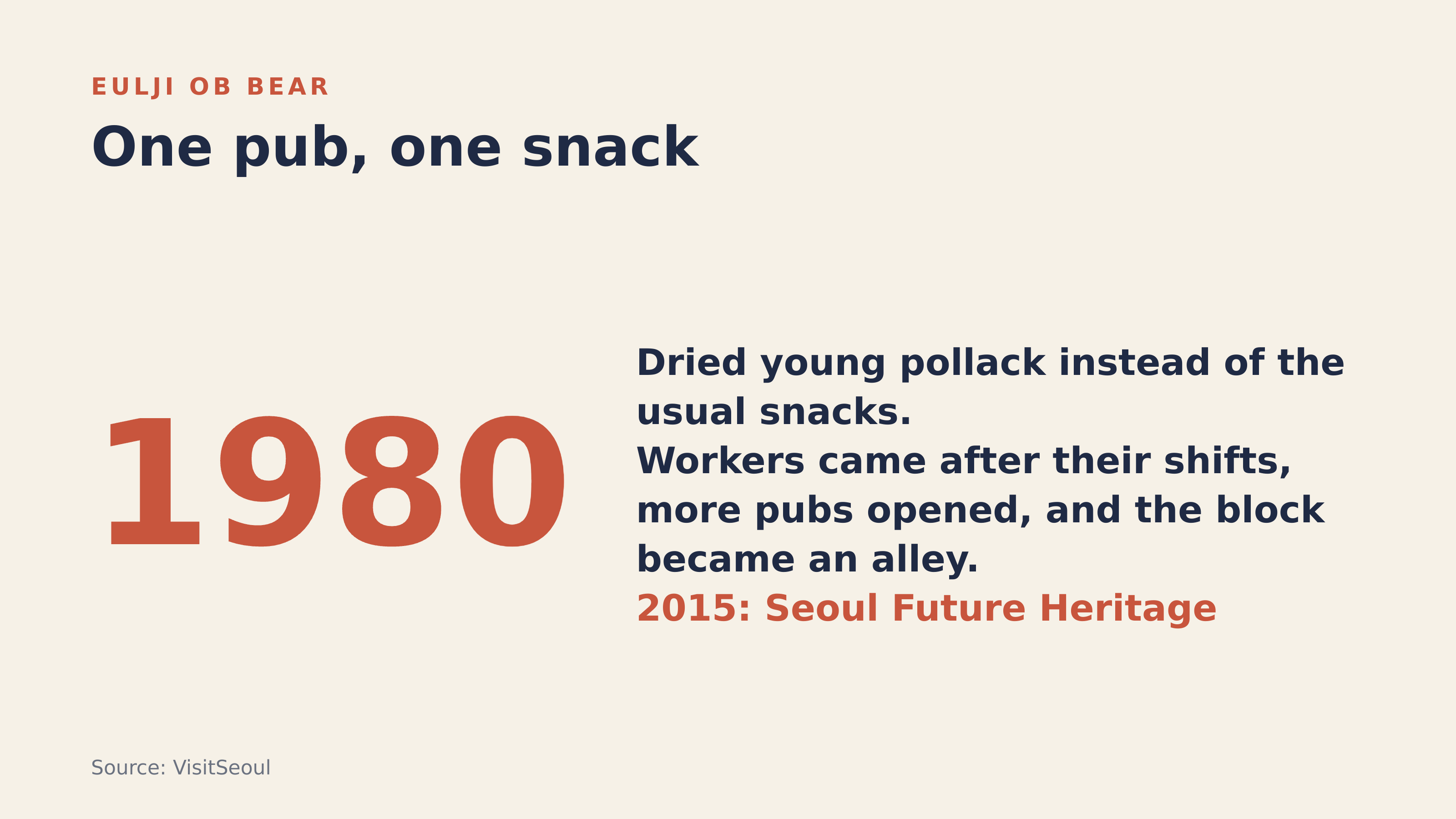
The beer came out of that working day. The same source traces the alley to a single pub, Eulji OB Bear, which opened in 1980 and served dried young pollack, nogari, instead of the usual snacks. Workers from the surrounding shops came in after their shifts, more pubs opened one by one, and the block became the alley. In the tourism organisation's words, "In 2015, the alley was designated as a Seoul Future Heritage site" (VisitSeoul).
That is the part the Hipjiro photos leave out. The vintage look is not a set. It is the outside of trades that are still open, which is why the district is a different place at two in the afternoon than it is at eight in the evening.
Dongdaemun works the same way a few stops east, and Dongdaemun Market: two markets share the name, and they never share an hour explains how the clock divides that district too.
If the alley is protected heritage, how did its first pub get evicted?
A heritage label covers the alley, not the pub
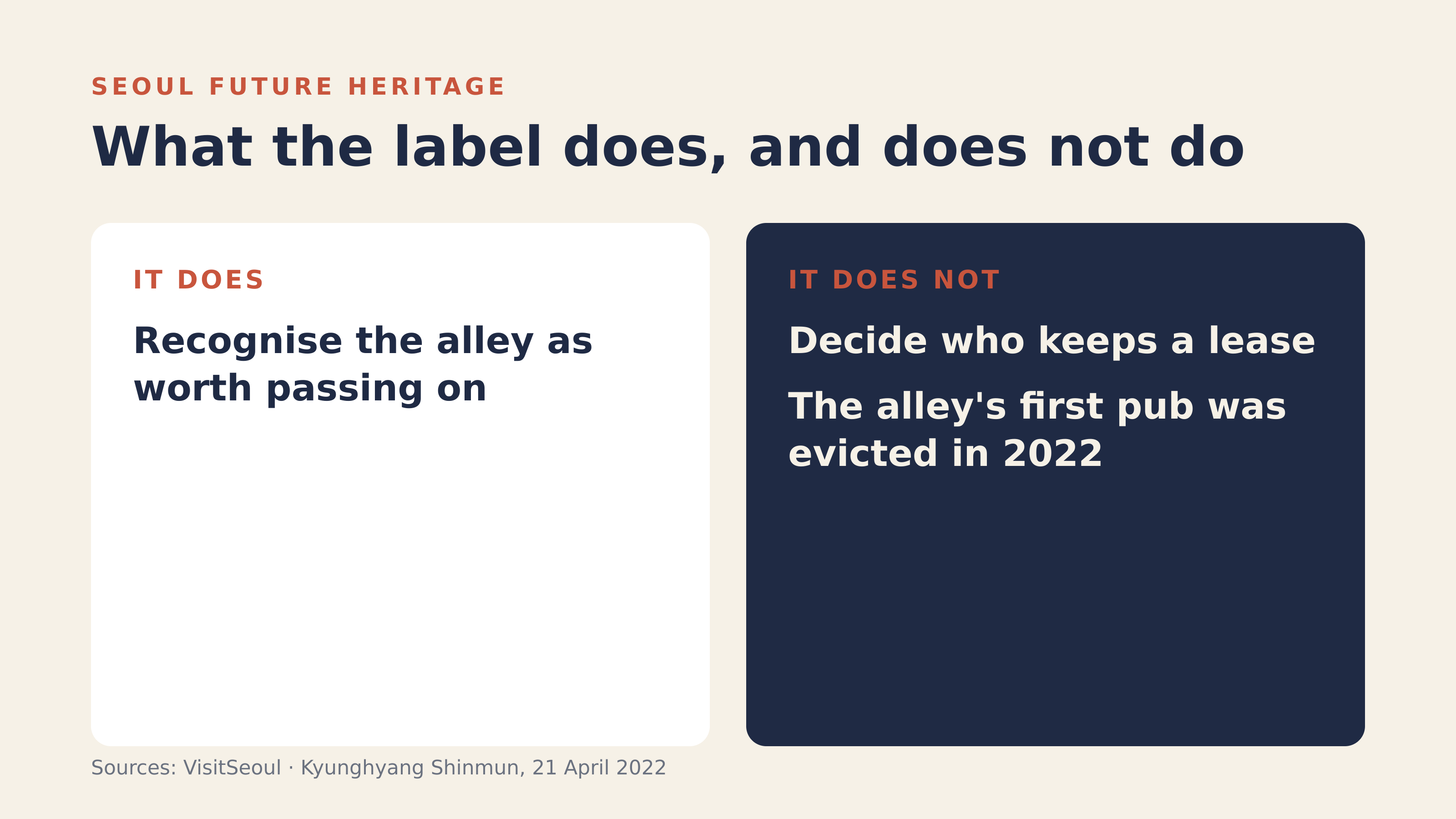
Seoul Future Heritage is a way for the city to say that a place is worth passing on. It does not decide who keeps a lease.
Eulji OB Bear is the clearest case. It was named a Century Store by the national small business ministry in 2018, and in the same year a dispute over renewing its lease began. The building owner sued for the premises and the pub lost. Court officers tried to enforce the eviction five times and were blocked each time. Kyunghyang Shinmun reported that the pub was finally "evicted after the court's sixth attempt at enforcement" (Kyunghyang Shinmun, 21 April 2022, my translation), in the early hours of 21 April 2022, forty-two years after it opened.
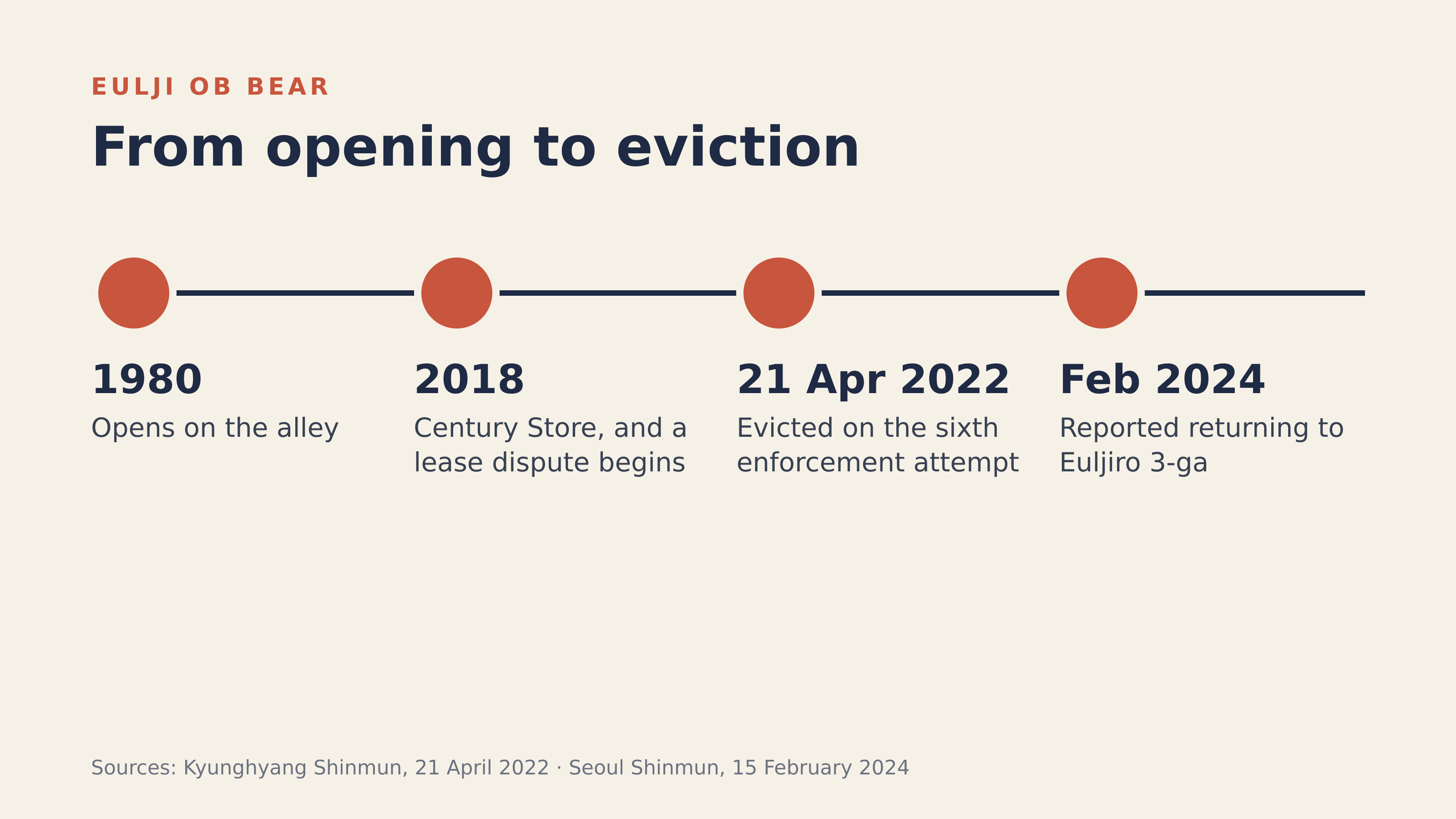
In February 2024, Seoul Shinmun reported that the pub was "coming back to Euljiro 3-ga" (Seoul Shinmun, 15 February 2024, my translation), at a new address. I have not confirmed how it is trading today, so treat that as the last report rather than a recommendation.
The larger change is next door. The Sewoon buildings, the long chain of shopping and apartment blocks that runs south from Jongno, went up in sections between 1967 and 1972, and the project's own site calls them "Korea's first mixed-use residential and commercial building" (Sewoon, my translation). Seoul's plan is to take that chain down in stages and put a green corridor in its place.
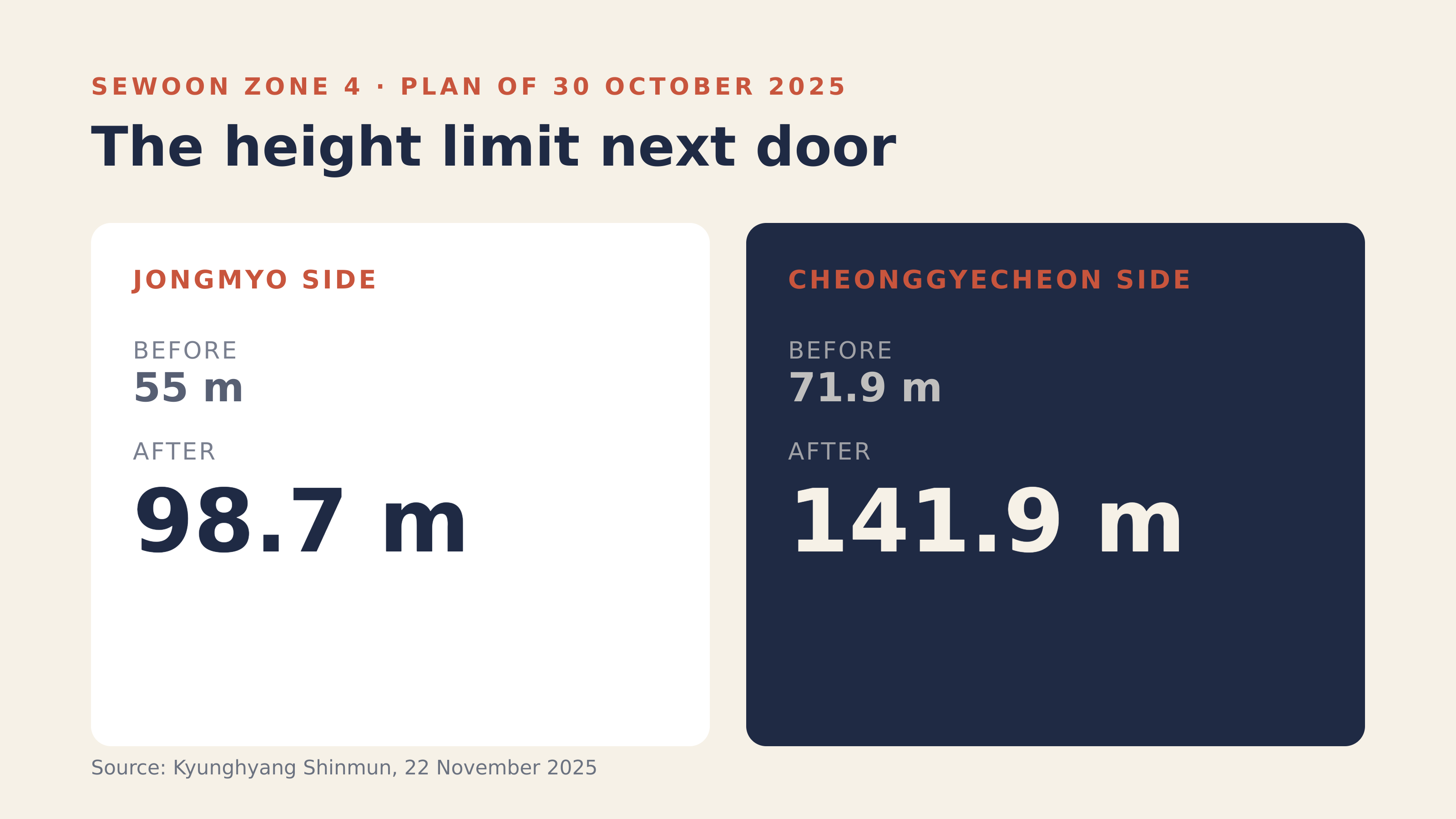
On 30 October 2025 the city issued a revised plan for Sewoon zone 4 that raised the height limit on the Jongmyo side "from the existing 55m to 98.7m" (Kyunghyang Shinmun, 22 November 2025, my translation), and on the Cheonggyecheon side from 71.9 metres to 141.9 metres. The national heritage authority opposes the change because Jongmyo Shrine is a World Heritage site, and as of that report the argument was still open.
None of that makes Euljiro a place to visit in a hurry. It does mean that the old buildings here are not a museum display, and the street you see this year is not guaranteed to be the street you see next year.
So what does an evening in Euljiro Seoul actually look like now?
What to actually do in Euljiro
Practically, one evening here is three things.
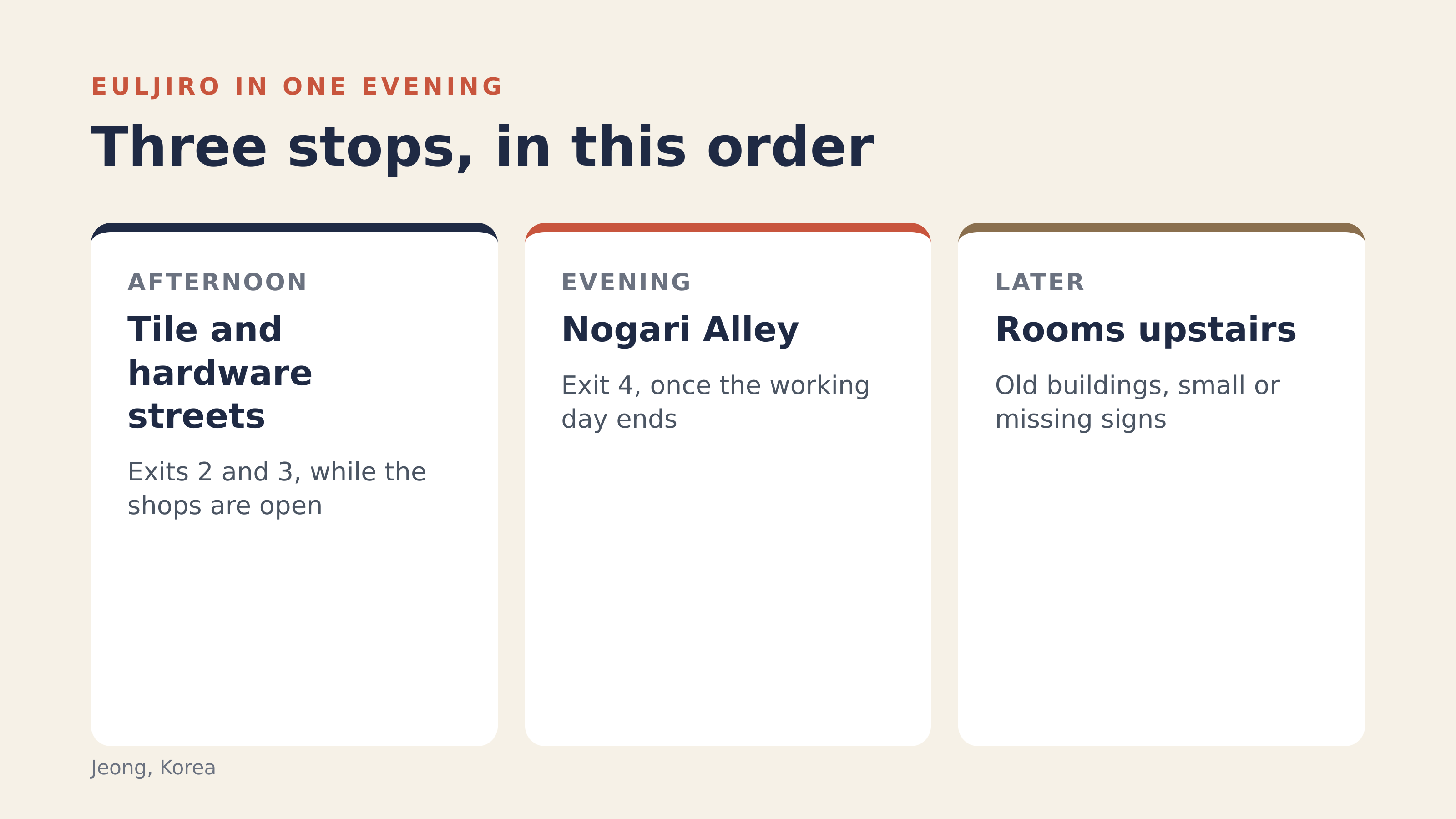
The trades, while there is still light. Walk out of exit 2 or 3 onto the tile and pottery street, then head north towards the stream along the hardware shops. These are working businesses, not a market put on for visitors, so keep your look quick and ask before you photograph someone at work.
Nogari Alley, once the shops close. Go back to exit 4. Nogari with draught beer is the combination the alley was built on, and Seoul's city magazine describes the pollack as grilled over coal briquettes. Drink inside, since the tables on the road are the part that ended in 2022.
The upstairs rooms. The tourism organisation notes that buildings which look old and ordinary from the street can hold cafés, restaurants and vintage shops inside. Signs are small or missing, so save the address of anywhere you want to find on a map app before you go, rather than hunting for a door on the night.
Myeongdong is within reach on foot, and the contrast is useful. Myeongdong shopping street: three layers, and the street carts are licensed one year at a time shows a street whose outdoor trade is still licensed, where Euljiro's was withdrawn.
FAQ
Where is Nogari Alley in Euljiro Seoul?
Next to exit 4 of Euljiro 3-ga Station, which is on Lines 2 and 3. The pubs are on the block beside the exit.
Can you still drink outside at Nogari Alley?
Not in the way the older photos show. The district office cancelled the road-use permits for outdoor tables in November 2022 and lifted the evening car-free hours in July 2023, according to reporting in April 2024. I have not confirmed any change since then.
What does Hipjiro mean?
It is a nickname made from the English word hip and Euljiro. Seoul's own city magazine was already using it in 2019 for the younger crowd that had started coming to the old printing and hardware blocks.
Is Eulji OB Bear still open?
It was evicted from its original Nogari Alley premises in April 2022. Seoul Shinmun reported in February 2024 that it was reopening at a new address in Euljiro 3-ga. Its current trading has not been confirmed here.
Is Euljiro Seoul worth visiting during the day?
Yes, for a different reason than at night. In daylight the tile, hardware and printing trades are open, and that is the district the bars grew out of.
One sentence is enough
Euljiro is a working tile, hardware and printing district that grew a beer alley in 1980, the road tables that made that alley famous lost their permits in 2022, and the Sewoon blocks beside it are part of a plan that is still being argued over.
References
Seoul Sarang, Seoul Metropolitan Government magazine, August 2019 — Euljiro Nogari Alley, location by Euljiro 3-ga Station exit 4 and the Hipjiro nickname
VisitSeoul, A Tour of Seoul's Streetside Architecture (3): Euljiro 3-ga's Nogari Alley to Hipjiro — hardware street after the 1961 covering of Cheonggyecheon, tile and pottery street, printing alley, Eulji OB Bear from 1980, Seoul Future Heritage from 2015
Ohmynews, 30 April 2024 — Nogari Alley road-use permits for 17 pubs from May 2017, cancelled November 2022, car-free hours lifted July 2023
Kyunghyang Shinmun, 21 April 2022 — Eulji OB Bear evicted on the sixth enforcement attempt, 2018 lease dispute and Century Store designation
Seoul Shinmun, 15 February 2024 — Eulji OB Bear reported returning to Euljiro 3-ga
Sewoon regeneration project site, history page — Sewoon buildings built in sections 1967 to 1972, first mixed-use residential and commercial complex in Korea
Kyunghyang Shinmun, 22 November 2025 — Sewoon zone 4 plan change of 30 October 2025, height limits and the dispute over Jongmyo