Ikseon-dong: The Redevelopment That Never Happened Is Why the Hanok Are Cafés

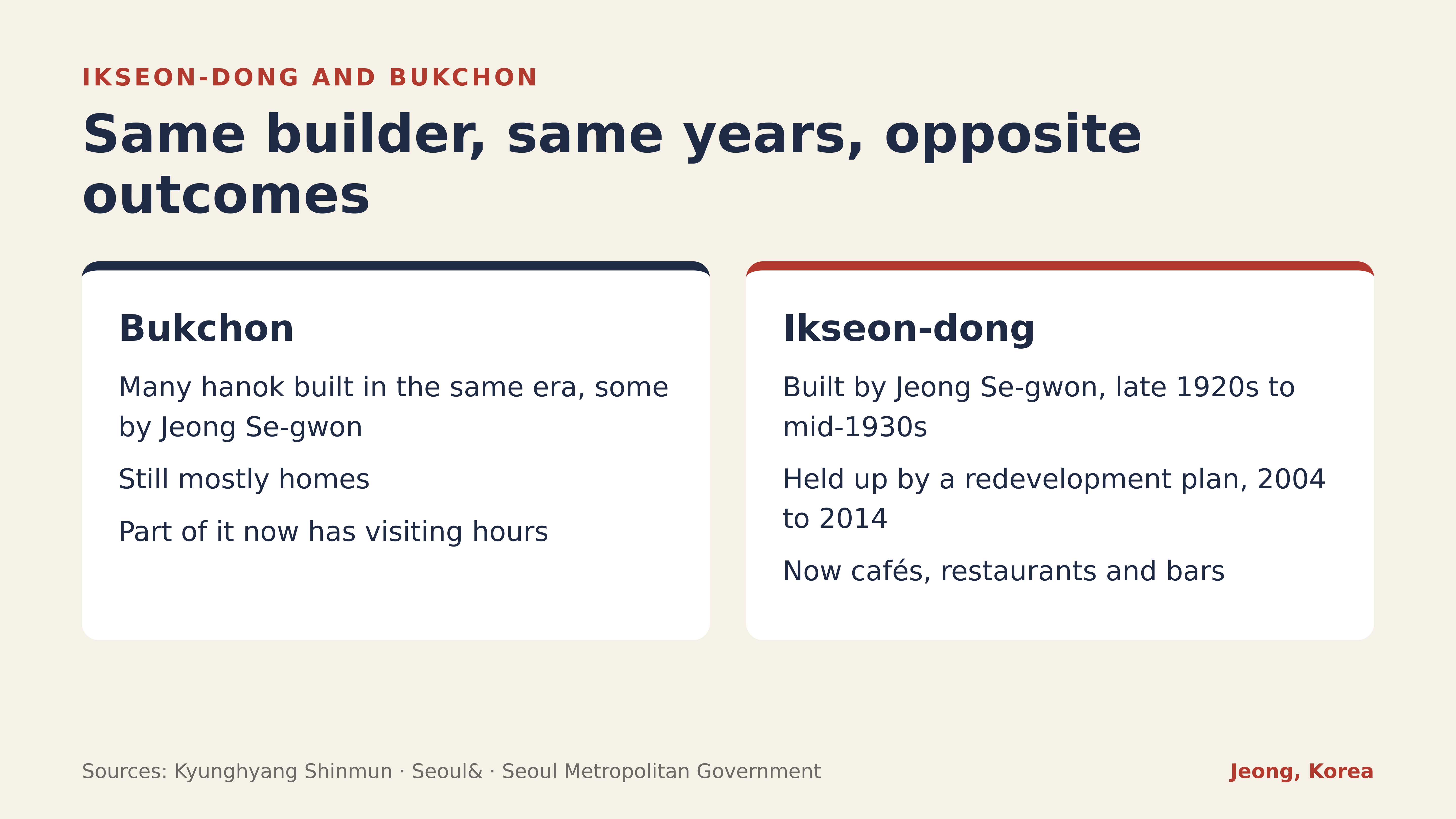
The man who built these houses also built hanok across Bukchon, in the same years. Bukchon is still a street where people live and get their post. Here, the small courtyards have turned into cafés, restaurants and bars.
Nobody decided that. It happened because a redevelopment plan sat on the neighbourhood for ten years and then collapsed. This guide covers how to reach Ikseon-dong from Jongno 3-ga Station, who built its hundred or so small hanok and why, and the one reason it looks nothing like Bukchon today.
Getting in: Exit 4, cross the road, and the alleys start
The neighbourhood is small and it starts almost at the station, so the only planning you need is the exit number.
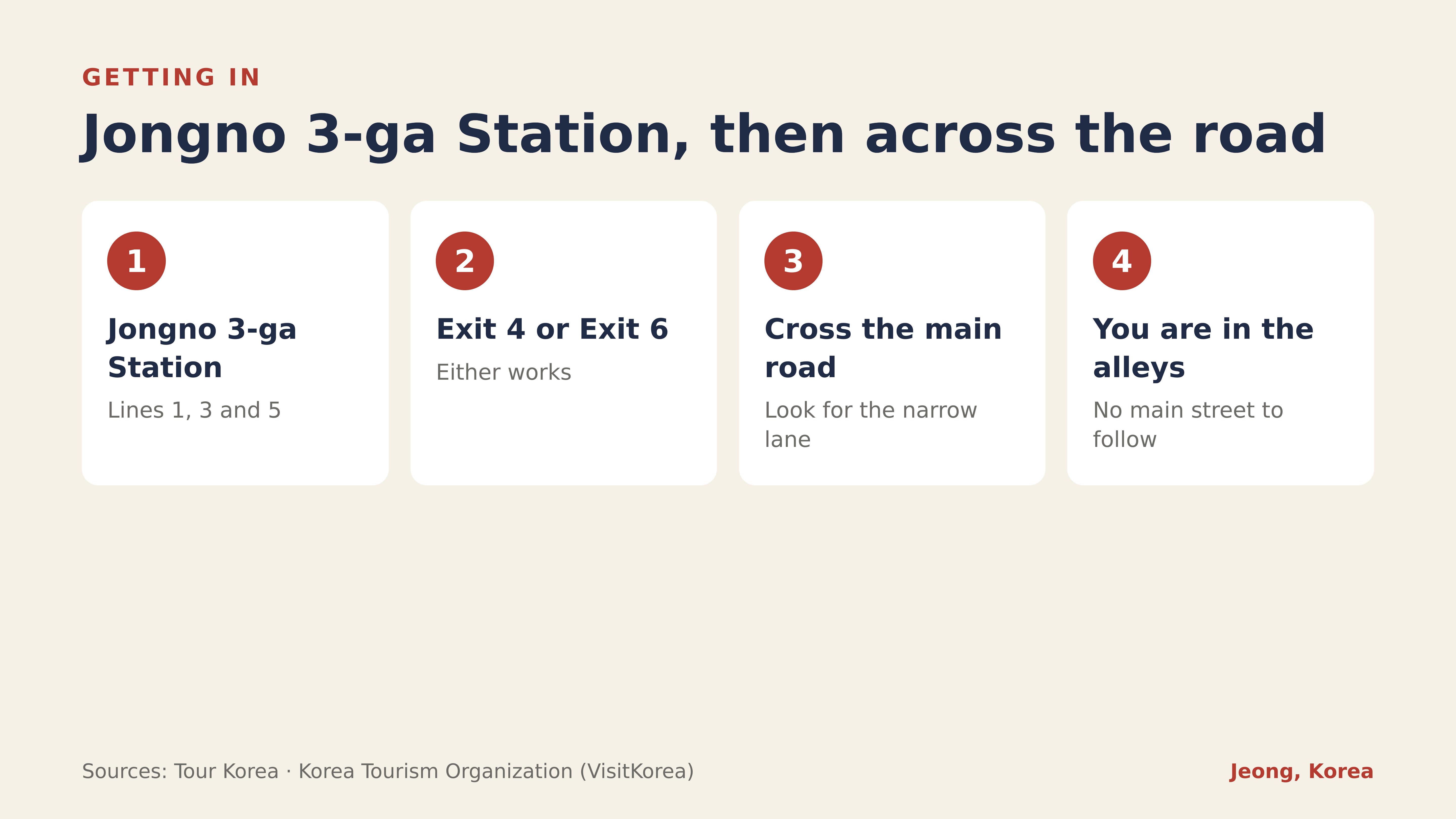
Take the subway to Jongno 3-ga, where lines 1, 3 and 5 meet, and come up at Exit 4 or Exit 6. A Korean travel paper gives both, noting it is reached on foot from "Exit 4 or 6". The Korea Tourism Organization's own feature starts the walk at Exit 4, where you step off the main road into a narrow lane. If transfers at a three-line station are new to you, Seoul subway map and transfer rules explains how the exits are numbered.
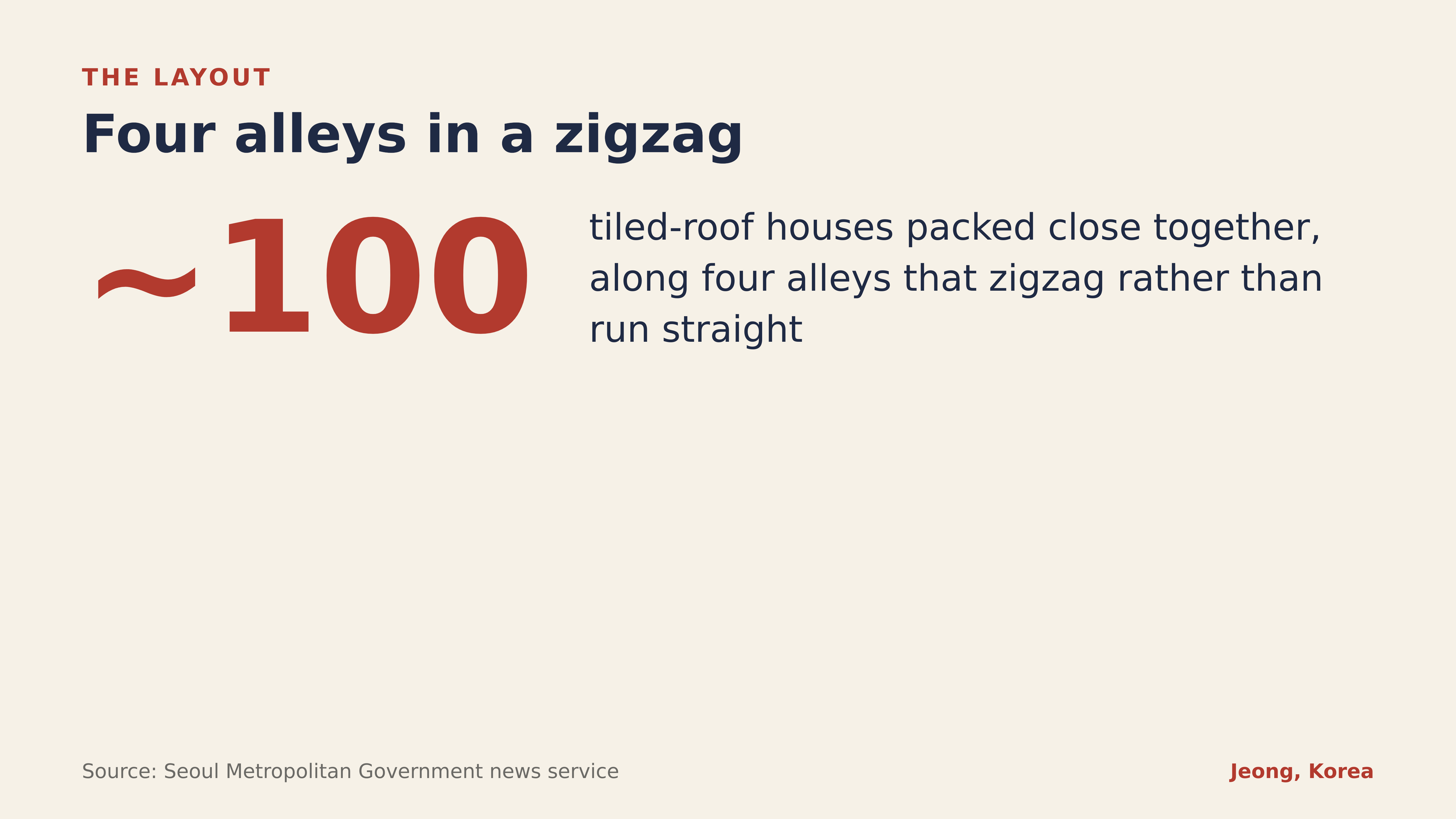
Once you are in, there is no main street to follow. Seoul's city news service describes it as four alleys running in a zigzag, lined with about a hundred tiled-roof houses packed close together. You may lose your bearings for a minute, which does not matter, because it is only four alleys.
Weekends are the crowded days. The same travel paper suggests weekdays if you want the lanes quieter.
So who put a hundred small hanok in the middle of Seoul?
A developer built them for ordinary families, in about six years
These are not old aristocratic houses. They were a housing project.
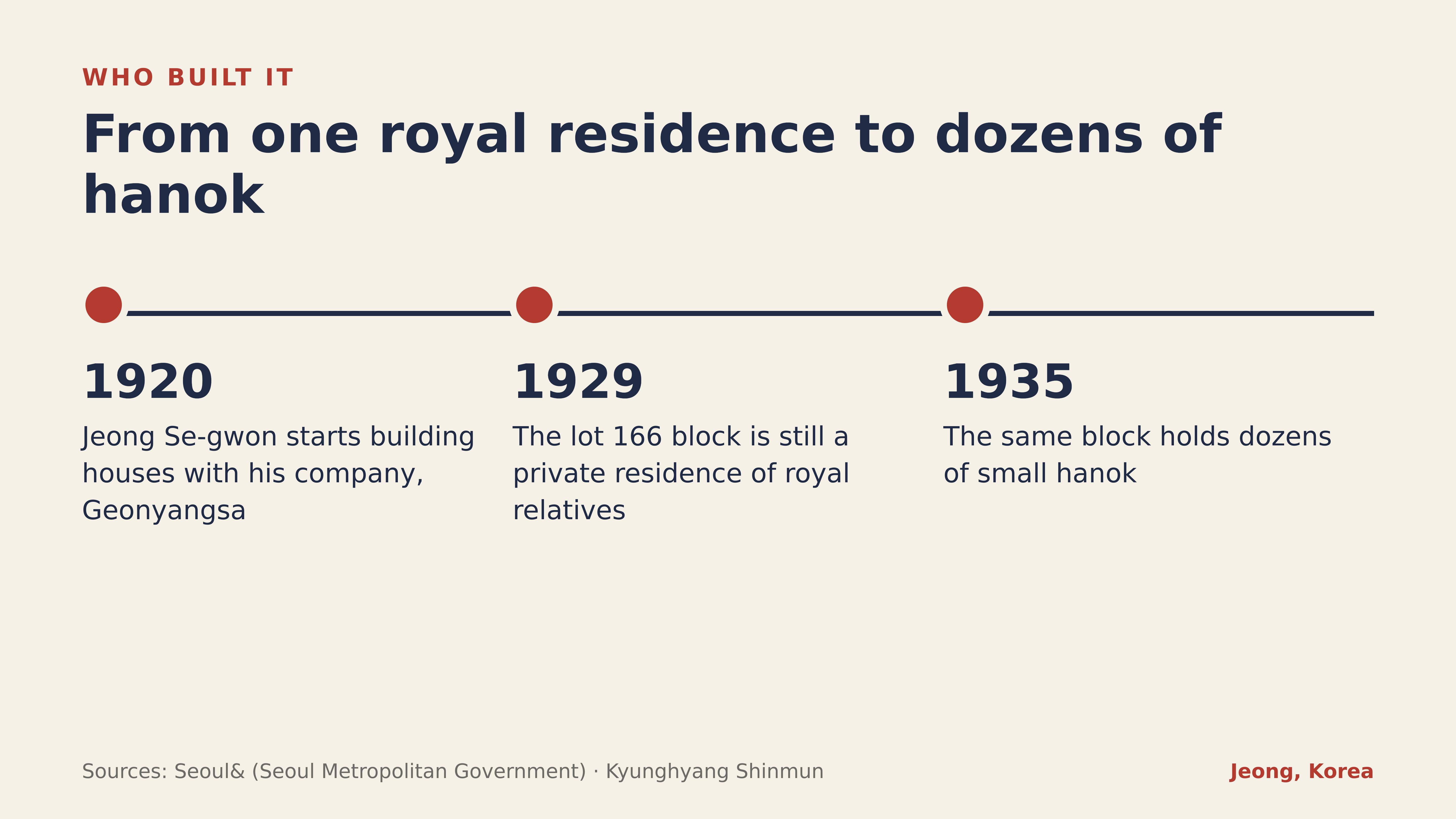
The builder was Jeong Se-gwon, a developer who founded a construction company called Geonyangsa and started building houses in 1920. Seoul's own English site describes the result as a community of hanok architecture "for the general public". According to a Seoul Metropolitan Government magazine, the block around lot 166 was still the private residence of royal relatives in 1929, and by 1935 it held dozens of hanok.
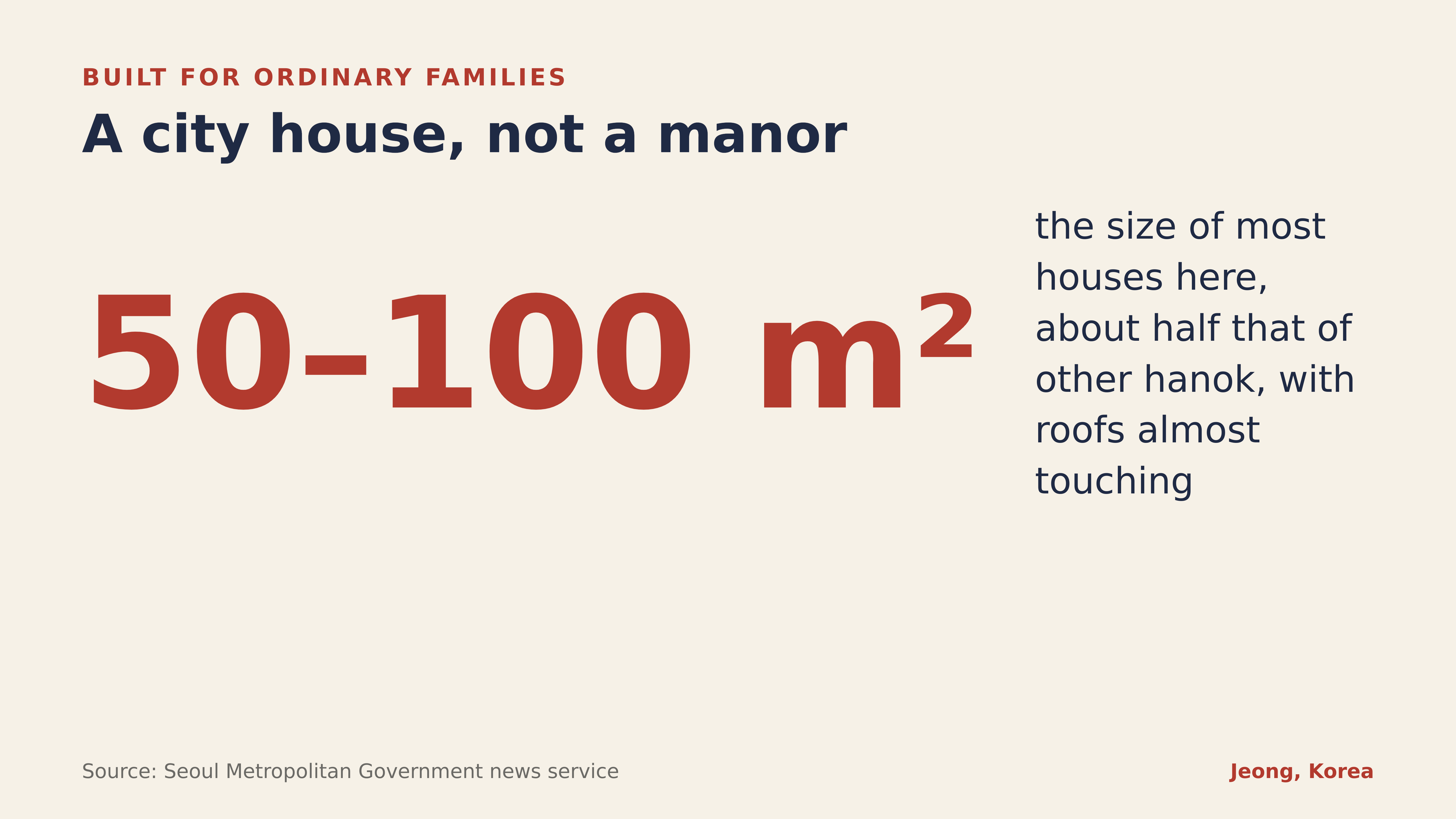
You can see the purpose in the size. The city's feature notes that most houses here are 50 to 100 square metres, about half the size of other hanok, with roofs almost touching. That is what a city house for a working family looked like when Seoul was running out of room.
Here is the part most guides skip. Jeong did not only build here. He supplied hanok across the old city, including Samcheong-dong and Gahoe-dong, the heart of what visitors now call Bukchon. A Kyunghyang Shinmun review of his biography puts it simply: most hanok left in those neighbourhoods were "built at that time".
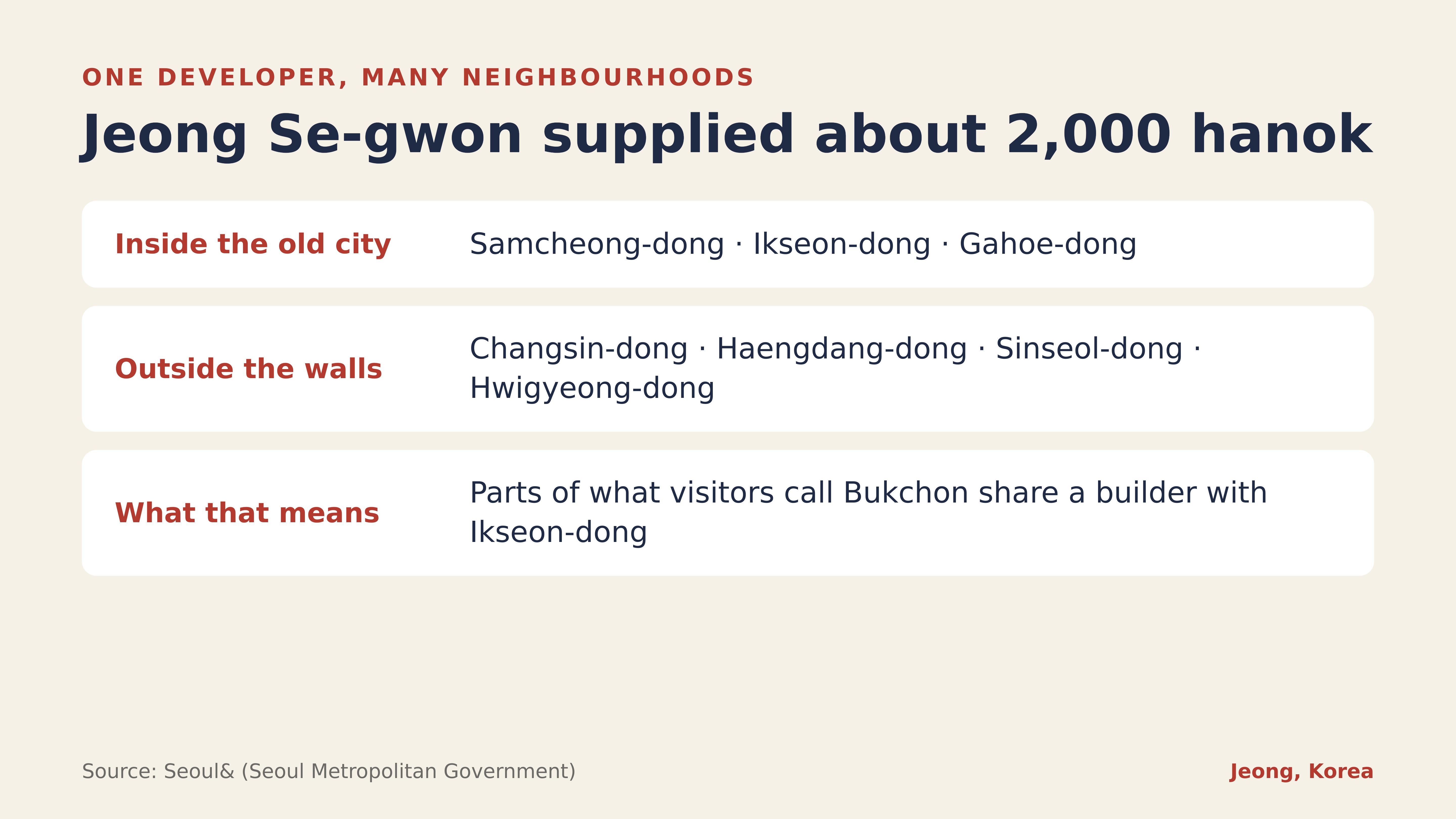
So parts of Bukchon and this place share a developer and a decade. Seoul's English site calls Ikseon-dong the oldest hanok village in the city, but the more useful fact is that it is a sibling of Bukchon, not a different kind of place.
Then why does it feel so different today?
Ten years of waiting for a bulldozer made it what it is
The answer is a redevelopment that never arrived.
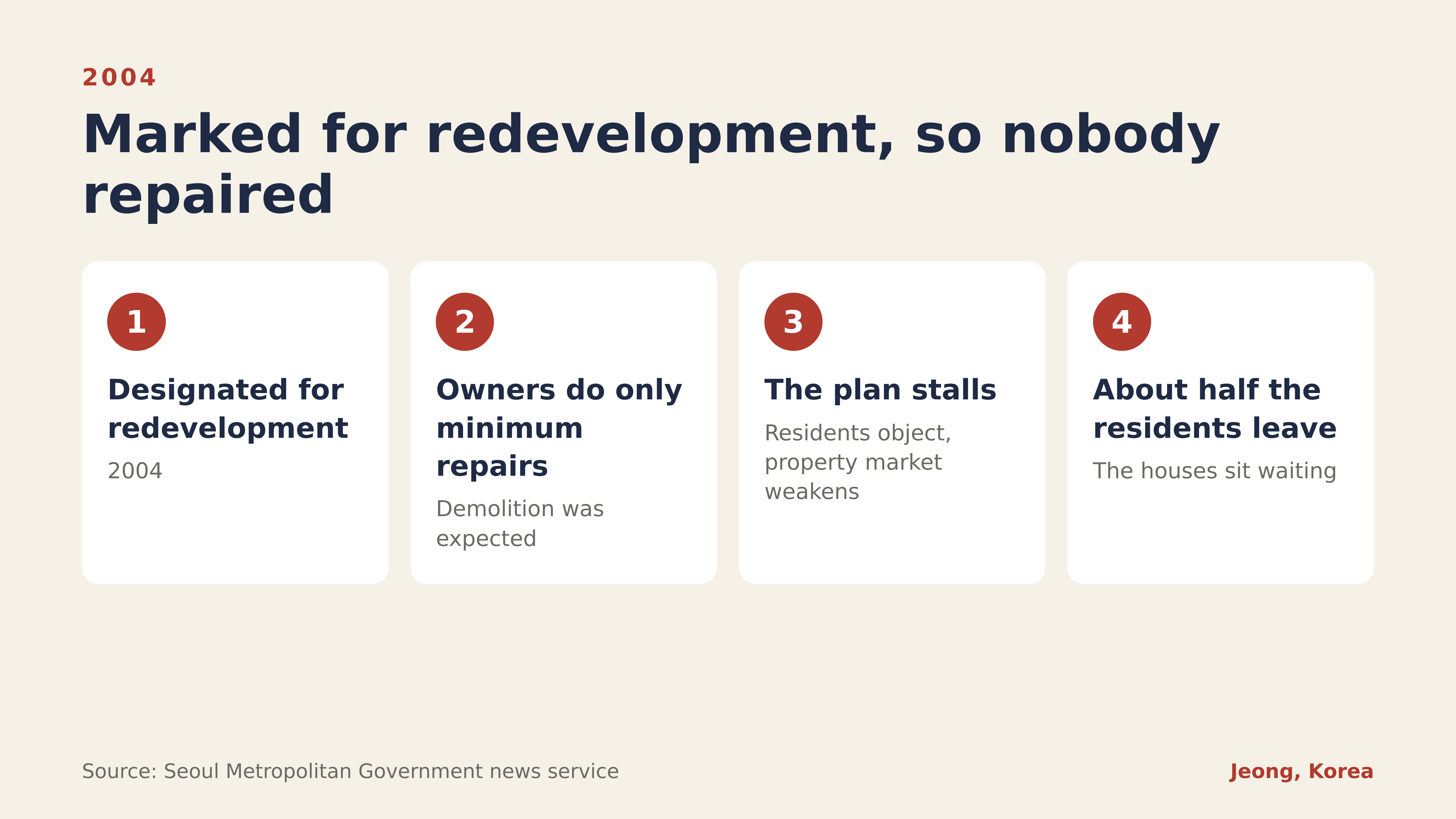
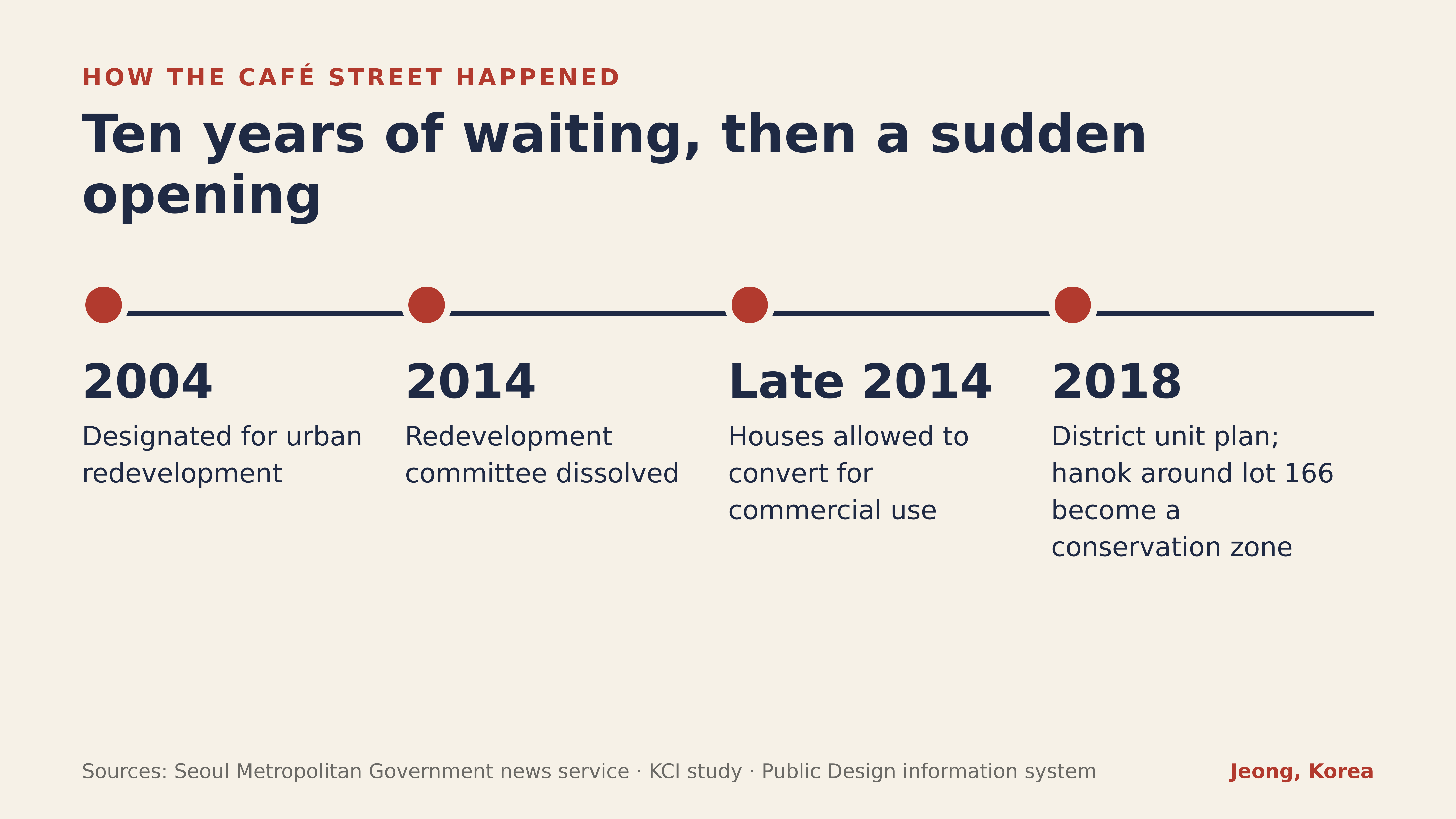
In 2004 the area was designated for urban redevelopment. A report on the city's news service explains what that did: it "nearly became a redevelopment site", and because demolition was expected, owners carried out only the minimum repairs. The plan stalled on residents' objections and a weak property market, and about half the residents moved away in the meantime.
In 2014 the redevelopment committee was dissolved. From the end of that year, owners were allowed to convert houses for commercial use, and empty hanok became cafés, workshops, restaurants and guesthouses. An academic study of lot 166 describes the neighbourhood as quickly commercialized after the 2014 cancellation. In 2018 the city placed the area under a district unit plan, and the hanok blocks around lot 166 are now a conservation zone within it, as a public design journal summarises.
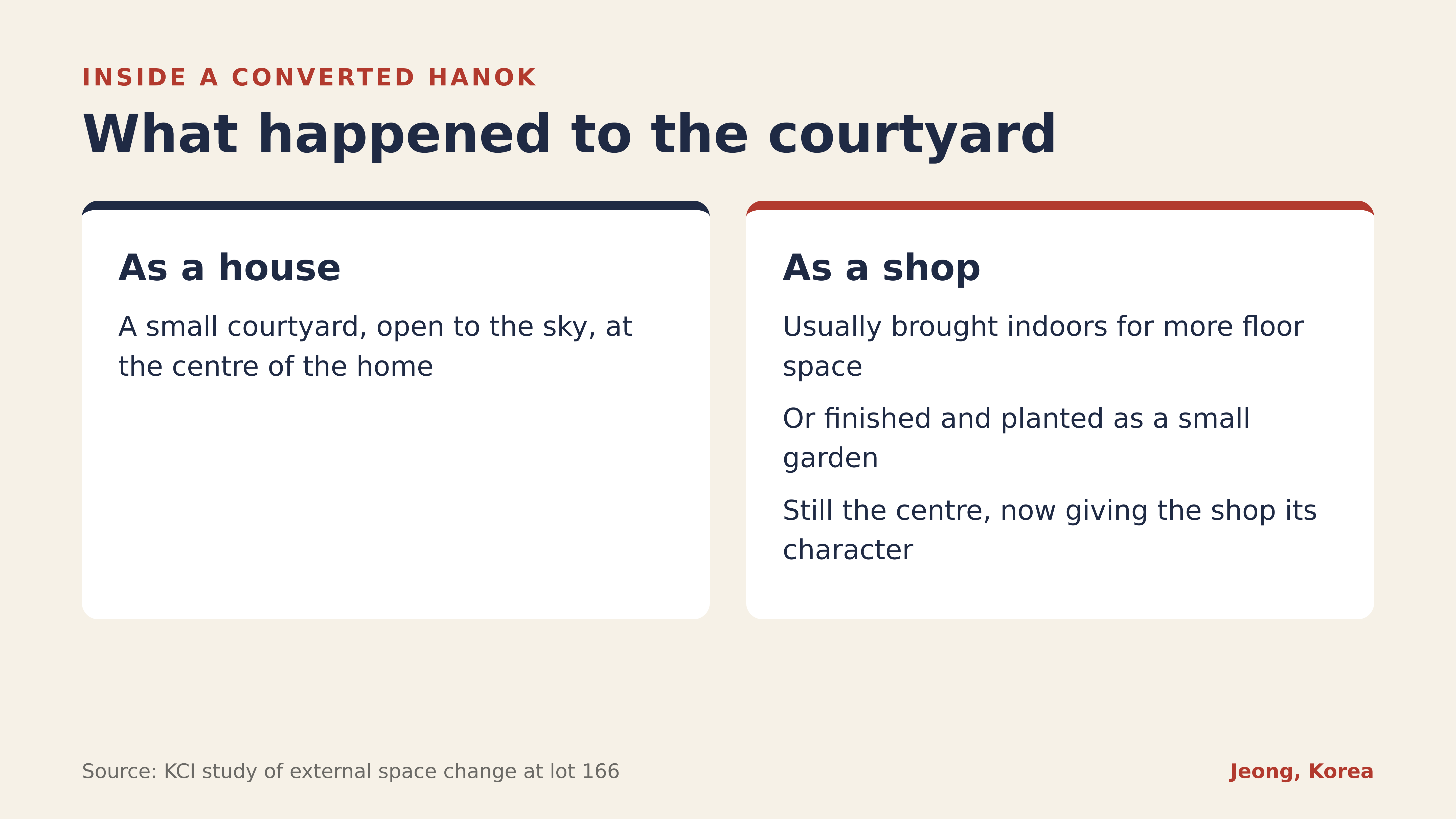
The same study notes what changed inside. When a house became a shop, the courtyard was usually brought indoors to give a cramped business more floor space, or finished and planted as a small garden. It also found the yard kept its role as the centre of the space, now used to give each shop its character.
So the café street is not the result of a preservation policy. It is what filled the gap after ten years of nobody repairing anything and then a sudden permission to trade. Bukchon never went through that gap, which is why it is still mostly homes and part of it now has visiting hours, as Bukchon Hanok Village: no entrance fee, and a 100,000 won fine explains.
So how should you actually walk it?
How to walk it without it feeling like one long café queue
Go on a weekday, and look up more than you look at shopfronts.
Shopfronts change often. The tiled roofs and the small plots have changed far less. Walk the inner lanes rather than the edge facing the main road, and you can still read the original layout: narrow houses side by side, sharing walls, each with a small yard behind the gate.
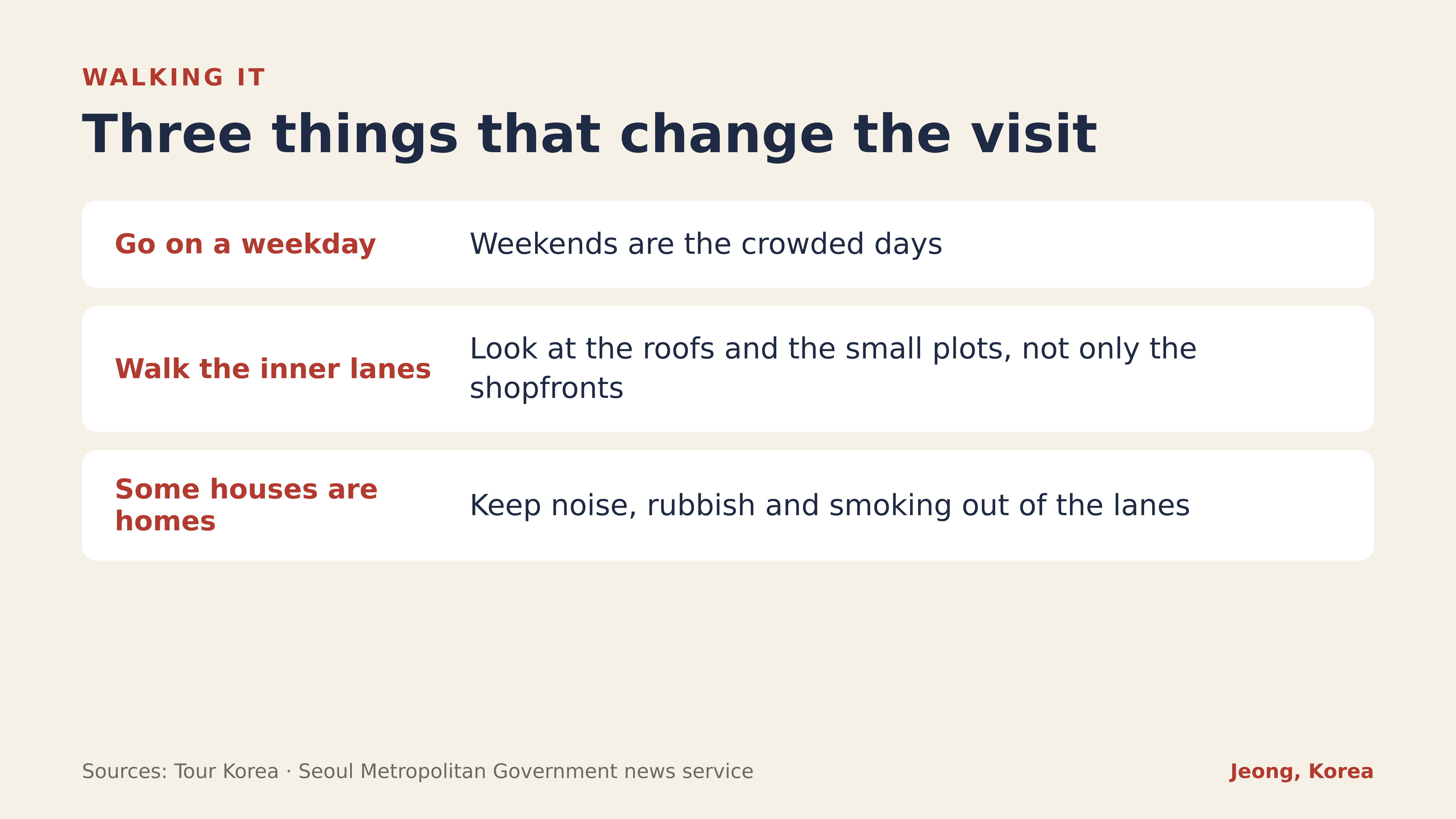
Remember that not every door is a shop. Some houses are still homes, and the city's feature mentions a neighbourhood sign asking visitors to keep noise, rubbish and smoking out of the lanes. Keep your voice down in the narrowest alleys, where the houses stand roof to roof.
When I explain this place to friends, I tell them to decide what they are going for. If it is a pretty lane for photographs, one pass is enough. If it is how a neighbourhood survived a plan that was meant to erase it, give it an hour and walk it twice.
FAQ
How do I get to Ikseon-dong?
Take the subway to Jongno 3-ga Station on lines 1, 3 or 5 and leave by Exit 4 or Exit 6. Cross the main road and the lanes begin within a short walk.
Is Ikseon-dong the same as Bukchon?
No, but they are related. The same developer, Jeong Se-gwon, built hanok in both areas in the 1920s and 1930s. Bukchon stayed largely residential, while this neighbourhood was held up by a redevelopment plan from 2004 and became commercial after that plan ended in 2014.
Is it worth visiting if I have already seen Bukchon?
Yes, because it shows the other outcome of the same era of building. It also sits a short walk from Insadong, where the Starbucks sign is written in Hangeul, so the two fit into one afternoon.
Do people still live there?
Some do. Many houses have been converted into shops and restaurants since 2014, but the area remains a residential neighbourhood in part, so the usual courtesy about noise and rubbish applies.
One sentence is enough
The hanok here were built for ordinary families by the same developer who also built hanok across Bukchon, and they became cafés because a redevelopment plan froze the neighbourhood from 2004 to 2014 and then let go.
References
-
Seoul Metropolitan Government magazine Seoul& — Jeong Se-gwon and the building of lot 166, 1929 to 1935
-
Kyunghyang Shinmun — book review of the biography of developer Jeong Se-gwon
-
Seoul Metropolitan Government news service — Ikseon-dong alley feature: four zigzag alleys, house sizes, commercial use permitted from late 2014
-
Seoul Metropolitan Government news service — citizen reporter feature: 2004 redevelopment designation and the 2014 dissolution
-
Korea Citation Index — study of external space change in urban hanok at lot 166
-
Seoul Metropolitan Government English site — neighbourhood page
-
Public Design information system — historic alleys feature: 2018 hanok conservation designation
-
Tour Korea (tournews21) — access from Jongno 3-ga Station Exits 4 and 6
-
Korea Tourism Organization, VisitKorea — neighbourhood feature starting from Exit 4