Seoraksan From Seoul: There Is No Train, and the Entrance You Pick Decides the Whole Day

There is no train to Seoraksan. There is none to the town below it either. If you have been searching Korail for a nearby station, that is why nothing came back.
This surprises people more than almost anything else about travelling here. Korea runs one of the densest rail networks in the world. You can be in Busan in under three hours, in Gangneung in under two, in Gyeongju before lunch. So the assumption that the country's most famous mountain must also be an hour or two down a line is a reasonable one. It is just wrong, and the reason it is wrong shapes the entire trip.
The other thing nobody tells you is that Seoraksan National Park has four separate entrances, they are on different sides of a mountain range, and choosing between them is not a detail. It decides which mountain you see.
When to come is a different question with its own answer, and I wrote that one out separately in Autumn in Korea: Don't Pick the Dates, Pick the Latitude. This is the other half. How you physically get there, and which door you walk through when you do.
The bus is not a fallback here. It is the system.
Take the express bus, and stop treating that as a compromise.
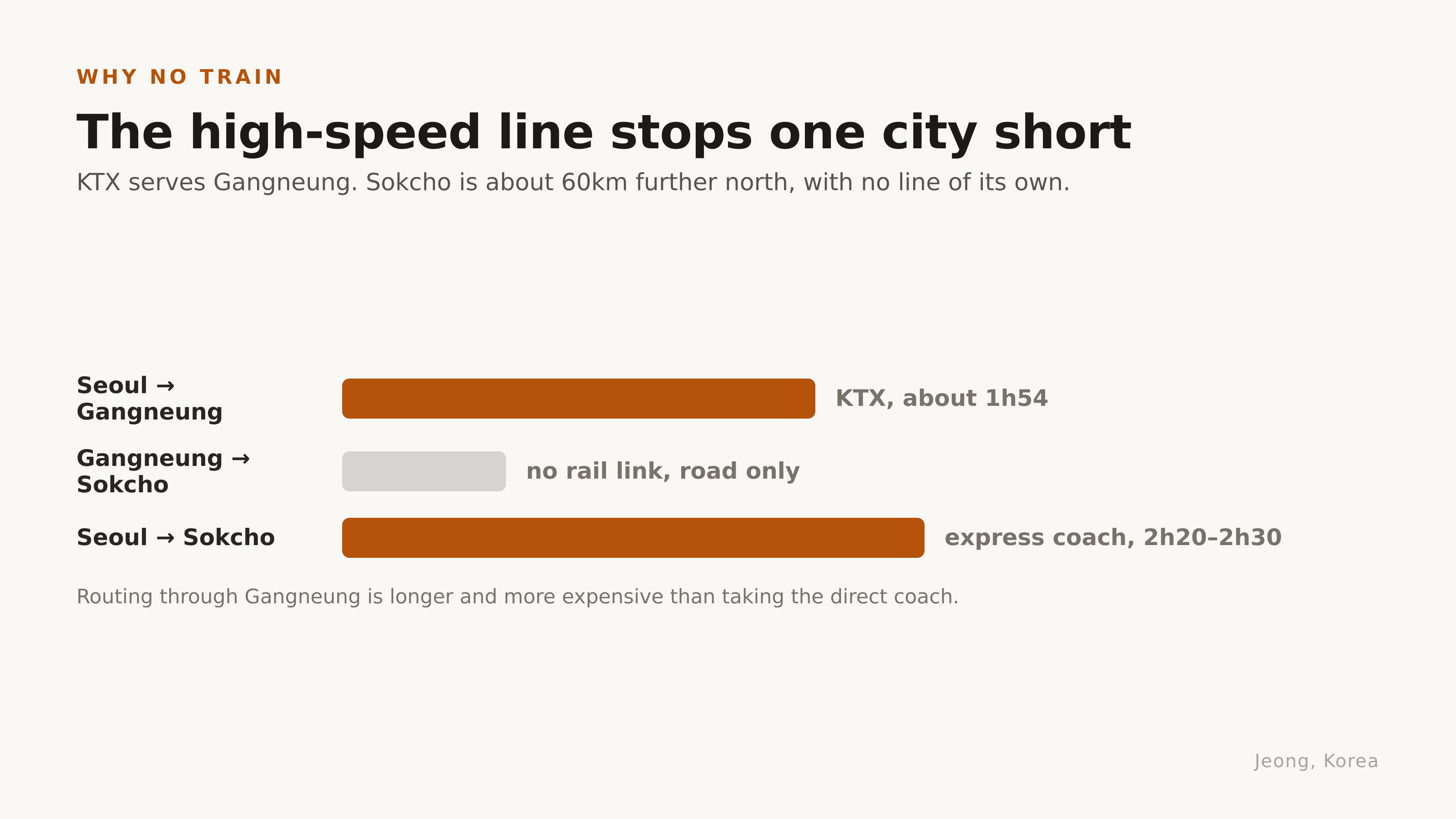
The reason is structural rather than temporary. The east coast rail line that would serve this stretch does not reach Sokcho, the city at the foot of the mountain. The KTX that everybody knows about terminates in Gangneung, which is a genuinely fast connection to a genuinely good city, but Gangneung sits roughly sixty kilometres down the coast from here. Arriving there and then working your way north is a longer, more expensive day than simply getting on the right bus in Seoul.
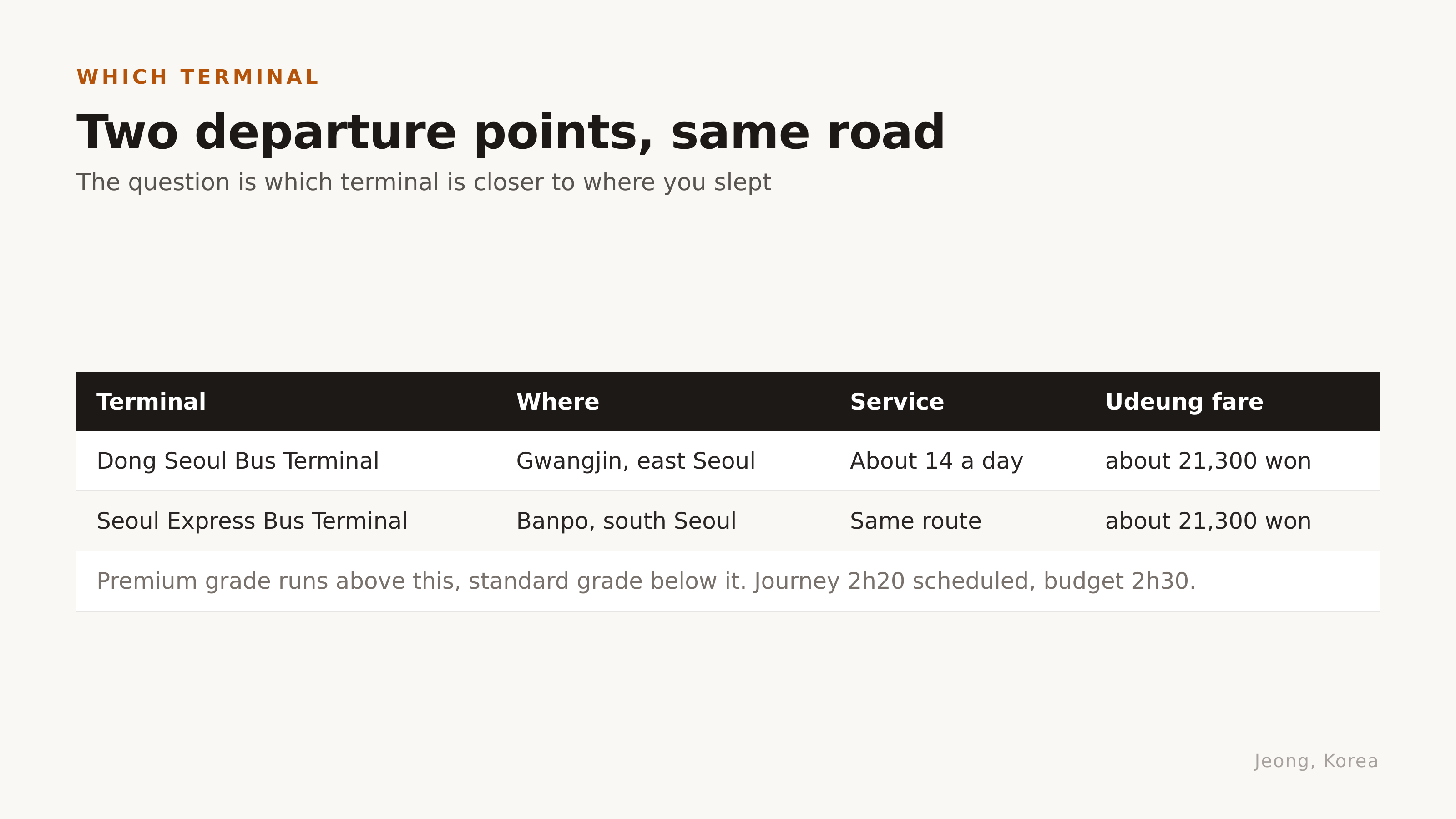
And the bus service is built for this. Express coaches run from Dong Seoul Bus Terminal to Sokcho about fourteen times a day, and the journey is roughly two hours and twenty minutes to two and a half, depending on traffic on the way out of the capital. Udeung grade, the wide reclining seats most Koreans book, runs about 21,300 won. There is a premium grade above that and a standard grade below it. Seoul Express Bus Terminal in Banpo runs the same route, so the real question is which terminal is closer to where you slept.
So do not look for a station. Pick a terminal, book a seat, and treat the coach as the intended way to arrive rather than the leftover option.
If you want the version of this trip that does have a train, the neighbouring city is a different story entirely: Gangneung: An Olympics Put It Two Hours From Seoul explains why one east-coast city got a high-speed line and this one did not.
But getting off the bus is not the same as arriving at the mountain.
The park has four doors, and they are not the same mountain
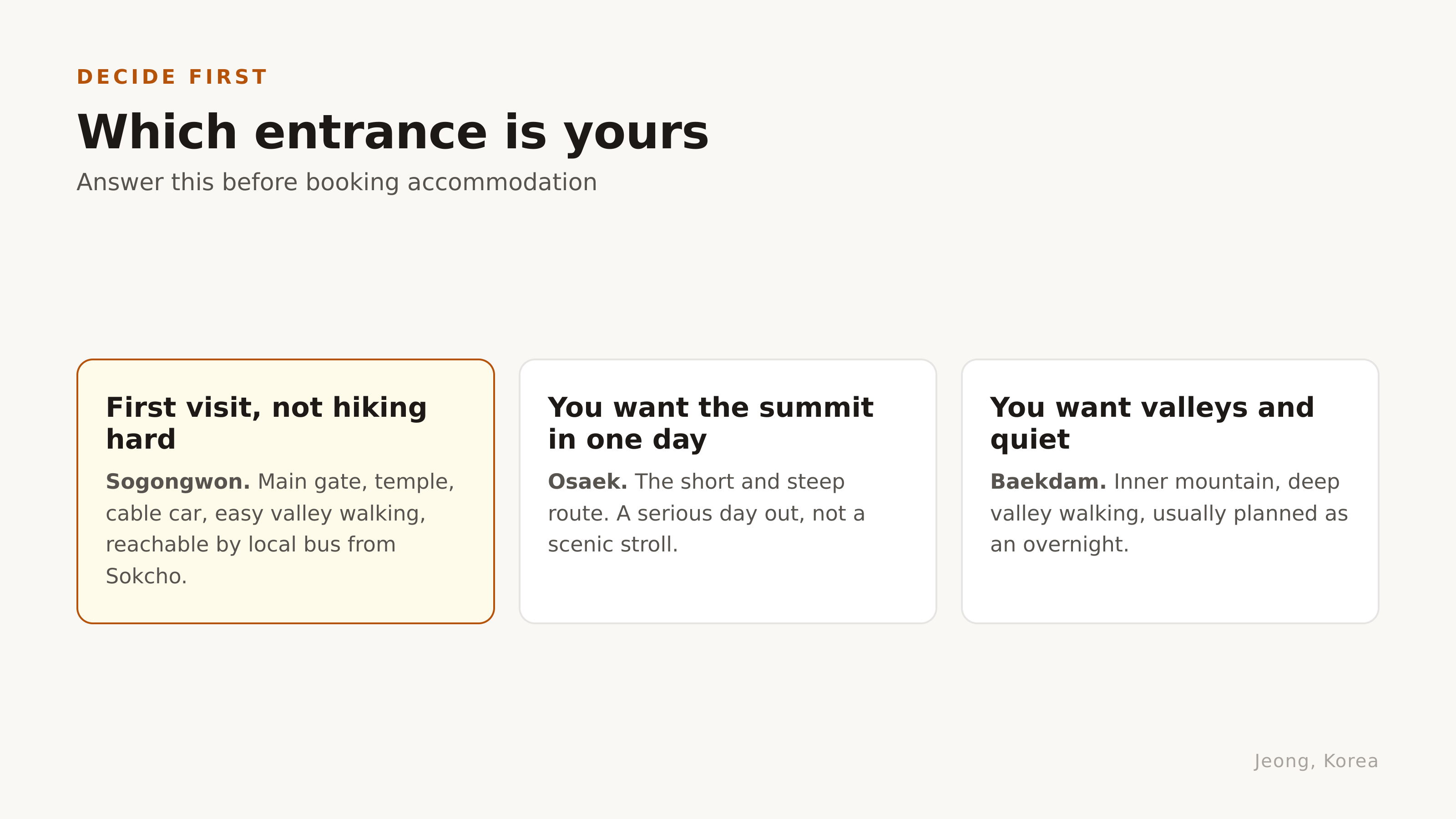
Decide which entrance you are using before you book anything else.
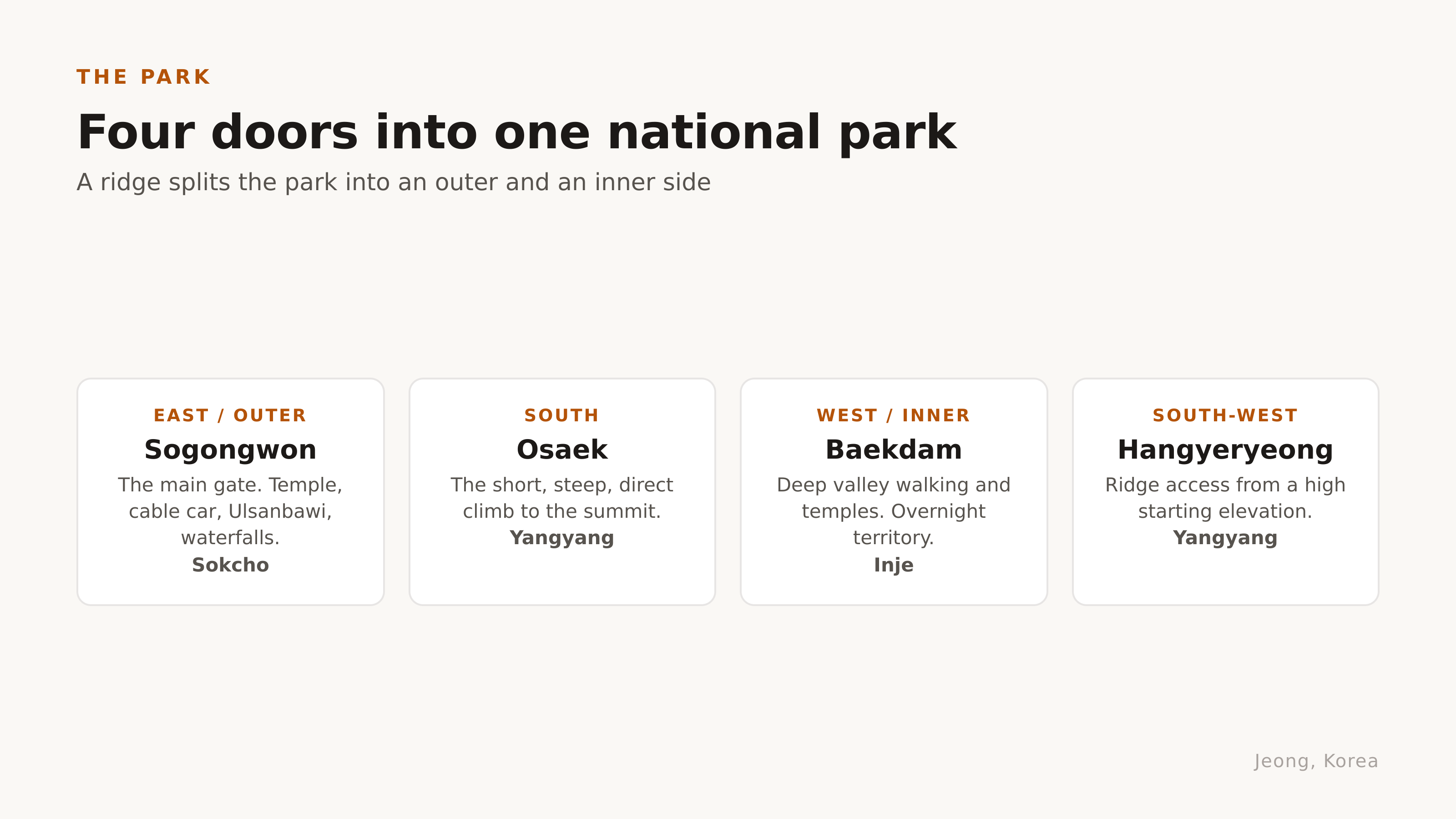
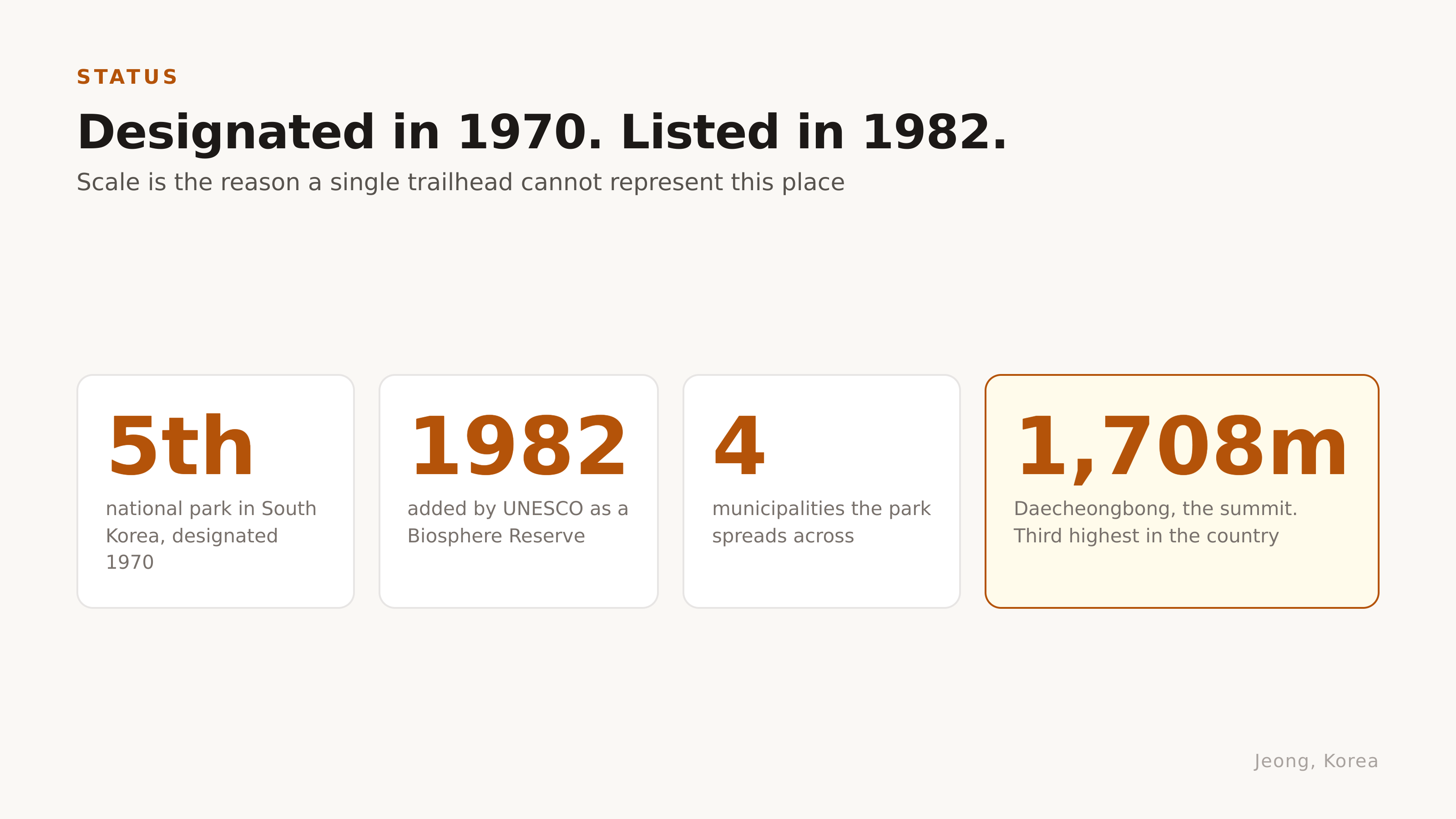
This matters because Seoraksan National Park spreads across four separate municipalities and is cut in half by a ridge. Korean hikers do not talk about it as one place. They talk about the outer mountain and the inner mountain, and they mean different terrain, different approach times and different days out. The park was designated in 1970, the fifth in the country, and UNESCO added it as a Biosphere Reserve in 1982. It is large in a way that a single trailhead cannot represent.
Here is what actually sits behind each name.
| Entrance | Side | What it is for | Nearest town |
|---|---|---|---|
| Sogongwon | Outer, east | The main gate. Temple, cable car, Ulsanbawi, waterfalls | Sokcho |
| Osaek | South | The short, brutal, direct climb to the summit | Yangyang |
| Baekdam | Inner, west | Deep valley walking, temples, overnight territory | Inje |
| Hangyeryeong | South-west ridge | Ridge access, high starting elevation | Yangyang |
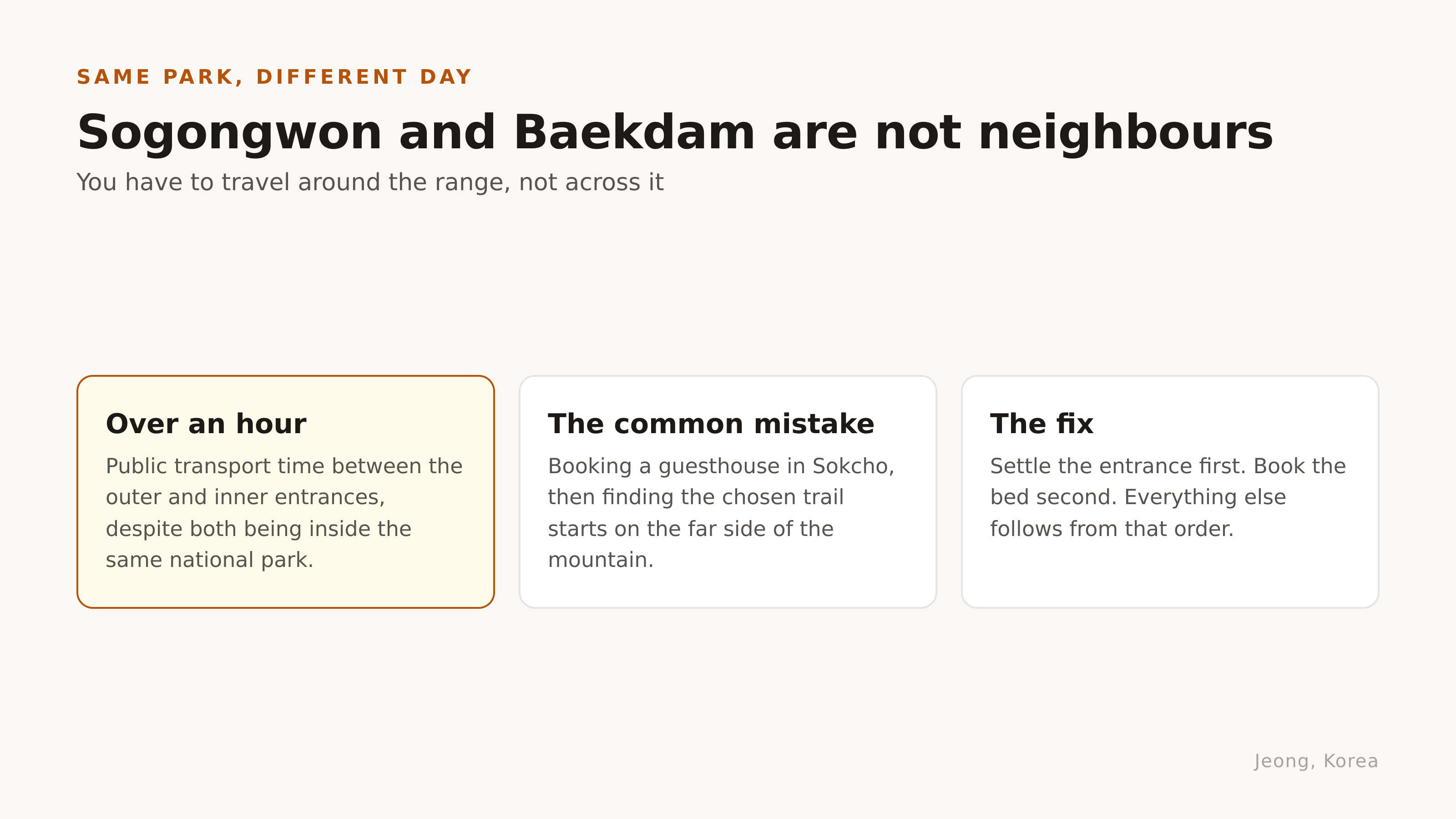
In practice the gap between them is bigger than the map suggests. Sogongwon and Baekdam are the same national park, but travelling between them by public transport takes well over an hour because you have to go around the range rather than across it. People book a guesthouse in Sokcho, then discover their chosen trail starts on the far side.
So the sentence to settle first is not "I am going to Seoraksan." It is "I am entering at Sogongwon," or Osaek, or Baekdam. Everything else follows from that.
Korea has one other mountain where this decision is made for you rather than by you, and the contrast is useful: Hallasan Hike: Only One Trail Reaches the Summit Right Now is the opposite problem.
Which leaves the question everyone asks last and should ask first.
The summit is 1,708m, and the mountain turns from the top down
Expect the colour to arrive at different times in different parts of the same park, on the same day.
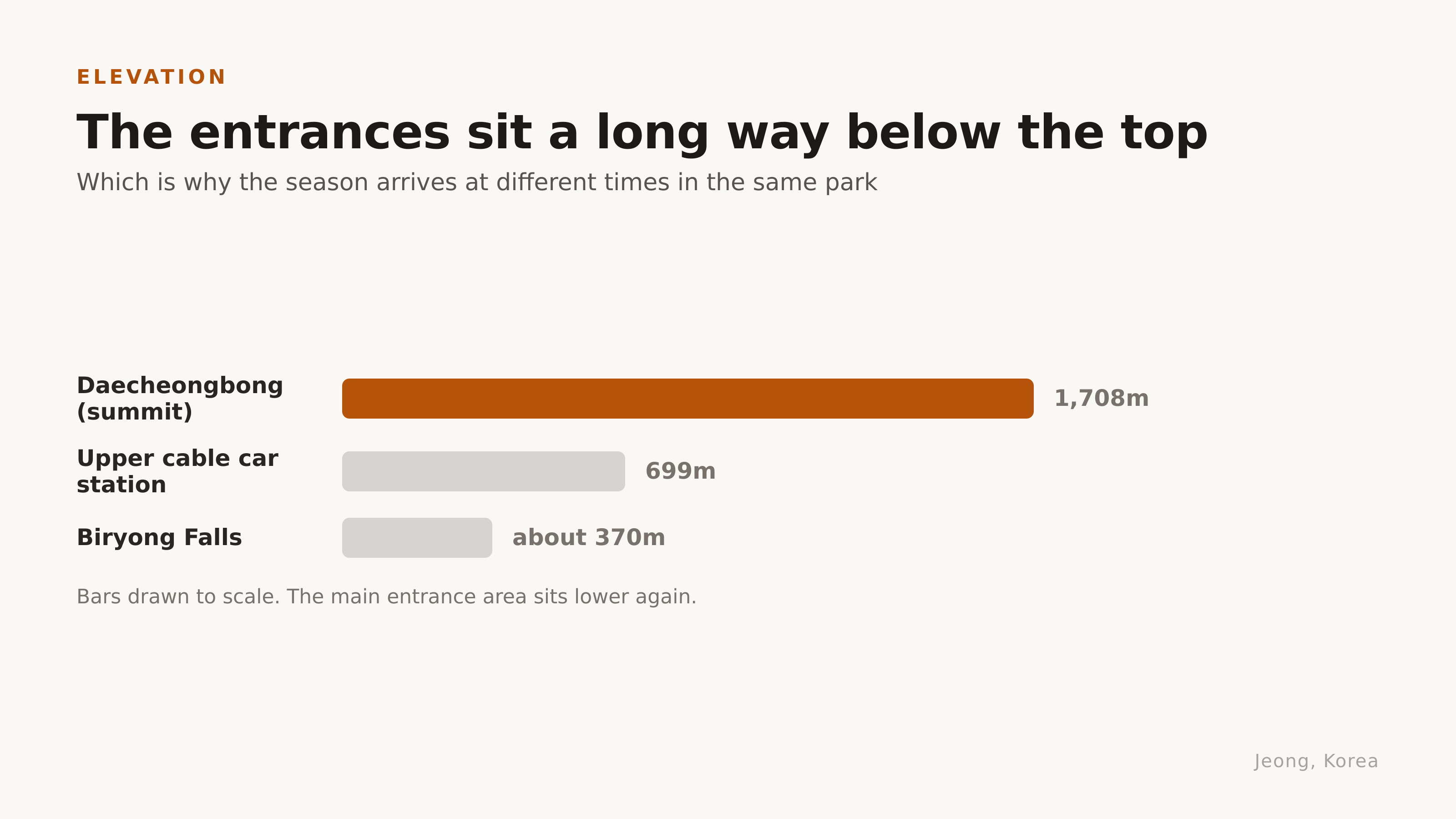
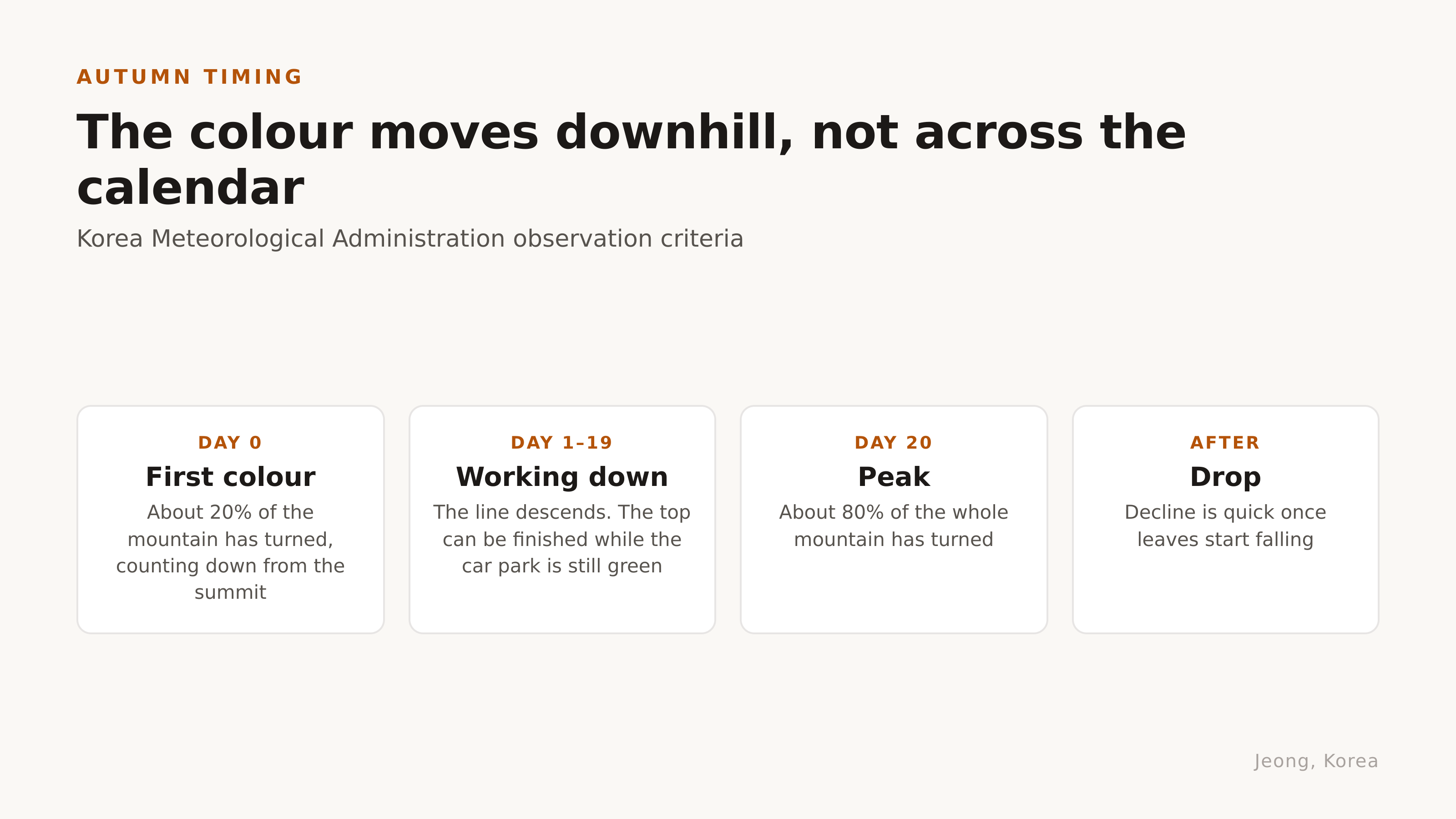
The reason is elevation. Daecheongbong, the summit, stands at 1,708 metres, which makes it the third highest peak in South Korea. The entrances sit far below that. The Korea Meteorological Administration records first colour when roughly a fifth of a mountain has turned, working downward from the top, and peak when about four fifths has. The gap between those two moments runs to about twenty days.
Twenty days is the whole life of the season on one mountain, and it is spent travelling downhill. In early October the summit ridge can be fully turned while the car park at Sogongwon is still green. By late October the base is at its best and the top is already bare. Both of those are the mountain working correctly.
So set your expectation by altitude rather than by date. If you are riding up, you are moving into the season. If you are staying low, you are behind it by a week or two, and that is worth knowing before you feel let down by a photograph you saw online.
What this comes down to
Three things decide this trip, and none of them are the ones people research first.
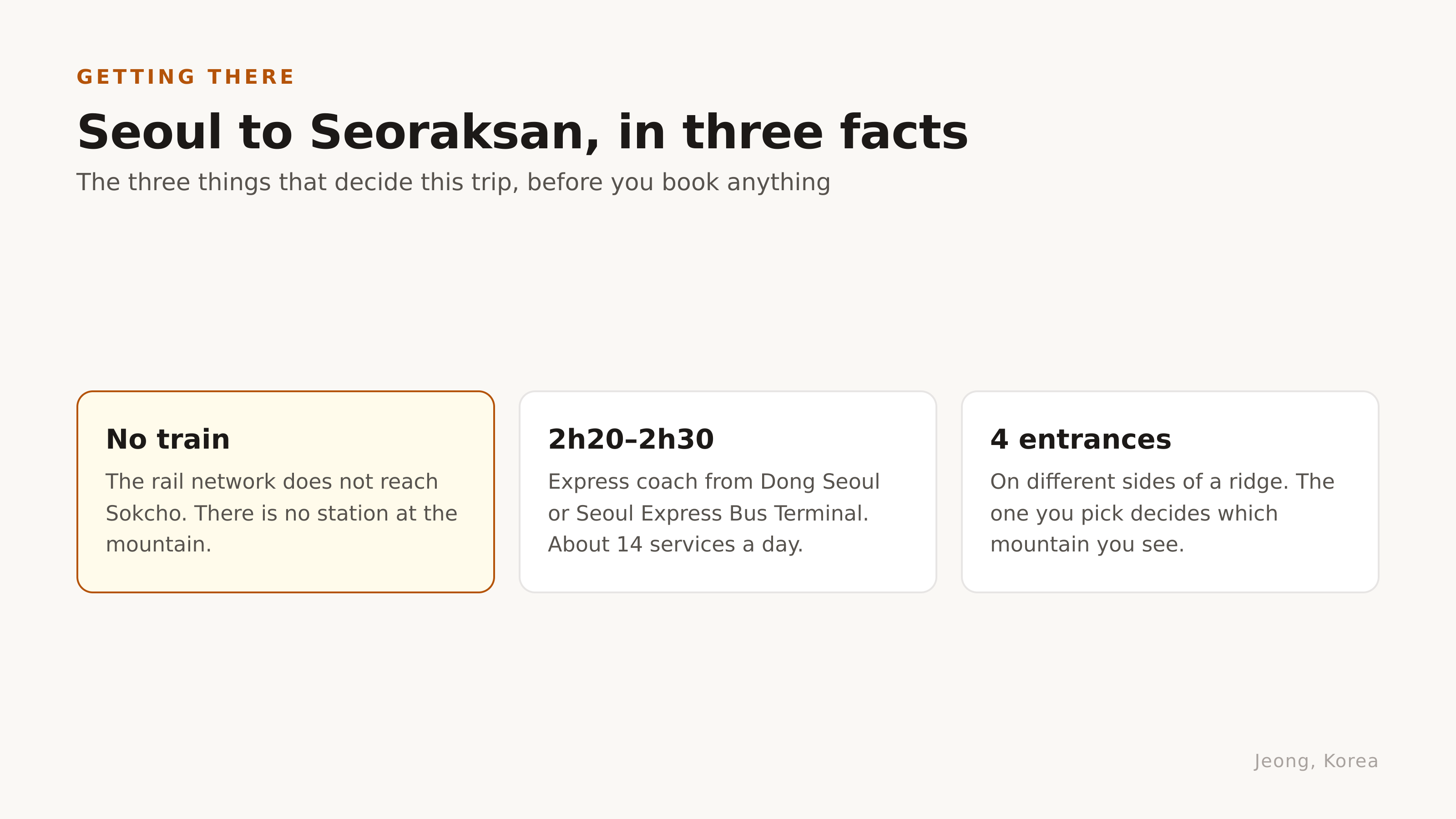
There is no train, so book a coach from Dong Seoul or the Express Bus Terminal and allow two and a half hours. Seoraksan National Park has four entrances on different sides of a ridge, so choose the entrance before the accommodation. And the colour moves down the mountain over about twenty days, so your altitude on the day matters more than the date on your ticket.
That leaves one thing unresolved, and it is the thing most visitors get wrong on arrival. There is a cable car at the main entrance. Almost everyone who rides it comes down believing they have stood near the top of Seoraksan. The upper station has a number posted on it, the summit has a different number, and the two are not close. That gap, and what you should actually do with a day here if you are not going to hike, is the next piece.
FAQ
Is there any train to Seoraksan or Sokcho?
No. The rail network does not reach Sokcho, and the mountain has no station of its own. The KTX serves Gangneung, about sixty kilometres south, which is a different city and a longer route in practice. Express coach from Seoul is the intended way to get here.
How long does the bus from Seoul actually take?
Budget two and a half hours rather than two. Dong Seoul to Sokcho is scheduled at roughly two hours and twenty minutes, and traffic leaving the capital regularly pushes it past that. Udeung grade runs about 21,300 won.
Which entrance should a first-time visitor use?
Sogongwon, on the Sokcho side. It is the main gate, it has the temple, the cable car and the walk toward Ulsanbawi, and it is reachable by local bus from the town where you will probably be staying. Osaek and Baekdam are for people with a specific climb in mind.
Can I do Seoraksan National Park as a day trip from Seoul?
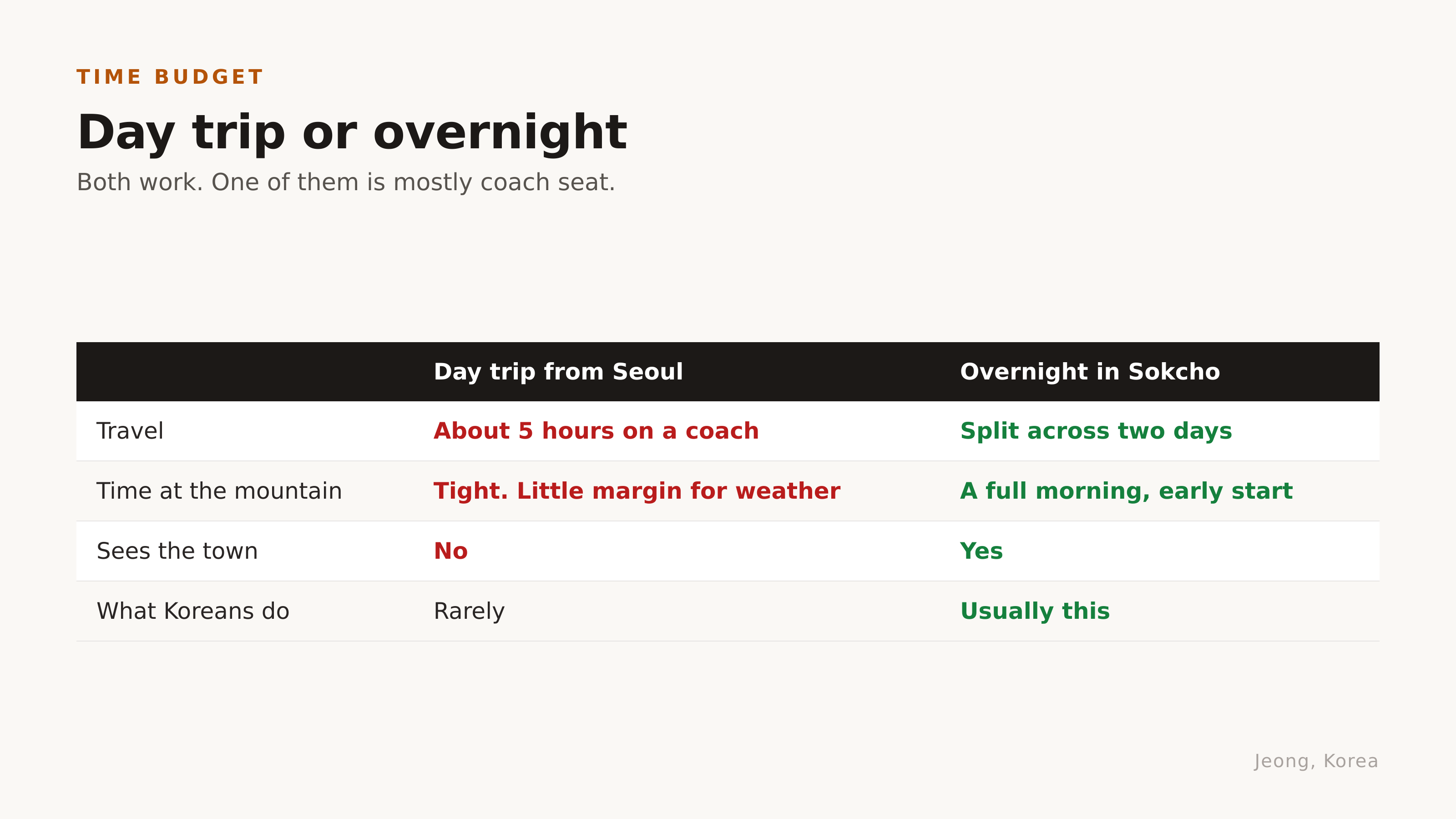
Physically yes, and it is a long day. Five hours on a coach plus whatever you do at the mountain leaves very little margin. Most Koreans treat this as an overnight, sleeping in Sokcho and starting early.
When does Seoraksan turn in autumn?
The summit usually starts in early October and the lower slopes follow through the month, with roughly twenty days between first colour and peak on any one mountain. Because this range sits at the north-eastern end of the country, it is where the national colour front begins rather than where it ends.
References
출처 : Korea Meteorological Administration, autumn colour observation criteria 출처 : Korea National Park Service, Seoraksan National Park designation (1970) and UNESCO Biosphere Reserve listing (1982) 출처 : Sokcho Express Bus Terminal and Dong Seoul Bus Terminal published timetables and fare tables