Hanwoo: The Menu Has to Tell You Where the Cow Was Born, and Domestic Is Not the Answer You Think

You are reading the grade. Read the two words in front of it instead.
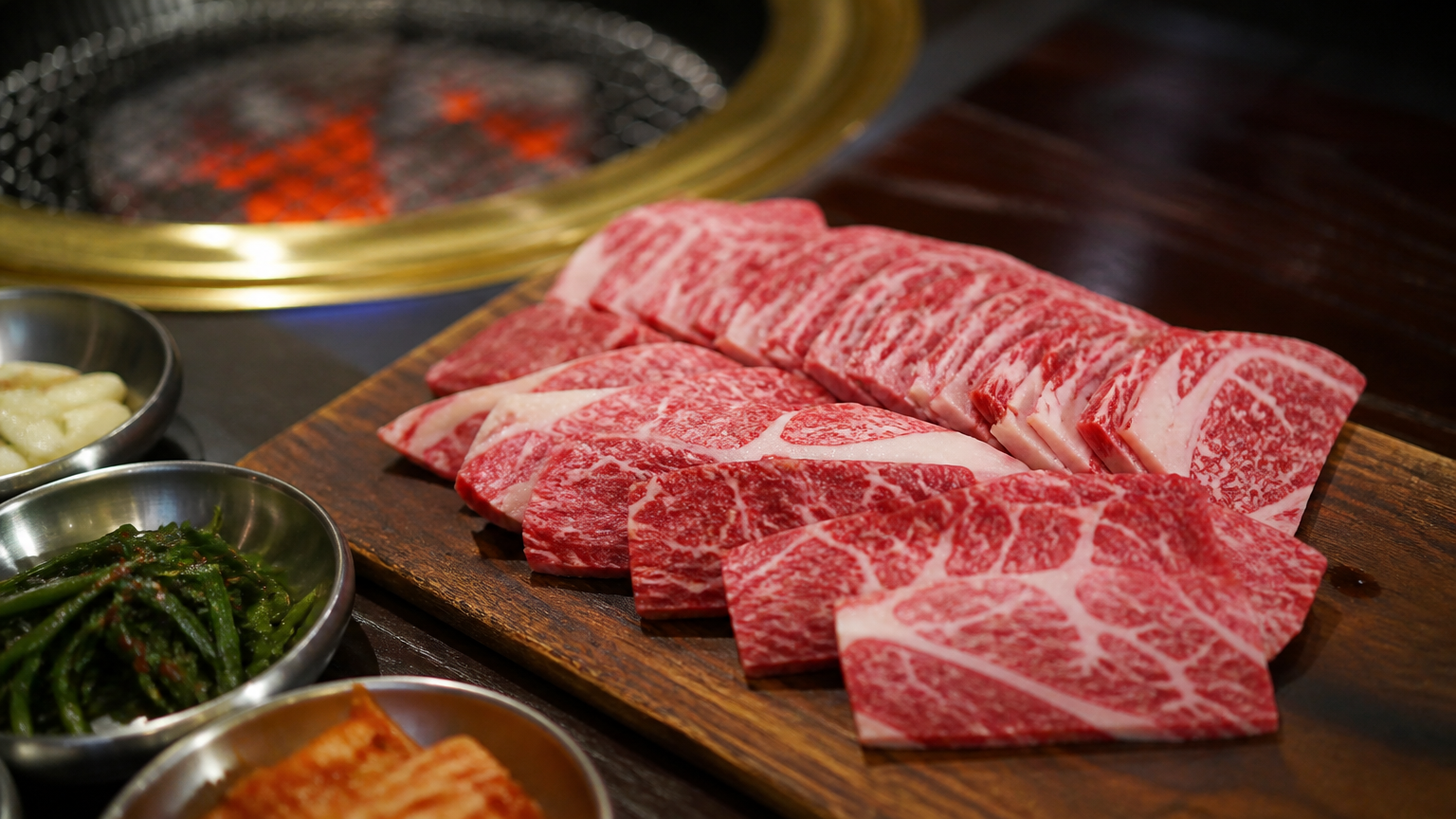
Last time we did the pork. This is the other half of the Korean grill, and it is where the money goes: hanwoo, the beef Koreans queue and save up for.
Here is the thing that catches almost every visitor. Korean restaurant menus carry an origin line, by law, and most people skim it as decoration. It is not decoration. It is the single most informative sentence on the page, and it will tell you things the price tag will not.
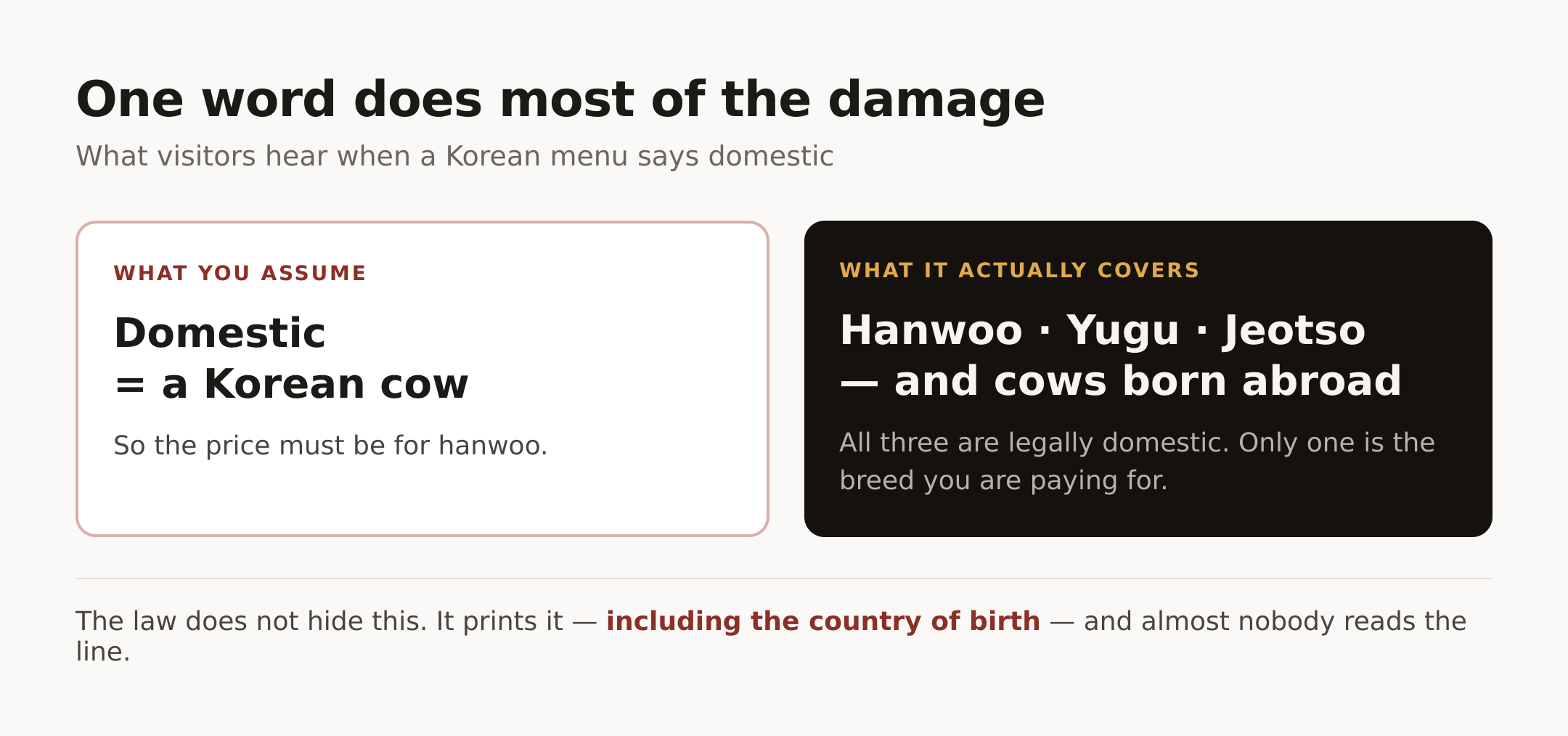
The trap is one word. Domestic does not mean Korean cow.
The label is a legal document, not a marketing line
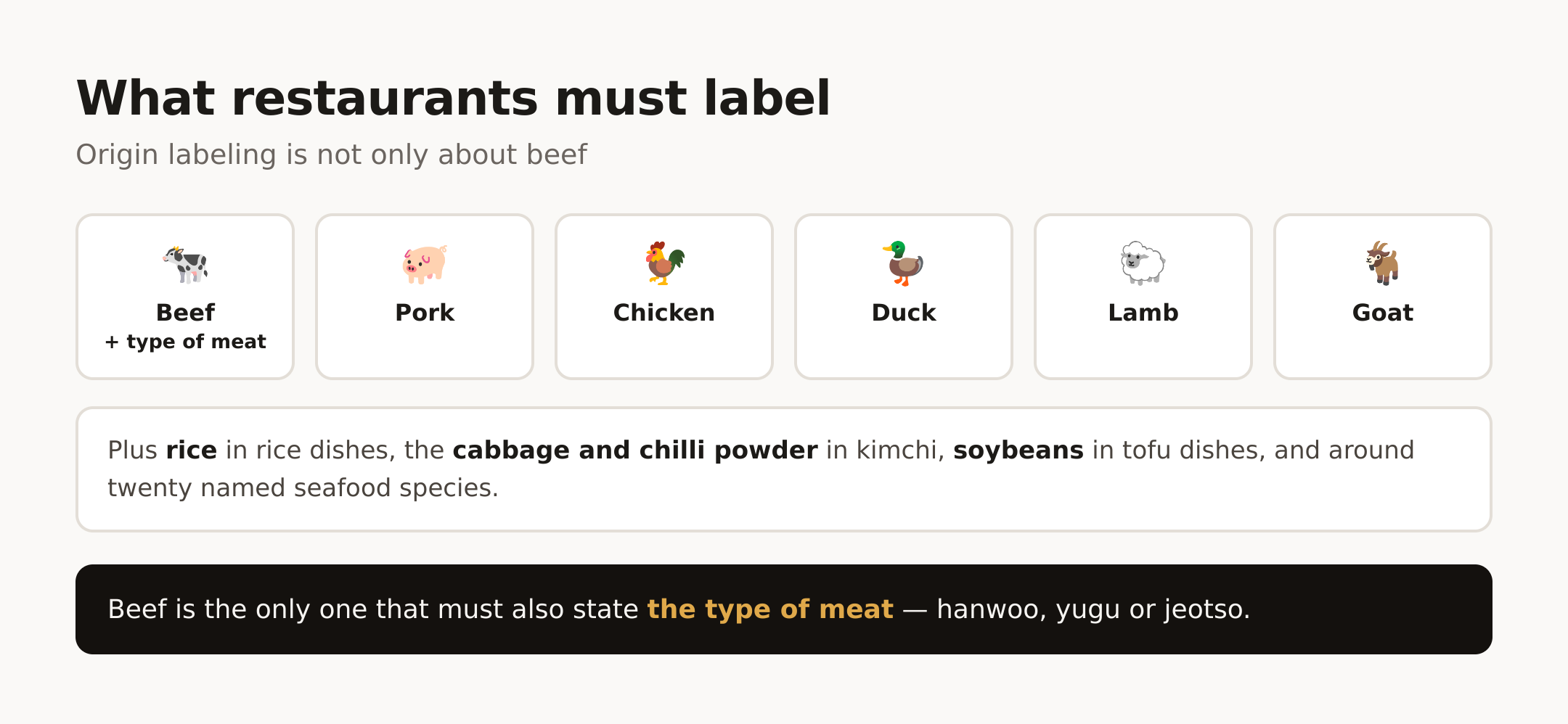
Korea's Act on Origin Labeling of Agricultural and Fishery Products requires restaurants to declare origin for the food they serve. Beef gets a stricter rule than everything else: the law says origin includes the type of meat for beef, and that the type has to be stated separately.
That means a beef line on a Korean menu is carrying two facts at once, and they are not the same fact.
The type of meat splits three ways, and only one of them is what you came for.
| Type | What it is |
|---|---|
| Hanwoo | Korea's own native breed |
| Yugu | Beef cattle, crossbreeds, dairy bulls — raised for meat |
| Jeotso | A dairy cow that has calved — raised for milk |
So a domestic beef line on a Korean menu might be hanwoo. It might equally be a retired dairy cow. Both are legitimately domestic. Only one is the thing with the reputation.
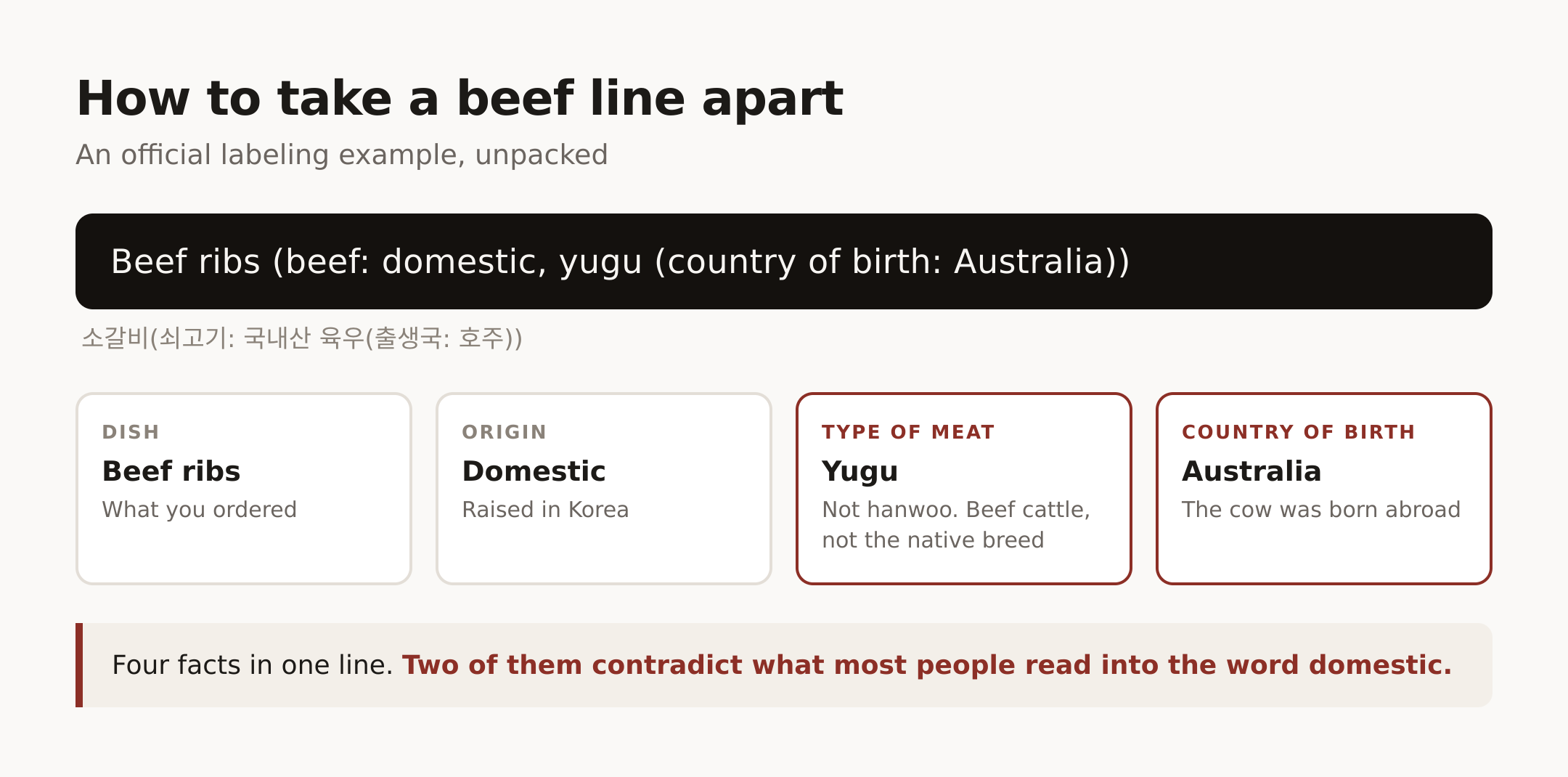
And then the part that surprises people most. The official labeling examples include this:
Beef ribs (beef: domestic, yugu (country of birth: Australia))
A cow born in Australia and raised in Korea is labeled domestic — and because that would otherwise be misleading, the law makes the restaurant print the country of birth as well. The label is doing the honest thing. Most diners simply are not reading it.
If you want the local rules that decide the rest of your evening at a grill house, Korean BBQ in Seoul: The Three Koreans Name, and Why No App Will Get You In covers the queue mechanics.
So what about that grade everyone quotes?
The number and the letter are measuring different things
Korean beef carries a grade like 1++A, and visitors read it as one score. It is two, and they answer two unrelated questions.
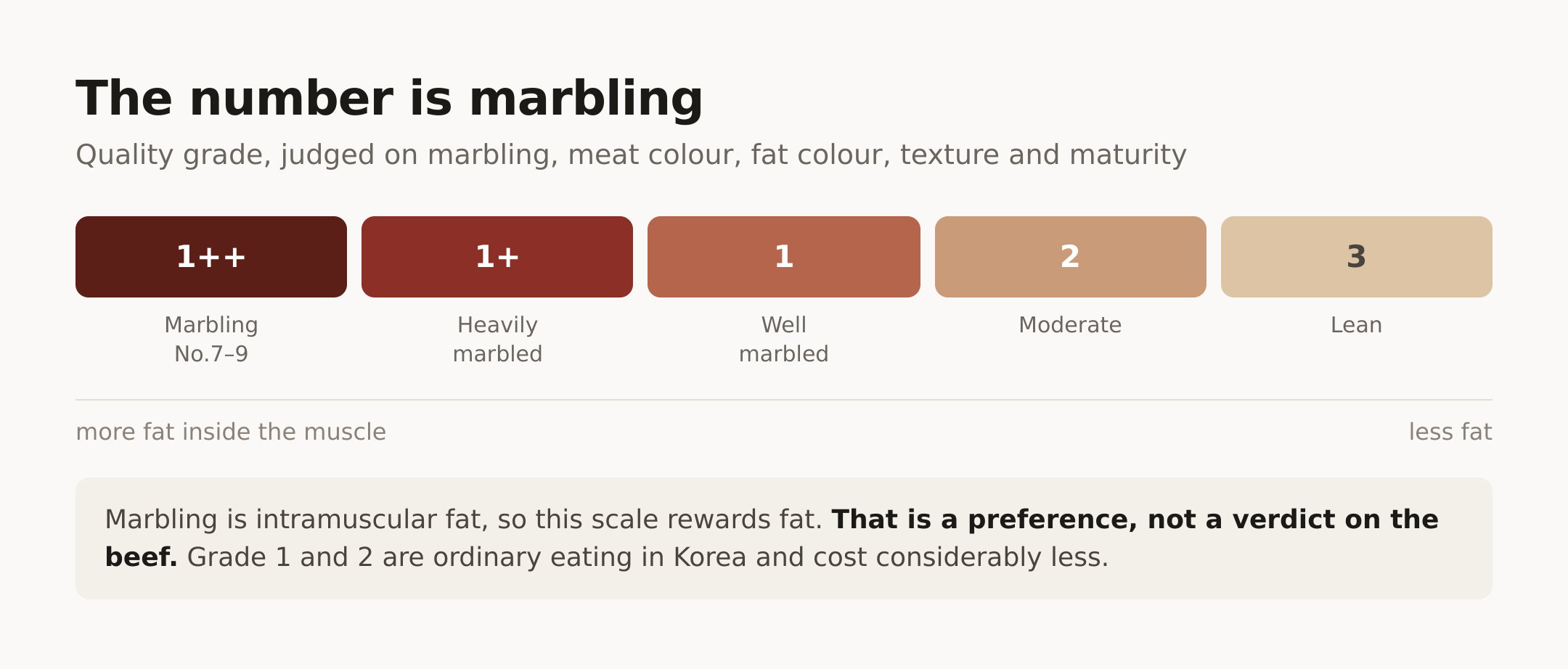
The number is quality. 1++, 1+, 1, 2, 3. It is judged on marbling, meat color, fat color, texture and maturity — and marbling carries it. A 1++ means marbling scored in the top band of the nine-point scale.
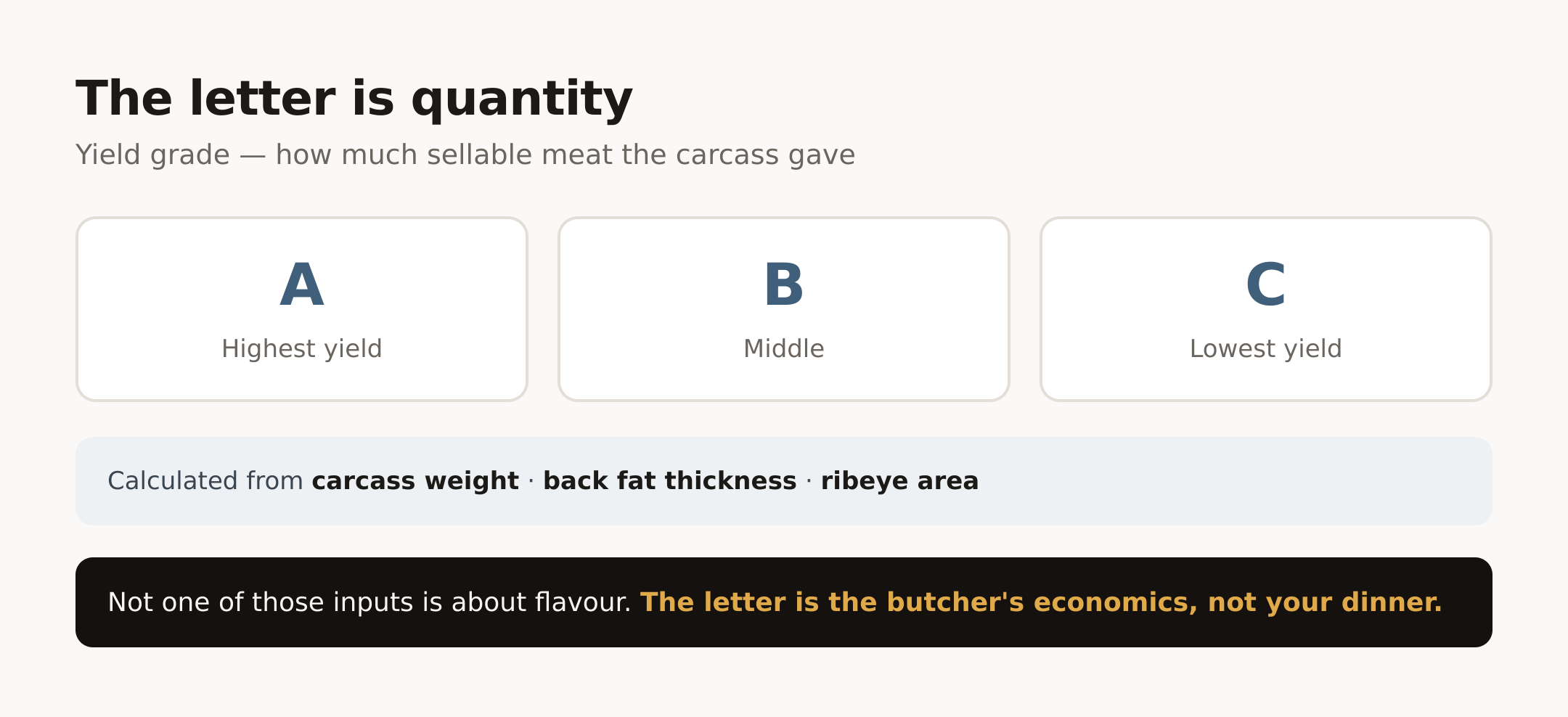
The letter is quantity. A, B, C. It comes from carcass weight, back fat thickness and ribeye area — how much sellable meat the animal yielded. It says nothing about how the beef tastes.
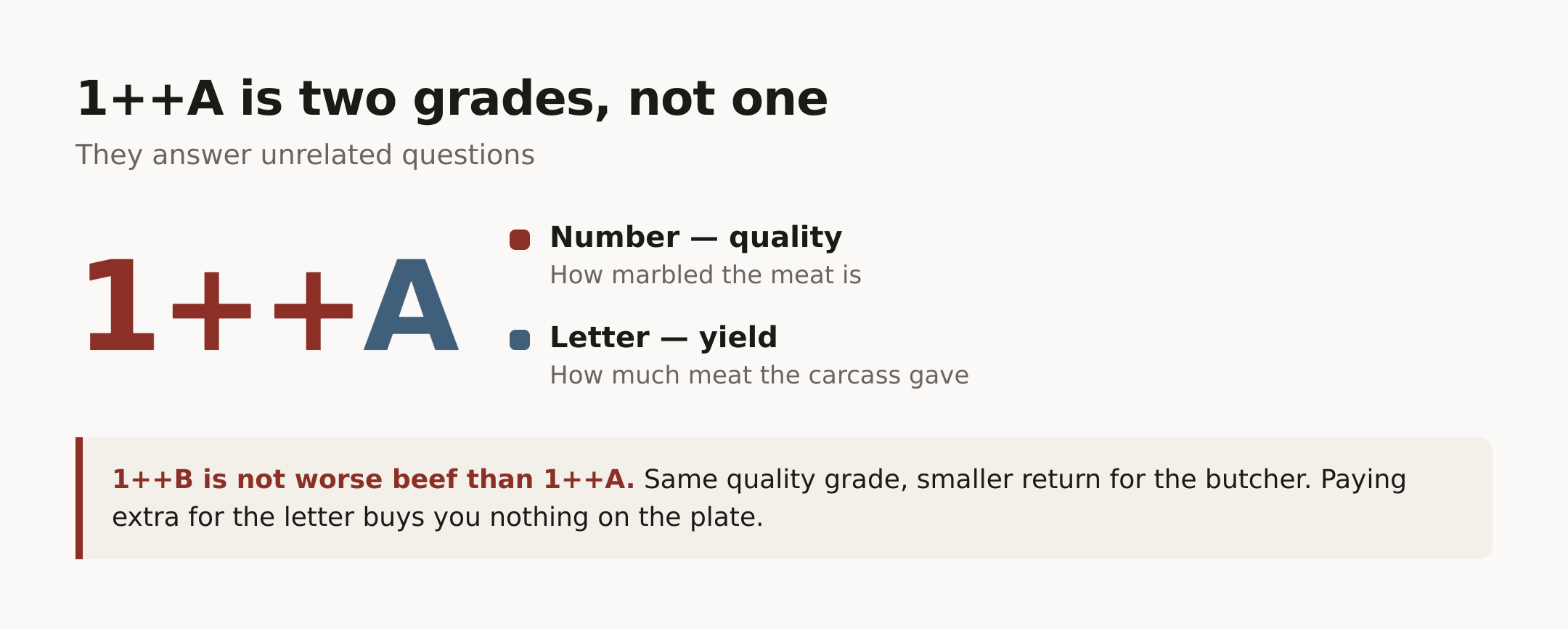
So 1++B is not worse beef than 1++A. It is the same quality grade from a carcass that gave less meat. If you have been paying a premium for the letter, you have been paying for the butcher's yield, not your dinner.
There is a second, quieter point here. Marbling is intramuscular fat, so a grading system led by marbling is a system that rewards fat. That is a preference, not a law of nature. Plenty of Koreans order grade 1 or 2 deliberately, because they want to taste beef rather than butter, and because the price gap is large.
So how do you use any of this at a table?
Reading a menu in about ten seconds
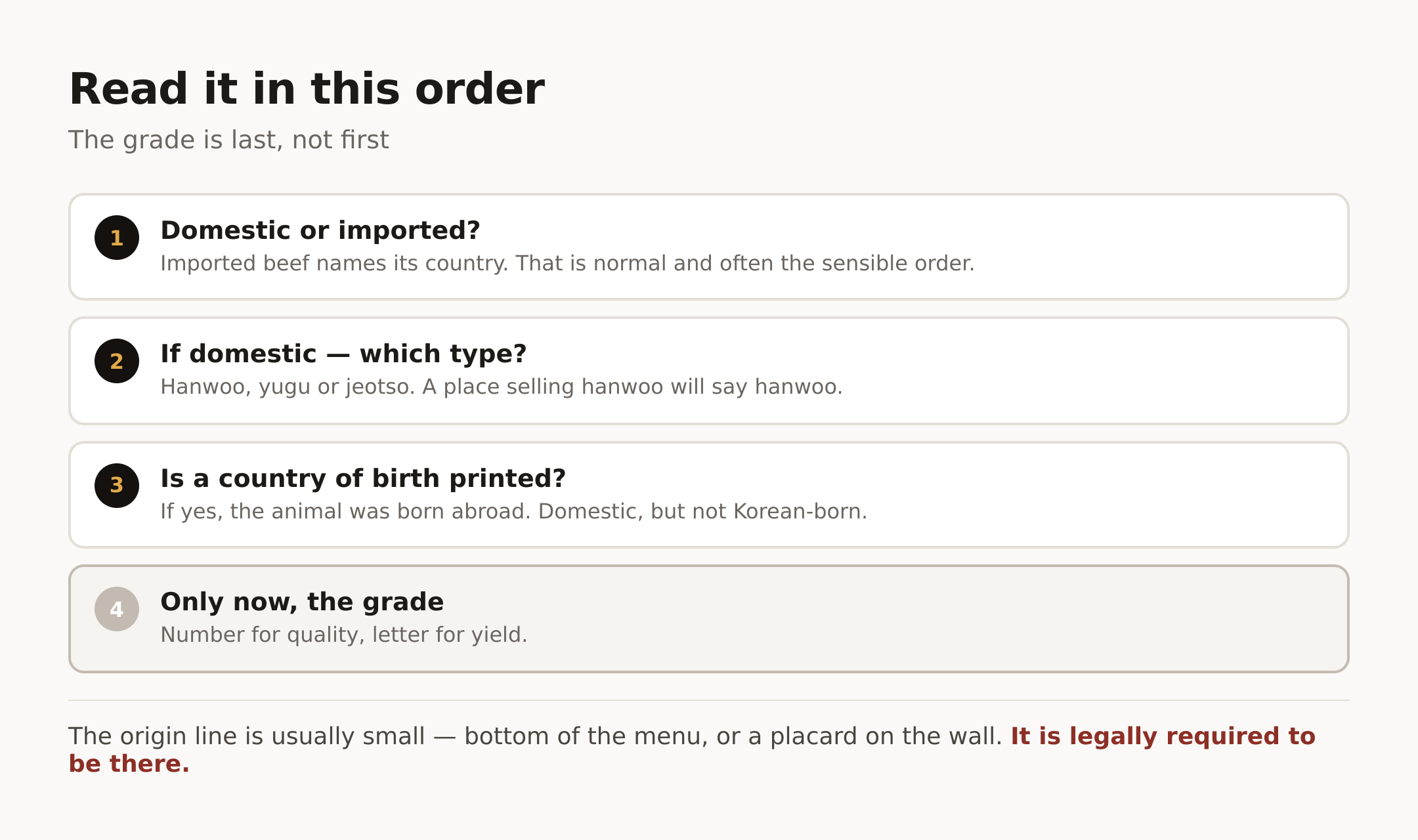
Find the origin line first. It is usually small, often at the bottom of the menu or on a wall placard, and it is legally required to be there.
Then take it in this order.
Is it domestic or imported? Imported beef will name its country. This is not a warning — imported beef is normal, common, and often the sensible order. It is just not hanwoo, and it should not be priced as if it were.
If domestic, which of the three types? Hanwoo, yugu, or jeotso. If a place is selling hanwoo, it will say hanwoo, because that word is the whole point of the price.
Is a country of birth printed? If yes, the animal was born abroad. Domestic, but not a Korean-born cow.
Only then look at the grade. Number for quality, letter for yield.
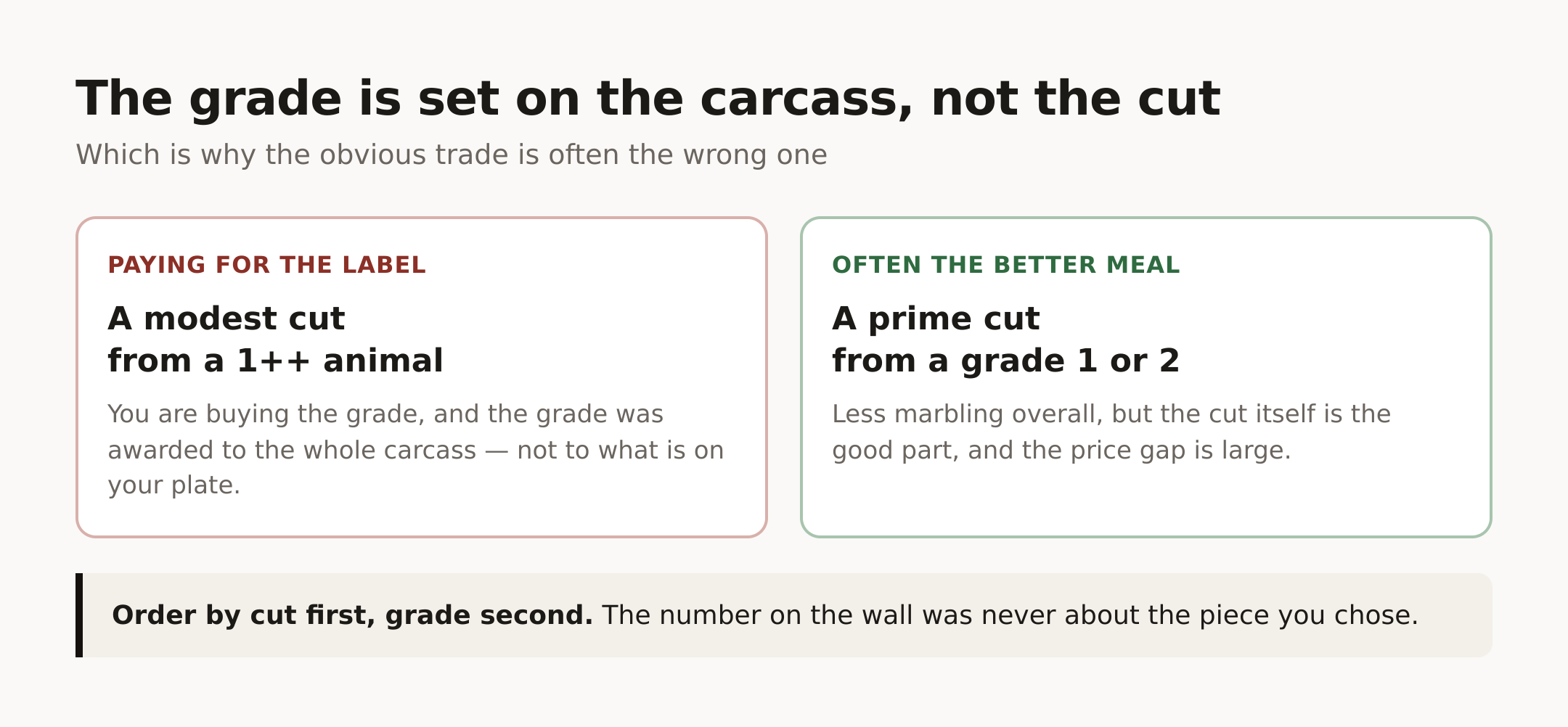
One practical note that saves more money than any of this: the grade is set on the carcass, not on the cut. A cheaper cut from a high grade and a prime cut from a middling grade are different trades, and the second one is often the better meal. If the marbled premium cuts are what you are after and the beef price is not, Galbi in Seoul: The All-You-Can-Eat Chain, and the One I Save Up For covers the cheaper end of the same craving.
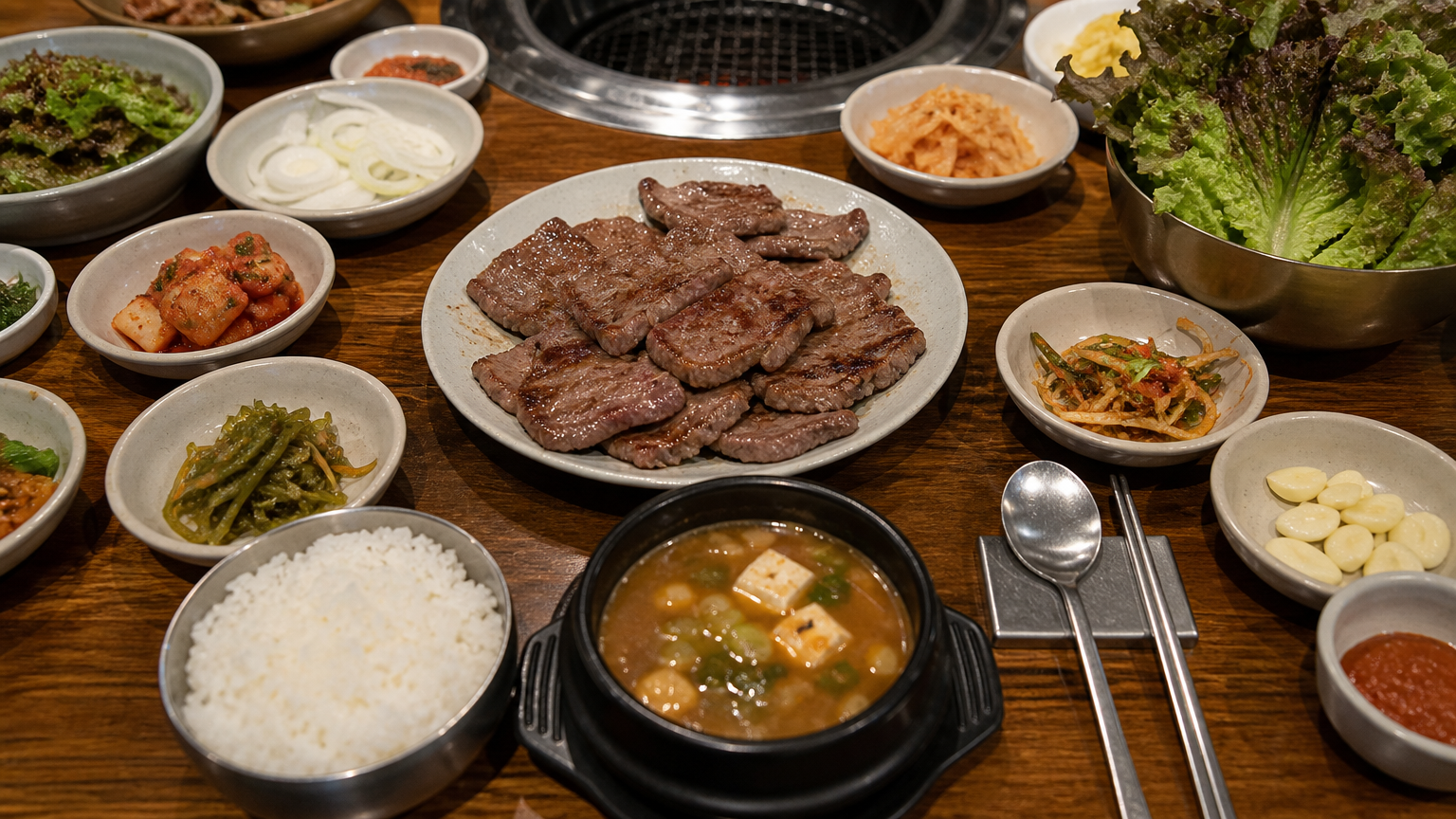
And keep the whole thing in proportion. None of this is a scam to detect. The labeling exists precisely so that the answer is available to anyone who looks, which is a stronger consumer protection than most countries manage for restaurant meat. The only mistake is paying hanwoo money without checking that hanwoo is what arrived.
The grade is the thing everyone repeats, and it is the last thing you should read. Check domestic versus imported, then the type of meat, then whether a birth country is printed. Hanwoo is a breed, not a compliment, and the menu is legally obliged to tell you whether you are getting it.
Next in this series, what Koreans order after the grill — and why the most famous version of it tastes, to a first-timer, like almost nothing at all.
FAQ
Does domestic beef in Korea mean it is hanwoo?
No. Domestic covers hanwoo, yugu and jeotso, and a cow born abroad but raised in Korea can still be labeled domestic — with its country of birth printed alongside. Look for the word hanwoo specifically.
What does 1++A actually mean?
Two separate grades. The number is the quality grade, driven mainly by marbling. The letter is the yield grade, from carcass weight, back fat thickness and ribeye area. The letter tells you nothing about taste.
Is a lower grade worse beef?
It is less marbled. Whether that is worse depends on whether you want fat. Grade 1 and 2 hanwoo is ordinary eating in Korea and costs considerably less.
Are restaurants really required to print this?
Yes. Origin labeling is mandatory for restaurants across beef, pork, chicken, duck, lamb and goat, plus rice, the cabbage and chili powder in kimchi, soybeans and a long list of seafood. Beef carries the extra requirement to state the type of meat.
Should I avoid imported beef?
No reason to. It is widely eaten and often better value. The point is to know which one you are buying before you pay hanwoo prices for it.
References
Act on Origin Labeling of Agricultural and Fishery Products, Article 5(3), and its Enforcement Decree Article 3(5), consulted through Korea's National Law Information Center. Restaurant labeling method and the hanwoo, yugu and jeotso definitions from the Enforcement Rule's Annex 4, cross-checked against public health office guidance. Beef grading criteria (quality grades 1++ to 3; yield grades A to C) from Korea Institute for Animal Products Quality Evaluation materials.