Tipping in Korea: You Don't — But Screens Have Started Asking

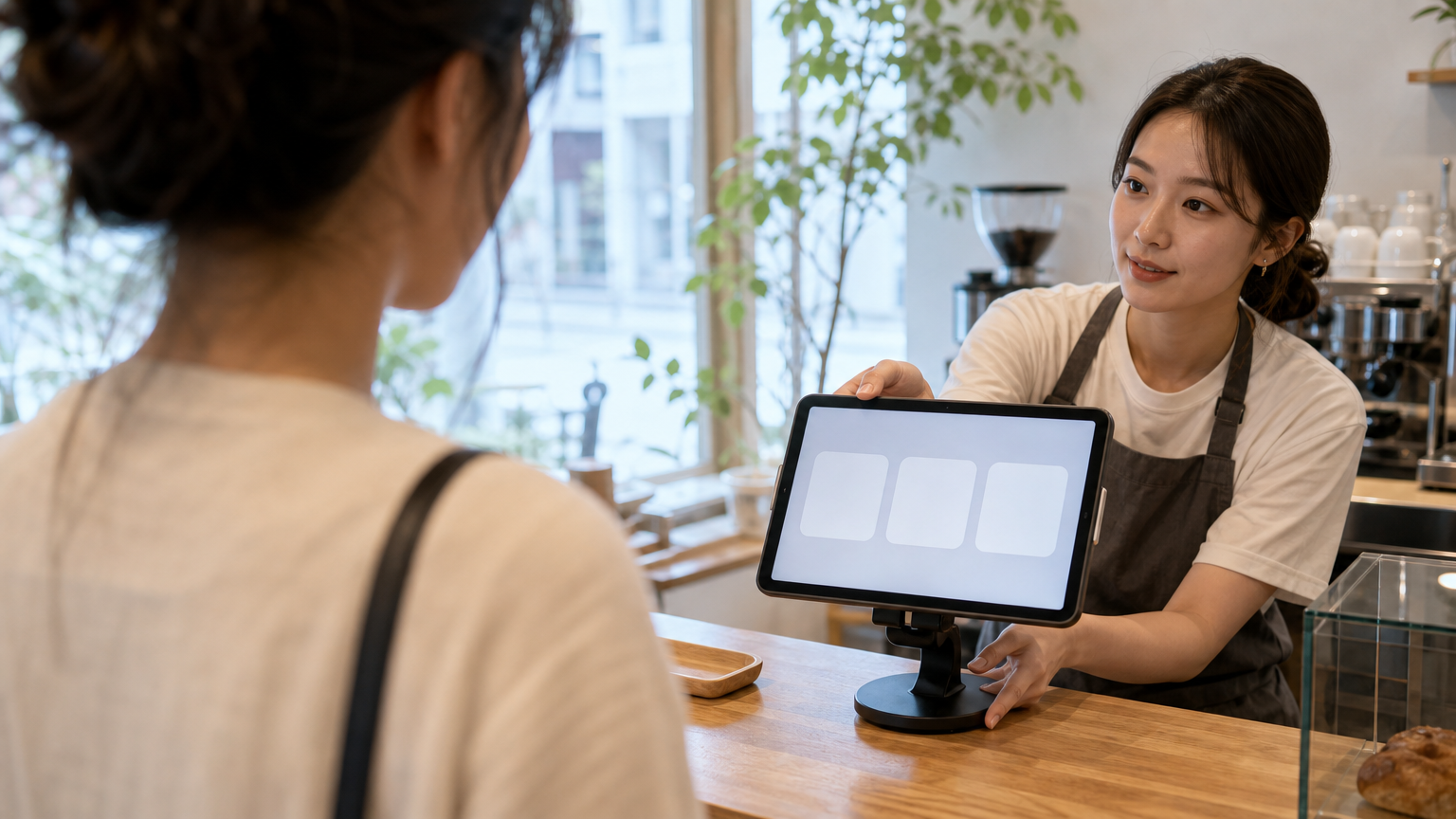
A friend texted me a photo from a café in Seoul last spring. The tablet had been turned toward her, and there were three buttons on it: 5%, 7%, 10%.
"I thought you said Korea doesn't do tips."
She was right. I did say that, and it is still true. But the sentence I gave her — the one every guide gives you — has stopped being the whole answer. Somewhere between 2023 and now, screens in Korea started asking a question Koreans had never been asked before, and most of us still don't know what face to make when it happens.
The short answer, and why it is no longer one line
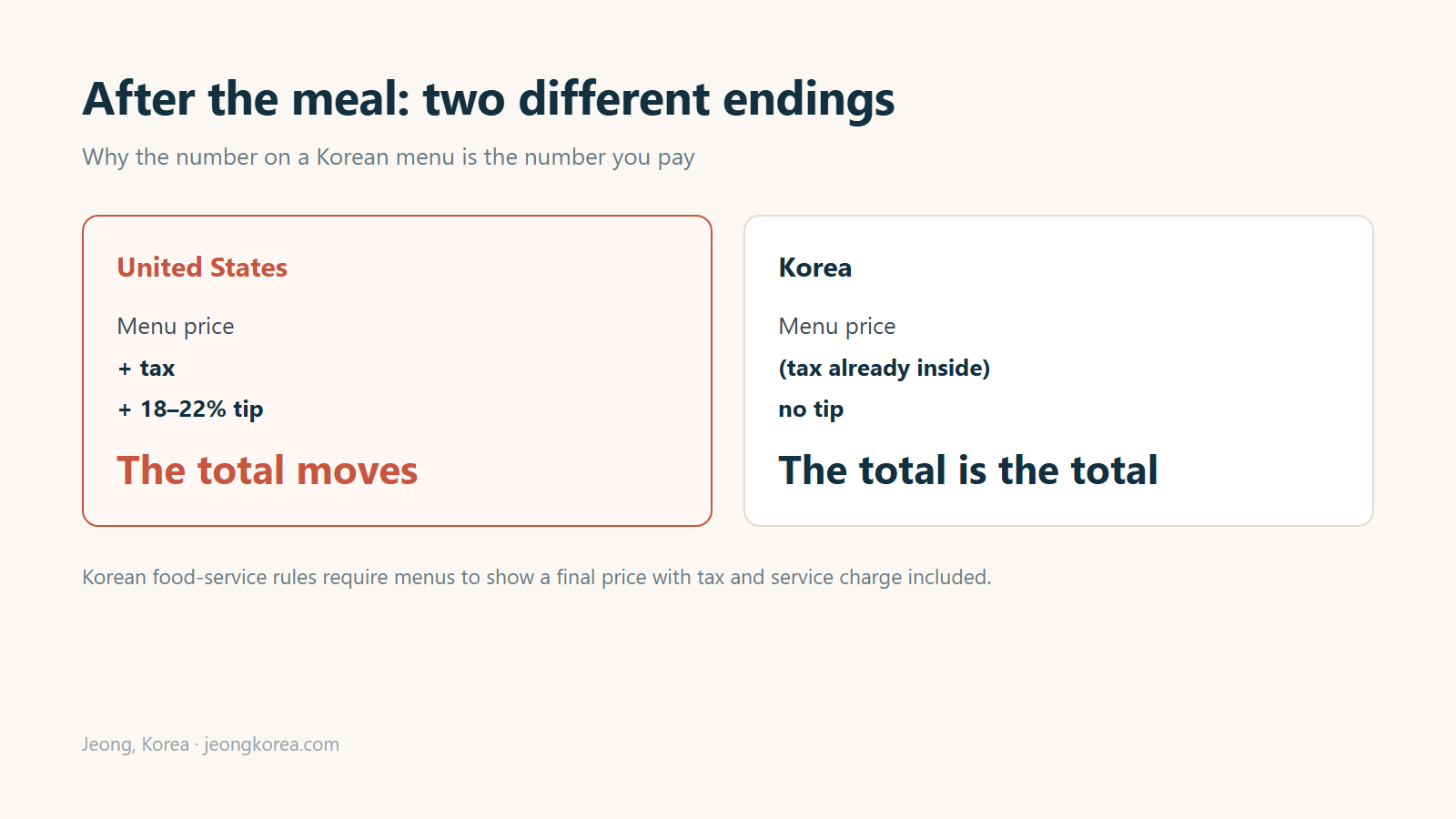
There is no tipping in Korea. Not in restaurants, not in taxis, not at the hair salon, not at the front desk. Staff are not paid on the assumption that you will make up the difference, which is the part that matters — the wage is the wage.
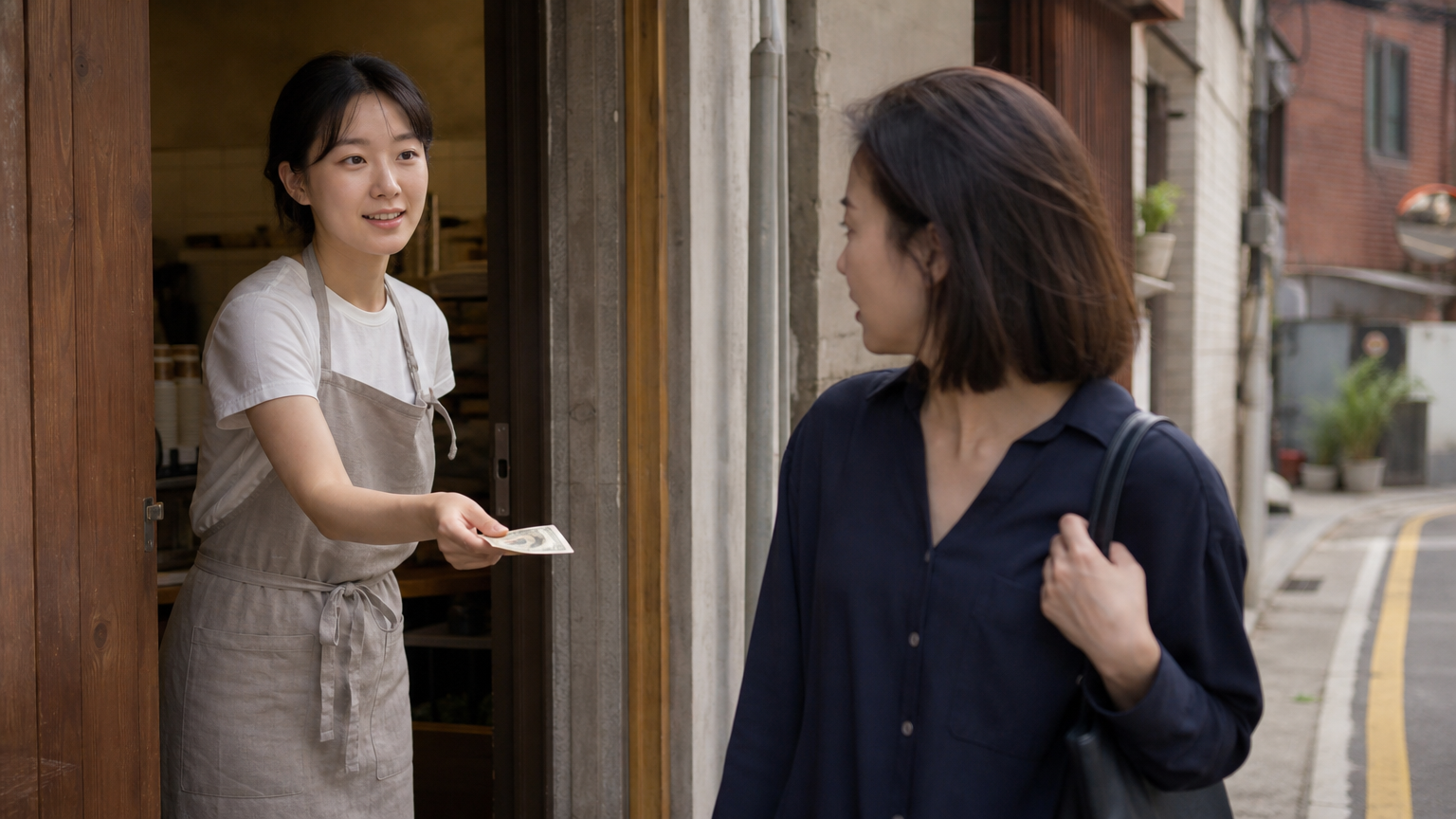
If you leave cash on the table, the most likely outcome is that someone will pick it up and follow you out the door to give it back. I have watched this happen. It is not a performance of politeness; the server genuinely thinks you forgot it.
So when people ask me about tipping in Korea, my answer has always been one word. What changed is that the one word no longer covers the situation my friend was standing in, with a tablet pointed at her and a line forming behind her.
Where the screens started asking
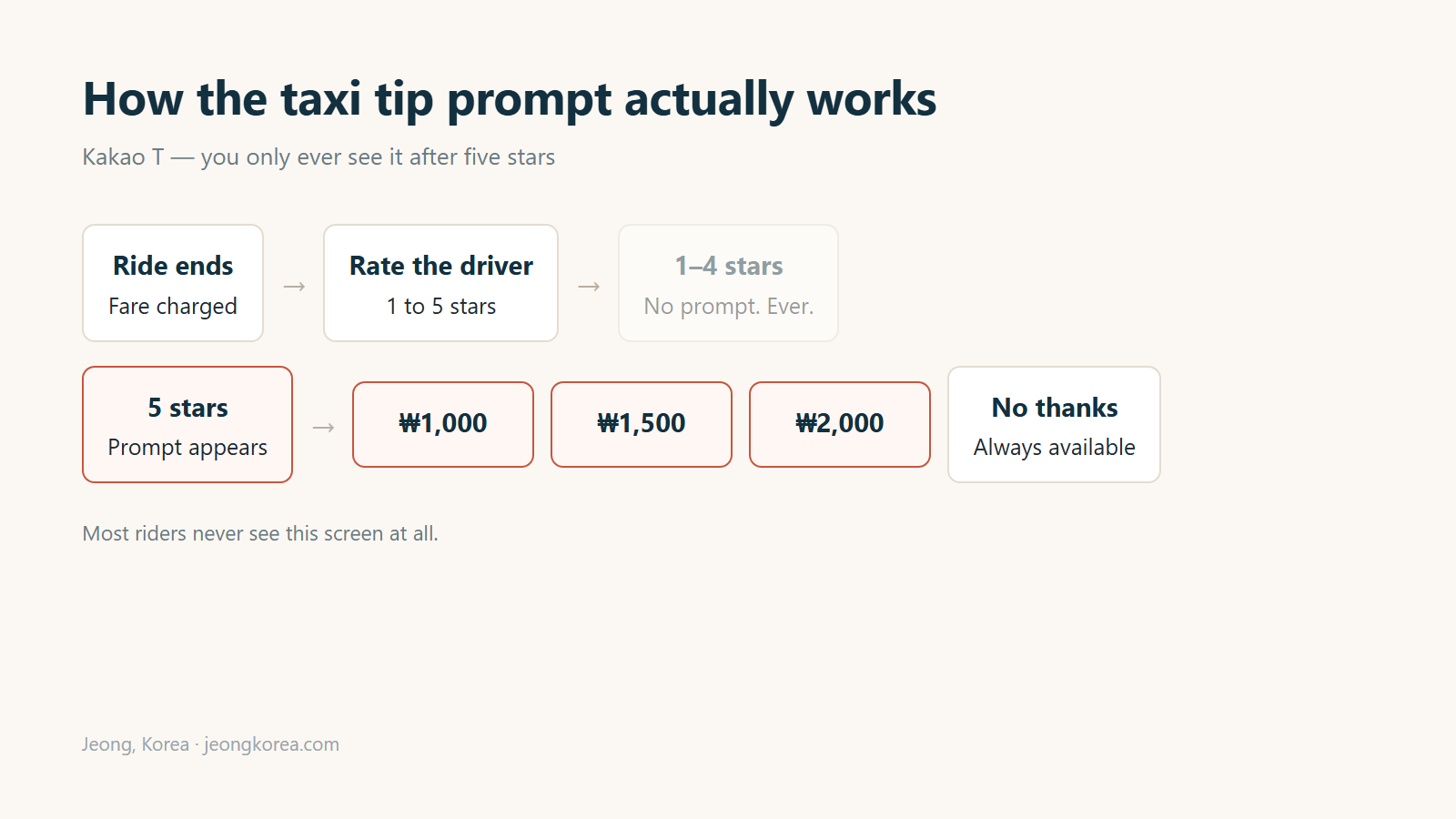
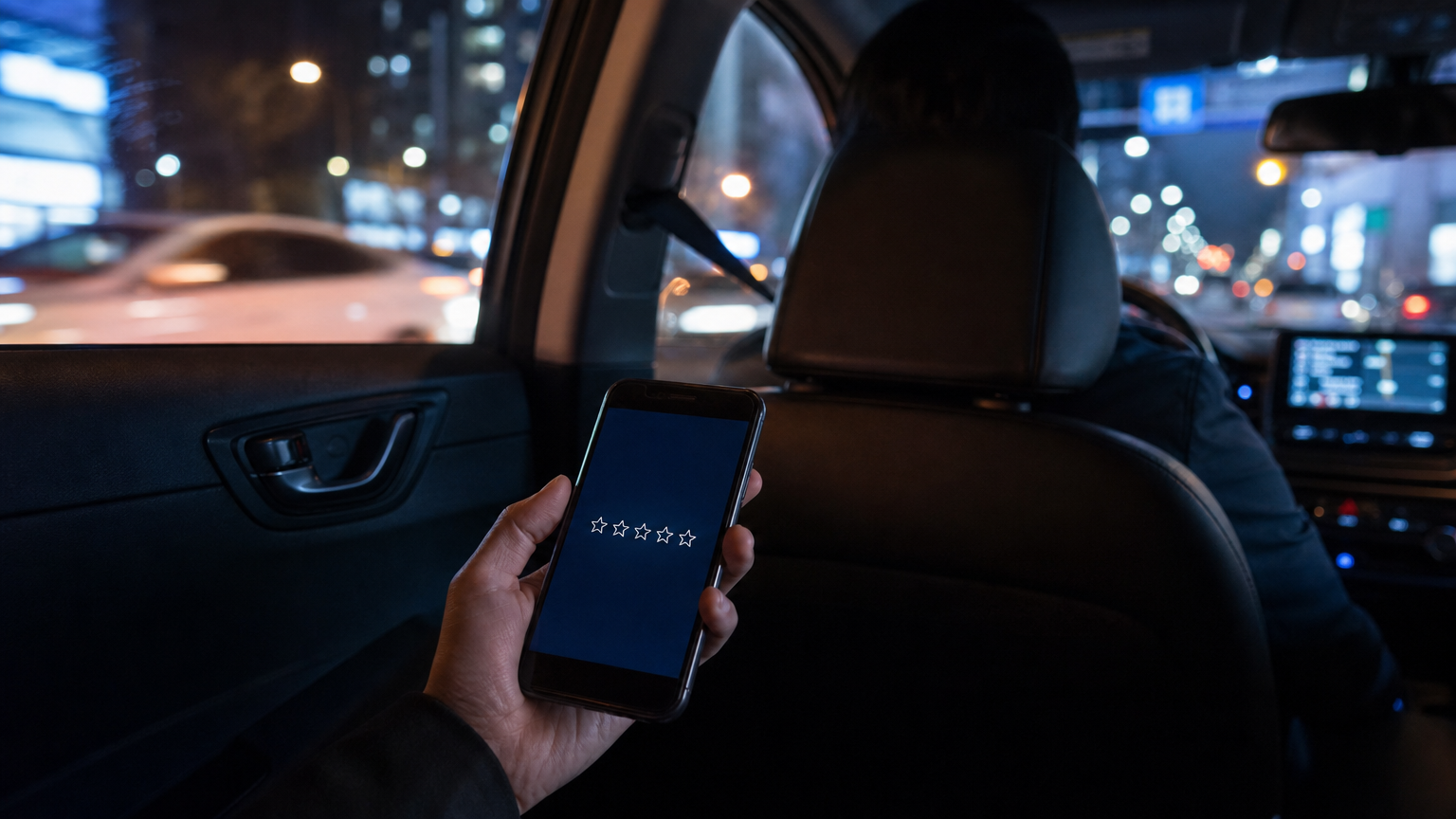
In July 2023, Kakao T — the taxi app almost everyone here uses — added a tip function. It is more careful than it sounds. The prompt only appears after you rate the ride five stars, it offers ₩1,000, ₩1,500, or ₩2,000, and there is a button that means no. If you give four stars, you never see it.
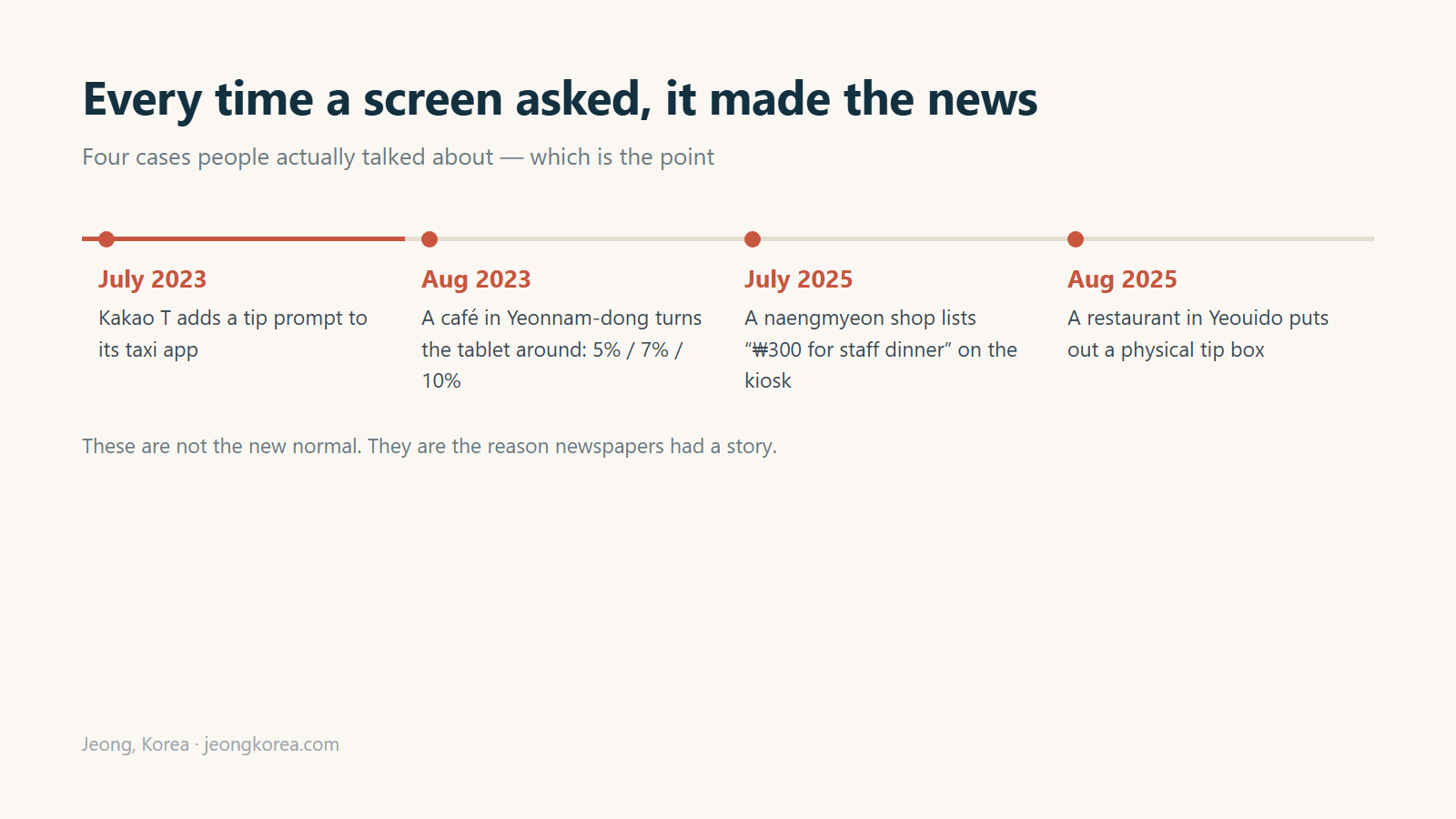
Then it spread sideways, in small strange bursts that each made the news:
| Where | What it looks like | What Koreans did about it |
|---|---|---|
| Kakao T taxi app | Appears only after a 5-star rating; ₩1,000 / ₩1,500 / ₩2,000 | Argued about it in the comments for a week |
| A café in Yeonnam-dong | Staff turn the tablet around before payment: 5% / 7% / 10% | Made national news as a complaint |
| A restaurant in Yeouido, 2025 | A physical tip box on the counter | Made national news again |
| A naengmyeon shop, July 2025 | A kiosk option labelled "₩300 for staff dinner" | Same |
Look at that last column. Every one of these became a story. That is the actual data point I want you to leave with: these are not the new normal, they are the reason the newspapers had something to write about. A tip box in Seoul is roughly as ordinary as a tip box in Tokyo — which is to say, someone will take a photo of it.
The law is standing next to you
This is the part no English guide seems to mention, and it is the part that should make you relax.
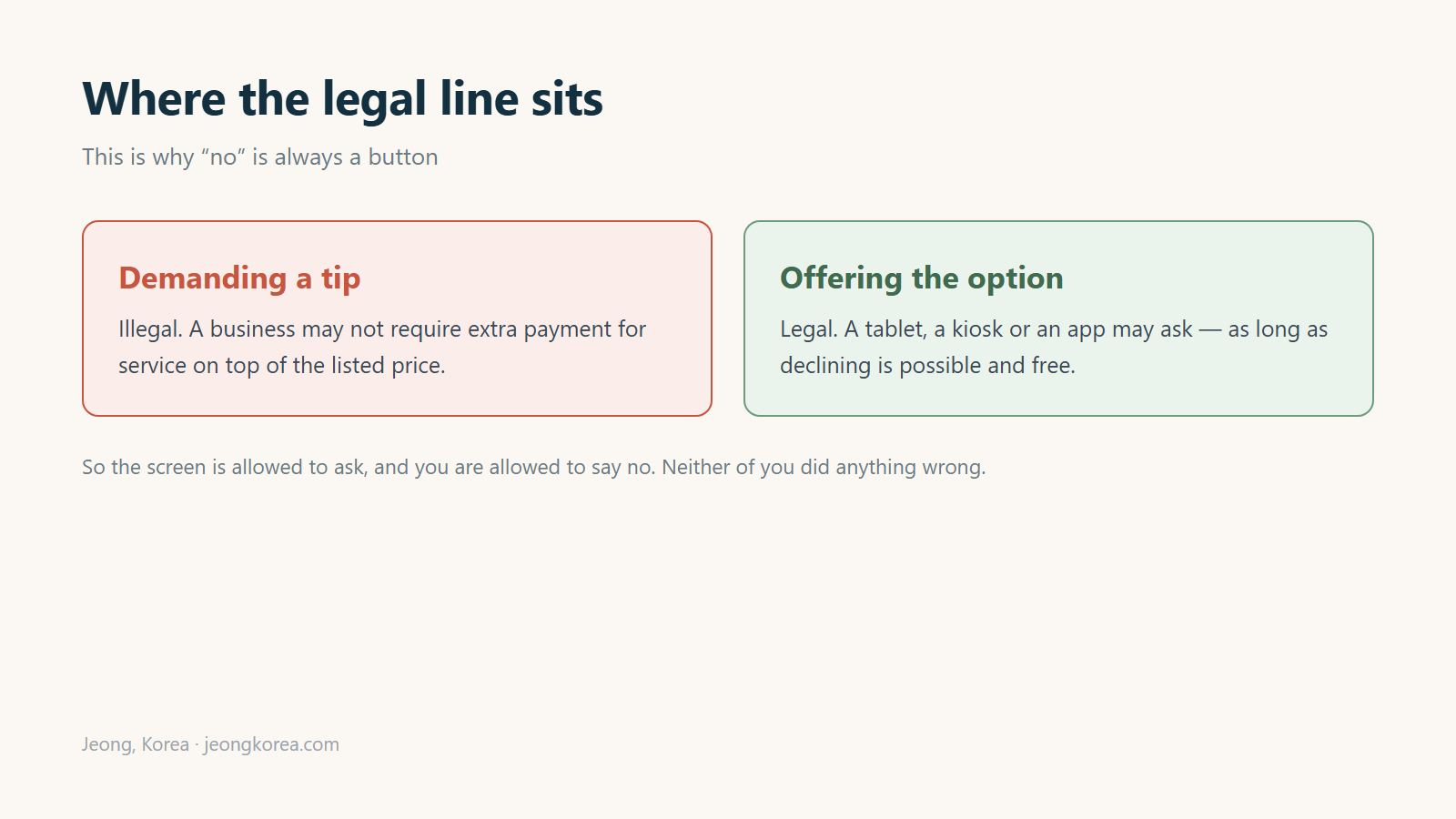
Demanding a tip is illegal here. Offering one as an option is not. That line is the whole legal picture, and it means the tablet is allowed to ask and you are allowed to say no, and neither of you has done anything wrong.
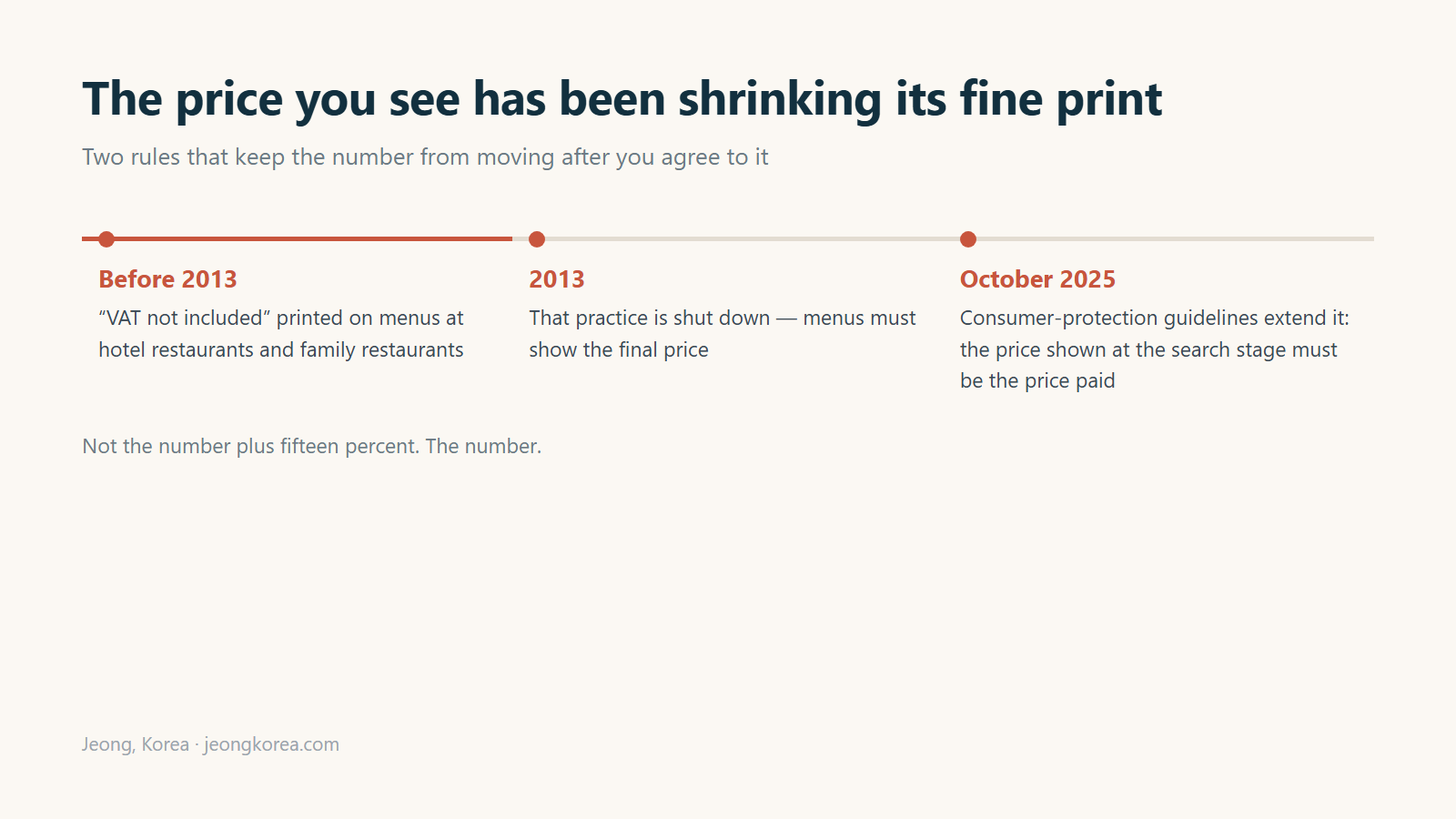
Underneath that sits a rule about prices. Korean food-service law requires the menu to show a final price with tax and service charge already inside it. In 2013 the practice of printing "VAT not included" was shut down, and from October 2025 the consumer-protection guidelines pushed it further — the price you see at the search stage has to be the price you pay.
So the number on the menu is the number. Not the number plus fifteen percent, not the number plus a tip you calculate in your head while people wait behind you. The number.
The one place money is already added — and it is not a tip
If you stay at a large hotel, look at the bill. You may find a 10% service charge sitting there.
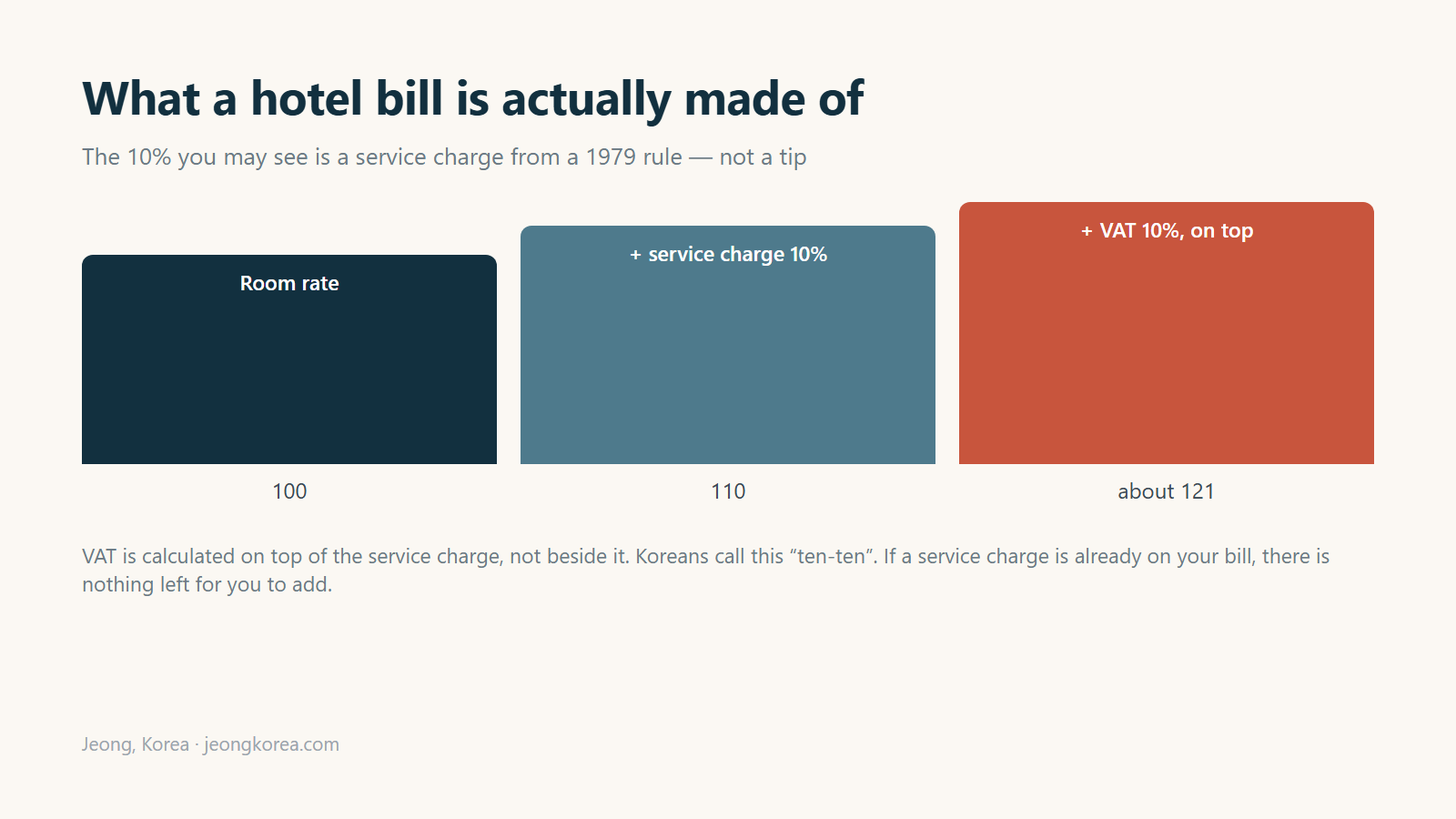
That is not a tip and it is not new. It came from a 1979 transport-ministry rule that set service charges at 10% of room and food-and-beverage bills. The government recommended dropping it in 2006. Some hotels did; some never did.
The part that surprises people is what happens next: VAT is calculated on top of the service charge, not beside it. Koreans call this ten-ten, and the total can land around 21% above the headline rate.
| What it is | Do you add anything? | |
|---|---|---|
| Service charge (봉사료) | A fixed 10% at some hotels, on the bill already | No |
| VAT | 10%, calculated on top | No |
| Tip | Does not exist as an expectation | No |
Two things follow. First, if you have already been charged a service charge, you have nothing left to add. Second, this is exactly why the final-price rule exists — so the number stops moving after you have agreed to it.
What I actually tell friends before they land
-
Restaurants and cafés. Pay what the menu says. If a screen asks, the answer is no, and nobody's day is ruined.
-
Taxis. No. If the driver was genuinely good and you want to do something, five stars is the thing that helps them. The app will offer ₩1,000 after that if it wants to.
-
Hotels. Check whether a service charge is already on the bill. If it is, you are done.
-
Delivery. There is no tip field. The apps never built one.
-
Hair salons, bathhouses, guesthouses. No, no, and no.
There is no situation in daily life here where Koreans routinely hand over extra money for service. I want to be plain about that rather than invent an exception to sound balanced.
So what do you do when the tablet turns around?
You say no. In Korean, 괜찮아요 (gwaenchanayo) does the whole job, and a small shake of the head does it too.
The reason I am confident telling a visitor this is that I would do the same thing, and so would the person behind me in line. The screen is new to us as well. You are not failing to understand a local custom — you are watching one being argued about in real time, and you happen to be holding the card.

FAQ
Is it rude not to tip in Korea?
No. It is the normal thing to do. Tipping is not built into wages here, so declining does not take money from anyone.
What do I do if a payment screen asks me for a tip?
Choose the option that means no. It is always there, because requiring a tip is illegal — a business may offer, but may not demand.
Do I tip taxi drivers in Korea?
No. Kakao T only shows a tip prompt after a five-star rating, and it is optional. Most riders never see it.
What is the service charge on my hotel bill?
A 10% charge that originated in a 1979 rule, still applied at some hotels. VAT is then calculated on top, which is why the total can reach about 21%. It is not a tip and nothing further is expected.
Do I tip for food delivery in Korea?
No. Korean delivery apps have no tip function.
Is tipping in Korea becoming normal?
Not yet. Every case so far — a café tablet, a tip box, a kiosk line item — became a news story precisely because people found it unusual.
Sources
Sources: Hankyung, Kookmin Ilbo, Kookmin Ilbo — tip boxes, Sisaweek — hotel service charges