Food Delivery Apps in Korea: Which One Works Without a Korean Phone Number

You land, you get to your room, you're too tired to go out, and you do the obvious thing: download the app everyone told you about. Then the sign-up screen asks for a Korean phone number, and that's where the evening ends.

This is the single most common thing my friends message me about after they arrive. Not the subway, not the language. Dinner.
Why Sign-Up Is the Real Barrier
Korea runs on phone-number identity. Most consumer services verify you by sending a code to a Korean carrier number, and some go further and ask for an ARC (the residence card foreigners get) or a domestic bank account. None of that is aimed at keeping visitors out — it's just how the plumbing was built.
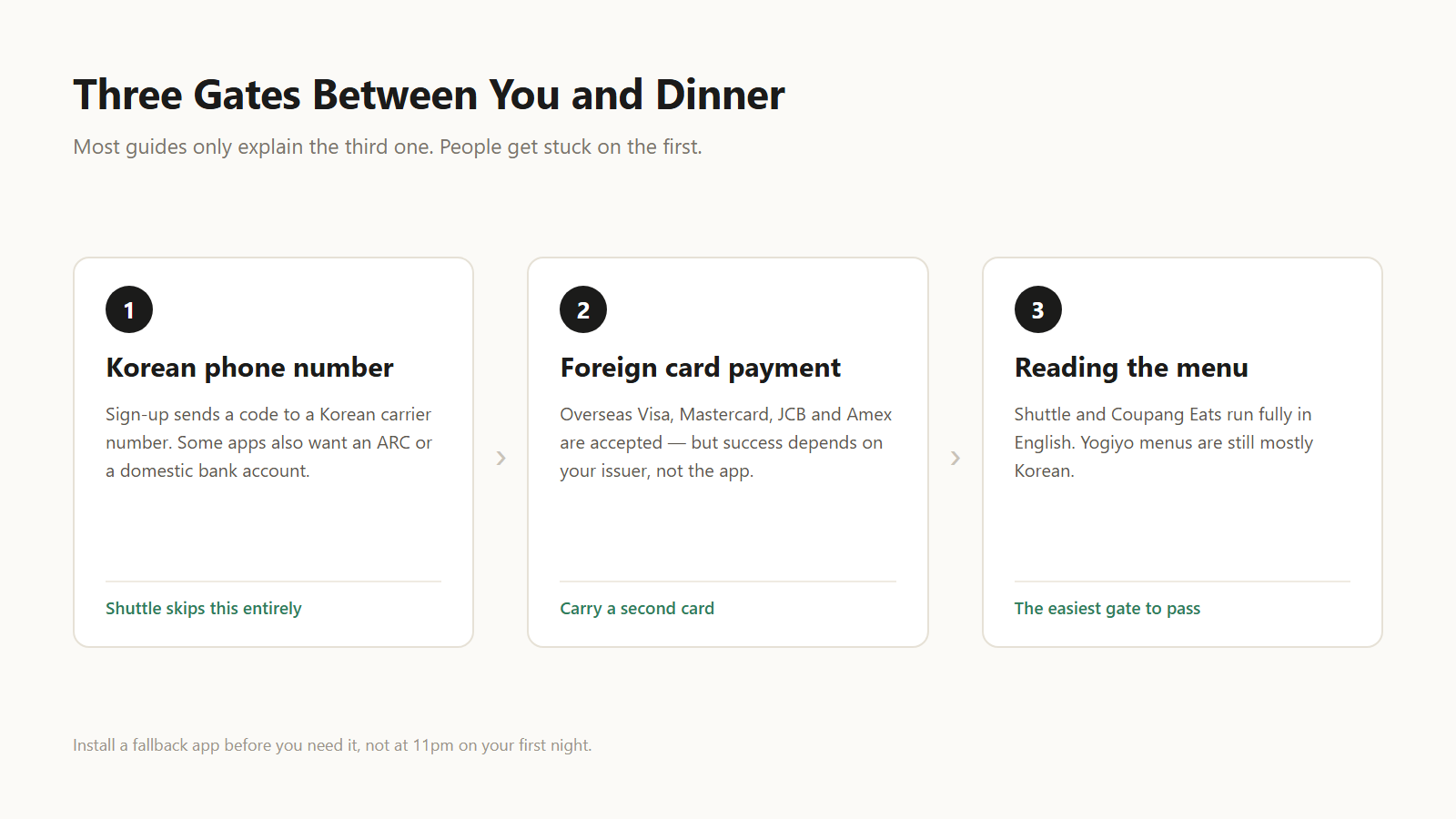
So the question isn't "which food delivery app is best." It's which one lets you in at all, and that depends on exactly three things.
-
Can you sign up without a Korean phone number?
-
Will it take your foreign card?
-
Can you read the menu?
Most guides answer only the third one, which is why people still get stuck.
The Four Apps, Compared
| App | Sign-up without Korean number | English | Notes |
|---|---|---|---|
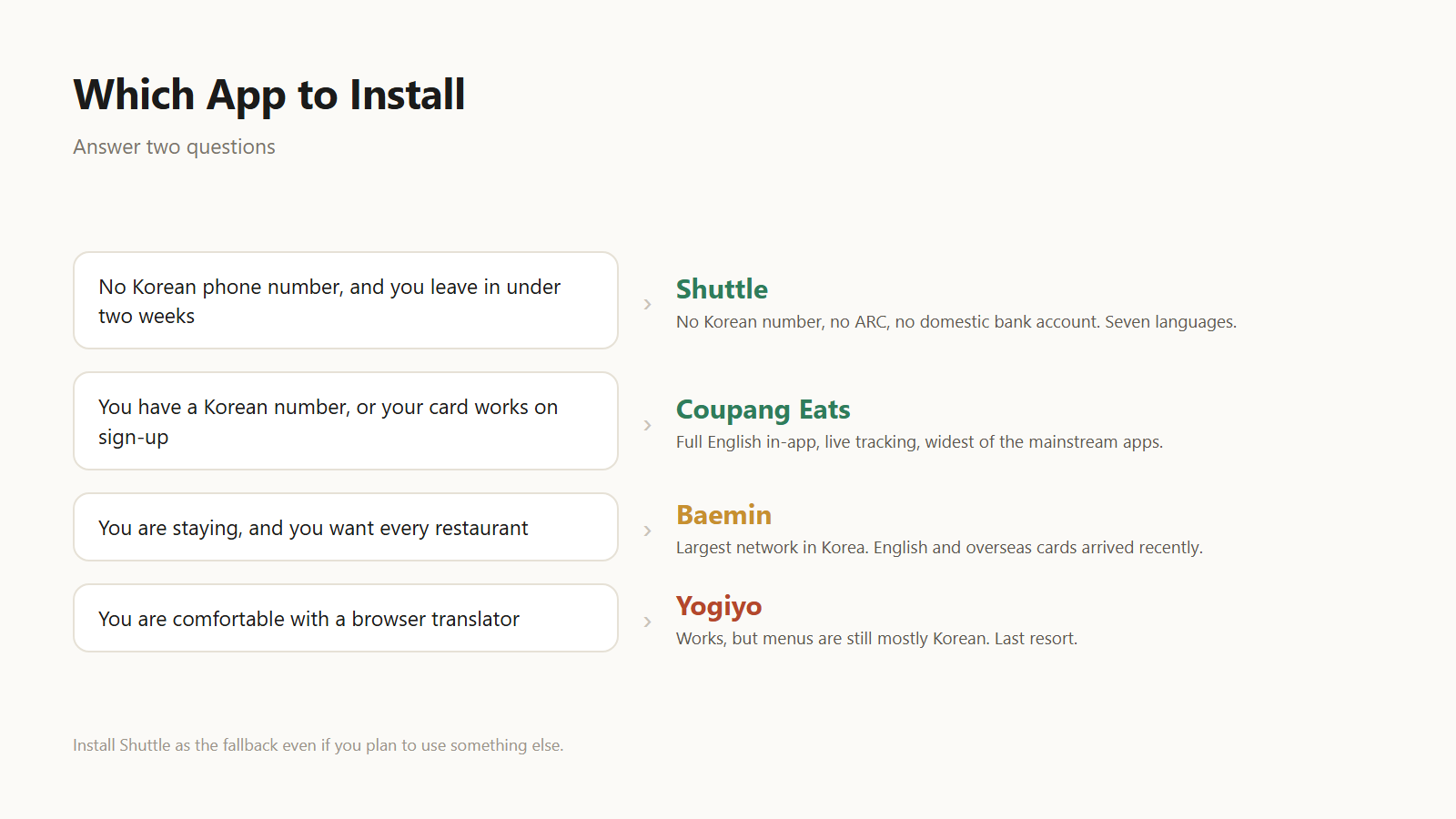
| Shuttle | Yes | Full | Built for foreign residents and visitors |
| Coupang Eats | Usually | Full, in-app switch | Widest restaurant coverage of the three below |
| Baemin (배달의민족) | Sometimes | Added recently | Largest network in Korea |
| Yogiyo | Difficult | Partial | Menus still largely Korean |
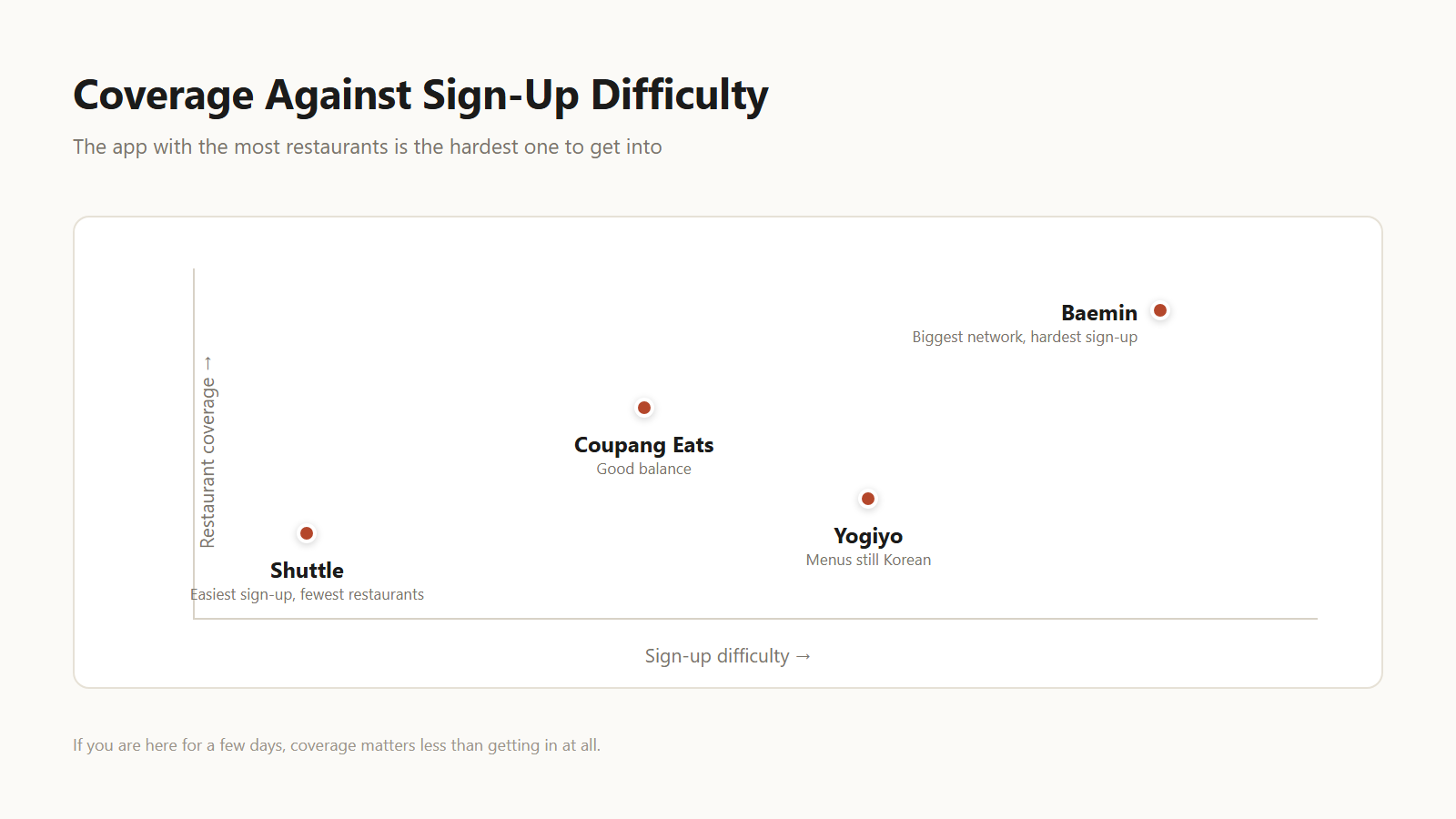
Shuttle is the outlier, and the one I send people to first. It was built specifically for foreigners: no Korean phone number, no ARC, no Korean bank account. The app runs in Korean, English, Vietnamese, Thai, Bahasa Indonesia, Japanese, and Simplified Chinese. The trade-off is coverage — it operates in a smaller set of areas and lists fewer restaurants.
Coupang Eats has an in-app language switch and real-time tracking, and it's the one most of my friends end up settling on once they're past sign-up.
Baemin is the biggest network by a distance, and it has opened up to foreign users over the past couple of years — English support and overseas-card payment both arrived recently. If you want the widest choice of restaurants, this is where it is.
Yogiyo technically works, but the menus are still mostly Korean. People use the website with a browser translator rather than the app.
What It Actually Costs
Delivery is not free here, and the fee is separate from the food.
| Item | Typical range |
|---|---|
| Delivery fee | ₩1,000–5,000 |
| Coupang Eats, no membership | ₩2,000–4,000 |
| Minimum order | Set per restaurant |
| Tip | Not expected |
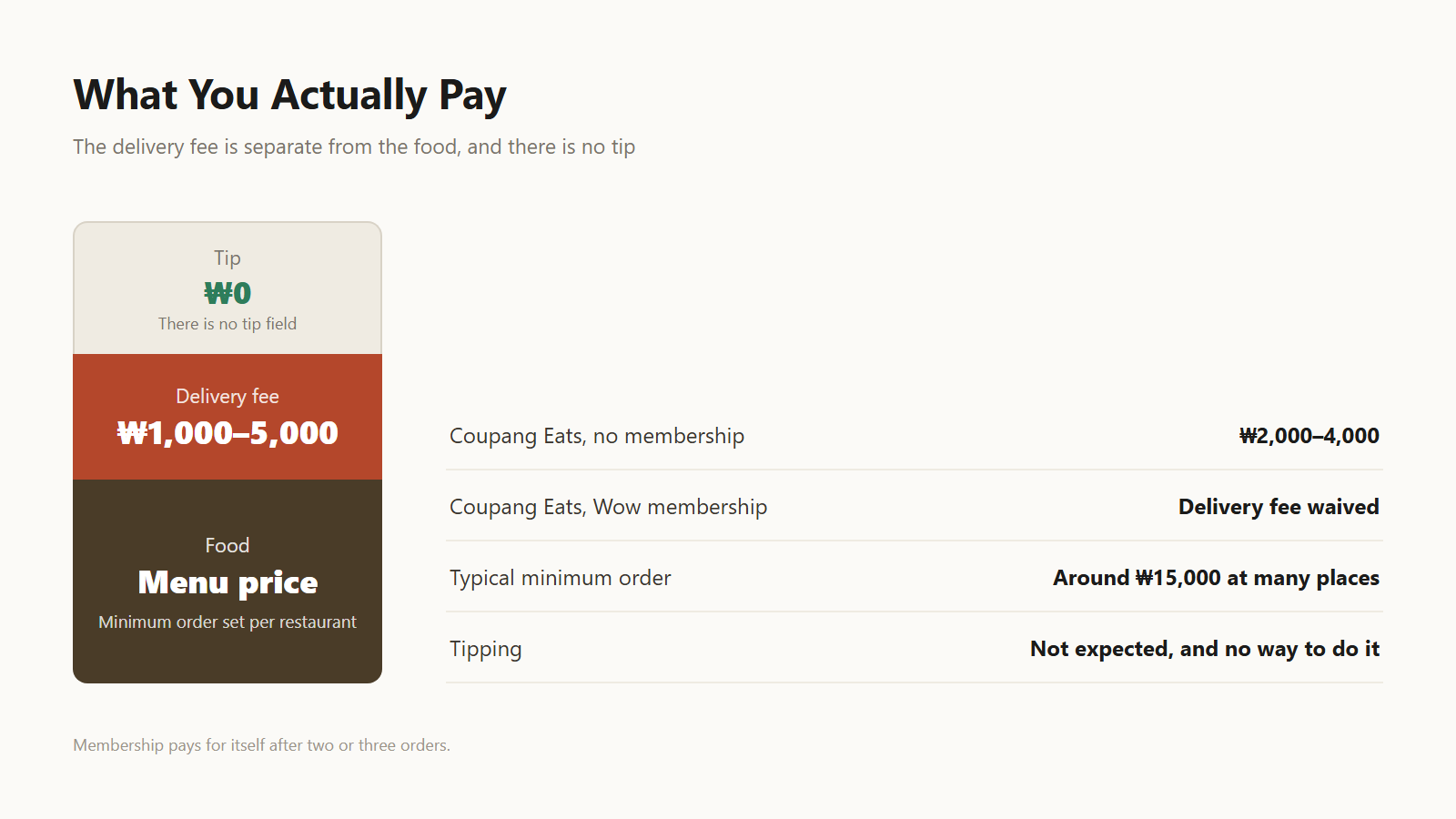
Two things worth knowing. Membership tiers change the maths — Coupang's Wow membership removes the delivery fee, which pays for itself quickly if you're ordering more than a couple of times. And nobody tips. There is no tip line, no cash handoff, no awkward calculation. The price you see is the price.
Getting the Address Right
This is the part that trips people up after sign-up, and it has nothing to do with the app.
Korean addresses are not the address your hotel booking shows you in English. Delivery apps want a Korean-format address, and the reliable move is to copy it from your accommodation's Korean listing rather than translate it yourself.
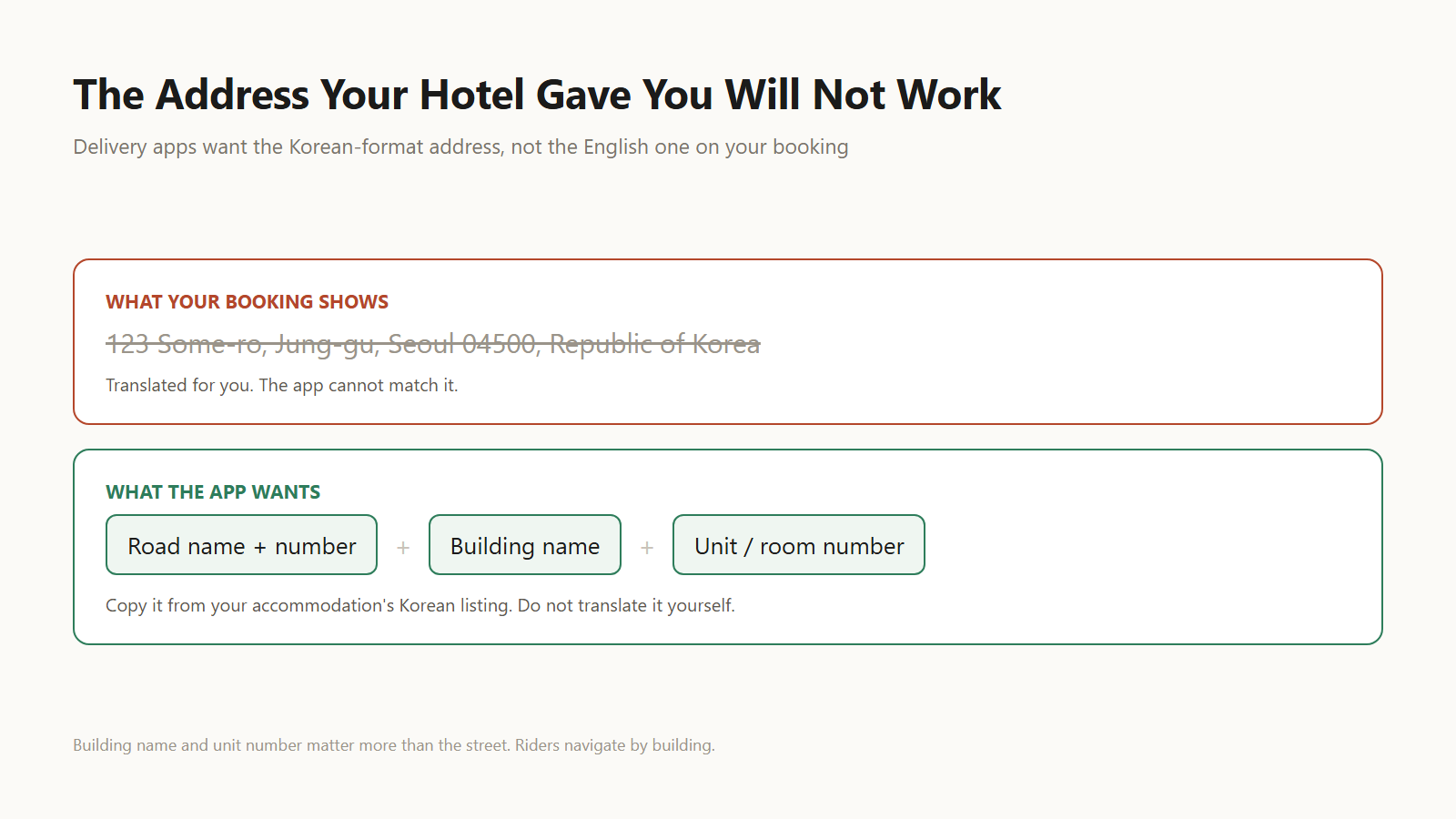
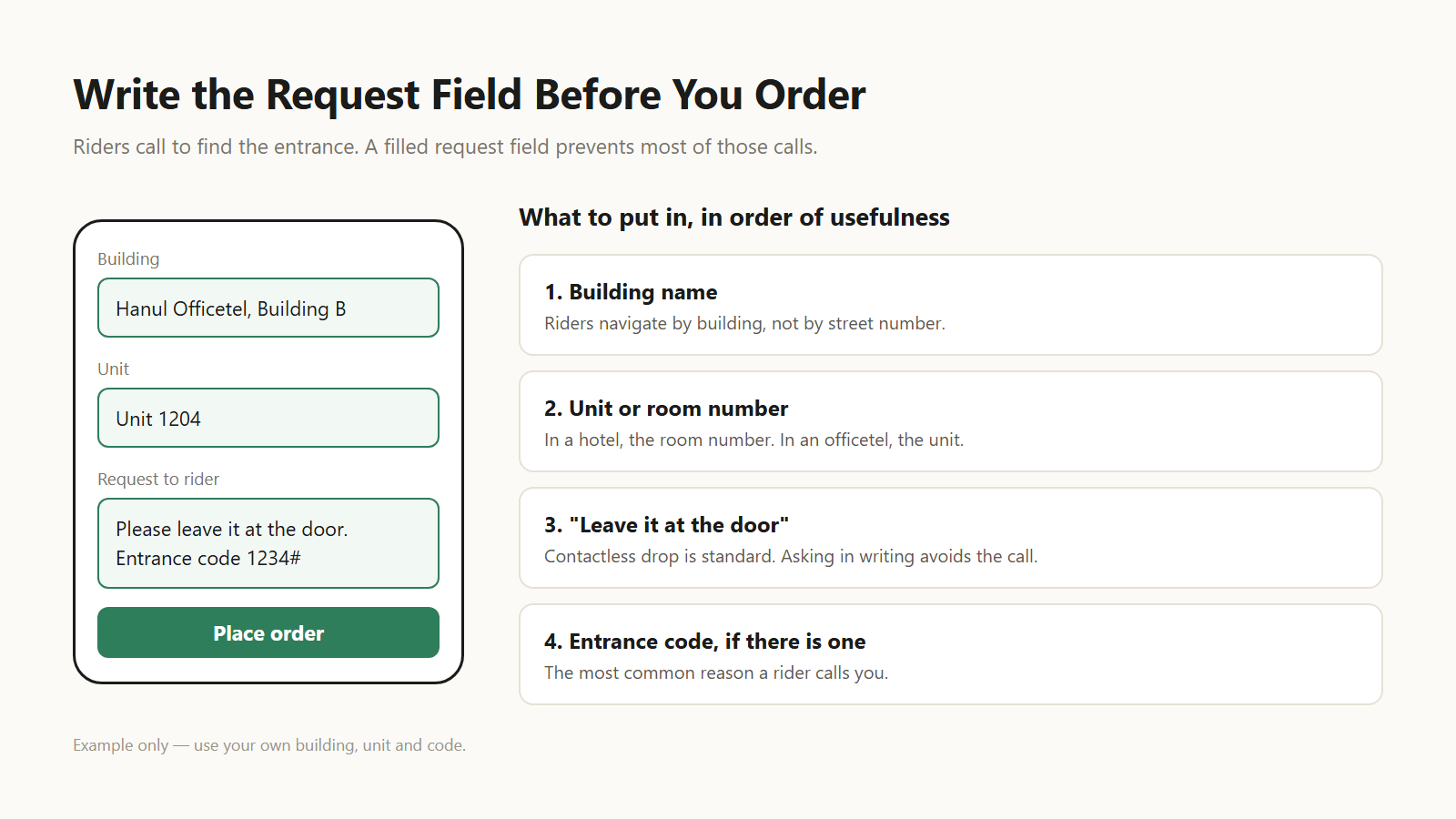
If you're in a hotel, put the hotel name and the room number in the delivery request field. If you're in a guesthouse or an officetel, the building name and unit number matter more than the street. Riders call — a lot — and if you can't take a Korean call, type the details into the request field before you order.
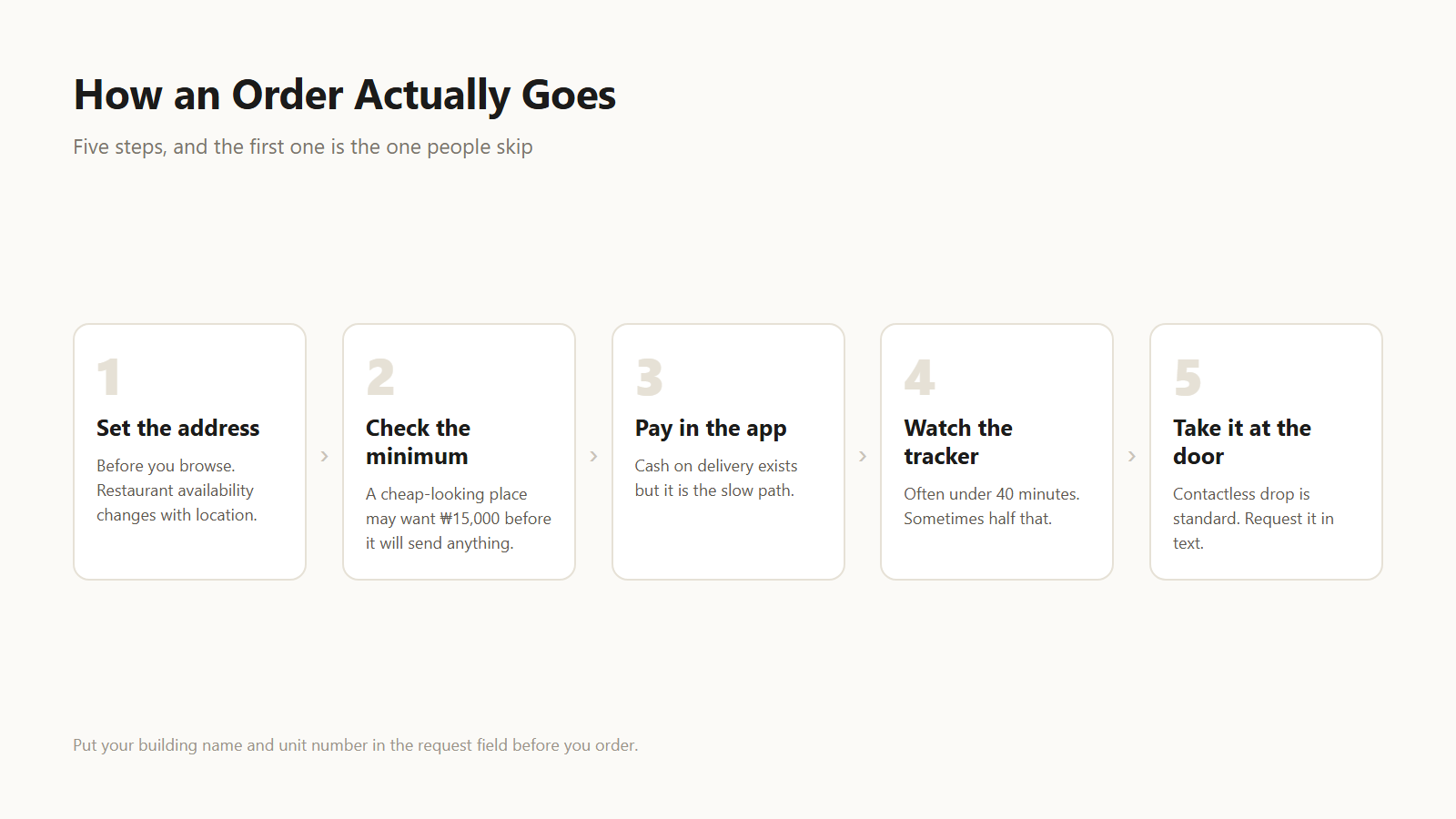
How an Order Actually Goes
-
Set the address first, before you browse. Restaurant availability changes with location.
-
Filter by minimum order. A place that looks cheap may want ₩15,000 before it will send anything.
-
Pay in the app. Cash on delivery still exists but it's the slow path.
-
Watch the tracker. Korean delivery is fast — often under 40 minutes, sometimes half that.
-
Meet the rider or don't. Contactless drop at the door is standard and you can request it in text.

The reason this matters more than it sounds: delivery is not a convenience layer on top of Korean eating, it is Korean eating for a large part of the week. Fried chicken at midnight, jjajangmyeon on a rainy afternoon, a whole meal delivered to a picnic mat by the river. If you can't order, you're seeing a version of the country with a piece missing.

FAQ
Can I use a food delivery app without a Korean phone number?
Yes, with Shuttle, which was designed for exactly this and asks for no Korean number, no ARC, and no domestic bank account. Coupang Eats and Baemin often work too, but whether sign-up completes can depend on your card and your app version, so install Shuttle as the fallback before you need it.
Will my foreign credit card work?
Often, and increasingly so — the major apps accept overseas-issued Visa, Mastercard, JCB and Amex, and Baemin has added Apple Pay for overseas cards. It is not guaranteed, and it can fail for reasons on the issuer's side rather than the app's, so carry a second card.
How much is delivery?
Usually ₩1,000–5,000 on top of the food, set by the restaurant and the distance. Coupang Eats runs roughly ₩2,000–4,000 without a membership and waives it with one.
Do I tip the delivery rider?
No. Tipping is not part of the transaction in Korea and there is no field for it. Do not try to hand cash to a rider — it creates confusion rather than goodwill.
What if the rider calls and I can't speak Korean?
Put everything the rider needs into the delivery request field before ordering: building name, unit number, and a line asking them to leave it at the door. Most calls are about finding the entrance, and a clear request field prevents most of them.
Sources
Delivery apps change their foreigner support often. These are the pages I checked while writing.