Laundry in Korea: The Coin Machines Are the Easy Half, and Your Receipt Is the Compensation Rule

Doing laundry in Korea splits into two completely different things, and people usually only find out about the second one when something has gone wrong.
The first is self-service. You carry your washing to a room full of machines, feed them, and leave with it the same afternoon. The second is dropping clothes at a counter and coming back for them. That second one is a contract, and there is a written standard behind it that decides exactly what you get if your coat comes back ruined.
Most guides cover the machines. This one covers both, because the counter is where the money is.
Korean laundry splits two ways
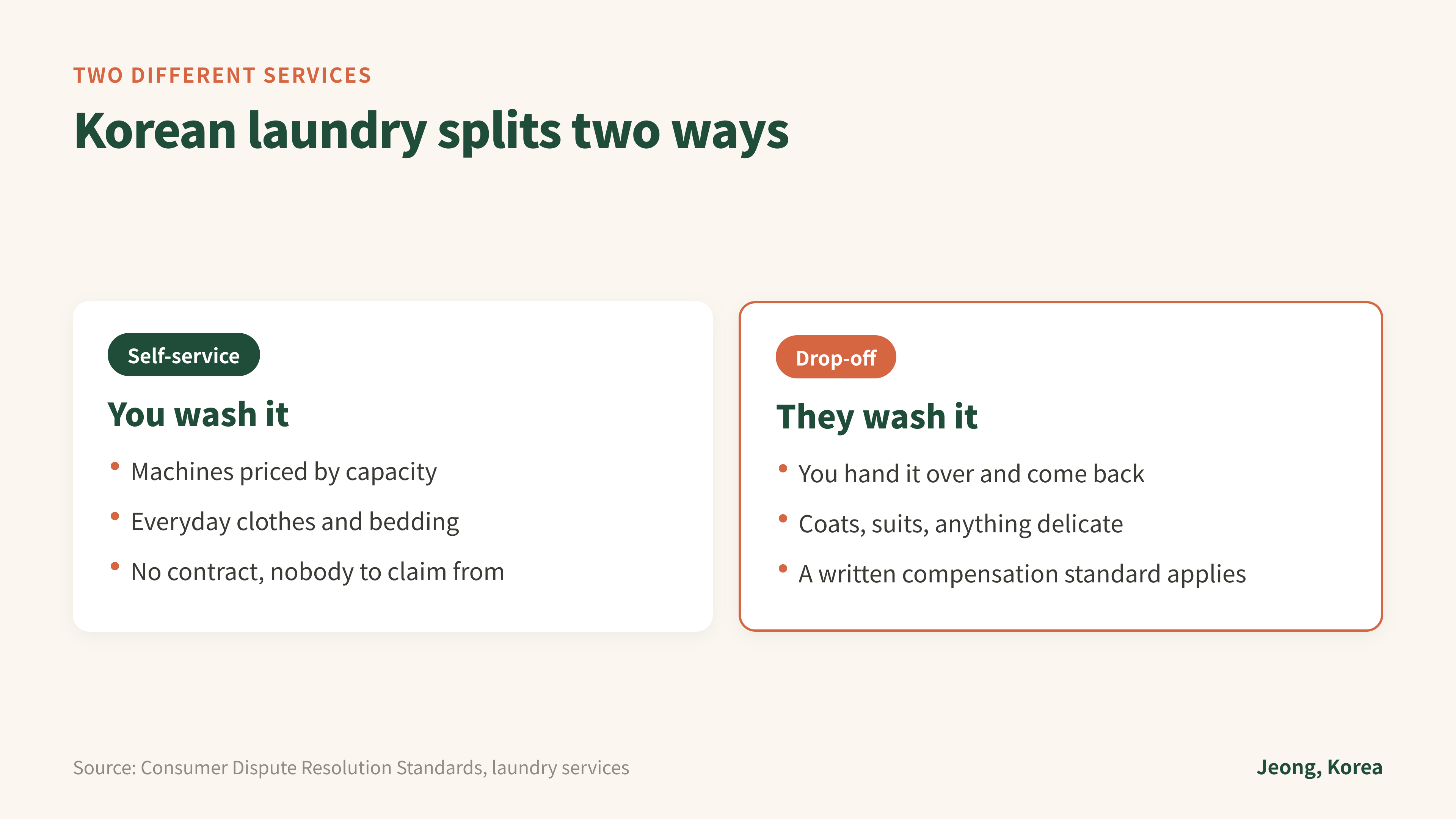
| Self-service | Drop-off | |
|---|---|---|
| Korean on the sign | 코인세탁, 빨래방 | 세탁소 |
| What you do | Wash and dry it yourself | Hand it over and come back |
| Typical use | Everyday clothes, bedding | Coats, suits, anything you cannot machine wash |
| If it is damaged | Your own problem | A written compensation standard applies |
The signs are the quickest way to tell them apart. A self-service place will usually say 코인세탁 (coin setak) or 빨래방 (ppallaebang), and you can see the machines through the glass. A drop-off shop says 세탁소 (setakso) and has a counter, a rail of finished clothes in plastic, and often nobody visible until you ring.
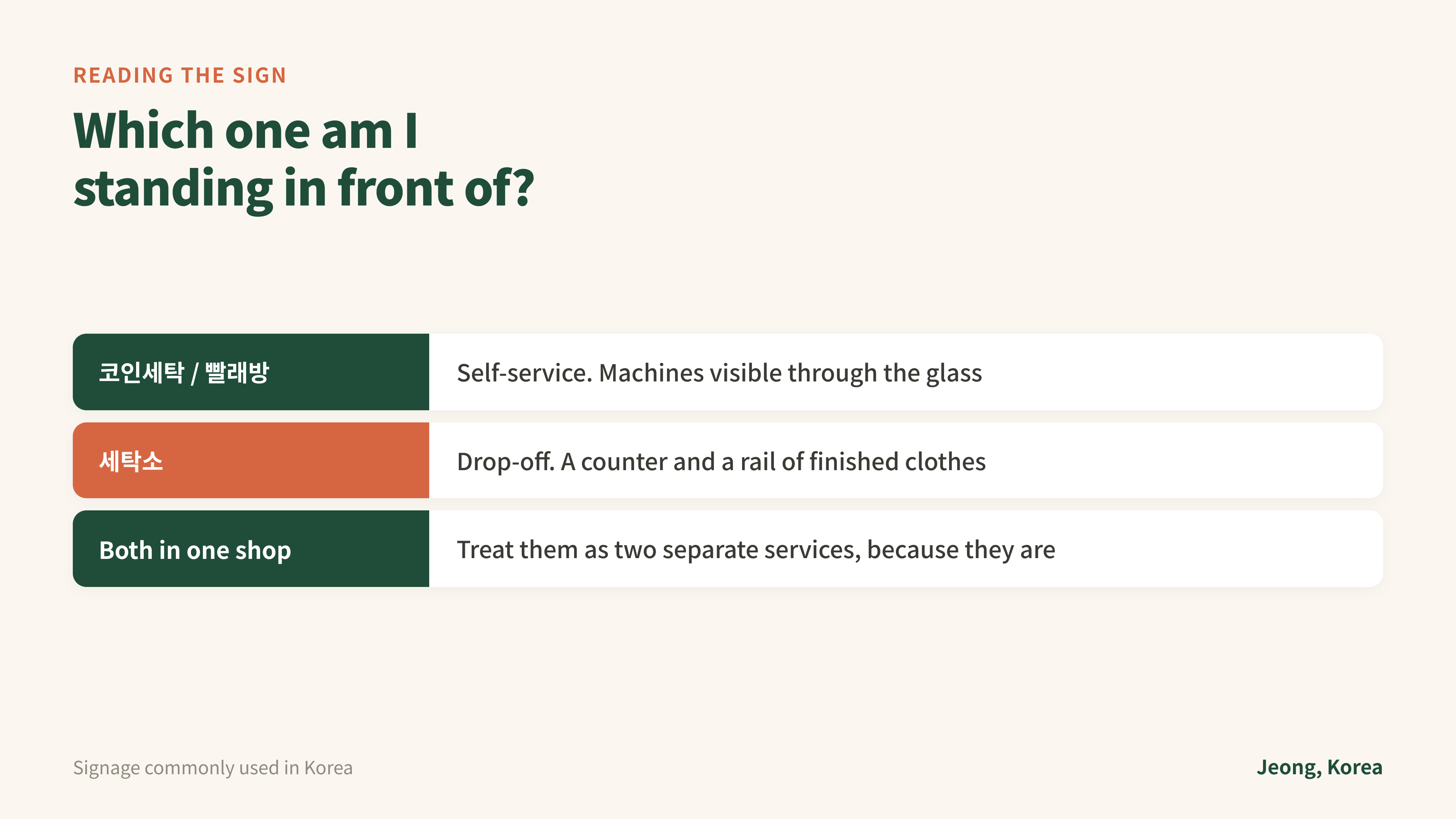
Some branded shops do both, with self-service machines on one side and a drop-off counter on the other. Treat the two sides as two different services, because legally they are.
Self-service: the machines are sized in kilograms
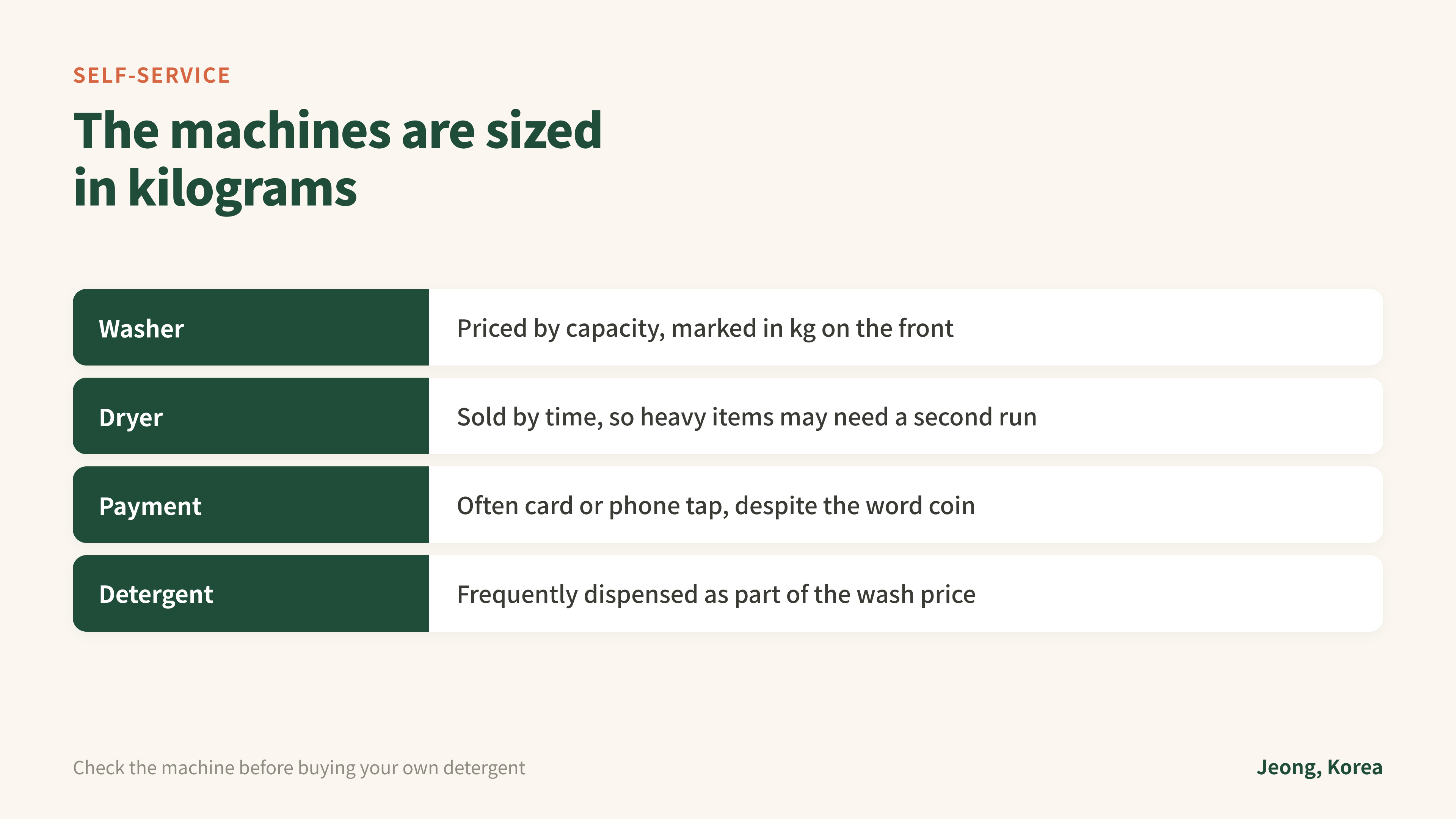
The main thing to understand is that machines are priced by capacity, and capacity is marked in kilograms on the front. You pick the size that fits your load, not the cheapest one, because an overloaded drum does not clean.
Dryers are sold by time rather than by load, so a heavy item may need a second run. Bedding usually needs the largest machine in the room.
Payment varies by shop. Many take cards or a phone tap despite the word "coin" on the sign, and most rooms run unstaffed around the clock with instructions on the wall. Detergent is often dispensed automatically as part of the wash price, so check the machine before buying your own.
Since there is no counter and no contract, there is also nobody to claim from. Which brings us to the other half.
The drop-off counter is where the rules live
Here you hand something over, and a shop takes responsibility for it. Korea has a written standard for exactly what happens when that goes wrong, and the whole thing turns on one small piece of paper.
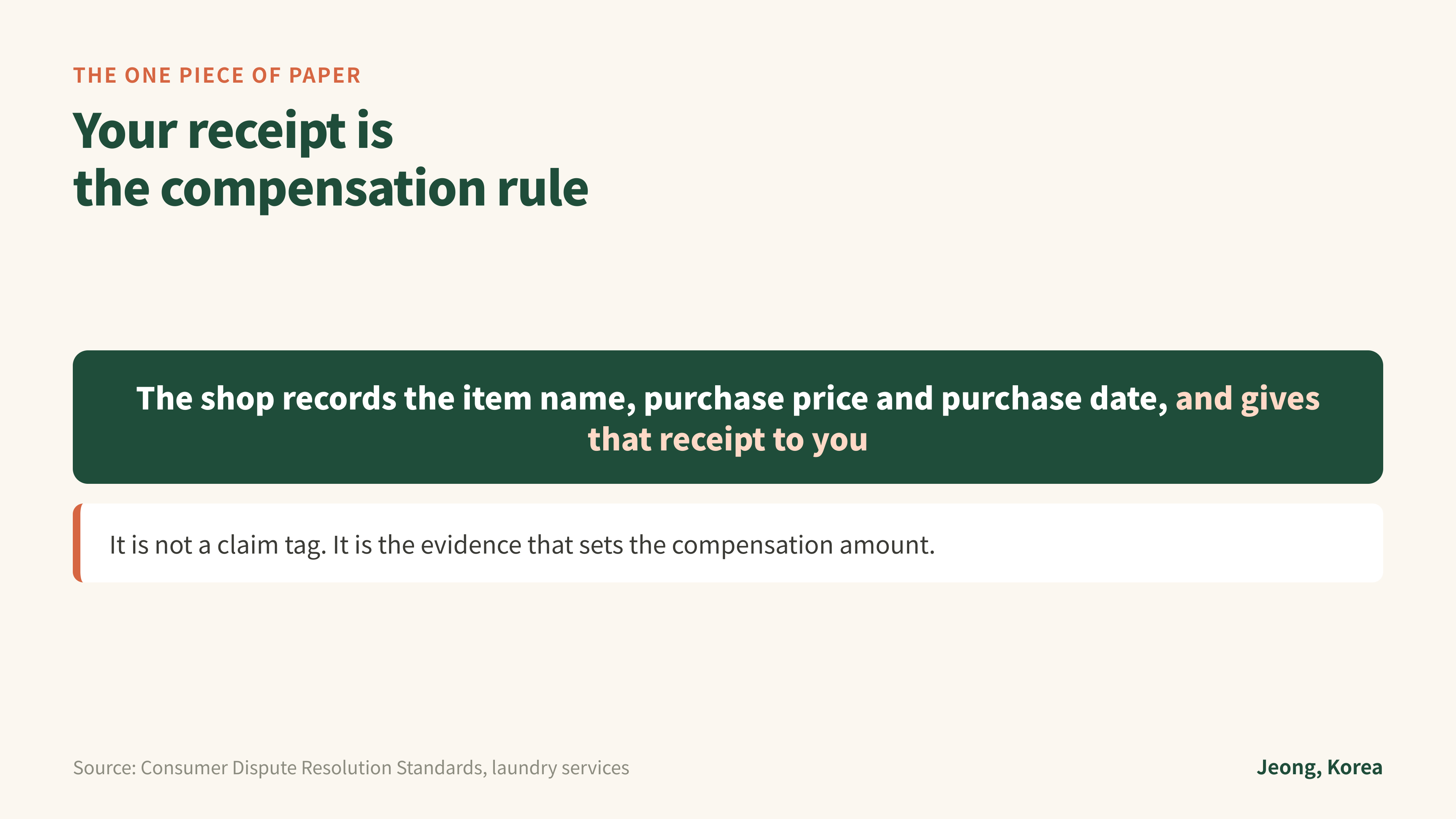
When a laundry shop takes your clothes, it is supposed to record the item name, the purchase price and the purchase date on a receipt and give that receipt to you.
That slip is not a claim tag. It is the evidence that sets the compensation amount.
If something is ruined, this is how the amount is worked out
The formula is fixed:
purchase price × compensation ratio
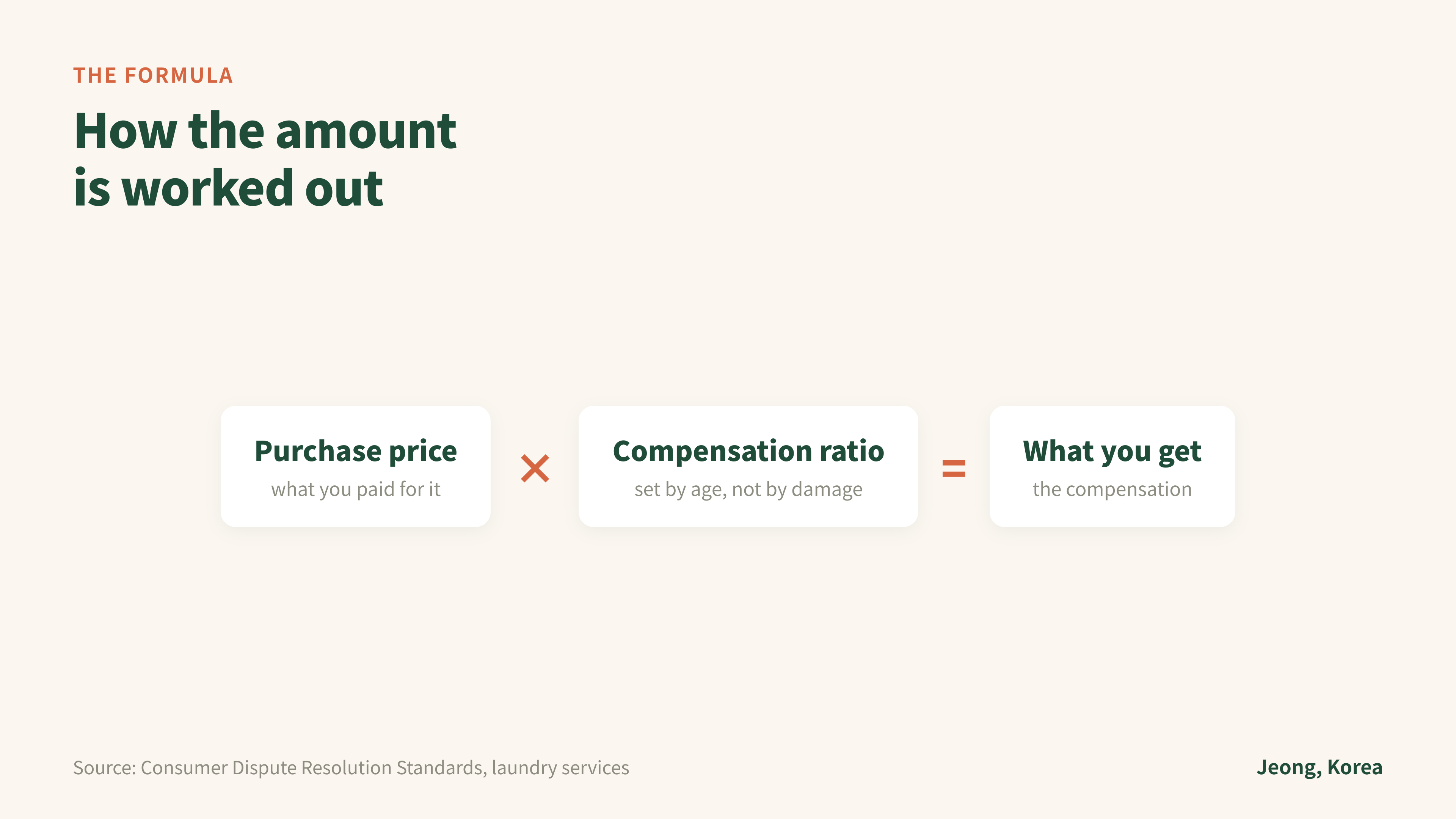
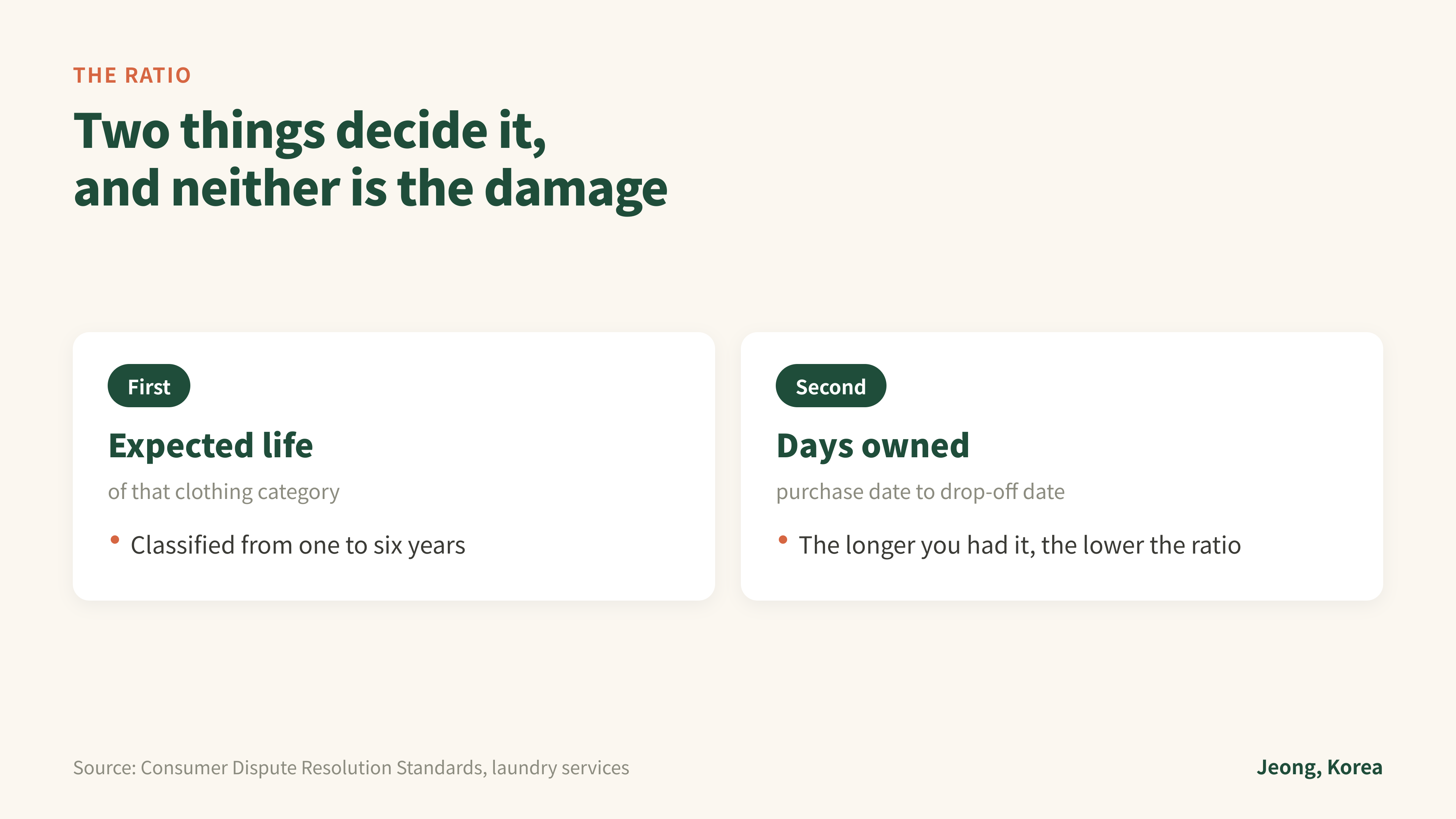
The compensation ratio is not a flat number. It comes from two things: the expected life of that category of clothing, which is classified from one to six years, and how many days have passed between the day you bought the item and the day you handed it in.
A worked example from the official guidance: a 600,000 won coat in a four-year category, handed in after 665 days of ownership, carries a 50 per cent ratio. The compensation is 300,000 won.
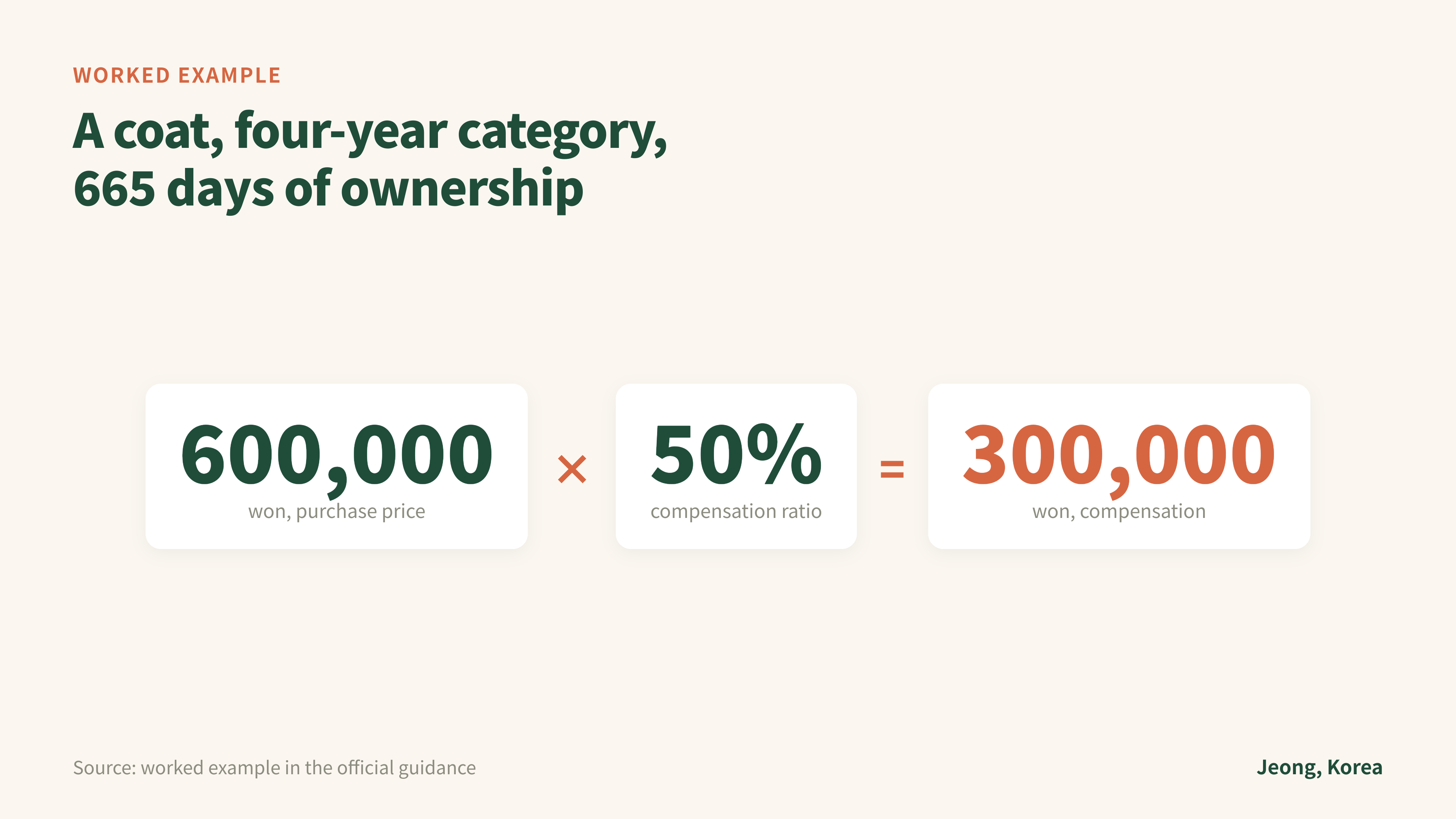
So the same damage to the same coat is worth less every month you own it. That is the intended design, not a shop being difficult.
What happens when nobody wrote anything down is the part worth remembering.
| Situation | What decides the amount |
|---|---|
| Receipt filled in properly | The details on the receipt |
| Details missing, or no receipt given | What you can prove: item, purchase price, purchase date |
| Nobody can prove any of it | 20 times the laundry fee |
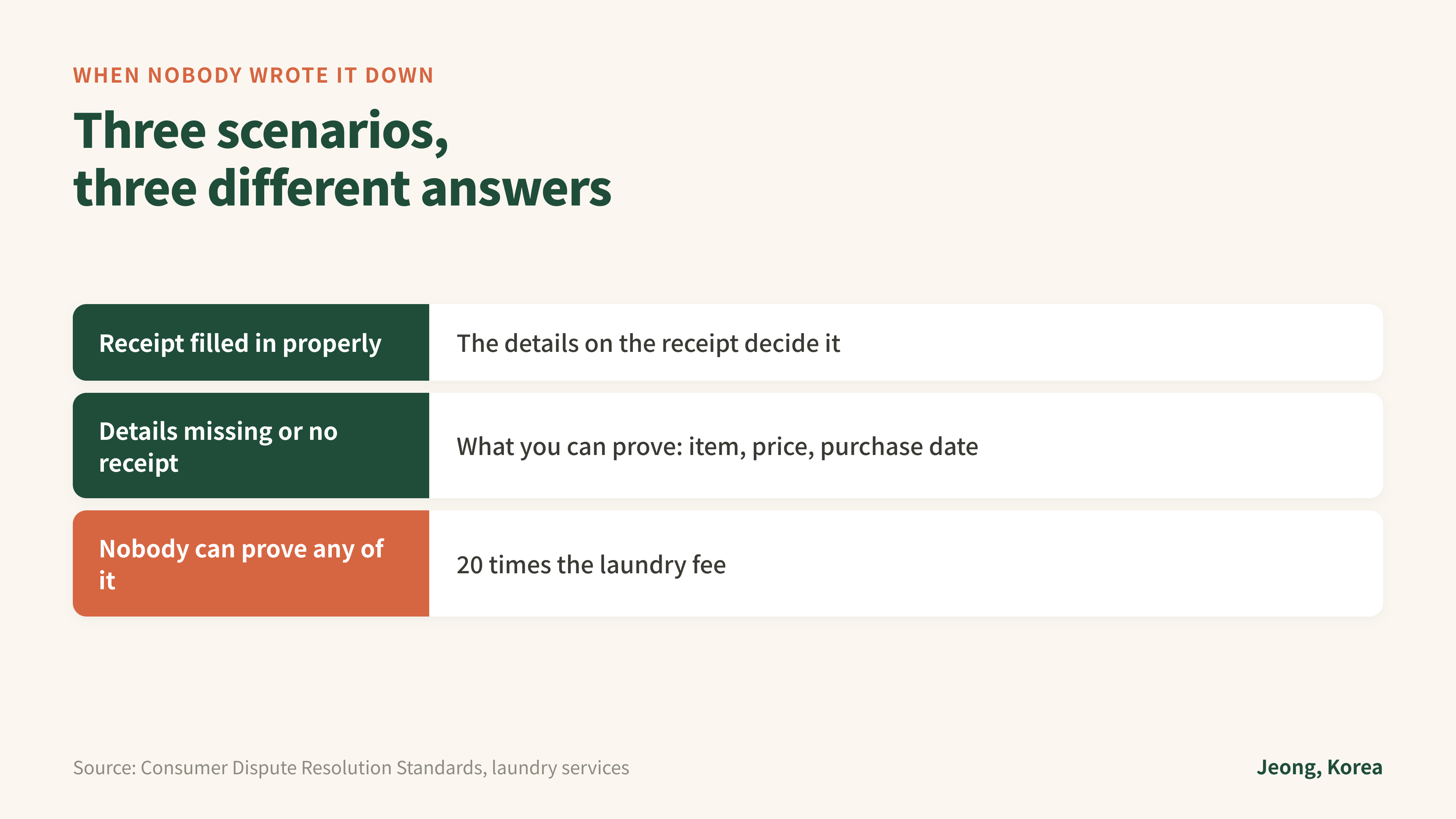
That last line is why a receipt matters to you rather than to the shop. Twenty times a cleaning fee is a small number next to the price of a winter coat. If the shop does not hand you a slip with the details on it, keep your own proof, a card statement or an order confirmation, for anything expensive.
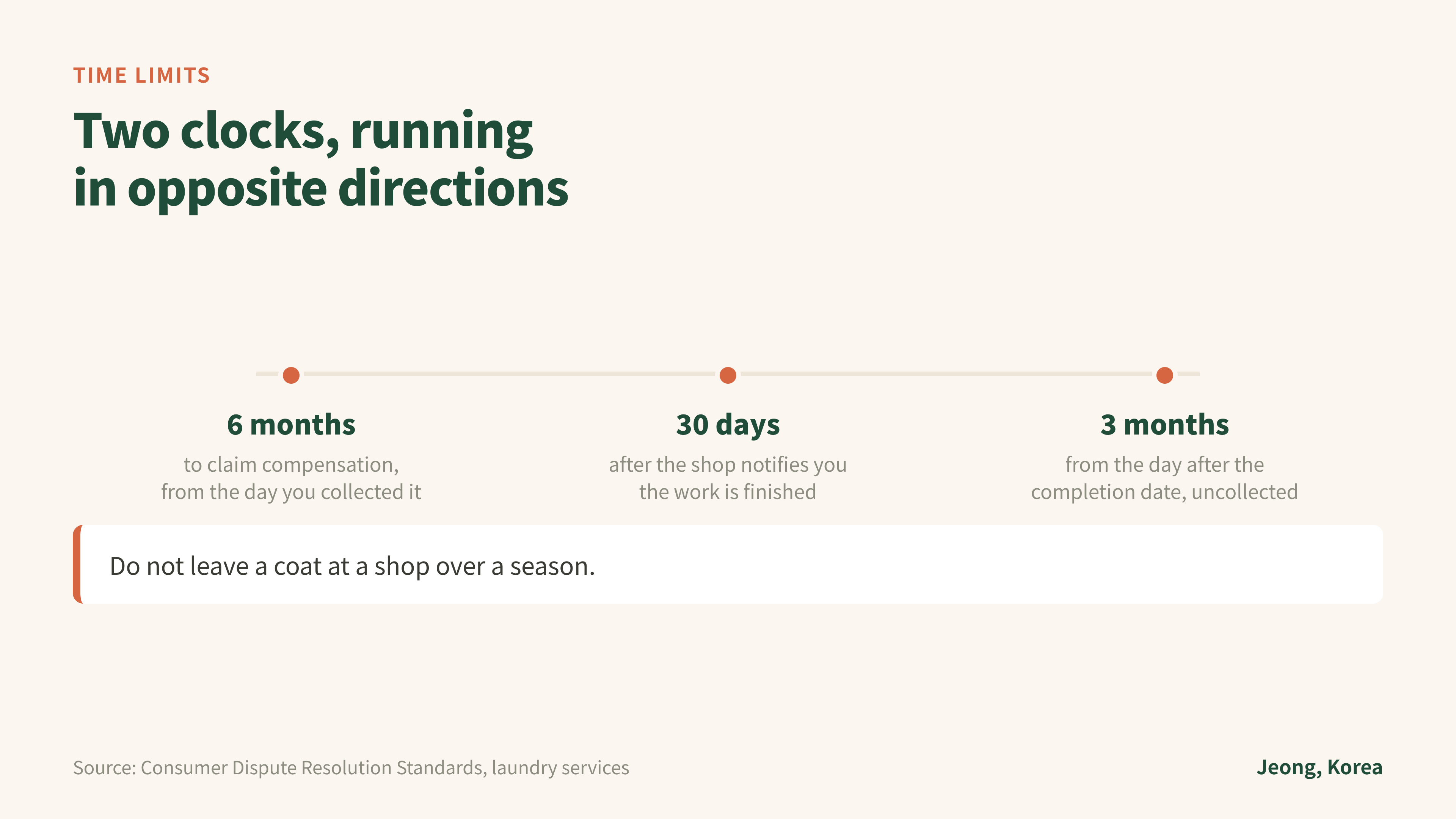
There is also a time limit at each end. Compensation has to be claimed within six months of the day you collected the item. And in the other direction, the shop's responsibility ends once it has notified you the work is done and 30 days pass, or three months pass from the day after the completion date without collection. Do not leave a coat at a shop over a season.
The shop is not liable for everything, either. It has to restore or compensate for damage, discolouration and stains, unless it proves the cause was not something it was responsible for.
What to say at the counter
You need very little.
| Korean | Say it like | Meaning |
|---|---|---|
| 세탁소 | setakso | laundry shop |
| 드라이 | deurai | dry cleaning |
| 물세탁 | mulsetak | wet wash |
| 얼룩 | eolluk | stain |
| 언제 돼요? | eonje dwaeyo | when will it be ready |
| 인수증 | insujeung | receipt |
Point at the stain, say 얼룩, and ask for 인수증 when you hand the item over. That single word does more for you than anything else on the list.
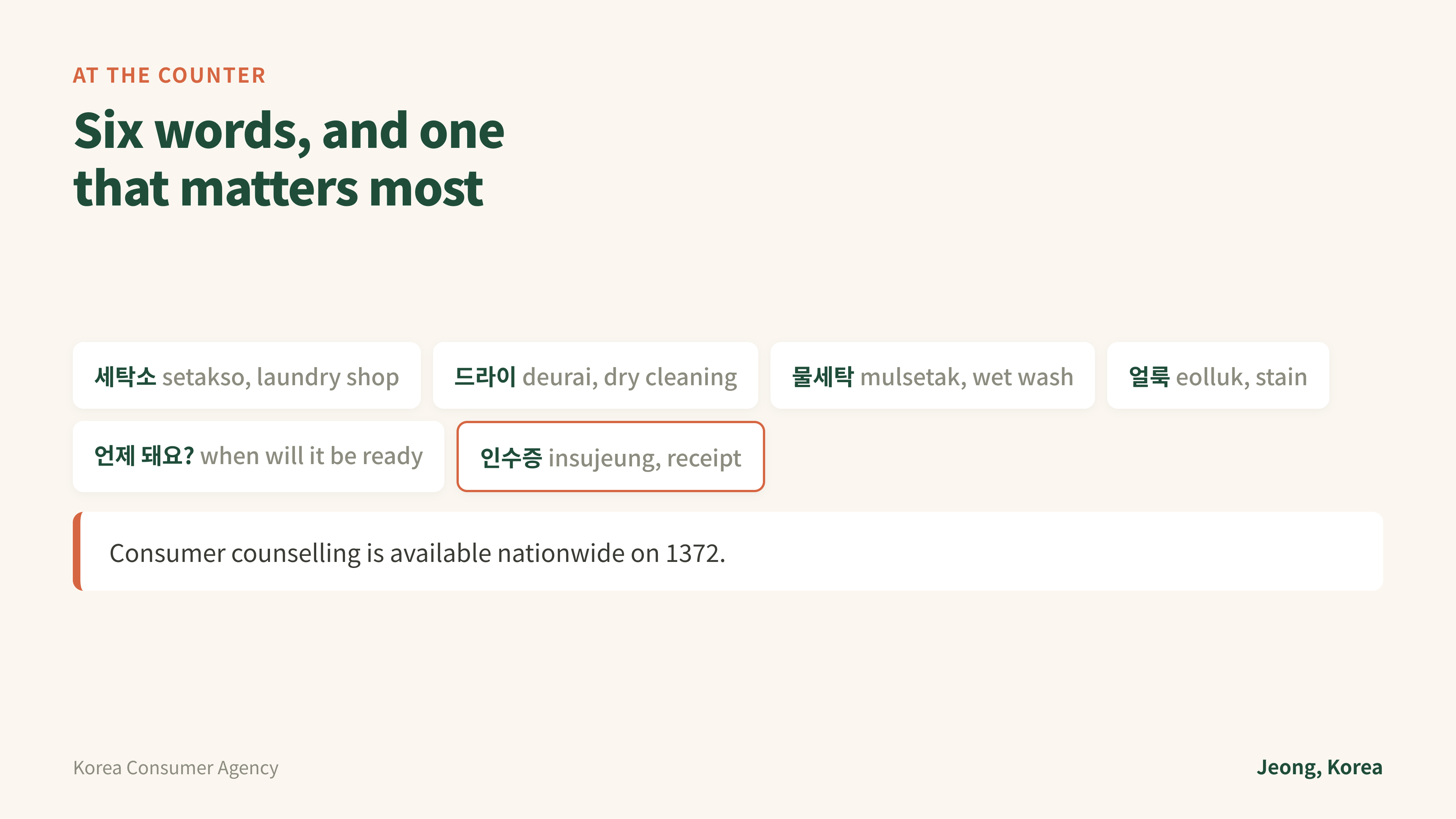
If a dispute does not get resolved at the counter, consumer counselling is available nationwide on 1372.
FAQ
How much do I get back if a laundry ruins my clothes in Korea?
The purchase price multiplied by a compensation ratio. The ratio depends on the expected life of that clothing category, classified from one to six years, and how long you had owned the item before handing it in.
What if the shop never gave me a receipt?
Then the amount is based on what you can prove about the item, its purchase price and its purchase date. If nothing can be proven, the standard is 20 times the laundry fee.
How long do I have to claim?
Within six months of the day you collected the item.
Can I leave clothes at the shop for a while?
Not indefinitely. The shop's responsibility ends 30 days after it notifies you the work is finished, or three months from the day after the completion date if you never collect.
Do coin laundries take cards?
Many do, despite the word coin on the sign. Payment methods vary by shop, so check the machine.
The short version
Self-service is the easy half: pick the machine by the kilogram marking on the front, and expect to pay by card as often as by coin. The drop-off counter is the half with rules. Ask for the receipt, because compensation is the purchase price times a ratio set by the item's age, and with nothing written down the fallback is 20 times the cleaning fee. Claim within six months, and collect within three.
One word at the counter, 인수증, covers most of it.
References
-
Consumer Dispute Resolution Standards, laundry services : Fair Trade Commission, via the Korea Easy Law Information service
-
Standard Terms and Conditions for the Laundry Business : Fair Trade Commission
-
Korea Consumer Agency counselling line 1372